Registration Open for Hanging Felted Spiral by Helene Dooley

Registration Open for Hanging Felted Spiral by Helene Dooley

Registration opens today for the online class Hanging Felted Spiral with Helene Dooley. The class is all about learning to felt a hanging spiral and will begin on April 8th. There are only 30 spaces available so register now to reserve a space. Register here by filling out the contact form at the bottom of the page. 

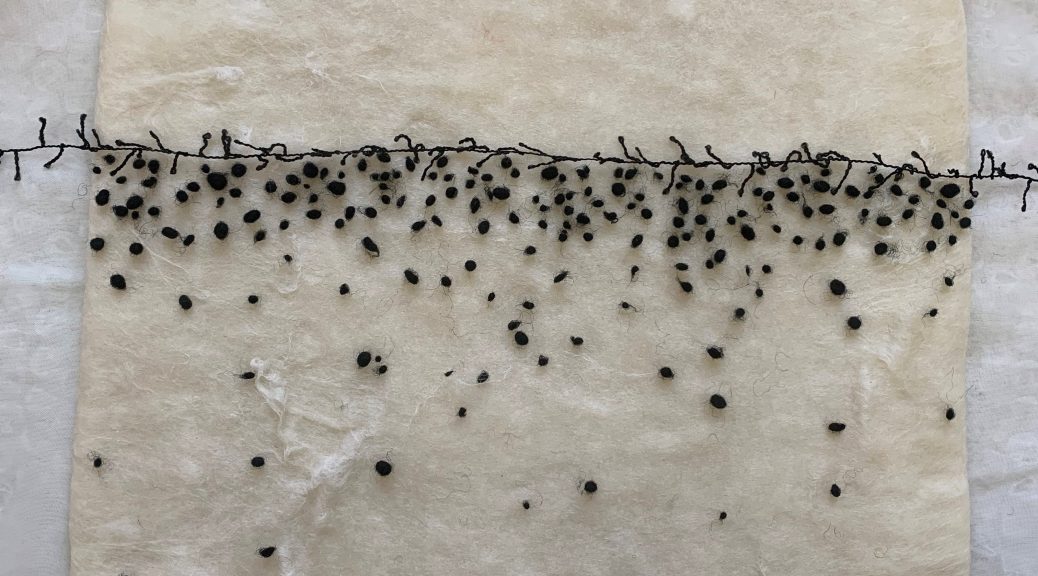
Helene has developed a method to create the felted spiral shown in the photo above. You will learn with Helene’s excellent videos and downloadable PDF’s. She will also be available on the class website for questions, sharing of your spirals and to encourage you to experiment with the knowledge gained in the class.

If you’d like to learn how to create a felt spiral, now’s your chance! To register for the class, fill out the form on the information page. 

Please note that Helene’s class is aimed at felt makers who have already developed their technical felting skills.  It is not suitable for felt makers who are at the start of their felting journey. A knowledge of book resists is preferable, though not essential.  Previous experience working in three dimensions is essential.  Also required is a basic knowledge of needle felting and sewing.


If you are a beginner, our online unlimited access Wet Felting for Beginners course, is always available. Please click on this link for further information and to register for the class. 


Let There Be Light

Let There Be Light

I’m out with lanterns, looking for myself.   Emily Dickinson

Sometimes things happen, that change our perceptions of who we are. That’s where I have been for the past 6 months, or more. I have suffered with anxiety and depression my whole life, but something wasn’t right this time. I decided to bring in the professionals, and I am so glad I did. Covid-19 and being rather isolated, to protect my mother with Alzheimers, has been really tough on me.

In an effort to turn things around, I started reading about the benefits of journaling your feelings. I tried bullet journaling, a couple years ago, and that lasted about a week. I have a gratitude journal, that I write in occasionally, but it’s hard to be grateful when you’re not feeling it. I read about art journaling and it seemed like a good option. It allows you to tell a visual story, with collage, paint, inks and all kind of media. Of particular interest to me, it can be amended anytime, with additional layers. I watched several videos, and was particularly intrigued with gel printing. I bought myself a small gel plate set, and used the brayer, I had from Ruth’s paper lamination class. It was a lot of fun, and husband Brian, got interested too. We signed up for an online class, Mastering the Layers with Carolyn Dube.

This article was coming up, and I thought a Multi Media Art Journal, would provide a perfect way for me to express all my different art interests. I found this wonderful journal, made by Ranger, that has fiber pages; denim, burlap, and heavyweight cotton paper. (Dina Wakley Media Journal – Blue Edition) This journal is perfect for expressing myself and the things I love.

For this article, I created the title page. I decided to include many fibers, and my related interests on this important page. My title “Love the Journey” reflects the new path I plan to uncover. I found an old set of magnetic letters, headed for the trash bin, and put them to use.


The butterfly was made from a gel print. The antennae was made from denim threads that raveled off the page. The right corner shows, some hand dyed coral silk lapp, cut from a wet felted piece I did quite a while ago. The blue pieces of knitting and crochet, are a combination of 2 threads; silk covered stainless steel, and a lace weight yak/alpaca/silk blend dyed by me. The silk covered stainless steel is one of those things, that seemed like a good idea when I bought it, yet has languished in a yarn bowl for years. Now, I have all sorts of ideas on ways to use it.


I included my shrink plastic and metal pieces, and embroidered them on the page with linen thread. The plastic hearts were a last minute addition to show humor is always a good thing.

Capi

9 Vases & a Plant Pot

9 Vases & a Plant Pot

Some of the first felt objects I made were vases: made around a flat u-shaped resist that I designed to try to get a good even layer of felt on the base (wobbly bases not being good for vases). Every so often I get the urge to make a few vases, so I thought I’d show you some I’ve made recently.

My felt pictures are often inspired by my coastal environment. So, I thought I’d make some coast-inspired vases.

I prefelted some recycled silk scarf pieces to make pebbles then added pebble shapes to the lower section. The sea area had a pewter-coloured merino base with blue and green wisps of wool plus some silky fibre for the sea foam. The wave was a combination of some sort of knitted yarn I’d also found in a charity shop, with added mohair and the same silky fibre (I’m not completely sure what it was, it was just hanging around and looked suitable!)

I made 3 in total – here are the other 2.

Sometimes it’s the materials themselves that suggest pieces rather than the local scenery.  I put some beautiful bright coral-coloured dyed locks against contrasting duck egg blue and teal merino and thought that might be interesting

‘Locks’ vase

Continuing my vase-making spree: I’d dyed some merino for a workshop last year and I thought it might be a good idea to use up some of the hand-dyed wool on vases.

Now enter stage left the plant pot.  A friend who’d previously bought a plant pot holder from me asked about making one specifically to suit a plant she had.  I wrote a blog a while ago about my love / hate relationship with commissions but that was about pictures – I felt much happier about a plant pot as it’s not such a big commitment.

I was keen to include her in the design so I did a couple of very quick potential design sketches and consulted her on the fibre colour choices. As the plant was only in a plastic pot with holes in the bottom, I scoured my local charity shops and found a beer bucket to make the plant pot water-tight.

We decided to go for coral / pink / burgundy colours to highlight the under-sides of the leaves and an overall texture rather than a leaf-shape pattern.

I decided to do the top of the inner 2 layers green so it would show when you look down at the pot. With hindsight I should have done the whole of the inner layers green but I wasn’t sure I had enough of the green so did the lower section white. I carded together various colours of merino and silk fibre rather than use the fibre labelled ‘carded’ on the fibre picture – but keep and eye on that as it comes back later on….. Then laid locks on top.

And here’s the plant in its personal designer pot. My friend was very pleased with it.

Then it was back to the vases but with a twist.  I recently found in a charity shop an old chemistry lab heavy glass 3 neck flask and, as ever, I thought….I wonder how that would work with felt.  There’s a little corner of my brain that is devoted entirely to felting possibilities and it kicks into play whenever I’m mooching about charity shops, which is often!

On the same day I found some interesting yarn in another charity shop so I splashed out a further 20p and thought I’d bring these 2 finds together.

I was clearly wearing my sensible head that day as I made a sample with the yarn to make sure it would felt and see how it came out.  Even more sensibly, I used it on both sides of my sample (I wish I always remembered to do that) so I could decide which effect I liked best

I stared to ponder the engineering challenge of the 3 neck vase and decided I’d have to have a hole underneath.  Usually my vase covers are solid on the under side and the glass slips into the top. With this I wanted the felt to fit tightly round the necks so I’d have the glass entry point on the base.  I carefully measured and calculated at least 40% shrinkage then made my resist.  This time an upside-down U-shape

I laid 4 layers of natural white merino over both sides of the resist then ran a single strip of the yarn around.  I then added single black nepps below the yarn line, more densely near the yarn and just a few further down the shape. This seemed like a good idea but it took absolutely ages to separate out individual nepps, pick out only round ones and of a similar size, and then place them where I wanted them to sit.  One of those decisions you regret before you’re half-way through but can’t bear not to finish as you’ve already invested so much time in it!

Anyway, here’s the finished vase.  Actually, I’m pleased with the pattern, although I’d intended the yarn to sit a bit further up the flask. I’d not properly taken into account how much of the felt would be underneath.

I thought I’d find some more old 3 necked lab flasks. Having consulted both EBay and Google it rapidly became clear that they are not to be had.  I have not found a single similar 3 neck flask (there are new ones which are much thinner and tend to have domed bases, no good for vases).  The nearest I could find was a similar heavy glass 2 necked flask which is on EBay for £40.  £40!  I now feel I can’t sell my vase as I don’t want someone to buy it for the flask and rip off the felt! So, that one is staying with me, at least for the time being.

And finally we come back to the pre-mixed fibre I mentioned (labelled ‘carded’).  If you’re ever lucky enough to visit World of Wool in Yorkshire, you’ll see they have two huge skip-type bins full of ends of lines and wooly remnants (one with coloured fibres and one just cream /white). There’s a low fixed-price per weight for the content of each bin and you can ferret out all sorts of hidden gems. I can spend a long time almost falling into those bins. This mystery fibre-mix was one such find.

I thought I’d make a vase using that plus a piece of a pink silk scarf I’d just found in a charity shop.  That day, alas, I was not wearing my sensible head and didn’t think to make a sample: partly because I didn’t have a lot of the fibre and partly, well, because I just didn’t think about it.

I laid out 2 layers of a matching pre-dyed merino, 2 layers of the mystery fibre and a strip of silk and set about felting.  Fairly soon my error became clear.  The mystery fibre was not felting at all.  I persisted.  It still didn’t felt.  I persisted.  And persisted.  In the end it did felt, presumably with help from the 2 inner layers of merino.  It shrank more than I’d expected and the fibre hadn’t been all that keen on pushing through the silk, which means the silk ruching is rather loose in places. But it’s fixed completely round the edges and anyway, I like a bit of loose ruching.

So, here are my recent adventures in vase-making, with a little diversion via a plant pot.  I hope you’ve enjoyed them. Do you have a favourite?

Mac Dragon

Mac Dragon

The Snow started Friday just in time for rush hour and continued into the early parts of Saturday. (Sometimes it’s good that I don’t usually go anywhere.) I do not want to go out and look at the driveway.  Looking at the garage roof, it may be better to stay in and finish writing this note to you. Then tomorrow, Sunday, I have some feet to work on if I can finish the gastrox and soleus muscles so I can get to the feet. I promise I will show you how that is coming in a later post. I also can report I have received Mr. Mer’s Hair! I will show you that but thought a week less fishy might be in order.


So to get to today’s topic I should get you caught up with my frantic (HA!!!) social life. Last week we were able to visit my brother, his family and my Mom for the first time since…. Well, sometime last year…. I think it was early August actually. We were hoping for a safe Christmas dinner but that plan was thwarted.  So it was an early March, (my)  Birthday / (Mom’s) Anniversary,  Dinner My brother was hosting. It was fabulous to see everyone and meet the new kitten (not quite so new now but still stuck with kitten brain). We were very pleased to get caught up on all the family news, especially exciting was the news that my Niece had been accepted into McMaster University. My parents and brother all went to Mac, I was a rebel and wound up in fine arts at the University of Toronto after doing 3 years of commercial art. (My Dad and brother were both PhD Geologists, but I love landscape so I guess that sort of fits in.)

I had brought my little ice dragon to show my niece since she has been interested in some of the strange things I felt. She did like the little guy too.

When I got home, I dug through the little ice dragons’ box and found I had his wing template but not the armature measurements. I did a few quick measurements of the ice dragon then started working on the little Mac dragon. I pulled out a couple of 18-inch steel florist wires and found the roll of 26 gauge steel floral wire and got to work.

 1 Armature in progress

This little guy is a bit bigger than the ice dragon but only a little. I used the 20ga for the main frame and used the 26ga for the tows and lower jaw (both yet to be twisted in the photo). I also added the 26ga over the main frame to give it a bit more strength. He needs to be able to stand up and look fearsome!

This slideshow requires JavaScript.

2-3 Adding wool to the armature body

I used a fine crimpy fleece I had purchased at the wool Growers Co-op in Carlton Place but found it to be too brown in tone. I switched to some of the core wool from Sarafina Fiber Arts, trying the darker grey but deciding on the lighter grey. (It’s really important to go check your source or reference material, in this case, the school colours.)

4-5 Always refer to your reference material

Now, to find the burgundy for the wings.   It is time to dig through the Red bin, I have a bag of red tones also in the basement.  Luckily, I found I had a corriedale called Aubergine by Ashford I had picked up at Wabi Sabi (one of the local fibre and yarn stores).

 6 “Mine!!”

The colour was perfect but looked a bit flat since it was too homogeneous. I added a bit of “i-have-no-idea-where-this-came-from fuchsia,”  which I had found while looking for my sari waste, which I never did find and I don’t think it would have been the correct tone if I had found it.

7 Mac Heraldry

A quick check of the McMaster shield Heraldry added the background colour of gold to the two colours Burgundy and Grey.  Ok, where did I put the boxes of beads, I need to find eyes!  They should be Gold or dark amber.

8-9 finding the right colour

I chose one of the dark amber beads in the little bag in the center of the second picture. The colour seemed to work with the body and upcoming wing colours. To add the eyes, I used a long needle to get the position, then used the tapered awl to get the depression the bead would be sunk into, (the eye socket). Leaving a longish tail of thread at the back of the head, I went from there across to the hole for the eye, added the bead and drove the needle through to the other eyehole. I again added a bead this time taking the needle out at the back of the head so I could tie the two threads together. I covered the knot with a bit more of the grey fibre.

This slideshow requires JavaScript.

10-14 “Don’t look yet! I can see my wings are naked!!!”

I again made a template to layout the wings. I dry rubbed them a bit to get them to be cohesive enough to remove the cards.

This slideshow requires JavaScript.

15-17 the strangely expanding wings.

Strangely with wispy wings, as I felt the wings tend to get bigger, not shrink like a good felt should do! Even my fiber is dyslexic and can’t be relied on to do anything the normal way everyone else dose! I could have done this using wet felting but I would have to have gotten wet so I went for the dry option. I am sure you will be much braver and may not melt with the application of dampness. If in dought you might try surgical gloves.

18 Mac Dragon is keeping close supervision on my work.

I counteracted the expansion that the punch tool seemed to encourage by working with a single needle on an angle, from each end, along the leading edge of the wing membrane. It was still a bit longer at the front edge than I had planned on, but I made a design change at the shoulder and was quite pleased.

This slideshow requires JavaScript.

19-24 the wings

“No don’t show that side! You haven’t added my tail enhancement!!!!”

“The Embarrassment!! Just for that, I will show them what you were drinking while you were making me!! That will explain any blurry or inappropriate pictures!!”

25 “Ha! She was drinking BEER!!!”

Mac dragon, it did take me 2 days to drink that one can, out of the 3 days it took to make you, so I am not likely to be too tipsy to operate a camera. Though it’s probably not a good idea to drink too much alcohol while needle felting…….

My final additions to dragon were the ear puffs with a bit of gold Bombay silk and the bifurcated tail embellishment. I added a secondary piece of wool and silk above the bifurcation. (I am sure it will attract other dragons with its flamboyantness and the bit of gold silk)

26 “I am the magnificent Mac Dragon! I can’t wait to start classes! I wonder what we will be taking…. I hope it’s Art!  Maybe stop motion animation would be fun?”

I tried out the Christmas video camera (the zoom is a disappointment and the frame rate is not as listed.) I had a long argument with the file this afternoon and got it finally to crop, rotate and convert to avi format.   I pulled out the little display turntable I had ordered in December(?), time is getting much trickery to keep track of than it used to be.  Let’s just say it’s the pandemic and I won’t worry about that too much. If I can get the file to add, I will add it here.

Video of Mac Dragon pretends to be a merry–go–round (If this doesn’t work I will beg Ann to help! Second try, my phone is much more shaky but worked better than the new video recorder for formatting!)

I would like to have been able to get Mac Dragon (short for McMaster U. Dragon) to his new home but I am snowed in until tomorrow. So, no one say anything to my Niece until after I can deliver him on Monday!

Keep safe and Keep Felting!!


Felt on a ball class fun

Felt on a ball class fun

A couple of weeks ago I finally got to teach my December Felting on a Ball Class. My guild had a group of ladies that wanted to try felting a pot on a ball. We scheduled the class for December, then we got locked down again for Covid, so we moved it to January and had a big freezing rain event so we moved it to February.

We used Corriedale wool. It is easily available in lots of colours. to make things more different than the regular felting on a flat resist and blowing a balloon up in it, routine, we made them with 3 different colour layers and we made them thick so they could be cut.

The first step was to make a small sample so cutting could be practiced later before cutting the pot.

With this method, you work inside out. So your embellishments go on first.


Then we moved on to the task of getting your wool onto the ball. the gerti balls are nice because they are a bit sticky. If you use a kid’s beach ball putting soap on it helps the first layer stick. The first layer is not too hard the second layer is harder and the third layer is harder still as it gets bulkier and bulkier.


Adding the pantyhose tops is fun. If like me you use the legs of pantyhose for making felt balls this is a good use for the top part that is left over.

After that the is lots of rubbing and bouncing and rubbing and bouncing until they are felted enough to remove the pantyhose and deflate the ball.

Then there is rolling and rubbing and some throwing if you like. sorry, no pictures of that part. I forget when I am talking.


The next day student cut their samples and started to cut their pots. Some cut more than others.


Carlene decided she wanted hers covered in locks so added more where they had shifted in the felting process.

Nicole needle felted her cutouts back onto the outside of her pot.

Christine did some cutting

Diane did lots of cutting and then added lots of beads.


Completing Montana Sunrise

Completing Montana Sunrise

Here is where I was when I left off in my last post about my latest nuno felted landscape. I decided the next step was to create more evergreen trees to add to the left hillside.

I used some green wool sandwiched between two pieces of water soluble fabric and free motion stitched some trunks/branches. These were then soaked in hot water and gently felted. I started adding them into the foreground. I decided I didn’t have enough so I went back and stitched more several times until I was satisfied with the volume. I also added in a few areas of lighter trees to give a bit of contrast. Once I had those arranged and pinned down, I started looking at the yellow brown area in the middle of the picture, part of the closest mountain. It seemed to have too much contrast and due to being the same color as the foreground, it “moved” that mountain too far forward.

So I added a couple of pieces of sheer nylon scarves, one deep red and one purple over the area. That’s better! I try a lot of different things as I’m working and take quick photos on my phone. I’m not showing all the photos as it is hard to tell the differences in some of them. But I use the photos to see how the piece looks from a distance and find any glaring problems. At some point in here, I added some sheer black fabric behind the foreground mountain as there were bits of black wool that were drawing my attention too much.

After I stitched down the trees with a variety of blue green threads and a bit of feather stitch, I started working on the foreground. If you click on the photo to enlarge it, you can see the details a bit better. The grass is a combination of raffia, burlap and cheesecloth. I also was bothered by the “driveway” of green on the middle right. At some point, I tore some of the wool from the surface so that it wasn’t such a line.

I arranged the grass bits numerous times and then started stitching them down. The photo on the left has the “clumps” stitched but I was trying various pieces of raffia on the very bottom and had them pinned in place. I also decided the raffia was a bit too light so I colored it with a felt tip marker in light browns, greens and dark brown edges. The photo on the right shows the piece after completing the foreground. Next up was the sky.

I wanted to “move” the colors in the sky around a bit with some stitching. But how to do that? I first thought about couching threads to the surface. The photo on the left shows that idea being tested. I wasn’t happy with that but couldn’t decide what to do. So I reached out to Antje (who has authored posts here in the past), and she made several good suggestions. I decided to use running stitch. I used variegated colors and mixed several strands together to not have such a solid color effect. Click on the photo on the right to see the starting of the running stitch. The point of adding the stitching was to soften some of the harder transitions in the sky. Thanks Antje for your help!

Here is the finished Montana Sunrise (16″ x 30″). It definitely has a bit different feel using a mosaic type of nuno felt instead of one piece of dyed silk. I think it is much less abstract than some of my other recent pieces. Now I have to find the right fabric for it’s matting. What color would you use as the matte?

Concertina Hat and Felted Bags Classes – Registration Now Open

Concertina Hat and Felted Bags Classes – Registration Now Open

I always look forward to each new iteration of these classes, its always exciting to see how each new group of felt-makers will interpret the weekly tutorials, looking back at the photos in the class galleries it is hard to imagine they were all following the same instructions! 🙂

These are just a few of my favourite creations made by students from previous classes.

If these photos have whetted your appetite and you would like to see more the full galleries are here:

Hats

Bags

Key dates for both classes:

15th March – registration closes
17th March – first tutorial will be posted
24th March – second tutorial will be posted
31st March – third tutorial will be posted
We will have use of the forum pages until 28th April so you can carry on making and sharing your creations with everyone or catch up if you need to take a week or two off during the course.

The tutorials for both classes contain step by step instructions and lots of colour photographs illustrating each steps. They will be pdfs for you to download and keep for future reference.

For more details and the contact form to sign up for these classes please follow these links:

Concertina Hat Class

Felted Bags Class

Thinking of joining in the fun but have questions about these classes? Please post them in the comments below or use the contact forms on the class pages above.

Deconstructing/Reconstructing

Deconstructing/Reconstructing

With the first quarter challenge being all about making samples by deconstructing/reconstructing different materials I had intended to spend a day doing precisely that and detail them in this post. Like a lot of well intentioned plans time slipped away and I’m sitting here with no new samples and a post to write!

For the sake of getting this post out on time I’m going to have to cheat and show some of the deconstruct/reconstruct work I’ve made in the past.

This sample was my first attempt at Nuno Felting, made with synthetic sheers and some cotton fabrics. I remember thinking at the time “never again” as the process seemed to take forever! Obviously I did do it again and soon learnt which fabrics I prefer to work with. This sample eventually got cut up and used for brooches. Thanks to Helene and her post, which you can find here, for reminding me about these.

My second sample had silk fabrics top and bottom, cut from charity shop scarves, with a piece of my aunties wool shawl in the centre. As you would expect, being somewhat bulky, the wool section shrunk far less than the silks but all three pieces felted very quickly and easily so I was encouraged to go on and make lots more Nuno felt.

It hung around for quite some time before I decided to cut it down, add some stitching and put it in a frame. It’s now a lovely reminder of aunty Das who has since passed away.

Off cuts of prefelt, or deconstructed fully felted pieces, never get thrown away as they are always useful for cutting up and using as inclusions beneath fabric when Nuno felting.

This little fossil sample was a trial using Merino fibres and cotton wadding left over from a quilting project. The wadding felts very easily and is useful for creating ”lumpy” relief designs.

One of the great things about making felt is that, even if it doesn’t work out how you wanted, it needn’t be wasted. This mossy pebble necklace is an example of that. I had intended it to be asymmetrical but when it was finished it wasn’t asymmetrical enough. There’s a fine line between something looking intentionally asymmetrical and looking like you tried to make it symmetrical and failed! This looked the latter….. just plain wonky!

Thinking I would work on it at some point I left it on display next to a grey Bergschaf bowl……… and months later had a light bulb moment! The necklace was deconstructed and recycled to create the large surface “bumps” on this bowl.

Another deconstruct project was this triangular scarf. I loved the combination of the Superfine Merino and Viscose Fibre but wasn’t particularly happy with the design of the scarf. Several months later, after never being worn, it got cut up, pleated, beaded and recycled to create this chunky, highly textural bracelet.

My final samples were inspired by a photograph I took of barnacles. I can’t remember now what they were attached to but I saw them in the harbour in Ullapool and just loved the shapes and colours.

The hand dyed cotton fabric, left over from an old project, was given to me by a friend. The barnacles are constructed from several pieces sewn together on the machine and stiffened using acrylic wax. The next step will be to sample materials and techniques to create the very textural background.

If you have any deconstruct/reconstruct projects you would like to share, big or small, we would love to see them over on the Forum.

2022 First Quarter Challenge – Making Samples (Textile Deconstruction and Reuse)

2022 First Quarter Challenge – Making Samples (Textile Deconstruction and Reuse)

Annie

I have a pile of old knitwear items that are nice colours but are now way too small for me.  They aren’t good enough to donate because some areas are worn and bobbly but most of the fabric is still good. Usually my first thought is to cut up and use old fabrics as embellishment in feltmaking but this time I decided to try something else first.

I’ve seen other people make scarves and jackets by patching pieces of old knitwear together so I decided to kill 2 birds with one stone and make a patched sample, but also take the opportunity to conquer my avoidance of my overlocker.   I’ve only used it once or twice very briefly and not terribly successfully, and since then it has sat in the corner mocking me.  It was time to be brave!

So I cut some small pieces from the knitwear and went for it. I like the way the fabric crinkles and goes wavy on the edges if you stretch it as you sew.  Success – I had joined several pieces together.  My next issue was that the overlocker was threaded with 4 cones of white so I decided to be brave and change the colours!  Three YouTube videos, lots of eye drops and some careful administering with the tweezers later and I had 4 different coloured threads in the machine.  Hurrah!  You can see in the photo the first sample on the left is with white thread and raw edges and the second sample on the right has the coloured threads and also I cut sections from the sleeves so that there would be no raw edges to fray.

Now I have some new confidence with the overlocker and a decent sample that may well turn into an actual scarf one day if I can get in the right mood to cut about 100 more pieces!  The knit fabric works well as it is cosy and is not itchy.  I’d love to be able to wear wool, but my skin is too sensitive to it 🙁

You can see in the photo above that I got some nice scraps from doing this that I used in my next sample.  Double bonus!  I currently have some ideas in development for some artwork based around stylised trees and these scraps lent themselves to it nicely so I laid out some of the scraps on to a small base of white Merino fibres and began felting.  For my artwork I often only take the felt to somewhere between soft felt and felt, but quite often not fulled depending on what finish I want and how much I want to distort the fibres and fabrics.  I took photos when it was softly felted then carried on until it was well felted but in this case I preferred it at the halfway stage as it looked fresher somehow and not overworked.

For my next felt sample I used unravelled yarn from one of the old pieces of knitwear.  I had been fiddling around with it and decided to pull it apart.  Where it had been so tightly knitted the yarn kept a fabulous crinkle in it.

It only unravelled in short lengths, I assume that’s because of how I cut it on the seam.  I laid a few strands down, then bunched a few up then also scattered some tiny pieces on. I think this could make an interesting addition to a landscape or a picture of a bunch of flowers.

I was intrigued by the unravelled knitting so set about fiddling with the knitwear I had been dismantling for the overlocking experiment.  Cutting a ring or strip from some of the knit fabrics and then gently stretching them resulted in an interesting elongated knobbly bobbly string of fabric – not yarn, not complete fabric, but something in between.  Magic!

I haven’t felted with these yet but will do and will report back.  In the photo below the inner circle is a slice of sleeve before stretching, the outer circle is after stretching.

I also got carried away and began unpicking another piece of knitted fabric which has interesting potential, but haven’t yet had time to try felting with it:

I’ll come back to the knitted fabric experiments at a later date.

I wanted to do another thing other than my default feltmaking so I decided to try some more fabric applique on paper with free motion stitch, as I like the effect.   I rummaged in my fabric scraps and found an offcut of upholstery fabric with birds on called ‘Birds and Berries’ by Sanderson.

I cut out a bird and a few other motifs then glued and free motion stitched them to some cotton rag drawing paper (approx. 20cm / 8inch square).  Then I freehand cut some hearts from scrap paper, tea boxes, sweet wrappers and collage papers then glued some on and stitched the rest on.

I really liked the result so went on to make a card for a golden 50th wedding anniversary in the same way but much bigger, 30cm x 30cm (12″x12″).  I loved the result but I regretted the size when I was cutting and attaching 50 hearts at midnight the day before the celebration!

Most of my textiles work involves feltmaking and much of what I use to embellish the felt is repurposed e.g. pieces of fabric cut from an old item of clothing or threads frayed from some old fabric.  I enjoy making small samples to see how different fabrics and fibres will felt before making bigger projects. Samples are quick and easy to make and can’t go wrong – you just experiment and discover new things, both good and bad, what works and what doesn’t work quite how you might have expected.

I am looking forward to making many more samples – the more you make the more ideas you get! 🙂

Update on Mr. Mer Part 2

Update on Mr. Mer Part 2

As I had mentioned before I had started the Mer-Family from Sara’s Mermaid-felt-along.  She had used 14 ga armature wire. I had not yet investigated armature wire when I started or I would have upped the wire strength since I had scaled up the figure. I also suspect I am working more firmly than she had intended.

I was finding the wire was unable to hold articulation at his waist. This could either be from the wool overpowering the gauge of wire used or the 14 ga wire may have broken at his waist. I am not sure that it has broken since it doesn’t feel like a bake. I have had a broken wire on another sculpture which might have been from metal fatigue but I hadn’t finished making it, so it should not have been tiered. For that one I did surgery, creating an incision and inserting a new wire. The incision was worked, with a course felting needle, diagonally across the incision to create the equivalent of scar tissue. Finally adding a surface layer to finish hiding the post-surgery look (you don’t want to leave a scar!).

This worked but I wanted to try something less intrusive. I was quite pleased with the glutes and lumbar spine /sacrum so did not want to do the incision. Instead, I decided to try arthroscopic surgery! (Without a license!!! Don’t tell!!)

I checked my options for wire. Since 14 ga aluminum was way too light, I suspected that either the 10 ga or the 9ga might work. Since I knew I wanted to position the Herring-ton rods (this is a fishy procedure) down each erector spinae, I would not likely need anything stronger than the 9ga. I checked the samples I had made during the wire study group and decided that 9ga should work.

21 Tools to sharpen the end of the 9ga aluminum wire

I cut 2 lengths that would reach from lower quads to upper back. I used the rasp and nail file to sharpen one end. I used an awl to make the insertion then worked the wire through the glutes and down the hamstrings.

22 insertion of the lower section of the first Harrington rod

I could easily feel where the end of the wire was through the wool (that Registered Massage Therapist career is still useful!!). I could rotate the wire to keep it more centrally located. As you may have noticed, the glutes are more posterior than the hamstring muscles so the wire needed to follow the couture of the body.

23 The white line indicated the approximate path of the 9ga wire.

The awl allowed me to insert the wires to either side of the spine, where the original twisted 14ga aluminum wire was located. It also allowed for an angle of descent into the glute so I could rotate the wire and get it to dive into the lower leg. I was sure I would need to cross the point of articulation (his waist), with enough length that the wires would stay well embedded and allow not only flection and extension (bending forward and backwards ) but, with this lateral placement should allow for lateral rotation!  When he had a single point spine (and less wool), he could bend forward and back but his rotational movement was minimal and not pose-able.

So the steps I took for this operation were:

  • Select the gauge required by reviewing my previous sampling,
  • Sharpen the aluminum wire with a file then refine and smooth the point with a nail file
  • Arthroscopic insertion (with an awl – I am sure it was well sterilized since it was brand new!)
  • Work the wire through the glutes rotating it to descend into the lower Hamstring muscle while palpating to keep track of where it was in the leg. Then repeat to this point with the second wire leaving the upper end loose and out of the body.

24 the insertion of the awl at a shallow angle

I check that the patent could do full flection at this point to confirm the operation was proceeding well.

This slideshow requires JavaScript.

25-28 Mr. Mer shows off his new flexibility

There is also confirmation that some rotational movement is already possible, I suspect he will have more once the surgery is complete and the upper rods are inserted.

For the second half of the operation;

  • I bent and tried to determine the best angle and location for the wires. *remembering that there is a triangular frame in his torso that is allowing some shoulder curvature (Protraction/ Retraction) and rotational posing. So I chose to position the wires more along the Erector spine (located to each side of the spine) and then redirected them into the lateral part of the lats (latissimus dorsi).

This slideshow requires JavaScript.

29-31 upper wire placement

 I trimmed the wires to a bit closer to equal length and sharpened the superior (upper) end of the wire.

I curved the wire to insert it but could not find my big pliers to straighten it out properly once the insertion had been made. I used one of my metal chopsticks to push against the wire to straighten it and it worked.

32 the skin graft to cover the inserted wire

For the skin graft, I took a section of the dark green fibres and needle felted a section down the center of the fibres leaving wispy edges for attachment on either side of the wire. (You can see the first part of the graft in the lower spine). I added more fibre to build up the Erector spinae muscle over the wire. (You can see that in the upper section of the lumbar and lower thoracic region). The wire is very close to the surface at this point so I need to make sure the fibre above this point is well secured so there will be no exposure of the surgical rods. (That would be embarrassing!)

I used the cop stick again to flatten the second wire and finish embedding it into his upper body.

Adding more wool fibre, I continued to contour and build up the muscles until the wire was well buried on both sides of his spine.

Mr. Mer is quite pleased with his operation and wants to show you how discreet the scaring is.

This slideshow requires JavaScript.

33-36 Mr. Mer shows you where the wires are and how discreet the post-surgery scaring

Mr. Mer insisted I neaten up his hands before the photoshoot so while listening to an audiobook (a werewolf romance this time) I pulled out my 40ga crown needles and got to work. It took most of the 8-hour book to get the hands tightened up and reduce the fuzzy halo on them. I will want to go back later and trim them with scissors ( I have ordered a pair with curved blades that may work well with his fingers.)

 37-38 working on Mr. Mer’s hands

I also worked on his head a bit more giving him a bit more cranium and a better jawline. I am still working on his face but it’s coming along. I have found him hair, but it is still with Bernadette (the truckers in Ottawa interrupted its arrival on library day.)

This slideshow requires JavaScript.

39-41 continuing to work on Mr. Mer’s head and face.

He has also had a bit of work done on his chest and I am back to working on his arms again.

42 a post-surgery treat

I gave him a chocolate for his post-surgery recovery but he seems to just want to hold it. Probably for the best, since I didn’t felt any internal digestive organs for him….. and he only has teeth in his lower jaw. Let’s not think about that too much….

Now on to his photoshoot!

This slideshow requires JavaScript.

 43-52 Mr. Mer shows off his progress so far

Mr. Mer is quite pleased with his progress and is sure Mrs. Mer will be happy too. He would like a bit more work on his human muscles (I have no objection, you should see my photo reference pictures!!) I think I may make the integration from his fishy under-section to his knees a bit more elongated too. Otherwise, he is almost done.

For the rest of the Mer-Family; Shark Boy needs his hair and maybe a bit of a touch-up with the 40 or 42ga needles. I have had a trip to the local purveyor of wool (Wabi Sabi) to pick up Corriedale for the Mer-Ladies. I am considering Goldfish /Koi as inspirations so have a lot of body reshaping to consider. I have contacted Adel about long locks for their hair and she will watch for some in the right colour and length. Adele does fabulous dyeing of locks and roving (Adele Forward on Facebook) just don’t buy the one that looks like goldfish when she posts it!!. She use to go to a lot of the fibre festivals in Ontario but has been working from her home and shipping out during the pandemic.

While I am waiting for Mr. Mer’s hair to arrive, I will keep working the intersection between the fish and man and adding a few more muscular details.

If you would like to create a Mer-Person (or family) for yourself, I would suggest checking out Sara’s mermaid felt- along on YouTube to get you started! (https://www.youtube.com/watch?v=hljS4YRmz9w)  What type of fish will your Mer-Person be related to? Will you stay more traditional? Or will it be a non-fish aquatic species, maybe a Mer-turtle? Whatever you chose to inspire you have fun and keep felting!