No felting this week

No felting this week

This week has not been a felting week or even a thinking about felting week. This week has been finishing and tagging week. I will be at Fibrefest this coming weekend.

The first part of tagging is creating tags. It always takes longer than expected to do. I needed tags for the batts, the scissor pouches and new ones for the little cardholders.


I had to weigh the batts and fill in the tags. This one and its twin are already sold and put aside for a friend who can’t make it to the sale.

I had to add the grommets to the scissor cases and tag them with the new tags. I started by adding the grommets to the left side through both layers. It makes it tight for the scissors. So I switched to adding them to the right side through the backside. I think I like this better. I like the way it looks better too.

They are all tagged now.

The other thing I need to do yet is put the spinning kits together.  I have to sand the holes of the whorls because they are to tight and I can’t get them on the dowels. Last year they were to loose and I had to glue them. The wool is in the bags at least. Now I have to print the instructions and finish the drop spindles. I am out of ink and today is a holiday so it will have to wait

Lastly, I need to figure out what I am taking as display items.


Fall Online Class Registration

Fall Online Class Registration

The fall series of online courses will be open for registration soon.  The registration for the 4 modules of Embellishing Felt with Surface Design Techniques – A Mixed Media Approach will open September 3rd. Click on any of the links about the courses to learn more.

Here is a video that I made about the first module of my online courses, Nuno Felting with Paper Fabric Lamination. I forgot I even made this video so I thought people might to see a little more about the class.

The second module is Experimental Screen Printing on Felt. Screen printing is loads of fun and you can obtain a huge variety of results with the techniques you will learn in this class.

Or you might want to try the third module which is Printing, Stenciling and Playing with Thickened Dye on Felt. You will learn how to make stencils and stamps as well as the use of thickened dye to decorate the surface of your felt and make your own unique designs.

The fourth module is Free Motion Machine Stitching on Felt. Have you always wanted to add machine stitching to your felt but didn’t know how? This course takes you through the basics of machine stitching on felt and works through to more complex techniques of using your sewing machine to embellish felt.

If you are interested in any of these online classes, please click on the links above for further information about the classes. You will also find the supply lists of what you will need for each class on the linked pages. To be added to the email notification list for any of these classes, please go to our Contact Us page and let me know which class you would like to take. I will then send you an email when registration opens. Or wait until September 3rd and fill out the sign up form on the specific class page. If you have any questions, please feel free to comment below.

The other online course this fall is Terri Berry’s Felted Concertina Hat class.

Registration for this class opens on October 10. You will definitely improve your felting skills with this class as Teri gives you so many options on ways to create concertina hats. To be added to the email notification list for the felt hat class, please go to our Contact Us page and put Felt Concertina Hat Class in the comment box. Teri will then send you an email when registration opens.

And last, but not least, our Wet Felting for Beginners online class is available any time. You will have unlimited access with this class. So if you’d like to know more about the basics of felting including laying out the wool, embellishments, shrinkage and a variety of felting methods this is the class for you. You can sign up any time at the link above.

Do Animals Have Emotions?

Do Animals Have Emotions?

This may seem like a rather philosophical title for a textile blog but please bear with me, I wanted to share a new direction and body of work with you.

Image result for animal emotion

These thoughts and ideas have been slowly percolating through the recesses of my mind for about 20 years, since a fairly heated debate with a psychology teacher on whether humans are the only animals who possess cognitive abilities (perception, attention, memory, motor skills, language/communication and visual/spatial processing). She quite vehemently argued that only humans possess all of these skills, I was a veterinary nurse at the time and forcefully argued the opposite, taking it further and arguing that animals also feel emotions too.

Image result for jain temple

This debate was recalled during a trip to India in January 2018 and a visit to a Jain temple. The Jains have an intriguing philosophy and what struck me most about the monks was the extreme lengths they go to in order to preserve and protect all life, they believe every animal is sentient and as such, must not be harmed by their actions (either directly or indirectly). Their vows of non-violence make them the ultimate pacifists, a stance which I thoroughly admire but have to admit, have no hope of ever attaining. They are strict vegetarians and do not eat after sunset for fear of accidentally eating an insect on their food, and the monks pluck out all their head hair rather than shaving it so as not to harm any lice that might be residing there.

While sentience is essentially another word for consciousness and it is relatively easy to argue that most animals, even the smallest, are “conscious” on at least some level, even if it is just awareness of food sources and potential mates. The idea that all creatures are sentient rekindled my thoughts about the cognitive processes and expression of emotions in animals.

Paramecia – are they conscious?

I knew I wanted to explore this idea from a creative perspective but was unsure where to start. Researching colour theory revealed a wealth of information about our emotional responses to different colours and this led me to play a game of “abstract word-association”; starting with a one or two words that described an emotion I worked on small squares of water colour paper, trying to express that emotion with just colour and mark making, these are some of the results:

Joy / happy
Eager / enthusiastic
Calm / relaxed
Jealousy
Isolation
Vulnerable / intimidated
Afraid / Scared
Anixious
Despair
Grief

These little sketches were surprisingly cathartic to make, if you or someone you know is going through a challenging time and finding it difficult to talk about how they are feeling, asking them to illustrate, in an abstract way, a series of emotions (both positive and negative) from a list of words may be helpful.

Taking Gladys Paulus’ mask workshop earlier this year has given this topic, and my approach to it, a whole new lease of life, no longer confined to 2D work I have been having a ball making various animal sculptures, each expressing their own emotion. As each new personality takes shape on my work bench I am finding myself creating whole backstories for them.

I am thrilled to introduce you to 2 new, very special friends:

“Laughing Lionel”

While the king of the beasts has a fearsome reputation, Lionel is really a very gentle, affable soul who likes nothing more than a good chortle at the ridiculous things humans do.

“Indignant Margo”

She isn’t quite finished, but will be a wall-mounted sculpture like Lionel when she is.

Margo is an old soul in a young body, she takes offence at almost everything and wears a permanent look of indignation on her face. She believes her purple spots are a sign that she is descended from aristocracy and therefore everyone is beneath her; if anyone is going to look down their nose at you, it should be the tallest of the beasts!

These two sculptures (and hopefully one or two more if can finish them in time) will be on display at the Art Box exhibition, at Denbies Wine Estate, Dorking RH5 6AA, UK, between September 23rd and 29th. If you are in the area please pop in and say hello, it is a beautiful place to visit and entry to the exhibition (with artworks in a range of media from 8 independent artists) is free.

Which animal and emotion would you like to see paired together?

Do you think I am anthropomorphising (applying human characteristics) the animal kingdom, or do you agree, animals do feel and express emotions, and perhaps some humans are too ignorant to understand when the animals around us try to communicate these emotions?

Why does everything seem to take so much longer lately?

Why does everything seem to take so much longer lately?

Why does everything seem to take so much longer lately? part 1

This morning I asked my hubby to please bring up the wool drying racks from the laundry so I could start washing a few fleeces. But first there was the little problem with the hose…. I went out to fix the Non-Kink hose which had sprung a leak followed quickly by a second leek.  With the help of a lot of teal duct tape the hose no longer aggressively throws water at me when I turned it on.  A fine mist is much better.

   Hose patch leaking less. 1-3

While fixing the hose I found that the pots and portable forest all needed watering. Yes my forest is portable. So a round of water for everyone! Oh no, the front garden looks thirsty and the grass seed on the little bit of grass also needs a drink.  While watering I washed out the big bin that I am eventually going to use to wash the fleece. Finally all the plants looked happy and my back insisted it was time to go sit down NOW!

Portable forest, planters and front garden 4-14

Sit, sit, sit, sit…. Ok I think I can get the kettle now and bring out the first fleeces. My smallest unwashed fiber is 6 oz. of Icelandic.  I also have half a lustrous fleece from the wool growers co-op (from Twist festival a couple weeks ago) there is also a full large possibly Icelandic fleece and 2 smaller full Shetland fleeces. I am not sure if the Shetlands are skirted hence having Glenn bring up the skirting table too.

15 Skirting table (yes it also looks like a close drying rack but less so with a sheet over it and fleece on top) 15

The Icelandic I am starting with is from Erin at Rocks End Farm. Her sheep have really nice fiber. As you know Icelandic sheep are an old breed and have a double coat. The tog is the long outer guard hair and the thule is the soft under coat. So in one sheep you can make your medieval outer wear from the tog and inner layers from the thule. You can even blend them together. We have heard that the Icelandic sheep in Iceland tend towards a coarser tog than many of the Canadian fleeces.  The Icelandic roving I bought from the World of Wool is very noticeably much courser than Erin’s fleeces.

16 Erin’s Icelandic Fleece 16

My end goal for this and the large Icelandic are to wash, then separate tog from thule. Most would crave the soft luxury of the thule but I’m after the tog. In fact most of the wonderful guild I belong to knows I’m on a quest for Tog. Some have been contributing to my growing tog collection. Once I have enough tog I can wind my wool warp (possibly from the thule or a thule/tog combination) for an Icelandic tufted blanket. It looks like a Raya rug or for those that don’t weave think of a deep shag carpet that you throw on your bed shag side down. The shag part traps air and body warmth. They were used for cloaks and blankets. There have been a few reports online about modern weavers trying this. I want to be one of them!

But back to step one. Wash the fleece, and I might as well wash the other fleeces I had been meaning to wash for a while. I have the drying rack set up. I have the skirting rack ready to check the other fleeces. I learned my lesson with the last Redo Arcott fleece, which was horribly dirty and full of chaff. It was worth every penny since it was free but it was a horrible amount of work to get it to a point I could use it for core wool. (Ann and her amazing picker and carder helped and did all the hard work after the washing!)

I ran the extension cord from the garage to one of my upside down planters that had become my water boiling station. Kettle on, I waited for the water to boil. And waited, and waited, and waited. Oh yah if you’re watching it water doesn’t boil. So while waiting for the first kettle I found my pruners and cut back more of the trumpet vine, then moved some of the thorn-less blackberry canes away from the blacksmithing and back into the bed along the house. Check the kettle, nope but there is a bit of steam. Hummm. Drag the vines to the composter, Yep first kettle done only a few more to go.

17 Kettle station with Sunlight dish soap 17

As the second kettle refused to boil I took pictures of this year’s set up. I am constantly amazed by what other non-felting, non-fiber people think things are used for.  The drying rack is from Ikea (they think it’s for cloths!!?!! Who could not see the amazing fleece drying potential?) The giant gray bucket with rope handles had been for sail last year at Walmart but I found it this spring second hand for a lot less and a smaller thinner one was at Dollerama. The gray bucket was labeled for storing kids toys. Who would keep kids toys in an unlidded container? (My kids had toys Mr. B had a box with a lid for most of his. Evil and Miaka’s were in small chest of Ikea drawers.)  The white plastic container with holes in the sides was from Dollerama. There was a bigger one earlier in the year luckily I hadn’t realized I wanted it since the medium sized one actually fits the gray bucket!

      The set up, buckets, drying rack fleece 18-23

Over the next 3 kettles worth of water (I will look for a bigger kettle while I’m out in stores now), I thot you might like a peek at the patio and the disaster which is my back garden. You may have noticed the somewhat rusty collection of implements partly hidden by tarps. I have not yet figured out how to use them in felting or garden decorations. That Glenn’s blacksmithing set up. He has a light duty farm forge (the second larger forge is under the trellis covered by a barbeque cover) hum I wonder If I could use one of them to heat the water next time? There is a leg vice it’s for pounding mettle and having the force transfer to the floor. There are 2 anvils back there somewhere and a cutting tool I’m not too sure what it is. It might cut really thick felt?

The west half of the back patio – Blacksmithing 24-28

My side of the patio is more comfortable with honeysuckle vine, trumpet vine and dwarf Japanese lilac standard giving shade. The sheet provides the remaining shade under the trellis. We have a few chickadees, one humming bird, a wood pecker and the evil Chipmunks (eaters of strawberries!).  Miaka’s garden swing is in the back yard. She seemed vary sure it was hers and would meow with grate annoyance until you relinquished the spot she wanted. (Evil just sat by the rock edge of the garden and ate chives when he didn’t think we were watching)

29 The east side of the patio – trellis 29

  backyard 30-31

Ah the water has boiled and I had layered loosely the 6 oz.’s of Icelandic fleece.  I checked and the water was finally close to hot. (Not cold and not warm but a little less than uncomfortably hot.) I had run out of distractions and had enough water so in went the fleece. Using the back of my hand I gently submerged the fleece so no dry bits were visible. Then went in to update my note to you while I waited the first about 20 minits-30 minutes soak.

   Layered fleece and putting it into the slightly soapy water to soak 32-35

Now that you have had a tour of the back patio and the fleece is starting its soak, Glenn is back from work.  He is about to be volunteered into helping with the rinsing.  Its probubly best not to tell him yet and let the fleece finish soaking.  i will show you what happens next, next week!


Carding Some Wool

Carding Some Wool

In a few weeks I will be at Fibrefest in Almonte Ontario. http://almontefibrefest.ca/ This week I have been making batts to sell there.

First I made a bat and then split it into thin layers.

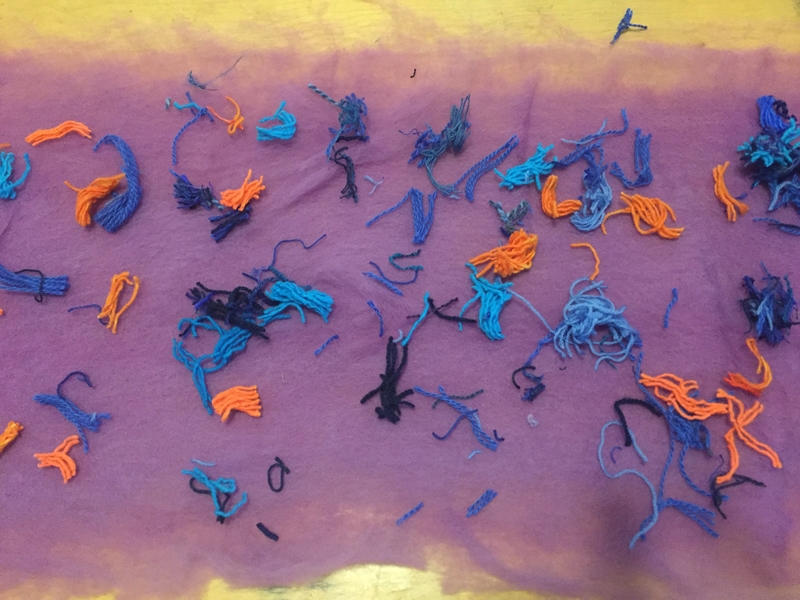
Then I add the yarn pieces and feed it into the carder

This is the finished batts. This was all one, I split in half. The bats are difficult to manage in a 7 foot length.

Then I did some purple

I did some more purple and some blues

I also did a few textured bats that have nepps for texture Only one picture sorry. I will leave it big to make up for it. LOL

This is a video my husband made of the carder working


Third Quarter Challenge – Part 3

Third Quarter Challenge – Part 3

I have showed you two segments of the process of creating my “cityscape” for the third quarter challenge and had gotten to the point of adding needle felted windows and doors to my buildings. Now on to the free motion machine stitching.

I started with the doors and I did a few many times overlapping. This wasn’t a good start but instead of tearing it out, I decided to push forward and see if I could fix it as I went.

I finished stitching around all the windows and doors. I was still unhappy with the perspective and the doors on the left hand building were standing out too much.

So I added a slightly darker thread and stitched the slats across the buildings and then covered up a bit of the lighter threads where they seemed too prominent. As I said last week, it would have worked better if I had done the diagonal lines across the buildings before I added the windows and doors. The perspective would have ended up better. Perhaps I will remember that the next time I do something with buildings and perspective required.

Next up, I needed to put a bunch of stars in the night sky. I had some Bonash Bonding Powder already. It is a powdered form of fusible which melts when ironed. I borrowed some silver foil from my friend Paula. It’s like this stuff. I tried a sample on some nuno felt on the right. You have to put the shiny side up and then cover it with parchment paper and then iron for 5-10 seconds. Let it cool down, peel the foil paper off and magically you have stars!

On the left, you can see the powder sprinkled on to the nuno felt. Then the foil paper is put on top and ironed down. Let it cool and when you peel it off, your shapes will appear in silver foil. You can use any kind of fusible and even cut out shapes if you like. I used the powder so it would look like the milky way/starry sky.

And here’s the result. I think I might have gone a bit crazy with the stars but it does resemble the inspiration photo. Hopefully, everyone will be looking at the shiny, night sky and not notice how the perspective is off in the buildings. So I hope you enjoyed the saga of the “cityscape” challenge. I think I will put this one on a black background and call it “Garnet Night Sky”, after the ghost town it was based on.


Cityscape

Cityscape

Some cities in the UK have evolved over several centuries so that old and new buildings are often knitted together – this gate is in the city of Salisbury.

Salisbury

Councils invest in sculptures, green spaces, floral displays and bunting to make cities more attractive and some individuals will spend time and money enhancing their own small bit of the city.

Yet all this effort is often spoiled by vandals, litter louts and spray-can yobs who deface walls.

My cityscape is mixed media – I chose not to depict a whole city – just one old city building.

I wet-felted a base from white merino wool, then needle felted the building using black yarns of different thicknesses as shown in the photo below.

needle felting with yarn

The bunting is cut from dupion silk scraps and glued in place, and the graffiti is hand stitched using a thick thread.  The finished piece is approx 33 x 23cm (13″ x 9″)

cityscape

Is anyone else working on a cityscape?

Photos as reference and inspiration Part 2

Photos as reference and inspiration Part 2

Part 2

(part 1 https://feltingandfiberstudio.com/2019/08/12/photos-as-reference-and-inspiration-part-1/ )


11

Thinking back to my earlier post on photos as reference and inspiration I was looking at the lilacs from my back yard and seeing inspiration for nuno felted scarves.  Using the flower petals for the ends (perhaps inverted with a block of the nondescript background for the middle. Moy MacKay’s technique with scissors may work with the petals or maybe bits and strands of silk. It would be a fun piece to try.


2 2

This is one of my Alum flowers in the front yard. Its starburst multi peddled flower reminds me of graphic design from the mid-century modern period (think of the sputnic patterns ~1950’s). Again it would be an interesting end to a scarf.


33,  44

Here I have started to crop flip and play with the image a bit more. Sometimes a fragment of a photo will be more interesting visually than showing the whole object. It is also much cheaper to play with a design with cropping copying flipping distorting photos on the computer then using all that wool and silk until you have a couple ideas you really like.


55

I think I would still elongate the sections in between the flowers. My brain then distracts me with what about adding the other 1/3 or the flower and making the edge round with little spiky bits like the flower itself. Oh you easily distracted brain you are going to get me into more trouble!

66

What If I add a frill to one edge? Or maybe 2 layers of frill but different lengths?

77

What would happen if I switched and made the longer frill patterned and the shorter one background colours?

88

These are all symmetrical options. What might an asymmetrical option look like? How would it drape?


99

I’m sure you get the idea try out the myriad of ideas that flit through the brain on paper or using the computer. A part of a previous idea may create an explosion of new ideas in a totally different direction or for a totally different completed idea.


What am I actually doing with the photos?

I have an old version of “Publisher” by Microsoft. Newer versions of publisher are available by subscription to Microsoft but this old version is working until I am forced to by a new computer and have to get into the 21st c with windows 10.


I am importing the photo to a blank work page and then make copies. I take some of the copies and flip them, invert them, crop them, stretch them. Then I start putting them back together.  I can take a pre-made shape and infill the image like this


Picture1410

Then add a second rectangle for the body of the scarf. There is a colour select tool that is helpful to select colours from within the photo.  Sometime the colour you think you see is not the colour you see when its isolated. (This is also helpful looking at landscapes or portrait.)


Picture1511

I have been enjoying “Photo pad” which is a free photo editing software for manipulating images too. It doesn’t have the ability to combine photos as publisher dose but there is always a printer, scissors and scotch tape!


Even importing images into word allows some photo manipulations;  Increase or decrease resolution, change colour. And there are a number of Artistic effects available.


1212 1313 1414 1515

12 Original photo, 13 “Photocopy”, 14 “Cut out”, 15 “Paint strokes”

There are a lot of other options including one that graphs the picture. An earlier version had an outline effect that looked like a colouring book this edition seems to have lost that.


If you are not already using photography to help inspire your felting I hope you will now consider it.  If you have some of these programs give them a try and explore what other features you can put to use.  If you have other programs that contain a photo editing option check them out too. You may have another tool in your design tool bag that you had not noticed were there.  Have Fun and Happy Felting!


1

Journey’s

Journey’s

Ruth has asked me once again to contribute to this wonderful blog. Thank you for the opportunity! Tesi Vaara

I started making traditional quilts in 1986. I was first attracted to Amish quilts because of their simplicity. Back in those days the fabric choices were pretty limited and the Amish’s use of solid colors interested me.

My sister led me down the path towards making art quilts. She had taken a class from Katie Pasquini Masopust http://www.katiepm.com/ and really enjoyed it. Katie held her Alegre Retreats in Sante Fe, New Mexico (they are now held in Gateway, Colorado http://alegreretreat.com/) and we started attending that together. Wow! My art quilt journey began…

In the Fall of 2008, my sister and I began taking a Design Essentials course with Lorraine Torrence https://www.lorrainetorrence.com/. This course was the first time I was able to learn about design elements and principals in depth! I realized for the first time that I could design my own quilts versus following someone’s pattern or technique. It was very freeing and also a bit frightening! I was intrigued with a book about tiles called the Tile Quilt Revival and one day the idea popped into my head that I could take a photograph and use a different version of their technique to create my own idea.

I wanted to do a series of quilts about my life journey. I decided I would make the first one, Memory Lane, based off the first 20 years of my life. I printed photos of my family and friends onto cotton fabric, drew out my design based off a photo taken while visiting the Living Desert Zoo and Gardens in Palm Desert, California. All the fabric was fused to Wonder Under, then cut out. I used some corduroy fabric taken from a rag rug woven by my grandmother for the fence rails. It took me over a year to figure out how to quilt it because each tile had to be quilted down. I had lots of fear that I would wreck it!

Memory Lane 2011 30″ x 22″

The second quilt in the series. Ebey Slough, covers most of my married life up until my divorce in 2009. I live in the Pacific Northwest, north of Seattle, in the small town of Stanwood. It is an area surrounded by waterways. I drove by this view on my way to work for almost 30 years. It never failed to amaze me. It was ever changing due to the tide and the weather. My ex-husband was an avid boater and fisherman so I got to spend a lot of time on the water in our little boat. It was one of the things I missed after my marriage ended, along with the Dungeness Crab he used to gather! Not many photos in this one. Too painful to include them and I wanted to remember the good times.

Ebey Slough 2012 37″ x 31″

I have almost always had a dog in my life so of course they had to have a place in the Journey’s series! Four Legged Friends was an exercise in using black and white fabrics and a design of my own. Each paw print has photos of the dogs in my life. This quilt was accepted into an exhibit in Brazil in 2016 and spent a year there. You can see these and other quilts I have exhibited on the Contemporary ArtQuilt Association website. https://www.contemporaryquiltart.com

Four Legged Friends 2013 42 1/2″ x 34 1/2″
Detail of Maggy, my yellow Lab

For more information on my journey, I have three interviews on the Create Whimsey blog. The third one also has Ruth’s interview from our Gail Harker adventure!

https://createwhimsy.com/projects/spotlight-tesi-vaara-art-quilter/

https://createwhimsy.com/projects/working-in-a-series-with-fiber-artists/

https://createwhimsy.com/projects/the-gail-harker-center-for-creative-arts-inspires-creativity/

Thanks again for letting me share a bit of my journey with you! I hope your journey is as blessed as mine is! Keep on creating! I love seeing all of your projects and processes.

Tesi Vaara

Third Quarter Challenge – Part 2

Third Quarter Challenge – Part 2

I showed you my ideas, concepts and sketches for my cityscape last week. Now on to the felting.

First I needed to make some prefelt for the buildings. I had a mixed brown batt already in my stash so I decided to use that as the buildings in my inspiration photos were variegated brown.

Once I got the brown wool to prefelt stage, I let it dry and then used my sketch to make pattern shapes for the buildings. I used tracing paper to trace the shapes and then cut them out of the prefelt. This is when my perspective began to go wonky.

I found a piece of hand dyed silk in my stash that looked like night sky. I put that over a piece of commercial white prefelt and then laid down the black base, trees and prefelt building shapes. I thought they were well positioned for the perspective I needed but with felting they must have shifted slightly.

Here it is after felting. The buildings are getting wonkier. There is a reason that I don’t usually felt man made designs. I have difficulty keeping the perspective correct and as I progressed in this process, they just seemed to get more and more off as I went. But I had hopes that with the addition of windows and doors, this would improve.

I did fold the extra silk fabric to the back and hand stitch it in place. This gives the edge a more finished look.

I eyeballed where the windows and doors should go and tried to get the perspective correct with them. But that didn’t really work out so well. In hindsight, it might have worked better to stitch my lines for the wooden siding first and then added the windows and doors afterward.

Next week, I will show you the machine stitching and the finishing technique I used to get a starry sky. If you have created a cityscape, please go over to the forum and post it here.