Browsed by
Category: Uncategorized

My year in review; 2025

My year in review; 2025

Belated Happy Solstice, Happy Hanukkah, and Merry Christmas. I hope you are still enjoying the festive season (hopefully with fibre and felt!)

What in the world did I get done this year? This should be interesting, since most of this year was a blur of post-surgery and anaesthetic recovery (including a few very tiny but powerful pain pills – I have no idea what they were, but I vaguely think they may have been green?), I am extremely curious to see if I actually got anything done this year. If you are curious too, let’s take a look!


January: I was trying to get organised after getting bad medical test results (I was never good at tests) and found out I was going to have another surgery at the end of the month. Then be out of commission for a lest a couple of months afterwards.  I focused on getting notes ready for the other librarians to take over running the whole Guild library while I was out of commission.  I also taught an inkle weaving workshop and took a workshop on tablet weaving.

A big cheer up was the felt Christmas card from Eleanor. I was not feeling well after diagnostic testing and dreading the impending surgery, so perfect arrival timing!

Felted cristmas card exchange from 2024, a 3-D christmas tree and a raven on a branch in black / white/ grey1.1) Above the card from Eleanor, below was the card I sent to Eleanor


February 1st found me getting a drive home from the hospital rather than going to the Spin-in in Chesterville, Ontario. I have photos of the guild’s February meeting, and a few shots from other guild members of some of the things I missed. I know I was doing things, but I don’t remember any of it.


March was also a write-off. Anaesthetic and my brain are not friends. Luckily, Ann and Ann were running the library.


By April, one of the Librarian Anns had to step away from the library due to illness. I returned to work,  a bit early, Glenn dropping me off and picking me up (driving was not an option yet), it was unfortunately shorter than normal hours. I was not really up to speed; it took all day just to keep the library running. I brought in felting to work on if I got my library work done, but no luck.moose head and moose bag i had been working on at the end of 2024 but was not getting enuff work done to work on them in January2.1) Moose head and moose landscape bag. At this point, it was still probably a good idea not to be doing a lot of stabbing with sharp objects.

April was not all frustrating and forgotten, I also got a surprise to cheer me up! I was watching Marie from Living felt on YouTube and had been commenting on her videos (not that I remembered doing so shortly after each episode), one of which was her store’s Birthday party. My anaesthetic brain at the time did not remember winning anything, so I was so happy and surprised when one of her deluxe wet felting kits arrived! Thanks, Marie, that really cheered me up! (and I got to try it for workshops much later in the year).

Living felt from Texis wet felting tool kit and bag2.2)A surprise from Living Felts on line Birthday party


May arrived, but was still mostly lost in the fog. I seem to have worked on the Library report, and I am pretty sure it was Glenn who drove us down to the fibre festival at Spencerville (south of Ottawa). I have vague memories that I was very sore getting there and back, but it was so nice to get out and see friends and look at shopping.

3.1) Spencerville Fiber festival 2 photos of shoppers and booths3.1) Spencerville Fibre Festival

The long weekend in May (Friday to Sunday) was also CanGames and ghelting convention, which I have told you about before. I finally thought it might be safe to try a needle felting project. I may have been a bit premature in trying that. I somehow wound up with 6 fingers on one hand, and my under structure wrapping was not as tight as it should be.

3.2-3.3) Oops still can’t count! hand with 5 fingers and a thumb 3.2-3.3) hand repaired to only have 4 fingers and a thumb3.2-3.3) Oops, still can’t count!

evicting racoon in live trap from the garrage3.4) I somehow forgot we evicted another garage dweller. He was not impressed.


By June, I was feeling safer to make expensive decisions, but I limited it to one new camera. The old one was over 13 years old and was needing an upgrade. I still don’t really remember much unless I am looking at the photos from what I was up to. (I am glad I took pictures, or I would not remember doing anything!)

4.1) new Nikon bird watching camera with sneaky powerful zoom feature.4.1) new Nikon bird watching camera with sneaky powerful zoom feature.

4.2) I continued to putter on the Mer-Boyfriend I was creating for the missing Miss Mer 4.2) I continued to putter on the Mer-Boyfriend I was creating for the missing Miss Mer.

June 07, we tried to be in two places at once, the Lamsdown Fibre festival and the Dickonson Day Demo. I was doing shopping and photography, so no felting!

4.3) Demo at Dickonson Day4.3) Demo at Dickonson Day

4.4) one of vendors at Lamsdown 4.4) one of the vendors at Lamsdown

I had been trying to be careful about large perchasess with anesthetic-brain but I had been waiting for a stock tank of about this size to go on sale, so I bought it!

4.5) 75-gallon stock tank, becomes perfect fleece washing station. 4.5) A 75-gallon stock tank becomes a perfect fleece washing station.

With the addition of a fleece washing station in the side yard/Driveway, I got to work washing my way through the fleeces from the last couple of summers I had not felt up to working on.

4.6) Glenn was very helpful working the spin dryer for me. (its an old RV hand washer/spin dryer) 4.6) Glenn was very helpful working the spin dryer for me. (It’s an old RV hand washer/spin dryer)

4.7-4.8)the father’s day weekend brings a blacksmithing workshop to the Glengarry Pioneer Museum in Dunvegan Onrario (East of Ottawa) - black smith made sisors on display on a folding wood table 4.7-4.8)the father’s day weekend brings a blacksmithing workshop to the Glengarry Pioneer Museum in Dunvegan Onrario (East of Ottawa) - needle felting mer-person4.7-4.8)the Father’s Day weekend brings a blacksmithing workshop to the Glengarry Pioneer Museum in Dunvegan Onrario (East of Ottawa).

This was a great chance to do some photography of blacksmithing, and do a bit more felting, on the young mer I had started last month.

4.9)There was also a demonstration of finishing a blanket by walking it. (walking is likely spelt differently when applied to a wet blanket thumped repeatedly on a table.) 4.9)There was also a demonstration of finishing a blanket by walking it. (walking is likely spelt differently when applied to a wet blanket thumped repeatedly on a table.)


July continued fleece washing, a bit at a time. I still seem to keep over-exerting myself, but I was feeling so far behind.

5.1) 3 more bins to sort and wash. 5.1) 3 more bins to sort and wash.

5.2) Trying to sort without a skirting table 5.2) Trying to sort without a skirting table.

This month, I was back to the Glengarry Pioneer Museum to demo felting for them at their Fibre/Textile day.

5.3) 3 of the Mer Family and their pets get out to a demo. It was an extremely hot day and they seemed happy to be in the shade of the porch.5.3) 3 of the Mer Family and their pets get out to a demo. It was an extremely hot day, and they seemed happy to be in the shade of the porch.


In August, the guild had a workshop on Cyanotype printing with felt. It was a half-day workshop and ran twice. I took lots of photos, which reminded me of playing with the enlarger in the dark room.

6.1)Cyanoprinting with felt6.1)Cyanoprinting with felt

August is also the time of the very large fibre festival Twist, about an hour away in Quebec. Glenn came with me as my attendant, and I filled in at the guild demo table with the Mer boyfriend I was working on. I missed getting a roll of garden felt, so I went back on Sunday. (We had the comfy duck sandwiches twice this year!)

6.2) I missed out on this size, but got a piece from the big roll 6.2) I missed out on this size, but got a piece from the big roll

There was more shopping, a bit closer to home, at Stash-it Fibre Festival in Kempville, Ontario (about a half hour south of Ottawa)

6.3) I seem to be focused on fiber acquisition again, I see more fleece washing in my future.6.3) I seem to be focused on fibre acquisition again; I see more fleece washing in my future.


September is Almonte Fiberfest (about half an hour west of the west end of Ottawa). I again did a “few” photos for the Mississippi Valley Textile Museum, who run the event (I hope I remembered to send them!)I am pretty sure I showed you the Booth Birds of a Feather by Catherine

7.1) Birds of a Felter booth, at Almonte FiberFest7.1) Birds of a Felter booth, at Almonte FiberFest

A few more fleeces to wash, the stock tank has been helpful, and fall seems to be holding off, so I may get these done before snowfall! One was a lovely but horribly dirty ram Shetland fleece

7.2) big Shetland fleece (looks like he took a mud bath before sheering)7.2) big Shetland fleece (looks like he took a mud bath before shearing)


In October, I tried a wet felted Slipper workshop with Ann. I was sure I could make a simple pair of slippers in a day…. No, not quite yet, it seems, but I had lots of fun, stayed reasonably dry and am looking forward to finishing up the slippers when I have another burst of energy.

8.1) Jan’s almost finished slippers at the end of Ann’s Class.8.1) Jan’s almost finished slippers at the end of Ann’s Class.

This month, I also spotted a cottage for sale, very close to my brother’s cottage. It had just had a major price drop, which might have potential, so worth taking a look at it.  There is also a Quonset hut, on about an acre of land, not too far from that’s for sale too. One is better for spin and felt in’s the other would be better for blacksmithing. At least neither is attached to a piece of protected swamp, which was almost everything I have looked at for the last few years!

8.2) cottage option8.2) cottage option

October is also the month for KanataCon Board game and Felting convention! They are the gaming convention with the HUGE second-hand game sale where I found a game about alpaca and one about lamas! I also got a lot more work done on the Mer-Boyfriend for Miss Mer.

8.3) Fiber related board games8.3) Fibre-related board games

8.4) Glenn with the young Mer-sturgeon now with bumps!! (on the mer not Glenn8.4) Glenn with the young Mer-sturgeon now with bumps!!

The day after the gaming/felting convention was a new Fibre festival in Merrikville Ontario. It was a nice drive down, fabulous weather for photographing the locks and a bit of good shopping.

8.5) Fall colours and the locks at Merrickville8.5) Fall colours and the locks at Merrickville

October was very busy. The day after Merrickville, we jumped in the car and headed for Toronto. We did a couple of shopping stops on the way to Oakville, but made it through all the Toronto Traffic! (Rush hour may be nearly 24 hours long!)

On Tuesday, Glenn and his brother did legal stuff, and I had a lovely day staring at architecture, photography, and felting.

8.6) Happy with his hand upgrade8.6) Happy with his hand upgrade

The next day, we stopped to shop with Monika at the Olive Sparrow on the way back to Ottawa. By the time we made it home, I felt wiped!  I think I could have slept for at least a week.


November arrived, and it’s time for the Guild Sale and Exhibition. This event is run by Ann, and I help where I can. I am still noticing I am not back to full steam yet. I usually can photo-document the event as well as run the music and demo felting. Not this year, photos and music were all I could manage. Most of the signage and layouts could be updated from last year, so not as much pre-work either. We had a couple of good felters with booths this year. If you check back in the blog, you will see the photos.

 9.1) Ann showing how a drop spindle works (she is wearing her new name tag) i cant remember when i made her her new name tag?) 9.1) Ann showing how a drop spindle works (she is wearing her new name tag).

At the end of November, I ran the needle felted landscape workshop. We look at wool in a painterly approach. Ann took this workshop and has been having fun with mist and trees!

9.2) November students and their felt Paintings (it looks like they had fun)9.2) November students and their felt Paintings (it looks like they had fun)

The next day, I got up nice and early and headed back to the guild. This time Ann was teaching, and I was the student. I was oddly tired (as if I had been very busy the day before) even before we started, but it was fun (and dangerous, you could get wet). I was able to get all the rolling done by the end of the class. I still need to do a bit more shaping to finish off, oh, the want of free time!!  I am not sure where all the time goes, but I seem to be missing more of it this year than usual!!!

9.3) my odd shape black hat in progress9.3) My odd-shaped black hat in progress. (Can you guess what it will look like?)


It’s finally December, and I’m not sure I was ever going to make it to the end of the year, but I am happy I did. I had a workshop teaching beginning Inkle weaving, with great students again!

9.4) Inkle weaving workshop9.4) Inkle weaving workshop

Inkle looms make straps, belts, trim, ties, and narrow woven band. It is usually woven where only the warp is showing, and usually the colour order of warping will determine your pattern. There is the option of Pickup (for which there are other better teachers), and I have taught the “inkle Two” class of many of the truly weird things you can weave on an inkle loom, but may or may not want to.


Throughout the past year, with the help of the other librarian, I have continued to volunteer at the guild library. I usually put in over 500 hours each year.  I am about to get to the number crunching for the library year end data. (which, considering my lingering deterioration of math skills, may make this more of a challenge this year)

I am glad this year is almost behind me. It was interesting to see what I did, even if I didn’t remember doing it, until I saw the pictures. The heavy fog seemed to go on for more than the first half of the year, with mini fog attacks even up to recently (I will be able to add again any time I want to soon). I am going to try to avoid having any anaesthetic for as long as I can in hopes my spelling improves, and my little bit of math comes back!!


I am optimistic that you are as excited and hopeful about 2026, it’s a pleasant shape, for a number, so I am optimistic. I also have some wet felting to finish and some dry felting to find! Have fun and see you Next Year!!!

Self-Felting; a Fictitious Fun Felting Class for The Fur-bearing Who Lack Thumbs

Self-Felting; a Fictitious Fun Felting Class for The Fur-bearing Who Lack Thumbs

Here’s a quick update: I am improving, but it’s two steps forward and a step and a half back.  Unfortunately, the two blog posts I have been working on are just not ready to go yet. So I wanted to tell you about something a bit different, I have been working on. It is felting adjacent and made Glenn laugh a lot.

The local guild is working on recruiting new teachers for our workshops. One of the barriers suggested to the acquisition of new teachers is “the paperwork requirements are intimidating”.  I am easily intimidated by forms, but I didn’t find this process at all scary.

The request was:

  • Craft CV (basically, what’s your background in your craft and how long have you been doing it?)
  • A lesson plan for your first workshop. Giving a suggestion of what you will be teaching, outcome goals for the students and a very basic idea of how you will do this.

Later all the teachers will fill out a spreadsheet that is used to create the schedule, and the web pages.  I made a yearlong catalogue of workshops to be displayed at demos and the guild sale. I used the information the teachers provided, and the schedule the team put together to produce it. After I had all the cut and paste and layout done, there were always lots of spelling mistakes that would be attributed to me….. I cut and pasted! Not my spelling problems!!  Since the pandemic, we are no longer doing a full catalogue, but I am no longer in trouble for other people’s spelling problems.  I do miss the fun of layout.

Now, on to the point of this very odd post.

I wanted to help by giving a non-intimidating sample form, for “New teacher”, of a new yet fictitious felting class. After writing this, I had this odd idea that actual felters might enjoy reading about this very unlikely felting workshop I created as a sample to make the forms less scary for potential new teachers. I have simplified the wording of the original questions again to reduce fear.

__________________

This is a craft CV ( which is just a fancy way of saying “what you have been doing in your craft”). It’s a way to find out about the potential new teacher’s background in what they want to teach. (it doesn’t have to be a stuffy list of all relevant education and exhibitions!) So let’s see what Miaka has to say about herself and her felting background. She has added some extra remarks beyond the questions that she hopes the teacher acquisition committee will take into consideration.

Fiber CV for Miaka Scott-Martin,

Education: Home schooled and self-taught felter.   I have been the Center of the universe for many years, directing my staff in its running. Unfortunately, my staff are not too bright and refuse to do my carefully explained bidding.  I use my love of felting to relieve this stress and utter disappointment.

o             When did you start the craft you are going to teach? In my teens.

o             Have you taken workshops on this topic, or are you self-taught? I developed this technique myself.

Craft experience: I watched my mother weave, felt and spin and assisted in some of these activities. Then, in my teens, I started to experiment with techniques of self-felting. After years of experimentation, I have come up with a style of felting suitable to those of us inflicted by a lack of thumbs.

My technique is suitable for most fur-bearing people who shed. It is easier if you are also able to purr. I practiced my felting for close to 20 years.

Teaching experience: my full-time job has me instructing and supervising the staff, but I must be patient with their inadequacies. I have extensive experience successfully instructing the big barking bad smelling new sibling on how to be the perfect cat.

o             Do you have teaching experience (with adults)? Great success with other fur-bearing people, the furless ones have proved a bit dim.

o             If you do not have previous teaching experience, you can partner with a guild teacher in your field to help give you experience.

Shows and exhibitions: This is not essential. Guild members can participate in guild shows and exhibitions if you would like the experience.

o             Have you participated in any art shows or exhibitions in your field? Alas, with my busy schedule of keeping the universe running, I was unable to enter any shows or exhibits even though I was a family member of the guild my entire life.  I was also unable to make anyone understand my superior typing style of body slamming the keyboard, so all the needed letters were there; you just needed to sort them out on your own.

Portfolio: Show examples of their work in the field of their workshop. (shows that the prospective teacher has not just taken a workshop on a topic, and after one piece is wanting to teach the topic.) Some teachers have a web presence and we can be directed to see their work there.

o             Do you have a portfolio to show us or a website to direct us to? Due to the ephemeral nature of my work and the horror of passing vacuum cleaners, most of my art installations have not survived. Please talk to my mother (one of the Guild librarians) for further details on them. I was particularly proud of my master-work, “Self-felting on white Dining room chair cover”. Alas, this great work too was lost to the horrid vacuum.

o             Please provide a good quality digital photo of yourself for web publicity and teacher bios.

Possible teacher photos:

small black and white cat sitting on cow hide in a spot of sunlight1) Miaka, taking a break from work,

small black and white cat leaning out the back of a cardbord sports car. licene plate says Miaka Rules and has a helow kitty skull and crossbones beside the licence plate car made of the finest cardbord box. 2) Miaka, looking out back of her sports car,

small black and white cat lownging in a patch of sunlight staring at vewer. 3) Miaka, center of the Universe, “Don’t interrupt me I’m Busy!”

____________________________________________________________________

New instructors were asked to write a very basic lesson plan of their workshop, giving an overview, goals and objectives. This gives the committee an idea of how the topic will be covered and that the teacher has thought through and has an organized presentation. This is Miaka’s plan to teach her workshop on self felting.

Outline of lesson plan for workshop

1 day  workshop with longer homework project

Class size; maximum number of fabric-covered chairs that can sit in good direct sunlight. Any Students who are too big to lounge on a chair are required to bring a blanket or pillow that they will fit on.

Prerequisites for this workshop:

  • No experience in felting necessary
  • Must have shed-able fur

Housekeeping

  • introduction of the teacher and what the workshop is about
  • where the washrooms are
  • point out the coffee maker, microwave and fridge
  • Mention local food sources.
  • Gets students to say their names and felting experience

Overview of the course

  • what students will be expected to do and learn
  • What the final project will be.
  • Notes can be given at the beginning or end of the workshop
  • Contact information for the teacher in case the students have questions

Introduction to felting,  (fibres and how it works)

How to grow your own fiber (good diet, lots of naps, dual coat, good grooming, etc)

Tools required

  • Sunny spot with a comfortable sitting item (Chair, couch, other fabric covered object)
  • An un-sunny spot can also be used, but it’s not as warm. This is sometimes the better location to felt, depending on your home cleaning staff.

Shedding

  • Practice shedding with suggestion from the teacher. (use of music, turning and repositioning regularly, long yawns and brief naps may be helpful)
  • Some find shedding easiest at certain times of the year, others are more fortunate and can shed whenever and on whatever they like.
  • Professional shedders can shed a single colour to stand out most on what someone else is wearing.

Self-felting

  • Regular turning and repositioning with constant purring will improve speed of felting.
  • Drool may also be applied but is not necessary for felt integrity.
  • This is not a quick process, and may be best achieved on a fabric surface not regularly used by others.

Problems you may encounter

  • BEWARE of the Vacuum, which can ruin months of good shedding and felting! I suggest “vomit in shoe” revenge if this happens.

Inspection and Positively critique the sample felting produced today.

  • Be positive and make suggestions for use on their masterwork home project. Answer any questions the students may still have.
  • Fill out the workshop questionnaire, since the students lack thumbs, their staff may assist them.

homework student master pieces

  • Students will practice what they have learned in the workshop at home, in a location of their choosing.
  • Suggested time line is working over the summer and have your self-shredded felt ready for the September show and tell meeting.
  • Students will bring in their finished felt for show and tell to a guild meeting. (get your staff to drive you back on the meeting Monday)

________________________________________________

After a teacher has done their CV and Sample lesson plan, the teacher acquisition committee will review the information provided and, if accepted, will pass along to The Workshop Coordinator a list of new teachers. The Coordinator will send out a spreadsheet of questions to fill in for each workshop that the teachers are offering for the time frame she has requested. That looks a bit scary but the questions are not too hard. Like, what time do you want to start your workshop, when do you want it to end? After teachers spend a bit of time answering all these odd seeming questions and sending it back, the workshop team will create the schedule.

  • Fill in the spreadsheet sent to teachers, it will have questions about the workshop and your teaching availability, and what level of students you want to teach.
  • You will also be asked for a couple of high resolution (good number of megapixels) photos for your workshop. What you are making is ideal. Miaka has elected to show an example of shedding for both cats and barking cats, as well as a shot of her wanting to felt but not having thumbs.
  • Availability: Let the coordinator know when in the next workshop time period you will be available. Eg: evening workshops, but not Friday, weekends good, not in March or September. Have holiday plans for April 1 to 4th so not available.

Workshop description (this information is used to publicize the workshop, on the web, at demos, or at guild meetings) Here is an example of what Miaka’s workshop might look.


Title: Self-Felting: for those who are lacking opposable thumbs

Instructor: Miaka Scott-Martin
Level: Beginner (B)

Prerequisite: no felting experience necessary, must have own fur, ability to purr is an asset.
Cost: (to be determined by Workshop team, by the number of hours the class runs)

Class size: 10, determined by the maximum number of fabric covered chairs and good direct sunlight. Students who are too big to lounge on a chair are required to bring a blanket or pillow that they will fit on.
Venue: Studio


small black and white cat hiding partly under a white comferter while looking at two needle felted sheep4) Don’t let the lack of opposable thumbs get you down and keep you from enjoying the wonders of 2-D felting

Description: 

Have you always wanted to felt, but lack opposable thumbs? This is the workshop for you! We will be creating a self-made 2-D felt. Taught in the guild studio, we will spend the day covering the topics of growing your own fiber, how felt happens, strategies for shedding, and where to shed for best felting outcome. We will make a small sample in class, then produce your masterwork at home. The teacher will provide notes and be available to answer questions if you have trouble during your homework.

Start your self-felting fun today!!!

Example of group self-felting project, in progress, tragically destroyed by a passing vacuum

This slideshow requires JavaScript.

5.1) Barking Cat and 5.2) the Center of the Universe,  collaborative felting project in progress


Students should bring: On the day of the workshop, bring your own un-brushed fur (to produce the best effect, avoid the brush for a few days to a week before the workshop)

Materials fee: $3 includes all the materials required for the workshop. To be paid to the teacher.

___________________________________

I hope you have enjoyed reading about Miaka’s proposed self-felting workshop, even if you are not self-producing your own fiber to self-felt. There may be a fur-bearing instructor near you, who is willing to provide a similar workshop that you could investigate.

As to her technique, the purring defiantly helps the felting, but I’m not convinced you have to listen to progressive new opera for the best results. This is a slow, careful build up of fiber, and requires time to get just the cohesive layering you are going for. It requires long periods of napping and body readjusting to perfect the felting process. This technique is not advised for those with fur allergies or those who lack fur. <Grin>

Miaka lived to just short of her 20th birthday. Luckily she got her Giant fish cat cave, which I told you about before, early and got to enjoy it for a short time. She continued her self-felting projects, experimenting with various work surfaces, into her very senior years. I am sure if she had run this workshop, it would have been successful, (I would have helped her with notes and photos).

large wet and needle felted fish held up as it were a fishing toffy fish. it is shades of grey finn wool with bits of blue grey silk fiber.6.1) The Giant Cat cave fish, to give you an idea of the size of it

small black and white cat (Miaka)curled up between the fins of her gient fish cat cave. she is blind by this point and had truble finding the mouth enterence.6.2) Miaka, curled up beside her Cat Cave fish. Tiny cat giant fish!


If you have the opportunity to share your knowledge with others who are interested in any of the fiber arts, please do. That could be formally as a teacher or informally at a social or chatting at a fiber fair. Sharing knowledge keeps the techniques from being lost or forgotten. Often when teaching, you will have a student try something that is brilliant and you will also learn from them.

Hopefully this hasn’t been too strange a post, I will endeavor to make more sense in my next one.

Have fun and keep felting!


A Few Felt Samples

A Few Felt Samples

I am out of time to do an original post today.  So it’s a throwback post. This one is from the early days of 2012.

Doing samples is fun and I still have the last two. They are just fun to have.

I haven’t been doing much that is interesting to look at lately. Everything is white and is waiting for the dye pot.  I thought I would show you some samples I made a little while ago. The first 2  are purple merino with some silk strips on them. I thought they came out nicely with lots of texture.

Purple wool with strips of silk before felting
Purple samples after felting

The second is orange merino with some silk and curls on it, here I wanted to felt the curls right into the background. I also wanted to see how it would stick if I put it over the silk. I really like the way the little blob of curls all became one with nice texture. The curls going across the silk stuck down very well. Enough wool migrated through the silk to grab the courser wool of the curls.

Orange wool with silk and curls before felting
Orange sample after felting

This last set I wanted the curls to be attached at the base and left loose and hanging for the rest of their length. I use a small piece of scrap floor underlay with a hole in it so the wouldn’t stick down. It worked very well. I am not sure how I ended up with one really long curl.

Small samples with curls with their resists on before felting
Small samples with curls after felting.

I am not sure what I am gong to do with these. I might make some buttons or hair clips. Do you have any ideas?

Egils Rozenbergs Tapestry Exhibition (Ottawa, 2024)

Egils Rozenbergs Tapestry Exhibition (Ottawa, 2024)

As I write this, I am just back from the private tour of the EGILS ROZENBERGS’ (Latvia) – Signs of the Time exhibition, arranged for the Ottawa Valley Weavers and Spinners guild. His work is monumental, and striking.  it is well worth the trip down to the New City Hall on Elgin St. (there is a parking Garage underneath the building. Use the Elgin Street entrance. As with much of Ottawa at the moment, there is construction and road work near the other entrance.) for those who find it a bit of a drive, let’s take a peek at the exhibit while it’s here! (Although you may want to come back for a second viewing when you have more time!)

This slideshow requires JavaScript.

1.1-1.3) City Hall Art Gallery – peeking through the windows and looking at the tapestries

The exhibit’s public Opening and artist tour is on Thursday, August 29, 5:30 to 7:30 pm the Tour begins at 6 pm. The exhibition runs from August 29 to November 24, 2024, at the City Hall Art Gallery (110 Laurier Avenue West, Ottawa, ON, Canada, Ontario)

The new City hall is actually an old building, the old teacher’s college (Normal School), built in 1875 and the expansion of a new wing in 1990. Besides city offices, there is civic space, including multiple gallery spaces.  We are heading to the gallery behind the grand piano in the atrium.

I arrived about half an hour early so have time to check out some of the architecture of Ottawa city hall.

This slideshow requires JavaScript.

2.1-2.5) Looking around the atrium of City Hall before the gallery opened.

I wandered back to find 2 people waiting for the talk but didn’t recognize them. They were the Tapestry Artist himself and his Canadian weaver friend, who would help him as a translator. Moments later, the Latvian Ambassador and his assistant arrived!

The artist is on the Left and the Ambassador of Latvia is on the right. both are standing in front of the City Hall Art Gallery3.1) weighting for the Gallery to open for the talk. The artist is on the Left and the Ambassador of Latvia is on the right.

The rest of the tour group arrived, as well as the gallery manager and we all went into the gallery.

We had a good turnout for a mid-day, mid-week time. Besides the local guild members, there are a few people you might not recognize; The Latvian Ambassador and his assistant, the Gallery manager, the Artist and his friend, and a fellow weaver who was also his translator (he did a fabulous talk in English). You might also spot Michel, Director of the Mississippi Valley Textile Museum!

Egils Rozenbergs' tapestries Exhibition Egils Rozenbergs' tapestrie book and 4.1-4.2) Stepping into the gallery you are greeted by the monumental tapestries, which were striking, even more so in person. / The show catalogue, the book on Egils Rozenbergs ($40.00) and the visitor book.

Egils Rozenbergs is an internationally known weaver. He gave an overview of his education and then a bit about the focus of his work. He told us how he started as a painter, then he switched from painting to the new department of Textiles, with a focus on large tapestries for exhibitions. Since his scholastic training,  he has worked as a Textile artist. He was selected to weave a tapestry for Queen Margrethe II of Denmark as a present from Latvia. He has also had 2 of his designs picked by the French Goblin Tapestry Studio.

He had selected tapestries representing some of his older series of work as well as his latest series. This new selection marks a shift in his source material (the type of “yarn” fibres he uses). His early work used Wool/ Linen and Copper, moving to Wool/Linen and Polyester, and now shifting to Polyester, Polypropylene, Nylon, and Acrylic.

Egils Rozenbergs' tapestries with the tour listening to the artist Egils Rozenbergs in front of one of his new tapestries5.1-5.2)He said his opening remarks and overview of the exhibition in front of his newest tapestries (his Transfiguration series), then answered some of our questions. / his translator friend, on the far left, is also a weaver.

We asked him quite a few technical questions; details about his loom, his warps and even weaving techniques.

He had a large horizontal loom similar to our 100-inch loom but only uses 2 shafts. (I was able to find the full picture that was used in the show promotional material, showing the loom he uses here: https://th.bing.com/th/id/OIP.hk0UBNJtxNtcQhIuT3o3vwHaE8?w=302&h=202&c=7&r=0&o=5&dpr=1.3&pid=1.7 )

There were questions next about if he was using a flying shuttle to compensate for the wide weaving width (that needed a bit of translation). No, he is using a manual shuttle and a tapestry technique for the pattern weft. Occasionally he had a friend weave with him, like we do for the 100-inch loom. I was wondering about what EPI he had set the warp. He could tell us how many warps in 20 centimeters which Ann S. quickly did the math and told us that it converted to 5EPI. That led to a follow-up about the visual difference between the wool ground and the new work with VHS and cassette tape (he had an ingenious way of adding twist as he wound balls for his weft! But I should not give away his secret, you will have to ask him when the exhibit travels closer to you.)  the PPI was greater in the newer weaving one of which was woven in plain weave where you can see both the warp and weft. The other tapestries were all weft-faced. One of the tapestries had a gradient in the ground, we found out he is using multiple strands of yarn, in different colours. He is switching out and in colours, as he weaves.  There was a question if he used a cartoon under his warp. He said he makes detailed drawings about 12×15 inches of his designs then graphs the design directly to the warp, making marks (drawing) on it.  He mentioned he sometimes frames and sells his preliminary drawings, as well as the tapestries.

He took us around the exhibit telling us about pieces he had selected.  These are made mainly of wool, Linen and Copper. He had been able to find coated copper (so it would not tarnish, he pointed at a tapestry from 2004 which was still shiny copper). I tried to remember everything he was saying and take shots to show you and the guild members who could not attend today.

In the area to the Left of the entrance, there were representatives of 3 of his series themes. The first represented the signs found in the Latvian beach sands near his home. This series was called Signs in the Sand which he has returned to over many years. The work on the Left was Morning Light 2004 Wool Linen and Copper, and on the Right, Sparkling Sea, 2016  Wool Linen and Copper.

Egils Rozenbergs' tapestries Egils Rozenbergs' tapestries Egils Rozenbergs' tapestries close up6.1 -6.3) Close-up of sparkling sea (R) from the Signs in the Sand series the copper seemed to move and shimmer like light on sand in clear ripples of water.

I was very impressed with both pieces (even if they are invoking water).

Egils Rozenbergs' tapestries close up Egils Rozenbergs' tapestries clsoe up6.4 -6.5) Close up of  the left

Egils Rozenbergs' tapestries7.1) this tapestry was from a series called Scars.  I don’t seem to have the proper title.  It had a lovely graphic rhythm. I think some of the symbols or marks were from ancient graves.

Egils Rozenbergs' tapestries close up7.2)   this was a close up. you can see the multi strands of the pattern weft, and how he is changing strands within the group as he weaves. The background is a solid blue.

Egils Rozenbergs' tapestries7.3) The other tapestry from this series was at the entrance to the exhibit. Signs of the Time, from the Series Scars, 2020. Wool, Linen and Polyester.

Egils Rozenbergs' tapestries8.1)  This tapestry represented the series of Mexican masks it was very striking too. The copper grabbed the light and reflected it back, making it hard to get a truly representational shot. This also gives you a good idea of the size of the tapestry and a suggestion of the size of the loom.

There were two tapestries from the Paris series, one was Rhythms of Paris 2012,  Wool, Linen and Copper. On a blue background, suggestions of the Eiffel Tower.

Egils Rozenbergs' tapestries Egils Rozenbergs' tapestries9.2)  The second piece was based on shadows on the ground in a park in Paris. (the top of a metal gate)

Egils Rozenbergs' tapestries10.1) This one is from a series of frames that support haystacks. I found it particularly mesmerizing.

Egils Rozenbergs is showing his book in front of one of his tapestries10.2)  At this point the Gallery manager reminded us that there was a book available of his work (it will go very nicely in the Biography section of the Guild library, once the guild pays for it.)

We wound up back in the main section with his newest series. It is based on the changing technology and Transfiguration. Are you seeing circuit boards?

Egils Rozenbergs' tapestries Egils Rozenbergs' tapestries close up11.1-11.2) This one had a plain woven background so you can see the warp showing through. Two Suns, from the series Transfiguration 2016 Wool Linen and Polyester.

Egils Rozenbergs' New tapestries12) these 3 are also part of the Transfiguration series. Notice the background on these 3,  old tapes that were joined together and twisted to create the ground weft.

Egils Rozenbergs' tapestries Egils Rozenbergs' tapestries Egils Rozenbergs' tapestries13.1-13.3 ) This is a close up of the tapestry on the far Left in the last photo it was called the Old Lady who walked along the sea from Transfiguration 2017 Polyester, polypropylene and Nylon.

Egils Rozenbergs' tapestries Egils Rozenbergs' tapestries14.1-14.2) Nothing is like it was Before from the series Transfiguration 2017,  Polyester, Poly polypropylene, Nylon  and Acrylic

Egils Rozenbergs' tapestries14.3  (on the left) This piece was hung further away from the wall so you could look behind it

Egils Rozenbergs' tapestries14.4) behind the back of the tapestry

Egils Rozenbergs' tapestries 15.1-15.2 Transformation Series the end of the tour

Egils Rozenbergs' tapestries exhibition Egils Rozenbergs' tapestries electronic sign outside city hall gallery15.3-15.4)  A couple of last shots of the gallery space

Egils Rozxenbergs’ presentation and explanation of his work were inspiring. I want to go out and felt a landscape a really big one! His repurposing of tape to weft was very effective and the coated copper got me wondering where I put my bobbin of fine cotton….  I hope if this exhibit travels somewhere near you (or you are visiting Ottawa before it closes) that you will grasp the opportunity and go see it.


1st quarter Challenge-done

1st quarter Challenge-done

Well, I must say this is the fastest I have ever done the challenge. In fact, I finished it before it was issued. It was a Christmas present for my hubby. My husband loves cast iron cookware. It does cook well and hold heat. He looks after them so I don’t have to worry about wrecking the seasoning by doing it wrong. The handles on the frying pans are hard to get a grip on when they are hot. Oven mitts always seem too big. we have some silicone ones but I always feel like the pan is trying to twist inside them. So this is where the felting comes in . I thought I would make some felt handle covers. wool is fire-resistant and a good insulator, so should work well

I measured the handles and then headed for the studio. I found a scrap of floor underlay for the resist and measured out 2 so I could do 2 at once.

Just about a perfect fit for my rolling mat.

I decided on a nice bright blue and added 4 layers of wool. I am not sure how much wool as it’s not a very large amount I just made sure both sides would have the same amount. Nothing beats guessing if it’s right. LOL

After both sides were wrapped around and wet I decided they were boring but being in a hurry ( leaving it too close to Christmas) I just added a strip of orange down the middle of both sides. I didn’t want there to be a right side up.

After wetting down it was on to felting: rub rub rub, roll, roll, roll.

I cut the handles in half so I had two the same size. Then a little more rolling and onto fulling. these are small and were coming together quickly so I fulled them in my hands by rolling them in a tube shape and in a ball.

One down and one to go

And they are now being used on the stove. they are nicly heat prove but not so thick you can’t get a good grip.

So how’s that for reading Lyn and Annie’s minds and being ready with my first post of the year? How about you? did you make someone something practical for Christmas or a birthday?


Naalbinding?

Naalbinding?

Ok, what is a “nal” and why would I bind one?  Well, if you have an interest in Viking textiles (yes I have the Icelandic variant warp-weighted loom to prove it!) then you may want to learn how to Nalbind. (yep that would be me please!) This fall the local Ottawa  Valley Weaver’s and Spinner’s Guild offered a workshop on 4 Wednesday evenings to teach an introduction to Nalbinding.

So now you know the where but may still be a bit confused by the what (it is) and why (would I want to do it).

“Nålebinding (Danish) literally ‘binding with a needle’ or ‘needle-binding’, also naalbinding, nålbinding, nålbindning or naalebinding”  I first saw it spelt with the double A (I have always liked words with double A’s). * I already love this word, look how many different ways you can spell it and still get it right!

The what:  there are multiple spellings depending on your location. It is usually described as a “type of single needle knitting” which is not at all like knitting.  it is produced by a series of interlaced loops but unlike knitting it creates a more dense and stable fabric.  if you use a pair of scissors and cut knitting it unravels, if you get a hole or slice in your nalbinded it will remain intact and not run or unravel.

When I first bumped into Nalbinding it was in the early 1980’s in articles on early medieval archeology. I was not able to find much information in English and it was mostly flat pattern analyses that were too much like some of the knotwork patterns to consider a true road map of instruction to recreate the process. Keeping the yarn looped and flat, while trying to stitch into the previous loops, was a bit of a disaster.  It was well before the helpful Mr. Google and the wonders of YouTube.  So, I put the hope of learning to make warm socks and cool hats aside and focused on my beloved Fragment #10 from Birka Sweden (Broken Lozenge Twill!) and making a ¾ size Icelandic variant warp-weighted loom. I measured from the inside of the trunk of my hatchback to the back of the seat, to get the height of my loom. It’s good to think ahead about how you are going to transport it.

diagram of flat layout of loops found in Nalbinding. 1) Flat pattern diagram of Nalbinding similar to diagrams I was looking at in the 1980’s you can see working flat would be a difficult way to work with yarn.

The next time I bumped into the opportunity to take a workshop in January(?) 2010, with a fellow Medieval enthusiast who had kept researching and been introduced to the thumb method of working the loops (so much easier than the flat table method!!).   She brought in samples of her work including a sock, mitts and a hand puppet

This slideshow requires JavaScript.

2-4) Samples from the first 1 day nalbinding workshop,  laptop and samples with notes and nalbinding, close-up of the blue and grey sock, mittens  in two patterns (thumbs to the side  and thumbs underneath)  

We used big lofty yarn and made a rectangle, which we were to join one end to the other and make a tube.

Rebeca showing us how to create one of the stitchs in nalbinding5) getting started with a needle and a single wool yarn
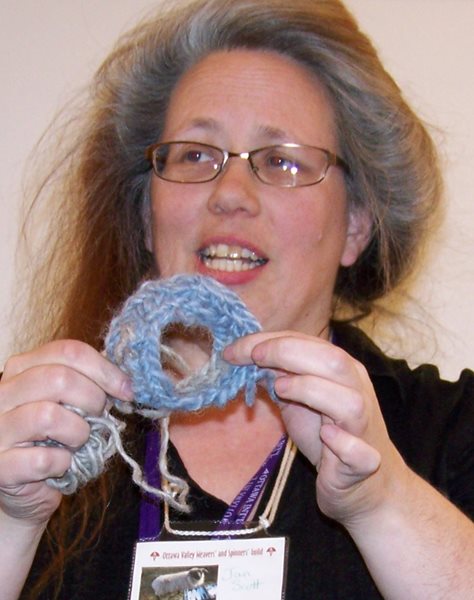
Well, that took an odd turn…. I seem to have developed a Mobius strip, not a tube! But I had a lot of fun so it was all wonderful!

My show and tell was my mobius tube in blue yarn6) My tube was not tubular… it just kept going and going.. it was a Mobius tube!

hands holding the mobius nalbinding sample7) close up of Mobius tube

another view of the mobius strip8) Mobius tube

added line to photo of mobius strip close up showing the edge as it is worked on and that it is not creating a proper tube.9) following the working edge of the Mobius tube

Life got busy again and I did not keep practising (how can you do better than create infinity?) so I forgot how I was doing the loop and where the needle was going. Later that year I did take a hat workshop with Ann McElroy.  It also did not turn out as she expected but I loved it. someone else loved it too since it disappeared while I was eating at a restaurant.

odd hat i made in Ann's hat class, it has long side pices that can be tucked in around the neck and a turn up at the front to bake a short brim. the visibl undersidhas striations of blue silk on black wool 10) Bad photo of me smirking while wearing the new hat

I also got a Road Bug travel wheel from Merlin Tree out of Vermont for Xmas, from my husband….

Small wooden portable spinning wheel with felt hat sitting on it, in corner of pictue is some of the nalbinding wooden spinning wheel sitting on table with wheels excesorys, candy and other show and tell11-12) Both sides of the new travel wheel “Road bug” by Merlin Tree out of Vermont, wet felted hat and edge of nalbinding at guild show and tell.

Time passes:

So speed ahead to last week, and I again attempted to overcome my befuddlement and learn to Nalbind hopefully without the infinity component! I again arrived extra early (about 7:30 a.m. for the 7 p.m. workshop, that’s ok I had lots of library work to do before the workshop started.) I had cleaned up the library work, neatened up the studio and had it ready for Meriam, our teacher. She set up a display of her work and a few books that might be helpful.

Display by the teacher of books and samples on table13) The display of samples and reference books.

skull water cup, notes, sissors, pen, notes and Wool single yarn 14) The class notes, water cup (yes that is a skull),  my scissors and pen, as well as the yarn we will be using

For our first night, we started with the Oslo stitch.   Tail by the palm, wrap around the thumb making an x and pinch it with your first finger and thumb…. OK, I have nails, long nails at the moment. At this length, they should brake and be short in a week or so.  In the meantime pinching it as required is a bit awkward but not impossible.  We progressed from practising the starting loops to making the first few stitches. Oh no! I have got to work on even tension!!  We also were shown and then practised, splicing our singles wool yarn. At the end of the workshop, we were sent home with homework (Practice starting, making a line of stitches and making splices.)

my samples, the tention is extreemly randome and still needs work 15) First night’s class and homework
I was pleased with the homework, it did look a bit better than the first try but I was very slow.  I am still working on getting an even tension.

Today I went in early (8 a.m. or a bit before?) to keep working on sorting, checking and pricing the donated books given to the guild library. I have already written a separate database to help sort and track the books. I have been checking the library database and the shelf location to make sure we have a copy and that our copy is in good condition then checking online for the price range that the book is selling for. (Some are out of print, some are rare so I can’t find them and most I get a good idea of a reasonable price) I am getting them prepped for members to look through at the October meeting, (which is getting very close!!)  Lastly, each book is tagged with an ID number and its price.

The studio also had a new loom being set up and the drum carder in use in the morning. there was a team for the 100-inch loom working upstairs too.

I took a quick break to watch and chat with Marie from Living Felt in Texas. I would like to make the bat she was making today but I can see a few modifications I would like to try! (Maybe if I get my blog post finished early I will get that started and maybe finished before going back in to work on the library?)

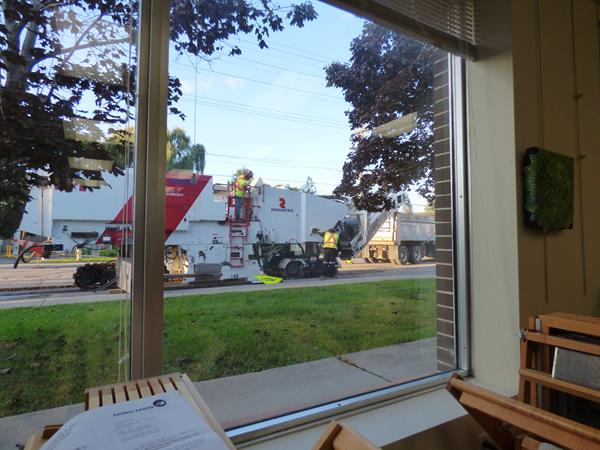
About an hour before the second night of the workshop was to start, the strange loud noise I had been hearing outside finally appeared in the studio window. Isn’t that a pavement stripper? (No not that other kind of stripper just working on pavement) sure enough, it started in the bike lane,  pealing the pavement away. It wound up working straight through the class but moving farther down the street so it wasn’t too disturbing.

large macheen that is removing the top layers of pavement on the street outside the window the room the class is in.16) Stripper of Pavement, the things you see looking out the studio window!

Tonight we reviewed starting and making the Oslo loops (I unknowingly had been doing a Danish version which seemed completely right at the time.) We then learned how to make our first line of stitches attach at the beginning and end to try to make a tube (not the Mobius strip I had created last time).  We then were shown how to add the next layer of our tube.

example of increses used to create texture as well as increse the size of cercumfrence 17) Example of increase used to create texture as well as make the circumference bigger.

hands showing which loop the needle gose throung in starting nalbinding18) reviewing starting

showing where to start the second row after joining the front to the back of the single layer19)showing where to start the second row

this is my sample i have worked part way across the second row and it is looking more even.20) My second row looks much better than the first row did

two pices of yarn spliced together with water to extend the working length of the yarn21) my yarn splice. I seem to be good at this part!!!

I likely had too much fun today since my thumb and index finger kept spassumming toward the end of the workshop, while I was pinching the yarn. I will have to do more hand and finger stretches before nalbinding. (Maybe not shift and lift books all day before class!)

Before heading home, we were shown increases and practised increasing on every stitch. This gave a wavy edge.

the frilly edge is on the far side of the tube and has been caused by incresing in every stitch22) Increasing in every stitch gives a wavy edge

When increases are used in a less extreme way (not in every stitch), you can make a hat.

a hat made in Nalbinding, there is a diferent type of starting that we will learn in 2 weeks.23) hat made with increases in nalbinding (it has a different beginning but we will look at that in lesson 4

By the end of day 2, I have gone from absolutely no tensioning to a bit more consistent to adding a second row.   We were sent off with homework to start another length of nalbinding single-layer chain and use it as the basis to make a tube.  Then do that again and again! Practice makes….  well it’s getting better..

I will continue my homework, interspersed with more Library work and maybe this afternoon I will take a little time and make that bat Marie was showing on YouTube yesterday. (It was very cute… but I think it needs a bit more bite!  Have fun and I hope our weather doesn’t look at the calendar and we wind up in a chilly wet fall. I prefer the slow lingering end of summer with warm days and cool nights (but no frost, I am so picky!)


2023 shopping trip to Twist Fiberfest. (cheap vicarious shopping!)

2023 shopping trip to Twist Fiberfest. (cheap vicarious shopping!)

Twist Festival August 10-13, 2023,  Complexe Whissell 530 Rue Charles Auguste Montreuil‎,Saint-André-Avellin, Quebec J0V 1W0

map to Twist from Ottawa 1) Map to get to Twist from Ottawa

About 2 weeks ago my trusty Sherpa, Shark Boy and I, jumped in the car early Saturday morning for about an hour and 20 minute drive (there’s a detour so it’s a bit longer this year), to Twist Fiber Festival in Quebec. Last year I went with Mr. Mer on a quest looking for his Hair, this year his son, Shark-Boy, is in want of hair! So far I have tracked down and purchased some locks that look like they may be good for highlights. I have also traded and been given some white locks that can be dyed to the colour he is looking for but let’s have one last look for long locks before we go questing for the perfect die colour. (I don’t think any of the home hair dye companies offer something tailored to the young teen Mer-person, but I guess I could investigate further. If not, I do have food colouring, cool-aid and some actual commercial dyes.)

We arrived, found the special parking, and unloaded my comfy walker which I will be sharing with young Master Mer today.

Shark Boy sits in his progect bag cliped to the back of my walker wating for twist to open lady with blue/gray purs in front of us is similer in colour to some of Sharkboys highlights in his shark parts 2) Waiting in line for Twist to open (Shark boy sitting in his project bag which has been bulldog clipped to the backrest of my walker. I think he is admiring the colour of the purse of the lady in front of us.)

labled diagram of site of twist fistival 3) Sight map sign.

Twist is held at the local community centre in Saint-André-Avellin. There is a large arena and gym space as well as 2 large, ok huge, tents outside. There are also workshops held on the Thursday to Sunday. I have taken some excellent felting and spinning workshops here in previous years. (Sculptural felting with Marjolein Dallinga and felted portraiture with Megan Cleland.)

We headed first to the arena to see the giant pile of bags of fibre (decreased by Friday shoppers) at the Black Lamb’s booth then started the search for long locks.

This slideshow requires JavaScript.

 4 -4.2) Awaiting the shopping hoards as Twist opens Saturday morning.

While looking through their fibres (and making the pile just a bit smaller), I spotted something as good as gold! 2 oak-handled Roger Hawkins mini combs!

Oak wooden handled mini combs made by Roger Hawkins 5) Two sets of Roger Hawkins Mini Combs. I have a set and they are fantastic. I was tempted to get a second pair but left them for others to enjoy too.

A quick circuit of the Arena did not look promising for Shark Boy’s hair. There was again a lot of yarn for the knitters. There seemed to be a few more booths with fibre than last year. there were also booths with tools and supplies for weaving, spinning, Knitting, and Sewing.

shark boy trying to flirt. 6) Shark boy had fun trying to flirt with other guild members we saw while shopping.          

This slideshow requires JavaScript.

7 -23)Slide show – first quick once around 

This slideshow requires JavaScript.

24-28) Slide show – first tour of the Gym

2 ladys in 1900's skert and shirts finger weaving Centure Flechay29) There was a display of Centure Flashay finger weaving

There was a booth selling circular sock knitting machines that had a display of old machines. Some of the old machines are works of art as well as functional tools.

This slideshow requires JavaScript.

 30-32Slide show – Circular knitting machine display

I checked in with my Sherpa before starting a more thorough look through the booths.  He was enjoying his book and I got a report from another guild member he had been spotted earlier having a nap and snoring happily.

Shark boy and my patent sherpa 33) Shark Boy and my patent Sherpa.

I had only a few items on my shopping list; Shark Boy’s hair, fork needles and some interesting fiber. I got into the booth with the books from the slide show above, it had been too crowded when I went past the first time and I could not see the back of the booth. Eureka!! Long locks!! And in colours Shark Boy might like! he had a hard time deciding on 2 of the packages. I also picked a bag of mixed colour locks and one in extremely bright red that may help Mrs. Mer later.

34-36) Happy Happy Mer shark!

Still no sign of a fork needle, unfortunately, two of the needle felting suppliers that are usually here, are not this year. I did find 10 spiral needles at the black lamb, and there were a couple of booths with a few other needles but they were not prominently located and I already had plenty of the gauges they had available.

On to the last item on my list, cool fibre. I had spotted some in a booth in the gym but wanted to look a bit more carefully through a couple in the arena booths too.

This slideshow requires JavaScript.

37- 39) Popular fibre booth

This booth was quite busy so it took a bit of patience to get in and see their braids and batts. But it was worth the effort and I found 3 braids that were particularly appealing.

Twist did not seem as busy as previous years but it was steady. There were also threats of heavy thunderstorms throughout the day but held off until the late afternoon. The vendors I talked to said it was busier on Friday for shoppers, but the sales were better so far on Saturday.

40) late Saturday afternoon at Twist.

One of the vendors had some very nice raw fleece. She had brought a picker with her and I cot her using it. I have an old Patrick Green picker that needs sanding and cleanup in the basement. I will show you when I get working on it. A picker is used to pick apart a fleece to prep it for carding. I did buy a bit of her fibre (unpicked) I will show you later.

This slideshow requires JavaScript.

41-41.1) Swing picker in use

Shark Boy and I had done a pretty good job with our shopping and it was time to check in with my patent Sherpa and see if he wanted to have a lunch break and to show him our finds.

  42- 46) shopping acquisitions before lunch

Heading to the car we checked on the sheep herding displays but the sheep or dogs were on brake

47) Sheep herding on the brake

We headed out to the other end of town to the restaurant, La Toquade for their fabulous “Club Sandwich au confit de canard sur pain an apricot, raisin et tournesol” Yummm…Cumfy Duck!!!

Comfy Duck sandwitch with half side of fries and salid 48) I have been thinking about this sandwich since Twist 2019

Last year, coming out of covid shutdowns, the restaurant was having staffing difficulties and was only open for breakfast, we both were very happy to see that lunch and dinner had returned. While we waited for lunch to arrive I went through the photos I had taken so far at Twist,  there were a couple of things I wanted to go back and see if I could find.

A few last shots from 2023 Twist.

This slideshow requires JavaScript.

49- 53) A few more shots of booths at Twist 2023

The rest of this year’s Shopping;

This slideshow requires JavaScript.

54-56 ) little batt of expensive fibres

I picked up the small batt of super expensive fibres (try playing name that fibre before reading the 4 fibres in the batt),

Diz and Diz hook57) a diz and diz hook (I added the leash to the hook so it won’t wander off),

58-59) a heat shaping felt sheet,

This felt has an odd feeling closer to non-wool craft felts but much more substantial. (I will investigate that further at another time).

It was a long day of shopping, photography and fantastic food. Now that it was time to head home, the forecast rain finally arrived. Even Glenn bringing the umbrella in could not forestall the water any longer. We have had a lot of rain lately, a full sponge as it were, so what was not an extremely heavy rain was lingering on the road longer than usual. This gave the car the fun of trying to hydroplane on the road to the highway as well as on the highway. We stopped under a bridge, got out the GPS and fled the Highway to the slower driving back roads until the rain gave up. After we won the debate with the GPS who wanted us to take the ferry across the Ottawa River, we returned to the highway and safely made it home.

I hope you have enjoyed our shopping trip. I always enjoy seeing my fibre friends’ photos of festivals I can’t get to, it’s cheaper and lots of fun cheering on their shopping!


More signs of getting back to normal; in-person socials week 1 and 2

More signs of getting back to normal; in-person socials week 1 and 2

As you saw last post, the Ottawa Valley Weavers and Spinners Guild is starting to do some of our per-pandemic activities. We have had our first Demo since 2019, we are starting to organize in person workshops, the guilds library is back to having members borrowing in-person and we have had our first two socials in-person at the guild studio. This last is the topic i would like to chat about with you today.

Before the pandemic struck, we use to meet on Mondays (once a month for the guild meeting and we had socials in the studio on the rest). When the plague struck it took us a bit of a learning curve to transition to using Zoom for both meetings and then socials. The library was unable to Zoom. So, when there was no shutdown, we collected requests, pulled, bagged and had books ready for picked up and dropped off at an external door near the studio. (A bit more work for the librarians but it kept the books circulating.)

We tried a number of things to keep the guild active and connected during the pandemic. I started weekly posting of old photos going back to 2002, we most recently were checking the files from the early part of 2018 (so i hope the pandemic dosnt go on too much longer i am running out of photos!! Good thing we are starting to make new photos!). The Guild had Zoom based study groups on various topic to try to make up for the lack of in person workshops. Our Program team found cross Canada and international speakers for us that were a fabulous addition and would not have been an option in-person (so the effects of the social distancing were not all bad).

We have struggled with technological options as we change from zoom to the long-waited-for in-person or ideally, a combination of in-person and Zoom. Ideally we would like to have some way for those members who live farther away or can not travel at night to participate in both meetings and socials. We also want to take this opportunity to investigate what works and may be applicable for the first in-person/zoom guild meetings coming up in September. This gives us the summer to run through options and try problem solving so the on-line participants can feel included. With the meeting program it will be more watching and less input from the audience ether by zoom or those present. So, not quite the same as a social but it should give some feed back for those organizing the meeting.

Two weeks ago we had our first in-person social. It was a good turn out, we had 9 in person guild members, with a mix of masked and unmasked participants as well as 10 on line members. For technology we tried Ann’s laptop with its build in mike and camera.

1 Ann’s laptop running Zoom

Pros; One person could talk to the zoom group
Cons; the mike did not pick up other conversations away from the lap top. Only one person in front of the lap top could hear or communicate with the zoom group.

A few more shots of what we were up to in-person. I had brought my in progress needle felted Iris (its in photo one), there was a lot of spinning happening, as well as some innovative options for plying. The bulldog clips and basket were ingenious. We could not find a lazy kate in the studio so we improvised with two magazine holders and a chopstick for another spinner.

This slideshow requires JavaScript.

2-8 a few shots from the fist social since we shut down at the beginning of covid

After chatting with the zoom participants it was decided that we needed to up grade the audio. I volunteered my x mass present of a video recorder with external mike for next week.

Week 2, we had Ann’s Lap top but now added my video recorder with external mike and my tripod.

Week two had a reasonable turn out, a bit less than week one with 8 in-person and 5 zoom participants (ginnypigs). this week we had spinning, fiber prep(Hackles) and felting, Ann this time since i was playing with the camera and Vid recorder. First we tried the external Video recorder/mike with Ann’s lap top then with the guild’s old lap top. (option 2 did not work since the Venerable old laptop did not recognize the vid recorder/mike it was too new)

The vid recorder has a zoom feature! which i discovered was vary slow and disturbingly jerky DRAT! I could zoom in but getting there was not fun to watch. So the concept is correct with a vid recorder and external mike but this particular one may not be the best choice (if i need to zoom in on anything).

9 Vid Recorder/ mike and Ann’s Laptop

10 the old laptop could get on zoom but the video equipment was to new for it to recognize

Pros; improved sound, more flexibility as to what the zoom members can see. smooth rotation from one spot to the next with the tripod having vertical as well as horizontal adjustments.
Cons; The mike works well so can pick up conversations that you may have thought you were having only with the person sitting beside you.

We wanted to try another experiment to see if we could get the zoom participants more than one view of the studio. To do this we signed into zoom from both the old guild lap top that runs the library programs (its ancient and i was not sure it could run zoom) and Ann’s computer. Unfortunately we quickly discovered that our internet bandwidth is vary low….. there was a lot of temporary freezing, but using two cameras gave the zoom group more options to see what was happening and from 2 perspectives. We may be able to do something about the bandwidth, we will investigate that further later.

This slideshow requires JavaScript.

11-16 shots from the week 2 social

We had a bit of show and tell, Ann got a new aperen!

This slideshow requires JavaScript.

17-20 Ann’s post appocolips apron. there were a few of us who want to look this up!

This configuration of hardware seem to be a big improvement from last week. The zoom members could see better what was happening and chat amongst themselves as well as have limited chatting with those at the social. I think our next option to try is to add the speakers the library purchased for use with viewing the guild videos. (The library also got headphones for when someone wanted to watch videos in the studio while someone else was weaving. The headphones would not be helpful in this instance.)

21 this is a big improvement over week one

Just when you thought i had forgotten about felting except for that brief glimpse of my iris in-progress, i have a few shots to update you but its Ann’s felting this time not mine. i had taken a couple shots of her background when i was at the farmers market buying her wonderful tasty chocklet chip cookies.Because i was curious i thought you mite be too, so i took a peek at the back of her back ground too. i had some quite fabulous video shots of Ann working on adding the moon to her background, unfortunately the Video was live feeding to zoom so i could not take a screen shot for you. i hope the shots i got with the camera will give you a sense of the intensely deep dark colours she is using.

22-24 Ann’s background for her little night landscape (front and back)

i hope if the groups you belong to are also struggling to figure out a blended in-person and zoom experience for  member we can share our attempts and figure this out. Please share suggestions of things you have tried. What worked what didnt?  in the meantime have fun and keep felting!


PS my computer had blue screened after a couple updates to software so its out to the computer doctor and looks like she will live with a minor surgery  (bigger C drive) and a good internal cleaning. maybe i should not felt on the desk right above the computer? in the mean time i am using Glenn’s computer which lacked programs i usually use and I lost half my pre-typed blog since he only has open office not word and if froze in stead of saving. i expect to have this up and ready to go hopefully before 2am (i did rewrite the second half twice and had to do some sneaky work arounds to get the photos! ooh i am looking foreword to my computer back! i hope she will let me felt in the office still!


A Bit Of Wire Work For Mr. Mer

A Bit Of Wire Work For Mr. Mer

Mr. Mer has spent another week making subtle comments about wanting an upgrade on his muscles…the fishy ones this time. His fishy bits are based on a Northern Pike which is common in the lake at my parents’ cottage. I have been beefing up his fishy bits but he says he is not ready for his close-up. I will keep working on his upgrades and try to tempt him to show you as soon as he feels he is done.  SO we will get back to him in a blog or two.

 Northern Pike reference


While we wait for him, I had something else I wanted to show you.

For the last week, I have been watching non-felting related videos from curios mondo. They seem to mostly have crafts to do with fabric stiffening products, that they sell, but have had some other interesting topics too. I did catch parts of the nine-class, workshop series on making a wire-wrapped bug necklace with beads. (They do the live broadcast free or you can buy the workshop and watch all of them at your leisure. So far I’m cheap and have so far only watched the live ones.)

You never know what you will be able to pick up while watching or taking a class. This includes topics that are not actually on the topic you mainly do. Even with missing large parts of the workshop, it gave me some odd ideas I wanted to investigate further. (yes, I will get back to that in a moment)

The instructor, while teaching, used the stepped pliers. I had been curious as to what their original purpose was. He used them while making a bail (it attached the bug to the chain).  He also had some very tiny-nosed pliers that might be quite useful for rolling ends of finer gauge wire. I have got to track down a pair of those! He showed an interesting technique of locking the bail and a similar way of making links on a beaded chain that I likely should have written myself notes on.

Another good suggestion he had was putting a mark on tapering rounded pliers so you will get the same size ring on each turning of wire. This would be more important on wire-work that shows but could affect your armature construction if you were working on a smaller scale.

He also work-hardened the antenna of the bug with a hammer (I would have suggested the smallest flattening hammer from the blacksmithing hammers around here which would have been more effective.) This might be useful in armature construction for the tips of claws if they are exposed? Or stiffening antler wires? You don’t want to work-harden the wire too much or it will be more prone to breaking when bent or posed. So, an area that will not be repositioned frequently like tips of claws or antlers may be fine.


Now back to what I got distracted thinking about while I was suppose-to-be learning to make wire-work bugs necklaces (with beads). It just doesn’t seem fair to give Mr. Mer a tennis ball but not give him a tennis racket.

Oddly, In last weeks guild social one of our members had made a tennis racket and was next going to felt a tennis ball. I seem to be working opposite to her as I had Mr. Mer’s tennis ball (which I used as my show and tell)  so now it’s time to make him the racket to go with it.

I have tried to play tennis in my much younger days. It did not go well. My glasses move if I run or suddenly change direction so I can’t see anything beyond blurs. This makes it hard to hit or dodge a moving object. I also got tennis rackets that tennis balls seem to be able to go right through!! That doesn’t seem fair at all. But if Mr. Mer would like to try then I should let him.  It may go better for him than it did for me. I am not sure if there are different rules for water tennis. I should ask my niece about that.  She might know. (She is very good at swimming, which I am not)

Now how to make the racket. It will be wirework! The gauge will be important.  With Something larger for the rim and much finer for the stringing.  I will also need to have a wrapped handle.  The black floral tape should work. If it is not adhering well I could try black acrylic paint, mog-pog or clear glue to finish it off.

Wire gauge selection

I pulled out and considered from 6 to 14 gauge aluminum for the outer rim. I decided on 9 gauge.  The little section of the inner rim had to be finer. After a bit of looking and debating, I felt the 12 gauge – 2mm Dollerama aluminum would likely work. For the lacing I selected the 26 gauge (steel?) coated gardening wire. After making the first racket I can see a way of making the lacing a bit neater but I am content with the first attempt.

2-3 two of the wires gauges I will need

The handle needs to be wider than the width of two 9 gauge wires. I debated between four or three wires and found 3 more in scale.

4 Three 9ga wire looks better than four

Since I didn’t have a bending jig I gently shaped the oval by hand at the top of the 9 gauge wire bringing the handle ends together and adding the middle piece of wire. I added floral tape to hold the handle in shape as I measured, cut, then shaped the lower curve in the 12 gauge wire. I added a wrap of black floral tape before taping it in place on the racket.

This slideshow requires JavaScript.

5-6 Lower rim of racket added

I cut off a couple of lengths of the 26ga fine coated steel wire. ( If I did this again I would have made each vertical a separate piece and wrap to give the spacing between each string.) I wrapped then laid in the vertical longer strings (9 in total).  Then, used the back of the felting needle to create a shed to pass the horizontal strings through.  (Why did I not grab the large darning needle hanging from my desk lamp? It would have worked even better.)  I added extra wire wrapping around the perimeter which would likely not have been necessary if I had done the wires individually.

7 the strung racket

At this point, I needed a bit more stabilization of the handle. It was compressing towards the base of the racket (The three wires were not sitting flat. One was trying to lift up between the other two.) I can fix such errant behaviour with more wire!!! I pulled the lengths of the 22ga black steel floral wire and carefully positioned and wrapped the thin wire around the parallel 9ga wire. This required another layer of floral tape over top and all looked much neater and more like a tennis racket!

This slideshow requires JavaScript.

8-10 Adding wire to strengthen the handle

Mr. Mer was thrilled with his new acquisition! Which he held and posed with trying to get just the right look.

This slideshow requires JavaScript.

11-15 The photoshoot!

Here is a quick idea of scale as I hold his new racket and ball

16 To get a sense of scale

He has put away his racket and ball carefully and wants me to get back to work on his fishiness. Then, maybe finish off the muscles of his arms….maybe some hair…… (Mr. Mer is getting demanding).

17 Good Job Mr. Mer! toys should be put away after you’re done playing.


18 A final shot

Mr. Mer does a few quick stretches to start the New Year

Mr. Mer does a few quick stretches to start the New Year

January 8th, 2022

It’s the new year and like a new crisp white piece of paper, it’s all possibilities as you hold your pencil above it and wait to decide which way to go. Will it be a drawing of a landscape, will I work on a sculptural idea, will it be a note that I shouldn’t forget something, too late I likely have forgotten it since the paper is still blank.

I have things I want to work on in the future, more stretching with the Mers, I want to chat more about needles and I have to catch up to Ann with her studio upgrade! I also want to revisit my Peg Doll loom and talk about project bags and boxes. We do not sell or know of a supplier who sells the peg doll looms. Sorry we can’t be of more assistance.

However, after thinking about it and staring at that blank piece of paper I think we should start the year with a good stretch.

Let’s talk about Rhomboids!!! Not only are they a fascinating shape (sort of like a square but more creative: “a parallelogram with no right angles and with adjacent sides of unequal length”) they are also the muscles between your shoulder blades (Scapula). Their job is to help stabilize your arms and shoulders when your arms are out in front of you. As in when you weave, spin, felt, or work on the computer (typing and mousing).  As the Rhomboids work, they are paired with muscles at the front of your shoulders (there are 3 of them so it’s not really fair, Poor Rhomboids!)

Although you may be feeling pain between the shoulder blades and stretching them out feels good it is often the anterior shoulder muscles shortening and causing the rhomboids to complain. So let’s look at a couple of stretches for Rhomboids and then try to open out the anterior shoulder. So Rhomboids won’t complain as much and you get to have fun longer!

There are a number of ways to stretch rhomboids, there are yoga stretches that focus on them, there are also cat stretches and the one I don’t see on the internet is the self-hug with rotation.

Now to help me with today’s blog I had offers from Dragon and Mr. Mer. I think Mr. Mer just wants to get out of his project bag and he has hopes I might keep working on building up his muscles more!  While Dragon has a lovely back ridge and frill, his articulation of the scapula does not produce Rhomboids that would stretch quite the same way ours do. So even though Mr. Mer is a bit fishy he still has similar articulation in the shoulder and upper back.

With my willing victim, ummm… Volunteer, let us proceed to discussing how to stretch this fabulous muscle and why stretching the muscles that Rhomboids are working with maybe even better.

I have had Mr. Mer do a hard day of typing (too bad he can’t see what he is typing since he is watching his fingers when he types. I guess he did not have to take typing in grade 9 like I did, it didn’t go that well for me but that is another story.)

 1  Typing and showing off his Rhomboids

You can see he has a well-developed upper back including Rhomboids, it may be all that swimming! The Felting needle stuck in his back is indicating the area of the muscle. It runs between the large scapular bone and the spine on an angle that looks Rhomboidal (thus Rhomboids, some muscle names make sense!).

 2 Rhomboids between the shoulder blades (Scapula)

I asked him to turn around without moving his arms so you could see how contracted the anterior shoulder is in this position.

3 View of the front of shoulders

Three muscles help your shoulders curl in; Pec Major, Pec Minor and Short Head of Biceps. Sometimes Upper traps “Helps” and elevates your shoulder too. It is not as helpful as you hoped either. This is totally unfair since poor rhomboids on the back are having to stabilize against all three of them in the front.

If you are feeling the tension between the shoulder blades you have a few stretches to ease that. One that was popular and easy to do was the cat stretch. (this is usually done kneeling on the floor then arching your back like a cat and tucking your chin towards your chest to give a stronger stretch). Mr. Mer said it looked more like the dead man’s float from Beginner swimming lessons (oh the horror of these memories, the cold pool, the wet water…let us move on)

This slideshow requires JavaScript.

4-6 the Cat Stretch

If, like me, getting off the floor may do more harm than good, you may like this one better. Try a self-hug, not too much stretch there unless you are really tight!

7 Self-Hug Stretch

Keep that self-hug position and rotate the upper body slowly left then back to the right.  If you need more stretch, try tipping the elbows down then rotating.

8 9 Self-hug with rotation

Now that Rhomboids have been stretched, let’s think about strengthening them while stretching out the anterior shoulder. This one is called the Invisible Can Crush.

 10 Preparing for the Invisible Can Crush

Bring your arms down to your sides, bent at the elbow. Imagine your favourite flavour of pop can magically floating between your shoulder blades. OH NO! someone has switched it for some terrible tasting Pop!!  Push your shoulder blades together and squish it for a count of about 7 seconds then relax. (Pop cans are weak and even weaker if they are invisible, so you don’t have to use all your strength in killing the can. Just use enough to feel like the muscle is working.)

 11 Invisible Can Crush

Next, lift your elbows up towards your shoulders and then squish the offensive pop again. (Count to 7)

 12 Invisible Can Crush

If we get Mr. Mer to turn around you can see that this will contract and strengthen rhomboids but also stretch the front of the shoulder. The change in position will stretch out a different part of the anterior shoulder.

 13  Invisible Can Crush front view

If we can keep the front of the shoulder from curling in we also reduce its likelihood of compressing the group of nerves that run past the front of the shoulder (the nerve bundle is called the Brachial plexus). If you squish the right part of the nerve bundle, you can get numbness in the hand or fingers which is not a good thing if you are using sharp needles!

Another way to stretch the anterior shoulder is a Passive Anterior Shoulder Stretch with a pool noodle. Unfortunately, I could not find Mr. Mer a pool noodle to fit him. I gave Ann some foam hair rollers that look like they might have been the right size but I will have to go look and see what I have here. Oh, I found a miniature pool noodle but it’s a bit too miniature.

14 This pool noodle is a bit small for his manly, er…Fishly back

This can be easily fixed by wrapping a towel around it to make it a bit bigger.  (I used a piece of felt and a few quick jabs with the needle to hold it in place! A couple of elastics will work with a real towel and pool noodle.

15  Pool noodle wrapped in a “Towel”

Mr. Mer is showing you where the pool noodle is positioned when he lies down (since he is not see-through) some people like to use the floor but I prefer doing this stretch on the bed.

16 Passive Anterior Shoulder Stretch, Pool noodle down the spine with a pillow under the head

17 The orientation of the pillow and pool noodle without Mr. Mer

The pool noodle (or pool noodle and towel) lies under the spine. This lifts the spine off the bed or the floor and lets the shoulders expand and relax towards the bed or floor. This is a passive stretch and should feel comfortable, not painful.  Adding a pillow under the head is often even more comfortable.

If you feel you want to increase the passive stretch you can either use a bigger pool noodle or move closer to the edge of the bed and let one arm extend off that edge. Do not over-stretch, it is important to listen to the muscles for what feels comfortable.

 18  Increasing the strength of the stretch by extending the arm

Remember to take a few stretch breaks while you are working. You can use a timer or drink something so your bladder reminds you it’s time to take a break.

I hope your shoulders and upper back are happy and you can now enjoy the potential that a new year brings just like a new crisp piece of drawing paper just waiting for your first flash of inspiration.

PS; Mr. Mer is so happy to be out of his project bag and is having a quick swim around my desk.  Or he is making a break for it! Have fun and keep felting!

19 “I’m out of here! See you later!”