As you’ve heard, here at the blog we did a Christmas card exchange. Well, not necessarily Christmas but I went with that theme.
I worked out my idea in my sketchbook and didn’t (I was sure I had) take a picture and now that pad has gone AWOL. It was simple trees. OK, I can use my computer to make a triangle by using the draw a shape thing in my wordprocessor program. No, problem. Now just drag it bigger to make the start size……nope triangles do not do that. I switched to publisher and with much fuss and bother and guidelines, I added the same amount to all sides and made a larger one.
I have already unpacked my stash of prefelt and put it into draws just like I was an organised, neat and tidy person. Well, that will last until I get everything else out of boxes and have to find a place for it all. Anyway, I got out the red and the white. seemed like appropriate colours. the red for the background and the white for the trees.
I wet the prefelt and shrunk it down to the size I wanted. checking against the picture I drew in my sketch pad.
then I cut the 2 sizes of trees the small ones will get needled onto the background and the big ones will be wet felted.
No jumping forward, I didn’t like the white trees but again I was sure I had taken some pictures here. Clearly, I was doing something wrong. I had my bag from the felted sheep glass handy and started adding curles. See the messy tendancies do come in handy sometimes. Now they are much better, textured, colourful and happy.
Here are the triangles ready for their turn felting
Again wite was do stark so I added some wool to them first. Blue, Green with sparkle and White with silk.
and all done and as shrunk as they can go.
I then added some curls as garland and embroidered some stars at the top so they look more like Christmas trees and not just random triangles. sorry no single picture of the green one.
For these trees, I added some pins and some gold string so they could be pinned or hung.
I thought about adding some baubles but |I thought they looked crowded on the small trees. They finished at about 2 inches I think.
Next, I pinned the trees to the card. I was going to send it this way but the packaging would have been too fat and turned it into a parcel and doubled the shipping. I took them off and put them into the envelope separately.
Usually, I make my cards postcard by ironing a print of the back of a paper postcard to it using fusible web. But I couldn’t find it. I printed out a card and tried to sew it onto the front of the card. I tried 3 times to do it and then gave up. I stuck some self-stick velcro dots onto the card and pressed the felt to it. No picture of that either as by then it was late and I wanted it in the envelope and ready to take with me to work the next day. It managed to fly over to the UK in record time and arrive safely at Lindsay’s house.
Lindsay kindly sent me a picture of what it looked like on the card.
It was back to school week so I was busier than usual. re-adjusting times and schedules.
Last time I showed you the finished visor. It had a lot of fulling and it was nice and sturdy. When the piece is well fulled, you often end up with a dull picture. This is caused by the backing fibres migrating through the coloured fibres. Sometimes they end up dull or fuzzy looking.
When I make pictures that will be mounted or framed I fix this by not fully very much as the picture will not be handled much and it will have the matting to help support it. for something that will be handled or used more light felting won’t help so it’s time to break out the the razor and shave it.
I get them at the dollar store. notice I did not pay the pink tax for my razor, I buy the cheapest ones they have regardless of the colour. It’s a pretty simple thing to do and it makes quite a difference. I hope the pictures show it well enough. It is hard to pick up with the camera. I tried to do one half at a time for you.
Before
1/2 shaved
Finished
Before
1/2 shaved
Finished
Before
1/2 way
Finished
and lastly, the sheep, I think it shows the difference very well.
I shaved the rest of the piece as well. This is the pile of fluff.
Here are the before and after pictures
Before Shaving
After shaving
I think I still want to add some stitching I am just not sure what. outlining seems redundant. Maybe I will add some leaves scattered about. and I don’t know about eyes for the sheep. Curved lines make it a bit cute and like it is sleeping and round makes it look odd. Sitting here looking at the flower, I can see something else now, how about you?
On Mondays, we have a social in the guild studio. I think some guilds call it open studio days. Because it is summer I usually go in around noon. I thought this would be a good time to do my visor cover. Jan can take some pictures too and all will be happy and bright. So naturally………
I packed my rolling mat, plastic, bucket, spray ball, rubbing tool, and wool but I forgot to ball of pencil roving. This is essential if I am going to try Ildie’s method of making the design with wet wool.
The forgotten ball
The best laid plans of mice and men often go awry. I am not a Mouse or a man so I had a look through the donated yarns and found one that was not too thin or tightly spun
This is as far as I got before I gave up. Yarn is not a good choice. It has too much structure so it doesn’t want to stay where you put it.
Besides learning that yarn is not good for this I also decided I had made the design too small. It will be very fiddly to add the colour.
Now I am back in the studio with all my supplies. All but one of the colours is Corriedale. One is Merino. the grey bat is unknown. I would say a medium wool and it is a short fiber. I sized my template for 30% shrinkage. you can get 30% out of most fibers. And why do a sample when you can live life dangerously?
The pencil roving was much easier to use to outline the designs. I wet it with soapy water and it stayed where I put it. The yarn had too many ideas of its own. I just did them freehand using the template to keep my design inside the lines.
This slideshow requires JavaScript.
Next was adding the colour. I got better as I went along. the first colours that have to be completely within the lines but right up to them is the hardest. When you add a colour next to another colour you can overlap and no one will see it. It will be between the other colour and the backing. Thinking upside down is a hard thing to do. you feel like you should say inside the lines. although I didn’t mess up the design lines I kept smudging the outside line. next time I will add them at the end.
This slideshow requires JavaScript.
I added the bat to the back. it was quite thin so I did 2 layers, one in each direction. and made nice straight lines, not that they will stay that way.
I rubbed this side first and then flipped it over. Doesn’t it look pretty all wet and bright under the plastic? Once I flipped it I was pleasantly surprised the sheep was on the right. Which, if you think about it, makes sense but when I was adding it I was thinking I wish I had left more space for it on the right. So that was a good thing.
I rubbed this longer than I usually do because I wanted the design to set well and stay put. I had no problem with it moving. boarder was another matter. it was constantly moving. I would lift the plastic and fix it. Then rub carefully and then it would move. In the end, I put it back where it should be and thought if it doesn’t stick, I will just needle felt it in place.
It moved a little while rolling but for the most part, it stayed put so I was quite happy. I rolled it a lot to get it to shrink. Whatever the bat is it makes a sturdy felt but does not shrink as much as Corriedale. I rinsed it with hot water and rolled it more, and more and when it wouldn’t budge anymore, I stopped. It got close but not quite there. I am sure it will still work but I haven’t checked yet.
It needs to be shaved to bring the colours back up and ironed to block it. I haven’t decided if I will add any stitching or beads. but I am out of time for now.
I bought a new to me car. The visor mirror cover was glued shut for some reason. When we tried to unstick it, it just came right off. Maybe it had fallen off so they glued it back on? I don’t know. The result is when I put the visor down I have the mirror. Even though you are not really looking at the mirror, it is distracting while driving. Must be because I am so beautiful I can’t resist looking at myself. LOL It is actually very hard to take a picture of a mirror and not be in the picture.
My thought is to make a felt cover for it and velcro it on to hide the mirror but I could still remove it if I needed the mirror.
I measured the mirror and a small amount around it to get the finished size I will need. I think I will add a little more.
Then I thought why not try Ildi’s method of felting with outlines and wet wool? I have some pencil roving and lots of wool and it’s a good sized to try it out. Here is a link to one of Ildi’s posts so you can see what I am talking about. https://feltingandfiberstudio.com/2022/06/27/felted-rug/
So far I have measured and done a couple of sketches of possible designs. these are smaller than they need to be but that is the size of the paper. I will have to find one of the larger sketchbooks to do a final design and then try to use the computer and the printer to enlarge it for shrinkage.
Aaaand, that is as far as I am. The plan is to have it for my next blog post, but we all know about the best laid plans of mice and men. I have my fingers crossed. It’s going to be a busy week.
Thankfully I have friends with grey wool. Jan and Bernadette found me some grey in many shades so I could complete my picture. I explained to both that I only needed a little bit, a handful would be more than was needed. I just needed it for a few rocks on my picture
Picture of wool
picture of me taking a picture
I didn’t take any progress pictures of the rocks. I was busy poking and talking.
And finally the finished picture, or so I thought. when you take a picture, you can see so much more sometimes. I really don’t like the roots over the rock. I had tried putting a rock in front of the tree but that looked worse. So, I will take the roots off and continue from there.
I managed to take the roots off and played with the rock some more and now I think it really is done.
I was looking around my studio wondering what to write about in this blog. I was remembered Ruth Lane’s recent comment in her blog here about using up supplies. I have a carded batt of merino / A grade mulberry silk from World of Wool that’s been kicking around for a while. I can’t remember if I bought it for something specific that didn’t get made or if I bought it on spec. I was interested to find out how it felted and what I might do with it so I decided to make a small test vessel.
I cut out a circular resist using a small mat as a template then started laying out the fibre outwards towards the edge. Apologies that these pictures are mostly white on light colours – I was thinking more about the making than the photography. I laid the second layer in a circular pattern before flipping it over to smooth the overlap onto side 2. After 2 layers on the second side, I flipped back and laid 2 more layers on side 1, followed by 2 more on side 2.
The resist & its templateFirst layer side 1 startFirst layer side 1 completedLayers 1 & 2 side 14 layers each side, ready for wetting out
After wetting it down I spent a lot of my time working the edge by pulling the voile over the edge so I wouldn’t get a ridge around the middle of the finished vessel. It felted quickly and I was soon able to start fulling – initially without removing the resist.
Working the edges FullingWorking the felt
Once I’d cut out the resist I found, in my vast collection of miscellaneous wooden objects, that the handle of a wooden pestle (as in mortar & pestle) was the perfect size for getting inside the vessel and working it from the inside.
I spent a while fulling it as I wanted it to be smooth and very firm.
Wooden pestle handle for fullingPacked & dryingvessel on original templateThinking about the green colour insideFinished merino / mulberry test vessel
I packed the vessel with strips of recycled bubble wrap that I keep for this purpose – you can see it green inside. Looking at this green bubble wrap made me wonder if I could make a vessel with a coloured interior but retaining the pale colour outside. I thought maybe if I used silk rather than wool to add colour I’d get less colour transfer, so I thought I’d give it a go.
While pondering this, I decided to try using the same resist as the test vessel but to make 2 small bowls rather than one vessel: so, cutting it in two around the middle rather than making a hole at the top to remove the resist. I dipped into my big boxes full of second-hand silk scarves bought in charity shops and chose a plain turquoise and a patterned blue one.
Carded merino / mulberry silk batt & two silk scarves ready for recycling
I put a circle of silk on the resist and decided to run a small line of coloured merino tops around the edge: partly as I was interested to see how it would look and partly as I thought I might not know where to cut when I was ready to remove the resist and separate the little bowls – I’ve made that mistake before!
I put a circle of the blue patterned silk on the second side. The merino and silk fibre layout was the same as the previous vessel. This time I also remembered to do the circular layer first followed by the radiating layer – I’ve learned that one before and obviously temporarily forgot for the previous vessel. It makes following the resist with the circular layers much easier and I prefer to try not to overlap that layer if possible – again it reduces potential ridges and produces a better join if you only overlap the radiating layer, in my opinion. I’m sure some of you will disagree but that’s one of the many things I love about wet felting: with experience everyone works out the techniques and tools that work best for them.
Process shots of the bowls
I was interested that I could see quite a lot of the inner colour throughout. I quickly began to suspect this was more about the amount of dye bleeding from the turquoise silk as about seeing the silk through the wool. I was getting a lot of turquoise in the felting water.
Again, I fulled them thoroughly. During the fulling, I decided I liked the silk on the outside better than the inside so here they are, still wet.
Bowl insidesBowl outsidesThe finished small bowls
And here are the 3 items. You can see how green the wool of the little bowls is compared with the vessel. I’m pleased with the bowls’ blue rims – I like this effect – but the vessel is my favourite. In each of the test pieces the fibre has felted beautifully: it’s very firm and extremely light – it has an almost papery quality about it that I find really appealing.
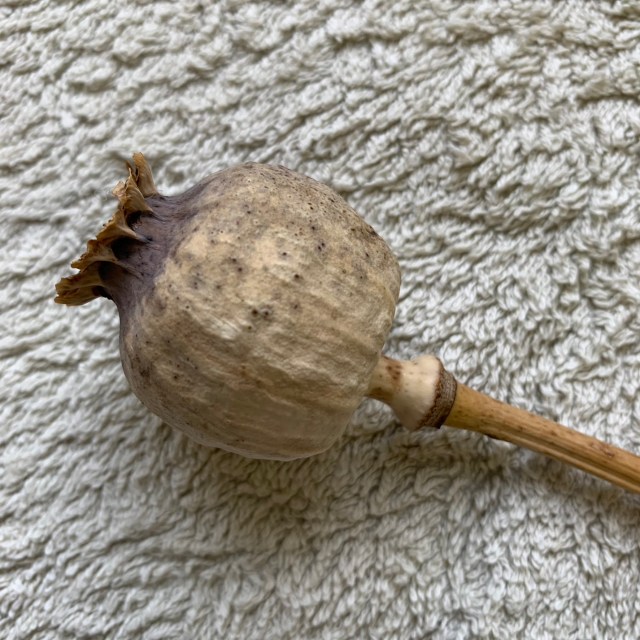
My imagination is now firing about what I could make next with this fibre. I have a dried poppy seed head sitting in a vase next to my desk. The felt reminded me of the texture and colour of the seed head. I’ve felted poppy seed heads before – one of my favourites. Another thing I have in the studio is some vintage cotton lace I was unable to resist when I saw it in a local second-hand shop.
Dried poppy seed headVintage cotton lace
I thought maybe that the lace would add a subtle surface texture so why not have a try? This time I made a small square sample using just 2 layers of the wool / silk mix batt with strips of lace in parallel lines.
Layout: fibre and laceFinished squareClose up of surfaceTest square of the batt with strips of vintage lace
Although it’s subtle, I really like the effect. As you can see in the close up shot, the batt has quite a bit of vegetable matter which in this case adds some interesting specks, enhancing the natural look.
I was running out of time but decide to start the poppy seed head. The merino fibre length in the batt is very short which makes the layout quite slow but very precise. In the first photo you can just see the strands of lace which I’ve laid out on top of 4 layers on the under side and are waiting for me to finish the final 2 layers on the top side before bringing them over.
The second photo shows how far I got yesterday before I had to stop. This is a multi-resist piece that will take a while to make. I’ll show it finished in my next blog.
I enjoyed letting the fibre lead my imagination in what I might do next. I’ve done mostly production felting recently – making multiples of things for shops and sales – so it was great just to see where things led me and enjoy felt-making for the sheer fun of it. I’m looking forward to getting back into the studio soon to finish the poppy seed head.
In my last post I mentioned a few of the projects I was working on with the “Making Waves” theme, along with other members of the Waltham Windmill Textile Group. I’d begun work on a 50cm x 90cm felted wallhanging inspired by the markings on large stone slabs on the beach at Seahouses in Northumberland.
Having recently bought myself a drum carder I carded a variety of left over bits of fibre, mainly blues, greens, yellows and neutrals, to make my background and laid them out with off cuts of hand dyed silk fabric, scrim and large nepps. On the left is how it looked after felting and on the right is where it’s at right now. I’ve added synthetic sheers, machine wrapped cords, hand and free motion stitch and in some areas I’ve heavily machine stitched to push them back and encourage the adjacent areas to stand out. The original bottom left section wasn’t working with those silk circles so they were pulled off and replaced with some stiffened, rust dyed fabric circles, recycled from another piece of work. I’m calling it Going With The Flow because a) it’s inspired by a trip to the beach b) it has flowing lines and c) like most of my work its design wasn’t preplanned. It’s evolving as I work on it, adding bits in and taking bits off until it feels right. It’s got a way to go yet before I can call it done.
One of the other challenges within the Making Waves theme is to make a 3D fish and my immediate thought was to create what many would regard as an ugly fish but which I prefer to think of as a fish with shedloads of character……..one that would get noticed amongst a group of pretty fish!
AnglerfishTasseled ScorpionfishOyster Toadfish
Having typed “ugly fish” into Google I lost many hours over the next few weeks looking at images and some incredible videos of life deep in the depths of the oceans. Each new search revealed yet another fascinating species of fish, some quite honestly didn’t look real while some, like the Tasseled Scorpionfish were strangely beautiful. One of the weirdest I discovered has to be the Red Lipped Batfish. If ever there was proof we descended from the oceans this red lipped, whiskered fish that “walks” on its specially adapted fins has to be it!
Red Lipped Batfish
Last month the Waltham group had a day making felted fish, some are finished, others are still work in progress.
Lucy made a wonderful wet felted Puffer Fish adding recycled plastics, including pipette tips, wine bottle netting and glass beads with recycling symbols underneath, to highlight the plight of our oceans.
Sue is very new to wet felting but she’s taken to it like a fish to water (couldn’t resist!) and has made “Angry Fish”. I think he looks more sulky than angry but he’s terrific!
Barbara’s felted fish is still work in progress but looking great, as is her sketch book and fabric fish purse!
Originally I had intended to wet felt my ugly fish but, after all those hours of studying them and getting excited about what I was going to make, for some reason when I took out my carded Corriedale fibres I found myself felting a cartoon version of an Angelfish…….I didn’t see that coming! Her name is TroutPout and she’s approximately 33cm x 36cm excluding her fins.
I’ve been enjoying teaching 3D Seed Pod workshops recently using wire wrapped with Tyvek fabric so decided to make my Anglerfish from wire rather than fibre. It was only when I’d got the 60cm x 33cm framework made that I sat back and realised I’d gone past the stage where I had meant to start adding my fabric! Time for plan B…..maybe I could use wire mesh to give it “body”?
I looked for some online but hesitated as I wasn’t sure how flexible or suitable the mesh would be. Having put the fish to one side, a few days later I joined the Lincolnshire Textile group and at my first meeting I was offered a piece of silver coloured Sinamay. Sinamay is one of the most popular hat-making foundations. It’s woven from the processed stalks of the abaca tree, a type of banana native to the Philippines. I couldn’t believe my luck……..being silver coloured this off cut looked like wire mesh but wasn’t and if I sprayed it lightly with water I could easily shape it to fit and stitch it with aluminium wire to my framework. So this is how far I’ve got. I’m going to add a few more wire spirals and do something more interesting with the eyes. He should have menacing teeth but I might not go that far!
Wire frame Anglerfish
Another feature of next years Making Waves exhibition will be an Octopus’s Garden so once the fish are done it’s straight on to making lots of coral and a few Octopus. I’m loving this theme and could quite happily continue with it way beyond our event next year…….it has to be the most interesting and enjoyable we’ve had so far!
I have had this mulberry paper with leaves embossed on it for quite a while. I loved the paper but never used it for anything. It is fairly thick and the embossed portions are really thick. The question was whether it would felt easily to the surface. I tore out a single leaf and placed it over a small torn piece of green, short fiber merino batt.
The wool and paper were then wet down (sorry for the blurry photo) and I felted as I had on my previous paper samples, treating the paper as if it was fabric as in nuno felting. I wondered whether I would lose the embossed lines of the leaf, whether the paper thickness was too heavy to felt in easily and if it would felt differently than the thinner papers I had tried previously.
Here’s the end result. You can still see the leaf. It felted very easily and doesn’t seem much different than the thinner papers. I think if I had done a lot of wringing of the felt it would have distorted the leaf but I was careful to avoid fulling in that manner.
Hmmm… how can I use this leaf paper in a design? What would happen if I added ink or dye to the paper before felting? What if I dry brushed paint over the surface of the paper after felting? What else could I do to the surface to enhance the feel of leafiness? How would hand or machine stitching look on the surface? Will it be easy to stitch through? Any other experimental ideas for me? Obviously, more samples to follow.
Next on to experimenting with paper in my landscapes. This is the layout of wool and a paper birch tree. (This also works for my spring tree for our year long tree challenge.) The piece is pretty small and ended up about 7″ x 9″ after felting.
Here’s the piece after wetting down and curbing the edges a bit before felting. Again, I treated this gently to allow the paper to felt in.
Here’s the piece after felting. I plan to add some free motion machine stitching to add more interest in the tree and more branches as well. I will probably add a few more leaves to the tree as well and perhaps a bit of detail to the rest of the landscape. The tree worked well and the paper really stands out to make the tree the focal point of the landscape. I definitely need to do more experiments with landscapes and paper. How else could I use the paper besides tree trunks? How would scraps of green paper felt in to make foliage? What would a variety of colors of paper layered over each other and then felted look like?
I love asking ‘what if’ and trying out these ideas, which lead to new ideas and further experimentation. I haven’t even begun to scrape the surface with how paper and felt can be used together. I would love to hear your ideas for experimentation so please leave a comment with your “what if’s”.
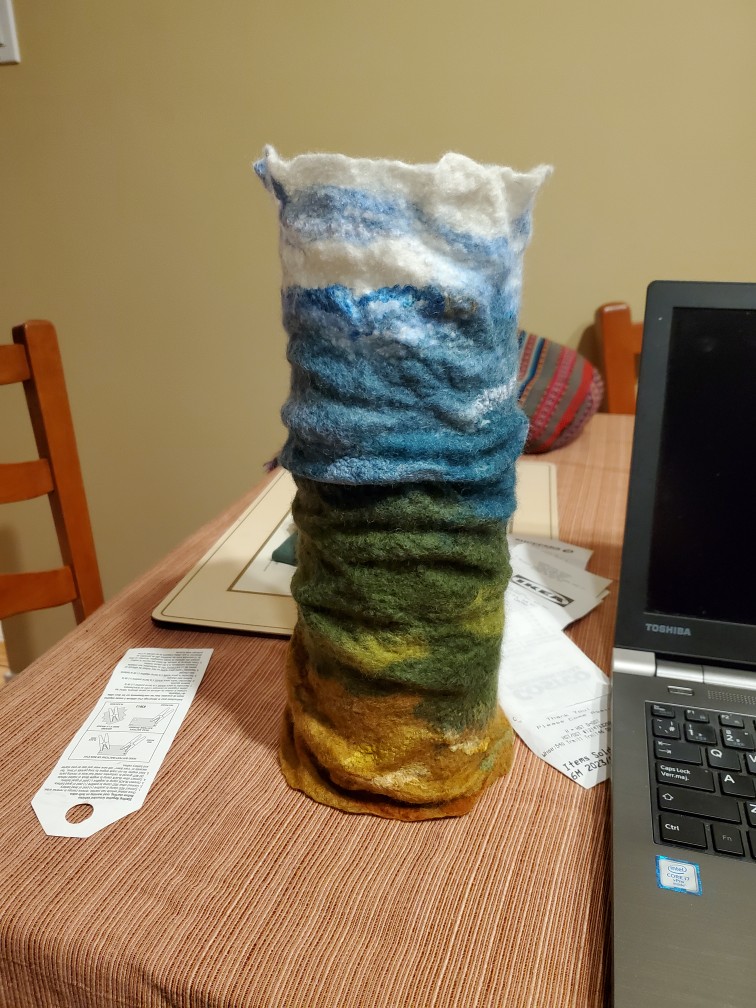
This last Sunday I taught the felted lantern cover workshop that should have happened in December but was delayed. I was teaching at the guild I belong to, Ottawa Valley Weravers’ and Spinners’ Guild.
It was a half day class. the biggest challenge with the lantern covers is laying out the wool thin enough to let the light through but with enough wool to hang together. They don’t need to be strong because the lantern will give them structure. For this class, I provided a glass vase so everyone would be working to the same resist size. You can use a large pop bottle with the top cut off but I would add some weight to it to make it more stable.
I had 5 ladies for this class. I showed them two examples of covers I made.
Everyone wanted the longer one so they could add wrinkles
I only just realized we ended up with just 2 colour palettes. the largest part of this class is taken up with layout and decoration. We discussed how you can add things to the inside of the cover that won’t show when it’s not lit up but will show as silhouettes blocking more light. A couple of people decided to give that a try.
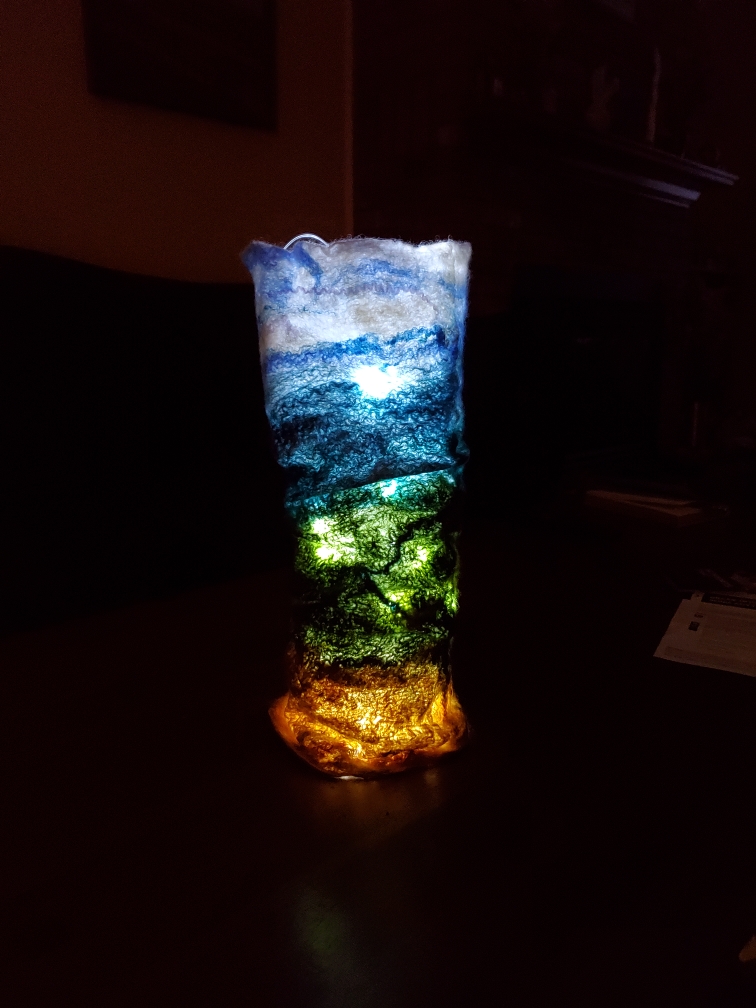
It is hard to see on the last one but she is adding white and blue silk hanky pieces to the wool. they disappear as soon as they get wet. They will show up again later. You can see them a little in the pictures below. I think everyone had a great afternoon.
Two of my students sent me pictures of their covers dry and lit.
Christine
Janet
I hope the others will send me pictures as well. One was very thin and delicate and I think it will look amazing lit up. If they send them I will add them here.
I did have someone ask why I like to make covers rather than making them with a bottom. There are 4 reasons, first making a nice flat bottom that will allow the vase to stand properly can be tricky. A cover that is self-supporting needs to be felted much more or be thicker to be stiff enough. Having an internal structure gives you something to put the lights in and attach the controller to. And lastly, the container inside allows you to add water if you would like to use it for flowers.
The last couple of weekends I have been teaching some workshops. Last Sunday was Nunofelt Scarves. This was originally scheduled for December. But I caught whatever nasty head cold was going around, it came with a very annoying cough. I did a test for Covid and it was negative.
Anyway, after a couple of years of no workshops and a delay, it was good to be able to teach people in person again. I am still rusty when it comes to taking pictures during class, so there are not very many of this one.
Yesterday I taught Wet Felt Birdfeeder/house.
This is the picture we use to advertise it.
Everyone in the class chose to do a feeder( larger opening) in a gourd shape.
I remembered to take a few more pictures but I still had a hard time remembering.
Laying out the base wool.
Decorating
The finished birdfeeders. I think some of the holes may need to be enlarged. They have balloons in them to hold the shape while they dry.
All in all, we had a great time on both days. It was so nice to teach again to interact and answer questions and see people be amazed when it really does work.