Browsed by
Category: Sheep Farming

More Carding and a Surprise.

More Carding and a Surprise.

My friend Mary came over to get some mohair carded. We mixed it with some merino to make it easer for her to spin later.  I have never done mohair before. It was very fluffy. It added a lot of volume to the batts.

mary carding carding mohair

This is the batt.  It is not as compact as a straight merino batt. If you wanted it more blended you would split the batt into layers and put it through it again.

mohair batt

She also had some left over bits from other projects that we carded together.

mixed colour batt mixed colour batt 2

mixed colour batt 3

Now for the surprise. My son came in from feeding the bottle lambs there lunch with a very noisy bucket.

chicks in a bucket

We have a rogue chicken and she hatched 11 chicks in a hidden nest in the barn. They are now in a box with  water that they splashed everywhere and some food that tastes best if you stand in it.

chicks in a box 1

It will be interesting to see how they turn out. They will get a pen next to the older chicks today. They can’t be left with mom or they will not survive. Between the barn cats and the wild predators they all disappear when we have let them try to raise them.

Dyeing Some Silk and Some Farm Life.

Dyeing Some Silk and Some Farm Life.

I have a couple of ladies coming for a class in nuno felt at the end of the month so dyed a few pieces of silk to add to what I have so they have a nice variety to choose form. I am using the low water immersion method form Paula Burch’s site. http://www.pburch.net/dyeing/lowwaterimmersion.shtml  I made collages of the dyeing. You stuff the silk tightly into a jar and then add some dye. The pictures are the dye with the stir sticks so you can see the colours and then of the first dye poured over, then the second so you can see what it looks like. They have to sit for an hour then you add the sodium carbonate.

peach and fire red
peach and fire red
pink and turquiose
pink and turquiose
emerald and black
Bright green and brazil nut

This is them hanging to dry.

scarves drying

And then dry. You can see that the colours are better when they are dry but I am still not happy with the emerald an black far right.

silk dry

I also wanted to share some farm life, not sheep I am afraid. These are my chickens getting to look at their new outside pen and true to there name they are chicken to come out. With some time and coaxing they did make it outside.

chickens going outsidechickens going outside 2

We also got some new baby chickens and turkeys. They come in boxes delivered to the local farm Co-op. The boxes are divided into 4 inside so they don’t over crowd each other to much. There are 2 boxes of chicks and one of turkeys

chichens in boxes

These are the turkeys, they are about a week old and have started to get feathers.

turkeys

These are the chickens, they are day olds. My son is taking them out of their box.

colin and chickens

They are very cute little yellow fluff balls with legs when they arrive.

Lambing in Sweden 2015

Lambing in Sweden 2015

Our guest author/artist today is Zara Tuulikki Rooke.  She recently shared the experience of shearing her sheep with a note that Spring will bring new lambs. So, today we share her experience of the birth of new lambs.

Spring has arrived (according to the calendar), which means the lambing season has started. Most sheep become receptive to mating in the autumn, when the length of daylight starts decreasing, and have their lambs in the spring, after almost 5 months of pregnancy (on average 145 days). However, some breeds are less seasonal, and can be manipulated with artificial light to mate at other times of the year. Spring is often late in the north of Sweden, so we waited until mid-December before we released our ram with our ewes. That postponed our lambing until May.

Now, it would be nice if one could calculate the exact date for lambing, but nothing is ever that simple. The 145 days is an average plus/minus 3 days, and you never quite know when (or if) the ram actually mated with the ewes, as they are in estrus for 24 to 72 hours, every (again on average) 17 days. So when it is getting close, you need to look for tell-tale signs. Some are quite obvious, such as the swelling bellies (which look especially large when they are lying down). The base of the tail will also feel very loose (as if the tail had been dislocated), and when the belly drops, the area between the ewe´s hips and ribcage becomes concave. Suddenly the ewes look underfed, which mine are not. And the day before lambing, my ewes had conspicuously enlarged udders, showing that milk production had started.

image

I thought that Citronella (on the photos above) would be the first to lamb. She was huge and we watched her closely (and frequently) for two weeks. But then suddenly, Lisen developed a huge udder overnight, and the next morning my eldest daughter found her with a lamb by her side. After watching and waiting about 30 min, the kids had to leave for school/preschool (they were a bit late that day, but we phoned ahead to explain why). I then decided to just quickly run back to the house to fetch a cup of coffee. And sure enough, when I got back less than 5 min later, Lisen had just had a second lamb.


image
A few days later, we found Citronella in the barn with two new-born lambs. Luckily, the kids did not have to go to School/preschool that day, and could sit on a bale of straw (dressed in boots, nightclothes and a jacket) and watch the new-borns as long as they liked. It is such a relief when all goes well, and all the mothering instincts are in place. As a sheep-owner, you need to be prepared to intervene if there are any complications during lambing. We have opted for easy-lambing, traditional breeds, with smaller lambs (compared to meat breeds), and we do not give our ewes extra feed before mating (which can increase the number of lambs). Ewes only have two teats, and if a ewe has more than two lambs you usually end up having to bottle-feed the additional lambs. So far, all I have had to do after lambing is check for milk – and admire the lambs. I also weigh the lambs after birth and the next day, to ensure that they are gaining weight.

image
Last to lamb was Brittis. She looked so much smaller than the others, so we thought we would have to wait at least another week. But, suddenly, she also developed pronounced udders, and the next morning she was not very interested in her portion of pellets. Hmm… a sure tell-tale sign! Now this lambing I was determined not to miss! So, I climbed up on a bale of straw and waited, as Brittis moved around and pawed the straw-bed. It is a sort of nesting-behaviour before lambing – although a bit annoying when I had just laid out a fresh layer of straw for her. Now she was digging up the older layers of dirtier straw. She laid down, stood up, moved around, laid down again, breathed heavily and stood up again. Over and over. And yes, I do remember how uncomfortable I was just before I had my kids… After an hour, I just had to run back to the house to get a cup of coffee. After another hour, I fetched another cup of coffee and an unfinished crochet project I had laying around. I ended up spending five hours on that bale of straw. But it is quite a pleasant way to spend time – as long as you have coffee and a piece of craft to work on. Finally, she went into labour, and I actually got to see the whole lambing. It really is amazing to see how quickly these newly born lambs scrabble to their feet and start suckling, during the constant licking and low, encouraging, grunting noises from the caring mother.

image

Here is a short video of the first few minutes of the newborns life.

https://www.dropbox.com/s/tvzwkr8mzd8vw9d/Video%202015-05-23%2002%2027%2047.mov?oref=e&n=93043268

A general rule is to keep the mother and her lamb/lambs in a small lambing pen for as many days as the number of lambs, plus one day extra. This gives them time to bond properly before they are released with the rest of the flock. Suddenly our little flock has more than doubled in number and there seems to be little black lambs running and jumping around everywhere. It will still be a while before we can let them out to graze (spring is very late this year), but they have access to an outdoor enclosure. And they sleep in the barn at night, which is much safer with a lot of foxes, and occasionally other larger predators around.
image
And I just cannot resist also showing you some photos of the first chicken that hatched here this spring. There is something very beautiful about a pair of small child’s hand carefully cradling a newly hatched chicken. The same goes for small arms hugging a lamb.

image

Thanks Zara for sharing this wonderful experience with us.


Felted Flower Class and Some Lambs

Felted Flower Class and Some Lambs

I taught felted flowers this last week as a short evening class. We had a good time. This is proved by me not taking many pictures again.

First they did a morning glory style flower to get the idea of laying out. Some of the students had not ever used roving before. Here they are shaping their flowers.

shaping flowers morning glories

calenes morning gloryThis is Carlene’s flower

Next they made more delicate flowers using silk hankies and they learned to make stamen and stems.

Carlene’s again

carlenes silk flower

and everyone together

Flower class finnished

And be cause it’s spring her are some lamb pictures.

lamb on mom lambs and mom 2

when lambs are born we put them and their mom into a small pen to make sure mom has milk and  everything is going well. After a few days the lambs get their eartags and vaccinations. Then into a small group pen with other moms and lambs and then after a few more days out into the big group pen were they can get outside too. It is fun to run and jump with other lambs.

This is my house lamb, he is a preemie. He is very small with not much wool and no body fat. He was born late Tuesday night. And just because I like them here are the roosters roosting on some lambing pens for the night. They go to bed early as you see it is still daylight out.

preemie lamb roosters

Birdhouse Class and Lambs.

Birdhouse Class and Lambs.

It is spring! Saturday I taught a Birdhouse Class.

Everyone had fun decorating their birdhouses.

Bernadette bird house 2

birdhouse 3 birdhouse 4

Of course there was rubbing and rolling and throwing

rubbing rolling

throwing

and everyone ended up with great looking birdhouses. Bernadette (second from the left) wanted a feeder so she made her opening much bigger.

birdhouses finishedThe other way I know that spring is here I we had our first lambs . We started with a bang, quadruplets. They are less than an hour old here, so not even cleaned up properly yet.

quad lams

and the reason my post is late this morning is because I have a visitor.

Fynn


Shearing Sheep in Sweden

Shearing Sheep in Sweden

Our guest author/artist today is Zara Tuulikki Rooke.  She shared with me the fact that April was time for shearing her sheep.  So, I invited her to write about it so that we can all experience it since most of us don’t have the opportunity to see it first hand.

Winter is finally giving way to spring, also in the north of Sweden. Or at least, we hope so. Yesterday all the snow almost melted away, and today it has snowed heavily all day… It´s what we call typical April-weather. In any case, the lambs are expected in about four weeks, which means it´s time for shearing. Apart from getting rid of the thick winter fleece before summer, it´s good to shear the sheep before the lambing starts. It makes it a lot easier to see what condition the sheep are in and to follow the lambing in case there are any complications. It is also more hygienic and easier for the lambs to suckle. We only have one ram and four ewes, of which three are expecting lambs and one was born here last spring (you can see the family resemblance between mother and daughter below). But we synchronize our shearing with a neighbour and bring in a professional shearer (Carina Jälkentalo). And that is what this post is about.

Photo 1

In Sweden it´s common to use what is called a “shearing stool.” It´s a platform that can be easily raised with a contraption where the sheep´s head is secured. First you shear the head and neck, then the front and shoulders, and then along the back of the sheep. After that, the platform is raised (to a better working-level), and you continue shearing each side, and finally the belly and legs. The model below is Citronella, the most social of my ewes, and she just calmly stood there during the whole process.

Photo 2

Citronella even got a kiss on her muzzle for being such a good sheep. That´s what I really like about Carina – she always takes the time to talk to and interact with the animals, which is reassuring for both sheep and sheep-owners. And after the shearing they also get a manicure (hoof-clipping), which is often needed after spending much of the winter on a soft straw bed. Citronella´s daughter Stjärna (which means Star) does not like being separated from her mother, but was given some extra attention by one of my daughters.

And who wouldn’t give a little bleat if you got your private parts sheared…?!

Photo 3

Next up was Brittis, my shy sheep with shiny, white locks. All my ewes are cross-breeds, and the three older ones are half-sisters by the same Gotland ram. Citronella looks like a typical Gotland, white Brittis got her looks from her cross-breed mother. This year she managed to stay quite clean until shearing – I guess there are some benefits to having more snow than bare ground and mud in their outdoor enclosure.

Photo 4

The last of my ewes is Lisen, once black but now turning grey. In the photos below you can see the difference in the fleece from the different parts of the animal. The neck and front often has nice locks, but is also where they collect a lot of scraps of hay during winter. The top of their backs can be matted from snow and rain, while the sides are usually nicer on a winter fleece. Lower down on the sides and on the belly, the fleece is often too dirty and matted or even felted to use for anything sensible.

Photo 5

Finally, we sheared our ram Teddy. He seemed really pleased with all the attention, and considering what a mess his fleece was (it felts really easily) I am sure he was glad to get rid of it. But I did save it, with plans to lay it out in my vegetable garden. That should provide some nutrients, keep the soil moist and weeds at bay, and I have heard that slugs don´t like crawling over wool. On the other hand, I have also heard that slugs thrive under wool. Hmmm. I´ll just have to try and see. In any case, I now have a ram that looks like a small mountain goat.

Photo 6

All the sheep got a little extra attention (and pellets) after the shearing. Their appetite increases when you shear their wool, which is beneficial also for the lambs they are carrying. Now we are ready for warmer weather and lambing next month.

Photo 7

Next in turn was our neighbour, or rather, our neighbour´s sheep. Their ewes are mostly white cross-breeds, also including meat-breeds, and most of them are much larger than ours. Their grey ram Edwin is of an old breed called Åsen, the same as our ram. One of the younger ewes was black with a small white patch on one side, but you can clearly see how the fleece has turned grey half way. So from underneath all that black wool, a little grey sheep came out.

Photo 8

The winter fleece is generally of lower quality than the summer fleece. But even with bits of hay in it I couldn’t resist the temptation of accepting my neighbours offer to take care of some of it. The thick winter fleece holds together and does not fall apart into separate locks like the summer fleece. This makes it suitable for felting entire fleeces. As my neighbour doesn’t use the wool herself, I ended up packing the best parts of 9 fleeces in my car. Needless to say, my stash of raw wool is getting quite large, and I am hoping for a warm summer with plenty of time for large, outdoor felting projects.

Photo 9


Thanks Zara for letting us come along on the shearing process.  Stay tuned for lambing! And let us know how the fleece works to keep the slugs away!

From Raw Fleece to Carded Batts of Wool

From Raw Fleece to Carded Batts of Wool

Our guest author/artist today is Zara Tuulikki Rooke.  She generously offered to take us through the process of preparing fibers from her own sheep to use for felting.

As I enjoy felting, I feel very fortunate to also be able to keep a couple of sheep. My four ewes are crossbreeds, from traditional Swedish breeds including the more well-known Gotland, and the perhaps internationally less well-known Rya and Finull. In any case, they do have really nice locks.

Photo 1

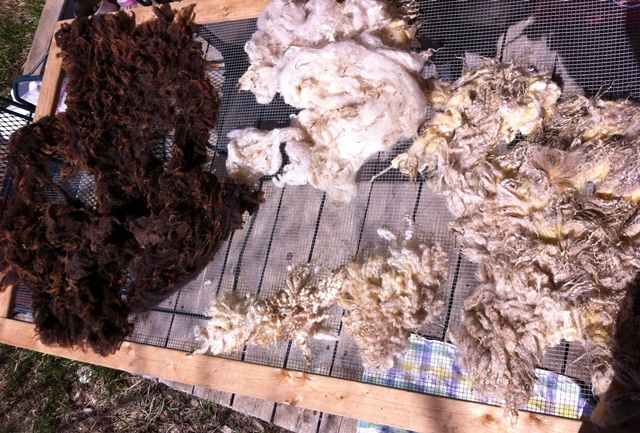
In Sweden, the common recommendation (with exceptions for certain breeds) is to shear the sheep both in the spring (to remove the thick winter fleece before they have their lambs and before the summer) and in the autumn (when they return to the barn and start spending more time indoors). The summer fleece (sheared in the autumn) is considered to be of higher quality. It has been grown while the sheep have been out grazing nutritious green grass, and not full of hay and straw like the winter fleece. Below is a photo of their summer fleece, sheared last autumn. The lighter, brown tips are from bleaching by the sun (and probably some dirt as they are unwashed).

Photo 2

My ram is from an old breed called Åsen. His fleece is straighter, without real locks. This breed can have a variety of fleece characteristics and different colours in patches on the same individual animal. My neighbour also has a ram of the same breed, and the darker fleece (black-brown-grey) on the photo below is from one of her lambs.

Photo 3

In addition, I also buy raw fleeces from pure Gotland sheep from a farm in a neighbouring village. The photo below shows some of the variation you can get between individuals, both in colour and in the size and shape of the locks. The lambs are born black, but later the wool turns grey and the once black tips are bleached by the sun. Or rather, they grown an increasing proportion of white hairs – there are no grey hairs, just different proportions of white or black hairs making the fleece look grey.

Photo 4

To a felter, this abundance of raw fleeces must seem like an ideal situation. And I certainly think it is. But, the process of turning raw fleece into carded wool is quite time-consuming. And that is what this post is really about.

After shearing, the fleece needs to be skirted and sorted, to take away wool that is too short, dirty or tangled. The short wool can either be from the head or legs of the sheep, or the result of what we call double-shearing (i.e. shearing a patch a second time to even it out). You usually also need to remove a fair amount of grass seeds and other vegetable matter that gets stuck in the fleece. That can take a lot of time, but it helps to do the sorting on some kind of wire mesh that allows small bits to fall through.

Then comes the washing. I try to get as much washing as I can done outdoors in the autumn, after shearing, up until the temperatures drop below freezing (in the North of Sweden that can be quite early in the season). I leave the wool to soak overnight in net-baskets in an old bathtub filled with cold water. The next day, the water will be really brown, but that just shows how much dirt you can actually clean out from a raw fleece with just cold water. I change the water at least twice after that, allowing the wool to soak for at least a few hours between changes, until the water no longer looks dirty. In my opinion, washing the wool in just cold water is sufficient if I am going to use the wool for wet-felting. During felting it will anyhow get washed again with hot water and soap.

Photo 5

During the winter, I do the washing in my bathtub indoors (which prevents anyone in the family taking a shower/bath for 24 hours), and then I usually use lukewarm water. If the wool is very dirty, I also add some washing powder (the type used for knitted wool items). The main rules when washing, to avoid felting the wool in the process, it to avoid too hot water, or quick changes in water temperature, and to disturb the wool as little as possible.

After washing comes drying. The net-baskets are easy to just lift out of the water and then I usually hang them up for a while to drip off a bit. If I am washing a smaller amount of wool, I often use one of those contraptions meant for spinning water from salad. Then I lay it out to dry, on a wire mesh or on towels on a clothes drying rack. Drying takes time, usually several days. It helps to turn the wool over each day and fluff it up a bit each time. It may seem dry on the surface, but wool has an incredible capacity for retaining moisture.
Finally, you have your washed and dried wool, ready for carding. However, some locks do need to be teased first. This means pulling apart the locks/fibres – and you will probably find even more grass seeds now. The photo shows washed locks, before and after teasing. It´s an extra step in the process, but if the locks are tangled in the tips, teasing really does facilitate the carding.

Photo 6

I own a drum-carder, which really does save time compared to using hand-carders. The wool is feed in under the small drum, which in turn feeds it onto the larger drum, as you turn the handle. After two or three runs through the drum-carder, you can finally lift off a batt of lovely, fluffy, carded wool. Then you can start felting!

Photo 7

It does take a lot of time and effort, and I do swear about grass seeds through the whole process, but each step also has its own charm. I often find it very relaxing to sort, tease and card wool. It provides an opportunity to really feel and look at the locks – and to plan what to do with them. And at the end of the day, when I look at my washed locks and carded batts of wool, I feel really wealthy. Perhaps, in part, because I know how much time and effort has been invested into those locks and batts of wool.

Thank you  Zara for such a wonderful tutorial with exceptional pictures to show us the whole  process from fleece to wool batts!

Felt and Stitch Bowl Attempt

Felt and Stitch Bowl Attempt

I needed a liner for a basket for collecting eggs. This is a small basket but I will need a bigger basket before long as we got some new chickens.

chickens

I thought I would try sewing around and around a flat piece of felt as I had seen on Lyn’s blog. http://rosiepink.typepad.co.uk/rosiepink/handmade-felt-and-stitch-bowls.html she sells  an ebook of how to do it. If I had downloaded it and if I had followed it I probably would have had better results. I am much to clever for that, not.  I did it form a vague memory of Lyn mentioning something on the Forum.

So I found a piece of felt  and cut it to what I hope will fit my basket. Nothing beats guessing when its right. 🙂

felt and bowl

Next I started stitching, switching the machine from turtle speed to rabbit speed as neatness doesn’t really count here. I also used up all my part bobbins so now I have some empty ones.

As you can see after the first go round it is still flat felt. I decided there was not enough stitching so loaded up the machine with orange and off I went again around and around.

stitching round 1 stitching round 2

As you can see that didn’t help at all. There was a slight curving on one side but not what I would call a bowl. Still I needed a basket liner and after all this is not a beauty piece but a partial piece I cut it.

cut to fit

and sewed it

re stitched

egg basket with eggsHere it is with some eggs in just to prove it really is an egg basket. I haven’t really used it yet in the barn. Theses are some that where collected this morning that are not in cartons yet.

I think the problem besides not buying the tutorial and following the instructions is that my felt was fairly thick and well fulled. I do know from my few attempt at free motion machine embroidery that the felt does strange things if not backed with something. The other thing that may have done it was I started at the outside. Perhaps if I had started in the middle the felt would have reacted differently.  All in all I ended up with a basket liner and had fun sewing like the wind round and round.


Needle felting class and Lambs

Needle felting class and Lambs

Recently I taught a needle felting class were we made little sheep.

Making Bodiesfelting bodies

Adding Legsadding legs

And Earsadding ears

Then its time to give the sheep some wool. These are hand dyed Blue Faced Leicester curls. They are small tight  curls perfect for small work.

adding curls purple sheep adding curls blue sheep green sheep with red heart brown sheep

brown sheep 1 blue sheeep and snowman

All very cute in the end and a snowman for company.

And this morning we had 2 new real lambs arrive. twin lambs 2015 It’s not a great picture but they were very new and not interested in posing for a good shot.


Around the Felting Studio and Farm this Week

Around the Felting Studio and Farm this Week

Not a lot of felting itself going on this week but I have been busy. Like everyone else I never have enough storage space in my studio so I painted up all the peices and hubby and son put a new shelving unit together for me. I started to put sort and put things on it already but more needs to be done.

shelf

I am teaching at a multi guild gathering today. We call it Distaff day and for a small fee you get two 2 hour classes, lunch, vendors and lots of chatting with like minded people. I am teaching nuno felt bracelets and taking hookers necklace. I will have pictures of the day in a later post.

stuff for class

I washed some old fleeces I found stashed away and salvaged a small amount of curls I will cut from the  matted back. I don’t know where I got these but they would have been free. They don’t look bad in the pictures but they were in rough shape.

washed wool

I received a raw flees I ordered for a hat project that you will get to see when it’s done.  I was down to picking between 2 fleeces and in the end picked this one because I liked the sheep’s name. The fleece is very curly. I love the smell of raw wool.

wiki fleece

Lastly around the farm: the chickens and turkeys arrived. The Black chickens are egg layers and the yellows are meat birds.

chickens 2 chickens 1

The turkeys are at the ugly stage

turkeys 2