Browsed by
Month: April 2016

I did some dying on the weekend.

I did some dying on the weekend.

I needed to dye some orange wool to make a flower for a customer so if I am going to get the dye pot out I might as well do a bunch of dying. You can never have enough dyed wool. I dye on the side burner of my BBQ outside when the weather is above freezing. Now it’s not much above freezing, it was only about 10c/50f  but that’s good enough for me.

I made a bunch of 100gram/3.5oz balls of merino top.  I heat up the big dye pot of water with some vinegar.  I Unwind a ball and soak it in warm slightly soapy water. I mix my dye and add it to the pot. I gently squeeze the water out of the soaked wool and pop it into the dye pot. I let it go from 20-40 min. If the waters clear I take it out early, if it’s not I leave it for the 40 min. While it’s cooking I start the next wool soaking and mix the dye. My water is very hard and it effects the dye process. I don’t think I have ever managed to get an even dye job. that is one of the reasons I usually recard most of my wool.  Dyeing with rain water is on my list for this summer. My rain water comes of a metal roof so I don’t know how much difference it will make but its worth a try .

This is the result of Saturday and Sunday.  The wind was not cooperating so excuse the sloppy display. I was just happy they stayed on the back of the chairs long enough to get  a picture.

whole group

Here they all are in groups

purplesI couldn’t get the colours one right no matter how I fiddled. There are 5 colours there. The middle 3 all look the same. Two are very close but one is purple and turquoise.

oranges This one is pretty close to true.

greensThis is very close to true.  The pale green is from an MX or fibre reactive dye used as an acid dye. Its called sage leaf. The one next to it, fourth  from the top is supposed to be olive drab but is more like sage leaf.  The yellow and green one is the exhaust batch after the greens and I quite like it. I think I will recard it to blend the small spots of green in to it. The blue is the exhaust after the purples.

While these where in the pot I added some yarns too. These are all form when I was learning to spin. I didn’t like the colours.

blue and brown yarn This was a natural brown plied with a white. It went into the bright blue dye bath.

brown and green yarn purple yarnThe purple one was white. The one on the right was natural grey plied with white. It went in the sage bath.. The one on the left was another brown and white and it went in the olive drab dye bath.  You can see the purple and the gray have gone all curly with not being plied properly. They are not balanced yarns. I think they will be fine to use for decoration on felt. It will add interest.

purple and blue yarn The one on the right is a commercial ladder yarn that was a horrible pale green. I had no idea what it was made off except it wasn’t natural. I tossed it into the bright blue bath to see what would happen. It came out great.  The top one went into one of the purple baths. It was a purple I mixed myself with turquoise and red. It spit into turquoise and purple. The others were ones that I bought mixed but they split too.  One of them started out pink but I can’t figure out which one now.

All in all a good weekend I didn’t even felt them badly like I usually do.


2nd Quarter Challenge and Last Chance to Sign up for Next Online Class

2nd Quarter Challenge and Last Chance to Sign up for Next Online Class

I seem to be a little stuck on landscapes lately. When I first read Ann’s 2nd Quarter Challenge I immediately thought I could do a stitched strip landscape. I have seen these in a variety of formats either with fabric or paper. So I decided I wanted to do one with felt scraps. I have lots of strips of felt that were cut off the edges of things and most I can’t even remember what half of the projects were to begin with.

Scrap Challenge Scraps

I got out all my scraps and sorted them into color piles. Some of these scraps were screen printing scraps and others from a variety of projects. The table these are laying on is 6 feet long to give you an idea of how many scraps I have.

Scrap Challenge Backing

I cut a piece of thin interfacing for a background. Some of my felt scraps were pretty thick so I didn’t want anything thick for the background as it wouldn’t fit under the sewing machine easily. Luckily, I cut this larger than 5″ x 7″ because it worked out that the landscape will fit in a 5″ x 7″ matt which is a standard size here in the US. I then started auditioning different scraps to make a landscape.

Scrap Challenge Layout

This is the layout that I came up with. The bottom brownish green felt is really thick and I was a bit worried it wouldn’t work but decided to just try it anyways. The sky and the felt right under the mountains were screen printed scraps.

Scrap Challenge Stitching Middle Layer

I started by stitching the screen printed scraps that were towards the middle of the landscape. I didn’t tack anything down but just stuck it under the sewing machine and free motion stitched the pieces down. I cut off the ends hanging over each edge as I went along.

Scrap Challenge Top Half Stitched

Here it is after stitching down the sky and then the mountains. I didn’t try to add much detail with the stitching, I really stitched just enough to hold the pieces down.

Scrap Challenge Adding Foreground

On the orange piece closer to the foreground, I did add a little bit of stitched detail representing grasses.

Scrap Challenge Finished Machine Stitching

Here’s what it looked like after I finished the machine stitching. I put it under a matt to cover the rough edges. It seemed like it needed a bit more in the foreground.

Scrap Challenge - Add Hand Stitching?

Here in Montana in the spring, we have a plant called Beargrass. I decided to add a stalk of Beargrass to the foreground. This shows the cut up pieces of white felt being auditioned.

Scrap Challenge Complete

I hand stitched a stem and leaves and then stitched each small piece of white felt down by hand with white thread. And this is the finished landscape. The pile of scraps I started with hasn’t shrunk in the least so I’m sure I could make another 8-10 landscapes with the rest of the scraps and still have some to spare. I do have some other unfinished projects that I might also work on with this challenge. Maybe I can do one for each month of the challenge. I will post my results if I do more.

Module 1 of Embellishing Felt with Surface Design Techniques - A Mixed Media Approach, Online Course by Ruth Lane

Don’t forget that today is the last day to sign up for my online class Nuno Felting with Paper Fabric Lamination that begins on Friday, April 29th. You can sign up here.  It’s going to be a fun class so I hope you’ll join me.


Welcome to the Family

Welcome to the Family

I had a big surprise last week when my youngest sister Carol sent me pictures of the newest members of her family — three ewes and four lambs!

It was an even bigger surprise to her that I use wool for felting.  In her defense, she lives in central Wisconsin and has a farm and she, her husband and son run a real estate business.  They are a little busy themselves.

It should have been no shock since she’s been an animal lover since she was a toddler.  She’s managed a dairy farm, a pig farm and has had horses and cows of her own. Carol also has five Border Collies and felt they needed more exercise.  Sheep would be great for them to herd. When she saw the sheep it was love at first site.

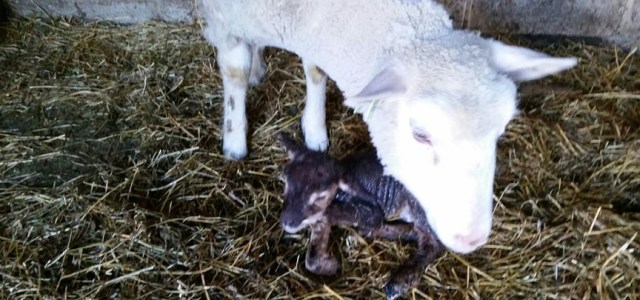
None of the sheep are purebreds. She thinks they are Corriedale/Dorset mixes. The ewes were pregnant when she brought them home.  Since then the oldest Mom, Secret 7,  had twin boys.  Carol’s granddaughter Madison named them Salt and Pepper.


Jpeg

Jpeg

The black Mom, Dusty, had a dark black boy named Little Will.

Jpeg

The youngest Mom, Amira,  had a teeny little brown lamb with tan on her face Madison named Rosie.  She was very weak and they had to milk Amira and bottle feed Rosie because she couldn’t get up and walk. But an hour later she was on her feet.  They will let Rosie and Amira out of the lambing pen as long as Rosie is doing well.  She is very tiny.

Rosie

The sheep have only been introduced to the two older Border Collies, Belle who is 2 and a half and Misty who is 1 and a half.  They just visit and fuss over the baby lambs.  Misty thinks all the babies belong to her.  She loves them.

The three pups are only 10 months old and will get introduced to the lambs when the lambs are at least half grown.  They want the sheep to feel safe and comfortable in their own space.  They  are going to build a special round pen for that so it will be easier to control both the dogs and sheep.

Carol is already planning on buying a Corriedale ram this fall. So, the excitement will continue.

I wish we weren’t so far apart, but I’ve been promised fleece next year. so, I’m sure a trip is in order.  Another new adventure!  In the mean time, I’m enjoying the pictures and updates.

Thanks to my nephew Bill and his daughter Madison for the pictures and to Carol for sharing this exciting experience with us.

Raw Wool

Raw Wool

If you use World of Wool regularly, you might have noticed that they’ve added some raw wool breeds to their naturals selection recently. I bought a couple last time I did an order, Blackface, and Radnor. They looked a lot like the photos.

I picked out all the locks first, and made a few piles of loose bits: a pile the same quality as the locks, a pile for surface texture and a pile for adding texture between layers.

The Blackface had quite a few different parts, longer straighter locks and some shorter and curly, and some wiry black parts – these went out for the birds – there was a clump which was really dirty and this went out for the birds too after a soak. I picked out some nice locks to keep raw:

OLYMPUS DIGITAL CAMERAI washed the rest, just a handful at a time, dipping them in soapy (anti dandruff shampoo) water to get rid of most of the dirt, then rubbing any dirty bits with shampoo, then rinsing. Here are some washed Blackface locks:

OLYMPUS DIGITAL CAMERAHere are a few more:

OLYMPUS DIGITAL CAMERAI forgot to take photos of the washed loose Blackface, but for this and the loose Radnor, I washed it a bit differently. I ran a bucket of water and poured some into a tub to put the loose fibre for a few minutes to get the main dirt off; I poured some into a tub with shampoo to leave it to soak, and poured some in a tub to cool down at the same rate for rinsing. This is the (nicest bits ) loose Radnor after washing and drying:

OLYMPUS DIGITAL CAMERAI’ll probably card that and the Balckface. I sorted and separated the Radnor the same as the Blackface, this is the raw Radnor:

OLYMPUS DIGITAL CAMERAThere were differences in some of the locks, some being a lot more crimpy. Here are some of the washed and dried locks:

OLYMPUS DIGITAL CAMERAA close up of the crimp, you can see there are bits of VM in there. It doesn’t bother me too much because I don’t mind a bit of VM on my natural hangings and the tiny bits will flick out if I comb the locks through my handcarders.:

OLYMPUS DIGITAL CAMERAI did get some other raw wool recently, I couldn’t resist when I saw it on Facebook for £1 per 100g, beautiful Portland wool, here are some locks:

OLYMPUS DIGITAL CAMERAI didn’t pick or sort them either, that’s how they came. I got them from Nancy from Nancy’s Fibres, if you’re lucky she might have some left. And just to add a bit of colour, here’s the small sample I made at the well being centre last week when we tried out fabric strips (yep, the second one is yet another charity shop scarf!):

OLYMPUS DIGITAL CAMERAAnd an angled photo of the texture:

OLYMPUS DIGITAL CAMERAThe third strip down is silk taffeta, which I did a post about a while ago: https://feltingandfiberstudio.com/2015/01/23/silk-nuno-samples/

An Order for a Hat

An Order for a Hat

I had a lovely meeting with Rebecca last night.  Rebecca has  several of my hats and wanted to order a new one. She wore a purple hat I made so I would recognise her.

Rebecca in purple hat.

She wanted a hat similar in shape as another one she has in turquoise.  She brought it along and I took some pictures so I wouldn’t have to rely on my memory.

turquise hat 1 turquise hat 2 turquise hat 3

She also ordered another flower in orange to go with it.

And of course I had her model it as well.

Rebecca in turquise hat

She is a very good hat model.  This is the colour she chose for her new hat.

rebeccas hat colour

She said I can add things to it if I want to. So now I will have to have a little think. I will have to find my dye pot too . I have no orange wool for the flower.


Composition and Design

Composition and Design

Zed and I were having a discussion about artistic talent and having “an eye for art” when she asked about the mini landscapes that I painted. Many people think that they are not “talented” and “can’t draw or paint” and have never been to art school. I too have never been to art school and I used to think that I couldn’t draw. But I have since learned that you can teach yourself (or learn) these skills and you can also learn the basics of design as well as practice creativity. Once you start practicing those skills and add in the elements and principles of design, you too can have “artistic talent”. I truly believe that everyone is creative but most people let their creative muscle turn into a couch potato. Zed was interested in learning more about art and design and I hope that the rest of you are as well. (All the photos are mono prints using acrylic paint and a gelatine plate that I have pasted into my journal.)

monoprint turquoise

I am planning on writing a post about composition and design once a month or so. I am certainly not an expert on the subject but I have found that if I write about it, I learn a lot myself too. I will give lots of references of both online websites and books that can be found in your local library (hopefully). If you can’t find a specific book, don’t worry, just look in your library in the art and painting section. There are lots of good books available that can help you improve your “artistic eye”. I am actually updating some posts that I wrote over on my Permutations in Fiber blog that were called Design Focus Friday. I started writing those back in 2010. If you’re in a hurry, just go over there and search under “Design Focus Friday” and you’ll find all my old posts there.

monoprint peach

When I looked up the definition of design here are some of the answers I got:

  1. make or work out a plan for
  2. create mentally
  3. an anticipated outcome that is intended or that guides your planned outcome.

monoprint painterly

Now I think that we all have done that sort of thing when we created a piece of fiber art. I also have heard many people say that they want to create spontaneously and creating a design first would put a damper on your creativity. I think that you can do both because once you know the basics of design, even though you are creating “spontaneously”, you are using what you’ve learned in the past to create a piece that has a composition that works due to the elements and principles of design. What do you think?

monoprint green orange

Here is an overview of design elements and principles. These are pretty standard and although there are some variations noted in different sources, I’ve tried to provide a comprehensive list. To develop a composition, you will be using design elements arranged with the principles of design in mind. There are no really hard and fast rules but the design principles can guide you to create a piece that draws the eye and keeps the attention of your viewers so that the message you are trying to express comes through in your art. Think of the elements as your building blocks and the principles as guidelines to follow in how to place your elements to achieve your best work.

monoprint glue gree bronze

Elements of Design

  1. Line – A mark on the surface that can be thick or thin, smooth or jagged. There are many types of line such as vertical, horizontal, diagonal, actual or implied, contour etc.
  2. Shape –A line that comes together to form a 2 dimensional object which can be geometric or organic.
  3. Form – A 3 dimensional object such as sculpture with real volume or thickness. It can be implied 3 dimensional shape using shading, lighting or other techniques in a 2 dimensional work.
  4. Texture – The surface quality of the object whether it is rough or smooth. This can be actual texture or it can be implied by various techniques.
  5. Color – This refers to the hue used from the spectrum of colors. A basic color wheel can be used to determine a variety of color schemes in including monochromatic, complementary, analogous or triadic.
  6. Value – A property of color, value refers to the lightness or darkness in a composition. Contrast can be depicted by changes in the values you use.

monoprint ghost

Principles of Design

1. Center of Interest – Also called the focal point or emphasis, it is the way to catch the viewer’s attention. The center of interest is more important in the composition compared to the surrounding areas.

2. Harmony/Unity – The presentation of an image that is integrated and pleasing to the eye. Agreement exists between the parts and provides visual connection.

3. Balance – The distribution of the visual weight in a composition provides equilibrium to the piece. This can be symmetrical, asymmetrical, crystallographic or radial. All of the elements of design can be used to create balance.

4. Scale/Proportion – This refers to the comparative sizes of the components of the composition. It is relative, size measured against other objects or against a “normal”.

5. Rhythm – Refers to the movement of the viewer’s eye over repetitive patterns in the composition. It involves a clear repetition of an element in the piece.

monoprint black and red

So if you’d like, do a little research. Look at the links I’ve provided below. If you can find it, the book Design Basics by David A. Lauer and Stephen Pentak is wonderful. I found a copy in my local library and it was the first design book that I’ve been able to read through without falling asleep. Do you have a sketchbook or studio journal? Do you use it much? Here’s an opportunity to start. Take a look at artwork that interests you either online, at a museum or from a book of your favorite artist’s work. How did that artist use the elements of design? Are the principles of design evident? Go through the list above and ask yourself how the artist used each of the elements and principles in the work. Why does a certain piece catch your eye and another doesn’t? Print out some of your favorite artwork and paste them into your journal. Write down your ideas about why you like the pieces. Let me know how it goes and check back next month for the next post on using line in your work.

http://www.bartelart.com

http://desktoppub.about.com/cs/graphicdesign/a/designbasics.htm

http://daphne.palomar.edu/design

http://char.txa.cornell.edu/

http://www.artgraphica.net/free-art-lessons/watercolor/watercolor-values.html

Small but Tricky

Small but Tricky

Since we’ve been traveling a lot this winter, I wanted a small project to work on. I’ve had a  frame for a small coin purse sitting around for a while. So, I decided to try that.

Unfortunately, the first one I made was too thick.  I had used three layers, the middle layer corriedale. I set it aside and when I returned I tried again.

I like the idea of using silk inside.  I had some yardage from a shop in Florida I purchased last year.  It was close enough to the turquoise batt I had on hand from another project.

20160325_155259

The first one was also a bit larger than I wanted. I’m always looking to lighten my handbag.  So, I had adjusted the resist to be a little smaller and used two layers. I also cut the silk to overlap so there wouldn’t be any gaps with the silk.  Of course, there is no guarantee it won’t shift during felting.

20160123_154933

I used mulberry silk to embellish it.

When I finished felting, I carefully cut the sides to match the curve of the frame.

20160325_155601

Then came the challenge — getting the felt into the frame and staying long enough to sew it on.  I tried Gorilla glue, but that made a mess and didn’t work.  I ended up using a blanket stitch around the edges then a nail file to push it into the frame.

The frame had holes on one side and a longer solid piece on the backside.  In order to get the needle through to the back, I had to run it on an angle while making sure the felt stayed in place.  Very fiddly!

Doing the second side was more of a challenge because the felt kept slipping out. I did manage to finish it without throwing it to the ground or out.  It seems to be fairly sturdy despite using a single cotton thread.

20160326_120537 20160326_121101

I’m pleased with it, but it was a lot more work than I had anticipated.  I have trouble with working small in tight spaces.  My hands were not happy. We’ll see how well it wears.  But I can guarantee there are no more coin purses in my future unless I design my own without a frame.

20160326_121301

Have you made these?  Is there a trick I was missing?

More Nuno

More Nuno

You might remember I had some unusual pieces of fabric in the nuno samples I showed a couple of weeks ago. In the small piece, I had a strip from a scarf which pretty much looks like  lengths of fine shiny threads held together loosely. This is what the scarf it came from looks like:

OLYMPUS DIGITAL CAMERAOn the bigger nuno sample, I tried a piece of a loosely woven and ruffled scarf, this is what that scarf looks like:

OLYMPUS DIGITAL CAMERAAnother unusual scarf I sampled was also loosely woven, it had different sections:

OLYMPUS DIGITAL CAMERAThe part I used on the previous nuno piece had lots of loose fibres trapped between the layers which I didn’t know until I cut it:

OLYMPUS DIGITAL CAMERAThey looked like soy top, but fell out so didn’t get felted with the sample. I don’t think I showed a close up of that piece, here it is:

OLYMPUS DIGITAL CAMERAThis is the full piece of the recent nuno sample I made:

OLYMPUS DIGITAL CAMERAThis is a closer look at the left end. The top and third piece are both sections of the pink scarf, cut from the different ends:

OLYMPUS DIGITAL CAMERAThis is a close up of the other pink piece:

OLYMPUS DIGITAL CAMERAThis is the middle section. The bottom piece is a strip of Sari silk, which I think Galina sent me. I’ve had mixed results with sari silk scraps I’ve had before so thought I’d try it out:

OLYMPUS DIGITAL CAMERAIt was difficult getting a photo of the right end of the sample, the colours were so bright. I had to ignore the beige crepey strip at the bottom, it didn’t attach very well anyway:

OLYMPUS DIGITAL CAMERAI managed to squeeze a couple of other strips on at the end, another piece of sari silk and, I think a sample of a piece sent by Lyn (sorry if I’ve got them wrong!) I also put a little piece of a scarf I’ve tried before at the bottom:

OLYMPUS DIGITAL CAMERAHave you tried nuno felting with any unusual bits of fabric?

Stitching Some Felt and a Frame

Stitching Some Felt and a Frame

I showed your this piece on the second quarter challenge post. https://feltingandfiberstudio.com/2016/04/05/second-quarter-challenge-2016/

11 reuse picture

I want to practice some hand stitching on this piece but found it floppy and frustrating to stitch. I thought an embroidery hoop might work but the felt is to thick.

I had seen pictures of the frames for rug hooking. They seem to have wire teeth similar to carding cloth around the edges. I thought that would be too aggressive to hold felt and they are not cheap. So off to the hardware store.

This is what I got, ABS pipe and some elbows.

ABS pipe peices

I assembled them into a rectangle and added the hook side of some industrial Velcro.

ABS pipe assembled ABS velcro

The reason I used the industrial Velcro is because the sticky on the back is so much better. And it is stuck and doesn’t fall off.

ABS all attached ABS all attached 2

It is a bit heavy after a while as I have no stand for it. Lighter pipe would be good but I think smaller pipe would cramp my hand holding it.

This is what I have done so far. Not far but a start.  I would like to try some different stiches. Someone suggested some couching of yarn. I think I will give it a try.

ABS stitching

Have you been thinking about the challenge? Have you been stitching on felt? What is your favourite stitch I should try?


Tutorial on Adding Details to Simple Painted Landscapes

Tutorial on Adding Details to Simple Painted Landscapes

Zed had requested a tutorial on how to paint in the details on the simple painted landscapes that I showed you last month. I found the painting of the basic landscape tutorial/video by Jude Atkin at the Start2 website.

This tutorial is what I do to add some depth and finish the paintings. One thing I would suggest is to take a look at landscape photos or paintings and look carefully at what gives the illusion of depth to the landscape. There are several ways to create more depth. I think one of the most important ways is to realize that things in the far distance are lighter, hazier and more blue-grey than those in the foreground. So the colors in your foreground should be a little brighter than those in the background. Also, there are changes in size as you move from bigger in the foreground to smaller in the background. If you google how to create depth in a landscape, there are numerous tutorials and articles that explain this better than I can.

original web

Here is one of my mini landscapes. I have been doing almost all of these on a 4″ x 6″ pieces of paper that I can then use to make 5″ x 7″ note cards. This is what the landscape looks like after I follow Jude’s instructions on painting simple landscapes. I do some in vertical orientation and some in horizontal orientation. I think one of the more important tips that Jude gives is to use a mix of complementary colors (on the opposite sides of the color wheel) to create your mountains and your foreground. With acrylic paints, the colors separate out during the drying process and give more variation than if you used just one color straight out of the bottle. The foreground here is a mix of purple and yellow ochre. The mountains were a mix of several colors including black and purple that I remember for sure. I tend to mix up some colors and then keep adding extra colors in or mixing two of the mixed colors together. I also like to let the sky get mostly dry before adding the foreground and the mountains. I paint the foreground, quickly add salt and then quickly paint in the mountain color and add the plastic wrap. If you let the foreground paint dry, you end up with a hard straight line across the top of the foreground which is distracting to me. If you paint both the foreground and mountains at nearly the same time, the paint colors mix together in the transition area and I like this effect better.

supplies web

Here are the supplies that I use to add details including colored pencils, Derwent Inktense pencils, Caran D’Ache water soluble crayons and a water brush. I use these because I can travel with them and many times I take these little landscapes along with me when I have to wait somewhere so I can work on them while waiting. You could easily use watercolor paints and a regular small brush. Or you could use watered down acrylic paint. With the watercolors, I don’t wait for the paint to dry completely between layers of paint. With acrylics, it will work better if you let it dry in between or you will lift the paint away from the paper when trying to add another layer.

The first step is to use a colored pencil that matches the color of your mountains hard edges. I used black here. Then I draw in the top edges of the mountains where there are funny jagged edges left from the plastic wrap. The photo on the right shows where the mountain tops have been drawn. Remember to draw unevenly and make the mountain tops different sizes and shapes.

To use the water-color crayons and the water brush, squeeze a little bit of water into the brush and brush some color from the crayon. It doesn’t take much. Start with less, you can always add more. Fill in the spaces created when you drew in your mountain tops. I usually dab the paint on with some areas lighter and some areas darker but not dark black. These are the furthest mountains and therefore will be more gray than the foreground ones. If your mountains are a different color, choose a color that is closest to the main paint color in the mountains.

mountain tops painted black web

Here I have completed painting in the grey on the tops of the mountains.

Now I like to add in further color into the mountains. Depending on the color of your mountains, choose a second color that works with your secondary mountain color. I chose purple and then added dabs of purple paint in different areas of the tops of the mountains. Again, some areas may be lighter or even mid tone but none that are really dark or really bright colors.

mountain tops painted purple web

Here is what mine looked like after adding in some purple to the tops of the mountains. You can also leave some of the areas the original sky color and it ends up looking like there is snow on the tops of the mountains as long as your sky color is light. I hope that you can see the subtle differences in each of these photos as I don’t really add that much paint to these details.

Next I like to take the secondary mountain color and add a bit more into the areas of the mountains that look really pale. These seem to be too light against the dark mountain color here so I added purple to these areas. In the second photo, I took some of the purple down into the transition area and then even into the foreground. If your foreground seems too bright, one way to tone it down is to use its complementary color and paint a wash over top of the entire foreground. I didn’t do that here but have on several that were overpowering and bright. The photo on the right shows the piece after I had painted in all the purple.

The next color that I used is a yellow ochre. This is the main color of the foreground. I like to take some of the foreground color and work it up into the mountains just a little ways. I also add more yellow ochre over the top of the purple that I just painted in the transition area between the mountains the foreground. Again, I just dab on the paint. I may work over the area several different times with the two colors that I am using. Or I may add in a third color if I want to add some more variety.

Then I went back to black paint. I chose an area in the scene where I felt would be a good separation of the background mountains from the ones that were closer. I added black paint all along that line. I just do light grey to start and build up the black to give the illusion of depth along that line. I also work some grey up into the background mountains to create further depth. I usually let that dry and then if more grey is needed, I add another layer.

While I have grey on the brush, I add a bit of grey to the transition area to create a little depth from the foreground. I paint the grey in dabs across the area where the mountains transition into the foreground and may even bring some grey or darker areas into the foreground at this point. The photo on the right shows after I am finished with the grey in this area.

The last details I add are to the foreground. Here I used an Inktense olive-green pencil to draw in a few suggestions of grass or leaves near the “flowers” that are created from the salt. You don’t need very many of these. Just a few clumps that are created with varying lengths of lines.

finished 1 web

And here is the finished landscape. I am usually surprised how much better they look with just this little bit of detail added. Don’t go overboard and try to draw or paint in specific “things”. I find that less is more and you’ll be happier with the results if you don’t over do it.

Now I will show you three more that were done a little differently. I will show you before and after details and give an explanation of what I did on each one.

This one is to show that you don’t need to make hard lines on all the mountain tops. On the left, you can see where I drew in on the left side to fill in the mountain sides. I forgot to take the photo before I drew on it. On the right is the finished piece. I did nothing to the soft edges of the top of the main mountain. It just makes it look misty and snow-covered. I added in grey paint to fill in the areas on the left inside my drawn lines. I added a bit more purple on the bottom but then I decided I needed a bit more color. So I added some orange into the “flowers”. I darkened the base of the mountain just slightly with grey and added in some shadow at the base of the distant mountain to make it appear a bit more distant.

This is one that I was attempting to get a water/sea-shore scene. In the original on the left, I thought the water was too green and I didn’t like that smudgy bit up on the left hand top corner. So I first filled in the center rock with a mixture of purple, orange and black in several layers. Then I added a dark blue over most of the water. Next I added a lighter turquoise blue in places in the water. The lighter water needs to go closer to the rocks and shore. The next step was to add white paint. Notice that I made a big wave to cover the upper left corner that I didn’t like. Not sure it is so believable but it’s OK. The last step was to put in the bright white accents with white gel pen. The white is put in mostly where the waves are crashing against the rocks.

Then there were a few of the landscapes where I put the plastic wrap too far up into the sky. The mountains took over the entire sky as you can see in the photo on the far left. So I flipped it over and made what was initially supposed to be foreground into the sky. The center photo shows where the piece has been flipped over. The far right photo shows the finished piece. All I did was add a purple line for the tops of the mountains and fill in with purple. I added a blue “haze” over the distant mountains to make them drop back further into the background. I added a little more purple into the base of the mountains and a little pink into the sky.

Here are three more that I have decided to turn over and make the original foreground into sky. I haven’t added any details yet. The original is on the left and the turned over version on the right. I could probably leave the top right landscape as it is but I don’t really like that piece that reaches the top on the left side. It will be easier just to turn it over and fill in the blue part to make it into mountain. In the middle landscape, you can see that there is a green blob in the left hand top corner of the original sky. Instead of calling it a total waste, I will add more green into the now foreground and lower mountains. And the last one I think definitely looks better flipped over without even adding any details. So if you are unhappy with the landscape you painted, turn it upside down and see if you like it better that way.

These are the rest of the landscapes that I painted that day. I have been painting a dozen at a time. All of these will be fairly simple fixes, penciling in the mountain top edges where they are needed and adding a few shadows and blue grey for creating distance. The bottom left one is bugging me a bit because it looks so much like a dome. I will probably take the mountain top edge off to the left and draw the edge above the pink sky. That won’t give such a regular shaped appearance to the resulting mountain.

I hope that this tutorial is helpful for adding details to your landscapes. It really doesn’t take a lot of artistic ability, just a bit of knowledge on how to create an illusion of distance and a little practice. So why don’t you give it a try and show us your results over on the forum?