Browsed by
Images

Electric Fringe Twister

Electric Fringe Twister

I have a confession to make… I seem to be falling behind on my fringe twisting duties.  It is a bit of a tedious job and requires sitting at the table and focusing on the task.  In the winter I find our kitchen quite cold, and so I have been putting off working on fringes.

Three woven pieces with untwisted fringe
Three pieces of weaving needing fringe twisting

Recently another weaver was talking about how much they loved their electric fringe twister.  I had a look on Amazon and ended up ordering a Lacis fringe twisting tool.  It was about $45 Canadian.

Electric fringe twister
Electric fringe twister out of the box

The tool uses two AA batteries.  There are two modes and you select them by pushing the button to the 1 or 2 position.  The 1 position rotates each black spindle and twists each cord separately. The 2 position rotates the entire head and twists all the strands together.  I found a short video showing these two actions online here.

Before I could get started, I needed to prepare the piece of weaving.  I selected one of the pieces of weaving and folded it in half, lining up both ends. I add a heavy book to the weaving to help keep the pieces aligned.  Next I use an open toothed comb (I think it is from the pet shop in the cat/dog tools) to untangle the warp strands.  Once the strands are combed out you can see that the length of warp left on each side is not the same.  I trim the warp threads so that both ends will have fringes of the same length.

Once the warp threads are trimmed, I move the book and reposition the weaving so there is only a single end of the weaving on the table. The book is re-positioned to weight things down and I am ready to try out the electric fringe twister.

Depressing the bottom of the black spindles opens a hook at the end and I am easily able to position a bundle of threads on the spindle. I repeat this for each of the four spindles. Then I move the button to position 1 and add twist to the strands.  Once there is enough twist, I remove two adjacent bundles from the fringe twister, tie a knot on the end, and then let them twist together. This is then repeated for the other two bundles attached to the fringe twister.  Yeah!  The first two pieces of twisted fringe are done.

Next I repeated this across the width of the weaving. When that was complete, I went back and gently trimmed the ends of each piece of fringe to tidy them up.  (Before trimming they look a bit ratty because the warp threads are different lengths.)  I rotated the weaving and repeated all these steps on the other end of the weaving.

It took me 30 minutes to complete the fringe twisting and trimming on the second end of the piece of weaving.  I do think the electric fringe twister is slightly faster than manual fringe twisting.  And it is easier on your hands as you are doing fewer repetitive movements.  So those are both very positive things.  (I did get faster and my last piece of weaving it was about 35 minutes to twist both edges and do the trimming.)

On the cons side of things… I found the fringe twister motor noise to be a bit annoying as it seems very loud. I also found that because the unit is round, that it rocks on the table.  This makes it more challenging to attach the warp bundles to the black spindles. More importantly, a few times when I hit the switch nothing happened.  I had to shake the unit to get the power to come on.  (I guess the batteries are loose, so the power connection is flaky.) It is very disappointing that a brand new unit does not function well.

After trying the electric fringe twister for the first time I give it an 8/10 rating overall.  The first night I twisted the fringe on one first piece of weaving and started work on a second piece before calling it a night.  On the next day I finished up the fringe on pieces two and three.  And I sewed a tag on the one piece that is shawl length.  The other two pieces are longer and should eventually get turned into a sewn garment of some kind.  Here they are all laid out together.  Next up for all of them is wet finishing.

Three pieces of weaving with twisted fringes
Three pieces of weaving with twisted fringe completed.


Christmas card for Antje

Christmas card for Antje

Our group did a Christmas card exchange again this year and I was partnered with Antje.  (You can see Antje’s post with the card she made for me here.) My first card attempt turned into a disappointing failure.  After casting about for more inspiration I decided to try using some of my handspun to make a card.

I cut out some felt the size of a blank card, and sketched out a design using chalk.  Then I decided that would be challenging to sew.  So I loaded a larger piece of felt into a frame and started over.

Supplies on the table including yarn, felt, beads, scissors
Gathering my supplies

Next I did a chalk sketch.  I outlined the size of my working area and the tree element I wanted on the card.

Chalk sketch of tree and size of card
Chalk sketch of my tree

The handspun I wanted to use was a very pretty singles.  It was quite bulky and not really suitable for traditional sewing as it would fray if tried to sew through the felt with it.  As a result I used a needle and thread to tack down the handspun at each edge of the tree.  (I actually had 2 working needles going, one for each side of the tree.)  The handspun was thick and thin which made the tree somewhat textured.  I dug around in my stash and found this very crazy gold fizz yarn that I used to make a bold star.

At this point I decided my card was a bit too plain.  So I bought some beads and then started playing with laying them on the felt.  I took my project to one of our guild socials and got some feedback from the ladies there about what beads to use.  Once the beads were selected, I started sewing them on.  There are dark beads as shimmery snowflakes and some white snow below the tree.  When adding the snow at the base of the tree I purposely changed the direction of the beads instead of doing plain rows.

Next I cut out the panel and made sure it was the correct size for my card.

Ann suggested that I sew the panel onto the card.  That way if Antje wanted to repurpose the panel it could be easily removed from the card.  (Unlike gluing which would be more permanent and possibly not good for the felt.)  I used some clips to hold the panel to the card and sewed it down at each corner.  I then decided to add a couple more stitches along the long sides.  Sewing the panel to the card was easy to do and the threads don’t show very much on the front of the card against the dark felt.  (Thanks Ann for the terrific suggestion.)  Success!

My next job was to send the card.  Unfortunately Canada Post went on strike and so mailing my card was delayed.  I did attempt to send the card via courier.  After waiting in a long line I was quoted a price of $117, which is crazy.  So the card went back home with me to wait till the strike was over.

I was nervous about sending the card since the beads could be damaged by some of the post machines.  So I padded out the envelope with a few hand knit dish cloths and hoped for the best.  Antje let me know that my packet finally arrived at her place on December 31st.  I am resharing the photo Antje took of the card and dish cloths once they arrived in the UK.

3 My surprise exchange collection from Carlene.


CCCE – AKA….Carlene’s Christmas Card Exchange

CCCE – AKA….Carlene’s Christmas Card Exchange

Spoiler alert – Carlene don’t read this if you still want a total surprise via the post!


For everyone else – please read on….

Regular readers will know that a group of us have an international card exchange each year and, as you have rightly guessed (too easy, so no prizes!), I was paired with Carlene.

I started off well – obtaining the postal address and checking what colours Carlene liked, which I should have remembered….it is known among other friends that should you want blue/purple coloured fibres that are for sale at various wool fests, then you need to get there before Carlene 😜

My major problem was – what to create? Should I stick with a Christmas theme and if so, should it be traditional or contemporary. But blue/purple was, for me, at odds with a traditional theme. So, contemporary, and if so then maybe something suitable for all year round….mmmm food for thought!

And that was precisely as far as my thinking went.


Life leapt in and totally dominated everything, like the sheer face of a cliff. Then prepping for a much-needed break by visiting family in Europe (all in a bid to escape this cliff-edged mountain), a little email plopped into my inbox….Card exchange….

OH NO!…HORROR!!!! Just to expand the graphic picture, imagine….startled, rabbit in headlight eyes; hands over gaping mouth and totally speechless! Some might say the latter is unheard of 🤣, but it was fact.

With no time, before imminent travel departure, to make my creation, all I could make were heartfelt apologies to Carlene. She totally understood my situation and was very supportive even to the extent of releasing me from my commitment. However, ‘giving up’ is not in my vocabulary.


Whilst away, I finally had my ‘Ta-da’ epiphany (quite an appropriate word for the time of year, so I feel I can use it here!) – a colourful contemporary wreath. I could incorporate Carlene’s colours and, as a wreath, it doesn’t have to relate solely to Christmas.

With the ‘What’, follows the ‘How’ – more thinking required….


On returning home (11 days before Christmas) I raided my huge wool/yarn stash, selecting a range of colours I felt would work together. I then set about crocheting a mix of differently sized semi-spheres to represent the baubles. As Carlene is into knitting, I thought she would appreciate the crochet work.


Next it was creating the 3D wreath base, for which I used ironing board padding (I often use this in projects, as it is more substantial than polyester wadding).

06 Finding the right size circles to fit the card required an investigative trip around the kitchen!


07-08   With the ring cut out, I reinforced the 3D-ness by blanket stitching the edges to be flat and adding cotton piping to the centre.

With the base prepped it was time to add the crocheted baubles, playing with the colour combination along the way. What I hadn’t bargained for was that the wreath ‘gobbled’ all the semi-spheres. So, it was back to my stack of boxes (it is always the one at the bottom in the second pile behind!) to pull out more yarn to create yet more semi-spheres.

An aside….with extremely limited space, I had unstacked my large boxes (60x40cm 24x16ins) of yarn stacking them into the doorway…Yep…..a Laurel and Hardy situation….until I restacked all 9 boxes I could not get out 🤣

My New Year’s resolution – sort out my ‘stuff’.

09 Fortuitously I was able to recycle an empty box for Carlene’s card, it was perfectly sized. All it needed was a little padding helped by a trio of ribbon cones.
09    Fortuitously I was able to recycle an empty box for Carlene’s card, it was perfectly sized. All it needed was a little padding helped by a trio of ribbon cones.


10 Ribbon cones – folded 1cm ribbon pieces, pinned to polystyrene egg shapes. Each cone is the size of a tea spoon!


11 The completed wreath


12 The wreath is 3D
12 The wreath is 3D

Ready to be sent I thought my story was complete, but there is another part to this saga.

Episode 2 – At home, I did not have a suitably sized Jiffy padded envelope. So, with completed addressee and sender labels it was a trip to the post office the second they were open, only to find they had very limited supplies, due to something called ‘Christmas’. One option was an origami type box which required two thinking minds (one being the postal assistant herself), and many dexterous fingers, to put together. Finally completed….it was….4mm too short!

The only other option was a humungous bag, so with no alternatives, the bag was duly labelled and handed over….

OHHHH!…This is going to Canada!…They have a postal strike….We (British Postal Services) can’t accept any more mail, due to the massive backlog, until 30 Dec at the earliest. Whilst I was fully aware of the Canadian Postal strike, I had not bargained on our postal service refusing to take packages, due to the backlog.

In hindsight, I’m so glad I ventured into the contemporary theme and chose to make it an all-season creation because poor Carlene will have to wait until well into the New Year.

Skidding in moments before this post is scheduled, I have received my Exchange Card from Carlene. It is amazing and is already with my collection of precious cards I display each year. Also included in the package were four knitted cloths in my happy colours….Thank you Carlene….Xx

3 My surprise exchange collection from Carlene.


14 The card displayed


I hope my endeavours at the end of this year have brought a wee smile. I did try Carlene….I will ‘keep you posted’ – so to speak 😜


Wishing everyone a happy, healthy and creative 2025 to come….🎈🍹

Our 2024 textile display – a true fellowship

Our 2024 textile display – a true fellowship

Every year on August Bank Holiday, our two villages (they are historically combined – one has the castle and the other the church!) have a show in the larger ‘castle’ village. It is a popular event locally, drawing in folk from the wider surrounding area. The event encompasses fun activities on the village green such as dancing, music and children’s sports etc. Then there is the fiercely competitive village produce show (including art) – thankfully, we haven’t as yet, had any Agatha Christie adventures needing Miss Marple or the services of the Murder Mystery Club!  All of this is combined with the very active local history group presenting their annual research and finally (the subject of this post) our textile group’s display of our year’s work.

Both the history and textile displays are set up in out-building workshops that belong to our patient, long suffering, textile ‘leader’. Each year she packs up her entire stock to provide shelves and tables for our pieces. I am in awe of her efforts as there is no way I could do likewise….firstly I have too much in my various stashes, secondly I’d have no where to transfer it and lastly if I did move it….I’d never find anything again. I’m sure I can see so many of you nodding to this….😂   All that said, it could potentially provide me with an annual clean-up and the finding of hidden long lost treasures!!! 😜


Tables and shelves filled with display work
The display all set up in our ‘leader’s’ textile workshop. I’m envious of her space!

Our textile group membership (35 members) is small by comparison to many other groups, but our ‘leader’ organises a varied programme of about 8 workshops each year to include all aspects of textile artwork, which we enjoy, with get-togethers, to keep our fingers and minds busy. Sadly we can’t all get on each workshop….I think we’d be too much for even the strongest tutor to take on! Thus far, there haven’t been any pistols at dawn….but we have an exciting, particularly for me, programme coming up….need I start cleaning the gun barrel???!!!

Among our members we have the usual mix of – extremely talented, pin-point perfect, very diverse, quietly challenging and the beautifully colourful. Over the years we have grown used to each other and can often spot a particular member’s work at 50 paces.

Our 23-24 programme for display included –

  • Nature inspired fabric collage – Suzette Smart
  • Paint and stitch landscapes – Fran Brammer
  • Batik – Rachel Forrest
  • Dyeing – Sarah Lowe
  • Make a mouse – Kathryn Ashcroft
  • 3d landscape wrap – Emily Notman
  • Eco dyeing and batik – Jane Charles
  • Material possibilities – Shelley Rhodes


Overview of nature inspired collage work close-up of nature inspired work

close-up of nature inspired piece
There is so much to see by investigating all the intricate details.

As a collective we each submit (those who want to) at least 3 finished works to create the display of our activities throughout the year. We ask for a nominal 50p, or donation, entrance from visitors which combined with other activities during the year raises significant funds (usually several hundred pounds) for that year’s chosen charity.

tables set for seeling fabric and haberdashery items
Tables set up selling haberdashery items and fabrics is another way we raise funds for charity.

close-up of hot wax creations

close-up of hot wax birds and flowers
Fabric, wire and wax – definitely a less painful use for hot wax!

These photos shown here are just a glimpse into our collection of work. Sadly, I am unable to show all the displayed work, or the exquisite detail in, and wonderful colour of, so many of the pieces.

a display of painted hares A variety of 'cross over' books display of fabric collage works

Workshops vary to suit all tastes, some are more prescriptive, others allow more creative freedom.


various created mice
Surely nobody could resist these sophisticated mice if they were to run around.

another set of sophisticated fabric mice


display of the groups challenge work
Our annual Mission Impossible – your challenge should you wish to accept it!

This year we had to choose a geometric shape and use it in a different way in separate individual, paper or fabric, 3” squares. To be presented in any format – book, hanging, tags etc.


material possibilities showcased
’Material Possibilities’ – allowed us all to have fun with paint, pens, paper, cardboard, fabric, scratching, punching, burning, tearing, stitch, and so much more.

detail of material possibilities another detail of manipulated fabric and paper possibiliites


collection of fabric landscapes
An alternative way to create landscapes in textiles.

close-up of a flat fabric landscape close-up of wrapped, vase shape, fabric landscapes


close-up of a fabric mouse complete with cheese and grapes
Yours truly’s contribution to this year’s display – definitely not a sophisticated mouse.
close-up of cheese eating mouse in his wine label decorated box
I was asked if the cheese was also real like the grapes! (the photo doesn’t do justice to the colours). Believe me, I did have to beg a few extra bottles, honest – sadly they were empty!


collection of framed fabric and paper works all of same colour palette
You could say my preferred colour palette has come to the fore this year.

As I reuse frames where possible and have a friendly framer who will cut the mounts for me, I accepted the 2024 challenge but instead of 3″ squares I used 3cm squares, with circles (centre) – all to fit my intended re-sprayed deep frame. Well, I did mention our membership included the ‘quietly challenging’ – I always listen and always follow newly learned skills….i simply adjust it in a way that both engages and makes me happy with my end piece!

I also produced 2 very different fabric/paper pieces for the Material Possibilities – on the right it is more in line with Shelley Rhodes our tutor whilst on the left I took inspiration from textile artist Helen Terry.

triptych of fabric collages on a shelf
Finally, I’m sneaking these in.

shelf displaying a collection of fabric collage works

In my last post, I received several requests to show which order my triptych pieces were displayed on the shelf (the walls and frames are white despite the photo!). I don’t have much space, so they share a shelf with other work. Ideally, given more wall room, I would put each in a much larger frame with a wide border around….to do this now, I would definitely need sky hooks!


My hope in showing our 2024 textile display is to encourage anyone thinking about joining a textile group to do so. If you don’t have one, then perhaps set one up. There is so much to be gained – shared experiences, learning new skills, feedback on ideas, new ways of looking at things, having fun with permission to experiment,  and so much more….but….most importantly….fellowship.

Repairing my fingerless gloves

Repairing my fingerless gloves

After having a green Christmas, winter has arrived in Canada at last.  In the past week Ottawa has received a few dumps of snow.  There is definitely an Arctic chill in the air.  As a result I have been firing up the wood stove and layering up to try and keep warm.  One of my favourite winter indoor accessories are these Possum Merino fingerless gloves.  I have a couple pairs of these and sadly at some point some hungry moths have eaten some holes into this pair.

Pair of fingerless mitts with holes in them from moth damage
Fingerless mitt with moth hole
Moth hole in cuff of the mitt
Fingerless mitt with moth hole
Moth hole in the glove


Fingerless mitt with moth hole
Moth hole in the glove

A few years ago I repaired my husband’s fingerless gloves by darning them with embroidery thread. The repairs were functional but overall I was unhappy with the results. This time around I wanted to try a felted repair. Unfortunately I could not find my felting needles. I am sure they are safely stored somewhere in my house.

Felting needles

Luckily I was able to purchase a few needles from Jan.

Next I needed to find some wool. I picked out this lovely Gotland fleece from Dover Farm Canada.

Grey gotland locks from Dover Farm Canada.
Using my hand carders to card some grey gotland wool

I quickly carded up a few locks using my hand cards.

I now had a mass of loose wool to use for my felt repairs.

Small pile of carded wool

Patch 1 before fixing (hole visible)

With my tools gathered it was time to start work. I placed the glove onto a piece of foam (pool noodle). Then added some wool and started poking away with the felting needle.

And here is the first hole after repairing it with wool. The felting needle shows where the hole was. Now I have a nice solid glove again.

Patch 1 after fixing. No more hole. The felting needle shows where the patch is.
Patch 1 on the inside of the mitt.

Here I have turned the glove inside out and I’m showing you the back of the repair. You can see the grey fuzz of the new patch of wool.

After I completed the first hole, the new few were quite easy to do. I will include a few more before and after photos below.

Patch 2 being started. The hand shows the small amount of wool used for the repair.

Starting patch 2. In my hand is the small bit of wool I will use for the repair.

Patch #2 after fixing. No more hole. Yeah!

Patch 2 after fixing. No more hole. The felting needle shows where the patch is.
Patch 3 before starting.

Hole#3 before fixing.

Patch #3 repair in progress.

Patch 3 repair in progress. The needle shows where the work is being done.
Patch 3 after fixing. No more hole. The felting needle shows where the patch is.

Patch #3 after a bit of poking.

Patch #3 on the inside of the glove.

Patch 3 after fixing showing the inside of the mitt.
Patch3 after fixing. This shows the inside of the mitt and how fluffy the new wool patch is.

Patch #3 from the side. This shows how fuzzy the inside of the mitt after adding the felted repair.

It only took me a couple of minutes to repair my gloves. Gathering the supplies (felting needles, wool and foam) took more work than the actual repair.

Fingerless gloves after repair. No more holes!

My fingerless gloves after being repaired. I fixed three moth holes and one thin spot that I found when checking over the mitts.

After the repair the gloves look a bit shabby.

Fingerless gloves after repair. No more holes!

But they feel comfortable.

I am delighted that my fingerless gloves are fixed and hope they give me many more years of service. I also hope the hungry moths stay far away. But if they don’t, at least I know I can fix any damage they do.

The Bull

The Bull

We have three public houses in Sturminster Newton (at one time there were 11 in our small market town!) and The Bull Tavern is one of the oldest. The building consists mainly of a 3 roomed 17th Century cottage with an attic room, built of old timber infilled with wattle and daub. Some additions were made in the 18th Century. Records show that the cottage was definitely an alehouse by the late 1700s. Apparently there was a slaughter house at the rear and a Pound where straying animals were kept until collected – upon payment of a fee of 1 shilling (which must have been a fortune when you consider that a married man’s weekly wages at the Town’s Workhouse were all of 9 shillings and a single man’s only 6). Part of the C18th additions was a stable block (which eventually became a skittle alley and later part of the restaurant of the pub). It is rumoured that the horses stabled there were used to help get carriages and carts up the adjoining steep hill leading to Sturminster Common and the small community of Broad Oak.

The building, known to Thomas Hardy (one of our famous inhabitants) as The Old Bull Inn,  is shown on the earliest known map of the area dated 1783, as being part of the Pitt-Rivers Estate.  You can learn more about the Pitt-Rivers family here: https://www.dorsetlife.co.uk/2012/04/sturminster-newton-and-the-pitt-rivers-family

About 18 months ago, after our then favourite landlords moved from the White Horse Inn in Hinton St Mary, the pub was closed for refurbishment. Hinton is a village about 1.25 miles away, where the Pitt-Rivers manor house is situated.  We used to walk there 3 times a week – our exercise with benefits – but since the benefits had disappeared we decided to patronise The Bull – for our exercise of course.  The only trouble with that was that it’s uphill on the way home whereas it was down hill from the White Horse.

During that time we had come to enjoy the chats with Marianne and Lance, the Bull’s managers.  Lance being the very good chef, and Marianne “Front of House”.  Early in January 2021, they announced that on Christmas Day they had got engaged.

One of my felt paintings – commissioned by a mutual friend –  had been given to the White Horse landlords as a wedding present a few years ago, and Graham, my husband, suggested that I do something similar as a wedding present for Lance and Marianne.

Felt picture of sepia tint image of old public house
My interpretation of an early image of The White Horse, Hinton St Mary

Although The Bull itself is a very interesting building, I wondered if I should do a picture of an actual bull for them. No date had been set for the wedding at that time, but I thought I should at least start collecting reference pictures, both of the pub itself, including some of their Pub sign and of some animals. I thought about breeds that might have been around in the 16th Century – White Park Cattle and black Gloucesters; and also looked at Herefords since that was the breed on the Pub sign.

image of Bull Tavern sign with hereford bull above image of the public house
The Bull Tavern and it’s sign

image of black bull with winners rosettes and image of large white bull
Gloucester and Park White Bulls

image of hereford bull head, image of bull grazing, image of bull in field
3 Hereford Bulls. I eventually picked the one at top left.

In the end I decided on a Hereford bull. After a lot of thought and manipulation of pictures, and also starting on a background field for the bull to stand in, I still could not come up with a layout that I was happy with. One idea was to surround the image of the bull with cameo pictures of nearby local landmarks – the water mill and the mediaeval bridge – with perhaps an image of the pub itself as well.

Then, just after Christmas 2022, Marianne said that they had set the date for the wedding – 10th June 2023.  Now I had to get my ideas together and get on with it.  The picture would need to be simplified if I was going to get it done and framed in time.

It was about then that my picture of the horse on the hillside in Devon was finished and it occurred to me that I could use a similar method of producing a figure with more depth.

image of felted horse on background of trees and stream
Detail from my Glorious Devon picture showing the horse added to the finished landscape.

  I finally decided upon a cameo type picture of the bull’s head and shoulders and I would use the background which I had made back at the beginning of this saga.  I would paint (with wool) the shoulders and neck and outline of the head on to a piece of flat wet felted core fibres.  With a separate face and ears, and a further separate set of horns and the nose on another piece.  I would cut all of the pieces from the backing when these were substantially finished.  I would fix the torso and neck onto the original background and layer on the face and ears, horns and nose, then I would do the final titivating and framing.  I made a start and here are the initial progress pictures:

This slideshow requires JavaScript.

As I said earlier, it was intended that this picture would be a wedding present for Lance and Marianne, but at the beginning of April this year, they told us that, because of various unforeseen difficulties arising out of successive pandemic lockdowns (which included them catching Covid between lockdowns so having to shut the pub again)  they had decided to give up the tenancy of the pub.  They had obtained a job, with accommodation, managing a Touring Caravan Park in Cornwall.  Marianne was leaving almost immediately and Lance would stay on for a couple of weeks, with his last trading day on the 19th April.  So the picture was going to have to be a leaving present.

That caused a bit of a panic at home as you can imagine, so I had to get my head down and finish it NOW!  These were the final steps;

This slideshow requires JavaScript.

I managed to finish the picture and, with Graham’s help, I mounted it in a deep box frame in time to hand it over to Lance on the 19th, when we went in for a final lunchtime meal.

So here’s the completed and framed picture – my entry for the 2023 Third Quarter Challenge – Something Special About Our Town.

image of felted bull head and torso on a field and sky landscape in wooden box frame
Finished and framed.

Spinning with my new Autowind Flyer

Spinning with my new Autowind Flyer

I love to spin yarn.  It is my favourite craft and I generally find it very relaxing.  This year my husband got me this fabulous gift – a custom plate for my car.

Woman holding a license plate that says Spin Yarn
My birthday present this year.

Speaking of gifts… recently a friend offered me a tremendous gift of an autowind flyer from Level Wind Systems.  What a generous gift!  I got a flyer for my Majacraft Rose because that is my go to wheel.

2 Majacraft Rose spinning wheels
Majacraft Rose with bulky flyer on left and Majacraft Rose with Overdrive flyer on right

I actually like my Majacraft Rose so much that I have 2 of them, one where I can use the regular and jumbo bobbins, and a second that has a massive Overdrive bobbin and flyer on it.  The Overdrive wheel is great for plying and for spinning bulky yarns.


The autowind flyer has batteries inside the left flyer arm.  When you switch the unit on, the yarn guide slowly moves up and down the right arm.  This results in the yarn filling the bobbin much more evenly.

This is a photo of the same bobbin.  You can see how the singles form a nice rotating layer on the bobbin.

Spinning using the level wind flyer
Spinning with the level wind flyer

I have spun a few skeins now and have discovered a few things.  When I put the flyer on I need to tighten the flyer onto the mandrel of my Majacraft Rose.  However, when I tightened the flyer enough so that it works properly, it was also impinging on the bobbin which made spinning not very nice.  I had to really crank the brake and there was quite a bit of drag.  To fix this I dug out some Plumbers tape (also called thread seal tape) and wrapped it on the flyer mandrel.  Then I installed the flyer.  The tape helps the flyer make a nice snug connection but also leaves the bobbin free to spin.  This resulted in a much nicer spinning experience.

Thread seal tape
Thread seal tape

Wrapping the thread seal tape on the mandrel of my Majacraft Rose


Another thing I discovered after using the thread seal tape was that my bobbin was sitting back past where the flyer could nicely wind on the singles.  This resulted in an empty area at the rear of the bobbin.  The singles were collapsing into the empty area which was not very tidy and could lead to tangles later when plying off the bobbin.

First bobbin with singles not filling the rear of the bobbin properly
The singles are winding on, but the rear of the bobbin is partially empty and the singles are collapsing into the space.

To fix this problem when I started spinning the next bobbin I added a simple felt washer behind the bobbin.

Flyer showing a felt washer added behind the bobbin

My current project is a pound of dyed fiber from Adele Forward, an Indie Dyer in Dorset, Ontario, Canada.  Adele posts her dyed roving, locks and yarn on Facebook.  Have a look if you are interested in buying some delicious dyed fiber.

Pile of purple roving
Yummy Superwash Merino dyed by Adele Forward

Bag of fibre showing the label Adele Forward
These 1 pound lots come in nice big bags.


This is my progress after spinning 3 bobbins of the same fibre.  You can see bobbin #1 in the upper right (with the slightly empty section at the top/back of the bobbin), bobbin #2 in the upper left (which was spun with the felt washer) and bobbin #3 on the wheel (again spun with a felt washer in place).

Three bobbins spunI have now moved on to plying.  Because I have 3 bobbins of singles plying is a multi-day job.  It took me about 5 hours to fill the first jumbo bobbin with plied yarn. And here are the bobbins after plying up that first big bobbin. There is still lots of singles left to go into the second skein.

Plied yarn on jumbo bobbin with autowind flyer


Lazy kate showing 3 bobbins of singles


And here we are with the second bobbin done and all the yarn wound into skeins.

Bobbin of plied yarn
Second bobbin of plied yarn

Two skeins of purple plied yarn
Two skeins of purple plied yarn (First skein is on the right)


I have to say I love how quiet and helpful the autowind flyer is.  It is a fabulous tool and I am very appreciative of this awesome gift.


Maintaining my Antique Wool Winder

Maintaining my Antique Wool Winder

A few years ago I adopted this Antique Skein Winder at one of our guild sales.  Originally there would have been a mechanism that would count the rotations and pop once a full skein was reached.  But that part of the tool is broken on this one.  However, it is still quite usable for winding up skeins of yarn.

I noticed that mine was looking quite dusty and the wood was quite dry.  Winter in Ontario can be quite cold and dry so this is no great surprise that my skein winder was looking a bit tired.

Dusty Antique wool winder with dry wood
Antique wool winder before cleaning

I dug out my bag of wood cleaners and assessed the problem.  I decided to use the Home Hardware Outdoor Furniture Wax.

Wood cleaners and conditioners

Before I started to use the wax I wiped down the skein winder with a damp rag to remove the surface dust.  Then I added a dollop of furniture wax and started rubbing it in.  This wax is nice to use because it is very wet and easy to spread around.  I also find it very nourishing to the wood.

Wood skein winder with a splat of wax polish on it
Splat of wax polish

When the whole skein winder was waxed the wood grain was showing really nicely and the whole thing looked amazing.  It didn’t take long to clean and maintain my skein winder and it was very satisfying to do because the results are so impressive.  Having tools that work properly is wonderful.  Having tools that are also beautiful makes them even more enjoyable to use.

Clean wooden skein winder

I do a lot of spinning and therefore this tool gets used all the time.  I went to the Chesterville Spin In on Feb 4th and bough this lovely braid of Superwash Merino combed top from Karberry Farm.

Braid of wool roving in blue, rust and white
Braid of Superwash Merino Combed top from Karberry Farm

After I spun it up I decided to take a few photos showing my skein winder in action.  To get started I move my spinning wheel off to the left and release the brake tension on the bobbin.

Majacraft Rose Spinning wheel on left and Antique skein winder on right
Majacraft Rose Spinning wheel (left) and Skein Winder (right)

Next I attach the end of the yarn to one of the arms of the skein winder and start winding.  (I use an elastic hair tie on the arm of the winder and simply tuck the end of the yarn under the elastic to secure it, and then I start winding.)  The yarn flows off the bobbin on the spinning wheel and onto the skein winder.  I do hold the yarn as I am winding so that it winds on evenly and with a bit of tension.

Yarn being wound off the spinning wheel bobbin and onto the skein winder
Winding yarn off the spinning wheel bobbin and onto the skein winder

After I have wound up the yarn onto the skein winder I have a nice neat bundle of yarn.  (In this next photo you can see where I attached the initial tail of the yarn using a hair elastic on the left arm of the skein winder.)

Top view of skein winder with yarn wound onto it
Skein winder with yarn wound onto it

Next I use scrap yarn to tie four figure eight ties on the skein, spacing them out around the skein.

Figure eiight tie on the skein using scrap yarn
Figure eight tie on the skein using scrap yarn

I also like to secure both ends of the yarn into the nearest figure eight tie.  I take the yarn end, flip it over the nearest figure eight knot, and then tie a light knot.  This allows me to always find one of the ends of the skein later because I know it will be in one of the four figure eight ties.

Yarn tail flipped over the figure eight tie and knotted lightly

Once the four ties are knotted and the ends of the skein are secured, it is time to remove the skein from the yarn winder.

Front view of yarn winder with skein of yarn on it with four yarn ties

My winder has six arms.  One of the arms has a neat elbow joint that has can be bent.  When I bend the arm to the side this releases the tension on the skein, making it easier to remove the skein off the winder.

Front view of yarn winder with one arm bent to assist with taking the skein off the yarn winder
Elbow joint bent to assist with taking the skein off the winder

After removing from the winder I twist the skein into a neat bundle for storage.  This skein of chain plied yarn will go in the pile of recent handspun waiting to be washed.  After it is washed and dry it will be ready for longterm storage or for use.

Twisted skein of yarn sitting on the base of the yarn winder
Twisted skein of yarn


And just for fun, I’m going to end this post by including the before and after photos side by side.  I love how it went from drab to fabulous with a tiny bit of elbow grease.  This handsome Antique skein winder deserved the TLC.

Dusty Antique wool winder with dry wood
Antique wool winder before cleaning

Clean wooden skein winder


Experimental Archaeology – Swanskin

Experimental Archaeology – Swanskin

I am lucky enough to live in Sturminster Newton, Dorset, England (known affectionately by locals as Stur). One of our Town’s claims to fame is our Watermill. There has been a Watermill on the river Stour here for at least 1000 years. The original mill was a Grist Mill – that is for grinding corn, but in the early 1600s a Fulling (or Tucking) Mill was built adjacent to the Grist Mill.
This was largely to facilitate the greater production of a fabric which had been produced in and around Stur since the 1570s. This fabric was called Swanskin. It was a tough, course white woollen fabric, made from locally spun and woven wool, which was then scoured, fulled and the surface teazed and fulled again. Fishermen working out of Newfoundland, many of whom were recruited from Stur, greatly prized the Swanskin for its all-weather, waterproof qualities, as did the British Army and Navy.
Originally the fulling would have been done by fullers treading the fabric in troughs filled with all sorts of nasty stuff, including urine. Once the fulling mill was built this hard work was done mechanically. The woven fabric, in its troughs of nastiness, was hammered by large wooden stocks which were driven by gears from the waterwheel. Eventually the fulled cloth was hung out to dry along the river bank, stretched out on tenter frames by tenterhooks.
A report about Manufacturing in Dorset dated around 1812 reads:

“There is a manufactory in the neighbourhood of Shaftesbury of a kind of flannel called swanskin, which is a coarse white woollen cloth, used for soldiers’ clothing, and made from 18d. to 2s. a yard; but this is of little consequence to Shaftesbury, the chief trade in this article being carried on at Sturminster Newton, where about 1200 people are employed in it, and where between 4000 and 5000 pieces, containing 35 yards in length, in a piece, yard wide, are annually made.

At present the woollen manufactures are almost confined to Sturminster and Lyme Regis, at which latter place broad-cloth and flannels are made in considerable quantities.

At Sturminster there are four or five clothiers, and about 300 weavers; sometimes 700 or 800 people are employed in the manufactory of Swansdown, (sic.) but the trade is not so considerable as was formerly the case.”

In early 2016 I was asked by the curator of our town’s Museum and Mill Society (now known as the Sturminster Newton Heritage Trust) if I could produce a sample of Swanskin for the Museum since it appears that there is no example of actual swanskin now in existence.  As Swanskin was such an important part of the town’s history, the Museum wanted to create an exhibit for future reference.  This I did, so far as I could, and I also wrote them a report on the process, which I repeat here – it was of course written for the edification of members of the general public, most of whom would not be conversant with spinning and weaving terms, so please don’t think I’m trying to “teach granny to suck eggs”.

“Swanskin – Experimental Archaeology

“In order to try to recreate the processes in the manufacture of Swanskin some research was carried out by Kathleen Sanderson (a member of the Dorset Guild of Weavers Spinners and Dyers). It appeared that the likely breed of sheep from which the fleece was obtained was the Portland. This breed was found in fact over much of Dorset in the 17th Century.
“Kathleen found however that the fleece from today’s much improved breed of Portland sheep was finer and more delicate than would have been the case in 1600. She therefore blended Exmoor fleece with the Portland to obtain as near as possible the coarser, more hardwearing fibres originally used.
Originally the wool would have been spun “in the grease” – that is still containing (inter alia) the natural lanolin. The resultant yarn would have been woven in this state so that the resultant cloth would have had to be washed and treated with fuller’s earth (scoured) to remove the oils and other detritus like plant material and insect life.

Spun and Plied Yarn, with fibres

“The sample shown was spun after scouring because this had been necessary to facilitate the blending of the two fleeces.
The yarn was plied and then twill woven – that is instead of the basic over one, under one, over one – of plain weave, the weft was taken over two and under two on the first pass then over one under two over two on the next. This results in characteristic diagonal lines in the weave.
“When “fulled” twill woven fabric becomes denser than would a fabric with plain weave.

“I wove the sample in this fashion on a frame loom. After the weaving, the sample was wetted and fuller’s earth rubbed into it on both sides, just to make sure that all the grease and oils had been removed. This was rinsed out, the sample soaped and rubbed by hand to start the felting or fulling process.
“This process would have been carried out by “Fullers” or “Walkers” in the 11th and 12th centuries. Though they would have done it by treading or walking on the fabric in wooden troughs rather than using their hands. At Sturminster Fulling Mill swanskin was fulled at the Mill using water power to move fulling stocks. These hammered the fabric until it was fulled or felted sufficiently to make it water repellent.
“The sample was fulled in a washing machine, first at a temperature of 40° with a very hard rubber ball acting as a fulling stock. This was repeated once more and then at a temperature of 90° until the sample was fully felted. When the sample was almost dry it was ironed with a steam iron on both sides and then fully dried.
The original swanskin cloth would of course have been dried on tentering frames in the open air.

“Once the Sample was dry it was brushed with a flick carder (the modern equivalent of using a frame covered in teasels) on one side only in order to raise a nap on the fabric.”

The mill was open to the public again this year, after having had to be closed during lockdowns.  It is possible that, during the first lockdown, some of you may have seen reports about the fact that the mill reverted to milling flour which was provided to local bakers.  Many people over here took to making their own bread so that there was a general shortage of bread flour, and, since approaches were received from people from all over the globe trying to buy bread flour from our miller, I assume that this was the same almost everywhere. 

I have added below some internet links about the Mill and our Society (Sorry – Trust!), and some of the news stories from last year –  Google has lots more.

Oh and a couple of my felt paintings of the mill – adding a bit of artist’s licence!

https://sturminsternewton-museum.co.uk/mill/

https://www.bbc.co.uk/news/uk-england-dorset-52369075

https://www.9news.com.au/national/coronavirus-flour-shortage-ancient-mill-turned-museum-grinds-back-to-life/e1c0fe1b-9ff5-42ec-bbcf-d311325a5f0a

https://edition.cnn.com/2020/04/29/uk/english-mill-flour-resumes-production-scli-gbr-intl/index.html

Happy Mother’s Day 2021

Happy Mother’s Day 2021

Last year I made Mom a felted picture of tulips for Mother’s Day. She is very fond of tulips but not so much taking care of plants. Thus, the felted tulips seemed the best option. I told you about them last year (https://feltingandfiberstudio.com/2020/05/10/a-bouquet-for-mothers-day/) so I hoped you might be curious if I gave her another tulip.

This year we have been having a long slow spring. Spring flowers started early and have lasted for weeks! It is a big improvement over some springs. We occasionally go from snowbanks and snow mould to crocuses to 20c+ weather in the space of a couple of days to a week (there is a lot of flooding those years). Ottawa is a wonderful place to experience weather in one year you can live through +40c to -40c. (I am glad there is a lot less of the -40c than when I was a kid)

this year with such a slow spring we got to enjoy the flowers for much longer! While we were working on the sinking garage sort and clear, I snuck out to the front garden to take a few pictures to see what would inspire me for this year’s Mother’s Day Felt picture.

The violets are out as well as the lungwort but mom really does like tulips

1-3 Harratige Violets and Lungwort

It’s still a bit early and there are more daffodils out than tulips in full bloom so let’s see what we have for inspiration options.


This slideshow requires JavaScript.


4-11 2021 Early Spring Garden

After much deliberation, I chose the lighter of the peachy pink and orange tulips.

 12  The photo was taken May 2nd, 2021. The needle felted picture is based on this tulip and was started the evening of May 6th and then worked on over the next 2 days while Glenn still puttered on the garage clearing.

The base layer is an inexpensive commercial felt in antique white. I have shifted the grey background to a more blue tone. The wool is a combination of superwash merino, Corriedale and a small amount of BFL.  The background was worked with both a single T36 as well as the fake clover tool with T40’s.

13    I used the template method of transfer, although the felt was thin and light so if we had a sunny day I could have done the window or lightbox method. I did not want to use the black permanent black markers and could not remember where I had put the coloured permanent markers so I used coloured pens instead. (the lost markers could have been replaced at Dollerama but are not considered essential!!!)  I measured out the 5×7 box and since my cardboard mat has also disappeared after I cleaned my desk I just kept checking with the ruler to make sure I was staying in the correct size for framing. (It is a lot cheaper to work in a standard size so you don’t need to cut a custom mat later.)

Looking at the picture, I have the Red Maple tree out of focus as the background. This is very gray/brown out of focus bark and is not really as appealing in the felt version. Well, we can fix that, if you need to move a tree, go ahead and move the tree! If the sun is not shining, just turn on the sun In your painting if you would like it to be there! you are God in your creative world! So I used the Magic of Tree-be-gone and switched it out for the amorphous sky and nondescript foliage.

 14-15 I laid in the background first and used both the single needle and fake clover multi-tool to get the background blocked in.

Yes, that is more what I was wanting.

16 Messy desk yet again

Next, let’s look at the colours. I ransacked my wool to find Pinks, purple, navy, greens, yellow, white and a scarlet red I could blend with the pink. The red was from a bit of superwash merino I had bought from the Black lamb and used on last years’ tulips. Unfortunately, I got quite absorbed in the colour blending and layering before I remembered to take another picture.

17-19 thin wisps building up the colour

I had started with the yellows and peach colours at the back part of the flower and worked forward. I found the tulip needed more contrast at the intersection between the edge of the leaf and the background. So working with the fibres generally parallel to the base of the picture  I added wisps of a slightly darker blue to the edge, then folded the fibre back into the blue. In a few spots, I used my fingernail to pull back the tulip so I could work in the blue(if you don’t have scary talons an awl would have worked too).

20-22 getting a stronger contrast along the edge of the tulip


I decided after adding the contrast I needed to add bits of lighter wisps to keep the sky from looking too grey. I cut up and blended bits of white and blue. If you are doing a lot of cutting little bits of wool you may want to wear a mask (I know we are still doing a lot of that, but in this case, we are avoiding wool lung, not covid)

 23

I was finally pleased and decided it was time to see what it looked like framed. I had bot extra frames from Dollerama for my felted picture workshop. I use to have Ikea picture frames but they now are using Plexiglass which isn’t as nice with wool pictures. (plexi is not as clear as glass and can get quite a static build-up, not the best if it’s only lightly felted). So I went with the Dollerama black wooden frame, I may get a precut mat upgrade later since the frames now come with a thin paper mat. Unfortunately, we are still in lockdown so no upgraded mat is possible at this time.

24-26

Yes, I think Mom will like that!

When I was done I printed out the info (Happy Mother’s Day 2021 and the photo that inspired the picture.)


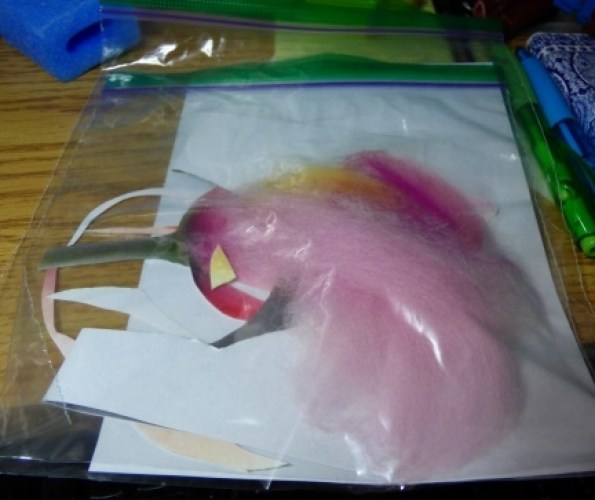
I also collected the pieces I had used for the template, the reference picture and a bit of the wool I had used. I put them in an extra-large sandwich bag to keep as a reference. I will eventually get around to organizing my work into a binder showing photos and references used on each project.

 27-28


I hope you had a wonderful Mother’s Day and Maybe even received a mother’s day present. (Possibly tulips or some very nice wool? Or the whole sheep?) Even many years after having expired from old age, my furry kids sent me a spectacular felting book; “Landscapes in Wool, the art of needle felting” by Jaana Mattson. I am looking forward to reading more of it. The back part of the book has paintings in felt she has made while the front half has step-by-step instructions on how she has made some of her pieces. I’m always intrigued to see how other felters work and see if there is something they are doing that I could incorporate to improve how I work.


It’s going to be 23c today so I guess spring is over and it’s time to get the 2 pails with dahlias out to their planters. After a call to Canadian Tier, I found out the garden center is open and the lines were much shorter in the evening (do not tell anyone, I still have a couple more plants to find).  Glenn came with me. he pushed the cart I pushed the walker and selected plants. I was successful and got most of the herbs and vegetables as well as a purple Raspberry and an exotic-looking honeysuckle! We put all the pots tucked between the planter boxes in the driveway.

29-30 No felting for me until I get most of this planted.

I also checked out the front garden the tulips are trying their best but are not going to like this weather.

  31-33 The later spring garden


 34  This is the same tulip I was felting. Now it is almost finished blooming and will soon drop its petals. What an amazing colour change!

I hope you have been inspired by spring. If your own garden has not inspired you this year then I hope you will find inspiration here and borrow mine! (Maybe just ignore the construction sign, though it is colourful!)