Wet felted Hat Workshop

Wet felted Hat Workshop

Sorry if this is popping up for you for the second time. I had to remove it last time because I posted on the wrong day. It seems I can’t read a calendar.

Last Saturday I taught a felted hat class. I had 6 students doing a variety of styles. I was sure I took more pictures but they are not on my camera so I must be doing something wrong. Thankfully, some of my students had pictures I could use. Thanks to all of you.

Let’s start with Dani’s hat. She wanted a cloche-style hat.

Then it was almost right but she wanted to flatten and shrink the crown. So, using her head ( it is your best hat block) we worked with the rubbing tool to get the hat to where she wanted it. She did do some more rubbing herself.

Finishing a felt hat on Debs head


This is the finished hat. You can see she used a different colour inside.

Next is Leanard. Leonard wanted a Robin Hood hat. this is a hat that perches on top of your head rather than fitting down around your head.

Here is the layout


And the finished hat. I say finished, but Leonard is going to work on shrinking the length more.


Next is Christine. She wanted an oversized beret.

layout for a wet felt berete


The finished hat. I think she was happy with it. What do you think? LOL


now we have Luna who wanted a witch hat. She picked a great deep purple for it.


This hat was a big layout so it took a little longer from start to finish and we ran out of time. Luna took it home for the final shrinkage and fulling of the brim to stiffen it.

finished hand made felt witch hat.


Lastly, we have the 2 I don’t seem to have taken any progress picture of.

Barb’s Cloche hat. She used some silk hankies to decorate her hat they won’t show up well until it’s dry.

And Susan’s folded brim hat. The turquoise was such a good colour for her.

All in all, it was a really fun class with great results.

Made in Canada: Sustainable Fibre Arts Conference 2024

Made in Canada: Sustainable Fibre Arts Conference 2024

This is a guest post by Charlotte P. of The Craft Council of Newfoundland and Labrador. I thought our readers would like to hear about this interesting conference being held in September. Thanks for writing the post Charlotte!

The Craft Council of Newfoundland and Labrador has the pleasure to announce the
Made in Canada: Sustainable Fibre Arts Conference 2024. The Conference is taking
place from September 19 to 23, 2024, in Gros Morne National Park, a UNESCO
World Heritage Site, in Newfoundland and Labrador, Canada.

Photo of eco printing on fabric with hands rolling up leaves and flowers into a piece of fabric.

Last held in 2015, our Fibre Conference brought presenters, participants, and visitors
from all across the globe together to discuss the exciting developments in the fibre arts.
While sustainability is far from a new concept, sustainable textile practices are evolving
and being adopted by hundreds of artists in Canada and across the globe. Focusing on
sustainability and respect for the land, water and air, this conference aims to discuss
sustainable and ecological craft practices and materials, and how sustainability can
support rural and urban craft communities and move forward in the craft industry. For
more information, please visit www.fibrearts2024.ca.

Among the workshops offered will be foraged plant fibre weaving, animal hide tanning,
papermaking with recycled textiles and flax fibre, and block printing with natural dye
mordants.

Photo of two hands holding a handmade loom and beginning to weave natural materials.

If you need a break from the hands-on activity, there will also be lectures and panel
discussions on sustainable animal fibre harvesting and processing, Indigenous fibre
systems, and other topics! Attendees will have the opportunity to connect with other
fibre artists during the conference’s meet & greet luncheon and cumulative artisan
market. For more information on the conference’s schedule of events, please visit
https://www.fibrearts2024.ca/program.

Sustainable Fibre Arts 2024 registration logo.

Registration is open now until July 31, 2024, with special early bird pricing open until
March 31!


Let it FLOW!

Let it FLOW!

I am fairly open about my mental health issues. I have spent the last few years searching for something that makes me feel better. Just in my short time writing for FFS, I have showed you a plethora of things, I’ve tried. No one is more surprised than me, to find my zen in quilting: English Paper Piecing (EPP) to be exact.

You might be thinking – isn’t that the kind of quilting where you sew everything by hand? Yes, that’s the one. It turns out, our grandparents had this figured out, a long time ago. I say grandparents – male and female – because in my genealogy, the men were as deeply steeped as the women. I come from 5 generations of tailors and sewers, and they were equally adept with needle and thread.

As an adolescent, I enjoyed the slow stitching of needlepoint, but detested machine sewing. My machine sewing was never good enough, for my (evil?) home economics teacher, and I just wanted to get my assignments over with. That experience left me scarred. I would not touch a sewing machine, to save my life. (I recently signed up for a FFS machine embroidery class, with Ruth Lane, and barely made it past threading the machine.) It must be the slow process of hand stitching, that makes the difference for me.

My happiness hand quilting, and all of the positive things I’ve heard about this subject, were not a good enough reason for me to post about it. I needed to offer something solid to our readers. I did a search this morning to see what (if anything) I could find. It turns out this has been looked at, and there are some findings that make sense. This is where the word FLOW comes in to my discussion. On a podcast called “Conscience Chatter,” episode 297 talks with “Lizz Leral, the Executive Director of Quilting for Community.” https://consciouschatter.com/podcast/2023/6/6-episode-297-lizz-leral-quilting-for-community

She states “There’s this idea of being in the FLOW state, or this feeling of being entirely in the moment and hyper-focused, and in a sort of zone.” (Lizz) She says that in today’s rush, in everything we do, we have a difficult time finding the zone we need to refresh. She mentions, a book called Stolen Focus, and I am paraphrasing here… once we are in our stitching zone (or felting zone) and we are interrupted, it takes an average of 23 minutes to return to our zen state. She says, “Hand Oriented activities help transport us” to that special place. This is further backed up by Oxford University, Journal of Public Health, Volume 34, Issue 1, March 2012, Pages 54-59: “The relationship between quilting and wellbeing” https://doi.org/10.1093/pubmed/fdr041

So, I have been slow stitching crazy quilt hexagon flowers.

Close up of a hexagon flower block. One center hexagon, surrounded by a row of six hexagons.

I have been enjoying this slow/flow, stitching so much, I joined the Tales of Cloth, 2024 Ice Cream Soda Quilt Along. I started with a limited fabric collection, and quickly discovered my idea wasn’t going to work as planned. A little bit of FLOW made me discover, I can pivot in a different direction: everything will work out. Instead of perfection, I will allow my quilt to become what it needs to be. There is no rush on completion, it will take as long as it takes. It’s meant to be a learning process, and sometimes that takes a little time.

Block #1 – Ice Cream Soda Quilt. I started this project with a fabric series, from Ruby Star Society, called Sugar Cone.

I hope this post, encourages you to…let it flow, too.

Capi

Felt and Stitch Phone Cover

Felt and Stitch Phone Cover

Lyn

For this quarter’s challenge I made a cover for my phone because it was embarrassed to be seen in its temporary cover – an old trainer sock.

I put down 4 fine layers of white merino wool then rolled it until it became very firm pre-felt.   Inlays from a scrap project were placed on it to make the design for the front and back of the phone cover.  I then rubbed the felt from the back, so as not to disturb the design too much, until it was fulled.

White merino with felt inlays

When it was dry I added wobbly stitching, cut the felt to size, then stitched the pieces together.

stitching into felt

You may have noticed that there are only 9 finger-holes in the dialling ring instead of 10 and I’d like to say that it’s artistic licence but in reality I simply ran out of space!

I made a fabric lining …

sewing a fabric lining

… to complete the phone cover.

felt and stitch phone cover - front

felt and stitch phone cover - back

The cover will protect both the screen and camera lenses when the phone’s knocking around in my handbag 🙂

Adventures in colour (Part 1).

Adventures in colour (Part 1).

Ions ago, I purchased all the bits and pieces that I needed for acid dyeing.  I never lost my enthusiasm for it (in principle!).  I listened to my textile friends waxing lyrical about dyeing. If I am to be perfectly honest here, I lacked both the knowledge and the confidence to try it.  So when I came across a dyeing course which was being run over the four Tuesdays in November, well, I didn’t have to think twice, I immediately booked it.  The workshops were run by an Irish Textile Artist and all round nice person, Sharon Wells (https://www.sharonwellsart.com/).  Sharon provided all the equipment and fibres but mentioned that we were free to bring along any fibres we wished to experiment with over the course of the workshop and of course our limitless curiosity!

Week 1:

During week 1 we worked with Jacquard Acid Dyes.  Once Sharon explained the basics of what would and would not work with these dyes, she set us to work, initially teaching us how to secure hanks for the dye pot.  We were each given our own pot to work with.  Then we got down to the fun work of choosing dyes, testing fibres and dyeing.

Our first experiment was with solid colour.  We each threw a variety of fibres into our respective pots and got to work.  It was great fun watching as the colours developed.  I had chosen orange for my first test and it was just so exciting watching the different hues develop.  I have prepared short slideshows of the results of each of the experiments over the four weeks.  Details of the fibres are included in the captions.

Next, to some of my fellow participants horror, we saw Sharon cut into an old shrunk felted jumper.  We were each given squares and shown how to randomly sprinkle the dye powder onto the surface.  This time we used a minimum of 3 colours on the sample.  Once prepared it was popped into the dye pot and other fibres were thrown in not to waste the dye that came off the sample.  Here are my results.

By this stage we were all getting really excited.  This was like alchemy or as one of us said, witchcraft (which is possibly a more accurate description as we all gathered round one of the cauldrons (yes there was one, the rest were pots))  and saw the reactions of the different coloured dyes we were adding to the pot full of fibres.  We were learning (among other things) how to control where the differed colour dye permeated the fibres and how the colours mixed throughout the process.  Here’s what I produced.

Week 2:


It is amazing how disciplines have their own languages. Mordants; fugitive colours; substantive dyes – Sharon quickly demystified all the terminology – a real confidence boost – then she produced a vat of fibres which she had been seeping in the mordant for some days.  She also gave us a variety of pots which we could work from.  Then came the fun ‘show and tell’.  Sharon had been growing and collecting various flowers and plants over the summer months.  She dried these especially for the session so we each got one to work with.  We had dried containers of marigolds, rose petals, sunflower petals, sunflower heads, and ground up nettle.  I got the nettle to try.  One of the participants opted for fresh eucalyptus.  We set pulling the dye out of the plants, straining it and then to dyeing our fibres.  Here’s our progress and the results:


  • nettle powder some of which has lost its colour from the sun, the remainder is a moss green
  • The beautiful and patient dog Loki with his ball
  • The marigold petals produced a delicate creamy result which differed in shade depending on the fibre used
  • The fresh eucalyptus produced a delicate green/yellow result which differed in shade depending on the fibre used


Then as a further experiment we took dye from a couple of the dye baths and added different components to see how the dye reacted.  We used tin, chrome copper and vinegar.  The results were surprising.

Top is the rose dye
middle L/R vinegar, tin, chrome, copper
Bottom is the Sunflower petals


I was disappointed with the colour of the nettles which were a murky colour.  Also the powder from the nettles made the fibre really grainy and unattractive.  I thought I would see if I could use fresh nettles from the garden.  Sharon had offered me some mordant to bring home for this experiment and like an idiot I forgot it.  So, based on an earlier comment she had made during the class I decided to try using aluminium foil as a mordant.  I steeped the fibre overnight and made up the dye which I strained.  Then I dyed the fibre.  The result is a beautiful soft green which I am very pleased with.  I am not sure that the mordant took as only time will tell if the fibre loses its colour but it did not happen when I rinsed it.  The grains from the original nettle powder were still scattered throughout the wool fibre so I took my carders to the Kerry sheep fibre.  Although I have yet to be convinced that natural dye is an avenue I want to pursue further I really enjoyed the day and the learning.

  • a sample of the fresh nettle dye looks green brown, like weak tea

I have so much to share from these four weeks that I will save weeks 3 and 4 for my next blog post. A million thanks to Sharon for facilitating such an interesting set of Tuesdays last November.

FANTASTIC FUNGI

FANTASTIC FUNGI

I don’t know if any of you are fantasy fiction fiends.  Some years ago now I read the first of a trilogy by Alan Dean Foster, called Spell Singer.  It was about a man in the 1960/70s who managed to slip through time/space to a different dimension of our world in which animals wore clothes and talked (including Mudge, the man-sized otter with a foul mouth!)  So why am I mentioning this?  Well part of the story took place in a marshy area inhabited by a lot of very depressed mushrooms and toadstools with faces, which moaned and groaned and exuded misery, which was catching!

My mind immediately trotted down the rabbit hole of needle felting mushrooms – with faces.  Mushrooms and toadstools of different varieties would have different temperaments and expressions.  I thought of the white spotted red capped Fly Agaric; plain red capped Gomphidus Roseus (with a name like that they would definitely look odd); white button mushrooms; brown chestnut mushrooms; large flat horse mushrooms; fairy ring toadstools and, eventually, bracket fungi.

So I was off.

I decided that the bases of the fungi with stalks would represent a piece of turf, probably woodland or scrub.  I had purchased, a few years earlier, some fibres sold for lining hanging flower baskets.  It never got used for that because the bulk of it consisted of sheep’s wool, and I considered that it would be wasted if used for it’s original purpose.  From the look of it, and of the quantity of “foreign matter” caught up in it, it was the sweepings from a mill floor or even a shearing shed.  (I think that this was a good way of using up what would otherwise be wasted.  Unfortunately I don’t think it’s available now.)

All the material was roughly dyed green but luckily so patchy was the dyeing that it was not a flat uniform colour.  The different thicknesses of the fibres, the kemp  and the vegetable matter all seem to have picked up different shades and tints of green.  Just what I needed.

To save on this precious material, I used some scrappy scoured merino bits as a base for the underside of the grassy humps I was making, and then topped them with the basket fibres, and needled the lot together.  I was delighted to find that, even close up, the result did look like a bit of scrubland grass.

In each case my fungi were to have faces and, hopefully, characters.  I thought that as they were all wearing hats/caps, I’d place the faces at the join of the gills and the top of the stalk.  I also decided that, rather than just a single lonely fungus,  I’d make families.

4 felted Gomphidus Roseus mushrooms with bright red caps and daft faces
Gormless Gomphidus Roseus mushrooms

3 Fly Agaric mushrooms. Red caps with white spots and faces with blue eyes
Fly Agaric Mushroom family – Granddad, Mum and Dad with baby

4 felted large flat mushrooms with hairy brown caps and black gills, with faces
Hairy Horse Mushrooms

The horse mushrooms are hairy, not because they were horse mushrooms but because I used some Herdwick fleece for the caps and didn’t know about shaving in those days.

In the end, the button mushrooms and the chestnut mushrooms not actually having any gills on view, I placed their faces on the top of their caps.  I also gave the chestnut mushrooms Fymo eyes – little painted and varnished balls on each end of a piece of wire.

3 large button mushrooms and one small mushroom with bright blue eyes
Buttons family

3 Chestnut Button Mushrooms with surprised blue eyes in the top of their caps with 2 baby buttons
Chestnuts. Looks like the Dad on the left has 2 wives and children – naughty!

The fragile, skinny fairy ring toadstools were to sit together in a circle, as they do, on a larger piece of grass with so much magic erupting from it that it became visible.  This was represented by whisps of iridescent trilobal fibre (of which I have lots.)  There was also magic appearing on the tops of their caps.  These were made from scraps left over from a large piece of white merino felt in which a large quantity of the iridescent trilobal was embedded.  (More about this felt at some time in a future post.)

Ring of tall thin white and iridescent toadstools facing inwards, with iridescent fibres in the centre of the ring
Magic Fairy Ring Toadstools – chatting. What about I wonder?

These were the main families I made, but in the end I did make quite a few solitary mushrooms and toadstools (perhaps that’s why they were so melancholy?)

It was while I was making the Horse Mushrooms, which have black gills and therefore black faces, that I started to think about bracket fungi and Welsh male voice choirs.  I can hear you saying “why?”  It was the black faces.  I am half Welsh. My mother’s family come from a South Wales mining valley, Ogmore Vale, and all my Welsh uncles were miners (hence the black faces), and they were all singers.  (I even got to go down a pit on a rare holiday to stay with the family when I was about 7 or 8 – and I cried for the poor ponies down there even though they were well looked after).  Anyway Welsh miners were magic to me, and having been thinking about magic since I made the fairy ring toadstools, I wanted to create a magical tree stump on which to grow a male voice choir of bracket fungi.

The inside of the tree stump was made up of part of a Jacob fleece which had absolutely refused to felt, and subsequently ended up in the cats’ bed – disappearing over time bit by bit into the middle of other needle felted items.  I covered the stump in more of the basket fibres to represent a rotting, moss covered piece of wood. Thanks to the unevenness of the core Jacob I was able to easily create a surface with the ridges and dips usually found on oak trunks.  There were also what looked like various entrances to the hollow centre of the stump.  I lined these with black or dark grey fibres to give them depth and added some mixed brown and iridescent fibres to represent magic escaping from the stump.  In two of these I also added a pair of (Fymo) eyes peering out at the world.

close up of tree trunk showing bracket fungi on left and 2 holes with eyes peering out
All that can be seen of the internal inhabitants

I added a sort of representation of tree age rings on the top of the stump, but also allowed the hole in the middle of it to remain and added a lot more escaping magic fibres.

Close up of felted tree stump showing top - tree rings and "overflowing magic".
Overflowing Magic

I made a lot of bracket fungi, both representing individual singers (baritones and basses – big and bigger ones)

close up of several bracket fungi with faces, large ones to the front, smaller towards the back
The basses and the baritones

close up of one large bracket fungus with face, blue eyes, large nose and open mouth showing toungue
Big Bass himself

And Tenors, since they were smaller, in groups of three.

close up of tree trunk showing 4 bracket fungi each with 3 faces
Some of the tenors

I know I researched a type of bracket fungus and was able to give them black “faces” on the undersides and brown tops with pale margins.  However I cannot remember what they were, nor can I find my reference pictures.  They may have been polypores of some sort.

Having made a batch of the “choir members” I needled them on to the stump, adding faces  with  singing mouths.  I attached the stump to an artist’s canvas board, 20” x 16”, which I had covered with a piece of cotton patchwork fabric, coloured in various greens, to represent the surrounding trees.  Originally I wanted to add a “dead man’s fingers” fungus, which could be conducting the choir, but at that time I had not heard of using an armature and it wouldn’t stand up on its own, so I gave up that idea.

A felted tree stump with bracket fungi with faces on a green background
The finished Tree Stump

My husband thought that the mushrooms would sell like hot cakes, but unfortunately I think I only sold one family.  I ended up giving the rest away, apart from the tree stump which I have retrieved from the attic.  I’d like to hang it on a wall in my workshop – if I can ever find a space large enough for it – if I can I might have another go at the dead man’s fingers.

Square #16 OVWSG Tapestry project and Template Transfer method

Square #16 OVWSG Tapestry project and Template Transfer method

As Ann told you the local guild, (OVWSG) is having our 75th anniversary this year. No, I have not been here the hold time! Although sometimes it seems like I may have been.  Unfortunately, I have been run off my feet getting my hubbies and my feet to all the Doctors and rehab appointments. Today was a OT, SLP, drop off forms at the Family Doctor and then on to the Neurologist and her nurse. We are final home again and finished dinner.

The post I started before all this began is languishing, needing more fighting with my old 2010 publisher program, it didn’t realize it was going to be used for illustration not layout as originally intended.  So a quick change of blog order and I am back on topic.

I too, have a square in the guild tapestry, it is #16. Ann gave me the bottom of the library, with buttresses and retaining walls showing through the trees.  Ann said it was appropriate since I have been guild librarian for a long time. Ok, that make sense. Now it is time to analyze the photo.

1) my square (#16), shows the Bottom of Canadian parliamentary library, retaining walls peeking out amongst the tree tops.1) my square Bottom of library, retaining walls peeking out amongst the tree tops.

Ann used a rounded pixelation modification to the original image. It is all a bit like looking at something without my glasses and I can’t get a sense of where the buttresses are and the shadows are obscuring the verticals…..mumble… mumble. Well two can pixeselate! After a bit of digging I got a different form of pixelation, using squares rather than circles to reconstruct the image. Ah, the buttresses are now visible and the phenistration makes sense and I can see the retaining wall placement more clearly!!! If I work from the square pixelation I can then soften it to something similar to the larger blurry blobs but maybe with a bit more recognition that it’s the library!

 2) Three versions of the image #16 (lower library and trees). Black and White, Blurry and square pixels 2) Three versions of the image #16 (lower library and trees). Black and White, Blurry and square pixels

It is also often helpful to have a black and white version of an image to get a better idea of tonal value. So i printed off one in grey scale too.

If you look carefully, you will see that the felt ground I have selected is 100% wool in a mid-tone grey. This does not lend itself to the “tracing” or “light box method” of transferring an image.  Have no fear, all those commercial art courses have given me sneaky devious alternative options! Let’s go to one of my go to favorites, the template method. Its not one I see used by most felters and it’s a good back up if you are working with felt you cant see through. It will require 2 identical images (so just photo copy a second version of your reference image). It can be helpful to push up the contrast a little to help you see edges and group shapes together. for this one since it was a complicated piece of architecture and lots of early fall foliage I went for more sections than I usually would.

Step 1. Take one of your two reference photos, cut it so any border is removed (so its your finished image size.)  See image 2 for trimmed images.

Step 2. Trace around the outside of the image. I miss cropped the square pixcilated image and it’s a bit of the building is missing so I have had to keep it shifted to the right.

3) use a permanent marker to trace around the reference image3) use a permanent marker to trace around the reference image

4) I have added 3 of the 4 lines. (I used the Blurrier image since it was the correct finished size. I had miss trimmed the image I had reformatted.)4) I have added 3 of the 4 lines. (I used the Blurrier image since it was the correct finished size. I had miss trimmed the image I had reformatted.)

Step 3. With good fine paper scissors, start usually with the back ground and cut away a section. (usually it’s the sky but this one doesn’t seem to have sky.) Keep the carefully cut off piece and put it in a zip lock baggie. (it is sometimes helpful to refer to if you misplace your segment lines.)

5) this is the reference I am working from so I can understand the architecture better. I will use the blurrier image as a secondary reference to help with the colouration as I start to felt.5) this is the reference I am working from so I can understand the architecture better. I will use the blurrier image as a secondary reference to help with the colouration as I start to felt.

Step 4. Make sure your image is sitting exactly as it should be in the outline you just drew. Use a fine tip permanent marker, (they do come in more colours than just black there some at the dollar store) to trace in the section you just cut out from your reference image.

  • TIP: sometimes it is easier to work with a medium or heavy weight of cardstock or cover stock  rather than light weight paper, if you are having trouble with this method try the heavier cardstock and see it that makes it easier for you.
  • Tip: if you are using pre-felt, or the soft craft felt (usually not made with much or any wool), and not the wool commercial felt I am using, you may find making dots (stippling) rather than trying to make a line works better to indicate an area. For a complicated under drawing, a good quality ground (commercial wool felt with a smooth pressed surface) will be the easiest to work on.

6) More pieces of the template have been cut out. By tracing around the remaining part as each piece is removed, gives a good indication of the blocks of colour or structure that will be needed when felting.6) More pieces of the template have been cut out. By tracing around the remaining part as each piece is removed, gives a good indication of the blocks of colour or structure that will be needed when felting.

Step 5. Cut out another section (again, usually working from the background towards the foreground will be most helpful, but use your judgement). Then add the cut out section to your zip lock baggie with the previous piece. Position your template (the reference picture with parts removed) so it fits exactly in the outline you made and repeat step 4. (Trace the section you just cut out.)

Keep going, carefully cutting out and tracing, until you have ether all the picture cut and transferred to the felt, or have enough of it marked out that you can add the rest of the detail as you felt.

I have gone to an extreme in the amount of detail when cutting out, but you can see how much detail you can get with this method.

The other thing I wanted to point out was about this good quality felt  (commercial, probably hot pressed), is that you can add more information for yourself, by using various sorts of pens and markers. I tried an old green permanent marker to indicate some of the deepest but brightest greens. I used a red ink pen to note the deepest red foliage. The yellow was one of two yellow highlighters. I also gently shaded areas of deep shade or dark roof with the black I was using to outline.

This slideshow requires JavaScript.

 7.1 -7.3 Using makers, pens and highlighters to add more detail into the section of the templated image I have outlined onto the felt.

I just have a bit more detail to add to the trees but I am almost ready to start adding wool. This is an easy way to transfer an image and you can get a lot of detail if you want to take the time.


Now that I have an image on the felt and ready to go, what else will I need to have, to make this as portable a project as the Moose bags were?

I have part of an old garage sale sign made of Coroplast (it is the fancy name for plastic cardboard!). I have added a bulldog clip and the reference photos to it.  The felt has been placed on one of my 8×10 x 1.5” thick wool felting-pad. I held it in place with a couple sewing pins.

Coroplast and Bulldog clip hold reference photos8) Reference photos on coroplast and felt ground on wool mat.

I have missed a step, as part of the analyzing the photo, I compared the colours in the image to the web site for one of the local fiber supplier of coreidale fiber (unfortunately its top, not roving, but it will still work). From the colours I selected I can blend the rest.

9) the colours I selected from the reference photo. Coriedale top and wool batts from Wabi Sabi Ottawa.9) the colours I selected from the reference photo. Coriedale top and wool batts from Wabi Sabi in Ottawa.

If you are not comfortable with pulling colours from your reference, you can use a window (a cut a small rectangle in a sheet of paper or card stock) this will isolate a small section of colour so it is easier to see what you are looking at. There are also sites on the internet that will pull three or four main colours from an image for you. Lastly, you could user the Colour Cards (I showed you the ones I got for my niece for x-mass 2023).

10) Essential Color Card Deck and similar packs of cards,  available for commercial arts, at graphic supply stores and amazon.10) Essential Color Card Deck and similar packs of cards,  available for commercial arts, at graphic supply stores and amazon.

“Essential Color Card Deck” (much cheaper than the pantone set), you can use these cards to match colours in your reference photo. Then they will also make blending your fiber to match the selected colour card easier, since it is isolated from the reference image and adjacent colours.

I have added 6 to 8 inches of top for each of the above colours, separating them into a few colour groups and have added a dark charcoal and a white to help make tints and shades.  I have also added the mini pet combs to the bag of fiber baggies. (I promise i will make tiny carder covers for them when i get time to work on the sewing machine. In the mean time they are in a heavy weight smaller freezer bag.)

 11) Mini pet combs sitting on top of the larger zip lock bag of small amounts of fiber.11) Mini pet combs sitting on top of the larger zip lock bag of small amounts of fiber.

12) starting to blend the fiber.12) starting to blend the fiber.

The wool mat with project fit in a large freezer zip lock bag. The reference images on corroplast and a separate large freezer bag for the wool and mini carders fit with the felt mat bag in my moose bag. If I can find a comfortable chair in a waiting room, I can use the walker seat as a table to work on, as I have while we waited for appointments today.

Moose is still a very gregarious bag, causing many people to come talk to us (or more likely to moose). I will have to remember to bring guild business cards and the web address for the Felt and Fiber studio blog to hand out to all the people Moose keeps flirting/chatting with, who may be felters but just have not realized it yet!

Working on my Tapestry Piece

Working on my Tapestry Piece

The guild I belong to is 75 years old this year. One thing we are doing to celebrate is a group tapestry. We have a picture of our Parlement Buildings in the autumn, divided it into 24 pieces and 24 members are doing one square each, in whatever technique they would like. The picture is heavily pixelated to blur it and make it easy for people to use different techniques.

They are due March 4 2024. I thought I better get started. I am the one organising it so I shouldn’t be late with my piece. I should credit Jan Scott here, it was her idea. I also have to credit her with great cunning as I am not sure how I ended up being the organiser.

Anyway, this is the square I have. It is off to the side of the picture. Because I have put off doing it, I was wondering why I didn’t pick just sky or trees for myself.

pixelated picture of sky and leaves

I had to go look to figure out what the dark piece sticking up was. I thought it might be a statue but seemed too tall.  It is a pointed crenelation on the west block of the parliament. The building is hidden by trees and the angle of the shot. The pixelation and then enlarging added a white pixel where there shouldn’t be one.

I wanted to wet felt and nuno felt a piece so I started with some prefelt. A thicker piece of white with orange-yellow for the sky and green for the trees to start, then added some fibres

felt background with some loose fibres on top.

I realised this was going to end up too big so I moved everything in, then added the silk for foliage. I want them to have texture. I had to root through 3 large bins and a small bin to get all the colours I wanted. I do not know why no matter how much fabric you have it’s never the colour you need. I wet the background first and I wet the silk before putting it down. Wet silk stays where and how you put it.


wet felt background and wet silk scrunched up on top

This is what it looked like when I quit for dinner and the next morning dry. Everything looks so much darker when it’s wet.

wet and nuno felt progress.   wet and nuno felt progression, dry


The next morning I rinsed the soap out with hot water and started some hard fulling to get it shrunk to the right size.

felt rolled up in plastic, ready to full

ready for cutting

finished felt ready to cut

And finally the cutting. You can sort of see how much it shrank. The whole piece started out the same size as the red mat. the cut pic is 6.6 inches (16.75 cm) long and 6  inches (15.24 cm) high.

felt tapestry piece cut to size

and the picture and the piece side by side. You can see one section of double layer silk didn’t stick down so I will fix that with a needle. I need to add in the crenellation as well with a needle.

With any luck by my next post, I should have it done.

And to lift everyone’s spirits and as proof spring will come here are early (sneaky ram) lambs born just a few days ago on a lovely warm and sunny day. they are not great pictures but the moms were sure I was a secret axe murderer or perhaps a wolf in people clothing and the lambs pick up on that and no one will give you a decent pose. and then add a very scary phone camera and there really is no hope. Good thing they are cute anyway.

2 black lambs with their mom 1 black lamb and 1 white lamb with their mom


Tips for Taking Photos of Your Fibre Artwork

Tips for Taking Photos of Your Fibre Artwork

This is a guest post by Dani D. Thanks Dani for your photography expertise!

Part 1 of 3: Telling the story

Hi! I’m Dani and this is my first post here, though 2024 marks my 20th (!!) year of blogging. I started blogging about raising my family, and then about photography. Now that my kids have grown up, I’ve moved my bloggy thoughts to a new home at Curious Crone, so feel free to come visit me there some time. 

Ruth generously invited me to share a few tips about digital photography and I had so many thoughts it turned into a trilogy. Today, we’ll talk about telling the story and basic tips on using your smartphone to take better photos of your fibre projects. In later posts, we’ll talk about the two most important factors that will affect your photos: light and colour.

In many ways, taking photos of your fibre arts projects is easier than photographing humans. The fibre art doesn’t stick out their tongue when mom is not looking (this happens rather a lot in my family photography business) nor do they give that tight-lipped fake smile while stage-whispering out of the corner of their mouth to the other subjects in the photo “if you don’t behave for this photos I will take away your devices for a year!” 

First, a few words about smartphones and apps. For this post, I’m thinking mostly in terms of taking pictures with your phone. There are two terrific free apps for editing photos: Google’s Snapseed and Adobe’s Lightroom. (And yes, you really should edit your images to polish them – it can make all the difference in the world.) I use Snapseed on my iPhone and Lightroom for editing dSLR images on my Mac, but there’s a great version of Lightroom as a mobile app and as an online editor. Both Snapseed and Lightroom mobile apps are available for iOS and Android. Did I mention free? 

As every photography teacher will tell you, getting the image as right as possible before you press the shutter saves you time and effort at the editing stage. So whether you’re taking photos of a wet-felted vessel or your adorable two-year-old nephew, take a second before you click the shutter and think about the following things: 

  • Is the background clear of clutter? 
  • Do other elements in the frame complement or compete with the subject?  
  • What story am I trying to convey?
  • Would a different perspective tell a different story? (Try shooting looking up at the subject, looking down at the subject, zoomed in to fill the frame, zoomed out to show something as small in a large background, shoot down from overhead, shoot at eye level, shoot super close to illustrate a fine point of detail.)

If you start thinking in terms of the story you are telling, your photography will improve immensely. In fact, as a successful licenser of stock photos to Getty Images, I’d argue the story is more important than the technical criteria of the photo. Every successful image should tell a story, whether it’s about the texture of the piece or the shape, the colours or the light. The photo is not just a static thing, it’s an invitation to interact with your creation or your creative process.

Collage of photos showing variety of fiber art tools, artwork and supplies.

How do you begin to tell that story? Don’t just snap the photo as soon as you have your subject trapped in the viewfinder – compose your image deliberately and thoughtfully. For more tips and ideas around how to compose your image, search up ‘rules of composition’ for ideas like leading lines, rule of thirds, etc. 

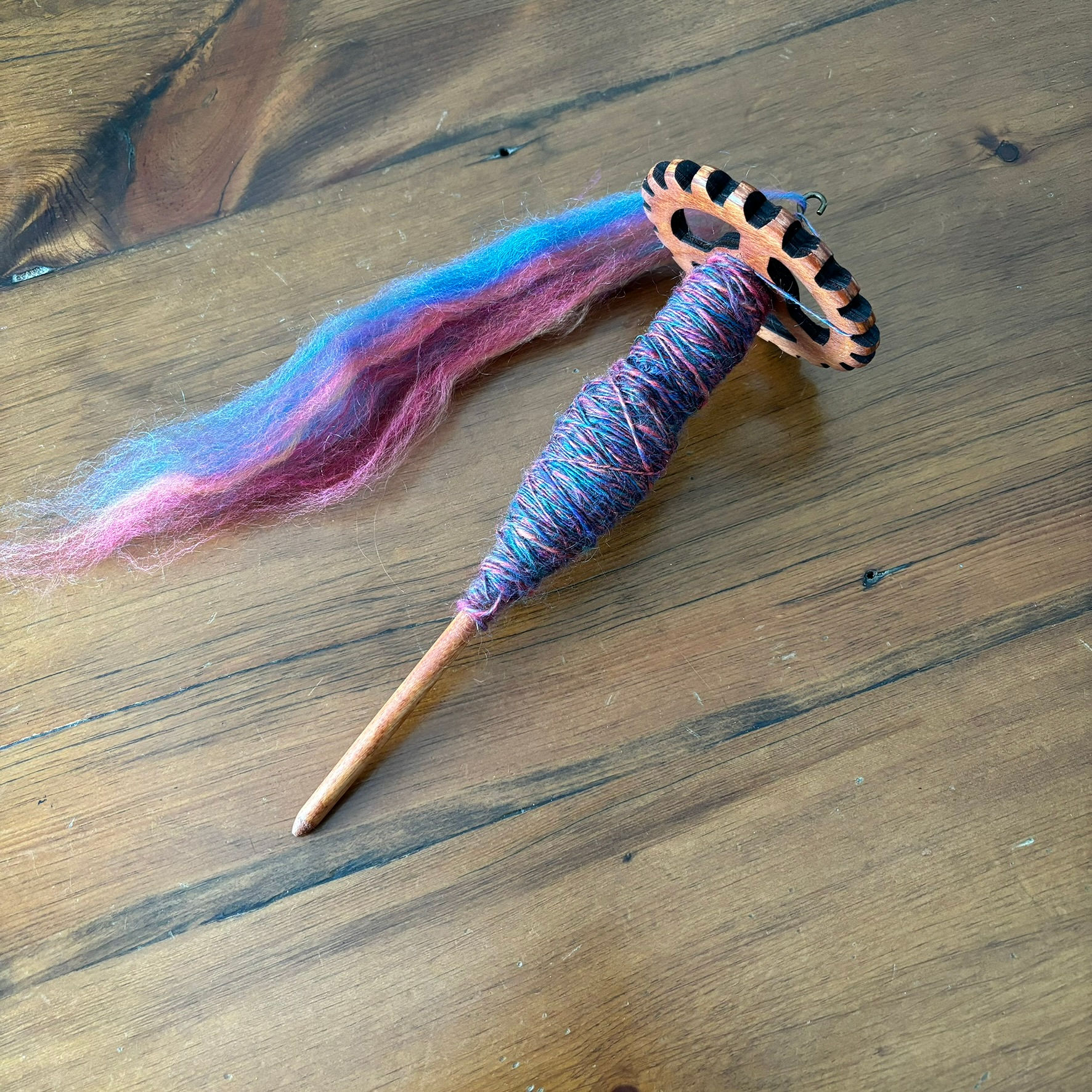
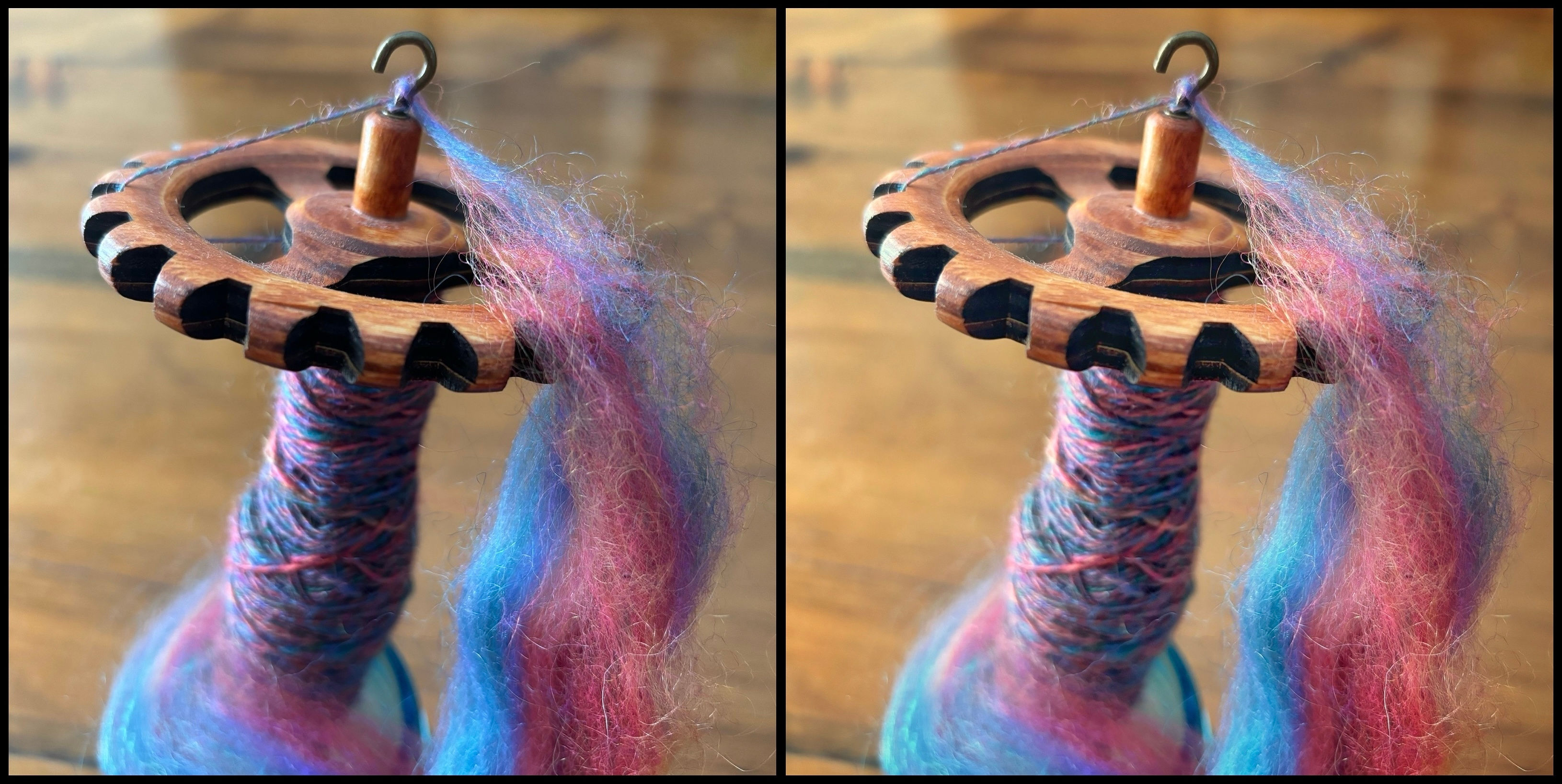
Here’s an example of me finding the story I wanted to tell. First photo, basic spindle and wool. Not very interesting.

Drop spindle with blue and purple handspun yarn on wood background.

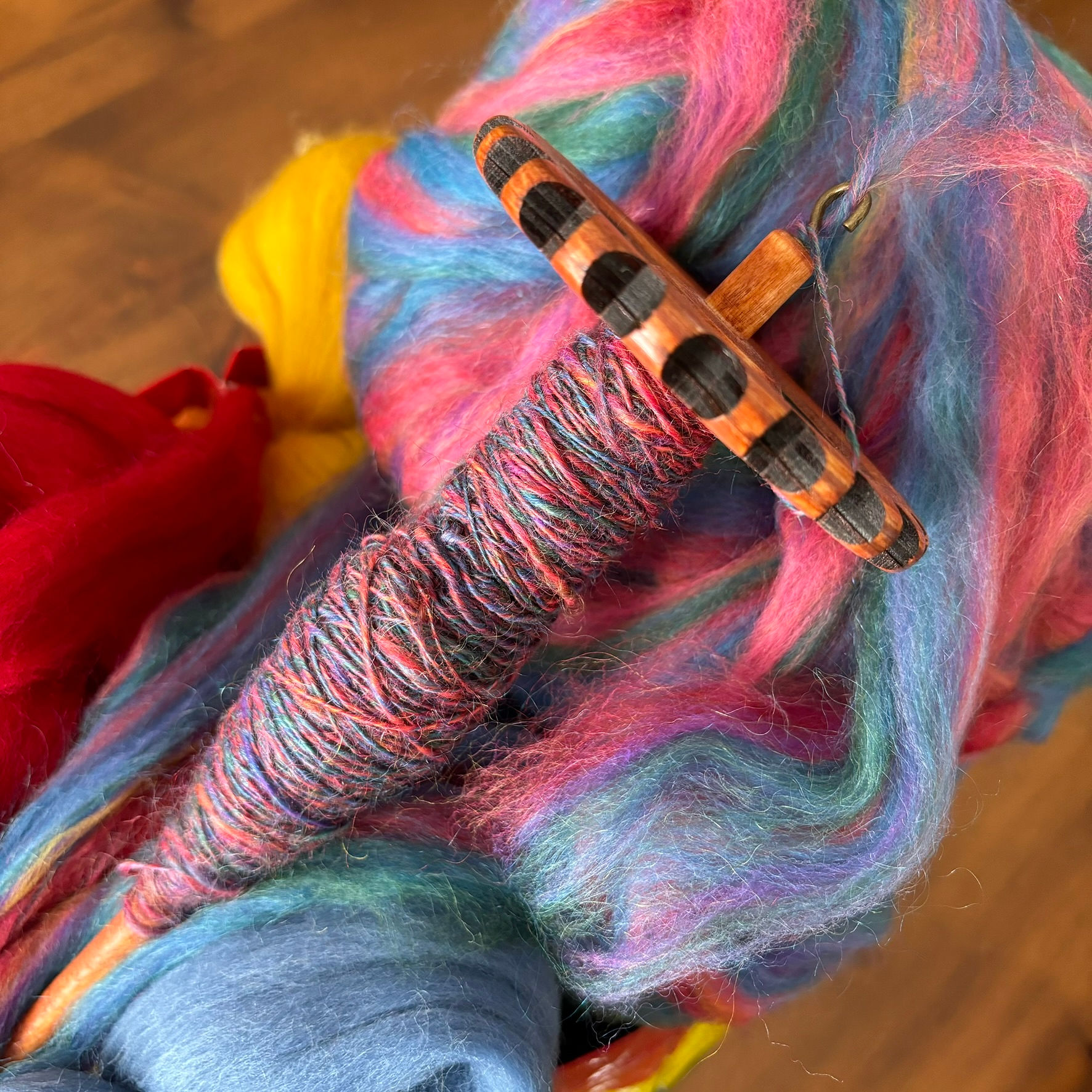
What if I added some fibre to flesh out the photo? Nope, too busy. Background is distracting focus from the subject.

Drop spindle with blue and purple handspun yarn on wood background.

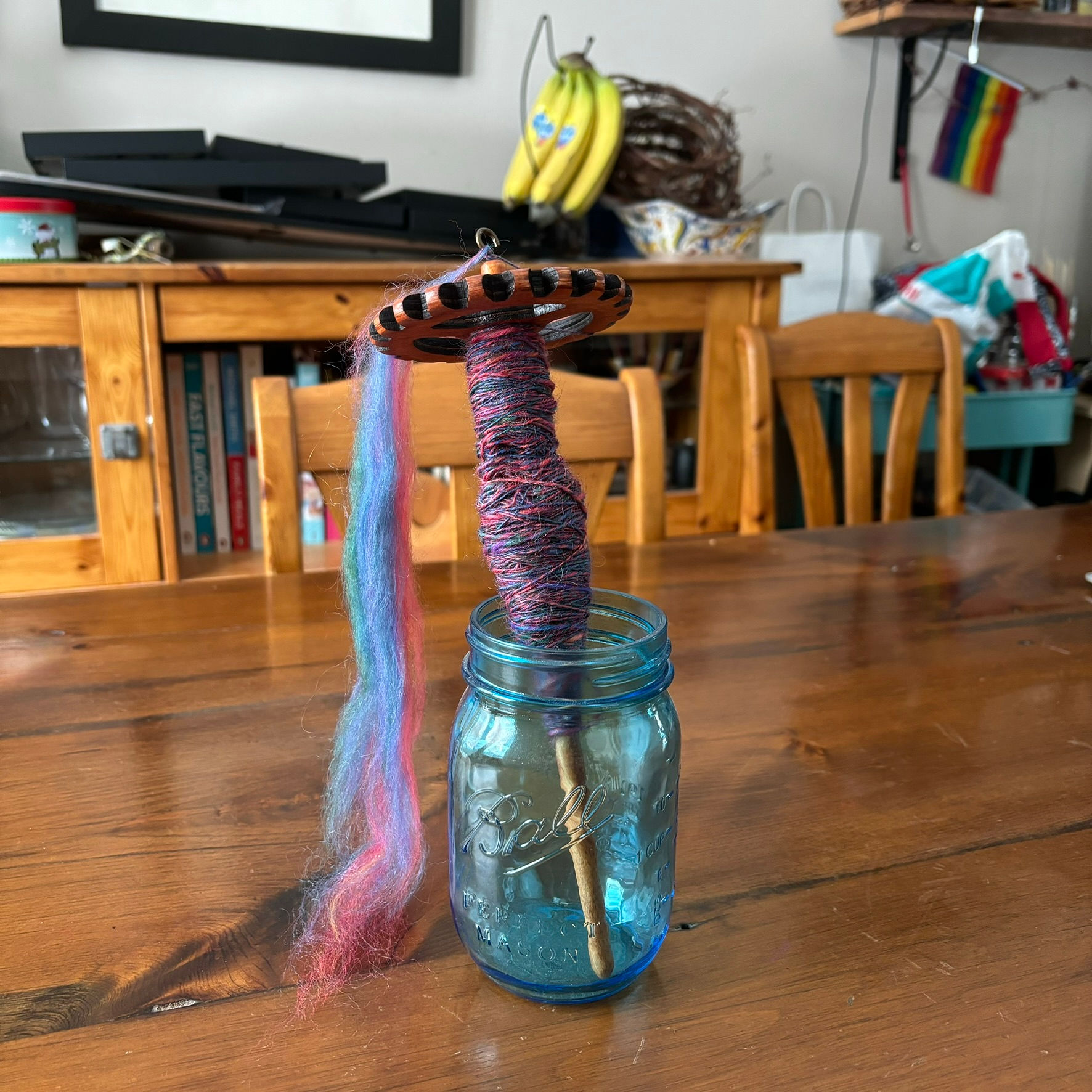
I love this blue mason jar. I could use it to stand the spindle up for a better angle. Except the background is too cluttered.

Drop spindle in blue mason jar on wood floor.

I’ve zoomed in and am playing around with the perspective.

If you’re making photos for an Etsy or other online shop, think about setting a mood with props and building a little tableau. An old piece of barn board and some cream linen evokes a sort of farmhouse chic mood, where a cup of coffee and an aloe plant set more of a lifestyle vibe. Just keep in mind that you want accessories to compliment your subject and not compete with it.

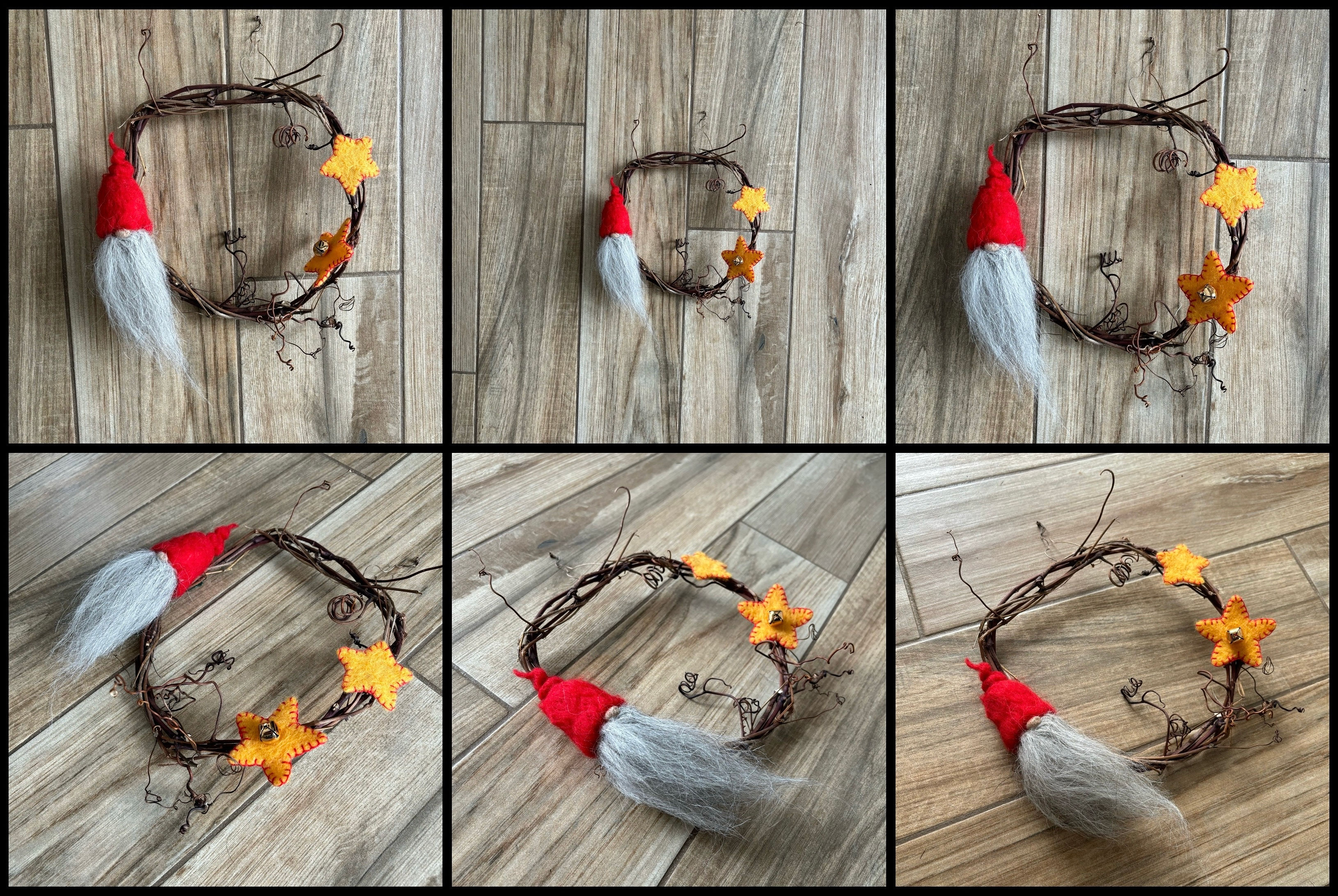
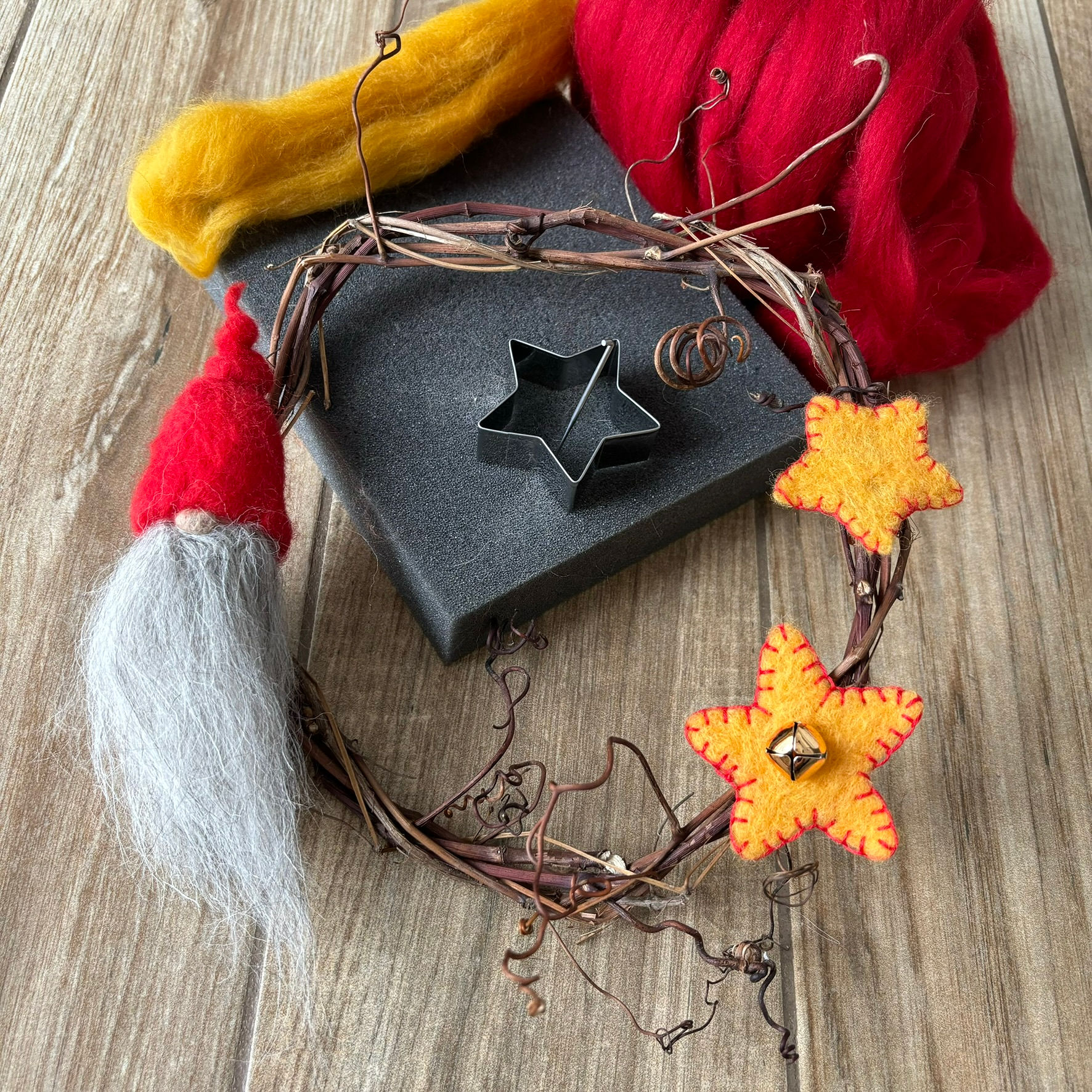
This is my kitchen floor, after a quick swipe to remove crumbs and pet hair. The first thing I noticed in the first photo was the seam down the middle of the wreath, which is a distraction. I played with the angles a bit but didn’t love any of these.

Collage of different photos of Christmas wreath on wood background

I pulled some loose wool and tools in to tell a bit of a how-to story. I liked that much more.

Collage of different photos of Christmas wreath on wood background

These last two photos show the difference editing can make. The first is straight out of the camera.

Christmas wreath with gnome and two stars on wood background

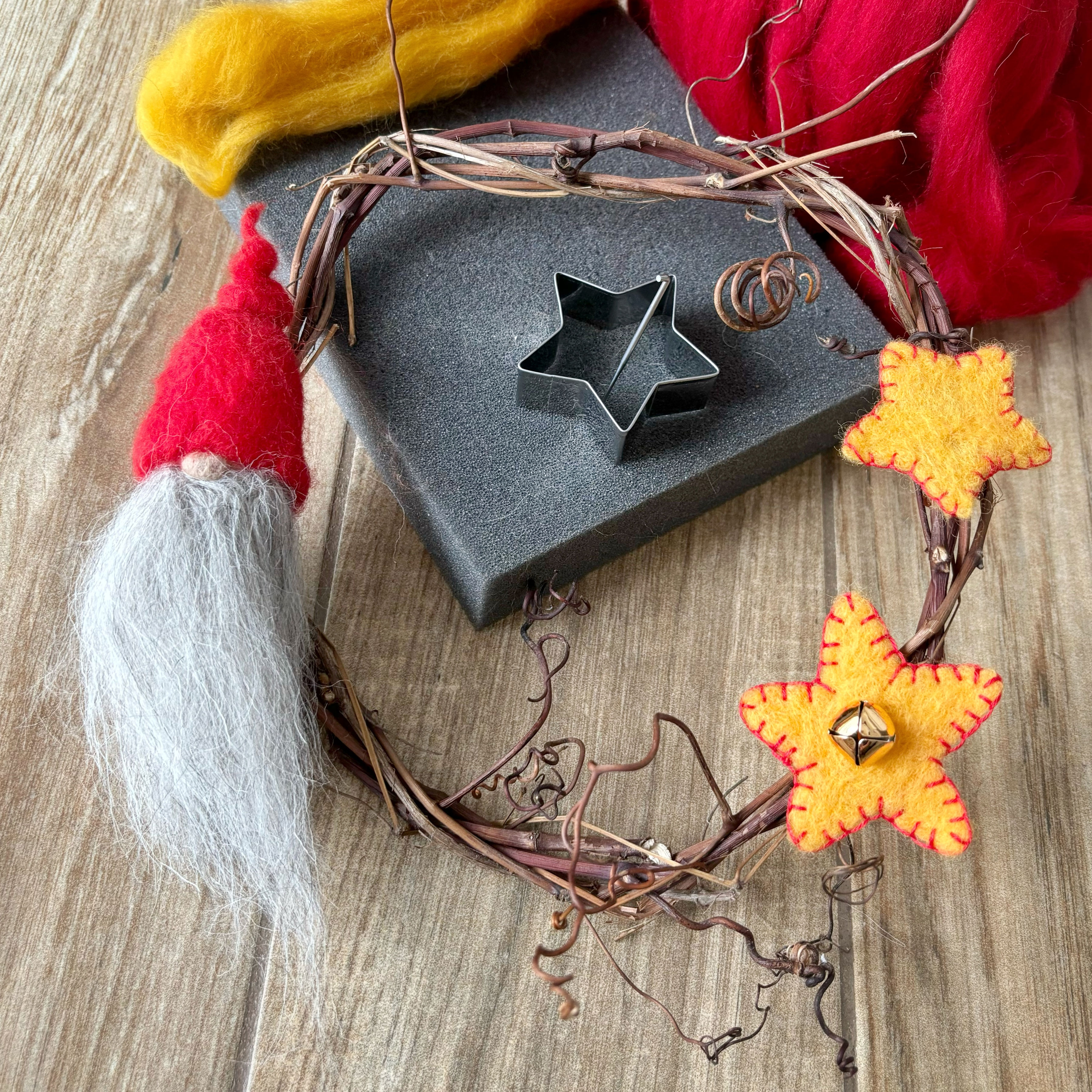
The one below has been edited for brightness (more), ambiance (more) and a slight rotation and crop to cut out the bit of gap at the top right to keep the viewer’s eye in the frame. Bright spots and colour will draw viewers’ attention, so use them deliberately.

Christmas wreath with gnome and two stars on wood background

I don’t like that I cut out a bit of the tips of the curly bits of grapevine, and I would have liked the gnome closer to the ⅓ line, and that the top of the felting needle doesn’t reach over the cookie cutter. But, if I don’t stop playing with this and get it to Ruth it will never get published!

Digital cameras love averages

A camera’s sensor pulls everything toward average, so it makes a bright scene more dull and a dark scene more light. The more dark the camera senses, the more light it tries to bring in, and vice versa. But on a sunny winter day, we don’t want it to turn all our lovely white snow to grey, and we don’t want it turning the closeup of our lush black felted hat to a murky grey either. Be aware of this and use the Brightness or Exposure setting in your editing app to make your whites bright (but not too bright!) and your darks proper dark.

There are three basic edits that will significantly improve most photos. In Snapseed, all three of them are under “Tools” (at the bottom) then “Tune Image” at the top left. 

Swipe down to find Brightness (I often lift the brightness a bit since I am usually inside where the light is dimmer), Contrast (a touch more contrast is often pleasant), and Ambiance. I love the Ambiance slider. I’m not entirely sure what the special sauce is, but it’s mostly mid-tone contrast, and it makes colours pop. Just a little swipe to the right is often enough to give you a lovely bit of extra magic.

Screen shot of Ambiance under tools in Snapseed

Here’s one of the photos from the series above straight out of the camera (left) and edited (right). I tweaked Shadows (less) , Ambiance (more), Contrast (more) and white balance (warmer). We’ll talk more about white balance in a later post.

Comparison of photo before and after editing in Snapseed.

So that’s my introduction to making the most of smartphone photography. First, think about the story you want to tell. Next, compose your image thoughtfully, and pay equal attention to what you include and what you exclude. And finally, give it a little polish with a photo editing app. But not too much!

Next time we’ll talk about the number one most important thing that can make or break your photos.

Valentine hearts.

Valentine hearts.

Valentine’s Day is almost here, and many a lovesick young man or woman will be in agonies deciding whether to buy, or make, a love token or two for their heart’s desire. Or, will they wonder if all that effort infused with such emotion, will be appreciated or even reciprocated?

No? Yes? Too much drama? Stick with some tasty snacks, yummy chocolates and a lovely bottle of red to enjoy on my own? That will be me then!

Anyway.

I will join in, my grandchildren will have my love with these felt and fabric hearts filled with lavender from my garden, to place with their clothing in their wardrobe or chest of drawers. And as always grandchildren are my heart’s desire these days.

I have used some left over pieces of my flat felt, and some fabric that I have cut into heart shapes.

This is the front and reverse of each heart

A heart shape of red felt with a smaller heart shape on top.

  Another red felt heart with a smaller felt heart on top


A felt heart shape multi coloured.               


Two fabric hearts, a lovely purple batik. This was a small piece of fabric picked up in a charity shop.

Purple fabric heart shape

The hearts have been stitched these together using hand sewing, and decorated each with another smaller heart shape, mostly for interest.

I have a jar dried lavender left over from last summer, a couple of spoonfuls used to fill the heart shapes, and after filling the shapes, the opening has been securely stitched closed.


A jar of dried lavender

A little ribbon attached to the top and secured with a pretty button and these little hearts can be hung on a garment /clothes hanger if wished, or stored in a drawer. Either way the lavender fragrance will hopefully remind them of me.

Red buttons and ribbon 2 red heart shaped buttons, and 2 other red buttons

This is the finished look of my felt and fabric hearts. I think they are pleasing to look at and they smell lovely too!


It is pleasing to see that my lavender shrubs are all putting on a fresh show of growth for the new year, and I can look forward to another crop of lavender for drying in the summer. Must remember to leave some for the bees though.


Lavender shrub


PS.

I seem to have got all my photo sizing mixed up this time, despite all best intentions of Ruth and Helene. I am sorry. I have a new phone too, mine had developed the battery life of a gnat, and had become very annoying.  The new photos on my phone are not behaving on my laptop. Hopefully I will figure it out before my next post – fingers crossed!