Various Vessels

Various Vessels

I mentioned in the blog post before last that we’ve started working with resists at the well being centre. After our first piece using strips to cut make channels and cut flaps, we moved onto 3D. Our next piece was using just a flat resist to make a simple case, either with or without a flap. I chose to do mine without a flap, because I wanted to finish it off at home and shape it differently over a bottle. I shaped it over a Lucozade bottle so it would fit perfectly:

The week after we moved onto bowls using a flat, round resist. After we’d done our final layer we added some carded Bluefaced Leicester and a few locks. Somehow our balloons for shaping had vanished so we took them home to finish off. I really liked the shape of mine, it was really texturey. It still had a bit of a ridge around the middle, but I decided to just leave it because a previous vessel I’d liked the bumpy shape of lost it went I worked on it a bit more and put absorbent cloths in. The vessel is still wet in these photos. This is the bottom:

One side:

The other side:

BFL Texture:

One of the weeks, there was just a couple of us and none of the new members so we made slightly more ‘advanced’ vessels. I used a resist that I usually use for birdpods, but shaped it for a vessel:

The top had an interesting shape where I’d cut it open, I thought about neatening it, but liked the curves:

I fulled it a lot and got some nice migration from the yellow inside. It looks a completely different shape from this angle too:

I rarely take photos at the well being classes, the room has a strange orangey light, and I generally just forget! We had another new member so we’re making soft wispy pieces again, and opposite me, our previous new member is making a more advanced vessel with very little instruction. I hope she brings it in next week, it was a great cylindrical shape by the time we finished, but needed more work at home:

Lambs

Lambs

This is a short post today.  There is not much time for felting at the moment. We have started lambing here on the farm. We are a little early. Seems we missed a ram lamb and he was a very active little  fellow. Naturally with the weather being cold and wet we have some in the house.

Here is a brand new lamb, still all wet. Mom and baby were moved to a pen of ther own shortly after I took the picture.

These are the house lambs They are on bottles. This is ther first top in the living room. They have now moved to a Big pen in the basement.

And this is one that is getting warm sitting on my knee as I type this for you to read.

I am not sure how I am supposed to get ready to teach  Techniques for Intermediate Felters on Saturday. No rest for the weary as they say.

Well thats it from me , I have lambs to feed.


Set Preparation for a Spamalot Production

Set Preparation for a Spamalot Production

I have been traveling on my annual buying trip for the store. My sister Rebekah goes with me so we go to her house first and then drive to Philadelphia for the show. We had an extra day before we had to go to the show so I volunteered to help Rebekah with creating set design for a production of Spamalot that she is currently working on. I did help in the past with set design and wrote a post about it here.

This was a bit different because we were actually making the set pieces. We started at the house making a “Las Vegas” sign. Rebekah had already created most of the lettering and pieces and we just needed to put it together.

We made the circles out of cardboard cake circles and covered them with aluminum foil. We used spray glue to apply the letters. There was a lot of spraying and stickiness all around.

Here’s Rebekah working on where the letters fit on the sign.

And here’s the partially finished sign. The welcome circles still hadn’t been applied and lights were to be fastened around the edge. But we had to go off to the school and start painting set pieces.

This is what it looked like when I arrived. The stairs on the left were my assigned job. You can see that they are lighter than the stairs on the right and don’t have any shadow or “depth” to the rocks.

So I spent nearly 6 hours painting the rest of the castle that needed “darkness” added.

This is a smaller piece that was sponged with a variety of colors of paint. The castle was done in the same way.

The builder guy was working on another castle tower. And Rebekah then drew in the stones and marked with what color paint they were to be sponged with. She did this for the entire castle. While we were working, there were at least 25-30 teens running around doing different tasks, working on lighting and various other pursuits to create the set. It was a bit crazy to say the least.

Here’s the Trojan Bunny. It will get more coats of paint but it has a few done one the right. Dry brushing is used to make it look like wood.

Here are more set pieces that have been created. My niece Lizzie painted the moose. If you haven’t seen Spamalot, it is a spoof of Camelot. It’s pretty silly thus the strange set pieces.

Here is the small piece of fiber art in the production. These are samples of dyed floor cloth. A large piece dyed with “water” colors will be for the Lady of the Lake to rise out of. I didn’t get a photo of the finished “lake”.

It was getting close to the end of the evening. I had been working up on the upper portion of the castle. The “crew” had been lifting up a very big, long pole thingee (not sure of its exact name) and had asked everyone to move out of the way in case it fell. They finished up and left. Rebekah, the builder guy and I stayed to clean up. You can see I was right at the front of the castle in the photo above. I walked down the steps and then helped builder guy to move the other tower. We stopped just short of the stair area and Rebekah went to the back of the castle to check if there was room to put the tower.

Then BOOM! This big, long pole thingee came crashing down on to the castle. We had all been under and around it before it fell. Luckily, no one was injured but it was a real scare. Amazingly, the set wasn’t really damaged. Working in theatre is more dangerous than one imagined.

The production is still going on and Rebekah is working hard to finish the set. If you’re in the Richmond area in early March, I would highly recommend going to see Spamalot. It’s a good show and the set is going to be fabulous, especially the part I painted.

Flowers For A Gallery

Flowers For A Gallery

I was lucky enough to be accepted into a lovely gallery last year and they told me they were taking new work in, so could I submit more.

I am drawn to a vase of flowers as a subject for felting.   Maybe this is because you could create something calm and understated such as a few sweet peas in a jar, or go all out and produce a bouquet in a vase.   I created a piece depicting anemones and lilacs and I wanted to share the process of it coming to life with FME (Free Motion Embroidery), and a little hand stitching.

Here is the piece felted.  It is backed with iron on interfacing as this helps to stabilise the stitching, and also helps it to glide better on your machine plate.

VASE OF FLOWERS BEFORE

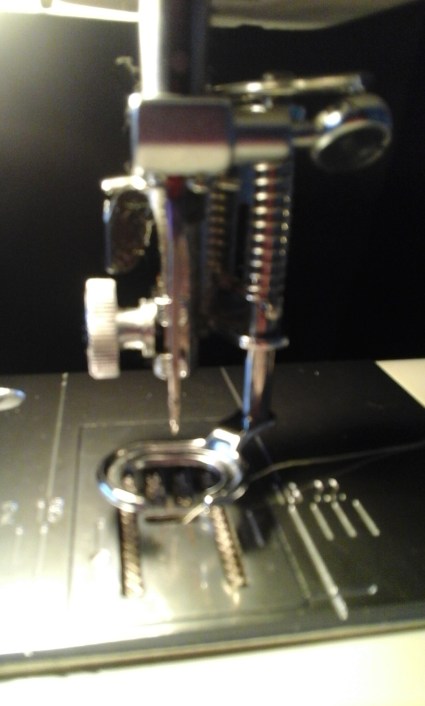
I use a metal open toed darning foot to do my stitching, for some machines you can get a see through plastic foot for better visibility.  On the whole I like it, but it has one annoying  drawback, it can certainly snag!  Mine will often scoop up some of the thicker felt, and it definitely has a liking to errant nepps, and a total love affair with curly locks! So you have to keep an eye that nothing has caught whilst stitching.  There are different types of darning feet, it totally depends on your machine.  A closed toe darning foot is available to purchase (I couldn’t for my machine), but maybe the visibility of the stitches would be diminished.   I have to work with what I have, quirks and all!

DARNING FOOT

So now it is ready to bring to life.  I really enjoy this part of creating a piece.  Out of habit I seem to start stitching any leaves first.   Leaves can have just an outline, or you can put a middle line down the length of the leaf , or add a few veins, the interpretation is down to you.

Here is a stitched leaf and an unstitched leaf, can you see what a difference it makes?

LEAF UNSTITCHED AND STITCHED

If any part of the piece has become wavy and lost it’s definition during the felting process, you can needle felt it into shape.

NEEDLE FELTING SIDE OF VASE

I decided to machine stitch the sides of the vase to give a little more definition too.  Be cautious about stitching absolutely everything, some parts look better as a suggestion, blending into the background.

STITCHED SIDE

I then turned my attention to the final part of the piece for machine decoration, the flowers.  I stitched around them and into the centre, using purple and off white threads.  There’s those nepps to watch out for!  It would make life easier to just not use them, but they are far too gorgeous not to.

FREE MOTION ONE

FREE MOTION TWO

Lastly I added a few French knots around the centre of the flowers to make them pop a little more.

FRENCH KNOTS

Now that my pictures are hanging in galleries, I have started using a professional framing service.   I was lucky enough to be given the whole spectrum of sample coloured corner ‘L’ mounts that they show the public to keep, as they were getting new ones, how lucky was that?  So I can decide at my leisure what colour suits the finished piece.  I chose the colour ‘Royal Navy’ because it actually has a purplish tinge, not the deep blue you may expect.  Here it is finished.   I am showing it to you unglazed to cut out any glare.

FINISHED

I hope it catches someone’s eye in the gallery soon!

3 New Things

3 New Things

I chose a few felt pieces to make things from recently. One was a piece I made about 3 and a half years ago, it was my first attempt at a plaid-inspired piece:

I thought I could improve it by adding some machine stitching, so I just added a few straight lines and some zig-zg stitches. A couple of strips looked too plain so I added some offcut strips, then sewed it up into a book cover:

The strap is removable, this is the front:

This is the back:

And, opened out without a book inside:

The other 2 pieces were texturey nuno pieces. They were planned to be the right size for coin purses. I was going to make them my usual way, of cutting out and blanket stitching, but I thought the first piece was a bit too ‘grungey’ for neat stitching:

And when I got the other piece to cut up I thought the same thing:

So, instead I just cut one piece for the inside pocket, and tried to keep the natural edges, just folded and stitched. This is the ‘antiquey’ looking one:

I tried a button, but I think it’s too new:

Inside:

The bluey green nuno I made this from is one of my favourite pieces that I’ve made. It made a nice purse too:

Open:

There are so many colours and textures:


Sometimes it seems like a cycle of just making lots of felt, then making lots of things from felt!

A felt Picture

A felt Picture

While making little bags I also made a small picture. i suppose it would count for the first  quarter challenge.  happy-new-year-prepare-to-be-challenged/ i hope to do somthing a little more challenging before the quarter is over.  I like little pasture scenes. I started with a piece of black prefelt and then laid the blue sky and pasture. I thought I took more pictures but it seems I didn’t.

This what the back looks like. I wrapped the coloured fibers around the prefelt . I use black prefelt because it will intensify the colours. If I used white it would take the colours towards pastel.

This is the front side felted.  I made the contours of the meadow by using a multicoloured roving I had. I think it lets you give the meadow some texture and shape without painstakingly adding tiny bits of colour. I added some clouds to the sky and some flowers to the meadow with some soft silk and little white blobs of sheep as place markers for the next part.

I added the sheep using some embroidery floss and french knots.

Then added the heads and ears. I used a grey for the sheep that are farther away. I think it worked.

At this point it could have been done but I needed something else. Your eye goes to the middle and it is empty. I discussed it over on the Felting and Fiber Studio Forum and I decided some trees were needed. I only know how to do one kind of tree that looks half decent so ever greens were next. I did them in a medium green and then when back with fewer strands and added some darker stitches to give them more depth.

Here it is finished. I had to trim the top off so it would fit in the frame. I always seem to make to much sky anyway so that worked out well enough.

I looks quite nice in the frame. The frame seems to pop it out. I didn’t realise how many scratches it had until I took a picture. I will have to paint it. It is not a great picture, ther was so much reflection. this was the best compromise between the light reflecting or having a clear shot of me in the glass.

I need to learn to embroider more then far away evergreens and sheep. A little cabin or a nice oak tree would have been a nice  addition to the picture. I am thinking of buying Moy MacKays book. Do you have a favourite art felt  or how to hand stitch  pictures or art books?


A Sweater Story…..Can You Help?

A Sweater Story…..Can You Help?

At the start of February last year I posted that I had had a go at felting a sweater with designs on turning it into a bag.  I had purchased it in a charity shop for the princely sum of £1.  It had a lovely cable pattern to it, and it reminded me of the sweaters my Mom used to knit for people for some extra money.  I remember being in awe that she could complete a sweater within a week,  not being a knitter I assume now that this is not really an awe inspiring thing after all……..the wonderful innocence of youth!  When they were finished she would put them under the seat cushions on the sofa for us to sit on and ‘press’.  She tried to teach me to knit but I don’t know whether it just didn’t sink in or I was too young to be bothered, I think it was probably the latter…….

The sweater went in on a 40 degree wash, just to be cautious, and it didn’t felt enough, so I did a second wash at 60, still not good enough, so it went in again at 90, luckily it had felted sufficiently at that point as I didn’t really have anywhere to go from there!

So then I had a felted sweater and I couldn’t figure out how to re-figure it into a bag shape.  Luckily I have a friend who is more of a sewer than me and she helped at this point, by cutting it in the correct places to maintain the pattern in a symmetrical way, and sewing it up using un-ravelled wool from the arms.  She also made a clever deep internal pocket by utilising one of the cuffs.  I am sure I would have just hacked at it randomly, she thinks deeper and in a more practical way than me.

20180124_142655

I wanted the bag to be an over the shoulder, sitting on your hip type of length and unfortunately the arms were of no use for this.  I came up with the idea of a bead/felted ball type of handle and sourced these lovely wooden beads online, and made forty felted balls, I think I used Corriedale wool.

BEADS AND BALLS

I had made the balls pretty tight, so it was a bit of a struggle to push a long, strong needle through them all, using wool salvaged from the sweater.  I didn’t line it as I wanted to see the cable pattern on the inside too.  Here is the outcome.

20170201_083442

Or I should say, it was the outcome for a short while…………I used it a couple of times then one day I had just arrived at a car park, I put the bag over my shoulder and SNAP! one of the lengths of wool sewing all the beads and balls together broke, and there I was scuttling around the car park trying to retrieve my wooden beads that were rolling in every direction! laugh? nearly!!

Now this is a sweater that has felted beautifully and I do want it to live life as a bag so Plan B is necessary.

I did like the felted balls with the addition of the beads.  However, if I am being really honest, the design didn’t sit the best on my shoulder……I really wanted a handle to compliment the soft, natural colour and pattern of the bag.

I thought maybe of producing a length of felt and encasing it in a pretty fabric, as I did here for my flower meadow bag that I made a while back.

20180124_140711

20180124_140732

Or perhaps I could use a twisted cord such as these but in a much better colour.  These examples are white with a blue fleck, black and a nice cobalt blue.  Or maybe two twisted together for thickness ?

20180124_142103

If I could knit, one solution would be to buy more wool and create some handles that way,  but this is not an option unfortunately as I do not have the desire to learn.

Those are the only ideas that I have come up with this far, so it’s over to you please, do you have any bright ideas to make my ex-bag into a loved bag again?

What would you do?

Felting with old sweaters

Felting with old sweaters

I’m a great recycler, as I suspect many textile lovers are. Much of my business is based on scouring charity shops and jumble sales for items that other people have discarded and transforming them back into desirable objects. Some old scarves get used for nuno felt; others are overdyed with indigo or overprinted.

Recently I had a go at darning an old sweater, after being inspired by an exhibition for a craft prize. But some of my sweaters have gone waaaay past the darning stage – so I thought I would try felting with them, using them as a kind of prefelt.

For the first sample I cut out circles and felted them on to two layers of white superfine merino. As they were 100% wool, they felted in really easily. I forgot to take any photos before felting, but the picture below shows the finished sample.

flextiles sample of felt with sweater circles

The circles on the left were covered with another two layers of superfine merino, as I wasn’t sure whether the base of two layers would be enough to support the circles. Obviously this felt was much thicker and you can hardly see the colour of the circles through the top layers.

The sweaters were knitted in stocking stitch, and the circles on the middle were laid out with the right side up, while those on the left were reverse side up. They looked quite different before they were felted, but after felting there was very little difference.

As you can see from the photo the superfine merino shrank a lot (around 50%) so there was very little space between the circles in the final piece. So in the next tiger stripe sample I left more room between the stripes.

flextiles felt tiger stripe sample before felting

You can clearly see the texture of the sweater before felting; after felting you can just about see the vertical rows of knitting.

flextiles felt tiger stripe sample

Although the stripes are also wool, they have not shrunk as much as the merino they are attached to. This leads to a pleasing texture of ridges, where the stripes are much higher than the base layers of merino. I’ve tried to show this more clearly in the photo below.

flextiles felt tiger stripe sample close up

After I made this sample I realised that white, green and purple were the colours of the Women’s Social and Political Union, which campaigned for women’s right to vote in the UK. White symbolised purity, green hope and purple dignity.

So to celebrate the centenary this year of some women in the UK getting the vote, I made a small suffragette neckpiece. 🙂

flextiles felt suffragette neckpiece

I really like using old sweaters this way – it saves me having to make prefelt!

What’s your favourite upcycling tip?


Recent Things

Recent Things

We’ve had some new members join our wet felting group at the Well Being centre this year, so I’ve been making ‘beginners’ pieces with them the past few weeks. One I always enjoy doing is a Nuno strip sample piece. I try to pick some fabrics I’ve not used before and like to pick an unusual one which looks like it’d never work, but I know from previous samples that it does. It’s usually one of the weird scarves I’ve picked up at a charity shop, and I chose my favourite ruffled loopy one this time.

The fabric I hadn’t used before was a piece of lacy fabric which I think was previously a blouse. It’s not that obvious it was lacy, but you can tell a bit better from this close up:

I usually start off absolute beginners with a soft wispy piece because it helps to learn to control pulling off the wool tops, but one of our new members joined while I was sorting out supplies so didn’t have them all at the centre. We had a practice run of pulling off the tops, and she did it well so we made a simple landscape which we usually do on week 2. I usually stick to a simple design for this to make sure it gets done, has a good outcome, and I don’t have to answer a million different questions: 2 layers, green for grass, blue for sky, add some embellishments for clouds and flowers, then felt. But there were only a few of us, and I could work 1 on 1, so I went with her ideas and just showed her how to realise the ideas, so we each made a kind of farmer’s field picture:


I usually end up with odd random things on mine, because I use it as a demo piece if someone isn’t sure, which is why it looks like I have discarded kids’ toys lying about (viscose nepps) and some half dug out potatoes (cotton nepps)! We used some pencil roving waste too, we both used a length of natural brown to make a ‘wall’, and I added some variegated green to see how it’d work for a hedge. I’m not sure it looks very hedge-like, but it did get a nice ripple to it, you can see the brown piece a bit clearer on the close up and see that the blend we used just above is actually made up of yellow and purple:

Our new member’s landscape piece turned out so well that we moved onto using resists the next week, some other members mentioned before New Year that it’d be good to do vessels again and maybe more resist work, so for new members to build up to and give a refresher to others, we made a simple piece with resist strips. Some of us put fibres or fabrics under or on top of our resists for extra effect, and embellishments on the top. I used the lacy fabric from the nuno sample piece, and a nice pink wool lock:

You can see more of the laciness on this piece:

Some of the fibres from under one of my strips:

Those nuno sample pieces always come in handy for when I’m planning a collaged felt project:

Because we all know the first rule of tidying up has to be getting everything out to make a mess again!

Polar bear for the 150th Anniversary Art show

Polar bear for the 150th Anniversary Art show

Another exiting felting post by Jan Scott

This is the Guilds display for the 2017 Ottawa Valley Farm Show in March of 2017. Lynda is hiding behind her loom, Ann is about to spend the day making felted beads with the kids, and Merilyn is spinning beside the empty chair where I was working. We do put on an interesting demo!

The Farm show is a huge display of farm equipment, seeds, antique display, farm oriented venders, trappers, government department’s booths, the wool growers co-op, and various breed and rare breed associations. It is really a huge event drawing people not only form the Ottawa Valley but the rest of eastern Ontario. It’s always early March so weather can be an issue. We had a blizzard the second day of the show.

I was getting lots of interest in the pieces I had already completed for the 150th Art Show.
It was time to start the next project. So before the demo it was time to decide what to do next. After much debate between Moose bison and polar Bear I decided to continue with the arctic theme.

By now you are likely starting to guess my working process. So yes it was back to the internet to find reference photos and work out a composition likely from a composite of pictures. Working with a square is a lot more challenging. The eye naturally is drawn to shapes that feel comfortable, shapes that follow the golden mean or Fibonacci to figure out stripe progressions (Rectangles). Shape that have proportions you find in nature. Squares are definitely more of a challenge. But I’m use to a good challenge, you should see my un-spell-checked spelling!

So the quest was on find an image I could made square. but not be too static. So either intensity or dynamic composition was what I was looking for. So find images that cought my eye, then crop to square.

As I perused the inspirational options I thought about the talk Robert Bateman had given at Halliburton last summer. He spent some time discussing some of his earlier work mentioning his frustration painting a polar bear in a snow storm then the next painting was a black timber wolf at night in a dark forest. He had mentioned that white wasn’t just white. So to look carefully and not assume you know your subject just because it’s “white”.

This slideshow requires JavaScript.

Some images were very interesting but just didn’t want to be square.

Then I spotted this one. The intensity of the look was amazing. The shapes were simple but if I could get the eyes it would work really well. The image dew you in, there was such contemplation and stillness. It was like looking a momentary paws in the action. I liked it! Ok I had my inspiration.

Day one demo
I brought my large foam pad, core wool (Rideau Arcott), and various shades of white grey browns yellow red and blue. (I as optimistic but didn’t think I would get the understructure done in one day.) I got dropped off around 7ish, parking can be very crowded so it was better to get there unusually early and I could set up and get started. Glenn had over time so it was a late pick up as well so I was there for over 12 hours. I got a lot done.

I had premade my background felt layer at home using my wicked 10 needles in a row tool. It was again impressive how well it worked on flat felting.

For the understructure I mostly worked upside down to help get the general proportions correct. I could have made a graph over the photo to make a more exact copy but I wanted the photo to be more an inspiration than an exact likeness.

I was explaining the backing layer that the understructure would be attached to.

I got a lot of “what are you making” in the morning, then by afternoon it was “is that a dog?”
Most said they would come back later to see what I had accomplished on their way out.

A couple more quick shots of the demo in progress before we go on to day 2.

This is a very cool loom from around the 1970’s. It was fascinating to see it working.

Ann had a lot of help making felted beads using pencils. She is really amazing!!

Merylin was busy spinning some of her Sheep’s wool she had dyed herself. She has a beautiful painted wheel.

Day 2 demoing
I had booked off 2 of the 3 days of the demo. So again I got there unreasonably early, got help to get the display set up again.

Today we had Gord with one of his great wheels (he has several)

I had the understructure to my liking and started working from the top down
Amada was spinning on her Hitchhiker wheel. She dose amazing natural dyeing some of which was on display.


As you can see in the foreground of the picture I had progressed to adding colour to my under structure. By the time I hit the eyebrows I was starting to get comments of “is that a polar Bear?”
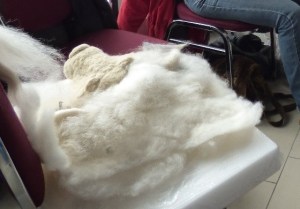
I chose blue face Lester since my memories of my Grandmothers Polar Bear rug is still vivid in my memory. Since I think the last time I slept on it was over 40 years ago it really did make an impression. It had a yellow tint to the white fur, the fur was stiff but not really course. It was smooth if you patted it in the direction the fur grew. It was a wonderful polar bear I don’t know what happened to it. I hope it is still being loved by small children sleeping on it.

This is the progress at about ¾ of the way through day 2. I was definitely felting faster on this one.

Day 3 of the Farm show demo.
I had a short day of work so rushed back for the final day of the demo. We had a pretty full demo team and the weather was a bit better than the previous days’ blizzard.

Laurie and Julie are Weaving, Merylin was spinning and I was still felting.

I got a lot more of the face done. But it was slow going due to hand blending each section I was working on. I was still finding the hand blending less uniform, which was what I wanted, than using the carders. Also with the different lengths of fibre I was blending with the blue face Lester it was a lot easier to work with it just by hand. I wound up with alpaca as well as wool to get the colours I had wanted.

I had a couple more evenings of touching up the colour and the Polar Bear was complete.

The pieces made another appearance at the demo for Dickenson day in Manotick Ontario.


This is my show and tell the meeting before the show.

Here are all the pieces I did for the 150th anniversary show.

While I was making Polar Bear I thought about my western Grandmother and about my brother who has done most of his work in the North so I am giving this piece to my brother Dave. This is his Bio so you will see why I was thinking of him.
(Dr. David J. Scott is the Executive Director of the Canadian Polar Commission in Ottawa. Prior to his current post Dr. Scott had a long career with the Geological Survey of Canada (GSC), finishing as Director, Northern Canada Division.
At the GSC he also served as acting Director General, Planning and Operations Branch, and led the GSC’s Gas Hydrates and Northern Resources Development programs. From 1999-2003, he was based in Iqaluit, Nunavut, as the founding Chief Geologist of the Canada-Nunavut Geoscience Office.
Dr. Scott holds a Bachelor of Science Degree in Geology (McMaster University, Hamilton, Canada) and a PhD in Geological Sciences (Queen’s University, Kingston, Canada) where his thesis research investigated the tectonic origin of two-billion year old oceanic crust in Arctic Quebec. He was a Research Associate in uranium-lead geochronology at the GEOTOP laboratories of the University of Quebec at Montreal. He has published and presented over 80 technical papers.
I am very proud of his many accomplishments. I wonder if he will put it in his northern office his southern office or keep it at home. Where ever he puts it I hope he enjoys it.

I have a PS to this Post Jan won the peoples choice award for her Polar Bear at our Canada 150 Show.