Silk Paper with Leaves on Felt

Silk Paper with Leaves on Felt

The original idea for this post was to create something for the 3rd Quarter Challenge. I also wanted to use up some silk paper I had made ages ago. We had been talking about using silk paper in felting on the forum a while ago and I thought it would be a good surface design.


Here’s the silk paper. I made it with leaves and stretched silk hankies. These were then glued together with fabric medium. The leaves have held up amazingly well since this is 3-4 years old at least.

A friend gave me some merino batt that was cut up into a variety of pieces. I placed them all together to make the wool base.

It was pretty thick which didn’t bode well for the “Beneath the Surface” part of the challenge.

Here’s the silk paper on the wool before felting.

I then added some coarse wool underneath the batt thinking it would migrate through and show on the surface. I don’t remember the breed but it’s coarser locks.

I then carefully felted the piece. Trying to avoid crushing the leaves but getting everything to attach. The merino was surprisingly hard to felt. I’m not sure why that was but it took a while. The coarse wool on the back didn’t migrate through hardly at all. So much for “beneath the surface”.

Here’s the end result. The silk paper felted in nicely and the leaves are entirely intact. They didn’t break or crack at all.

Here’s a closer look and you can see the surface texture here too. Now what to do with it? It’s about notebook cover size but I’m afraid that would be too hard wearing on the leaves. I took it back to my studio room and ended laying it on top of one of the canvases that I am working on for a different project.

It looks pretty good. Hmmm….. I think it would look good if I trimmed off the felt edges and then added some either stitched, tyvek or lutradur leaves. Perhaps a few viney bits too. As you can probably tell, I haven’t quite decide what to do with this yet. And I need to do something else for the third quarter challenge.


Woolfest 2018

Woolfest 2018

Well another year has rolled by and it was time to immerse myself once again into the wondrous spectacle that is Woolfest here in the UK, held at Mitchell’s Lakeland Livestock Centre, Cockermouth Cumbria.  I know, tough job but someone has to do it…….

A fabulous day was had spent amongst fellow crafters, fibre enthusiasts and livestock folk.  There were 158 exhibitors this year,  I think there has been over 200 in previous shows.   There seemed to be many new demonstrations going on such as silk papermaking with found and gathered materials, lino cutting and printing on fabric and stitching on felt, braiding with a Manx loom, cutting hand woven fabric for garment construction, quick threading on the rigid heddle loom, broomstick crochet,  speedy warping and Tunisian crochet.  A lot going on, and a lot of things I have not the first idea what they are!!

I know how we all like photos so here they are, no real explanations, I just took what I thought would grab your interest.

The first picture is the show ring, where each breeder gives a talk about their particular livestock.  I was particularly taken with the magnificent sheep that the lady on the left in blue was showing, a close up in pic two, and even better in pic three.  Star of the show for me.

20180622_133147


20180622_161304

20180622_161310

He was a huge gorgeous chap!  The breeder Joanne very kindly told me he is a coloured Ryeland, a five year old tup that they use for their main breeding.

Joanne has said that the fleece is better for needle felting rather than wet felting, and here are some of her wonderful pieces.

JOANNE 1

450682_1

Now we have a few more fibre providers!!

20180622_161221

20180622_160036

20180622_161128

20180622_112305

20180622_162851

This next beauty had four horns, two on the top of the head and two curling around the face.

20180622_163051

20180622_164527

20180622_113205

There was also some home grown, ethically produce angora rabbit fibre for spinning and felting, and here are the bunnies.

20180622_100314

20180622_100351

20180622_100335

There seemed to be more beautiful garments and clothing on display this year, here are some pics.

20180622_133601

20180622_141840

20180622_105606

20180622_133553

20180622_154358

20180622_154329

20180622_170828

20180622_144458

Some beauties amongst those don’t you think?

I thought you may like to see this folklore spinning song I saw.

20180622_103334

A few more goodies, yarns and some beautiful knitting bowls.

20180622_100242

20180622_111019

20180622_102215

Fabulous fibres.

20180622_153817

20180622_111216

20180622_112738

20180622_153809

And of course the fleece crèche where you can buy your raw fleece and collect it at the end of the day.

20180622_111830

This next lady is from the Eden Valley Guild of Spinners, Cumbria, demonstrating weaving.

20180622_150209

20180622_100847

20180622_113223

So the time flew by as it always does when you are having fun, and before we knew it from arrival at 10.00, the clock had whizzed around to 5.30 without us noticing.  However in this time I had ample opportunity to adequately purchase feed for the hungry beast that is my Stash Monster, we all know how they are happier with regular tops ups………! The offerings this time include Shetland, Gotland, Jacob, Suffolk and Cheviot tops, lovely buttons, Merino, Jacob x and Teeswater locks, silk boucle, silk laps, hand painted paper, nepps, small piece of tweed, pot of fabric dye and a wooden stamp, little sample packs of sari silk yarn and carded sari silk, big block of olive oil soap and white scrim….I think that is everything…….Believe it or not that was the epitome of restraint !  Stash fed and I can continue being a happy crafter!

I hope you have enjoyed reading about my day at the show.  It was over too soon but it will return to delight again next year.

Finished Bookcovers, Unfinished Purses

Finished Bookcovers, Unfinished Purses

I actually finished a couple of notebook covers this week. The first one is the landscape piece I showed cut out ready for sewing. This is the front:

And this is the back:

I think every time I use ‘scene’ type pieces for book covers, I tell myself to make the top and bottom ‘sections’ bigger next time, because I always have to compromise over what gets cut off. I always forget! But, then I can use those nice pieces for something else, like part of a collage book cover! I tried to make this next one nice and bright, you might remember me choosing some of the pieces back in February:

And I did make a start on it in March, and then put it away for a while. I realised last week that I was going to be hot, sweaty and miserable no matter what, so I may as well just try to be a bit productive and get my sewing machine out and finish the cover:

Other side:

This is the inside, with some hand dyed cotton fabric as lining:

Front and back opened out:

I bet a hat made like this would look great! I still haven’t manged to get any further on some purses I cut out, but I did get a photo of them:

Making Felted Sheep

Making Felted Sheep

Another flash back post. some needle felted sheep. I hope you like them.

With the start of show season gets closer I realise I only had a few sheep left. Time to make sheep parts.

sheep body 1 sheep head 1

I have to make bodies and heads. I roll them up and give them a few pokes. I use 2 needles held together with a hair elastic. It makes them comfortable to hold.

needles

There will be white sheep too

sheep head 2

Once they are rolled and poked they get put in to the legs of some nylons.

sheep parts ready fo the wash

These will go into the washer and dryer with a regular load of laundry.

I also make wet felted snakes to be cut for legs and a flat sheet of felt to cut ears out of.

sheep parts

I can’t find my bag of black spare parts.  may need to make more.

This is what the finished sheep will look like.

sheep small

They all get a safety pin on one side so you can wear them.

Preparing Nuno Landscapes for Framing

Preparing Nuno Landscapes for Framing

I have been working on getting my nuno landscapes prepared for framing. I have to say this is not my favorite part of the process. But I want these to look professional for the upcoming exhibition so I am trying not to procrastinate too much in completing these.

I hand dyed all the backing fabric. I had to add a bit of fabric paint to four of them to make them darker. I always have a hard time getting the exact color I want with dye. I never take the time to figure out a “recipe” for certain colors. Then I hand stitched all the nuno landscapes to the backing fabric. I used a hand applique type stitch and it is barely visible.

I got all of the foam core backing cut to size by the framer.  Each foam core backing is 2″ bigger on all four sides of the landscape. Thin cotton quilting batting was cut to the size of the foam core and then all three layers are put in place and pinned.

Once the landscape is pinned in place, lacing can begin.

Lacing is not hard but does take a lot of time and the thread does have a tendency to get all tangled up while working. Plus the tension needs to be correct so that the fabric is stretched evenly over the foam core board.

Here are four of the pieces on their backings. I have two more to complete and then they are off to the framers. Once they are framed, I will show them to you again.


Chico the needle felted dog

Chico the needle felted dog

Hello, Leonor here. My guest post for today is going to be a simple “show and tell” as the weather here in London is too warm for complicated thoughts!

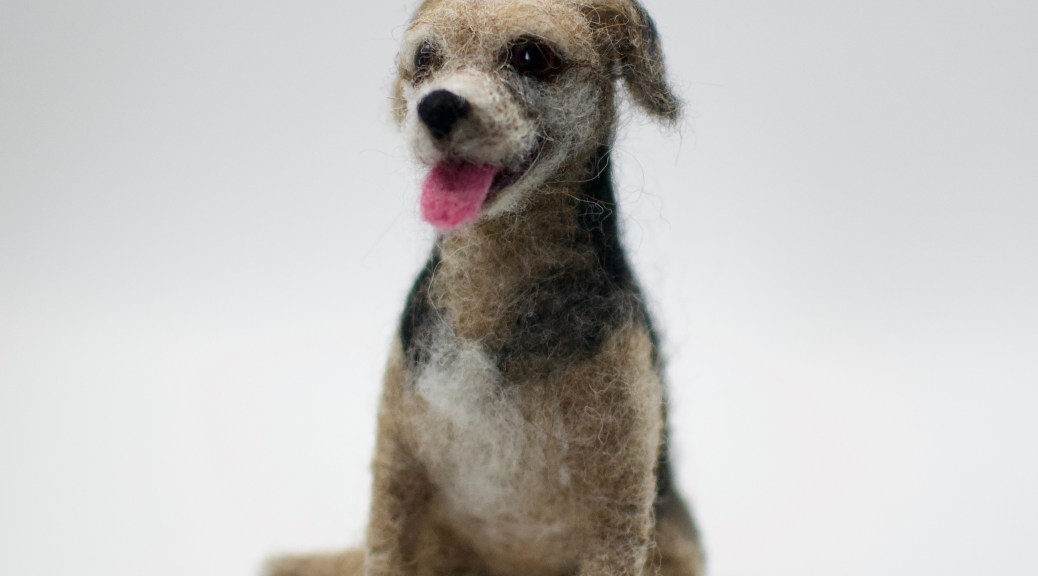
Some of you might be aware that I am a fibre artist by trade. Anything wool and I love it. I got into this business a little by accident, and making custom needle felted dogs was even more unexpected – basically, a friend asked me for a mini of his whippet, I took the challenge, and the rest is history!

I’ve now been playing with wool professionally for around 5 years, and I must confess there was one hurdle I was yet to conquer in my work – creating an open mouth. I’d tried once and it didn’t come out right, so I more or less gave up on it. That is, until I made Chico!

DSC_1102

At first I was going to make his tongue out of polymer clay (the idea of finishing it off with a nice layer of glossy varnish to mimic moisture was very attractive to me) but then I decided not to. I liked the idea of a 100% fibre sculpture better.

DSC_1106

I made the lower jaw separately, making sure the upper section was thin enough to accommodate both parts without looking weird. I added a layer of black around the edge to make it more realistic, and then a little white on the back for teeth. The tongue was made using two shades of purplish pink blended together. I made two mini tongues and chose the one that fit best.

DSC_1110

I received a few reference photos to make this little guy, my favourite was one where he was sitting with his leg to the side and smiling. I just had to make him this way.

DSC_1115

I love the detail of paw pads, the feet immediately look real. You can’t really tell from this picture, but Chico is er… anatomically correct. I like a realistic sculpture!

DSC_1114

Below is a picture of the original Chico. The mini version is off to a Spanish island as a surprise for the whole human family. I hope they like it!

unnamed

Have you ever created a needle felted animal? What wool did you use and how did you like your experience? Let me know in the comments section.
Questions? Happy to help, just leave a comment!

Trying To Be Productive

Trying To Be Productive

I’ve got a craft fair in a couple of weeks, so I’ve been trying to make some new things to take with me. I can never predict what might be popular or sell, so I’ve given up trying to 2nd guess, it just leads to a lot of stock piling up and a lot of disappointment. Instead I decided to concentrate on things I enjoy … with the exception of felted soaps, I’m going to give in and make some, they’re guaranteed to generate interest! Sounds like a plan, ay? Except we’ve been having the most ridiculous heatwave here, so I’ve managed to do very little, unless you count sweating and eating ice cream as being productive 🙂 I did manage to make one new piece of felt though, a ‘seascape’:

And I even managed to turn it into an A5 book cover. This is the front:

And the back:

I had a look through my already made felt pieces and found one from a challenge which I thought would make a nice cover, so I cut that out:

I’ve got both ends sewn so far, so I’ll show it all sewn up next time. I also got as far as choosing some pieces to cut up for piecing together, probably also for book covers, though maybe bags since I bought a load of zips with that intention. I just hate sewing zips!

Any tips for secure closures which doesn’t involve zips or magnets? I’m leaning towards lobster clasps and D rings at the moment. I like delrin clips but making the felt straps is so time consuming.

Felting Tools Part 2

Felting Tools Part 2

Here is part 2 of Jan Scott’s felting tool post. It was much prettier in the word doc format but I don’t seem to be able to transfer that to the blog.

I have a large selection (24 years of collecting) of Massage related implements that may have potential for Felting.   One of which are the I.T. Band rollers. They were once veryexpensive and rather limited to acquire. A few weeks ago I found a number of variations of surfaces on rollers at Dollerama for 4.00 each.

So I got a few and gave one to Ann. She tried it out at the Felt in using a pool noodle to mimic a rolling pin (a really big Rolling pin!)

Another massage tool you might like to consider would be the Bar, it is used on large muscles to work out knots.
It is similar to a rolling pin but has groves.

There are also foot rollers and trigger point balls. Not only are they excellent for getting tension out of Levator scapula or the plantar arch, they also work quite nicely to felt with.  They come in various stiffness’s for the knobby bits. There are similar balls with knobby bits at the dollerama for much less money. Check the pet toys and the kid’s toys. The tall purple cylindrical roller was from Walmart in the exercise section and was still cheaper than the massage supply stores.

If you find a theraband roller in a second hand store you might want to grab it. Not only is it wonderful for treating both Golfers and tennis elbow (a common felter’s complaint) it also is a cylinder with grooves so again good for felting. They come in different firmness in case you were wanting to use it to stretch your medial or lateral Epicondilitis.

I have been keeping an eye out for Fondant rollers with groves and patterns, they are a Kitchen implement which may also be useful in felting. I have also seen pictures of a regular wooden rolling pin with a bamboo place mat elasticed to it. It looks like it would work too.

Ann has been tracking down wooden facial massagers and foot rollers from Ali express out of china. It’s a very interesting site but be very attentive to the size of items some look much bigger in the picture than what they are when they arrive. They are good for getting into small corners but some of them have a bit of a squeak when rolling.

For needle felting too there are tools not originally designed for felting. I only started to try Cookie cutters for needle felting templates recently. I am not sure if I will investigate further since I really have enjoyed the sculptural aspect of felting but for a production felter it may be helpful to start with a standardized base shape.

I have a number of different sizes of dowels, Meet skewers and wooden scraper for rapping wool around. Most were acquired at the Dollar store in the art or cooking sections.

I have been wanting to try wax on felt to crate claw tips, beaks and noses. I have a suspicion that melted crayons may work. If I need more stiffness I can add paraffin wax.  If I need more flexibility I can add more Bees wax. To melt the crayons, I have been cruising the second hand stores looking for a melting device.  This is what I have found and am looking forward to trying it out.  I will let you know how it goes!

I have found the Extra-large Zipper Bags at Dollerama to be extremely helpful. The Foam pad I used for making the 3D pictures fits in it perfectly. The Foam is a chair pad I bot at Walmart. The 3” thickness I found to be safer than the smaller 12×12 by 2” deep pad I have also been using. I have been leaving the thin plastic over the foam, finding it gave me good separation from the wool and the foam.  As I continue to work in one aria the plastic eventually will deteriorate. I have just kept moving to a new section but eventually will add another layer of plastic over the foam.   The Foam I chose has no memory foam content. (I have heard rumors of needle felting and memory foam are not compatible.)

Have you noticed at Dollerama, the test tubes with screw tops? They have decretive erasers in them, but you can empty them out, add a bit of wool at the bottom and then they hold felting needles very nicely.  I have been keeping the needles I’m working with stuck in the side of my foam but the test tubes are grate to store extra needles. I have labeled each tube with the needle type size and source. I will add a label to the lid once I find a good storage box for all 16 reasonably available needle types. I am still tracking down spirals in a coarser size.

Now that I have most of the needles that are available it will be easier to determine what the Chinese supplier are labeling as small medium and large, or fine medium and coarse.

There is one last thing I think would be important to any art and craft person which is a comfortable table height. I was lucky to find a small adjustable table at Walmart. The top is 30”x19” so hold a table loom or all my needle felting stuff. It adjusts from 21 to 28 inches so has worked well for seated work.

16.jpgI also have a printer table that was not the height I had hoped for. So added leg extensions of PVC piping to raze it up.  I think Ann is using the same technique on her table to make it a good height to stand and work at. With a bit of height adjustment, you can have the table slope just enough to drip water off one corner and into a bucket or drain.

Ergonomics, in body position, comfort of tools and working height is important if you want to keep doing what you are enjoy for your entire lifetime.

I hope that I found something that was new to you and that you will share some of your best finds with me!

Third Quarter Challenge – Beneath the Surface

Third Quarter Challenge – Beneath the Surface

This year’s challenge theme is all about surface design. So you would think that most surface design is just that, the top layer of embellishments added to the surface. But wool is such an interesting fiber. You can add things underneath the top layer of wool that will affect the surface design. So that is this quarter’s challenge. To add something underneath the top layer of wool that will change the surface after felting. I am using photos from our library here on the website so not all of these photos are of my work. But these are to give you some ideas.

One of the things that you can put beneath the surface are inclusions such as marbles. Here Ann has made some felt cuffs where the marbles definitely change the surface design. You can leave them in, take them out or cut them partially open to have the marble or inclusion partially exposed.

Here are a few more pieces that have inclusions in the felt. I have used yarn, a felt bead, marbles, and a glass color sample. I have also created craters with a different color wool underneath to create a complementary color scheme.

You could also use resists under the top layer of wool to create a design. By having a different color underneath, you will expose the contrasting underneath color when the resist is cut out and removed. The piece on the right is cut back applique where three layers of felt were stitched together and portions were cut back to reveal the design.

Another method of changing the surface from beneath is to have two or more layers of wool in different colors, these can be stitched as in the photo above to create ridges and then cut back. Or you could try this with felt beads with layers of color and then cut them to use on a surface. Or if you created a vessel with thick walls with multiple color layers, you could carve parts of the vessel back to show the different colors. There are many options with this technique.

Using a coarser wool under a finer wool will change the surface design as well. In the photo above, Terri Berry used a Gotland wool underneath the top surface teal merino. She used a plastic resist to create the pattern under the merino. The Gotland migrates through the merino and the only teal merino left is where the plastic pattern blocked the migration. You can read her entire post about it here.

You can use different wool underneath to achieve a different texture on the surface. These two samples were created by Zed with two layers in each sample. The sample on the left is Mixed 56’s on the bottom covered by 18.5 mic Merino. The sample on the right is two layers of 18.5 mic Merino. The coarser wool underneath gives a different texture than the two layers of Merino. (Thanks Zed!)

One very simple way to change the surface is to use a different color underneath the top layer. As you can see in the photo above, the red on the black wool looks different from the red on the white wool.

There are many more ways I have seen that people have created different surface designs by what they put underneath that top layer of wool. These are just a few examples to get you started. What can you create by changing the surface design from beneath the surface? I hope you’ll give it a try. And if you create something for the challenge, please show us over on the forum. 


Felting tools (most of which were not originally meant for felting) Part 1

Felting tools (most of which were not originally meant for felting) Part 1

This is a guest post from Jan Scott. It is in 2 parts as she has many felting tools now. She is great at thinking out of the box.

One of the problems with delving into Felting is that there are very few tools that were originally created for the purpose of felting. I am starting to suspect a lot of felters have a similar form of dyslexic distraction as I have. Do you find while wandering through Dollarama or Walmart your brain will look at some odd item and declare “WOW that would be grate to felt with!” Sometimes it’s the boot tray or a van rubber mat (that lives over at Ann’s since I don’t have a big enough table for it) or it may be a cylindrical plastic dog toy with knobby bits on it. The person who made the item definitely didn’t have felting in mind as the end use but we can see its potential.

I have been collecting “Odd” felting tools for a while now. And thought you might be interested to see what I have found. You may already have a wooden scraper and a package of skewers for Needle felting and car mats for working surfaces. But you may have missed the Iliotibial band roller (massage tool) so let’s compare and see if we can inspire each other.

My first felting tools were a lid from a Tupperware Juice pitcher, some bubble rap and a piece of curtain sheer. I have expanded a bit since then.

Tupperware Juice lid – source Garage sales, second hand stores.

I have made quite a few hats with this and a pool noodle. Pool noodles can be found in many types of stores. Improvements in pool noodle technology has led to a variety of sizes and shapes which can either give a more aggressive felting experience or used to shape around when the felt is drying. The smaller noodles come in 3 sizes and were found at Dollarama in the craft area.

I added bamboo place matts but trying to replace them as the warp threads start to rot has been a bit more challenging. Dollerama has not been carrying them at the moment. If they don’t restock them I will have to watch the second hand stores for matchstick window blinds and more placemats. I have tried non-slip matting which comes in a couple sizes and longer lengths (and doesn’t seem to rot out). I found that it worked but was not quite as quick as the matchstick placemats.


I also found a Ball Brause Sprinkler originally used to water bonsai. I recently had one of those odd thoughts that occur rather frequently while shopping as I spotted a garden sprayer with a compression pump (4.00 at Dollarama). It has a much larger capacity than the Ball Brause and adjusts from a strong stream of water to a fine mist. Ann tried it out for me at the Felt In. She is very brave around water.

I am not that fond of getting unnecessarily wet, much to Ann’s amusement. I have been trying to perfect wet felting without getting wet myself. In this endeavor I have found boot trays effective. They come in many sizes, depths and various patterns on their boot surface. I have one that is extra-long with a trellis pattern and a much shorter tray with ridges. In the spring, Giant tiger stores often have their end of season sale on boot trays. Other spots I would check would be Walmart, Home Depot, Costco and Dollarama. They have worked quite well to contain the water and keep me dry.


Mainstays Manor Lattice Boot Tray Mat, 17” x 35” Walmart

Costco Deal: Bird Rock Home Rubber Boot Tray 34″ L x 14″ W x 2″ D

Winter car mats have the same usefulness to work over as the boot trays but don’t contain the water as well as they do. If you are lucky you might also find a van winter mat reduced for quick sale. Even the regular car mats have textures that may be to your liking.

I have also found that plastic gloves are helpful for keeping my fingers dry while wet felting! I have some from work and found some in the automotive section of Dollarama (they’re black but work great). I have tried the dish gloves but find they have poor palpation through the thicker gloves.

Part 2 next time.