Browsed by
Category: Wet Felting

Bubble Texture

Bubble Texture

My best-laid plans have gone awry, so I am going to show you a short piece I did back in 2012. Texture seems to be a popular topic so this should fit right in. Although this is an older post if you want to comment or ask about it you can.

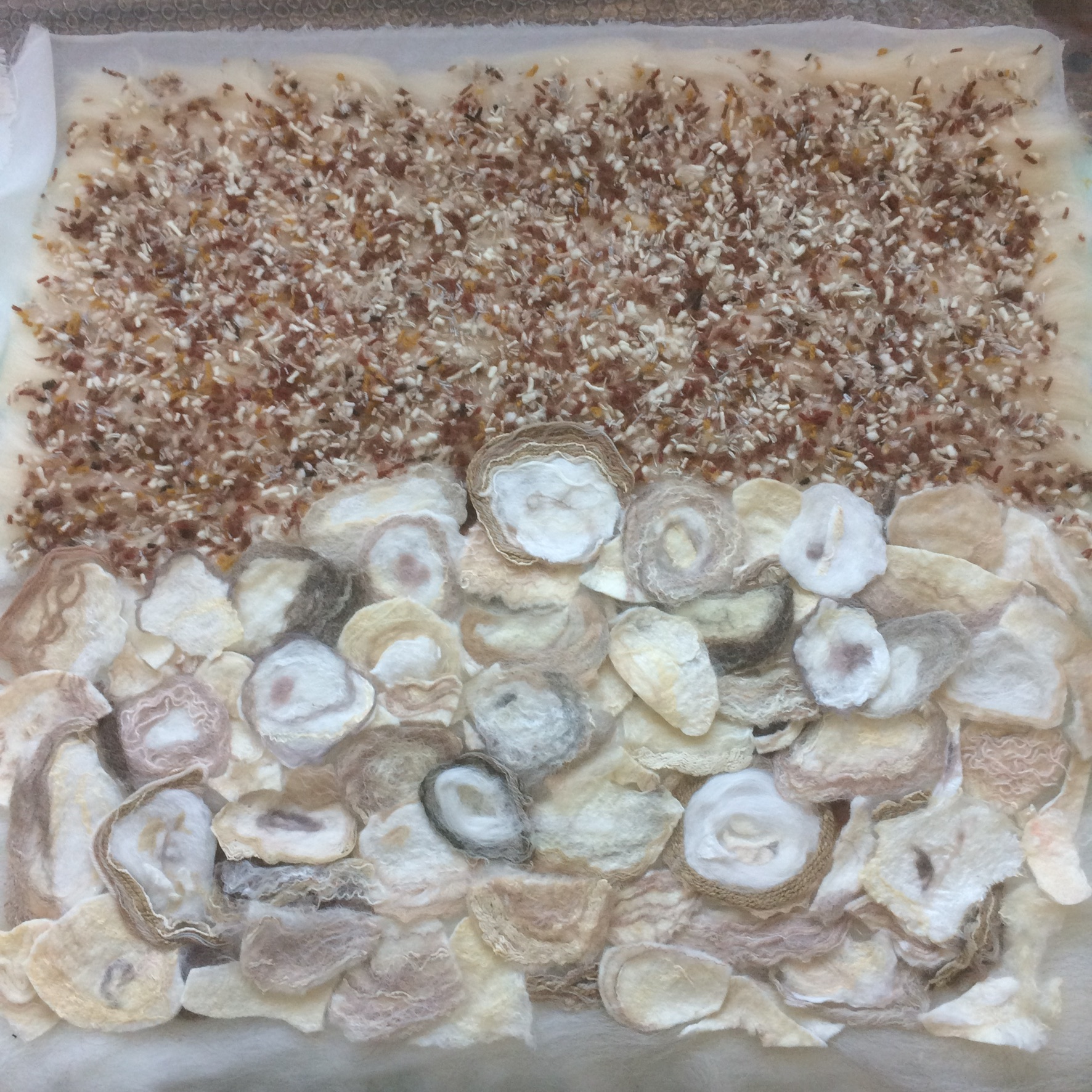
People seem to be interested in how to make bubbles in felt. I know there is more than one way but this is how I did it. This is the storey of my bubble hat. I had made a renaissance hat form Chad Alice Hagen’s hat book. I t was to show a group of ladies that were taking a hat class with me. It is a big hat made on a resist that is shaped like a big droopy mushroom. When you finish it you make wrinkles in it and clothespin them till it dries. The problem is it looks great if you push it all forward and take a picture but from the back, it doesn’t look very good. I am sorry I don’t have a picture of it at that point.

What I did was use a shibori dying technique. I used felt balls but marbles or crumple tinfoil will work the same. I started in the middle. You pull the felt around the ball and tie it off as tight as you can. Move out from there repeating the wrap and tie. When it was all done I dropped it in a simmering dye bath. I let it boil for about an hour. When using this as a dye technique it is usually done on a non-felting fabric so you open it up later and flatten it out you have a die pattern. When you do it to felt at a boil it felts more and the bubble shapes stay in. Making bubbles takes a lot of felt. The hat would fit my dog now. If you put your hands in like a puppet it makes s great Muppet monster.

Experimenting with Felt Rope and Structure

Experimenting with Felt Rope and Structure

I thought I would move on in my experimentation with creating structure in felt and differential shrinkage, this time using a felt rope. I’m not sure why I thought this was a good idea but I suddenly remembered why I don’t make many felt ropes.

I used a batt of yellow short fiber merino and tore it into a strip. I then worked a bit on trying to dry roll it to get some of the air out. But that wasn’t working too well so I added soap and water. The rope turned out OK but is far from perfect. I always forget how much patience these take to do them correctly. Now that the rope was done, how to add the felt to this spiral structure?

I came up with the idea of covering a PVC pipe with lime green mixed 56’s wool. I probably should have used merino but this is what I had grabbed for this project. I covered the pipe with wool and then wet it down.

I wrapped the rope around the wool covered PVC pipe and then began adding wisps of wool over the rope. I wet it down as I went to hold everything in place. I then spent a fair amount of time rubbing and working around the rope so that the wisps would stay in place and hold the rope down to the felt. Apparently, not enough.

Here it is after felting. What a mess. The ends of the rope were coming loose and it looked like my dog Edgar had been chewing on it. (Not really because he would have torn it to shreds in a matter of seconds.)

I took a break and then decided I need to full it much harder. I found a thinner stick to put in the middle and worked the piece with soapy hands as well as rolling it on the ridged mat and banging it hard against the table.

Here is the end result. Not appealing or impressive. But I might try again with a much thicker inner and outer layer of wool.  I also will probably try wrapping the rope around a flat resist instead of a 3D object. I can always full around the pipe or dowel rod after the felt is holding the rope together better. Not totally a disaster but close! I do think it’s good to go ahead and post about something that doesn’t work out as planned. Perhaps someone else will learn something from my trial and error experimentation. And perhaps you can empathize with me that not all projects are beautiful or perfect. What have you experimented with lately?

Final Bark Color Mixing Experiment

Final Bark Color Mixing Experiment

I tried one last experiment with creating bark and color mixing. I showed you last week my attempt with color mixing with a drum carder. And there was another experiments here.  I had part of the mixed batt left over from last week so I decided to combine all of my techniques and see what happened.

First I split my batt in two layers. You can see the felted piece from last week on the right. I then added two layers of green wool over the surface of the bottom batt.

Then I cut up the felt piece from last week and placed it over the green wool. I wanted more green migrating through between the felt pieces.

Then I added the other layer of batt over top of the felt pieces. With everything layered up, I was ready to wet down.

I wet it down and then did a lot of rubbing. I worked carefully between the thick felt pieces in the center of the sandwich so that they would stay in place and there would be a nice indentation between. I also fulled the felt very hard to get lots of green migrating through the top surface.

And here is the finished piece of bark. (Edgar is helping me take photos.) Finally, this is the look that I wanted when I started this experimentation. It has a wonderful texture and the color mixing is what I envisioned. So a combination of carded batt and layered colors with thick felt in between did the trick. Yay! I will have to decide if I am going to add any stitching or other embellishments to this piece or just leave it as is. What do you think?

Basket Mark 2 Finished.

Basket Mark 2 Finished.

This week I finished the basket. All it really needed was to have the handle finished and that would have been fast and easy. But a white basket is not only boring it does not fit with me. I can’t keep anything white clean for long.

So faze to of the basket: dying.

I have a turkey fryer/corn cooker for dying outside. After clearing a spot on the porch for the dye pot and my son cleaning all the bugs and spiders and webs out of the hose and burner I got some water heating. Usually, when you are going to dye wool you wet it first. it gets you a more even take-up of the dye. I didn’t want that in particular so I popped it in dry.

you can see I only put it in partway. Ther is about half the bottom of the basket sticking out. This is limy green. after it had cooked for about 45 min just under a boil the water was clear and I removed it and added a dye from ProChem called Mallard. It’s a blue-green and put the basket into the pot the other way up. I forgot to take a picture of that, sorry.

Once the dye was exhausted I rinsed it and blew the beach ball up in it again, another alien.  I am really pleased with the way the colours came out.

Since I had the dye pot hot I dyed some wool too.

My original idea was to use a piece of a tree branch in the handle.

It was ok when I was holding it but as soon as I put it down this happened.

It dropped right to the bottom. So much for the cream buns you just bought. It is much too heavy. Looking back at the pictures I had seen with wood in the handles, they were all small and the wood was mostly driftwood, which is much lighter. Those baskets seemed to be more decorative than useful.  I went back to just rolling all the excess wool up into the handle. It makes a nice sized comfortable to hold handle.  You can see the colour mixing better now its dry.

when I let go of the handle It still falls to the side but not nearly as much, so the cream buns are safe.

You may have noticed that one side of the basket stretched out more than the other. I think it was from the ball being blown up in it. I should have rewet it and fulled it some more but I didn’t want to. I was thinking of how to fix it or make it a feature rather than a flaw.

I pinched it a couple of different ways and that would have worked but I didn’t really like it. the heck with it, it’s just for me.

The basket part feels a little light even though there is 200grams of fibre in it.  It was a bigger resist but I reasoned to myself that there is more wool in 200 grams of Corriedale then there is in the same weight of Fin. I didn’t put any yarn in it, mostly because I forgot. I wanted to prevent the basket lip form stretching out any more. I tend to overfill my baskets and bags. Off to search my handspun for some appropriate yarn. I found a yarn that is predominantly the same colour as the Mallard on the bottom of the pot and did some decorative and structurally helpful stitching. I am pleased with the results.  Sorry about the pictures. I was trying to keep my arm out of the way and get far enough back to get the whole basket.

I think there will be more baskets in my future.

Color Mixing with Drum Carder

Color Mixing with Drum Carder

Experimenting with color mixing by drum carder was on my list of to do’s and I got around to that this past week. I created a sample with similar colors when color mixing by felting alone in this post.

First off, I had to get the drum carder out and find a space for it on my studio table. The chosen colors were blue green and red orange. I wanted to see how the drum carder mixing differentiated from the felted layers of the same colors. I used the same proportions of colors that I used in the prior sample, which was about 3 to 1 red orange to blue green.

Here is the batt that I created with those colors. The photo on the left is one run through on the drum carder and the photo on the right is two runs through the carder. I then tore the batt in half as I didn’t need that big of a felt sample. So I still have another sample I can make in these colors.

I wanted to try a different way to texture the bark so I used some cut up pieces of heavy interfacing (Pellon). It’s probably about a quarter of an inch thick. I peeled apart a layer of the batt, put the interfacing pieces down and covered with the rest of the batt. After felting, I should have split the batt into two equal pieces, that would have worked better than a thinner layer on the bottom.

The front is shown on the left and the back on the right after felting. As you can see, the interfacing came through the ends as I didn’t have enough wool covering the ends. And the back shows that I had too thin a layer under the interfacing pieces. But it was easier to see the interfacing to stitch around. The interfacing was not thick enough to feel through the wool and didn’t give a good texture. (Doesn’t the photo on the left remind you of a short rib?)

I then added some free motion machine stitching so the texture was more evident from the interfacing pieces. I also trimmed off the ends that were showing and did a little needle felting repair in those areas.

Here are the two pieces side by side. The one on the right does have silk nuno felted on the top too. Which do you think works better? The carded sample is more homogeneous in neutralized red orange but I do like the mottled appearance of the layered color mixing on the right. The carded sample definitely needs more value contrast than what it has now. How do you mix your colors of wool? We’d love to hear about over on the forum.


Dipping my toe back in …….

Dipping my toe back in …….

During most of the Covid 19 lockdown in the UK I couldn’t travel the 8 miles to my studio. I did bring wool home, but I haven’t made much felt recently. Early on in lockdown I decided, while the weather was good, to focus on my long-neglected garden. I thought it would take a couple of weeks to knock it into shape. The weather stayed good so I stayed in the garden. 10 weeks later I found I’d slipped into gardening full-time.

As the only fibre involved in my garden project was the permeable membrane under the reclaimed brick circular patio I built…

brick circle
Very proud of my reclaimed brick circle!
View from brick circle
View up the garden

….that adventure doesn’t have much relevance here. So, I’m going to tell you about my first felt-related venture back into the outside world.

One outlet for selling my work is a beach hut gallery in Whitstable harbour (the coastal town where I live). It’s an open-air market offering locally created art and craft plus international food. I’m a member of a group called ‘Made in Whitstable’ which rents one of the harbour huts year-round and we share the time there between 7 individuals / groups.

As it happens, one of my weeks in the harbour came very soon after open air markets were allowed to reopen in England on 1st June. What to do? The leap from venturing out only once a week (to food shop) to market trading seemed quite daunting. After much thought and discussion (via Zoom and FaceTime, of course) I decided I’d give it a go.

clean hut
I gave the hut a good clean as it’s been empty for a while

The market organisers have done a lot of work to put in safety and social distancing measures in preparation for reopening. I visited the market before it reopened to have a look around and see what other traders thought.

I then filled the hut with my pictures (about 50:50 felt and photo canvases). I only took felt that was behind glass as felt asks to be touched and I couldn’t be sure that was safe. I stocked up on hand sanitiser and antibacterial cleaners. I made various signs to cover different scenarios. I thought I’d probably only take card payments, though I did have my cash bag and disposable gloves just in case.

inside hut left
Inside left
Inside hut left felt
Some of the felt pictures
inside hut back
Back Wall
inside hut right
Photos on the right

I planned mostly to stay outside the hut when open but I had two fallback positions in case there were too many people. First, I could cordon off the entrance so I could be in the hut and other people could look in but not enter. Second, I could close it and go home at any time.

I had a few ‘social distancing’ nightmares in the nights before opening the hut and did feel quite anxious as I took the short walk from my home to the harbour on the first day.

Hut with barriers
My hut with barriers & tape

There were lots of barriers and hazard tape everywhere; signs reminding people to keep 2 meters apart; a one-way circulation system with arrows on the floor and boxes drawn around the hut entrances. It looked a bit like a crime scene!

My first day, a Friday, was very quiet in the morning. People seemed to be a put off coming into our part of the market. At lunchtime it started to rain, so I closed and went home. Saturday and Sunday were warm & sunny. Whitstable is a very popular day / weekend trip destination within easy reach of London and can get very crowded, especially with good weather. Was this going to be a problem? No!  There were lots of people on the beach and the food huts were busy but the footfall in our area was low.  By Sunday the barriers were slightly adapted to improve flow. By Monday, even more so. There was always the option of putting in more barriers or limiting the overall numbers but these weren’t needed.

market and relaxed barriers
Sunday
hut with no barriers
Monday


Sales overall were disappointing but I don’t regret having a go. It was nice to chat to people, even if it was from at least 2 meters away. There were some issues with queues near the food huts but people are tackling them and they didn’t impact on my area. My next week in the Harbour is in late July and this has given me a chance to try things out; to see how it works and how it feels. Indeed, the chance to dip my toe back into the water. I can look forward to the next time with more confidence that I can cope with and adapt to the new environment.

whitstable panorama copy (2)

Felt Basket Mark 2

Felt Basket Mark 2

I thought I would have a try at another felt basket. If you missed the other one it is here: https://feltingandfiberstudio.com/2020/06/01/second-quarter-challenge-mark-1/  It was part of the second quarter challenge and I guess this one counts too as we aren’t out of the second quarter yet. This one I wanted to be bigger and wider. I made the resist 30 inches (76 cm)across

This is how it compares to the one for the grey basket

I decided to use white Corriedale wool for this one. Corriedale is readily available so it might be a more useful example for people. It’s white because I only 100 grams of dyed Corriedale. I used 200 grams for the basket. I was sure I took a picture of the resist covered in wool but it seems to have disappeared. I am sure you can imagine a big circle covered in white wool.

Ta da, a wave of my magic felting wand and

The finished basket is 19 inches ( 48 cm ) across.

Next, I blew up a beach ball inside the basket and rubbed away some of the wrinkles that showed up when I tried to make it round with the ball.

It is now sitting outside on the table drying. It looks pretty freaky but it will be the right shape when it’s dry. Next week I hope to show it to you finished, and looking pretty and more basket like.


A Spring Shawl

A Spring Shawl

This is a throwback post. We had a very busy first day at the farmers market. The busiest day we have ever had. We had what we thought was a 3-week supply of Pasties and sold all but 2 of them. So there will be no felting this week while I restock 4 flavours of pasties for next week and hopefully enough to last more than one week. So, I hope you enjoy this post from a few years ago.

The museum store wanted some shawls that are more “springy”.  This is the first one.

It is a pastel pink and blue silk with pale pink wool on 2/3 of it. I then added some silk hanky flowers and leaves at each end and in the middle. It was to plane so I added some more leaves down the length. At this point, I remembered to take some pictures.

pink-shawl-silk-flowerspink-shawl-left-end pink-shawl-middle pink-shawl-right-end

The pink wool is in a very thin layer so it will be very lightweight for spring. The finished piece is about 15 inches wide so it can be a small shawl or a wide scarf.

finished-spring-shawl finished-spring-shawl-wool-side-2

finished-spring-shawl-wool-side-1 finished-spring-shawl-silk-side

I like doing shawls with a silk section left to float as you walk.

The pictures are in my studio, taken hastily as my turn to blog snuck up on me. Everyone seems to be complaining about it being too dull outside to take pictures. I have the opposite problem. The sky is blue, the sun is shining and the ground is covered in white highly reflective snow. It is blinding out there.

Are you thinking about spring things with soft colours or are you still in hibernation with warms cozy colours?


Playing with Color Mixing in a Bark Sample

Playing with Color Mixing in a Bark Sample

I’m still playing around with Ponderosa pine bark samples. This time I wanted to play with colors and add some nuno felted silk to the top layer. I wanted to see how neutralized the colors would become with fiber migration in the felt. You can see my first bark sample here.

So I started with blue green and red orange, complementary colors on the opposite sides of the color wheel. When you mix these type of colors with paint, you will get a neutralized color leaning towards brown or black. So what would happen with felt with the fiber migration? I didn’t have a true blue green so I used a layer of darker green leaning towards blue and then added turquoise on top of that. Then the red orange on top since the Ponderosa pine bark leans toward more red orange. I used a herringbone style layout.

Then at the last minute, I decided I wanted to add more texture and decided to use the left over pieces of pre felt from my poppy vase I showed you last week. It wasn’t even really felted at all, just laid out and wet down. I put it underneath the layers of laid out wool as you can see in the photo on the right. I should have used harder felt as you will see later.

I then wet it all down. You can see the back in the middle photo. On the right, I added some cut pieces of hand dyed 5mm silk that Paula gave me. (Thanks Paula!) These were cut in the shapes of the bark after it falls off the tree and I just randomly applied them. There are two layers of silk in some places.

Here is the piece after felting. We have been having a discussion over on the forum about rubbing vs rolling and I was thinking about everyone’s replies when I was felting this piece. It seems everyone has different ways of felting. Check out the discussion here. We’d love to have your input too! If you want to know how this piece was felted, I use a ribbed mat underneath and mainly rub, apply pressure and gently vibrate with my hands.

And here’s the piece after fulling. I fulled this piece very hard as I wanted a lot of fiber migration and mixing of colors. I did that by rolling the felt against itself on the ribbed mat, throwing, and scrunching between my hands. I will definitely have to play with mixing colors more this way because I love the end result. I think I will try making some batts with these colors and then felting them to see the difference in color mixing. I didn’t like the end result of the use of prefelt to add more depth to the piece. The prefelt just squashed out and felted into a sort of small hill. The already hardened felt in my first bark sample was much more defined as you would expect.

I am planning on adding some free motion machine stitching to get more definition in the depth. I may also add more fabric applique but haven’t decided yet. What do you think it needs?


Some Stitching, Some Felting and Some Growing Babies

Some Stitching, Some Felting and Some Growing Babies

I am slowly adding some stitching to the needle books. I did a small sheep book. It is about 2 x 3 3/4inches or 5 x 9.5 cm closed.

And a larger one,4 1/4 x 4 3/4 inches or 11 x 14 cm closed. I am not sure it’s done. I was thinking it needed another sheep down in front. I was thinking it should be a black sheep but I am not sure.

and I started my second quarter challenge.  I am not going to tell you what it is but you can guess if you want.

And here are the cute little chicks from a couple of weeks ago. They have grown a lot and no longer look alike. The chickens hardly even look at me, maybe they are sad they have reached the ugly stage. In another couple of weeks they will be pretty.


And here are the turkey babies. They are very interested. It was hard to get a picture I had to spook them so they ran away so I could get a picture as they came running back with curiosity. Turkeys are very funny.


And lastly one of my apple trees has started to bloom.

All in all, a good week. I hope yours was too.