This is the shape I am currently working on. It started as half circles with a section flattened so I could tape them together the other way around.
I have a flower shape in my head.
I didn’t get very far before life interfered again. We had all the snow I showed you last time melt, and then another dump of snow and melt. Now the scillas are out.
Sometimes, when I think about the cuts I am planning, I think it will work, and then other times, I think no, that’s not going to work at all. Then, I started thinking about how to figure it out. The best way for me to do that is to write out how to do it. Then I had to sort out what would be the best way to try it out without having to actually make it.
I figured out a good way to model the shapes and wrote that out, but now I have to do a trial run to see if it works and if I missed anything.
It mostly worked the way I think it will, but I have another idea I am thinking about that may work better. Thinking is as far as I have gotten with that.
So far, I think the online class will be a 3-week class, with several weeks of after-class help access. How long is normal for after-class access?
Before talking about felt, I just wanted to share with our friends who have mild winters. It is March here in Central Canada, and there is very little snow left. But as I said, it’s March, and March is a fickle month. This is what I woke up to last Saturday.
March 29 snowfall.
Followed by freezing rain overnight Sunday.
March 30, freezing rain on top of snow.
Do not be feeling sorry for me. This is fairly normal here. We expect it, but I am envious of you sitting out in your gardens enjoying the spring flowers.
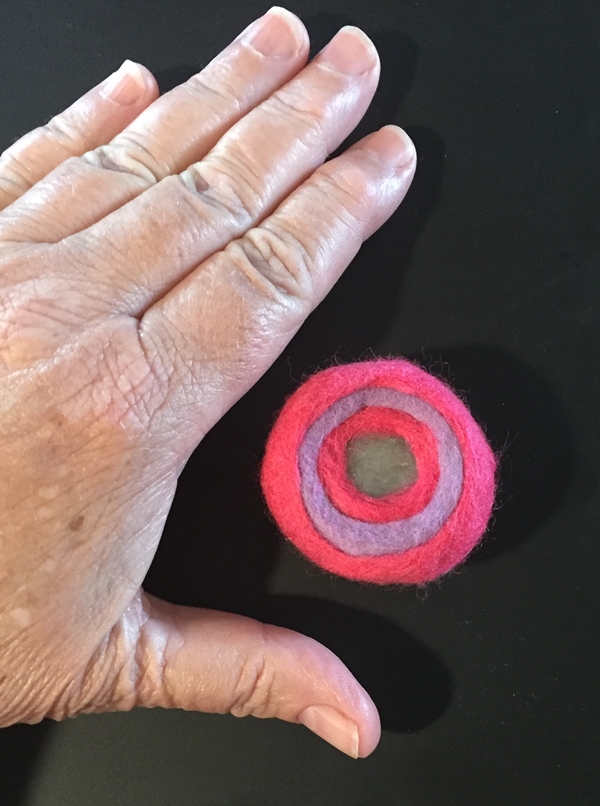
Now some felt. I finished up the pink sample for the book-resist workshop. I finished the pages 2 different ways just to show them. I think it might look nice with a light inside.
I made a second sample using a football shape. It is smaller.
The resist was fiddley to get out because I didn’t want a hole in it. So, didn’t want to cut a hole in the end.
After removing the resist, I sewed up the hole.
Stitching up the hole Stitching after fulling.
Here is how it looks finished. I am really pleased with it. The stitching was resistant to being pulled out, but I did get it out.
I may have to make another one. I may just have to stitch on this one. I have the wool ready for the next sample. I hope to have it done for you to see next time.
I have finished the first draft of the resist workshop. 6 pages, and I haven’t added any pictures yet. I printed it out, and I am working on the first sample. I will add notes to the draft and add in anything I missed. The first sample is a circle resist.
All stacked and ready to goTime to start rubbing
That is how far I got, one set of all the surfaces rubbed. I am going to have to find my studio microwave and set it up so I can reheat these when I get back to them.
The only other fibery thing I have done lately is spin on my drop spindle. I do this mostly when I go to guild socials. It’s a nice, portable way to work.
Here are some balls I made earlier,
The dark pink has some silk in it, I think it came from Louet a long time ago. The light blue and purple is from a batt I bought at a fiber show. The other three I made on my blending board. They are meino and sari silk. I like the pops of colour and slight slubbiness it gives the yarn.
Now, I am working on a sample pack from World of Wool. I got it last year. I am just getting to it now. They no longer sell this wool. It is Merino and Stelina (metallic-coated nylon). The Stelina is very sparlkely.
I did the yellow first, mostly for a change. I don’t do much yellow. It is hard to get the sparkle with the camera but there is lots of it. As usual, I found it stuck to several things when I pulled my laundry out of the dryer. It really does get everywhere.
That’s it for my fiberiness for the last little while. I hope everyone is coming out of the winter blues and into the joys of spring. I am looking forward to being able to sit in the garden, in the sun and enjoy my felting and fibers among the flowers and bird song.
Sorry For the late post, I thought today was tomorrow.
Last weekend I had four ladies for a techniques class. This is not an advanced class, but it is also not a beginner class. People had to already know how to make felt.
First, we did inclusions. They used a piece of thicker prefelt and elastics to enclose some large glass beads (the kind they are used in the bottom of vases for decoration) and a felt ball. Then laying out a base and top they enclosed some glass beads, a felt ball, a circular resist with a hole and a squashed tasimo pod with a resist over it. Sorry, I forgot to grab the camera until they were at the rubbing stage. Part way through they cut some holes on top of the beads and pod.
When they were laying out I had them cover a pebble with 2 layers in different colours. I had them put a resist on top of the first layer and wrap it with the second colour. They popped them into a piece of nylon stocking to contain it all and make it easier to felt. You can see the first sample on the table in the picture below. They mostly felted the pebbles during lunch while eating and chatting. Once it was mostly done they cut a hole in the top and after healing the cut edge removed the resist and cut a smaller hole to reveal the pebble. Similar to the one below that I made a few years ago.
Next was cracked mud. I had them layout two 10×10 pieces( top and bottom) they added painter’s tape in 2 widths and then added the top
Naturally, because it was a wet felting class, they had to do some rolling.
I had them cut the mud sections at different stages of felting, prefelt, mostly done and done. so they could see how that affects it. I think they could have used more felting before the fulling but we had limited time and had to move on to book resists. I had them make a four-page book resist using half circles. they managed to get it laid out and wet down but then we were out of time so they had to take them home to finish.
3 students sent me pictures of the finished pieces. The first one she manipulated to look like origami.
And this one, She says it needs more fulling but wanted to get me the picture.
The third student got creative and combined her samples into a tea cozy.
All in all a good class. I just wish I could squeeze more techniques in. But no matter how fast you want to be felting takes time.
Happy Christmas everyone! At the moment you are probably up to your eyes getting ready for the days of festivities which lie ahead. So, I will give you a few options here. Here is a slideshow of my blog which you can go through in a few minutes if you are stuck for time. Alternatively you can read my narrative or if you have a while to spare why not grab a cuppa, pull up a chair, watch the slideshow and read the narrative!
I covered the resist with orange viscose and two layers of red merino
Then I added silk paper I made. I didn’t like it so I pulled it off when it was at prefelt stage
This is the lid of the furniture polish I used to shape my bells
Here they are after drying. I cut them to size as they were rather long
Here is a view of the inside of one of the bells
I rolled the bottom edge to show the orange viscose
I pinned the soluble paper to the bell and drew my pattern
I cut back the excess paper ones I had stitched the pattern
Then I added the beads
Here they are ready for dunking
The paper dissolved once the water hit it!
Then I crocheted the ‘rope’ I painted the silver bells with some bronze nail varnish
Here they are, ready to go!
A detail of the free motion machine embroidery and beading on the tree
Disaster struck using masking tape on the inside of the card. Back to the drawing board
I stippled the card using a stencil brush and red then gold paint
Inside the card (no masking tape this time!)
A selection of handmade Nepalese paper for Karen to play with
All packed in the box
Here’s the finished card which I glued to the lid of the box
All ready for posting
And finally, here they are, on Karen’s beautiful Christmas tree
I was so delighted when I drew Karen in the Christmas card exchange this year. I was also a bit daunted as I have been going through a bit of a dry patch creatively over the past number of months. I knew I wanted to do something that ‘stood out’ (in other words 3D) but this can be a bit of a challenge when it comes to postal systems.
While searching through one of my fibre presses I came across a deep small box that I had used to transfer a porcelain bowl home from my holiday in NZ earlier in the year. We won’t even talk about how my weird creative mind works but seeing the box instantly brought to mind bells so, decision made, I got to work on them.
First I made my resist. I intended making two bells. I covered the resist in an orange viscose fibre and then laid two layers of red merino on top. I added a hanging loop to each bell and some silk paper to each bell which I later pulled off as I didn’t like it. Once prefelted I cut through the resist to make two shapes and then started working on shrinking and shaping. Next, I searched for a suitable bell shape which I could use for the next stage. That’s where the beeswax came in! The lid is shaped like an old fashioned beehive which is an ideal shape to work with. Lots of rubbing and shaping ensued (and I will admit a bit of cutting as the shapes were too long), until I ended up with bell shapes I was happy with. Then I rolled the bases so that the orange showed on the outside.
I decided I wanted a simple embroidered design on each bell. I drew my tiny design on water soluble paper and added my stitches and a few beads to each bell. Then I dissolved the paper and reshaped the bell on the top of my little beehive! Once dry, I got to work on the ‘rope’ and the bell. My little jingle bells were silver and I had been searching, to no avail for gold ones which I thought would look better. Then I thought of using some nail varnish on the outside of the bells. Worked a treat! I then took some cotton embroidery thread and made the ‘rope’ which I attached to the body of the bell and to the inside of the little ‘jingle’. Then I threaded ribbon through the loop at the top of each bell so that Karen could hang them up. They fitted nicely into the box but I felt there was something missing. So I added a few little squares of Nepalese paper which I thought Karen might like to experiment with. Some of these are quite a lot heavier than the usual ones which are used in felting but I have managed to felt them into pieces. I thought she might have fun trying them out.
Next to the card. My cards were the same size as the box so I thought it might be fun to attach it to the box when it was ready. I opted for a monochrome effect to start with; I prefelted a tree which was made from black merino and margillan silk. Then I laid the tree onto a white merino background and felted the lot together. Once fulled, I cut it to size. Then it was decorating time which I did on my sewing machine using free motion embroidery. I added some beads too.
Time to address the card! I stippled the outside of the card with a stencil brush using red and then gold paint. Then I decided to do the same on the inside but got too creative and used masking tape so I could control the area where I was adding the colour. Once happy, I went to remove the masking tape. Disaster! It took away a goodly portion of the card too. I was not a happy bunny! On to the second attempt with the card (without masking tape this time), I was more successful. All done and ready for the post.
Karen has received her card today and I got mine from her yesterday. I love my card. Karen has gone to such detail with it I am going to treasure it. Like Lindsay’s card from a previous swap, it will be putting in an annual appearance at Christmas time.
I love the concept of the card swap. It keeps my felting friends close in my heart, especially at this time of year. Thank you to Ann who organised it and us.
Wishing everyone a merry Christmas and a happy, healthy and peaceful 2025!
I had my first workshop of the fall season last weekend. It was a fun one, Vessels. I like vessels because they do not have to fit anyone when they are done. They can go completely sideways from the original idea and still turn out great.
I had 5 lovely ladies for the day. They had a great time( or seemed to at least) and I had fun too. I love to see people marvelling at the magic of felting and go from very sceptical to amazed at what they have made.
In this class, they all started with the same round resist. Everyone always asks about size. In this case a good sized dinner plate. Very technical.
On to the pictures
Laying out the wool. I like to teach laying out 2 sides without wetting and then go back to do the wetting and wrapping. I don’t know that there is any great difference but I don’t like laying out wool on a wet resist of wet wool.
here they are wrapping one side of the wool around the resist. For those whose layouts grew a lot, we feather the wool towards the middle so it will be more even. You can see the second side waiting to be placed on top, wet down and then wrapped around.
Next, were the embellishments. This part is fun for them and me. I love to see how diverse the ideas are. I usually bring wool, handspun yarn, silk tops, throwsters waist, trilobal nylon, sari silk waist, silk hankies and locks for people to use. I seem to be missing one pot.
Then, of course, there is all the rubbing and rolling. This is the point where I usually gabb on about wool and felt, the eganomics of making felt and sheep….. and anything else that helps pass the time so there are fewer complaints about how long they have to rub or roll. It is a boring sort of thing to do, I usually listen to an audiobook.
We talked about different ways to cut open your felt to get different types of pots and how shaping can change them. one lady said she wanted a pot more like a fruit bowl shape. I suggested turning her pot into two bowls by cutting across the middle. She decided not to but it inspired 3 others to cut their pots at 1/8, 1/4 and 1/3 to get 2 pots as a set.
I am missing one there Not sure how that happened. Here are some pictures students sent me of the pots dry
My American Aunt, Rose (born in Ireland but she lived her adult life in the US as a religious sister and kids’ teacher) used to have a phrase about nice things. They were ‘for special occasions and bonfire nights’. I suspect it was from a time when folk had one good outfit in their wardrobe but it’s a phrase that has stuck with me and, while the saying sounds fun, it has led to me not letting go of beauty, storing them up in boxes or in the wardrobes for that ‘special occasion’ to come along. As I get older I have come to realise that every day I get to be on this beautiful earth is a special occasion and so it is time to get out the glad rags and let loose! I am finally applying this simple principle to my fibre stash; so in this post I want to talk about some of those gorgeous samples that I made during the various dyeing workshops I have taken over the past nine months. I wrote about them in my last three posts and you can find them all here if you would like to catch up with them. Adventures in colour Part 1; Adventures in colour Part 2; Dyeing to Eat.
I have to confess, it took a while for me to brave using the results of the workshops – the special occasions and bonfire nights phrase was stuck in my head and I was afraid I might ruin the samples (silly!). In the end, I decided to simplify things and just play. I started with a little weaving. Some time ago I bought a small loom, nothing fancy, it cost less than €13.00. It’s from Sostrene Grene, it’s a great shop for reasonably priced bits and pieces and it now is online. Their website is here
Here is a photo of my little loom. It’s great for playing as I watch TV:
Small wooden hobby loom with pen included in the photo for size perspective
As I did not have specialist thread and as this was just a play, I set the warp up using cotton thread. Then I got to work, using some of the fibre and yarn which I dyed during the natural dyeing workshop last November. I also used a cotton yarn for the background of the piece. Here is a photo of some of the hand dyed fibre:
The final result for the fresh nettle dye. I love the variety of tints!
Here is the result of my first play:
Background is cotton yarn and highlights are provided with wool skeins merino and linen fibres.
Next, I decided to use some of the yarn which I dyed during the Procion dye workshop. At this stage I had purchased proper warp thread and I decided to use a metal hoop for my base. I used a small nylon ring within the hoop and I set this off centre when I was setting up the warp. Again here are some photos of the fibre and thread used. I love the vibrancy of these colours!
This slideshow requires JavaScript.
And here is the result. I plan to add nylon fishing line to this and hang it as a mobile.
Hand dyed (procion dyes) fibre woven onto a circular hoop.
Next, it was finally time to be a little brave and use one of my favourite fibre samples. This is merino wool which was randomly dyed in the dye pot. I loved the result as it reminded me of photos taken of deep space by Hubble. Here are two photos of the fibre sample I made.
This slideshow requires JavaScript.
I felt I might ruin the effect if I didn’t felt it carefully. So my layout had to be simple. In the end I decided to make a cowl with it. The sample length was 60cm and it was quite thick so I divided the fibre lengthways into two equal bundles being careful to keep the colours intact. I took the two bundles and stretched both out very thinly width wise, again being careful to maintain the colours. As the fibres were going to run in one direction I decided to use the nuno technique to stabilise the piece. I used margillan silk for this purpose (measurement length of sample x 2 by the width of the stretched fibre).
Then I cut a resist which was the same length as the sample. I wrapped the silk around the resist as it was to form the base of the cowl. I wet this to keep it in place (margillan is so light it has a habit of wandering!). Then I carefully laid the fibre on top of the silk. (Tip: the start and end of each of the two lengths of fibre were not placed at the edge of the resist to avoid any possibility of creating a ridge). I wet the piece down, rubbed and started rolling. (lots of rolls to encourage the fibre to go through the silk). Once this was done I started fulling the piece. Here are some photos of the process:
This slideshow requires JavaScript.
And here are photos of the finished piece. I am pleased with how the colours have kept their integrity and it has not become a muddy mess! All set for the cooler weather.
This slideshow requires JavaScript.
Next, I took some silk fibre which has been dyed in the same pot. Here is a photo of the fibre:
Front view: Silk fibre. I can’t help thinking about Hubble when I see this photo!
This time I set it onto a black background. I was so pleased that it adhered well to the fibre but the black did not destroy the colours. This was probably helped by the fact that I did not fully felt the piece as I intended to frame it so I knew I could stop my process whenever I found it aesthetically pleasing. There’s lots of texture in it which I am pleased about. The black background definitely reminded me of deep space! Once rinsed and dry, I set to work doing some free motion embroidery. Lots of little stars. I then added some silver seed beads for a little starry sparkle. What do you think?
Mixed media: procion dyes were used on silk fibre which was then felted onto merino. Machine embroidery and hand beading introduced stars to the piece
Next, a quick update on my more recent dyeing exploits. I attended wedding recently and I needed a cover up which would tie in with my dress. I did not have time to felt a piece but I knew that I had some light wool fabric which would be perfect if dyed. Previous samples from the Mexican dyeing course I attended confirmed that I could achieve the colour I wanted from avocados. I prepared my fabric (scoured and used an alum mordant) ate the avocados and then I dyed the fabric. I threw in a little prepared merino and silk fibres too to see what might happen. Once dyed, I hemmed the wool shawl. I am delighted with the result. This is one piece that will not be kept for ‘special occasions and bonfire nights’. Here is the result:
Handmade wool fabric wrap (dyed with avocado skins and stones) natural dyeing
Then I decided to use the merino and the silks which were dyed in the same pot to make a flower. The colour achieved was a lot lighter but I am pleased with the result of the experiment:
hand felted and beaded flower (dyed with avocado skin and stone) Merino and silk fibres used Natural dyeing
Finally, every year, there is a local collaboration between two of our neighbours a farmer and a food producer (we live in a rural area). They grow a field of sunflowers which members of the public are invited to pick and make a donation either online or through their honesty box to the local hospice charity. It is always a popular event. I picked some sunflowers this week and they are now looking gorgeous in my sun room. I took off the bottom leaves from the plants before placing them in water. I decided it might be fun to see if I could extract dye from them. I also made a little pigment. Unfortunately, the photos do not fully do justice to the beautiful green tones I achieved from the dye, but I thought I would share them anyway:
This slideshow requires JavaScript.
I know I am not alone in my need to behave like a squirrel and hoard my treasured items. I am so pleased that I have taken a tiny percentage of my mine and transformed them into something else which in my view are aesthetically more pleasing.
Now it’s time for you to share. Are you a hoarder too? If so, what do you hoard and do you ever think about transforming some of your stash?
Did I get your attention? My quest is to make diamonds, felt ones, that sparkle and shine. As you have heard from several of us the Ottawa Weavers’ and Spinners’ Guild is 75 years old this year. It is our diamond anniversary, so the exhibition theme for our Fall Sale and Exhibition is diamonds. You can interpret that any way you want. I thought Jan and I could collaborate, My part is the diamonds and probably a helmet but I will let Jan tell you about her part.
So now I am on a quest for the best way to make the diamonds. Originally I thought I would use a small resist that I could leave inside to help them be more 3D. I was thinking I could pull and shape them.
Well, that didn’t work out at all. the squares couldn’t be pulled and the diamonds didn’t look right with the middles pulled. It was partly because trying to get them pulled and a bit pointy was so hard. The big reason though is their size. When you try to stretch them you are pulling on two ends of the same fiber. Jan said kind things about them but truthfully they are terrible. It would only be worse if I tried to make them nuno felt. They look better in the picture than in person.
On to the next idea. I decided, who cares if they are 3D? Flat would be fine if they are the right shape. Next is a piece of shiny ( probably polyester) fibre from my stash. I thought it would felt in but wasn’t sure. Also, I decided I wanted August’s page to be pink so I combined the two. I used a piece of white prefelt and pink merino
I added some red sparkly fabric to one corner. It doesn’t look sparkly but it is.
Even dry the camera wants to focus on the wool and not the sparkle. It needs shaving but I am out of razors. The next stop Dollarama for the econo bag of razors.
One more try this week. I cut out some silk, some sparkly and some sequined fabric. Wow, is it fiddly to cut without cutting the sequins and they still fly everywhere. I put some face down and then put red prefelt on top.
Then some black prefelt and I tried to match up the fabrics to the bottom ones.
I rubbed this longer than usual to make sure the fabrics were stuck. My plan had been to stop at the soft felt stage. Cut out some diamonds and then finish felting. Unfortunately, I was listening to a good book and just kept going on autopilot. and before I knew it it was done. Now it is drying. I will cut out some shapes tomorrow and see what they look like. We may have to modify the project.
How would you make felt diamonds? All advice gratefully accepted.
Sounds like a quick and easy project, right? I thought so too. This is a case for my glasses to go in when I’m in bed. It will hang off the little bookcase beside my bed. Probably better than on the edge of the bed where they sit now.
I picked up some very pretty little batts at a local fibre shop. It is a combination of Canadian Ramboullet and Merino. It is sold as a wet felting wool, among other things. . The colours I picked were mottled and it is quite a short fibre. I did not do a sample as this is such a small project it is the sample. The batt is 50 grams and I don’t think I used half of it.
The other factor in doing this now was I knew I was going to the store to pick up wool for my workshop on the weekend and could pick up more if I liked it. I thought this small project would be just the thing.
This is the shape of the resist. I will fold the long part over to make a loop and use a button to hold it in place.
I split the bat so I could keep it thinner and still have it go in 2 directions. I am not used to using batts but they are a fast way to do simple layouts. After the first layer, I added some offcuts of cotton batting I thought might make an interesting raised texture. I wet it all out. It took a little more soap than expected to wet it out. I think there is some lanolin still in it but it is not greasy feeling.
I rubbed it for a while. it did get a skin but wasn’t starting to tighten up. I did a bit more and switched to rolling. I did that for a long time, flipping and changing direction, rolling on a ribbed mat all the usual stuff but no shrinkage. This was after about an hour rolling. You can see that it hasn’t shrunk at all
Next was heading home to the kitchen to rinse with hot water and get tough with it. I scrunched and rolled it in my hands and threw it in the sink. Maybe a little bit of shrinkage. It is definitely felt. It is holding together and I have removed the resist and the insides are not trying to stick to each other.
So what next? Time to do some laundry. I put it in a small delicates bag and tossed it in with a load of laundry, and then into the dryer. No pictures of that, I was too frustrated by then. I was also thinking that I would take it out and it would be 3 sizes too small.
This is the result, a very small amount of shrinkage, mostly in height. This is actually after it was dry and I had turned it inside out and then back because I forgot to take a picture.
I turned it inside out which made it stand open more so that is better for the purpose. I had to smooth out the edge divot from turning it inside out . the felt is quite thick.
It will work for the purpose. My glasses ended up a little too far down in the holder so I stuffed a little wool roll in the bottom so my glasses are easier to get hold of. It’s not a big difference but I can grab them a bit better. more wool may be added.
I just need to add the button and I am good to go.
I did let the store know that the wool is not good for wet felting. They said the mill is trying different ratios of the wools to find what works best. I suggested it would be good to make socks that would be fine in the washer and it is still good for needle felting.
Spring is here, My hubby has veggie growing fever. He has half my table as one of the few cat-free areas. Why do cats like to lay on top of seedlings?
I was asked to give a Valentine-themed workshop, specifically hearts. No surprise there. This is a short evening class. I am teaching in person in Ottawa at my guild on Feb 7, 2024. https://www.ovwsg.com/events/event/2407-felted-hearts/I had no pictures to put with the workshop so I had to create something. I decided on heart-shaped baskets with rope handles.
I started by finding a heart shape on the internet and sizing it up to about 6 inches across. I decided to do one this size and one bigger to end up at 6 inches.
they will fit nicely onto my rolling mat. I need to keep an eye out for a bigger one of these. This one is supposed to be for drying dishes. It might do for one person for their lunch dishes.
I decided on one in red and one in this year’s Pantone colour of the year coral pink. The colour doesn’t show well wet but you will see it when it’s dry
Next was adding embellishments. Coral pink is one of my least favourite colours so I added some sari silk in the colour Salsa. It is primarily red with bits of other colour in it.
The red looked pretty plain so I added a pale pink heart
Next of course was all the rubbing and rolling and cutting it out and rubbing and rolling and fulling. The red one is now 6 inches across and the pink one is 4 inches across.
I rolled a couple of snakes for handles. The idea was to poke holes in the hearts to poke the snake ends through and tie a knot. the pink one was okay, but the red one wasn’t long enough so I just felted the ends in. Jan thinks they should have a bell on the tip but I am not sure. I think I will offer them to the student but I don’t think I will add them.
And here they are on Jan’s new photography backdrop which I am sure she will be telling you all about in a later post.
Tada!
I like the picture of the pink one best. The angle is good. The red one is more from over the top of the heart. The chocolate hugs are some Jan gave me as a librarian present. Perfect for a Valentine’s photo shoot.