Browsed by
Category: Community

Needle Felted Animals

Needle Felted Animals

Since I started running workshops in 2017 I’ve often been asked if I will teach needle felted animals, maybe how to make a hare or a fox, etc. and my answer was always the same….. “sorry no, but I can put you in touch with someone who will”. There are so many terrific needle felters out there and, not only that, I didn’t really fancy spending hours stabbing fibres when I could be wet felting.

That changed when I got an email last November from a guy who wanted to buy his wife a needle felting workshop as a Christmas present. It was time to change tack so I agreed to run the class and immediately went out and bought various grades of wire and pipe cleaners and started hand carding fibres to make my first hare.

I didn’t concern myself too much with realism or body part proportions! Harriet went through several stages, at one point looking like an otter, at another like a kangaroo, before blossoming into a hare.

By the time she was finished I was hooked!! Two more hares followed in quick succession, the last one being this simplified version to use as a one day workshop for anyone who hasn’t needle felted before.

Happy with the hares I turned my thoughts to making a squirrel. If you google “anatomy of a (whatever)” you will find lots of diagrams and images of skeletons which can be used to get the correct proportions and shaping for your animal armatures. I used one as a reference for making my red squirrel armature as I wanted this one to be as lifelike as possible. It’s also useful to save photos, taken from all angles, of whatever animal you are making and refer to them constantly. I know a lot of felters use glass eyes for their animals but I decided to stick with felting mine as I think you can achieve more character that way.

Each animal is made with Cheviot fibres for the core and then cladded with carded Bergschaf or Corriedale. I was very pleased with how this one turned out.

I recently made a frog and this turned out to be my favourite piece. He seemed to take the longest but you can place him in all sorts of different poses and I just love him! Again, a quick search on the internet produced a diagram that was used to get the proportions and create the armature.

I changed my mind about the colour scheme part way through so he ended up with pink feet and a green body which just looked wrong! I couldn’t face starting again with the feet so I simply dipped his toes in Inktense paint and cured his problem!

So as you can see, this reluctant needle felter has really got the bug! I’ve done my first two classes and I’ve four more lined up, which I’m really looking forward to. The Christmas present of a hare workshop was well received and that particular lady, Jo, has since been back and made a red squirrel and her daughter in law made the lovely mouse…..pretty impressive for first attempts!

Jo’s Hare
Jo’s Squirrel
Janes Mouse

My only problem now is deciding what to needle felt next!

Studio Space -“Final” Layout

Studio Space -“Final” Layout

On my last post, I showed you my new studio space. I had just moved in and my beloved fibre was still very much scattered around, and I felt a little at a loss as to where I should place my furniture.

It’s been 3 months, so how have things progressed?

IMG_5106

The quick answer is, very much as I’d expect – there’s still work to be done! For good reason, however: I’ve been busy working on a new collection and have been concentrating my energy on that instead of changing things around.

IMG_5107

I did manage to add a little touch of whimsy to this corner. A few of my for-dyeing fibres are tucked in those cubicles, and I managed a way to show off a few o my hand spun art yarns, as well as some commercial ones I have plans for very soon.

Holes in the walls are a no-no, so I’m buying some MDF, placing it behind the shelves and  drilling that instead to keep my vertical storage organised. Having it propped against the walls as is isn’t agreeing with me.

IMG_5108

My little reading corner, currently filled with work stuff. When I’m sewing I feel I never have enough space to place my finished items.
I managed to add a little artwork to the walls, to liven the place up. My ceiling is very high and the bare walls looked a little sad. Wish me luck when it’s time to remove them…

IMG_5109

Placing the sewing table in front of my window was both smart and silly. I get plenty of light (my initial reasoning) but when it’s windy I can feel the draft from the window ventilation slots. For now, it stays where it is, but I might change it later.

Have I told you I named the sewing machine Marge?

IMG_5110

My former dining table can be completely stretched now, which is lovely. It might look chaotic but every item is in use for my current project! Ok, most items are.
Spot the Christmas wreath in the background… it’s needle felted.

IMG_5111

I made this wreath for my husband, who had to spend the holidays by himself in Scotland. I wanted him to enjoy a little seasonal joy and made this in a couple of hours. What do you think?

That’s my tour of the studio space. I’m still going to add more artwork to the walls, and might change the big table’s orientation. Other than that, I’m very happy with my work area and have found my energy is higher here, especially now that the days are growing longer. I’m looking forward to working in my corner during Summer.

Thank You from Zed and the Holiday Card Exchange

Thank You from Zed and the Holiday Card Exchange

Zed wanted me to include her thanks to all of you for your generous support. Here’s what she had to say:

Ruth,
Please could you pass on my sincere gratitude to everyone who made a donation or bought an e-book or tutorial to support me at this difficult time. I was absolutely blown away by the kindness and generosity of so many people.

I’ve had very little motivation to felt or be creative at all for many months, and whenever I did try, it felt ‘forced’ so wasn’t really enjoyable. As well as the generous donations, I also received many comments and messages which have made me feel very appreciated and cared for. In fact, they made such an impact that I felt like a huge weight was lifted from my shoulders. I’ve been feeling so much more positive. And although I haven’t had chance to do any felting yet, (but who has over the holidays!?) I feel like I have a renewed love for it, and have had lots of ideas for things to make and write about. I hope everyone enjoyed the holidays, and I hope the new year brings great things for everyone. Thank you so much 🙂

Now on to my regularly scheduled post!

Every year on the forum, we do a holiday card exchange where members make fiber art cards to send to their assigned partner. It’s a lot of fun and you get a great small artwork from another member of your “tribe”. It’s always fun to see what everyone creates and the cards are always so different. You can see some of them here. You have to scroll down and go through all the pages to see all the cards that have been posted so far.

My partner this year was Antje. She is one of our regular contributors here and I correspond with her frequently so it was fun to send each other a card. Since I was working on the concept of using stuff up, I searched in my studio for felt that would work for a holiday card. I found some screen printed red and green felt.

The red pieces had almost berry like shapes and the green had pine needle shapes. Perfect! I just had small pieces so I cut and stitched them into strips and then sewed them all together. I butted up the edges and zigzag stitched them together. They were a bit wonky but I didn’t need perfection. Once I had a post card shaped red and green felt, I needed to add an element. So how about a tree? I found a piece of white felt and cut a fairly wonky tree shape.

Here’s the card after stitching around the edge of the tree to attach it to the background. I then found some star sequins and did a little French knot to hold each one down. I then fused the felt down to a regular white card blank.

Then I found a nice font on the computer, printed it in “matching” color and added a holiday greeting. I did add a little surprise inside but forgot to take a photo of that before I sent it off to Antje. It was a bit nerve racking because it took over three weeks to arrive. I sent a package of wool to Lyn on the same day and that was received in less than a week. But a card in a standard envelope took what seemed like forever. Just when I was thinking I would need to make another card to send, Antje received it. Yay!

Then, just after Christmas, I received a package from Antje, much bigger than a standard card. What could be in there?

She did send this lovely card which is gorgeous. Such an innovative way to depict a tree.

But then, I also got these three items. The birch bark piece on the left is wonderful and since I love trees, it is going to find a prominent place in my home. I love everything that Antje sent me and it was such fun finding these extra surprises. Thank you Antje!

We would love to have you join us next year with our holiday card exchange. Join our free forum so you’ll know when to sign up.


Plaited felt vessel

Plaited felt vessel

This is a guest post by Kim Winter of Flextiles.

In September I started a two-year part -time basketry course at City Lit, which is an adult education institute in London. Although it’s only one day a week in college, there’s at least another day’s worth of homework, so it’s quite intense. But I am enjoying it immensely.

Plaited paper vessel

In the first half of the term we focused on plaiting, mainly with strips of watercolour paper. In the second half of the term we moved on to willow, which was much harder on the hands! You can read more about either of these subjects on my blog if you’re interested.

Stiff paper or card is ideal for plaiting, as you can get nice sharp edges and the structure retains its shape. But I like messing about with different materials, so I wondered what would happen if I plaited strips of prefelt and then felted them afterwards. How would shrinkage affect the overall shape and pattern?

If you don’t know how to make a bias weave plaited basket, there are some good instructions here. I don’t usually twine around the base as shown here – I just use pegs! – but otherwise the method is the same.

I used commercial prefelt for this experiment, in two colours. The white prefelt was merino wool, while the grey prefelt was Gotland. Gotland has a sturdier finish than the merino, but in my experience they have slightly different shrinkage rates, so that was another thing to throw into the mix! 🙂

I cut six strips of each colour and then wove them together to make a squarish 6 x 6 base. I pinned them together as I went along, and when all 12 strips were in place I then stitched horizontally and vertically. I did a couple of back stitches at the beginning and end to secure the threads but left the ends long so I could use them to continue stitching up the sides.

Prefelt strips woven and pinned together
Prefelt strips stitched together

(Apologies for the quality of some of these photos, but they were taken in artificial light, as the days are so short at this time of year!)

Once the base was stitched, I started weaving the sides by overlapping the central two strips on each side and then continuing to weave under and over the adjacent strips. I pinned and stitched as I went along.

Weaving and stitching the sides

This is what the piece looked like after I had woven the sides and cut off the excess felt.

Normally with plaited baskets you have to make a border by tucking the ends in or stitching a band around the edge. The advantage of felt, of course, is that it is self-sealing as the fibres mesh together, so I planned to finish just by trimming the edge after felting.

Once the weaving was complete, the felting could begin. I wetted the piece down, rubbed with soap, and started gently rubbing it all over, turning it inside out to make sure that both sides were felted.

I had to keep opening it up and turning it around during the rubbing phase to make sure the sides didn’t stick together (I could have used a plastic resist but didn’t bother, as I never rubbed for too long in one position).

The prefelt strips felted together fairly quickly, but despite the care I took when rubbing, holes started to appear at some of the intersections. So when the piece was partially felted I did some more stitching to ensure that there were no holes. I’m afraid I didn’t take any photos of this as it was quite dark by this stage!

This is what the piece looked like after felting and fulling.

I was tempted to leave the felted ends on, as they gave quite an organic feel, but in the end I trimmed them off, and rolled the piece some more to seal the cuts.

I also initially thought I might leave the stitching in, as I liked the marks and texture it added. But when I took out the stitching on one side for comparison, I felt that it distracted from the subtlety of the pattern, so I ended up taking it all out!

The inside and the outside have different patterns due to the weaving, but during felting some of the fibres have migrated through, so you can get an idea of what colour is on the other side.

Scaled up and turned upside down, I also thought this could make a good flowerpot hat – I can see Audrey Hepburn wearing something like this, can’t you? 🙂

So it is possible to plait with felt, though it is rather fiddly and time consuming. The forms are softer and more rounded, and you get a subtle idea of the pattern on the other side.

Thank you for reading, and I wish you all a very happy and creative 2020!

Knitting & Stitching Show 2019

Knitting & Stitching Show 2019

One of the highlights of my calendar in November is always the Knitting & Stitching Show at Harrogate. I’ve never thought that the title does this show any justice as it’s so much more than knitting and stitching!

The event, held over several halls in the Harrogate Convention Centre, features a wide range of exhibitions, most of which have the artist in attendance so you get to meet and chat to them about their work. There are also a number of artists in action (literally), workshops, lectures, demonstrations and a huge variety of craft retailers as well as artists selling their handcrafted items.

I’m guessing there will be a lot of our readers who didn’t attend this event due to location so I thought I would show what to me were some of the highlights.

Marian Jazmik “Beyond the Surface”

Marian Jazmik is a mixed media textile artist who uses a wide variety of materials, often heat distressed, to create stunning highly textural pieces of art. I was particularly drawn to her work by the wonderful neutral colour pallet. Depending on which piece you are looking at, close inspection might reveal sisal, plastic straws, packaging, cotton buds, scrim, beads and free motion stitching. She often uses heat treated Dipryl, a spun-bond fabric similar to Lutradur.

Marian Jazmik “Beyond the Surface”

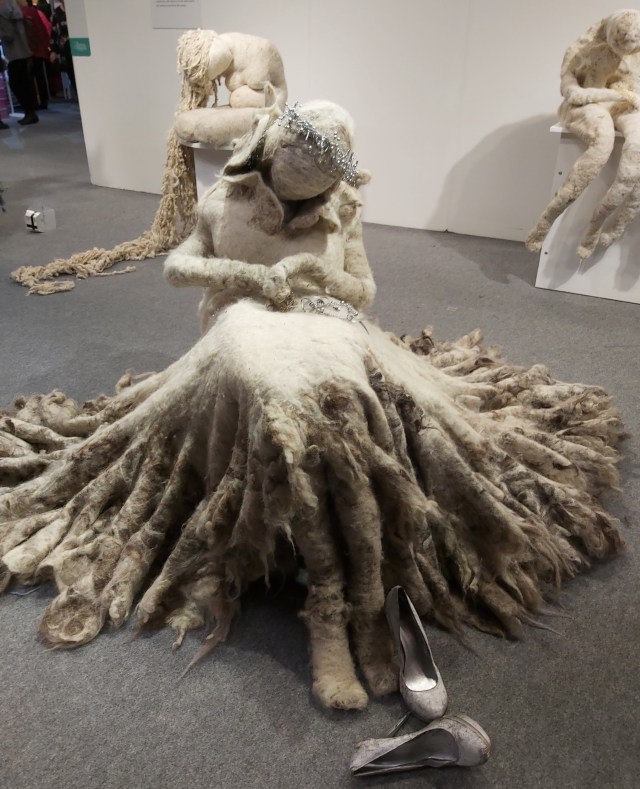
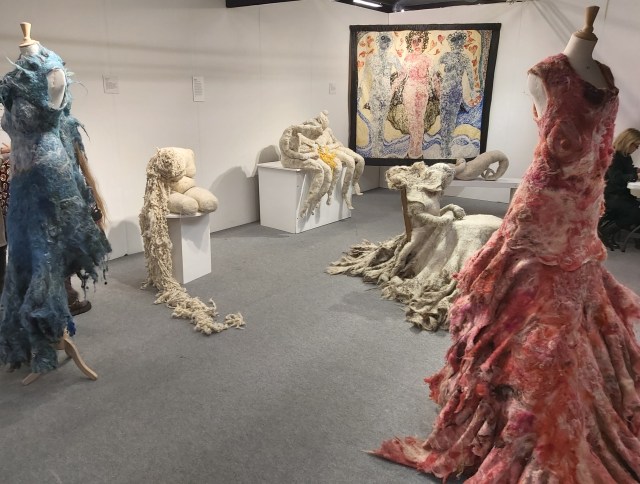
Catherine Kaufman aka the “Woolly Queen” is a Feltmaker working with locally sourced fleece which she needle felts to create life size sculptures celebrating the female form. It was the scale, and again the colour scheme, that made this exhibit stand out for me. Also hearing how the figures are worked on at home on her kitchen table! Catherine begins by making a wire armature which she then covers with fleece. I felt the most powerful figure was Rapunzel and, learning that the hair for this figure was Catherines first attempt at spinning, I’ve been inspired to have a go myself!

Rapunzel by Catherine Kaufman
Catherine Kaufman

Daisy Collingridge explores the potential of the human body and celebrates its physicality through her textile sculptures. The human form is so unbelievably varied, despite us all being built from the same components. Daisy has a strong fascination with human endeavour and the extremes the human form can take, dictated through genetics and choice.  These soft sculptures came from a desire to push the traditional craft of quilting to the extreme. The technique used is no longer recognisable as quilting in the traditional sense but the fundamental idea of sandwiching fabric is the same.

Daisy Collingridge

The figurative work has a grotesque element and body image and body transformation are obvious narratives through which to view her work. Each piece is a “body suit” and as part of the installation viewers can watch a film of the figures in action.

The Artists in Action area is always an interesting space with Textile artists and Feltmakers creating their work and demonstrating to the public. It was nice to meet Lizzie Houghton and watch how she creates her beautiful hats.

Artists in Action – Lizzie Houghton

Angie Hughes, one of my favourite Textile Artists, was also there demonstrating surrounded by samples of her beautiful work.

Artists in Action – Angie Huges
Vivienne Morpeth

In a different part of the hall I came across Vivienne Morpeth, a fellow Lincolnshire Feltmaker who specialises in fabulous Nuno felted garments.

Vivienne Morpeth – Nuno detail

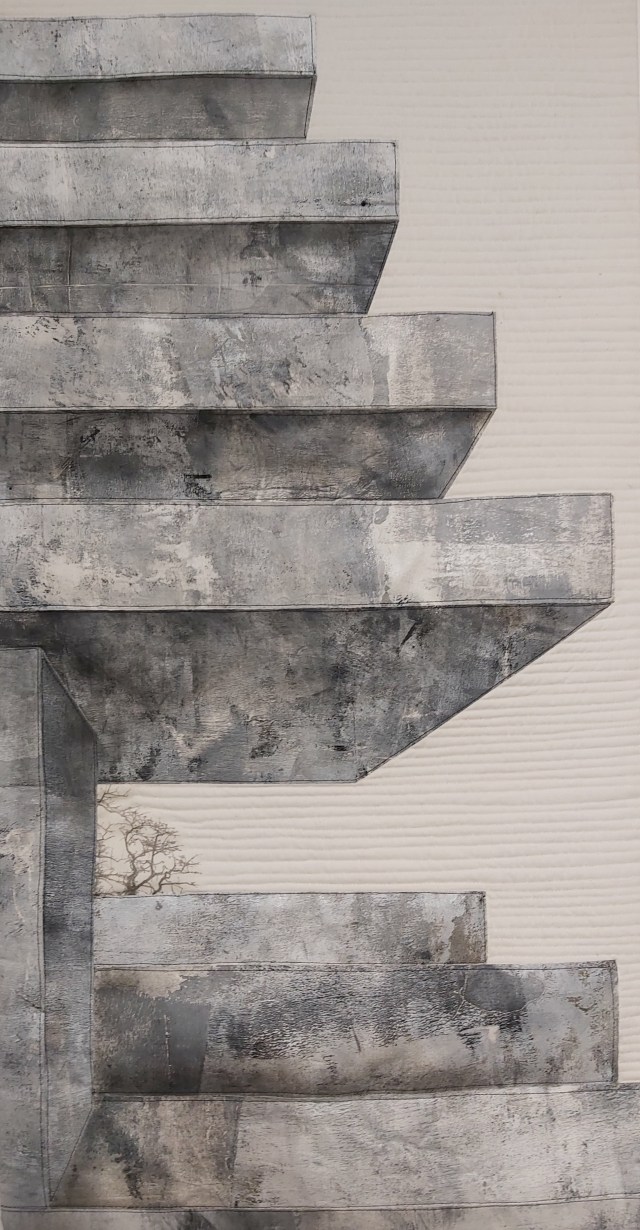
CQ London, a subgroup of The Quilters’ Guild of the British Isles, have been meeting since 2017 in Camden Town, London. It is an eclectic group, whose members possess a wide range of skills and interests. This was their debut exhibition and it consisted of two themes, London and Notan, a Japanese design technique featuring positive and negative shapes in a harmonious balance of light and dark. The following two quilts were standout pieces for me. The Southbank building was instantly recognisable and very dramatic in its simplicity. The fabric was painted with acrylics before bonding and stitching.

Southbank 14 by Sabi Westoby

City Textures by Connie Gilham was another favourite. Depicting St Paul’s, Roman walls and the Thames it was created using painted and dyed silks, cottons and sheers, again a very striking image.

City Textures by Connie Gilham

On a smaller scale, but equally beautiful, were these exhibits in the Embroiderers Guild area. Out on Tiles won the Beryl Dean Award for best hand stitching.

“Out on the tiles with a crumb of comfort” by Patricia Blinco

Alyssa Robinson won the Val Campbell-Harding prize for best machine stitching.

Alyssa Robinson

This piece by Jane Dexter titles Wood Grains was also one of my favourites.

“Wood Grains” by Jane Dexter

This is just a tiny snapshot of the show, there was so much more and I came away with my head full of inspiration and my bag full of goodies! If you live in the UK and haven’t been it’s well worth a visit if you get the chance.

Zed Needs Your Help!

Zed Needs Your Help!

If you have been reading this blog for any length of time, you will remember Zed’s posts. She does some wonderful experimental felt making and is always trying out new fiber, embellishments and other fun stuff and letting us know what happens. Zed has not posted here since June because she has been having a very difficult situation in life. She has been on disability benefits ESA and PIP due to conditions called Myalgic Encephalomyelitis (ME) and Basilar Artery Migraine. Last year, Zed was offered the chance to try self-employment for a year under a government scheme. Although it wasn’t a ‘runaway success’, with the safety net of Working Tax Credits to make up the difference in income to the same amount as ESA, she decided to try and make a go of ‘Felt by Zed’. Zed didn’t realize that she wouldn’t be entitled to the other low-income benefits she’d previously claimed which help with rent and council tax, so she used her savings and money from her mom’s will to cover these. Unfortunately, the savings ran out at the same time a PIP re-assessment resulted in a benefits cut of 33%, so soon income was less than expenses.

Zed’s debts have spiralled and due to bad advice, and other unfortunate experiences with the system, Zed is now being threatened with eviction. Zed is unable to work a normal job due to ME and is finding it difficult to even afford food. By raising $1,000.00, Zed will be able to pay past debts and start fresh. Zed may be entitled to Universal Credit but won’t be able to get an appointment until after the holidays. It takes 5 weeks for the applications to be approved.

We here at The Felting and Fiber Studio feel it is important to help our own. We have started a GoFundMe campaign for Zed and have contributed $200 to start out the campaign. Here is the link if you would be so kind as to donate a few dollars or pounds.

https://www.gofundme.com/f/zwgeb-zed-needs-your-help?utm_source=customer&utm_medium=copy_link&utm_campaign=p_cf+share-flow-1

If all our readers could afford a few dollars, we could reach this goal very quickly. Or if you don’t feel comfortable giving through GoFundMe, would you consider buying one of Zed’s e-books? https://feltingandfiberstudio.com/shop/felt-by-zed/

Your generosity will allow Zed to pay back any debts owed and afford the basics over the holiday season. We appreciate any amount that you are able or willing to give. Thank you!

The Felting and Fiber Studio Team


A Felting Adventure

A Felting Adventure

This is a guest post by Lindsay Wilkinson. You can find her here: Lindsay Wilkinson Artwork (Facebook and Instagram). I am also excited to say that Lindsay will be joining us as a regular contributor and I am looking forward to seeing more of her work.


Last week I set off on a felting adventure I’d been looking forward to for a long time. I was travelling from the UK to the Netherlands to do a 2-day wet felted seed pods workshop with Gladys Paulus, an internationally acclaimed felt artist whose work I’ve long admired.

I’m one of those people who cannot go on a walk without coming back with pockets stuffed full of found natural objects like shells, pebbles and seed pods and they have often inspired my felt work so here was the opportunity to learn from an expert.

The first challenge began before I even left home: how to fit everything on that long list of course materials into a suitcase that I could take on a plane? The answer? – ditch most of the clothes.

The venue (Atelier Fiberfusing) was a large warehouse-type building in a beautiful setting which had acres of working space – it was a real luxury for me to work on an enormous bench as my studio work area is pretty small.


After brief introductions (my nine fellow participants were all experienced felters from 5 European countries, the USA and Australia) we quickly set about making our first experimental piece using pre-felt we’d pre-made then stitching and felting to create very textured pieces.


Mine looked decidedly like a brain and I love it!

Our second experimental piece investigated differential shrinkage – using the fact that thick felt shrinks less than thin felt – to create shaped structures. I’ve exploited these properties before, for example in making 3D shells, but was still amazed at how much shaping we achieved in our pieces.

Finally we set about our main piece. I decided to work from this small eucalyptus seed pod I’d picked up somewhere on my travels.


We worked on these for the rest of day one and the whole of day two. There was plenty of expert one-to-one advice and support throughout the process and we also got to share in others’ learning as we were encouraged to gather around each other’s benches at key moments.

Here’s my eucalyptus-inspired seed pod. It’s not perfect but I am really pleased with it and learned so much through the process of design, making and experimentation. I particularly like the very textured surface (created by adding silky mohair locks and a small amount of kid mohair) and was thrilled to learn how to create the shaping of the body and how to attach a stem.

We finished by putting all our work together and everyone seemed impressed with how much work and variety we’d produced in 2 days. (Most of these are in the top picture)

Take-home lessons? Lots! I was particularly struck by how different our pieces were even when starting with the same template. There are so many ways you can work with and manipulate the felt and I realize a resist is more of a starting point than a defining feature. I also really enjoyed learning from others, particularly Gladys but also the other participants. Apart from a one-day beginners felting workshop about 8 years ago, I’m a self-taught felt maker but will certainly look out for other group learning opportunities.

I’m now buzzing with new ideas and can’t wait to start using some of the new skills and techniques.

Here’s a bonus photo of the scenery near Atelier Fiberfusing on Sunday morning.

Someone send inspiration and help…

Someone send inspiration and help…

I recently moved from London to Edinburgh. When asked why I was moving farther north by my baffled English friends, I couldn’t resist telling them it was because England just wasn’t cold enough for me, nothing but Scottish weather would suffice! Some of them actually believed me…

It’s not easy packing up a whole life and its contents, but having a work studio mixed with the personal makes things even harder. Once almost your whole life is safely hidden in boxes, only half the work is done – the unpacking, deciding where everything goes, both in the domestic and business front, is hard work. I’ve been at it for two weeks already and my new place still isn’t finished!

Feel free to be horrified by the mess and judge me, I can’t hear you.

EA1E1A69-CC8C-4D6C-AC0A-C7D0C0EA1F9A

This was the lovely blank slate I had to work with. The ceiling is very high (typical of early 1900’s flats around here), the wood floor is real and the fireplace works. Happy sigh.
(Now comes the cringe-y part)

34BDEF0B-9734-400B-B25B-7AA74C1CF370

It looks like a hurricane passed by, I know. I think I panicked and simply started to take things out of boxes before I had any inkling where anything should go. I kept coming back to the room, standing in the middle and staring at everything, having no idea how to organise my precious stuff. This went on for days!

IMG_4891.jpeg

After a few days of this my brain seemed to finally awake and I’m now finally able to see where I want most things to be, and I’ve started arranging my fibre slowly.

IMG_2091.JPG

I also got one of those adjustable tables that lets me use the computer whilst standing; I’ve yet to use my chair!

IMG_6162

My sewing table is now tucked into the window nook, affording me a little view of the sea and the stunning cloud formations above it. Inspiration might strike more often from now on with all this weather drama…

227280F6-E3F5-4F81-B68A-BC8BAFA86FA1

I promise my floor is now a lot more bare of items, and I’ve finally figured out where certain pieces of furniture will go. Once it’s all done I’ll even have a knitting chair near the fireplace, so I’m feeling very happy indeed.

Let me know if you’d like to see the finished studio, I’m happy to share.

Have you moved recently? Share your experiences with me so I know I’m not alone in dreading the sight of a moving van or two in the near future…


Roots and Leaves

Roots and Leaves

In my last post, Work in Progress, I wrote about the A4 challenge I was working on with my local group at Waltham. I was well underway with my planning but, as often happens once I start on a piece, part of my plan changed. I decided not to use the felted backgrounds I’d originally made and instead I created the forest floor using painted and heat distressed Lutradur hand stitched to a cotton background. I used 70gsm Lutradur from Spunart and painted it with tones of green, yellow and grey Inktense. By applying the heat tool you can make wonderful lace effects which are very effective when they are layered.

Once all the elements were ready to be assembled, i.e. the pebbles, greenery and leaves, I positioned the roots in order to decide where everything else would fit. The easiest option for assembling would have been to use glue but, as Waltham is predominantly a “stitch” group, I went with the more time consuming method and hand stitched it all in place. The final stage was to attach it to a canvas to make it more robust for transporting and hanging.

Roots

I’m really pleased with the finished piece, which I’ve called Roots, and looking forward to showing it at The Big Textile Show at the end of this month.

I was hoping to show you Jacky and Caroles finished A4’s but unfortunately life’s got in the way for both of them! Neither ladies have managed to do anymore to their work as yet so instead here are some images from a recent workshop I attended with Textile Artist Jan Dowson.

Jan’s Workshop Sample

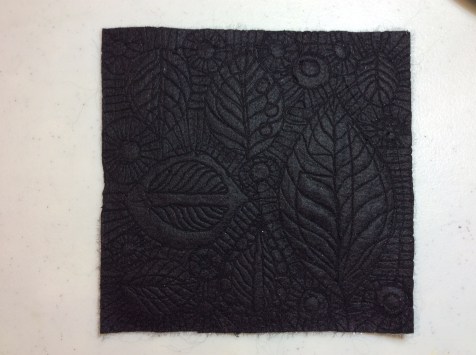
Jan was teaching a technique made popular by Susan Lenz. Susan layers polyester velvet onto polyester felt, free motion stitches with 100% cotton thread and then hits it with the heat gun……what’s not to like!! This was right up my street but rather than using square shapes as Susan does I used a leaf theme for my overall design. I’m now waiting for my order of polyester felt to arrive so I can make a larger piece…..

Adding free motion stitch to my leaf design.
The stitching is easier to see from the back
Ready for turning up the heat!
The finished piece.
Work in Progress.

Work in Progress.

Last year I joined a group of creative ladies who meet once a month at Waltham Windmill. As well as working on our own projects we have a number of set “challenges” requiring us to work to a certain theme. This week I began one those challenges which is to produces three A4 size pieces of work using just three colours. Each piece is to have one predominant colour, plus a small amount of the other two. The format can be landscape or portrait but all three will be displayed together. The design, techniques and materials are entirely up to the individual.

My first thought was that I wanted my 3 pieces to be joined together and initially I was thinking along the lines of a leaf motif, using the veins to span the gaps between the work. The first design was for a very simple “spear” shaped leaf.

The second idea was to simplify it even more and loose the outline of the leaf. The background would possibly be heavyweight interfacing or Lutradur and the veins would be free motion stitched, spanning the gaps by stitching onto dissolvable fabric.

In the meantime I happened to take my dog for a walk in the woods at Hubbard’s Hills in Louth when I had a lightbulb moment! There were some wonderful exposed tree roots at the top of the hill and I suddenly saw these as being the joining element of my 3 x A4’s. The design now was for a “forest floor”.

I realised that I would need a sturdy backing so I’ve wet felted these using Bergschaf fibres and they will be individually mounted onto stiff card…..at least that’s the plan so far! There will be little background showing on pieces two and three but far more on piece one so I included some thick cords under that sheet of felt to indicate buried roots.

The tree roots above ground have an aluminium wire as their core, wrapped with wadding and strips of medium weight Lutradur before being painted grey.

I’ve started making the weeds using free motion stitch on dissolvable fabric but I will look at alternative materials, possibly Lutradur, to introduce different textures, create more bulk and not least to speed up the weed making process!

The fallen leaves at the base of the roots will be FM stitched on Lutradur. Once they’ve been cut out using a soldering iron and heat distressed to make them curl they will be painted in varying shades of gold.

I’ve managed to get a couple of other group members to send me images of their work in progress…..

Jacky approached the challenge by choosing blue, green and gold as her colours and using the “stack and whack” method to cut them up. After selecting her fabrics they were cut up quite randomly and then machined together in strips. The three sets were then layed on top of each other and sliced through again. The yellow and green shapes in the resulting strips made her think of plant pots and this led to her theme of “neglected pots and plants”. In this piece Jacky has added an appliqué cactus and free motion stitched the neglected straggly plants on the left. This one isn’t far off being finished but Ive been told the other two are still piles of fabric on the workroom table!

Carole has chosen to use a combination of plain and patterned fabrics in her chosen colour scheme of red, blue and yellow. Each of her A4’s feature a different piecing technique i.e. strips, curves and crazy patchwork. Again this is a work in progress but already you can see how individual members are putting their own mark on their work and how different everyone’s finished work is going to be. I will post images of the completed challenges next time.