Browsed by
Month: November 2019

A very small amount of progress.

A very small amount of progress.

I am afraid it has been a busy week and I have mostly been working on getting my Christmas card done for the exchange. I will do a nice post about that after my partner has received it. I don’t want to spoil the surprise.

So really the only thing I have done is finish making the background for my 4th quarter piece.

Next, I downloaded some outline drawings of leaves and copied them randomly onto a piece of wash-away stabilizer. they are are all close-ups. The leaves didn’t show on the overall shot.

I wasn’t sure what sort of thread I would use to stitch these, but the other day I stopped into a craft store and they had what I hope will be just the right thread. Of course, it has gone missing so I can’t take a picture of it. Here’s a picture from the web. It’s the one in the front, red and orange and a bit of green. Surprise…. its called autumn.

Next time I hope to show you some stitching done.

Three Goals in One Project

Three Goals in One Project

Happy Thanksgiving to all of you from the states. I hope you are enjoying a wonderful day with friends and family.

Last week, my friend Deb told you about her experience with nuno felting. This is the piece that I made during that nuno party.

The plan was to get a nuno felt piece completed at the party. This piece is only about 5″ x 5″ and I planned to get at least one more done but somehow I didn’t manage that. The other two goals were to create a colorscape for the 4th quarter challenge and to use the end result as one of my Level 3 color studies.

So the color scheme is red orange, green and blue. I originally thought I would lay green threads on top and then couch them down. Then I would add some french knots as poppies? But here I go being too literal again. It was just supposed to be a “colorscape”. I needed to keep it simple.

So I found some thin, hand dyed green thread and added it in with running stitch, also called Kantha stitch.

Then I added the red orange thread in Kantha as well. I like how the Kantha mimics the same texture as the nuno felted silk. So here is my colorscape for the 4th quarter challenge which is also going to be part of my homework for class and it was completed at our group meeting. So I managed to get three things off my list in one piece. Yay!


Colourscape & inspiration from sampling

Colourscape & inspiration from sampling

colourscape

above: Colourscape in felt

I was fascinated by this colourful photo of Chilhuly Glass.  I love the transparency of the glass and the way the overlap gives a secondary, and sometimes tertiary, colour.

Chihuly glass installation at the Bellagio in Las Vegas

But how to achieve that effect with fibres?

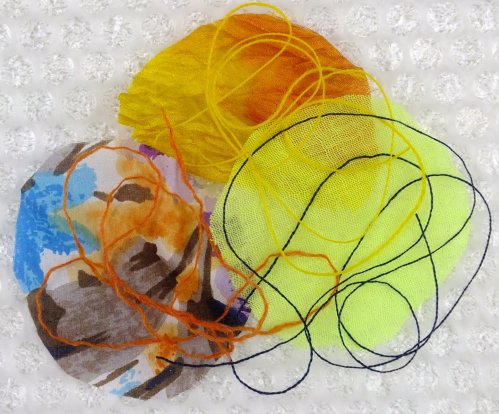
My first idea was to try delicate nuno felt so I cut three circles of fabric (2 are silk and 1 is unknown but it’s open weave) and some lengths of 100% wool yarns that I reduced to one ply.

fabrics and wool yarn

I arranged wool on each piece of fabric then overlapped the circles. I was hoping that gentle agitation would make the wool fibres migrate into all the fabrics and hold them together.

fabric and yarn wetted down

Long story short – it wasn’t successful and it would have been a waste of a photo to have shown the resulting mess.  The thin strands of wool were not ‘loose’ enough to work through the silk but the wool on the open weave unknown fabric was ok.  Also there wasn’t enough transparency with the silk.

My second idea was to try cobweb felt.  I fluffed up a small amount of wool fibres …..

puff of fibres

…  wet it down, then added a spiral using just one strand of wool.

fibres and wool yarn

I made two more puffs of fibres in a similar way then placed them down as shown in the photo.  I felted them very gently.

fibres and wool yarns put together pre-felting

When the felt was dry I picked it up and I liked the effect but I wasn’t sure where I was going with it – should I make a see through piece that needed light behind it or a piece to be mounted onto a stretched canvas?

dry cobweb felt

Eventually I decided to make my colourscape using puffs of fibres and one-ply yarn on a thin base of bright white merino fibres so that I could mount the finished piece onto a stretched canvas.

Sampling may look like a lot of effort, but it actually saves time, frustration and materials!

Sampling also inspires new ideas.

I made circular puffs of fibres in different sizes and decided to just use one line of yarn on some, but not all, of the circles.

My colourscape developed during the laying the down of fibres to become the almost finished piece, shown below, that I trimmed with a rotary cutter when dry.

The trimmed felt is 43x28cm (17″ x 11″) … and yes … it really is that bright!

I have a lovely assortment of commercially dyed wools: vivid fuschia, vibrant lilac, canary yellow, bright orange,  spring green, fluorescent pink etc…

…and the puffs of fibres were see-through enough to imitate the effect of layers of glass.

circles laid down and felted

Then it was time for a bit of pencil-end chewing as I still wasn’t sure of where I was going with it.

I knew I had to keep the circles theme so I sketched out several ideas but none really felt right.

So I put the felt to one side and carried on with other things. The next day an idea formed.  I  picked up some cookie cutters, an air erasable pen then I drew circles of two different sizes on the cobweb felt using the cookie cutters as guides. I cut them out, shuffled them about, put them back, and I liked the result!

I secured the circles in place with a single-sided fusible fabric, ironed onto the back, then,  as this piece so lightweight, I simply applied a thin layer of fabric glue to the fabric backing to attach the felt to a stretched canvas.

Below are some close-ups:

circles 1

circles 2

circles 3

circles 4

Anyone else taking up the fourth quarter challenge?  A colourscape really can be anything at all: wall art, clothing, vessels or perhaps a small piece to put on a greetings card.


Flax Study Group Part 1

Flax Study Group Part 1

Flax Study Group Part 1

(Sorry. I got to the first part of the harvest and realized this could grow into a book! So i will tell you about the violence and weapons like swords, brakes, hackles and skutching later.)

There are many reasons you might want to join a local guild. There is the comradery of people who are also interested in what you are interested in. There may be access to shared equipment or resources. There may also be the opportunity to join a study group.  The Guild Ann and I belong to is reasonably old by North American standards and reasonably large for a local guild. We have members with interests from spinning, weaving, felting, dyeing to tatting, lace making and naalbinding . We even have at least one (Icelandic) warp weighted loom represented within the membership.  We have socials every Monday nights if we are not having a meeting which happens once a month.  At socials we spin, weave, knit and chat. One of the chats led to the idea to form a study group to grow and process flax. I think that was about a year ago.

28

Pre planting planning:

Cathy Louise offered planting space at her farm and started to research on seeds appropriate for our climate and length of summer. I tracked down books in the library, looked on line for information, and volunteered to photograph the experiment. We had a number of people that expressed interest but not all made it through to the end. We found a particularly good book on growing flax in Canada.  Cathy Louise bought the seeds (we divided the cost amongst the participants; $7.00 Canadian) and prepared a row in her farm garden for the planting to take place.  I think it was 4 feet wide by 40 feet long.


We had to wait till the field was dry enough to work (there was flooding again this year as the snow melted)

11

This is April 4, 2019 at Cathy Louise’s field south of Ottawa while most of my garden was still covered in snow.


Day 1 planting:
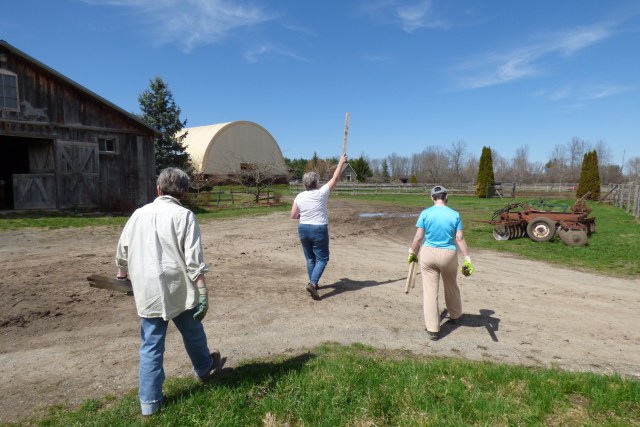
22 Cathy Louise Leads Us to the field

The study group arrived on a bright sunny day (May 5 2019) to rake, stake and plant the 3 bags of seeds to start the beginning of the practical part of the study group.

  • density 4 seeds per inch hand scattered


Step 1 measure and mark the planting section for the flax.

3-4 Positioning the Flax Plot

Step 2 weed and rake the area of planting. Put up a line to mark the planting area.


5-6 Weeding and raking to prepare for the flax seeds


Step 3 we had three seed packages so we cut the section into thirds and marked them by a stake.

We planted each section by scattering the seeds by hand. Then raked and tamped them down.


This slideshow requires JavaScript.

7-13

14 14 Afterwords,  relaxing with everyone on the deck (there use to be cake)

The end of planting was celebrated by cake on the deck!

Cathy Louise gave progress reports as the seeds became plants on our study group face book page; OVWSG Flax Project. (There was much rejoicing when we saw the little green bits  and they didn’t seem to be weeds!)

(Skip ahead a little)

Weeding party- June 08 2019

  • Checking the amount of growth of the row. Height just over 4 inches?
  • Instructions- if it’s not flax pull it.
  • A quick touch up along the edges (was that implement called a stirrup hoe?
  • visit the very pretty cows
  • Celebrate with cake and ice tea!!

This slideshow requires JavaScript.

15- 21 Some of this green is not like the other green so get rid of it! Glenn’s technique is vary relaxing.

22

22 We Work hard evicting and terrorizing weeds.  So we relaxed with Cake and ice tea! it was vary good!

All this took just over an hour and then we celebrated with cake!

Cathy Louise posted updates at the flax grew

23 23

June 22 Cathy Louise Posts update on flax groth

24 24

June 28 updated on flax from Cathy Louise


2525

July 7 update from Cathy Louise

26

26July 11   In early July, Strings were added across the flax to help keep it upright before a large rainstorm was forecast (Cathy Louise, Bernadette and Julie did the stringing)

27 27

July 22 the seed heads suggest we should be harvesting soon updated picture from Cathy Louise

First harvest Saturday July 27, 2019 at 10 am. The harvest took an hour to complete.

2828 Flax flower and seed pods

This slideshow requires JavaScript.

29 – 39 the Harvesting Teem.  small bundles were pulled and tied with a flax plant to hold the bundle securly. the bundles were staked along the fence rail to dry.

4040 the first part of the harvest is in . look at the weeds that snuck in  among the flax plants.

You can see that we left about 1/4th of the row to continue ripening so it could be used as seed for next year. We split the remaining flax in two more harvests so we could not only have viable seeds but also see how leaving it to grow longer would change the characteristics of the fibre.

To also give comparison we were going to rett most of the fibre in a trough but wanted to also see what effect dew retting would create. To sate our curiosity Bernadette took a few bundles home to dew rett (spreading and lay it out on the grass, turning it to start the rotting of the outer part of the stalk to allow access to the inner fibre)

I will show you more of what happened to the unsuspecting flax plants after they were pulled up by their roots and left to dry by the fence. That will be for next week, or i am sure you will feel like you are reading a book!


3rd and 4th Quarter Challenges

3rd and 4th Quarter Challenges

As you remember I was finished my 3rd quarter challenge except for adding the name. After chatting with others at one of our guild social evenings I decided to put the name on the bottom left. I think it looks right for us because that’s where we see it usually. And that is because usually when you see a map of Ottawa it also shows the 3 cities across the Ottawa river to the north.

It turned out terrible. I need to make the letters bigger and then make them farther apart so the finished word looks right. It actually looks better in the picture here, than in person. I ripped it off and will try again.

I started my 4th quarter challenge. the colours this fall were amazing and I thought about doing a landscape with lots of fall trees but I just wasn’t feeling it. This is what I have done so far. I cut some dark green prefelt to 12×20. this is always harder than it sounds. I do have a proper rotary cutter now and that works way better than the cheap one I had before.

Then I started adding colour. I am not sure why the pieces of fibre look so blurry. When I zoom in, it looks in focus.

Lots of nice fall colours. They are actually dull compared to the leaves this year. the leave glowed even without the sun this year. They looked unreal.

That’s as far as I am. Next time I will show you how it felted up and what I plan to do with it. And hopefully the city name on the cityscape.

Machine Needle Felting a Wool Collage

Machine Needle Felting a Wool Collage

I have begun another class at the Gail Harker Creative Studies Center in LaConner, WA. The class is Advanced Experimental Stitch 301 and lasts for two years. Our first session was all about color, dyeing and then creating different fabric collages in a variety of color schemes. If you want to follow all of my progress and homework, you can take a look at my Permutations in Fiber site.

I decided I wanted to try a few of the color schemes in felt. I could use up some printed felt that were samples from my online courses and also use my Janome needle felting machine that has been languishing in a corner of my studio for years. A win-win!

I started out with a dark violet background and then cut out two partial printed leaf shapes and three circles from orange printed felt. The color scheme is violet, orange and green. It is hard to see the violet and green since they are both such dark values.

First I had to unearth my needle felting machine buried under a ton of stuff. I should have taken a photo of the buried machine but didn’t think of that in time. I began by felting in the two leaves. Since everything was felt, the machine handled it very well. The only issue is the edges get a little wonky and you need to start from the outside edge and work in. The felt leaf shrinks as you go and will get all bunched up if you try to needle felt down the outside edges first.

Here is the end result. The photo on the left shows the front side. Because the felt is printed, it is white underneath and I didn’t like the white showing through so much. I turned it over (middle photo), and liked the back side much better. But still a little too much white. What to do? I have no problem with mixing medias so I found an orange and green Sharpie and just added a little ink to the wool to get the colors the way I wanted them (right photo).

On to adding a little hand stitching with hand dyed thread. I had originally planned to do chain stitch and cover the green and orange completely with chain stitch as a filling stitch. But then I decided I like the colors of the mottled orange and green. So I stuck with just outlining. For the leaves I used stem stitch. I could add some veining in the leaves but decided to leave it as is for now. It’s not a color scheme I use all that often but I like it. Do you try different color schemes? Or do you stick with your favorite colors?


Nuno Felting Party

Nuno Felting Party

This is a guest post by Deb Stika who is a member of my local art group. 

I’m a member of Ruth’s art group and am back reporting on Nuno felting. The above photos are of the finished product. I really wanted to like Nuno felting but I can’t honestly say I did—even though my art group buddies repeated the tutorial session for me because I missed the last one—thank you everyone!!! Nuno felting is a lot of work. Some of the work very tedious and messy…

Getting to work with lovely wool fibers was nice…


Pulling the fibers apart was fun…


And laying them down was satisfying…


Smooshing around with soapy water… endlessly…

And rubbing…rubbing…rubbing…then rolling…rolling…rolling…


And rubbing some more…


And then you toss the darn thing…HARD!!!

Ruth said if I was not happy with doing Nuno felting that I should not try felting. I
don’t think there is any risk of that happening!!! Thanks again to my group…I
enjoyed being with you as always!

Do you have experiences with nuno felting that made you feel like this? We’d love to hear about them.

Werewolf Boy

Werewolf Boy

1Ghost Girl looks lonely 1

Werewolf Boy:

Last post I showed you the OVWSG sale and exp. between photos I was demoing needle felting.  I brought the ghost girl and had already decided she looked very lonely even with her ghosts on strings. After a bit of consideration I decided on giving her a friend, Werewolf boy.

23Workshop sign up table and the beginnings of a friend  2-3

As you saw before, I made the armature from the same Dollarstore floral wire (no gauge noted on packaging). Learning from experience I doubled up the wire for the legs and arms but the head loop is single. The tail is actually one-piece cut in half and then folded which gave four offset twisted pieces. I made the farther end two strands and the nearer end four strand. I had left a tuft to start the tail and anchor the wire as I was building the body shape.

For this one I wanted to have the appearance of mitts, boots, a hood and muzzle mask, jacket, tail and maybe another basket. Like the ghost girl I wanted the hood to be removable. I still do not have a base. I had wanted to take another wander down the street to the used-to-be-there forest, the crows do not look pleased, but there has been a lot of mud created by the heavy equipment moving tree pieces around into piles. I may be able to get to the scrap pile now that the ground will be starting to freeze. If not I may try to find a piece of firewood and split it. In the meantime, they can enjoy the softness of my working foam (garden kneeling pad from Dollarama $2.50 Canadian.  They should be back in the stores by February).

I made the frame and then decided the shoulders were a bit too wide so adjusted them and started with the boots followed by chest, arms, neck/head and then legs. I am not sure why that felt like the right order. I used wast wool from combing again for the body and primarily locks or teased locks for the costume pieces. The wool is from a dark section of the giant Shetland fleece from earlier this summer.

For the hood and mask I started with the mask, getting the upper jaw then adding the lower jaw. Adding a strap and then worked on the hood. I joined the jaw with the strap and the hood then added the ears. I found the ruff a bit thin and wanted to add as few more curls to augment it. The seam ripper was sitting close by so instead of trimming the locks with the scissors I tried the seam ripper.  Although my seam ripper is sharp it produced a less straight cut then the scissors would have. It also has the advantage of being able to get into spots my larger scissors could not reach.  It may be a useful tool to add to my felting tool box.

Another odd tool was the foam hair rollers which I had picked up in three sizes, again at Dollarama. (No I don’t work there or own stocks in the company but maybe I should look into that?) It made working on the curve of the assembled hood and small basket quite easy.

456

Felting Tools (What you put them in your hair? how odd.) 4-6

78

Werewolf Boy needs a basket for trick-or-treating 7-8

I again got distracted as I was working so there are few pictures (that makes up for the last post!) to make up for such a horrible pho-paw, I had werewolf boy participate in a couple photo shoots so you can see him.

This slideshow requires JavaScript.

Werewolf Boy dose Photos Shoot 9-13

1415Ghost Girl meats Werewolf Boy and its time to Trick-or-Treat 14-15

These small figures were fun to create and then dress in their costumes. Now I have to find them a better base but that may be best left for a later day.

A Felting Adventure

A Felting Adventure

This is a guest post by Lindsay Wilkinson. You can find her here: Lindsay Wilkinson Artwork (Facebook and Instagram). I am also excited to say that Lindsay will be joining us as a regular contributor and I am looking forward to seeing more of her work.


Last week I set off on a felting adventure I’d been looking forward to for a long time. I was travelling from the UK to the Netherlands to do a 2-day wet felted seed pods workshop with Gladys Paulus, an internationally acclaimed felt artist whose work I’ve long admired.

I’m one of those people who cannot go on a walk without coming back with pockets stuffed full of found natural objects like shells, pebbles and seed pods and they have often inspired my felt work so here was the opportunity to learn from an expert.

The first challenge began before I even left home: how to fit everything on that long list of course materials into a suitcase that I could take on a plane? The answer? – ditch most of the clothes.

The venue (Atelier Fiberfusing) was a large warehouse-type building in a beautiful setting which had acres of working space – it was a real luxury for me to work on an enormous bench as my studio work area is pretty small.


After brief introductions (my nine fellow participants were all experienced felters from 5 European countries, the USA and Australia) we quickly set about making our first experimental piece using pre-felt we’d pre-made then stitching and felting to create very textured pieces.


Mine looked decidedly like a brain and I love it!

Our second experimental piece investigated differential shrinkage – using the fact that thick felt shrinks less than thin felt – to create shaped structures. I’ve exploited these properties before, for example in making 3D shells, but was still amazed at how much shaping we achieved in our pieces.

Finally we set about our main piece. I decided to work from this small eucalyptus seed pod I’d picked up somewhere on my travels.


We worked on these for the rest of day one and the whole of day two. There was plenty of expert one-to-one advice and support throughout the process and we also got to share in others’ learning as we were encouraged to gather around each other’s benches at key moments.

Here’s my eucalyptus-inspired seed pod. It’s not perfect but I am really pleased with it and learned so much through the process of design, making and experimentation. I particularly like the very textured surface (created by adding silky mohair locks and a small amount of kid mohair) and was thrilled to learn how to create the shaping of the body and how to attach a stem.

We finished by putting all our work together and everyone seemed impressed with how much work and variety we’d produced in 2 days. (Most of these are in the top picture)

Take-home lessons? Lots! I was particularly struck by how different our pieces were even when starting with the same template. There are so many ways you can work with and manipulate the felt and I realize a resist is more of a starting point than a defining feature. I also really enjoyed learning from others, particularly Gladys but also the other participants. Apart from a one-day beginners felting workshop about 8 years ago, I’m a self-taught felt maker but will certainly look out for other group learning opportunities.

I’m now buzzing with new ideas and can’t wait to start using some of the new skills and techniques.

Here’s a bonus photo of the scenery near Atelier Fiberfusing on Sunday morning.

Someone send inspiration and help…

Someone send inspiration and help…

I recently moved from London to Edinburgh. When asked why I was moving farther north by my baffled English friends, I couldn’t resist telling them it was because England just wasn’t cold enough for me, nothing but Scottish weather would suffice! Some of them actually believed me…

It’s not easy packing up a whole life and its contents, but having a work studio mixed with the personal makes things even harder. Once almost your whole life is safely hidden in boxes, only half the work is done – the unpacking, deciding where everything goes, both in the domestic and business front, is hard work. I’ve been at it for two weeks already and my new place still isn’t finished!

Feel free to be horrified by the mess and judge me, I can’t hear you.

EA1E1A69-CC8C-4D6C-AC0A-C7D0C0EA1F9A

This was the lovely blank slate I had to work with. The ceiling is very high (typical of early 1900’s flats around here), the wood floor is real and the fireplace works. Happy sigh.
(Now comes the cringe-y part)

34BDEF0B-9734-400B-B25B-7AA74C1CF370

It looks like a hurricane passed by, I know. I think I panicked and simply started to take things out of boxes before I had any inkling where anything should go. I kept coming back to the room, standing in the middle and staring at everything, having no idea how to organise my precious stuff. This went on for days!

IMG_4891.jpeg

After a few days of this my brain seemed to finally awake and I’m now finally able to see where I want most things to be, and I’ve started arranging my fibre slowly.

IMG_2091.JPG

I also got one of those adjustable tables that lets me use the computer whilst standing; I’ve yet to use my chair!

IMG_6162

My sewing table is now tucked into the window nook, affording me a little view of the sea and the stunning cloud formations above it. Inspiration might strike more often from now on with all this weather drama…

227280F6-E3F5-4F81-B68A-BC8BAFA86FA1

I promise my floor is now a lot more bare of items, and I’ve finally figured out where certain pieces of furniture will go. Once it’s all done I’ll even have a knitting chair near the fireplace, so I’m feeling very happy indeed.

Let me know if you’d like to see the finished studio, I’m happy to share.

Have you moved recently? Share your experiences with me so I know I’m not alone in dreading the sight of a moving van or two in the near future…