Browsed by
Month: June 2012

Second Quarter Abstract Challenge

Second Quarter Abstract Challenge

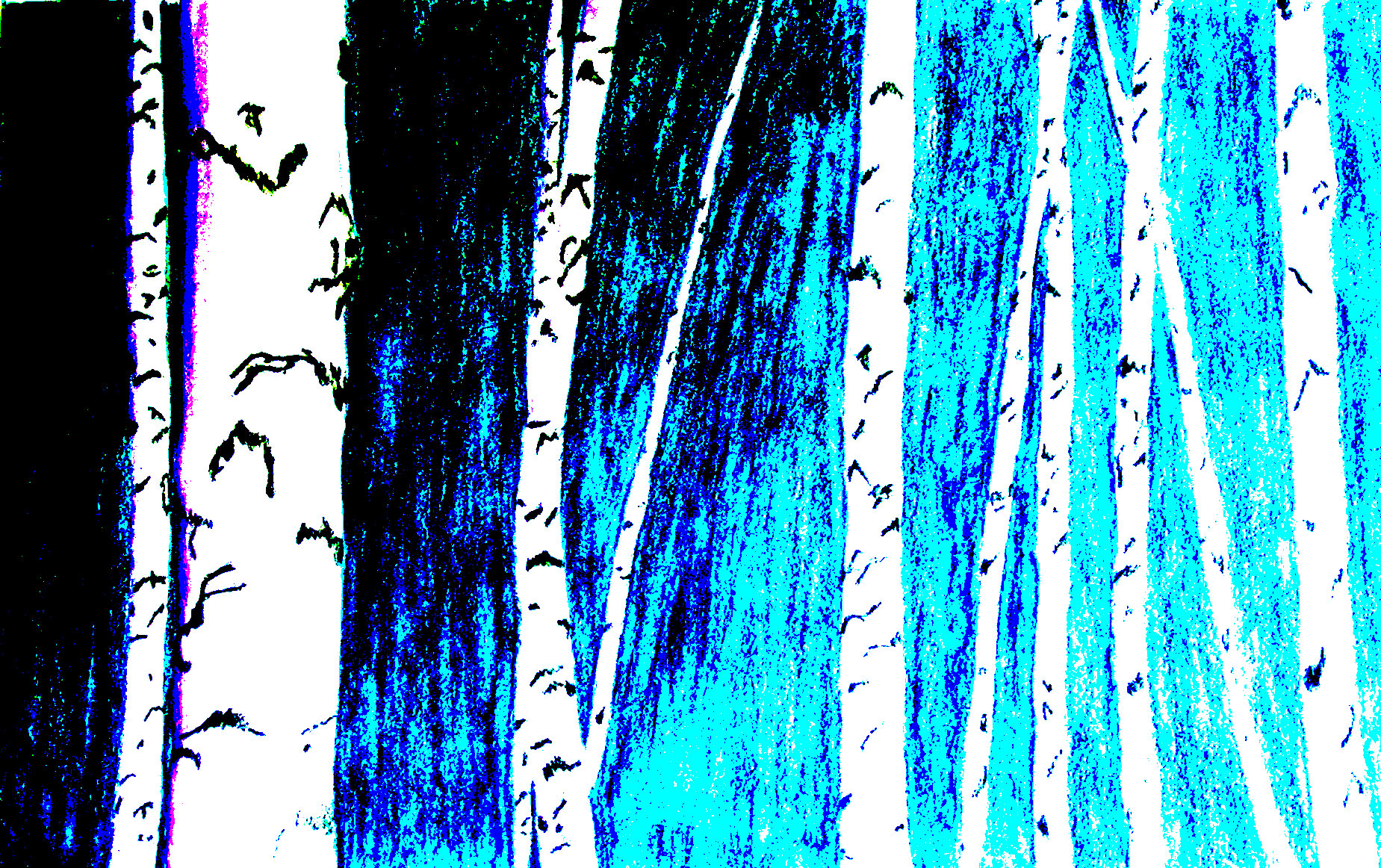
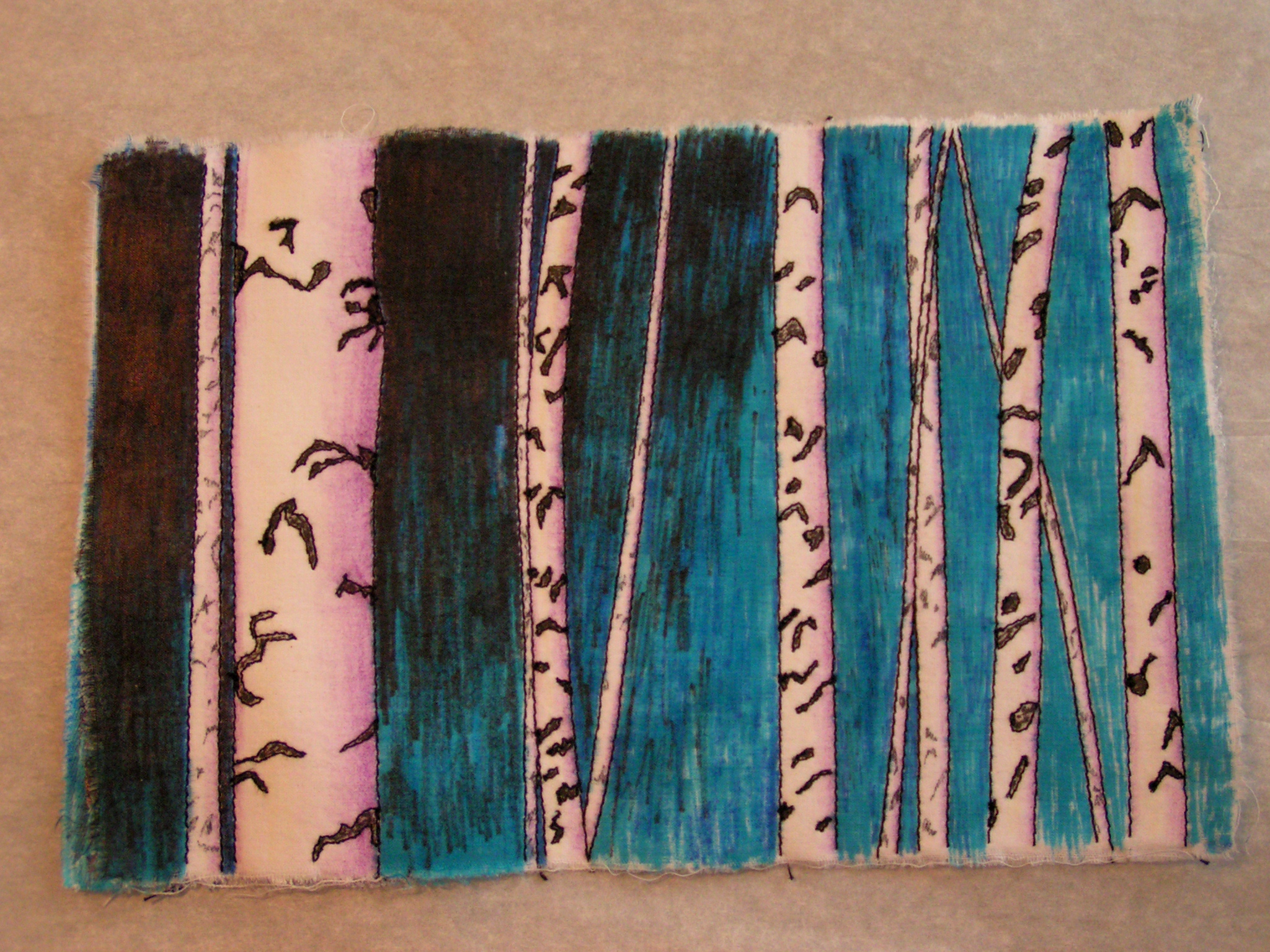
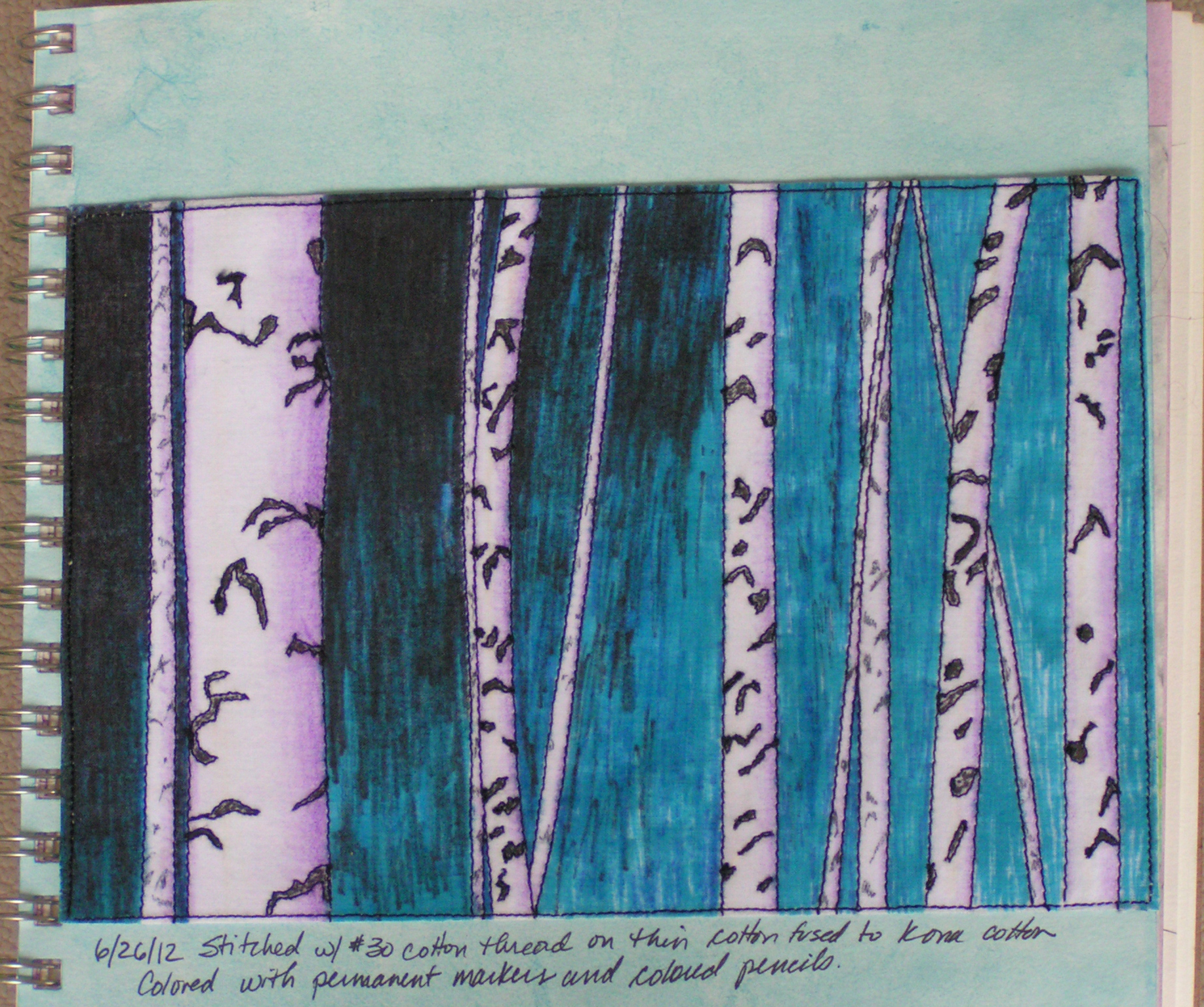
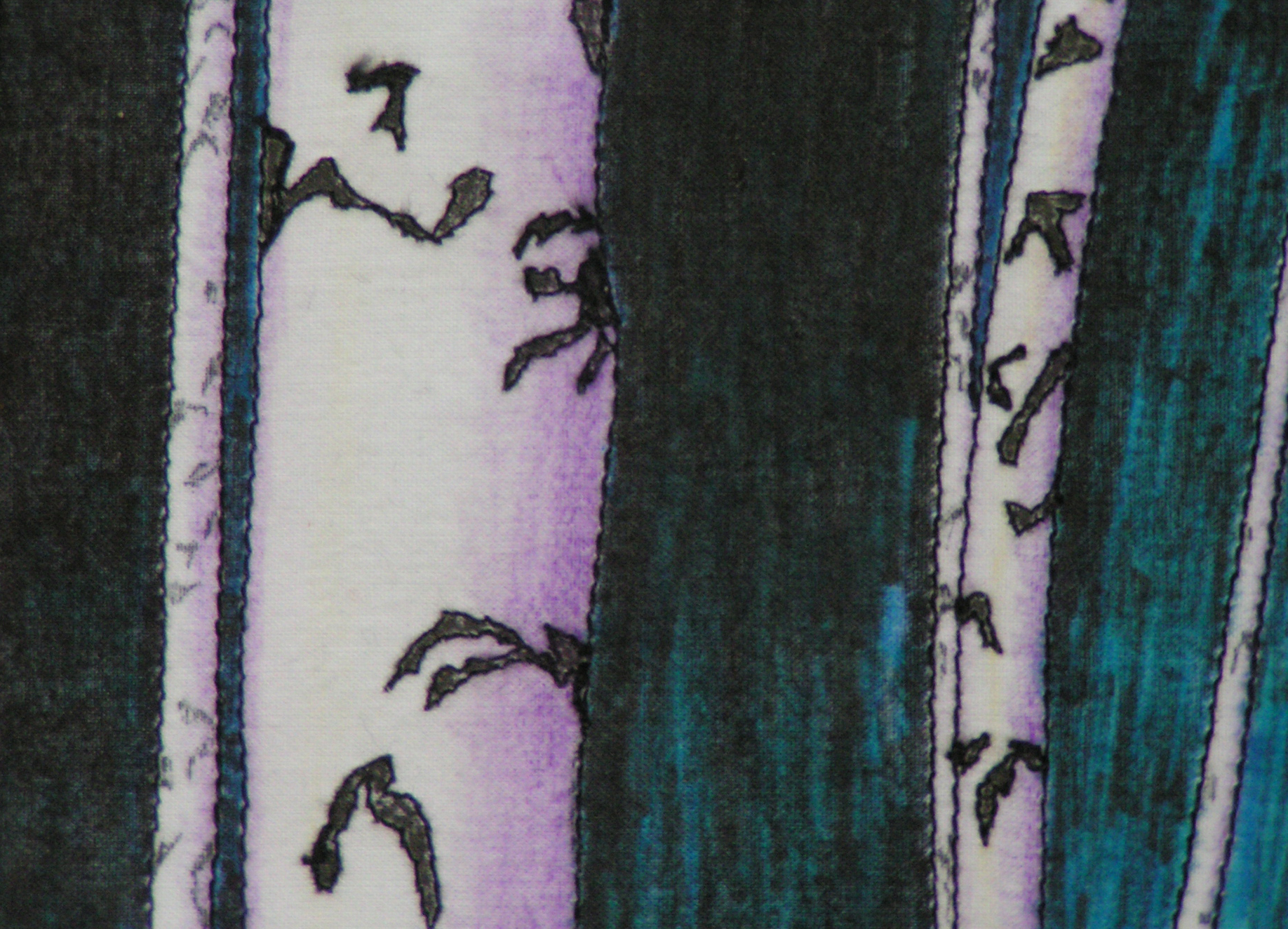
I have been working on Ann’s abstract challenge throughout the quarter but haven’t had that much time to put into it. If you didn’t see my earlier posts, here is the first one and the second post. Basically, I took one of my sketches and then “abstracted” it in Photoshop Elements. I’m not sure it is really that abstracted but it is certainly a change from the original sketch. I was planning on felting a piece but just didn’t have the time. Instead, I machine stitched a piece and can use it for my stitch class homework too.

This is the original sketch in my studio journal done with watercolor pencils.

Here is the photo after being “abstracted” in Photoshop.

Here is my interpretation on fabric. The colors are off as this was taken indoors. I fused a lightweight cotton to heavy Kona cotton and then stitched the outlines of the trees. On the foreground trees, I stitched outlines of the black marks on the trunks. I then colored in the piece with permanent markers and added the shadowing with colored pencil. I forgot to take any photos just showing the stitching.

Here it is in my sketchbook. I stitched around the edge and trimmed it. This is closer to the true colors of the piece. I like how it turned out but it isn’t really that abstract.

Here’s closer view so perhaps you can see the stitching. You can click on any of the photos to see a bigger view. I really enjoyed this challenge and for me, it was a challenge. As I said in my prior posts, I don’t feel comfortable doing abstract work. And I’m not sure that this piece would be really classified as abstract but it is certainly different from what I would normally do. So thanks Ann for the challenge!


My Studio Challenge Contribution and Excuse

My Studio Challenge Contribution and Excuse

The second quarter is almost done and I finally have one of my planned pieces done. It is the simpler of the two but I  know I will not get the more complicated one done. This one was done like a line drawing with just a few bits of colour. It didn’t turn out as nice as I would have liked.

I make myself a piece of prefelt. Prefelt is just barely felted wool. You stop the process when everything is just holding together. I used Briggs and Little country roving. It comes as 5 strands of very thin roving ready to be put through a spinning machine. The only colour I had was red. It bleeds. I thought it might give the piece an interesting look. Here is the first strand on the prefelt.

roving on prefelt

Next I drew the picture and added some coloured felt from my left overs bin. Before cutting out the shapes and placing it, I brushed the back side with a dog brush to make it fuzzy.

all the elements added

I covered it with netting and rolled it up in a straw mat and rolled in all directions. I didn’t do any heavy fulling to shrink it because it does not need to be really strong.

I did start my second piece. I made the felt for the base. I used some cotton gauze for strength so I wouldn’t have to use much wool. I plan to cover the whole base with more wool  in several layers using my embellisher so wanted to start out fairly thin.

wool folded over to make neat edges
second base ready

While we are talking a little about technique people ask me why I use a star burst Tupperware lit to do my rubbing. I do it because when I rub directly on the sheer no mater how lightly I rub the I pull would right through the sheer and out. I’ve found about 1/3 of the people who come for classes have the same problem. I don’t know if our hands are just to rough or what.  Here are 2 pictures of what happens.

wool pulled through

And lastly my excuse. Besides waiting to long to start I have been getting ready to sell at our local medieval fair. One of the things that has taken time is my costume. Here is the under dress drying on the line after tea dying so it is not bright white.  There is a lot of material in it and I haven’t hemmed it yet. I have a little over a week to go and I have to make the top dress yet. I have a busy week ahead.

underdress dyed with tea
Pricing – The Formula

Pricing – The Formula

There is no perfect formula for pricing. What works for one person might not work for another. The formula presented today is in standard use and even if you don’t end up using this method exactly, figuring out your prices this way will give you a baseline from which to start.

Here is a basic pricing formula:

Materials + Labor + Overhead + Profit = Wholesale Price

Wholesale Price x 2 = Retail Price

To have a complete understanding of the formulas, you need to understand what each of the items in the formula above include. Materials are the raw supplies that you use to make a product. Fiber art materials might include wool, fabric, silk, dye, textile detergent, thread, resist materials, paint, embellishment fibers etc. If you are making work in a different media, whatever raw materials that you use to create your piece should be included. A nuno felted scarf might cost $3.00 for wool, $10.00 for the silk fabric and dyeing costs of $2.00 for a total of $15.00 material costs.

Labor is the value of the time needed to make an item. Many newbies do not include a labor cost in their pricing structure. I think this is a big mistake. What would it cost you if you had to hire someone else to make the item? When estimating labor costs, the lowest you should choose is minimum wage. Estimate an hourly wage and then determine how long it takes to make each separate item. For example, if your labor cost was $10 per hour and it takes you three hours to make a scarf, then the labor cost you use in the formula above for the scarf would be $30.

Overhead is costs that do not directly relate to a specific product. Many people who work at home tend not to include overhead costs. However, if you use water, electricity or other utilities, overhead expenses are necessary to include in the formula. Overhead could include rent, utilities, repair and maintenance on any equipment, telephone, computer use, credit card fees, bank charges, legal and accounting fees, subscriptions, memberships, continuing education, advertising, print media, packaging and shipping supplies, insurance and selling expenses. Selling expenses are things like show fees, display costs, travel, photography, samples and sales commissions. You can figure out these numbers by looking at your bills for one year’s time. Then figure out how many hours you work in a year and divide the total overhead by that many hours. This will give you an hourly overhead cost. This can be added to your hourly labor wage or you can apply it proportionately to each product.

Profit is not a bad word. Everyone should be making a profit from what they make. If you leave this out of the formula, you will never be doing more than breaking even. Your profit might be as low as $1-2 on each item but it still needs to be calculated into the formula.

Once you’ve figured out your labor and overhead costs, you’ve got the bulk of the work done. You only need to review these on a yearly basis to see if they need to be changed. For example, if you stay with the $10 per hour labor charge and come up with a $7 per hour overhead charge, the formula for a scarf that takes three hours to make would look like this.

$15.00 + $30.00 + $21.00 + $4.00 = $70.00 wholesale price

$70.00 x 2 = $140.00 retail price

Go ahead and work out the pricing for all of your items that you make. Compare these prices to what you currently have your items marked? Is there a big difference? Can you see items that don’t really make sense to make in that they take an inordinate amount of time? Are there certain items that you think you can increase your profit margin?

A quick word about the wholesale versus retail price. Many people sell their items at the wholesale price in retail venues. They skip the last part of the formula. This is a real pet peeve of mine, when artists come in and tell me they sell work at local shows at a certain price but that is the same price “they need” from me before I mark it up in the store. It will be impossible to sell these items in a gallery because the customer will just wait until the artist is selling at a local show and the customer will get the item for half the price they would pay in a gallery. Galleries will be unwilling to work with you if you price this way.

Next time, I’ll discuss other pricing methods and some general tips for pricing. If you have any questions, please feel free to ask. I’d love to hear your comments about how you figure pricing and what seems to work best for you.

Navy Blue Merino and Soy Bean Top

Navy Blue Merino and Soy Bean Top

A while ago I made a few pieces of felt using soybean top and navy blue Merino. This is the layout stage for a felt vessel:

I love the soft, golden sheen of soy bean top

I softly felted the piece, then when it was holding together, I shaped it over a glass jar. It turned out roughly how I’d expected though I’m thinking that it might make an interesting purse with a few adjustments and some sewing.

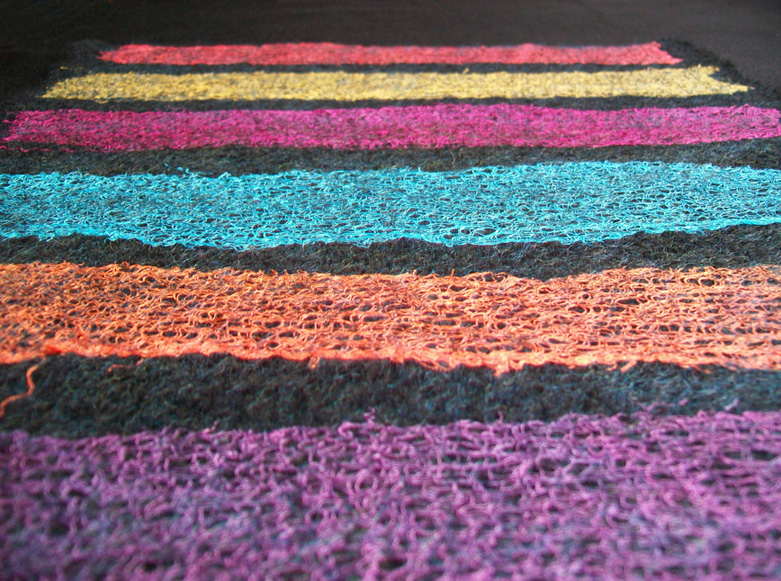
This is a close up of the texture, it reminds me of something woven or knitted felted into the wool.

I also made a large flat piece of felt using the same coloured blue and lots of soy tops. It’s such a nice colour combination, I just have to decide what I want to make from it now, then dare myself to cut it 🙂

NYC Travel Journal Update

NYC Travel Journal Update

This is an update about my trip to NYC and filling out my travel journal that I made. Everyone else was happy with their books but only my brother-in-law (besides me) filled his in. My sister and husband just saved things to paste in later. We were busy for the entire time we were there and I only had a few moments each day to work in my journal. I would collect lots of paper bits during the day to paste in the journal. I then would paste in a few things and write about the day with a permanent pen. The extra sketches and embellishments were done on the trip home. I used Inktense pencils and a water brush to do the “watercolor” portions. This works great if you used a permanent pen but won’t do well if your pen will run with water. You are welcome to click on the photos for a larger view and you can read what we did in NYC if you’re interested.

I still have a few blanks spots for photos and the last three pages to fill in with some photos and subway maps. We were in the studio audience for The Chew which is on ABC while we were in NYC. The show airs on August 2nd. We might be visible in the studio audience.

I really enjoyed filling the journal out and since I can never keep things straight about where we went and what we did, this will be an excellent reminder of our trip. Have you used a travel journal? Do you take any art supplies with you when you travel? I’d love to hear about it or see your journals if you have any.


Making things from spare felt

Making things from spare felt

A lot of the times when I make a piece of felt, I don’t really have anything specific in mind for it. I just have an idea for a colour scheme, or want to try out new fabric or fibres or see how different things work together. Unless I’m doing a sample to keep, I try to make pieces that will be big enough to be used for something, like a book cover or a purse. I know from discussions we’ve had on the forum that I’m not alone in doing this, others have a ‘felt box’ where finished pieces go until the day we realise they are just ‘perfect’ for what we have in mind 🙂

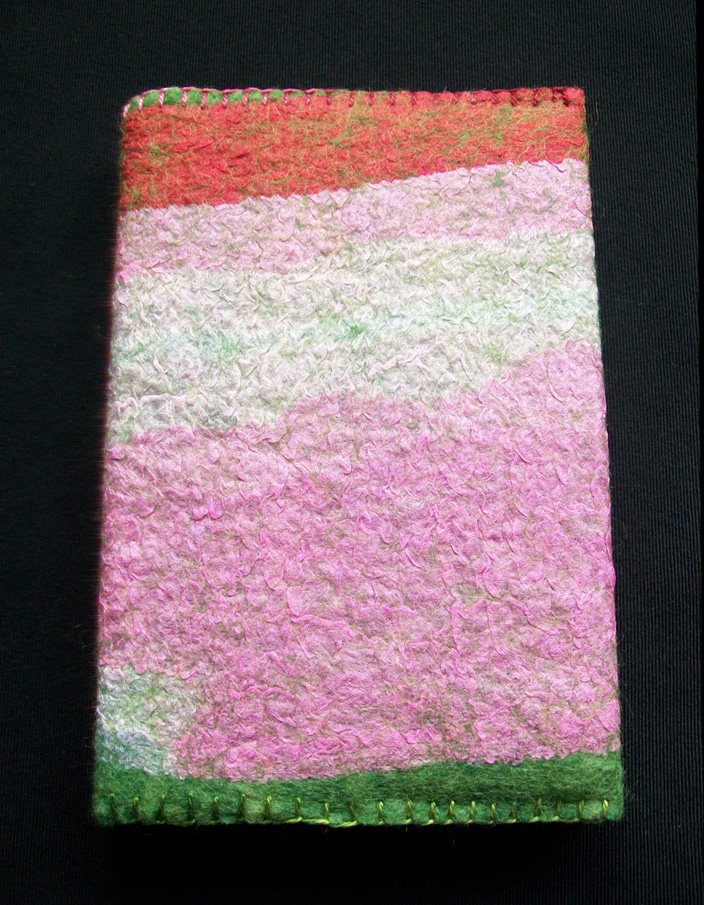
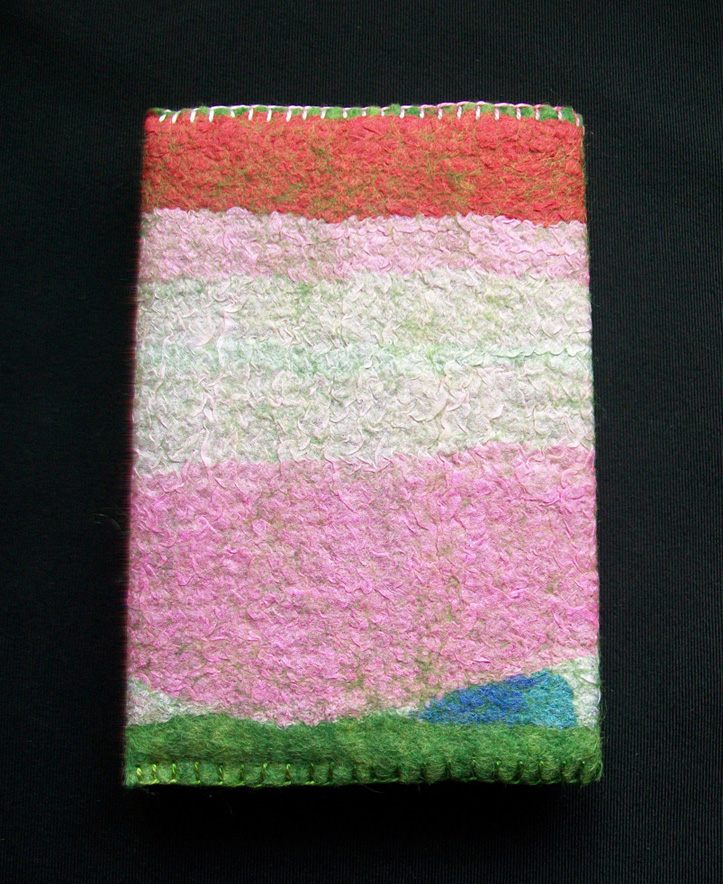
Recently, I had a look through my box and found a nuno felted piece I made a while ago, it was just the right size for a small book-cover. I usually use three layers of wool when I make pieces that will become book-covers, but when I made this piece, I wanted to keep some of the nuno texture in the silk, so just used two.

This is the front:

And this is the back:

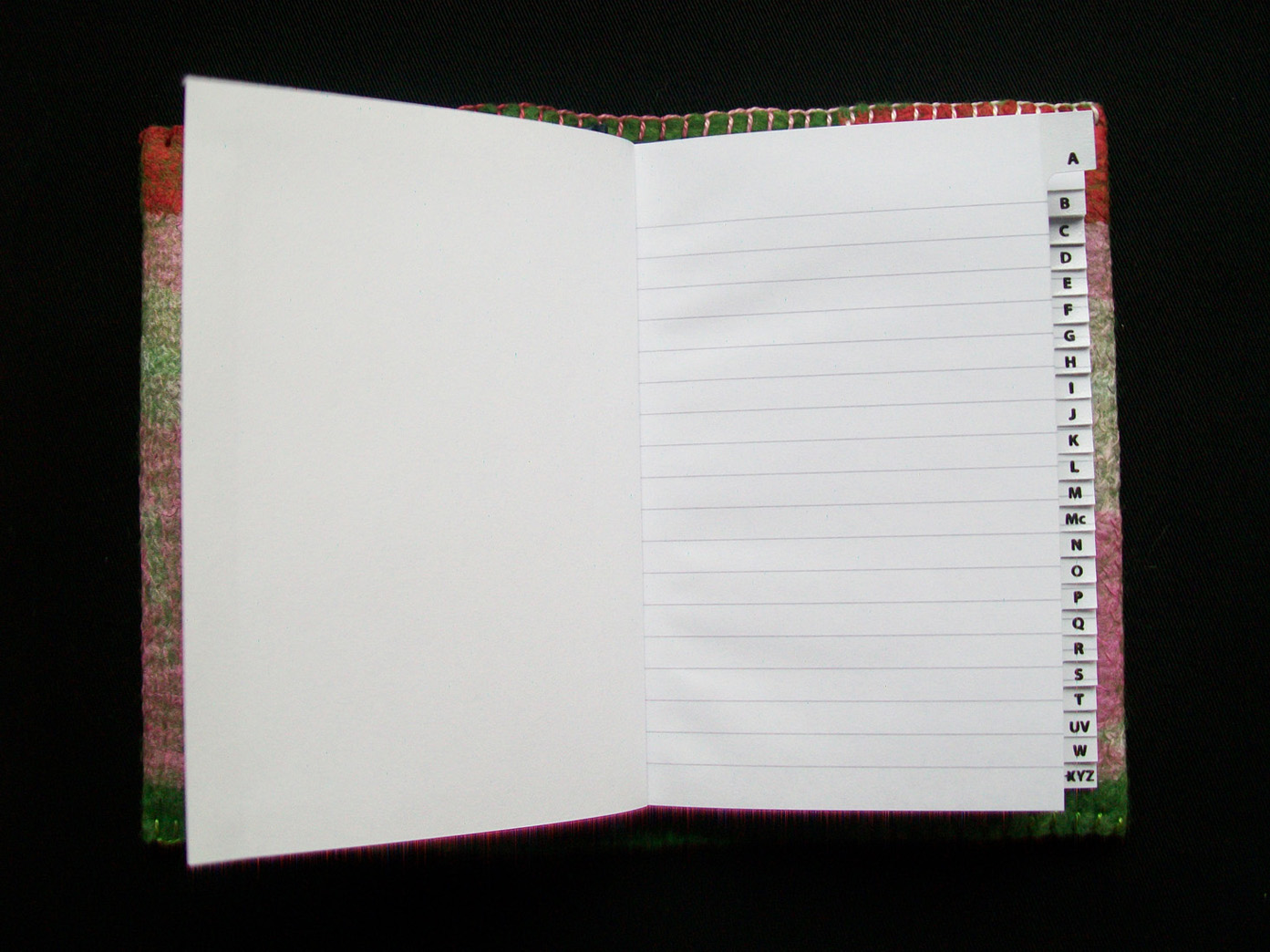
I know most of us stay in touch with friends and family by email today, but I still like to keep an address book, just in case and I do have some odd relatives who don’t have the internet!

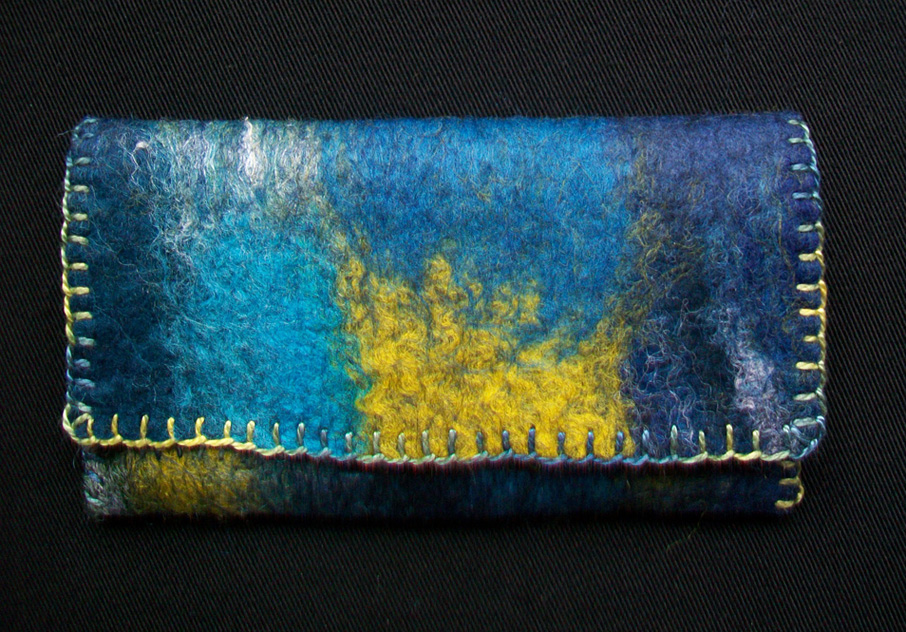
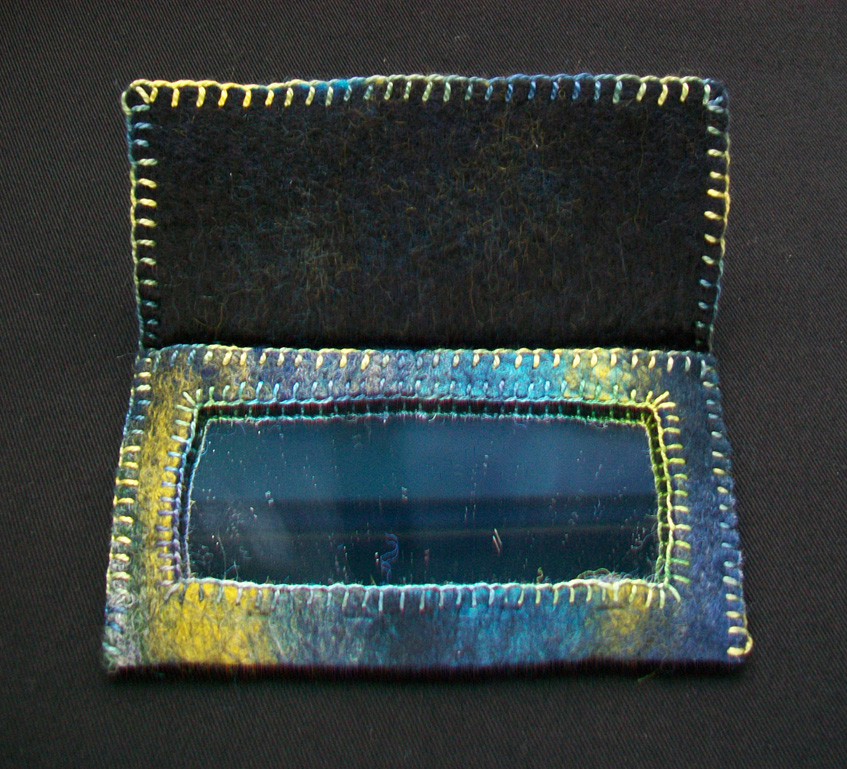
Many years ago I bought some small mirrors to use with some mosaic tiles that I had, but they were too thick, so they stayed on a shelf. Then a few years ago I made a case for one and gave it to my mum as a present. I have another couple of boxes for felt off-cuts and looking through one, I found a piece I thought would be perfect for another mirror case, it was an off cut from a piece of felt I’d made for a trivet. I made this one slightly different and cut a hole in the centre of the felt so the mirror could be seen.

I should have wiped the mirror 🙂

Do you have a box or place to store your unused pieces of felt? What do you use your offcuts for?

Making a Small Travel Journal

Making a Small Travel Journal

By the time you read this post, I will be in New York City. My mom and dad kindly let us use their timeshare condo in downtown Manhattan. My sister and her husband are joining us there and we’ll be there for a week. In preparation for our trip, I thought it would be fun to make a small travel journal to keep memories of the trip in. Since I was making one for me, I thought I’d make one for each of us. I thought it would be interesting to see what each person chose to remember in their book. I’ve made a mini-tutorial of how I put the books together.

The covers were made with some hand-made paper that I made about a month ago with my local surface design group. I didn’t really have plans for the paper when I made it but it was the perfect size for a small book cover. It’s about half the size of an 8 1/2″ x 11” sheet of paper. You could use a piece of hand-made felt, a couple of layers of heavier cotton fused together or a piece of cotton canvas to use as a cover. It needs to have a little weight to it but not be completely stiff.

I then painted some paper with a light wash of acrylic paint and cut the sheets in half. This paper is slightly heavier than computer paper but not by much. I painted some in green, blue and orange. You can choose any color scheme to match your cover.

I painted enough sheets so that I would have 12 half pages per book. I then took three sheets and folded them in half, one inside the other to make the signatures for the book. That’s just a fancy word for the sheets of paper that go together in a group to be sewn into the book. Oops, I forgot one step. Before I folded the signature, I made a fancy center page of the New York City sky line.

Here is the pattern that I drew. I found a photo of the NYC sky line and sketched it out. I then used a ruler to make the lines a little straighter and then used a felt tip marker to make the lines a little darker.

I then traced the pattern on to a piece of freezer paper and ironed the freezer paper to one of the blue pages to use as a stencil. I then sprayed the paper with black spray paint. This is the stencil after it’s been used several times. It worked to use the same stencil four times. The last use didn’t give as clear an edge so if you want a really clear edge each time, make a new freezer paper stencil each time. But I was being lazy and it really didn’t make that much difference in the end result.

Here’s the painted sky line. I did draw in the pointy part of the top of the Empire State Building later with a black Sharpie. Looks more like a castle to me but I guess it looks somewhat like a city skyline.

I just got this new Pfaff sewing machine. My old machine was a cheap Brother machine and it just wasn’t working like I needed for machine embroidery. This machine is really fancy but I really like how it sews so far. I used it to sew my little books.

Previously, I had searched online for maps and photos to use in the books. I thought it would be good to get everyone started and give the books a feeling of being in New York City. I used Google maps for the front covers.

I used a piece of double stick tape to apply the map to the front cover to hold it in place while I was stitching. When you stitch through paper with a sewing machine, you should increase your stitch length. If you put your stitches too close together it tends to tear the paper. I used orange thread and stitched around the outside of the map. This book is put together with all straight seams so you only need basic sewing machine skills. Remember to put the map in the correct position so that when the book is closed, that the map ends up on the front of your book and right side up.

This is the trickiest part. Open one of your signatures and place it on the inside of your book cover. You can see the seam where you stitched the map on the front. Line up the fold with that inside seam about 1/2″ to the right of it. Carefully stitch along the folded line. You can tie the ends of the thread either on the inside or outside. You could leave them long to tie beads or other decorative fibers on the outside if so desired. I tied mine on the inside and cut them short. Keep lining up your signatures alongside the previous one about 1/4″ apart and stitching them into place.

This photo shows the outside cover of the book after two signatures had been sewn. I tried to take a photo of the spine of the book after all the signatures had been sewn but couldn’t get a photo in focus. Sorry.

Here are the four books after having all four signatures sewn in place. I really had fun with these books. I’m not sure if it was because I like making books or if it was finishing a project. I’ve been making so many samples for my class that I never feel like I’ve really made a project. It was nice to have a finished piece.

I then found some painted paper that kind of matched and glued it into the front cover to hide the stitching from the map on the front. I also glued in some of the photos I had found online. This is graffiti on the right hand page.

I also sewed two pieces of paper together to make a pocket. I then glued it into the back cover. We can put tickets or other memorabilia in the pocket.

This photo shows the hosts of The Chew. It’s a cooking show that’s filmed in NYC. My sister got us tickets to be in the studio audience. I’ve never even seen the show but I like cooking shows so it should be fun. I’ll let you know if we’ll be on TV!

A friend of ours got us tickets to go to a Mets baseball game while we’re there. My husband is excited about this. So now we’ll all have a little book that we can journal in, draw sketches, paste photos, tickets and other ephemera about our trip. I’ll post some photos of the completed journal when I get back.

Do you use a journal? Have you made a travel journal before? I’d love to see yours if you have any samples.

Dyeing Silk with MX Dye

Dyeing Silk with MX Dye

I dye my own silk and one of the ways I do that is with MX dye. MX Dye is a fiber reactive dye and works on cellulose or plant fibers like cotton , linen and hemp. It also works on silk. As far as I know silk is the only fiber that you can use both weak acid dyes that are for protein fibers and the MX dyes on.

Scarves blowing in the wind.

I like to use the low water dye method. With this method you use a jar and just a little water. What I do is scrunch or twist or pleat up my silk to be dyed. In this case they are all about 2 feet wide and 8 feet long. Then you pack it into the bottom of a jar that is big enough to hold the silk and the dye (1/2 a cup) and the fixative (1/4-1/2 cup).  It is important that it be a snug fit for this method to work.

I mix up 2 colours of MX dye in 1/4 cup of room temperature water. Pour them over the silk in the jar one at a time making sure they silk is covers with liquid. If it floats as you can see a couple of my jars did you need to carefully weight them down with something non metal. Metal will effect the dye. Once the dye is in the jar you don’t want to disturb them. You don’t want the dyes to mix completely and give you a solid colour.

dye in jars

I am very impatient. So I usually go do something else for 20 min to an hour then I come back and add the fixative. With MX dye you have to raise the PH to get the dye to stick. The cheapest thing for this is PH up from the pool store.  You can use washing soda( not bicarbonate of soda) or order it from your dye supplier but pool chemical is cheap especially at the end of the season. I add a tablespoon for each cup of water including the mix water. Stir to dissolve and then pour it into the jar.  You should leave it for an hour to react but I am impatient as I said and usually dump everything out after about 20 min. Rinse the silk in cold water then hot soapy water then one more cold. Here are some results.

I am sorry the pictures aren’t better but the wind wouldn’t cooperate.  They were dry in about 10 min. If you want really good detailed instructions I would read about it on Paula Burch’s site. http://www.pburch.net/dyeing/lowwaterimmersion.shtml

Everyone’s Least Favorite Subject – Pricing

Everyone’s Least Favorite Subject – Pricing

I have owned a craft gallery now for over 14 years and I haven’t met one artist or crafts person who likes pricing their work. Many have no understanding at all at how to price their items and many artists, especially newer ones, under price their work significantly. I’ve never had anyone say that they thought pricing was easy even if they’d been doing it for a long time. I’ll be taking several of the next few Marketplace Monday posts to talk about various aspects of pricing. I hope that you’ll be able to glean some information to help you in your pricing strategies.

For these articles, I have consulted several books and I’m also drawing on my years of working with hundreds of different artists. I would check out your local library to see what books they have available about selling your “crafts”. The two that have been the most helpful for me are Handmade for Profit by Barbara Brabec and Crafting for Dollars by Sylvia Landman. These are both older books and I’m sure that there are many more out there.

‘Price is the figure something sells for. Value is what that item is worth to a buyer. Quite often the two have nothing to do with one another.’  (Excerpt from Handmade for Profit) There is no perfect formula for pricing and what the marketplace will pay is a very large factor. There are many aspects that will affect what a customer will pay and the value that they see in your work. My point here is that if you continue to work on your pricing and tweak your system as you learn what works and what doesn’t, you’ll become more profitable in your business.

You should always research and study your marketplace before beginning to tackle pricing.  Check out how other work similar to yours is priced. I’m sure you’ll find a wide range of prices, but you’ll be able to find an average price for a similar product. Make sure that you are comparing the same markets. What someone will pay in a small rural town will be completely different from a customer in a pricey boutique in a city like New York City. The internet makes the world a small place but not all markets are the same. Keep a notebook of various prices that you see at art fairs, online and in galleries.

Another thing to think about before starting your pricing system is whether or not you are really paying wholesale prices for your supplies. It is impossible to make a business profitable when you buy your supplies at retail price. The more you can cut your expenses and your labor in making a product, the higher your profit margin will be. Streamlining your production is very important and if you are truly a business and are planning on producing multiples of the same type of item, the time required to make an item will determine its profitability.

Next time I will be discussing the cost of labor, raw materials, overhead, selling expenses and profit. I’ll give you a formula for basic pricing and how to use it. So get your research done, cut your expenses down and next time we’ll get into the nitty-gritty of pricing.

Cotton Gauze

Cotton Gauze

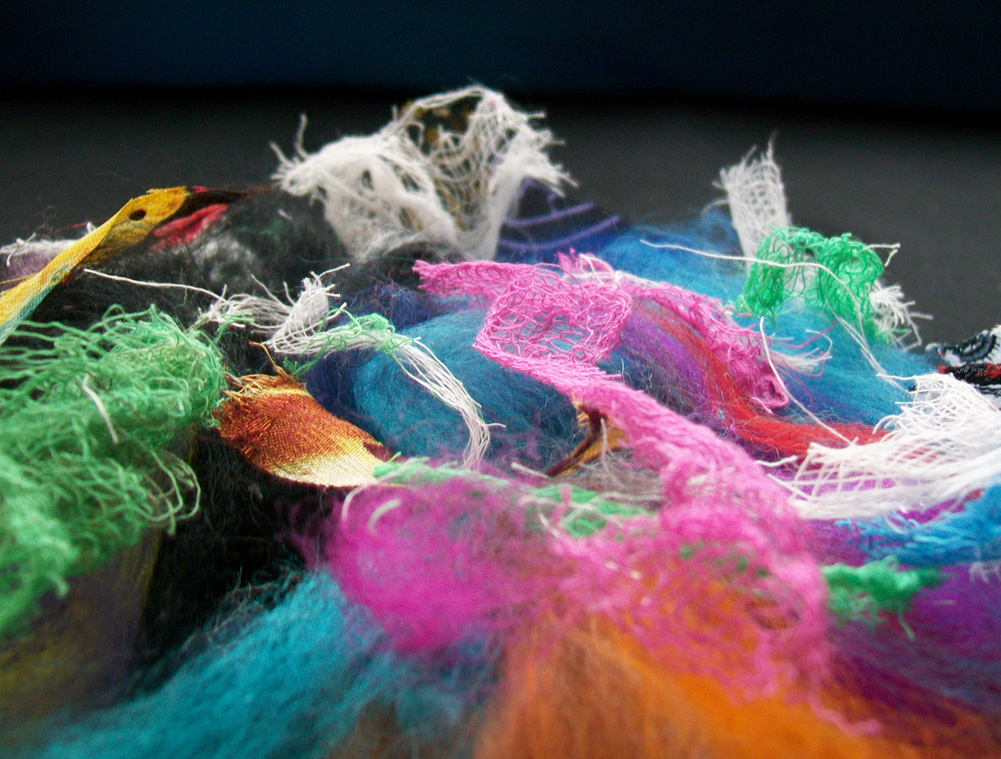
I’ve been quite busy lately working on my project of ‘other’ fibres and fabrics used in felting. I’ve been making a lot of felt pieces using lightweight cotton fabrics like muslin and cheesecloth. Another fabric I’ve used is Cotton Gauze, this is sometimes called ‘Scrim’, and I’ve used a couple of different types. Here is a selection of some dyed pieces I have.

It’s really good for creating texture and effects. I’ve been making large bold pieces to use for bookcovers.

I’ve also made some smaller pieces with resists, using the gauze for texture. This piece was for making into a pouch.

and this became a textured sculptural vessel

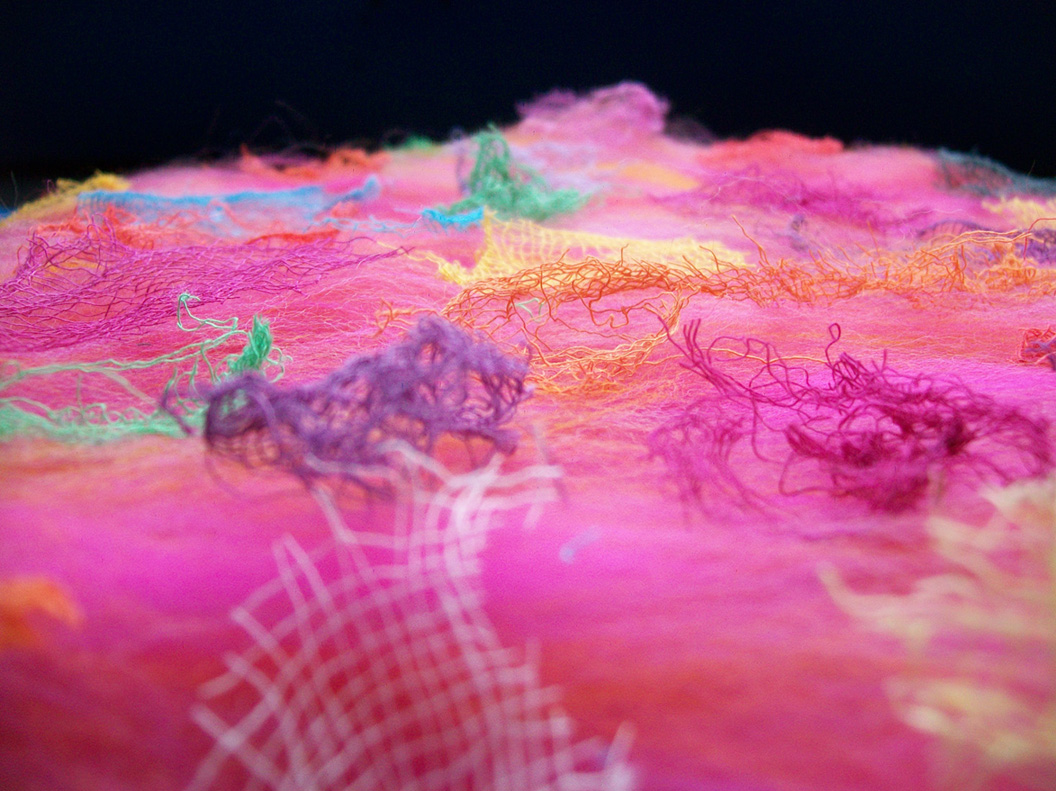
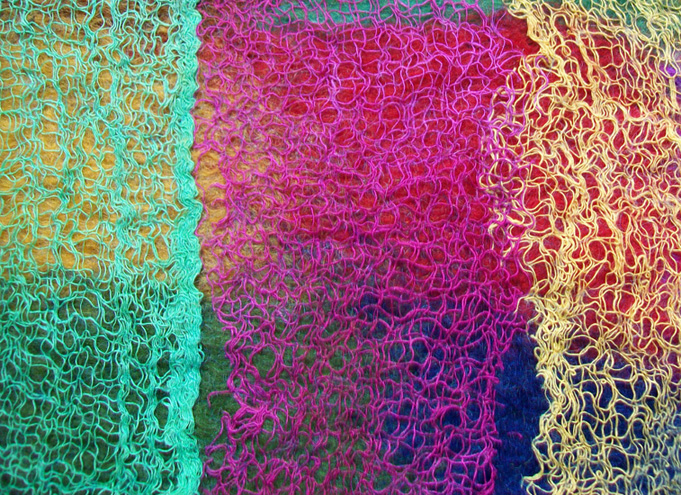
I’m starting to have a huge pile of colourful, texturey felt pieces all waiting to be made into something once the weather gets too hot for felting. This is a close up of a large piece I made for making a purse and matching mirror case out of.

The lightweight cottons also work really well for using in scarves and wraps instead of the usual silk. Do you use scrim or cotton fabrics in felting, or fibre art? How do you find it to work with? Have you ever dyed your own? I’d love to hear about your experiences with it and see photos if you have links 🙂