Browsed by
Tag: storage

Craft Basket Makeovers – part 1

Craft Basket Makeovers – part 1

A good few years ago now, after I had acquired and learned how to use my spinning wheel, I was casting around for some means of storing the associated equipment in a reasonably respectable way.  The wheel and associated bits lived with us in our living room and needed to be tidy.

Quite by chance I came across a shop selling off cheaply a large deep cane laundry (I think) basket.  It was only going cheap because one of the handles was broken and it had no lid.  The much reduced price compensated for something which was no problem as far as I was concerned.

I used to work in Maidstone (Kent) and nearby there was a lovely shop called C&H Fabrics (sadly no more) which sold both dressmaking and curtain fabrics and haberdashery.  I could never bypass their remnant section – they almost always had something good and large enough to be really useful.  I managed to purchase several large pieces of curtain fabric of a design which was really “with it” at the time (most rarely  for me, I am usually following several years behind fashion fads).  This was during the time when Macramé made it’s first appearance and I was very “into” this.  So I removed the remaining cane handle and instead added two twisted cord macramé handles.

laundry basket without lid, with macramé handles, filled with spinning equipment


Then I set to and lined the whole of the basket using the curtain material, making sure that there were pockets around the sides of sufficient size to take threading hook, spare bobbins; flyer; carders; ball winder and my Neatsfoot oil – my wheel had a leather connection between the treadle and the footman – the bits that actually drive the wheel, and the neatsfoot oil is a good natural conditioner for leather and ok for oiling the metal parts.  The rest of the associated bits – fleece, box of carded rolags, tea towel used as a lap cover, cord for tying skeins and niddy noddy would just sit in the middle.

Now I needed a lid for the basket to keep the dust out (our bungalow was very dusty because part of it was still a building site).  So I cut two circles of the fabric and a circle of wadding.  I attached the wadding to the wrong side of one of the circles, by machine quilting around the pattern/motifs printed on the fabric. On the other circle, which would be the underside of the lid, I added a zipped pocket.  I then finished the lid by stitching the circles right sides together with another length of macraméd cord attached to one side.  Then, after turning the circles the right side out, and hand stitching the turning gap, I attached the other end of the cord to the basket. The lid sat on top of the basket with everything safely inside; well except for the niddy noddy which was too tall and had to stick out of the side, so it made do with a length of cord to attach it to the basket.  My brother in law had made the niddy noddy for me, having already made one for my sister.  It is purposely on the large side because each circle of a skein wound on it would be 1 yard long.  This made it easy to calculate the skein’s length.

Lined spinning basket with lid folded open to shop equipment in pockets
Finished basket open

Finished basket with closed lid to show quilting, with niddy noddy poking out of top.
Finished basket, closed.

The fitted out basket sat comfortably by my chair and spinning wheel while I was working at home, but was a bit big to take with me when I went to my spinning group each week. Luckily my sister, having visited the Willows and Wetland Centre on the Somerset Levels, gave me a large basket which she had bought there.  The Levels is a large flat low lying area where Withy Willows have been commercially grown for basket making for at least the last 200 years.  In fact willow baskets and other items have been made there since pre-Roman times.  If you are interested there is more information on the area here: Somerset Levels (As an aside, Glastonbury Abbey, also referred to in the link, used to own much of Sturminster Newton where I now live, despite Shaftesbury Abbey being much nearer to us and owning most of the rest of the surrounding land.)

But I digress.  The basket which my sister gave me was intended as a picnic basket.  It was short and wide and it’s carrying handles positioned so that it was carried flat.

picnic basket on lawn with handles up
See how the handles work to carry the basket flat?

It was just what I needed to carry tops (roving?) and spinning equipment when I was away from home.  Of course it needed to be fitted out with pockets to keep everything tidy and safe.  I had sufficient fabric left of the remnants used for the large basket to make them match.  I lined the base of the basket adding pockets at one end for flyer and bobbin, lap cover and oil.  I didn’t want to spoil the look by using the plastic box for my rolags and by then I had learned basket making courtesy of the WI.  So I made a basket to fit, lined it and made a lid with more of the fabric.  The lid of this little basket was quilted in the same way as the lid of the large basket, and also attached with macramé cords made from fine crochet cotton, with a wooden toggle closure.

small handmade cane basket with fabric lid attached by macramé cord with macramé and wooden bead closure
Rolag basket in the sun

By this time I was also “into” Tunisian Crochet. I had been making ordinary crochet items for as long as I could remember but fell for this new (to me) technique. So in addition to storage for threading hook, personal bits, glasses etc., I needed storage for at least one Tunisian crochet hook – this looks like a knitting needle, but instead of a point it has a hook. I also needed somewhere safe to put large sheets of paper patterns, as I tend to use diagram type patterns and they take up a lot of room. So I set-to to line the lid of the basket with just one layer of the fabric, but with pockets, short & fat and long & thin attached. I sewed this onto the inside of the lid but left one of the shorter ends unattached so that I could tuck paperwork etc., inside.

Open lined picnic basket showing lid lined and with pockets, and with rolag basket and other equipment in the basket.
All my equipment (almost) in the basket.

Incidentally, the sharp eyed amongst you may have noticed that odd bit of hooked wire tucked away in the longer tube/pocket and be wondering what it is.  It’s a do-it-yourself lazy kate – a device for assisting with plying yarns from one, two or more separate bobbins.  An old shoe box (or a basket) and this bit of wire are all you need, poke the wire through one end of the box, slot the bobbin(s) on and poke the wire through the other end of the box.  It’s not the best way to do it, but if you put some tension on the yarn by passing it from the bobbin around the wire once before taking it to the wheel for plying, it works.

Oh and a quick boast – can you see the handle of the threading hook poking out of one of the lid pockets?  The handle was actually a light pull which I had made while having a go at wood turning some years earlier, and the hook is only an unbent paperclip – but it works ok too.

So that was my basket set up and ready for journeys.  Oh yes, the niddy noddy.  That was too big again, so it had to sit on top.

Closed picnic basket with niddy noddy on top attached by cords but with handles down.
Basket with niddy noddy (but the handles are down so I’ll have to remove the niddy noddy, put the handles up and replace it because the right handle won’t go over the end of the niddy noddy – then I can pick up the basket.)

Eventually the cane hinges of the lid, and the cane closure wore out so they were replaced with macramé cords.

Some time before I moved from Kent to Dorset in 1999, I wrote an article about these baskets and submitted it, with photographs, to the Journal for Weavers Spinners & Dyers as I thought it might be of interest to them.  Apparently not though; I eventually received a letter returning the photos (but not the article, so I’ve had to rewrite it!) and saying “… the Editorial Committee … felt that the article was rather too indirectly concerned with weaving, spinning and dyeing ….”   Oh well!

Moving Studio Space.

Moving Studio Space.

I am moving my studio over one room. The space is exactly the same size. You would think no problem, easy peasy. Not so. You still have to empty all the shelves and pack up everything. I did get a new old set of shelves that holds my wool better.

I moved the carder and my felting table in to one end.

table end

The door will disappear and the table will move out form the corner once the other room is empty. I have my bins for shows under the table and the one set of storage bins under the end.

The other end has my book case, wool and other fiber storage.

storage end overallThe clothes wrack is on wheels I got it at the Target going out business sale.

storage end 1 storage end 2

I should have enough room to do some teaching. I have room to put up a couple of 6 foot tables.  I like the way it’s set up it’s not crowded and feels more inviting than the old set up. I am really looking forward to getting back to work in it.

Did you feel the but coming? The problem is the stuff that’s left behind. I want most of it but what to do with it. For the moment and I hope short term it will be packed up and be stored. the sewing machine will go into the nest room along that eventually will be mine but it needs to be renovated and the plumbing fixed so I have sinks. Then I will have no excuse for not washing the fleeces I have.

left overs 1 left overs 2

You never know how much stuff you have until you have to move it. :O)


Keeping Track of Supplies

Keeping Track of Supplies

We’ve talked a few times about how we store our felting and craft supplies, but how do you keep track of what you have so you know when you’re running low? Do you have a system? I don’t have enough room to keep the whole amount of my wool and fibre supplies out, so I usually keep some out to use…

OLYMPUS DIGITAL CAMERA… and the rest ‘spare’ in bags (or pillow cases!) out of the way in cupboards.

OLYMPUS DIGITAL CAMERAThis often leads to me running out of certain breeds or colours, or in some cases, ordering twice because I forget that I checked before the last time I ordered. I decided to do an inventory of all my supplies and stock this week, so I know exactly what I have, then I can try to find a way to keep a better track of it all. I thought the easiest way to do this, would be to put an old sheet down on the floor, get everything out…

OLYMPUS DIGITAL CAMERA… make lists …

OLYMPUS DIGITAL CAMERAand weigh it all.

OLYMPUS DIGITAL CAMERAI had some Word documents with lists of what I usually use from the last time I tried to be better organised, so I started with those and did print outs for my supplies and also for what is ‘spare’. I decided I’d start with my ‘natural’ wools and do the dyed wools and fibres another day. I have my natural wools split into lights and darks, and I also separate the commercial tops from the locks, scoured and carded wools. I know it sounds like a lot of messing about, but it is easier for finding what I want with limited space.

OLYMPUS DIGITAL CAMERAI wasn’t thinking when I started with the light colours. I weighed everything first, then added to the supplies I keep out if they were getting low. But when I did the dark colours, if any of the supplies were low, I added to them before writing down the weight, so I didn’t have lots of scribbled out numbers or have to do two lots of weighing 🙂

OLYMPUS DIGITAL CAMERASo, now I have huge lists with the weights of all my supplies, and spare supplies, do you have any tips or advice about how to keep track of it all better? The only thing I can think of is to weigh the supplies again after each use and also the spares each time I get more out.

UPDATE: I have uploaded a couple of Word documents, altered from the lists I made doing my natural wool supplies inventory, in case anyone wants to use them for themselves. They are in tables, but are easy to alter to suit you. For a list of Commercial wool tops in different breeds, click here then click the link to open the Word doc. For a list of scoured, washed and raw wools, locks and fleeces, click here for the Word doc attachment.

Wool Supplies and Samples

Wool Supplies and Samples

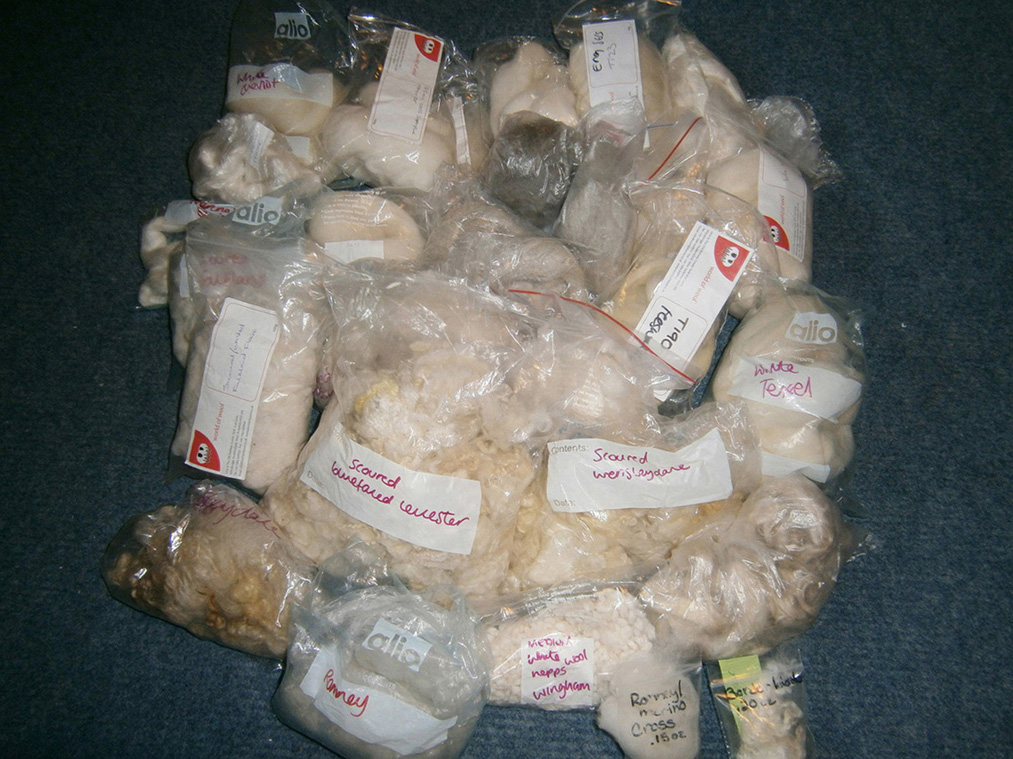
While I was laying out my white texture felt piece the other week, I had all my bags of white and light grey wools spread out on my floor, along with my stash of raw wool locks, so I thought I may aswell go ahead and do an inventory of my white wools, to see if I’m running low on any and need to order more. I usually keep a small stash of each wool breed (or colour) out in my felting boxes and put the rest away in my supplies bags and boxes, it makes it easier to have a large selection of breeds or colours to choose from without taking up as much room. These are the white wool tops, scoured and carded wools I most commonly use.

OLYMPUS DIGITAL CAMERAMy favourite raw wool locks are Gotland, Teeswater and Wensleydale. There’s also some raw mohair locks here.

OLYMPUS DIGITAL CAMERAAfter scribbling down the names of all the different wools I commonly use, I checked whether there was a good amount in my felting box and whether I was low in my supplies and needed to order more. This took a while, and it suddenly occured to me that if I made myself a document on Word, I could print it out any time I needed to do another stock check. It’s only taken me about 4 years of felting to think of that 🙂

WHITE WOOLS INVENTORY

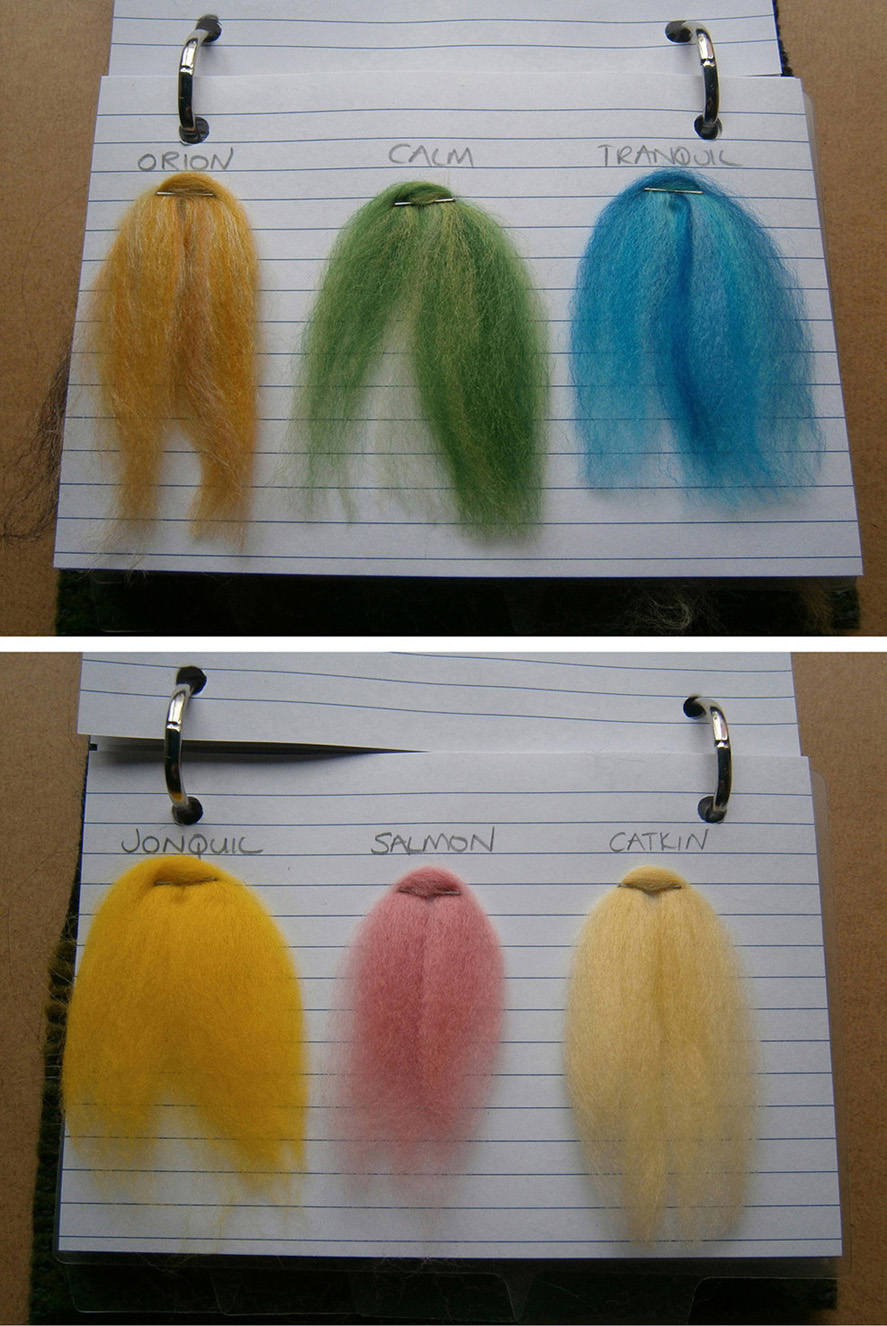
A few years ago, I spotted some really inexpensive index card holders in our local supermarket. I thought they would be perfect to use for wool samples, so I bought a few and made myself a cover for one.

4635492385_23f0e04d9f_oI like to pull off a small sample of wool tops and staple it to the index card with the name of the shade or blend. I buy almost all of my supplies from World of Wool, but on the rare occasion I buy something elsewhere, I make a note of that too.

coloursIt’s really handy for natural wools too, the texture and staple length can be seen as well as the colour.

naturalsDo you have a system for storing your wools and fibres or keeping track if supplies are getting low? How about storage? I know that is always a favourite topic for fibre artists! 🙂

What I’ve been up to lately

What I’ve been up to lately

This week I started thinking about spring. It is coming, so to help throw off the February blahs I made some felt bird houses.

They are made form Romney wool. the original wool is a mix or white and brown that I dyed. you get a really nice variation in colour that way.  These still need their strings to hand them up and I think the big one might end up as a squirrel house.

The other thing I did this week was get 2 new book cases to store wool on. I wanted to get all the dyed wool out so I could see it and get all the breed specific wool out so I could see what I have. I thought it would be lots of room but I still have a bin of mixed colours( not in the picture),   I have my white and black wool in a bin each and that works fine and the Romney batts that are at least in a cupboard.  I also  have 8 or so bags of raw wool to be washed.  I need to find a way to store the bin plus of yarn so I can see what I have. It’s just not working to have it all in bags inside a bin. I would like to get the over the door hangers that have all the little clear pockets for the yarn. I haven’t found them anywhere yet. Oh well it is better than it was so I will just have to be satisfied for the moment.

Before
After