Browsed by
Category: Marketplace Mondays

Wholesale vs Retail

Wholesale vs Retail

Many people have asked me about the advantages of selling wholesale versus selling retail. I have talked a little about wholesale but thought I would take the next couple of columns to discuss it in more depth. This information is based on what I know of wholesale shows in the US and Canada. I am unaware of wholesale shows in Europe or Australia. I would love to hear about wholesaling in Europe or other countries if you have experience in this area.

There are many differences in selling wholesale vs retail. You need to have your pricing worked out completely before you attempt selling wholesale. If you’re just beginning to sell your work, it is probably best to sell on a retail basis until you have a full line of products, a solid pricing system and a business plan in place.

Some of the reasons people sell their work on a wholesale basis is that they won’t have as much selling cost, they don’t have to spend their time selling their work or going to retail shows and they can spend more time in their studio. By selling in large volume, they can streamline their processes and make enough profit without having to do numerous retail shows or sell on consignment. Many wholesale artists do only 2-3 wholesale shows a year and get enough orders to fill their entire production schedule for a year.

If you are planning on selling on a wholesale basis, you need to consider the needs of your customer. Your customer base will now be galleries, stores or museum shops. A buyer for a shop is going to think differently than the average retail customer. A buyer is looking for products that will “work” in their store. This is different for each buyer but most who have been in the business for any length of time have a good idea of what will sell for them and what won’t. Buyers are looking for an entire line to sell. Items that either go together or have something in common. You should consider selling package deals with an assortment of your products in various colorways or styles. It is easier for the buyer to purchase and you will then have a simple way for buyers to meet your minimum order.

If you are planning on selling both retail and wholesale, your wholesale line can be different (and often should be different) than your retail line. The items that you sell on a wholesale basis should be ones that can be made fairly easily and you can streamline the process, therefore cutting down the time needed to make the item. Try to develop a line of products that go together in some way so that stores will buy the entire line.

Next time, I’ll continue on talking about wholesale selling. If you have any questions, please ask and I’ll include the answers next time.
Finding a Venue for Your Work

Finding a Venue for Your Work

There are many options for selling your work available and not all of them are the right place for what you make. It is important to find a venue that fits your particular type of work and the appropriate customers will then be able to find you and buy!

Finding your niche takes a bit of research and sometimes trial and error but if you take the time to investigate the venue, it will save you time and money in the long run. The list of venues is endless including retail shows, farmer’s markets, wholesale shows, galleries, specialty shops and online venues. Think about your best customer and where that customer might visit either personally or online.

Do you make small needle felted dogs? Perhaps you should think of visiting locally owned dog or pet businesses and seeing if you could sell your work there or even just put up a flyer. The pet business in the US is big and continuing to grow. People love to spend money on their pets. Or maybe you could put flyers and samples up at the local humane society or veterinarian offices. There are also dog shows and other dog sporting events that might work as a venue for you.

If you make high end felted clothing and accessories, your local farmer’s market might not be the best venue for you. Find a high end craft show or sell your work in galleries. Trying to sell your work where others are selling pieces for $20 and under doesn’t present your work in a good light. People are expecting low end type items at a farmer’s market. If you sell felted soaps, cat toys or small, inexpensive felted items, the farmer’s market might be the perfect place to sell your work.

Do you make pieces that have a spiritual nature? This could be anything from using symbolism in your work to using spiritual sayings in some way. Think about approaching shops that carry “products for the mind, body and spirit”. There are specific magazines and journals for every type of industry. Advertising in this type of journal might be a more direct approach then advertising in a magazine that is less specialized to your niche. For an example, check out Retailing Insight.

I’ve talked about this before, but always check out each venue carefully before taking the plunge. Go to local craft shows and see what others are selling. Talk to the other artists and vendors and get their opinion of the show.  See what kind of advertising and promotions that you see being done for each show. It is especially important to be prepared before trying a wholesale show. These are usually major investments of time and money and I have heard of newcomers not selling anything at all at their first wholesale show. Do you have that kind of money to invest without any return? I don’t want to scare you away but research and preparation will increase your odds of getting sales if you are in the right venue.

Online venues are an entirely different aspect of selling your work. There are many options and again, the important this is to do your homework. Check with other people who are selling online and see what venues they like the best and why. Putting your work in an online venue doesn’t mean you put up your photographs and buyers come. It takes a lot of work and promotion to get people to see you in that vast sea of sellers on the internet.

So keep working on finding that perfect niche for what you make. If you try a venue and it doesn’t work, what did you learn from the experience? How can you apply that lesson with the next venue? It’s not a failure, just another learning opportunity.

Even More About Pricing

Even More About Pricing

The articles about pricing could be endless, but this will be the last one for now. I don’t want everyone to get “over priced”. (Sorry for the bad pun!) There are many ways to price your artwork and there is no one right way. If you have figured out a basic pricing system, then you can tweak it with these suggestions and see what works best for you.

These methods of pricing are from the book “Crafting for Dollars” by Sylvia Landman.

  1. Direct Material Costs – This method works when costs for materials and labor remain consistent. Take, for example, sewing work shirts. Assume you can make 15 simple shirts per week and that raw materials total $76.25. Assume you want to earn $100 per week for your labor.  Add the raw material cost to your labor cost and divide by the number of shirts you can make a week. The resulting cost per shirt is $11.75. Assume your overhead cost is $59 per week. Divide the overhead (59) by the number of shirts (15) and the result is $3.93 per shirt. This brings the total cost of each shirt to $15.88. Add to this a profit of $10 per shirt and the total price of the shirt is $25.68, or $26 rounded up. (This book was written in the 1980’s.)
  2. Direct Labor Costs –  This method focuses on labor. It works for crafts that are labor intensive but require very few or no raw materials. Take beaded earrings as an example. Seed beads and earring findings are relatively inexpensive, but what if it takes 3 hours to make a specific pair of earrings? You could charge $8 per hour and add $4 for supplies for each pair. You would then charge $28 per pair using this method.
  3. Hourly Rate – Setting a price this way works best when performing a service. Suppose you offer to re-string necklaces for your customers. You need no raw materials other than stringing cord. Time yourself to determine an hourly rate.
  4. Markup Pricing – This system works for pricing products rather than services. For example if you make gift baskets and the empty basket retails for $10 and you pay $6.50, the difference $10 – $6.50 =  $3.50 or 35%. You can add 35% to any size basket you plan to resell. Check the typical markup price of items in your industry. Once you know the profit margin for the basket alone, you can use the same system to calculate the price to charge for each item placed inside.
  5. Break-Even Point – Try this method when making similar or identical items. The break-even point comes when income equals expenses. Take Christmas tree ornaments as an example. Suppose you make a hundred ornaments to sell. Add up the cost of all raw materials you will use. Say the total comes to $300.00, including freight charges to ship the supplies to your studio. Selling each ornament for $12, you will break even after you sell 25.  Selling the remaining 75 would be all profit, including labor for all one hundred ornaments.
  6. Percentage of Actual Costs – Building contractors use this simple system. They add up the actual costs: labor, raw materials and overhead. To this they add 15 percent for profit. Artists who make objects requiring costly materials can make this system work to their advantage.
  7. Profit System When Selling at Retail and Wholesale – Sylvia offers a true example of a hard-learned lesson in her craft business. “Like many teaching crafters, I decided to self-publish instructional pattern booklets. Desktop publishing capabilities enabled me to produce them from my home office. I calculated labor at $2 to produce a single sixteen page copy. Raw materials totaled $1.50 for paper, plastic slide cover, and a color photo. Overhead came to $.50. Total cost to produce each booklet – $4. Several other teachers in my network charged $6 to $8, but I charged $5, feeling satisfied with my first self-publishing effort in 1980.” Sylvia sold her booklets through a specialty magazine and her first two titles sold well so she added four more. Sylvia was happy and thought “What could go wrong?”. But then she reports, “I found out the first time a shop asked to buy multiple copies. The owner wanted to use my booklet designs for group classes. She wrote that she expected the usual quantity discount of 50% off the retail price. Selling copies at 50% off would bring in only $2.50 per booklet, less than the cost to produce each one. Feeling like the novice I was, I realized that the more I sold, the more I would lose. I had neglected to build in an element of profit in my pricing system. Re-calculating my pricing structure, I came up with this: $2 labor+$1.50 raw materials + $.50 overhead plus $2 profit. The total of $6 became the new retail price. Still, I owed the shop owner information about quantity buying. So I used the method below.”
  8. The “Discount” System – “My ‘instant’ discount schedule for quantity buyers read as follows: For 3 to 7 copies – 10% off; for 8 to 12 – 15%; for 13 to 18 – 20%; for 18 to 24 – 25%; for 25 to 50: 30%; for 51 to 99 – 35%; for more than 100 – 40%. Adjust these figures and percentages to suit your needs and products. When selling at both retail and wholesale, you will still earn a fair profit for each unit you sell. Though you may make less than when you sell a single unit, you will make up the difference by selling in volume.
  9. By the “Each” – Grocers use this term to sell, for example, a single can of soda rather than the whole six-pack. You may find it easier and more practical to charge by each element consumed in producing your product or service.  Sylvia explains “Quilters in our area charge by the spool of quilting thread. Thus, when a client wants a quilt-top hand-quilted, the price depends on the amount of thread consumed. Large quilts with sparse hand quilting may cost the same as a small wall hanging bearing profuse, close quilting. The concept is simple. It takes the same amount of time to make the same number of stitches, be they widely spaced or close together.” Consider charging by the board foot, by the yard, by the page, by the inch, by the pound, by the head or by the project.

Combining these ideas to make it work for your pricing system may make it easier for you to decide how to price. Some other pricing tips are:

  • Offer a broad range of items so you have varying price levels.
  • Offer quantity prices if appropriate. I sell cat toys and they are priced one for $3 or four for $10.
  • Think about giving a small freebie item with a higher price item.
  • Don’t apologize for your pricing. Just say the price and then explain the benefits, value and story.
  • Don’t lower your prices at the end of the day at a craft fair.
  • If you have a really hot seller that you can’t keep in stock, raise the price.
  • Don’t lower your prices. Explore new markets or niches for your products.
  • Start a pricing notebook. Look at the “going” price of others making similar items and write them in your notebook. Include your calculations and ideas for pricing in your notebook.
  • Don’t feel guilty about taking a larger profit on some items. It will make up for the items that have a lower profit margin.
  • Find ways to add “value” to your products. This may be through packaging or even just a good story to sell your items.

I hope these articles have helped you with pricing. It still isn’t any more fun to figure out prices but you shouldn’t be underselling your work. That defeats the purpose of selling your work in the first place and doesn’t help any other artists in the hand crafted market place.

If you’ve made it this far, Congratulations! I would love to hear about any topics you’d like to learn about in regards to selling your work. Leave a comment and let me know.

Pricing – The Formula

Pricing – The Formula

There is no perfect formula for pricing. What works for one person might not work for another. The formula presented today is in standard use and even if you don’t end up using this method exactly, figuring out your prices this way will give you a baseline from which to start.

Here is a basic pricing formula:

Materials + Labor + Overhead + Profit = Wholesale Price

Wholesale Price x 2 = Retail Price

To have a complete understanding of the formulas, you need to understand what each of the items in the formula above include. Materials are the raw supplies that you use to make a product. Fiber art materials might include wool, fabric, silk, dye, textile detergent, thread, resist materials, paint, embellishment fibers etc. If you are making work in a different media, whatever raw materials that you use to create your piece should be included. A nuno felted scarf might cost $3.00 for wool, $10.00 for the silk fabric and dyeing costs of $2.00 for a total of $15.00 material costs.

Labor is the value of the time needed to make an item. Many newbies do not include a labor cost in their pricing structure. I think this is a big mistake. What would it cost you if you had to hire someone else to make the item? When estimating labor costs, the lowest you should choose is minimum wage. Estimate an hourly wage and then determine how long it takes to make each separate item. For example, if your labor cost was $10 per hour and it takes you three hours to make a scarf, then the labor cost you use in the formula above for the scarf would be $30.

Overhead is costs that do not directly relate to a specific product. Many people who work at home tend not to include overhead costs. However, if you use water, electricity or other utilities, overhead expenses are necessary to include in the formula. Overhead could include rent, utilities, repair and maintenance on any equipment, telephone, computer use, credit card fees, bank charges, legal and accounting fees, subscriptions, memberships, continuing education, advertising, print media, packaging and shipping supplies, insurance and selling expenses. Selling expenses are things like show fees, display costs, travel, photography, samples and sales commissions. You can figure out these numbers by looking at your bills for one year’s time. Then figure out how many hours you work in a year and divide the total overhead by that many hours. This will give you an hourly overhead cost. This can be added to your hourly labor wage or you can apply it proportionately to each product.

Profit is not a bad word. Everyone should be making a profit from what they make. If you leave this out of the formula, you will never be doing more than breaking even. Your profit might be as low as $1-2 on each item but it still needs to be calculated into the formula.

Once you’ve figured out your labor and overhead costs, you’ve got the bulk of the work done. You only need to review these on a yearly basis to see if they need to be changed. For example, if you stay with the $10 per hour labor charge and come up with a $7 per hour overhead charge, the formula for a scarf that takes three hours to make would look like this.

$15.00 + $30.00 + $21.00 + $4.00 = $70.00 wholesale price

$70.00 x 2 = $140.00 retail price

Go ahead and work out the pricing for all of your items that you make. Compare these prices to what you currently have your items marked? Is there a big difference? Can you see items that don’t really make sense to make in that they take an inordinate amount of time? Are there certain items that you think you can increase your profit margin?

A quick word about the wholesale versus retail price. Many people sell their items at the wholesale price in retail venues. They skip the last part of the formula. This is a real pet peeve of mine, when artists come in and tell me they sell work at local shows at a certain price but that is the same price “they need” from me before I mark it up in the store. It will be impossible to sell these items in a gallery because the customer will just wait until the artist is selling at a local show and the customer will get the item for half the price they would pay in a gallery. Galleries will be unwilling to work with you if you price this way.

Next time, I’ll discuss other pricing methods and some general tips for pricing. If you have any questions, please feel free to ask. I’d love to hear your comments about how you figure pricing and what seems to work best for you.

Everyone’s Least Favorite Subject – Pricing

Everyone’s Least Favorite Subject – Pricing

I have owned a craft gallery now for over 14 years and I haven’t met one artist or crafts person who likes pricing their work. Many have no understanding at all at how to price their items and many artists, especially newer ones, under price their work significantly. I’ve never had anyone say that they thought pricing was easy even if they’d been doing it for a long time. I’ll be taking several of the next few Marketplace Monday posts to talk about various aspects of pricing. I hope that you’ll be able to glean some information to help you in your pricing strategies.

For these articles, I have consulted several books and I’m also drawing on my years of working with hundreds of different artists. I would check out your local library to see what books they have available about selling your “crafts”. The two that have been the most helpful for me are Handmade for Profit by Barbara Brabec and Crafting for Dollars by Sylvia Landman. These are both older books and I’m sure that there are many more out there.

‘Price is the figure something sells for. Value is what that item is worth to a buyer. Quite often the two have nothing to do with one another.’  (Excerpt from Handmade for Profit) There is no perfect formula for pricing and what the marketplace will pay is a very large factor. There are many aspects that will affect what a customer will pay and the value that they see in your work. My point here is that if you continue to work on your pricing and tweak your system as you learn what works and what doesn’t, you’ll become more profitable in your business.

You should always research and study your marketplace before beginning to tackle pricing.  Check out how other work similar to yours is priced. I’m sure you’ll find a wide range of prices, but you’ll be able to find an average price for a similar product. Make sure that you are comparing the same markets. What someone will pay in a small rural town will be completely different from a customer in a pricey boutique in a city like New York City. The internet makes the world a small place but not all markets are the same. Keep a notebook of various prices that you see at art fairs, online and in galleries.

Another thing to think about before starting your pricing system is whether or not you are really paying wholesale prices for your supplies. It is impossible to make a business profitable when you buy your supplies at retail price. The more you can cut your expenses and your labor in making a product, the higher your profit margin will be. Streamlining your production is very important and if you are truly a business and are planning on producing multiples of the same type of item, the time required to make an item will determine its profitability.

Next time I will be discussing the cost of labor, raw materials, overhead, selling expenses and profit. I’ll give you a formula for basic pricing and how to use it. So get your research done, cut your expenses down and next time we’ll get into the nitty-gritty of pricing.

How To Approach a Gallery – Part Two

How To Approach a Gallery – Part Two

Now that you’ve done the leg work, researched the gallery and gotten an appointment to present your work as I discussed in Part One of Approaching a Gallery article, what are the important things that you need to discuss at your meeting and what should you bring?

The most important thing of course is to bring your work that you wish to sell. If the gallery has requested specific items, make sure to bring in a good selection. You need to have at least five to seven of each item to make a nice display. You can also bring more with you and leave it in your car. Then if you are asked for more pieces, you will have them readily available. You should have an inventory sheet listing all of the items, how many of each you will leave with the gallery and the retail price of each item.

Each of your items should have a hang tag that tells your story but it should not have any of your contact information on the tag. Galleries do not want customers reading the tag and then trying to contact you directly. The tag should have room for pricing but you’ll need to work with the gallery on whether you should price the items or whether the gallery will price the work. Bring a few extra hang tags just in case one gets lost. Also bring business cards and any other information cards that need to go with your products.

If your items need to be displayed in a certain manner to sell well, you might consider bringing a display rack that the gallery will use to show your work. Again, you will need to discuss this with them but many galleries will appreciate the offer. Think about ways to make it easier for the gallery to sell your products. Do you have signage that will help sell your work? Bring that along and see if they want to use your signage. Some galleries will make all their own signage but many don’t.

Bring any other written information that you have such as an artist statement, brochures, postcards or resume. You may not need any of these items but it will be useful to have them in case the gallery does want the information. You might also check to see if they need any digital photos for adding to their website. You can bring those on a CD or offer to e-mail them to the gallery after the meeting. You should also bring your own consignment form just in case the gallery doesn’t have one. Most will but if they don’t, bring your own already filled out and ready to sign. If they won’t sign it, I would not put my work in that gallery. You have will have little recourse at all to get your work back if you don’t have a signed agreement. You can find consignment agreements online. Here is one I found at Law For Art.

Once you’ve shown your work and the gallery has decided to take all or a portion of your items, you need to ask questions about how they handle consignment. What is the percentage that the gallery takes? When do they pay for items that have sold? The standard is to pay for items sold in the following first week of the month. So if your items were sold in June, then you should be paid no later than end of the first week in July. What happens if a customer damages an item or if one of your pieces is stolen? The gallery should be responsible for any damage or shoplifting and should pay you the amount that would have been due if the item was sold. All this information should be in the consignment agreement. Take the time to read it and make sure you understand it before you sign.

Where in the store will your work be displayed? If items sell, how often do they want you to bring in new work? Check to see if it is OK to come in periodically to rearrange or switch out work that isn’t selling with other pieces. I think it is important to stay in contact with the gallery. If you live nearby, check in occasionally to see how your work is selling. Get to know the gallery staff. The more they know about you and your work, the better they will be at selling it. Developing a good relation with the gallery is key to selling more of your work.

Ann had asked about why a gallery/store takes your work on consignment versus buying it wholesale. Some galleries only take work on consignment. Others do both. Many times it is in the way you approach the gallery. If you are tentative and don’t specifically say that you sell on a wholesale basis, the gallery will often tell you that they will take your work on consignment. This is less of a risk to the gallery because if the work doesn’t sell, they can give it back to you without any investment lost. If you want to sell you work on a wholesale basis, then your approach to the gallery should be made in a professional wholesale manner. You should contact them and give them information about your work with a wholesale price list and make it clear that you want to sell your work to them wholesale. If the artist tells me that they only sell their work wholesale and I want their work, I will buy it wholesale. If I am not sure that the work will sell well, I will either not order it or I will offer to carry it on a consignment basis.

I would love to hear any of your experiences in approaching a gallery and if you have any questions, I’d love to find an answer for you. Also, if you have any specific topics you would like to hear about in future Marketplace Mondays, let me know.

A Real Life Example of Product Presentation

A Real Life Example of Product Presentation

Amanda from FeltFinland has graciously offered to do a guest post for Marketplace Mondays. Take a look at her website to see some of her delightful creations that will really put a smile on your face. So here’s Amanda.

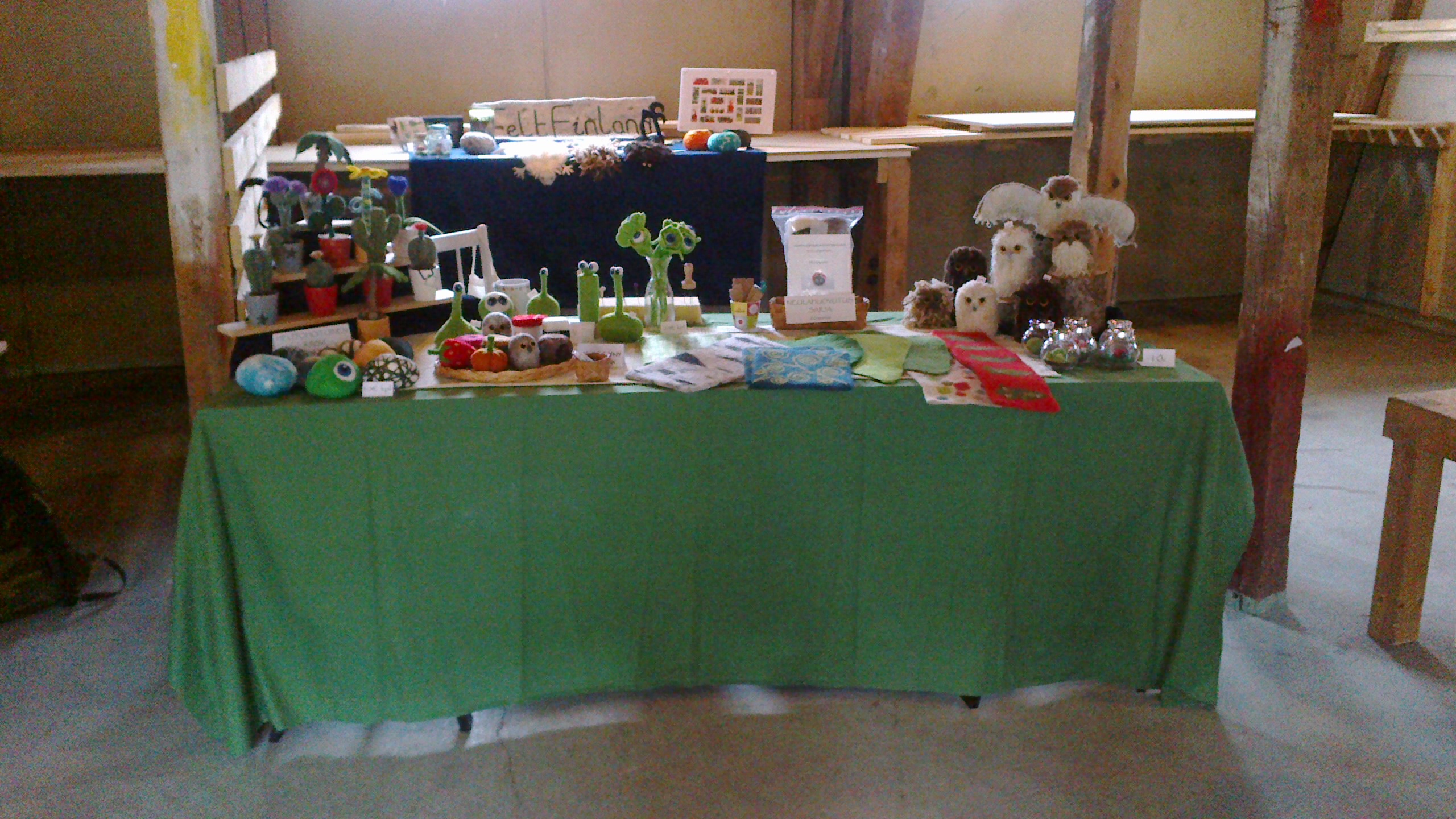
You have worked hard to make some great felted works of art. You have an opportunity to sell them. What you need are those extra little touches that will catch the eye of the buyer and also encourage them to return and buy again another day. Product presentation is a key part of selling. No matter how stunning your creations, if they are haphazardly piled on a table, not many people will give them a second glance. I have developed and learned a few ideas over the last 3 years of selling at craft fairs which I am happy to share with you.

Make use of all the space on your table without overcrowding.

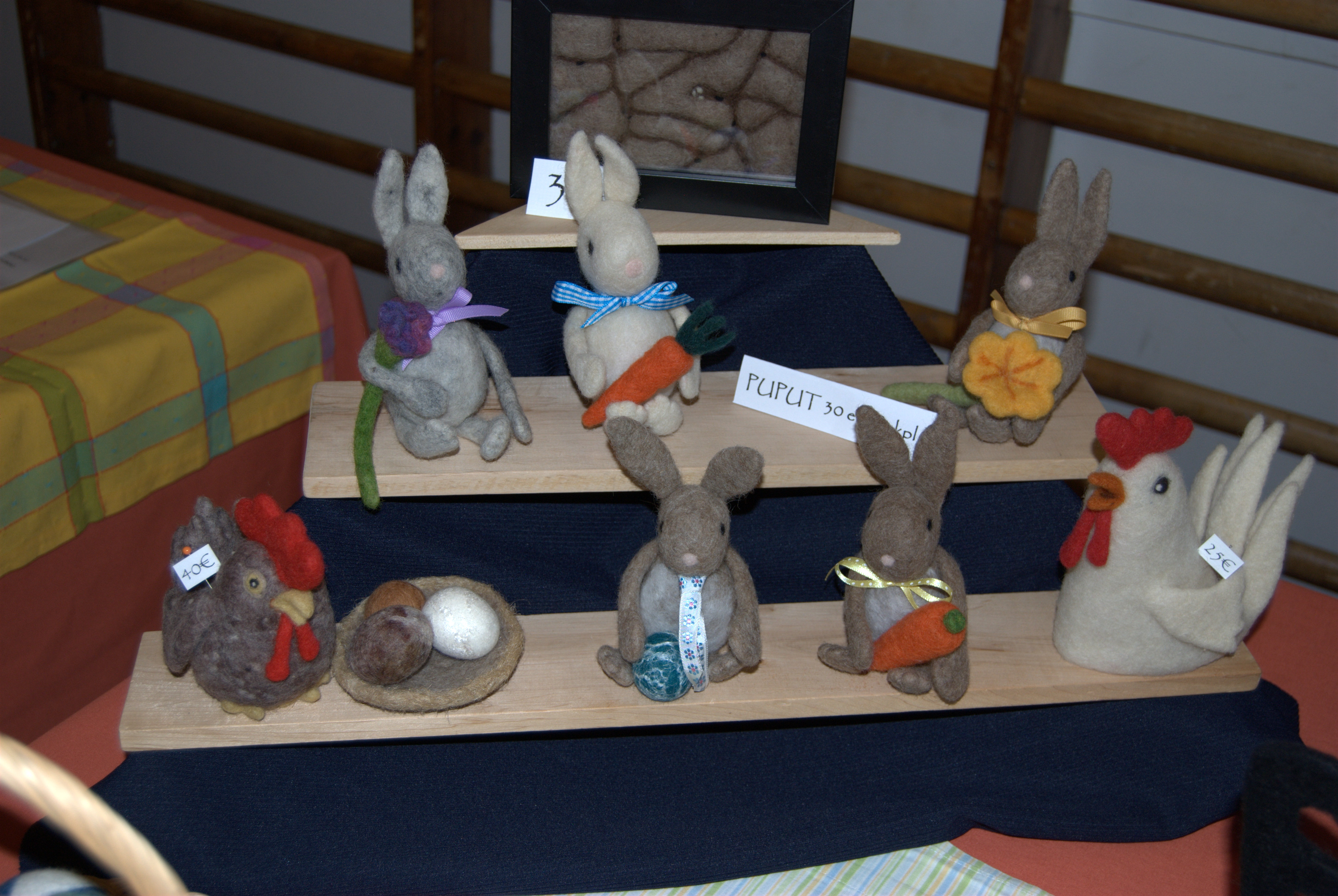
Don’t forget you can add height – a small set of shelves, an upturned box, branches, logs are a few things I have used. I have always liked wood and wool together. 

Choose an appropriate coloured cover (sheets and old curtains are cheap options) for your table, one that won’t detract from your work. Make sure it is big enough to fall down and cover the front open side of the table. This allows you to store your boxes and bags under the table without the world seeing them! One of the photos shows how not to do it – pink cover which is too short – all the tables were set up the same by the folks organising the fair!

I also like to use baskets and basket weave trays of various shapes and sizes to display my products – this also helps to keep things together and prevents products getting all muddled.

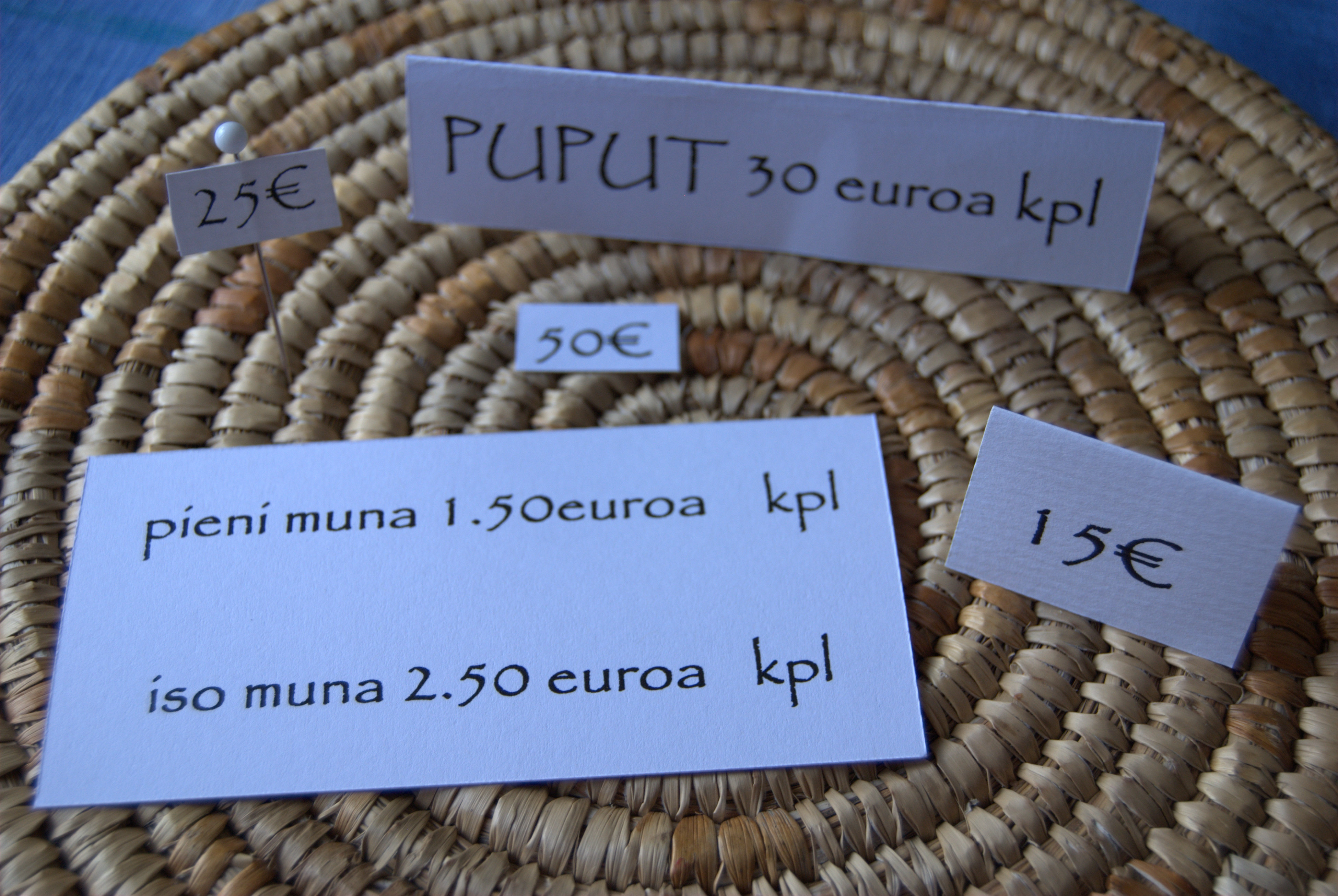
Pricing – personally I like to individually price my items, using free-standing labels on the table top next to the items or small price tags stuck on pins then stuck in the relevant item. I do not like to put sticky labels directly onto the felt.

If you do not want to show your prices, have the costs of each item readily available (in your head!) for when a customer asks. Print prices on stout card from your computer using a clear bold font – these can easily be reused too.

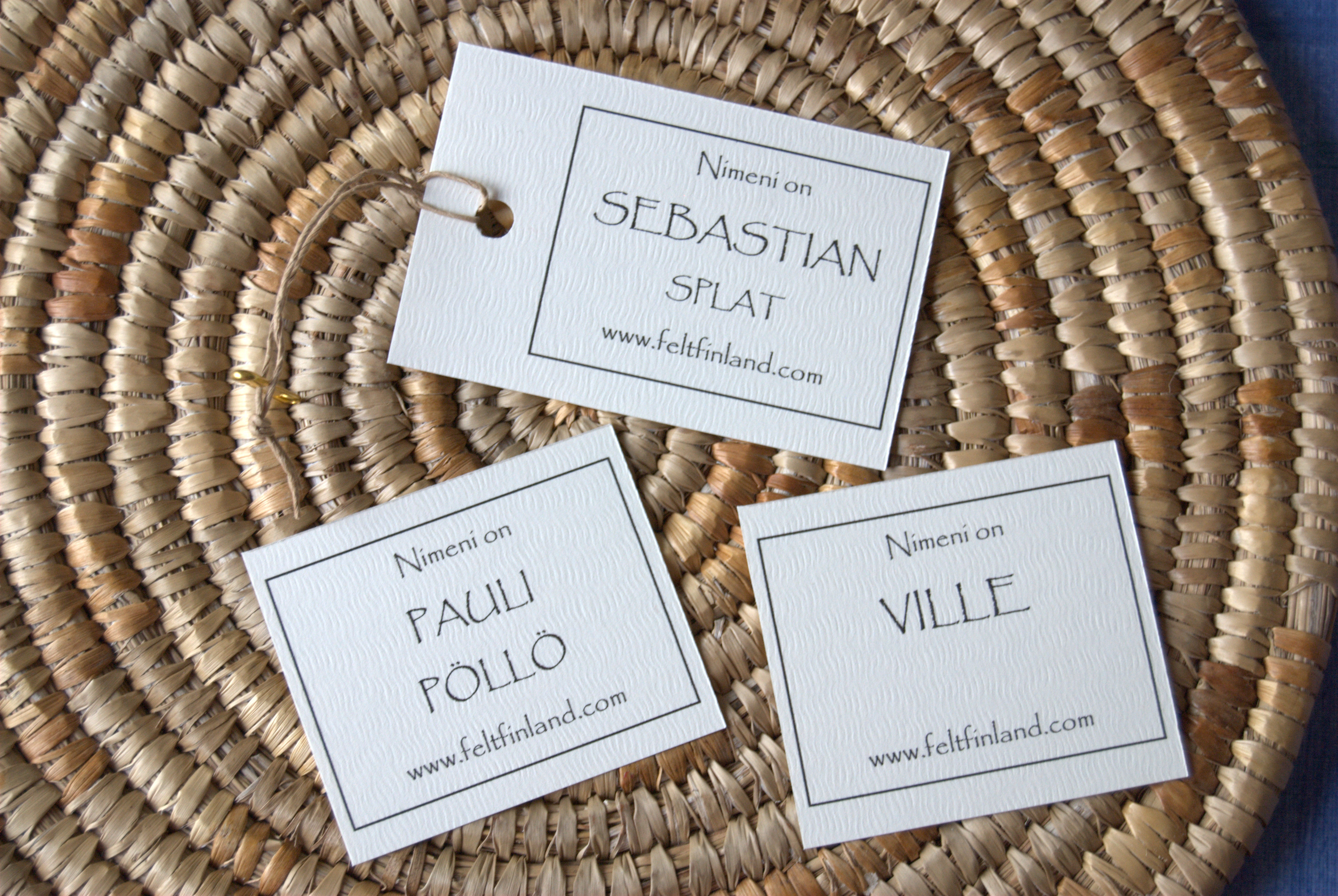
Add your own personal touch – I give names to a lot of my creatures such as Aliens, Owls etc. I print them onto good quality card from my computer and these go home with their owner. Don’t forget to add to the label your company name, website etc. 

Pop one of your business cards into the bag the sold item is going home in. 

Cellophane bags work really well with small felted items and can be sealed with customised stickers. Bags are available in different sizes and cellophane wrap can also be used. Paper bags have their place but will hide your creation! Plastic bags have their use if it is pouring with rain to keep your sales dry on their way home!

I hope these few pointers will help. I found it useful attending craft fairs as a buyer and seeing how other people presented and packaged things. It gave me some great ideas but also showed me what not to do!

Guest poster: Amanda Heikkinen


How to Approach a Gallery or Store to Carry your Artwork – Part 1

How to Approach a Gallery or Store to Carry your Artwork – Part 1

As a store owner, I really hope that you pay attention to this post if you’re thinking about approaching a gallery or store about carrying your work. One of my pet peeves is artists showing up without an appointment. Take a few minutes and find out the gallery’s policy for taking work, either on consignment or wholesale and follow that process to a T. Starting out on the wrong foot by just stopping by can really reduce your chances of getting your work accepted.

Do a little research first. Find several businesses in your area that you think might be good possibilities for your work. Look at their websites and see if they have a submission policy listed. Print it out and read it carefully. While you’re on the website, look at other artist’s work that they carry. Do they have work that is very similar to what you do? If so, you probably need to find another place as they will have their loyalties with that artist first and most likely will not take in work that will directly compete with something they already carry. Do they only show paintings? Unless your work is two-dimensional and a “wool” painting, the gallery will most likely not be interested in carrying work like felted soaps or nuno felted scarves. If the gallery doesn’t have information online about their submission policy, call and ask what it is. Again, make sure to follow whatever instructions you are given.

Once you’ve found a few businesses that you feel might be a fit for your work, do a reconnaissance mission and check out the gallery before trying to make an appointment. Don’t try to talk to the staff about your work, just go look at the gallery. Does it seem like a good fit? Do you know some of the artists whose work is in the gallery? Does the gallery carry your type of media and if so, what kind? Do you have work that you think will be a good addition to the mix that the gallery carries? If you do happen to know any of the artists, contact them and ask them how it has been working with the gallery. How has their work been selling? Do they get paid in a timely manner?

Next, you need to do a little planning and thinking about your work and what you think will interest the gallery the most.  If you are submitting photos of your work, make sure to get good clear shots with a white or neutral background. If you will be showing your work in person, think about which pieces make a nice set and plan on taking enough work so that the owner or buyer can get a feel for what you do. Most galleries carry work on consignment basis which means that you don’t get paid for the work until after it sells. The gallery will take a percentage of the retail price since they are the ones selling the work. An average percentage rate is 60% of retail paid to the artist and 40% of retail paid to the gallery. Make sure to take this into consideration when pricing your work.

If you are submitting your work by e-mail, write a nice letter to accompany the photos and price list. Tell the gallery about yourself and your work process. Explain why you think your work would fit well in their gallery. Ask them to reply to the e-mail so that you know they received it. You could also include your artist statement and resume if that seems appropriate. Again, make sure that you follow all the directions you were given for submission.

In Part 2, I’ll discuss visiting a gallery with your work, what questions you should ask and what to do if you get accepted. The worst thing that can happen if you approach a gallery is that they say no. Don’t let that scare you off from trying. There are many reasons for the no and it isn’t always because your work isn’t good enough. Ask why your work was rejected. You might be able to learn from the situation and improve your presentation with your next try.

The Top Ten Ways to Improve Your Booth Displays

The Top Ten Ways to Improve Your Booth Displays

I’m sure there are more than 10 ways you can improve your booth display but these are some major issues that you should address when displaying your products. You will be amazed at the difference a little change in your display will have on increasing your sales. It is worth your time and effort to create the most eye-catching and welcoming booth to attract more customers to take a closer look at your work.

  1. Neatness – Make sure that everything is neat and tidy. You should have table coverings that reach all the way to the ground so that you can use the space under the tables for storage. Make sure all boxes, gear and anything that isn’t a display or your product is hidden from sight.
  2. Warm and Welcoming – Your booth should be welcoming to your customers. Try to avoid the “cave” appearance.  Do you have room to add any cozy touches such as a floor lamp? You should also have some type of flooring, even if it is an indoor show. For someone who has been on their feet for a while, it is nice to have something soft and cushy underfoot. For outdoors, you  might try the interlocking foam squares and for indoors perhaps a piece of remnant carpet or carpet squares.
  3. Full Displays – The displays in your booth should be full but not overcrowded. Avoid cramming pieces in but you also don’t want only one or two pieces alone. Bring enough product to refill your displays immediately after making sales. If you run out of something, then remove that display or shelf entirely or fill the lower displays with silk flowers or driftwood so the displays don’t appear empty.
  4. Group Products – Have enough of each type of product that you carry so that you can group them together. If you have a choice of colors, make sure that the group of products shows these color choices. Grouping products also helps with your signage so that if a product needs explanation, then one sign can be placed by that group.
  5. Match Displays to Products – Everyone has different products and so no one type of display will work for all. The display should show the product to its best advantage. Does it need light shining on it? Should the item be propped up? Does the product need to be filled with paper to give it shape? The key to the right display is visibility. If it can’t be seen right away, then the customer won’t see it. Can you display your work vertically? What type of display makes your work the most visible?
  6. Bring Products Forward – The less distance the customer has to travel to be able to touch your products, the better. If you are selling small items such as jewelry, perhaps all the display cases need to be at the front of the booth. Use shelves that are shallow and avoid deep cabinets. With deep shelves, the products towards the back will be less visible and in the shadows.
  7. Eye Level Displays – Put as many of your products at eye level as possible. Things on the floor/ground will be missed. Make it easy on the customer, so that they can see all of your beautiful work without having to work at it. Also use different levels in your displays to give interest.
  8. Branding Banner – Use a large banner in the back of your booth with your “brand” on it. Make sure it is easy to read from a distance and includes an eye-catching color or photo.  The banner will help to draw customers from a distance. If you are selling small products, it would be wise to invest in posters with blown up photos of your work that can be seen from a distance.
  9. Improve Lighting – Color sells. If a customer can’t see the colors or details in your work, you will lose sales. Lighting is the key. Be creative with your lighting. There are many types of battery-powered lights these days. Perhaps your products would look good with under lighting. Use a piece of plexiglass with a battery-powered light underneath to add light to your displays.
  10. Tell the Customer What to Do – Use simple signs to let your products speak for themselves. Perhaps your sign will say “Felted merino scarves, the softest scarf you’ll ever feel”.  Or it could be “Scented felt soaps – Smell me!” Get the customer to use some of their other senses besides sight. Encourage them to pick up the product and you will see more sales.

Once your made your improvements, continue to tweak your booth displays and designs. See what works and what doesn’t. Look at what other artists do that works. Can that be adapted in some manner to improve your displays?

I’d love to see some photos of your booth at a craft fair. If you have some, please feel free to add it to our Flickr group or start a post on the forum.

Do Your Displays Complement Your Products?

Do Your Displays Complement Your Products?

For the next couple of Marketplace Mondays, I will be focusing on product display. The display of your work can be the difference between excellent and dreadful sales. Planning your display in advance and doing a little research, will go a long way in your success.

To get an idea of what options there are for display, look at other booth displays to see what you like or dislike. You can do this at local craft shows or there are several Flickr groups, Craft Fair Displays and Arts & Crafts Fairs are two examples, where you can find booth and display photos online. When you’re looking at the various displays, think about the following:

  • What colors draw you in?
  • What makes certain displays stand out?
  • Does the signage catch your eye?
  • Do you like the arrangement of the booth space?
  • How does lighting affect the displays?
  • Do you immediately know what product is being sold?
  • Does the display complement the product line?

Once you’ve gotten some ideas on what you like and what works well, you need to start considering what you want your booth to look like. Remember that your booth should help to draw people in but shouldn’t overshadow your products. If customers are frequently complementing you on your beautiful displays and booth, you need to rethink your display ideas as the displays are outshining your work.

Consider all of the following when working up your booth design:

  • Space – how will the floor plan be laid out?
  • Theme – can you use a theme to reinforce your brand?
  • Color – what colors will work with the color palette of your products?
  • Levels – how can you place your products at various levels to create depth and interest?
  • Signage – how much signage do you need and for what purposes?
  • Lighting – how can you use lighting to emphasize your products?
  • Simplicity – how do you create a display that doesn’t overwhelm your product?

Answer these questions to get started on designing your booth. I’ll discuss these ideas and more in the next article. If you have some great display ideas or photos of your displays, we’d love to hear about them and see how you display your work. Feel free to add your display ideas to our Flickr group photos.