Browsed by
Category: fibre

Adventures in colour (Part 1).

Adventures in colour (Part 1).

Ions ago, I purchased all the bits and pieces that I needed for acid dyeing.  I never lost my enthusiasm for it (in principle!).  I listened to my textile friends waxing lyrical about dyeing. If I am to be perfectly honest here, I lacked both the knowledge and the confidence to try it.  So when I came across a dyeing course which was being run over the four Tuesdays in November, well, I didn’t have to think twice, I immediately booked it.  The workshops were run by an Irish Textile Artist and all round nice person, Sharon Wells (https://www.sharonwellsart.com/).  Sharon provided all the equipment and fibres but mentioned that we were free to bring along any fibres we wished to experiment with over the course of the workshop and of course our limitless curiosity!

Week 1:

During week 1 we worked with Jacquard Acid Dyes.  Once Sharon explained the basics of what would and would not work with these dyes, she set us to work, initially teaching us how to secure hanks for the dye pot.  We were each given our own pot to work with.  Then we got down to the fun work of choosing dyes, testing fibres and dyeing.

Our first experiment was with solid colour.  We each threw a variety of fibres into our respective pots and got to work.  It was great fun watching as the colours developed.  I had chosen orange for my first test and it was just so exciting watching the different hues develop.  I have prepared short slideshows of the results of each of the experiments over the four weeks.  Details of the fibres are included in the captions.

Next, to some of my fellow participants horror, we saw Sharon cut into an old shrunk felted jumper.  We were each given squares and shown how to randomly sprinkle the dye powder onto the surface.  This time we used a minimum of 3 colours on the sample.  Once prepared it was popped into the dye pot and other fibres were thrown in not to waste the dye that came off the sample.  Here are my results.

By this stage we were all getting really excited.  This was like alchemy or as one of us said, witchcraft (which is possibly a more accurate description as we all gathered round one of the cauldrons (yes there was one, the rest were pots))  and saw the reactions of the different coloured dyes we were adding to the pot full of fibres.  We were learning (among other things) how to control where the differed colour dye permeated the fibres and how the colours mixed throughout the process.  Here’s what I produced.

Week 2:


It is amazing how disciplines have their own languages. Mordants; fugitive colours; substantive dyes – Sharon quickly demystified all the terminology – a real confidence boost – then she produced a vat of fibres which she had been seeping in the mordant for some days.  She also gave us a variety of pots which we could work from.  Then came the fun ‘show and tell’.  Sharon had been growing and collecting various flowers and plants over the summer months.  She dried these especially for the session so we each got one to work with.  We had dried containers of marigolds, rose petals, sunflower petals, sunflower heads, and ground up nettle.  I got the nettle to try.  One of the participants opted for fresh eucalyptus.  We set pulling the dye out of the plants, straining it and then to dyeing our fibres.  Here’s our progress and the results:


  • nettle powder some of which has lost its colour from the sun, the remainder is a moss green
  • The beautiful and patient dog Loki with his ball
  • The marigold petals produced a delicate creamy result which differed in shade depending on the fibre used
  • The fresh eucalyptus produced a delicate green/yellow result which differed in shade depending on the fibre used


Then as a further experiment we took dye from a couple of the dye baths and added different components to see how the dye reacted.  We used tin, chrome copper and vinegar.  The results were surprising.

Top is the rose dye
middle L/R vinegar, tin, chrome, copper
Bottom is the Sunflower petals


I was disappointed with the colour of the nettles which were a murky colour.  Also the powder from the nettles made the fibre really grainy and unattractive.  I thought I would see if I could use fresh nettles from the garden.  Sharon had offered me some mordant to bring home for this experiment and like an idiot I forgot it.  So, based on an earlier comment she had made during the class I decided to try using aluminium foil as a mordant.  I steeped the fibre overnight and made up the dye which I strained.  Then I dyed the fibre.  The result is a beautiful soft green which I am very pleased with.  I am not sure that the mordant took as only time will tell if the fibre loses its colour but it did not happen when I rinsed it.  The grains from the original nettle powder were still scattered throughout the wool fibre so I took my carders to the Kerry sheep fibre.  Although I have yet to be convinced that natural dye is an avenue I want to pursue further I really enjoyed the day and the learning.

  • a sample of the fresh nettle dye looks green brown, like weak tea

I have so much to share from these four weeks that I will save weeks 3 and 4 for my next blog post. A million thanks to Sharon for facilitating such an interesting set of Tuesdays last November.

A card for Christmas!

A card for Christmas!

This year we all decided to do a Christmas card exchange within the Felting and Fibre Studio group. It is just so lovely to make for another creative! It’s a bit frightening too as I wanted to give it my all. I also thought it might be a nice time to try something new and experiment – no personal pressure at all!  I was so excited to be partnered with Leonor who I know has received her card at this point.

So, I put my thinking cap on.  My first attempt was, and I am being perfectly honest here, an unmitigated disaster and the memory is probably best confined to the bin in which it quickly landed.  So it was time to move on and put the thinking cap back on.

Okay so, by way of background.  I had a poinsettia plant which I managed by some miracle to keep alive for about 5 years.  I will quickly add that this had nothing to do with green fingers, it just liked its position in my sun room with my orchids as companions (again the orchids like the room).  This summer the poinsettia developed a honey fungal disease which is a total disaster if it hits orchids so we had to part ways.  I managed to stem the spread of the disease and the orchids are safe for now.

As a tribute to that most beautiful poinsettia, I thought it could be my focus for the card exchange.  I wanted mixed media so I felted each petal, then I did some free motion embroidery on each one.  I hand sewed it onto a felted backing and added hand dyed stamens to the centre.  It was then mounted on the Christmas card.  It was a little too big for the card so I decided to mount it in a frame before posting it off.  The postal service can be a bit dodgy but I am pleased it worked on this occasion.  From Leonor’s message to me, I think she likes her card and  I have made more since.

Here is a little slide show of the highlights of my process.  Sorry, I forgot to photograph the hand sewing so you will have to use your imagination for that part.  Some of the photos are slightly distorted so apologies for that too.

This was a fun make with a bit of learning thrown in for good measure. You might like to make some too. If you do, I would love to see it! Also if you have any questions on the making just pop them in the comments section and I will be glad to answer them!

Wishing you peace, love good health and happiness and, of course lots of creativity over the Festive Season and for 2024!

Helene x

Xmass Card Exchange! (the moose edition)

Xmass Card Exchange! (the moose edition)

I have been working on something secretly… but now you can peek!

I seem to be on a moose theme lately and after a few options, I returned to it for my Xmas card exchange. Ann had been talking about her original plans for her piece and I had liked the option of a removable pin on the landscape, so it could be viewed as either a landscape on its own or the broach integrated with the picture.

I started with the same moose image that had been used on the guild anniversary bag.  I scaled it down to 3 smaller sizes to give me options, then printed out the images. I decided on the largest version of the options and cut out the silhouette. I traced the shape onto a piece of white craft “Felt”, ok it is a non-woven fabric but the amount of wool in it is somewhat suspect. It still works as a backing to build the moose on so I continued with it.

silowet of a moose printed page of moose in various sizes to use as a template  1.1 1.2) Moose Silhouette

I again used the Maori short fibre batt in the sand and reddish brown with a T38-333 needle. I put on the audiobook I was listening to and got to work.  ….I was sure I had taken a few shots as I started, but could not find them. So I unfortunately seem to have a shot of the moose part way done. I have the basic structure built, the armature wire has been added down through the head and curled into the neck. (Which was the same way, I had treated the moose antlers on the bag.)

Moose with antler armature  2) Working on a half 3-D image of moose with armature in near side antler

I had used a thicker marker than I wanted to use (I am sure I put the fine one somewhere……safe) so I need to both, solidify the space between the legs and get rid of the residue of the outlines. To do that, I added white wool. I pulled it into little pieces, about .5” long and made sure the fibre direction was very disorganized.  Once the in-between leg spaces were firmly felted I started looking for my good scissors. I had seen videos of the beautiful cat heads being cut from their felt backing before mounting them on another fabric for framing, so I was sure it was possible. I carefully trimmed around the outside of the moose. I used the good embroidery scissors to bevel the edges so the white would not be seen, then added a bit of wool where needed along the edge.

close up showing white between moose legs and snow in landscape3) I used the same white I was using for the snow in the background picture.

Next was sewing on the broach pin, I should have searched more for the white buttonhole thread, but I did find the black which should be strong enough to keep the pin attached. You can find these pins in various configurations at craft stores and online at Aliexpress. I have a bag of various sizes, … which has again wandered off somewhere. (Pre-new Year’s resolution – clean up my studio!!! or stop putting things in “Safe” places.)

bag of broach pins in various colours sizes and latch styles 4) Broach pins, in two styles and many sizes and colours.

checking size of broch pin to moose attaching broach pin with button hole thread pin attached to moose5.1, 5.2, 5.3 Attaching the pin to the moose (not the same as Pin the Tail on the Quadrupedal Large Animal.)

I also added extra white behind the body to make a level surface for the broch pin.

Close up of the antlers vewed from above 6) Close-up of antlers.

Here is an overhead angle showing the back antler is flat while the front antler has an armature wire and is curved. (This is why he got a little travel box and not a bubble mailer). The odd pink thing is my T38-333 needle with a pink elastic which is helping him stand to show off his impressive rack! (of antlers)

Since you can see the foam pad I am using for this project, I should probably talk about it. This is a gift from Ann. Her husband picked it up at his work. Its original purpose was for packing of, I think,  air filtration equipment. It has a plastic-y top layer and a softer foam underneath, so it would both support and cushion the delicate bits it was packed with. The top layer worked well to felt on.

parking foam, made from two types of foam 7) Foam from shipping equipment

It sits comfortably on my lap as I worked.

Next, I put on a new audiobook (Which again derailed my memory to take regular photos as I worked) and moved on to the background the moose could inhabit if it was not out adventuring with his recipient. As I considered what elements to include, I settled on snow, leafless trees/branches, a small pond with cattails, and a dark night sky with moonlight.

For size, Ann said from about 3×5 to postcard size. I started with a piece of good wool felt (from the Black Lamb) and marked out the design on a 3×5 scale but realized the poor Moose would feel squishy in such a small landscape. So I went searching the desk for postcards, I know I had one from Monika at the Olive Sparrow and one from Heidi Feathers. I found Monika’s first so started expanding the landscape to fit it.

postcard from Olive Sparrow checking size of picture to postcard, postcard is bigger and cn be seen extending mostly at the bottom of the fel;t picture 8.1, 8.2) checking image size against the postcard.

To check size, I compared the landscape, with the Olive sparrow postcard. It needs to be a bit wider and taller. I tried a bit of Tugging then added more fiber extending the sides. A good thing felt is forgiving if you want to expand your image.

You have probably read before or heard me in person strongly suggest you try to work to a size that can be economically framed. That means choosing a finished size that will fit a standard matt size. In my earlier days, I spent 13 years as a custom picture framer, mostly archival framing and hand mounting  (I also worked with parchment but I discovered that not everyone is as excited by it as I am. With the help of a friend, I even made some deerskin parchment!)  When I found my postcard from Heidi Feathers I realized that yes, there are different standards of sizes from North America to the rest of the world!!

My solution was to expand the snow and sky so it could be cropped to fit into a standard size frame on either side of the water. The other solution would be to float the felt background in a shadow box which could allow the edges to be visible.

In the 1990’s there was a framing trend called a memory box, it had a front or back hinge on a shadow box frame so that you could change what was on display. It was advertised to show off holiday trip photos and mementoes. I have found a few of them turning up second-hand and have grabbed the ones still in good condition.  You may want to keep an eye out for them too.

background for Moose pin, adding to the top of image 9) First, I extended the top adding height to the sky, trees and moonlight.

adding to the bottom of image 10) Then I added more to the bottom snow and under the pond. There is a bit more to the right of the largest tree.

Moose now has more space to stand and admire the reflection in the pond.

checking spacing for moose on the landscape 11) Checking if the moose fits in his landscape, yes much better!

Now what have I forgotten? Oh! He can’t see the pond or the reflection since he doesn’t have an eye, I can fix that!

adding an eye to the moose so he can see the landscape (trees in back ground, pond and cattails in pond with reflection of moon. 12) Added an eye to Moose and repositioned him in the landscape.

Now that moose is happy in his landscape it’s time to tuck him into a bubble pack and then into a cardboard box, which is covered in tape and brown paper. Then send him on his exciting journey to his new home.

Moose and landscape going into buble wrap bag moose and landscape wraped in buble wrap ready to go into little box to travel!13.1,  13.2) Moose entering his bubble wrap bag for his big trip!

He went off to the local postal station to start his exciting travel adventure.  I am now waiting to hear he has arrived safely.

AH HA!! He has arrived and I can now show you! I hope Marie will let us know if Moose is behaving or if has he run off to World of Wool. (He is closer to Wool Meca than he was in Canada!)

I hope you had fun seeing the mini-Moose and his landscape come together. Next time I promise to take pictures before enjoying an audiobook! I am looking forward to seeing all the cards once they have all arrived.

PS Marie’s Card of Festive Trees has arrived!! Thank you!!

A lantern for a door prize

A lantern for a door prize

Hi folks. It seems I am running behind as I didn’t know it was Tuesday already. So lots of pictures and not much text today.

My guild Sale and Exhibition is in a couple of weeks and I promised a door prize of a lantern. In reality, it is a glass vase with a cover and fairy lights inside. They are very pretty. You want them to look interesting when they are not lit as well as when they are lit.

So I started out to make a scene. I used bats to save layout time.

water

ground

sky


And then wrap it around

and then I decided it was still boring so I should add a little village.

I thought the white was too bright so I went will black. I want a hint of a village in the distance. I did one on each side.

In retrospect, I should have gone with white. There would probably have been enough migration of fibres to dull it down a bit. As was predictable if I had thought about it they disappeared. I will shave it later to see if I can get a hint of where they are and add them back. but it can wait as after felting I decided it was way too thick for a lantern. I am definitely out of practice felting. I do like the scrunched-up water and flared sky though.

Try again. this time I am using a nice blue merino top and some orange and gold silk lap. the silk should be interesting enough on its own.

A nice thin layout

and some lovely silk lap

and done, here they are together, silk never shows as nice as it is in a picture.

The light forme the fairy light shines through nicely even with the light on


Much better than the first one

so that’s my adventure in felting this week. I hope you like it, I hope the winner likes their prize.

Bat on a stick…..

Bat on a stick…..

One of the things that I have enjoyed doing over the last few years, is watching and chatting during live YouTube felting tutorials from Sara (Sarafina Fiber Art) and Marie (Living Felt). I have been inspired by projects shown by both felters.

As you probably have noticed, when seeing my adventures with the four-person Mer-family and their Mer-family pets, I don’t always follow the instructions exactly as suggested. In fact, I tend to fall off the rails…., wander off into left field, or was that right field?… ok, I tend to get distracted part way through a tutorial and wind up doing my own possibly completely different thing.  I am not saying that is a bad thing. It can open new options and create something that is vastly different than the original tutorial goal.

For Sara’s Mermaid project (google You Tube “Mermaid Felt Along 1: Armature”, “Mermaid Felt Along 2 – Body Shapes”, “Mermaid 3: Wet Felted Tail” and “Mermaid 4: Finishing” to see what I was supposed to do), I deviated first by wanting to do a merman but felt he needed a family. Instead of using both wet and dry felting, I used only dry felting.  With the change of scale and shape, I needed to augment the armature strength. Lastly, I made them Fish-People (Pike, Koi, Shark, and Arctic Char) rather than the more traditional mermaid shapes Sara was creating. I created some accessories for them and more will be needed. For the Mers themselves, I wandered off into thoughts of what kind of family pets would a Mer family have.  So the addition of family pets was created, Miss Manta and Sharkette. This could continue to spiral outwards from the original tutorial with Mer-Nabours and other yet unthought-of Mer-friends and accessories! Years of enjoyment even for someone who really would rather not get wet.


Two weeks ago Marie, from Living Felt, out of Texas, sent me off on another spiral with her “Needle Felt Simple Animals: Bat, Owl, and Red Panda Forest Friends!”.  This is a very beginner-friendly project, with simplified shapes and lots of explanations of tight wrapping to build up the core understructure. She did examples of blending and layering colours of fibre. All three projects were extremely cute. I am not sure I do cute, especially extreme cute, well not as cute and friendly as Marie can do at least.

Marie started by using a wooden skewer to tightly warp her layers of core wool, creating the basic shape. This got me wondering about other skewer like objects that you could use which I had on hand *actually I looked as far as the shelf beside my desk to find 3 options. I had also purchased at the Almonte Fibre Fest in early September, some short fibre Maori batts, one of which was white and another was charcoal. I had wanted to investigate working with short, somewhat springy, fibre and this seemed to be an excellent opportunity.

1) White Maori Batt, wooden skewer, knitting needle, one mettle chopstick

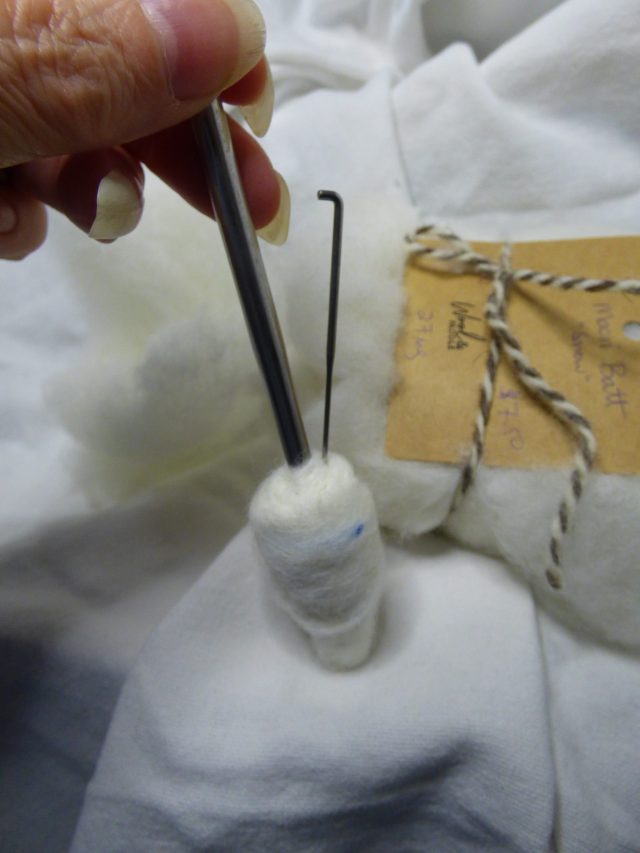
I decided to try the chopstick. It doesn’t have quite as much grip as the wood, but it’s not quite as slippery as the knitting needle.  I like the slight taper,  it was comfortable in my hand and oddly like the single knitting needle it happened to be sitting in a cup with my pens, markers, small files and metal pick set (that was for cleaning my drum carder, I don’t know why it’s here) by my desk.


one mettle chopstick on white batt of Maori short stale lenght fiber 2) selected a chopstick and Maori batt

using a chopstick to wrap fiber around and build up the core structure.3) using a chopstick to wrap fibre around and build up the core structure.

Adding thin layers of roving, wrapping tightly and tacking down, then poking from the base to further firm core layer.

Tearing off thin strips from the batt then drafting them to a narrow roving. This shows the VM and makes it easy to remove.4) Tearing off thin strips from the batt then drafting them to a narrow roving. This shows the VM and makes it easy to remove.

I found the white short-fibre Maori batt had more bits of VM than most of my spinning fibre. It was not a large problem and easily picked out before wrapping it to the core. It compacted to a firm core shape and was easy to work with.

Looking at Marie’s bat she used commercial felt to make the wings. While extremely cute you can’t pose or position the wings. Ok, I am going off instructions already!  There are a few ways to add an appendage with wire to a body. This time, since I was adding a symmetrical structure, I chose to pierce the body with a floral wire (unlabeled but suspect it is 22g). I centred the body on the wire then folded each wire up at the point it pierced the body on each side. I then folded each half, in half, twisting to create the leading edge of the arm, leaving a loop to add the “fingers” at the end of each wing.

wire piercing body, center body on wire and bend the wires5) wire piercing body, centre body on wire and bend the wires

folding each wing wire in half6)folding each wing wire in half

Next, I needed to add the “fingers”  to the end loops.

wing one armature with fingers added and wire bent ready to add to bats right palm loop.7) wing one armature with fingers added and wire bent ready to add to bat’s right palm loop.

both wings have full arm armatures. note that the fingers have 3 different lengths.8) both wings have full arm armatures. note that the fingers have 3 different lengths.

I often make very thin wings for the little dragons I’ve been making. I usually wind up using a fine fibre combed top laid in thin wisps in various directions. I have also used hand-carded fibre such as on Mrs Mer’s Finns effectively.  I was curious how the short fibre of the Maori batt would work for a top coat as well as for thin wings.

The Charcoal coloured Maori batt beside the small white Maori batt9) The Charcoal coloured Maori batt beside the small white Maori batt

I started with wrapping the body and armature.

wing/ arm armature and body covered in the short staple Maori10) wing/ arm armature and body covered in the short staple Maori

It was a bit fuzzy, but with further poking the surface became smooth and firm.

At this point, I again became quite distracted with another thought. Those scrawny arms are not going to be able to move those wings!!! So I had to add deltoids and bicep muscles, now he could try out his arms as we went to enjoy hamburgers at the butcher shop in Bell Corners (he did not have any since he doesn’t have a mouth or eyes yet it could get messy.)

You Tube Video link  

11) Video: bat on a stick in KIA trying out his muscles before he gets his wing membranes

Ann checks out Bat in progress12) Ann checked how firm he was and laughed at his fabulous physique.  (don’t tell bat!)

I made a couple of attempts with just the Maori but was finding I was not getting as firm and thin as I would like, so added a longer fibre in a thin web to let the Maori attach to it. when I had a thin layer of felt  I carefully attached it to the fibre wrapping the wing armature. I bent the armature and then sculpted the wing membrane further.  Once I had the wings looking more wing-ish, I made quick ears and added them.

I decided I wanted a more three-dimensional face (oh no deviating again!) so added a small nose and eye sockets which I filled with small beads for eyes.

Marie’s Bat only had its stick stuck in while she was creating the core shape. It kept your fingers and the sharp end of the needle well away from each other. She then removed it and added the layers of colour to make her cute bat. I like the bat-on-a-stick look and have kept it so far. Bat on a stick may be a cool Halloween hair ornament or a felting supervisor in a demo basket.

I have not had time to finish off the last bits for Bat on a stick he still needs his teeth, I tried to make them with the Maori white but was not happy with the first attempts. Next, I resorted to wet felting but I was still not happy.  I have a couple more options to try to make tiny teeth. I am also considering feet or legs and feet, so I may be adding another part armature to finish him off.

In the meantime, I have been taking him with me to the OVWSG guild library. I am working through the last few years of donations, sorting ones to keep in the collection and getting the rest ready to sell. Bat has supervised as I wrote the database for the sale books. I am almost finished with the data entry for the books. The magazines that are extra I have sorted by title and year ready for shopping! (it was a big job)

box of magazines sorted by year 13)just a few of the magazines being prepped for sale.

He also watched as I had my last of 4 evenings of nalbinding workshops which has been fabulously fun. I now know I can’t count since I keep losing track of where I am in my increases for my hat. I am off to find a stitch counter so I have a hope of getting the mythical (in my case) flat starting disk to make my hat. For this workshop, I do want to follow the instructions. (I have had a blast wandering off instructions for the felting though)

Felt Bat on a mettle chop stick with articulated wings  14)Thumbs up!  Bat on his chopstick supervising from the shelf above the desk at the OVWSG Library.

Each trip to work on the library bat has accompanied me. He has found a spot on the shelf above the desk where he can sit in a clip on the extending magnet. He is giving me a thumbs-up on all the work! Even without his teeth or feet, he is very supportive.


I hope you too get a chance to watch some of the various online felt-alongs. You may also find inspiration in previous blog posts by all the fibre artists here. You never know what might inspire your next project, maybe you too will find a multi-year project! Or maybe just a quick little bat! (with or without a stick).

The Bull

The Bull

We have three public houses in Sturminster Newton (at one time there were 11 in our small market town!) and The Bull Tavern is one of the oldest. The building consists mainly of a 3 roomed 17th Century cottage with an attic room, built of old timber infilled with wattle and daub. Some additions were made in the 18th Century. Records show that the cottage was definitely an alehouse by the late 1700s. Apparently there was a slaughter house at the rear and a Pound where straying animals were kept until collected – upon payment of a fee of 1 shilling (which must have been a fortune when you consider that a married man’s weekly wages at the Town’s Workhouse were all of 9 shillings and a single man’s only 6). Part of the C18th additions was a stable block (which eventually became a skittle alley and later part of the restaurant of the pub). It is rumoured that the horses stabled there were used to help get carriages and carts up the adjoining steep hill leading to Sturminster Common and the small community of Broad Oak.

The building, known to Thomas Hardy (one of our famous inhabitants) as The Old Bull Inn,  is shown on the earliest known map of the area dated 1783, as being part of the Pitt-Rivers Estate.  You can learn more about the Pitt-Rivers family here: https://www.dorsetlife.co.uk/2012/04/sturminster-newton-and-the-pitt-rivers-family

About 18 months ago, after our then favourite landlords moved from the White Horse Inn in Hinton St Mary, the pub was closed for refurbishment. Hinton is a village about 1.25 miles away, where the Pitt-Rivers manor house is situated.  We used to walk there 3 times a week – our exercise with benefits – but since the benefits had disappeared we decided to patronise The Bull – for our exercise of course.  The only trouble with that was that it’s uphill on the way home whereas it was down hill from the White Horse.

During that time we had come to enjoy the chats with Marianne and Lance, the Bull’s managers.  Lance being the very good chef, and Marianne “Front of House”.  Early in January 2021, they announced that on Christmas Day they had got engaged.

One of my felt paintings – commissioned by a mutual friend –  had been given to the White Horse landlords as a wedding present a few years ago, and Graham, my husband, suggested that I do something similar as a wedding present for Lance and Marianne.

Felt picture of sepia tint image of old public house
My interpretation of an early image of The White Horse, Hinton St Mary

Although The Bull itself is a very interesting building, I wondered if I should do a picture of an actual bull for them. No date had been set for the wedding at that time, but I thought I should at least start collecting reference pictures, both of the pub itself, including some of their Pub sign and of some animals. I thought about breeds that might have been around in the 16th Century – White Park Cattle and black Gloucesters; and also looked at Herefords since that was the breed on the Pub sign.

image of Bull Tavern sign with hereford bull above image of the public house
The Bull Tavern and it’s sign

image of black bull with winners rosettes and image of large white bull
Gloucester and Park White Bulls

image of hereford bull head, image of bull grazing, image of bull in field
3 Hereford Bulls. I eventually picked the one at top left.

In the end I decided on a Hereford bull. After a lot of thought and manipulation of pictures, and also starting on a background field for the bull to stand in, I still could not come up with a layout that I was happy with. One idea was to surround the image of the bull with cameo pictures of nearby local landmarks – the water mill and the mediaeval bridge – with perhaps an image of the pub itself as well.

Then, just after Christmas 2022, Marianne said that they had set the date for the wedding – 10th June 2023.  Now I had to get my ideas together and get on with it.  The picture would need to be simplified if I was going to get it done and framed in time.

It was about then that my picture of the horse on the hillside in Devon was finished and it occurred to me that I could use a similar method of producing a figure with more depth.

image of felted horse on background of trees and stream
Detail from my Glorious Devon picture showing the horse added to the finished landscape.

  I finally decided upon a cameo type picture of the bull’s head and shoulders and I would use the background which I had made back at the beginning of this saga.  I would paint (with wool) the shoulders and neck and outline of the head on to a piece of flat wet felted core fibres.  With a separate face and ears, and a further separate set of horns and the nose on another piece.  I would cut all of the pieces from the backing when these were substantially finished.  I would fix the torso and neck onto the original background and layer on the face and ears, horns and nose, then I would do the final titivating and framing.  I made a start and here are the initial progress pictures:

This slideshow requires JavaScript.

As I said earlier, it was intended that this picture would be a wedding present for Lance and Marianne, but at the beginning of April this year, they told us that, because of various unforeseen difficulties arising out of successive pandemic lockdowns (which included them catching Covid between lockdowns so having to shut the pub again)  they had decided to give up the tenancy of the pub.  They had obtained a job, with accommodation, managing a Touring Caravan Park in Cornwall.  Marianne was leaving almost immediately and Lance would stay on for a couple of weeks, with his last trading day on the 19th April.  So the picture was going to have to be a leaving present.

That caused a bit of a panic at home as you can imagine, so I had to get my head down and finish it NOW!  These were the final steps;

This slideshow requires JavaScript.

I managed to finish the picture and, with Graham’s help, I mounted it in a deep box frame in time to hand it over to Lance on the 19th, when we went in for a final lunchtime meal.

So here’s the completed and framed picture – my entry for the 2023 Third Quarter Challenge – Something Special About Our Town.

image of felted bull head and torso on a field and sky landscape in wooden box frame
Finished and framed.

Safty First; a look at wool

Safty First; a look at wool

I am still not up to the next step in the phone-carrying project, mega-stega-blob (fibre layout and wet felting come next). No, I am not just avoiding getting wet! I have tried to do non-offensive activities beyond lying down, watching movies and reading my audiobook (mostly not all at the same time). Monday I got to the guild studio and worked on the library (the books felt heavier and more tome like than usual.) Tuesday I pulled photos then pulled weeds, while sitting and started my blog chatting with you! Since I am still waiting for a few items from Aliexpress to arrive, (they may be in a literal slow boat from China) I think I should consider a few other aspects of the topic they will cover. (Ooh I’m being verbose, cryptic and obscure! I am defiantly feeling better!)

Recently I have had a few different questions about aspects of safety. I want to chat about how to keep you and your needles safely not attached to each other, by stabbing, poking and other forms of impalement. I have been making a chart of the different types of options and want to also test them, with Ann, with the enthusiastic needle felting tools we both purchased last winter. The chart is underway, but with more possible safety items on their way, let’s wait on that aspect of safety.

Instead, let’s turn from the sharp pointy blood-inducing excitement of needles to something softer that can also be dangerous to felters. Wool (and other fibres).  What could be dangerous,  concerning or even caution inducing about wool? It’s so soft and fluffy! It has that lovely sheepy aroma when it’s fresh off the sheep. Sometimes it’s even still warm if it’s really fresh off the sheep.

skirting a fleece. 2 sets of hand pick through part of a fleece sitting on a table. skirting dirty raw wool at the OVWSG studio.

Ok you can get muscle aches or strains washing it, wet wool is quite heavy and moving big bins of water around can defiantly get painful. When I phoned my doctor to mention my tetanus shot was due and I was about to wash a bunch of dirty sheep fleece, she had me come in the next day to get my booster.  (This was near the start of covid when restrictions were most enthusiastically applied, so I was very surprised at how insistent she was that I should come into the office and have the tetanus shot before working with dirty wool.  I would rather be safe than sick or sorry. Even if it means getting the other kind of needle.)

Most of us avoid any thoughts of buying aromatic wool, tetanus or the fun of skirting a fleece by just purchasing prepared fibre, usually even pre-died.

So if you are avoiding working with raw wool in your endeavours, have we avoided all potential problems with wool? No, but don’t rush off to throw out your fibre horde of fabulous feeling fibres and colours!!  The precautions for wool are quite specific and can be mitigated. As you probably remember I love anatomy, physiology and pathology.  I know not everyone is quite so excited about how it all works or how it all can go wrong!  So I will not get into the details of alveoli to capillaries’ oxygen exchange (whew, I bet you are breathing a sigh of relief and thankful there is no exam at the end of this post!!)  You are likely already aware but I do want to mention a bit about the historical problem with the wool-to-yarn industry.

For many activities or professions, there is a pathology associated with it.

  • Tennis has Tennis elbow (lateral epicondylitis),
  • golfers can get golfers elbow (medial epicondylitis) or
  • Weavers can get Weavers bottom, (a false bursa on the ischial tuberosity). Weavers get their pathology from many hours of rocking side to side while sitting on a hard loom bench.

By the time of the industrial revolution and the introduction of large mills, we see a rise of a pathology with wool (Wool Lung) and a slightly different one (Byssinosis) associated with breathing in cotton dust or dust from other vegetable fibres such as flax, hemp, or sisal. This was exacerbated by working with the fibres in enclosed, poorly ventilated areas (the mill buildings) for long periods of time (working for years, at 6 work days a week).

The pathology wool lung is neither as cozy nor warm as it sounds. (Wool lung sounds like someone kindly wrapped your lungs in a soft fluffy blanket of wool.) The way the pathology works is that small airborne particles lodge in the lung. Over time these partials make breathing increasingly difficult and interfere with the lung’s ability to bring air into the body. A similar problem can develop with breathing in dust from other vegetable fibres.  If you are a weaver look under the loom after you have woven a tea towel with tow linen, (for non-weavers, you probably have a lot of dust and bits of broken fibre under the loom to clean up.)

There is another potential problem with wool, (even if you skip working in an early industrial mill, and avoid raw fleece processing), is the nature of the fibre and its ability to get airborne. Think of it as the quality of fluffability. Finer fibres, shorter fibres and older brittle fibres that can break into even smaller pieces will all become airborne more easily than courser, heavier, and longer fibres.  I have found that I have the most airborne fibre particulate from older dry short fibres. Fine fibres that attract static can also be problematic.

Grater fluffatude: Fibers and parasitical are more likely to get airborne.

  • Finer,
  • shorter,
  • older fibres that are dryer and prone to breakage,
  • dusty fibres

less fluffiness: are Less likely to get airborne

  • course,
  • longer,
  • less fragile fibres

In my stash, I have many types of fibre. Some are brand new and recently acquired and some are quite old, second-hand acquisitions or appreciated gifts of often unknown age. I have a few bits in the fibre stash that are brittle and quite suspect but are just the colour I wanted. So if I don’t want to just avoid using fibre that I suspect may have nefarious plans for my health, there are ways to keep us safer. (Re; not wanting to throw away fibre may require Fiber AAA: I have trouble throwing out wool, I know it’s a problem but the first step is to admit it is a problem.)

Most fibre we use is not a problem or is only mildly so. If we have decided to keep a fibre we know or suspect is problematic, that the fibres are likely to get mobile and try to end up in our lungs, what should we do to reduce this possibility?

There are a few things we can do to mitigate getting fibre, dust, and bacterial content from the fibres, into our lungs.

Keep the fibre from getting in the lungs: (its so much nicer when wool is on the outside of the body)

  1. Protect your lungs. We all have N95 masks from the pandemic. There are also wonderful repertory masks, with even finer particulate-blocking abilities. (They are more industrial looking and are not as stylish as the blue medical ones from covid). (There is more about this at the end of the blog)
  2. Improve ventilation. This can be working in an outside studio (when weather permits), or using a good air filter if you are working in a smaller indoor studio. I would not suggest an oscillating fan near your fibre work to improve air circulation, that can go terribly wrong –think parts of your 2-D picture can decide to just wander off as the fan turns farther than you thought it was set to turn!!! I guess that mountain was not inclined to be there, (like the Frank slide the mountainside got up and left!) we will now have to add a grassy plane or maybe more sky?
  3. Label your stash, if you cannot part with something that is problematic, (but the colour, crimp, or lustre is just too good to part with) label it or leave a paper mask with the bag so you will remember to avoid getting wool on the inside of your body.
  4. Be aware of which fibres are likely to get airborne (short, brittle, older, or finer) and protect yourself if those are the fibres you need to use in your projects.
  5. Check with your Doctor, If you are going to be working with raw wool or doing fibre prep, of wool or other fibres, you may want to check your tetanus shot is up to date. We used old slightly rusty hackles when processing flax and I have never seen a sheep have a thorough bath before getting their haircut! So, I suspect the enthusiasm of my doctor to make sure I had mine was not just her wanting to stab me with a needle. (really I don’t bug her very often!)
  6. Reduce static: Ann had a spray bottle to mist fibre as she used her big drum carder. This reduced static and thus reduced the amount of fly-away fibre. Misting wool, if you are needle felting, may be problematic if you get the wool too wet. Wet wool can reduce the life of the needle.  I have heard that leaving a dryer sheet, (or a piece of cloth that had been soaked in fabric softener (unscented) and left to dry will work) will reduce the static in fine loose fibres like angora rabbit.
  7. Use the weather to help you. (this is probably more of a sub-point to #6 (maybe 6.1) but it’s nice to have lots of options) Use the weather to help you keep the fibres in line. if it’s humid, as it tends to be in parts of our summers, fibre is not as likely to get airborne as it will if the humidity drops which happens in our winters.
  8. read #1 again and don’t forget to wear a mask if you are working with problematic fibres.

Masks a quick overview of options:

Dust mask, medical blue mask and fiber Dusk mask, medical mask and 3 types of fibre (Short turquoise, older dry brown top and unwashed short locks)

Masks come in various options, from large full-face and half-face air filtering masks, (they look very cool and Sci-Fi but may not be the strong fashion statement you wanted to make while working.) I have a half-face mask with the lovely double respirators but took it to a workshop and now I can’t find where it is.  If you ask Mr. Google to show you a “Half face woodworking respirator mask” you can see ones similar to what I picked up at Princess Auto on sale. There are other options that are less striking in their fashion statement in case your workspace may be visible to others. (this may be a good option if you have preexisting respiratory issues.)

I also have what used to be sold as a painter or dust mask (possibly for automotive painting?) the Dollar Store used to have them regularly. They hold the mask away from the nose so are more comfortable for some people.

"Dust mask" in packaging N95 designation “Dust mask” in packaging N95 designation

You may still have the blue paper filter masks that were very popular (or unpopular in parts of Canada and the States). I was ahead of the crowd and had one hanging by my office desk for use with old dry wool well before covid arrived.  I have since used up all the masks I had for work and for wool, stupid covid.

edge of blue 3 layer paper medical mask and short wool fiber in blue/green colour Short fibre, this particular fibre is standing in for some of the equity short but much more fly away fibre that is hiding in the basement and would not come out for the photo shoot.

Not all fibre has this problem, in fact, most do not, but if you bump into some that make your nose twitch and your Kleenex seems an odd colour when you sneeze (the colour of the wool you’re working with) then its time to grab a mask, improve the ventilation, use an air filter in your studio or use the outside studio, and reduce the static/lack of humidity.  Once the offensive fibre is well embedded in your wet or dry felting, it should not be a danger to us or others, being that it is no longer airborne. (Well, unless you are using some fabulous aroma added to your felting work and there is a lot of wool sniffing going on!) hummmm….. no don’t get distracted!

I am hopeful I will be back to the Mega-Stega-Blob soon! Have fun, stay healthy and keep felting.

Using up supplies: investigating a new fibre

Using up supplies: investigating a new fibre

I was looking around my studio wondering what to write about in this blog. I was remembered Ruth Lane’s recent comment in her blog here about using up supplies. I have a carded batt of merino / A grade mulberry silk from World of Wool that’s been kicking around for a while. I can’t remember if I bought it for something specific that didn’t get made or if I bought it on spec. I was interested to find out how it felted and what I might do with it so I decided to make a small test vessel.

I cut out a circular resist using a small mat as a template then started laying out the fibre outwards towards the edge. Apologies that these pictures are mostly white on light colours – I was thinking more about the making than the photography. I laid the second layer in a circular pattern before flipping it over to smooth the overlap onto side 2. After 2 layers on the second side, I flipped back and laid 2 more layers on side 1, followed by 2 more on side 2. 


After wetting it down I spent a lot of my time working the edge by pulling the voile over the edge so I wouldn’t get a ridge around the middle of the finished vessel. It felted quickly and I was soon able to start fulling – initially without removing the resist.

Once I’d cut out the resist I found, in my vast collection of miscellaneous wooden objects, that the handle of a wooden pestle (as in mortar & pestle) was the perfect size for getting inside the vessel and working it from the inside.

I spent a while fulling it as I wanted it to be smooth and very firm.

I packed the vessel with strips of recycled bubble wrap that I keep for this purpose – you can see it green inside.  Looking at this green bubble wrap made me wonder if I could make a vessel with a coloured interior but retaining the pale colour outside.  I thought maybe if I used silk rather than wool to add colour I’d get less colour transfer, so I thought I’d give it a go.

While pondering this, I decided to try using the same resist as the test vessel but to make 2 small bowls rather than one vessel: so, cutting it in two around the middle rather than making a hole at the top to remove the resist. I dipped into my big boxes full of second-hand silk scarves bought in charity shops and chose a plain turquoise and a patterned blue one.

Supplies for making two small wet felted bowls on a single resist: merino wool and mulberry silk carded batt with two second hand blue patterned silk scarves: one dark blue patterned, one plain turquoise
Carded merino / mulberry silk batt & two silk scarves ready for recycling


I put a circle of silk on the resist and decided to run a small line of coloured merino tops around the edge: partly as I was interested to see how it would look and partly as I thought I might not know where to cut when I was ready to remove the resist and separate the little bowls – I’ve made that mistake before!

I put a circle of the blue patterned silk on the second side. The merino and silk fibre layout was the same as the previous vessel. This time I also remembered to do the circular layer first followed by the radiating layer – I’ve learned that one before and obviously temporarily forgot for the previous vessel. It makes following the resist with the circular layers much easier and I prefer to try not to overlap that layer if possible – again it reduces potential ridges and produces a better join if you only overlap the radiating layer, in my opinion.  I’m sure some of you will disagree but that’s one of the many things I love about wet felting: with experience everyone works out the techniques and tools that work best for them.


I was interested that I could see quite a lot of the inner colour throughout. I quickly began to suspect this was more about the amount of dye bleeding from the turquoise silk as about seeing the silk through the wool. I was getting a lot of turquoise in the felting water.

Again, I fulled them thoroughly. During the fulling, I decided I liked the silk on the outside better than the inside so here they are, still wet.

And here are the 3 items. You can see how green the wool of the little bowls is compared with the vessel. I’m pleased with the bowls’ blue rims  – I like this effect – but the vessel is my favourite. In each of the test pieces the fibre has felted beautifully: it’s very firm and extremely light – it has an almost papery quality about it that I find really appealing.


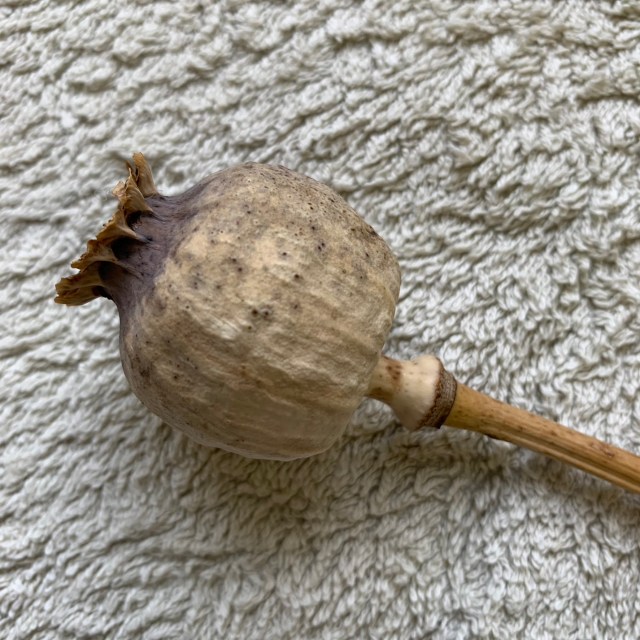
My imagination is now firing about what I could make next with this fibre. I have a dried poppy seed head sitting in a vase next to my desk. The felt reminded me of the texture and colour of the seed head. I’ve felted poppy seed heads before – one of my favourites. Another thing I have in the studio is some vintage cotton lace I was unable to resist when I saw it in a local second-hand shop.


I thought maybe that the lace would add a subtle surface texture so why not have a try? This time I made a small square sample using just 2 layers of the wool / silk mix batt with strips of lace in parallel lines.


Although it’s subtle, I really like the effect. As you can see in the close up shot, the batt has quite a bit of vegetable matter which in this case adds some interesting specks, enhancing the natural look. 

I was running out of time but decide to start the poppy seed head. The merino fibre length in the batt is very short which makes the layout quite slow but very precise.  In the first photo you can just see the strands of lace which I’ve laid out on top of 4 layers on the under side and are waiting for me to finish the final 2 layers on the top side before bringing them over. 

Circular resist partially covered in carded merino and silk batt
Work in progress: 3D wet felted sculpture with multiple resists laid out, wetted down and partially felted

The second photo shows how far I got yesterday before I had to stop. This is a multi-resist piece that will take a while to make. I’ll show it finished in my next blog.

I enjoyed letting the fibre lead my imagination in what I might do next.  I’ve done mostly production felting recently – making multiples of things for shops and sales – so it was great just to see where things led me and enjoy felt-making for the sheer fun of it.  I’m looking forward to getting back into the studio soon to finish the poppy seed head.

Making Waves Update

Making Waves Update

In my last post I mentioned a few of the projects I was working on with the “Making Waves” theme, along with other members of the Waltham Windmill Textile Group. I’d begun work on a 50cm x 90cm felted wallhanging inspired by the markings on large stone slabs on the beach at Seahouses in Northumberland.

Having recently bought myself a drum carder I carded a variety of left over bits of fibre, mainly blues, greens, yellows and neutrals, to make my background and laid them out with off cuts of hand dyed silk fabric, scrim and large nepps. On the left is how it looked after felting and on the right is where it’s at right now. I’ve added synthetic sheers, machine wrapped cords, hand and free motion stitch and in some areas I’ve heavily machine stitched to push them back and encourage the adjacent areas to stand out. The original bottom left section wasn’t working with those silk circles so they were pulled off and replaced with some stiffened, rust dyed fabric circles, recycled from another piece of work. I’m calling it Going With The Flow because a) it’s inspired by a trip to the beach b) it has flowing lines and c) like most of my work its design wasn’t preplanned. It’s evolving as I work on it, adding bits in and taking bits off until it feels right. It’s got a way to go yet before I can call it done.

One of the other challenges within the Making Waves theme is to make a 3D fish and my immediate thought was to create what many would regard as an ugly fish but which I prefer to think of as a fish with shedloads of character……..one that would get noticed amongst a group of pretty fish!

Having typed  “ugly fish” into Google I lost many hours over the next few weeks looking at images and some incredible videos of life deep in the depths of the oceans. Each new search revealed yet another fascinating species of fish, some quite honestly didn’t look real while some, like the Tasseled Scorpionfish were strangely beautiful. One of the weirdest I discovered has to be the Red Lipped Batfish. If ever there was proof we descended from the oceans this red lipped, whiskered fish that “walks” on its specially adapted fins has to be it! 

Last month the Waltham group had a day making felted fish, some are finished, others are still work in progress.

Lucy made a wonderful wet felted Puffer Fish adding recycled plastics, including pipette tips, wine bottle netting and glass beads with recycling symbols underneath, to highlight the plight of our oceans.

Sue is very new to wet felting but she’s taken to it like a fish to water (couldn’t resist!) and has made “Angry Fish”. I think he looks more sulky than angry but he’s terrific!

Barbara’s felted fish is still work in progress but looking great, as is her sketch book and fabric fish purse!

Originally I had intended to wet felt my ugly fish but, after all those hours of studying them and getting excited about what I was going to make, for some reason when I took out my carded Corriedale fibres I found myself felting a cartoon version of an Angelfish…….I didn’t see that coming! Her name is TroutPout and she’s approximately 33cm x 36cm excluding her fins.

I’ve been enjoying teaching 3D Seed Pod workshops recently using wire wrapped with Tyvek fabric so decided to make my Anglerfish from wire rather than fibre. It was only when I’d got the 60cm x 33cm framework made that I sat back and realised I’d gone past the stage where I had meant to start adding my fabric! Time for plan B…..maybe I could use wire mesh to give it “body”?

I looked for some online but hesitated as I wasn’t sure how flexible or suitable the mesh would be. Having put the fish to one side, a few days later I joined the Lincolnshire Textile group and at my first meeting I was offered a piece of silver coloured Sinamay. Sinamay is one of the most popular hat-making foundations. It’s woven from the processed stalks of the abaca tree, a type of banana native to the Philippines. I couldn’t believe my luck……..being silver coloured this off cut looked like wire mesh but wasn’t and if I sprayed it lightly with water I could easily shape it to fit and stitch it with aluminium wire to my framework. So this is how far I’ve got. I’m going to add a few more wire spirals and do something more interesting with the eyes. He should have menacing teeth but I might not go that far!

Another feature of next years Making Waves exhibition will be an Octopus’s Garden so once the fish are done it’s straight on to making lots of coral and a few Octopus. I’m loving this theme and could quite happily continue with it way beyond our event next year…….it has to be the most interesting and enjoyable we’ve had so far!

more shopping for the Mer’s, again looking for Hair

more shopping for the Mer’s, again looking for Hair

As is the way with my life, I have had another change of plans.

My goal was to find hair for two more of the Mer family. My plan was to look for long locks at the fibre festival “For the love of Fibre”, in Spencerville and if that didn’t work out I would look at the Peterborough Weavers Guild fibre fest on the following weekend. We had also discovered that because of the Coronation Upper Canada Village would have free admission the same Saturday as the event in Spencerville (much closer to UCV than Ottawa.)

So part one of my plan was on May 6th to head to Spencerville. Then if I felt up to it, on to the Historical 1860s village at Upper Canada Village. I had a couple of friends who were working there last summer and have wanted to see it for quite a while. Let me show you how the first part of the plan went.

Last year “For the Love of Fibre” was the first post pandemic fiber festival that I got to attend. It was held in Johnstown, just a bit further south than this year. I am pretty sure I showed you that exciting.

May 6th arrived looking like it might be a sunny day with big puffy clouds to add to the photographic opportunities. We got up extra early to gather the couple of things we would need to bring. I had planned to bring Mrs Mer as well as her son Shark Boy to look for long locks for their hair. I discovered she was…. ummmm, busy canoodling (aggressive cuddling, enthusiastic hugging?) with her husband, so I just turned their project bag around and went to find her son. I picked up my camera and Shark Boy’s1q project bag and headed to the car.

It was a nice drive down. The trees are in the budding to early leaf stage and I was suspecting we might see the first trillium as we headed south. We got there early, arriving just before Ann. She took a picture of us getting Shark Boy settled and us ready for shopping (Glenn brought a book). You can see how excited Sharkboy looks! It must be the thought of getting his hair. I think he has decided on a Mohawk with long hair down his back, sort of an extra-long mullet. I think the Mohawk is to complement his front Dorsal fin.

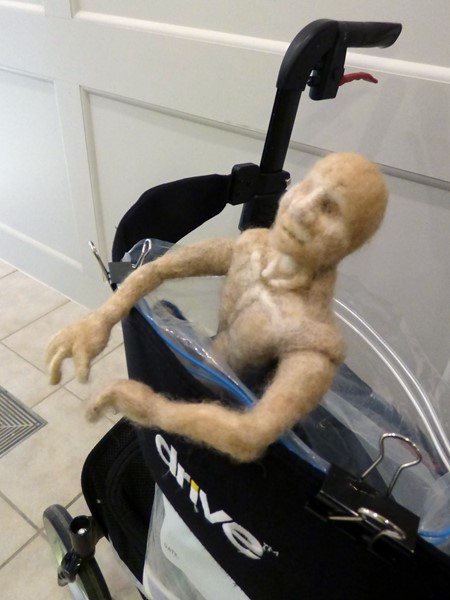
1) Sharkboy standing in his project beg attached to Jan’s black walker with her husband (and the back of my Grey Kea Soul, I am sure you were expecting I possessed a black soul!).1) Sharkboy standing in his project beg attached to Jan’s black walker with her husband (and the back of my Grey Kea Soul, I am sure you were expecting I possessed a black soul!).

There were 3 outside vendors, with the rest inside.

2) Stone Spindle Farm Booth; with alpaca yarn, fiber and hats. The vender is hanging up suit cages full of low-grade alpaca to provide the birds as nesting material.2) Stone Spindle Farm Booth; with alpaca yarn, fibre and hats. The vendor is hanging up suit cages full of low-grade alpaca to provide the birds as nesting material.

 I was admiring some indigo-dyed alpaca but wanted to wait until I found out if there were any locks inside. (OH the not-buying remorse I felt later!!! I do know who bought it and that it will be well enjoyed.)

3) baskets strewn artistically under a pule trees with an E-Bike near the front with panions baskets.3) baskets are strewn artistically under a few trees with an E-Bike near the front with pannier baskets.

Did you notice the cool bike baskets, some have lids.

Inside we found a few of our guild members had booths! I did a fast wheel around the venue looking for long locks but to no avail. Sorry, Sharkboy! We will have to try plan 2, next weekend. Even with not having the long locks I was looking for there was a good selection of vendors having Yarn, fibre, baskets, bags, and fibre tools. I didn’t get every booth but here are some of the highlights.

4) A quick over view of part of the venders.4) A quick overview of part of the vendors.

5) digging for colours in balls of hand died Super wash Marino fiber.5) digging for colours in balls of hand died Superwash Marino fibre.

6) More fiber from the Black Lamb booth.6) More fibre from the Black Lamb booth.

7) Beautiful project bags and peruses7) Beautiful project bags and purses

8) Moose hill woodworks had lots of fiber tools, all beautifully made. (Yes, I got another spindle of a type I didn’t have.)8) Moose Hill Woodworks had lots of fibre tools, all beautifully made. (Yes, I got another spindle of a type I didn’t have.)

9) Odd new spindle, I was trying it with some of the new extremely soft Finn wool I also purchased. The back of the tag says Yellow Birch, 1.3oz/39g9) Odd new spindle, I was trying it with some of the new extremely soft Finn wool I also purchased. The back of the tag says Yellow Birch, 1.3oz/39g

10) Beaux Arbres booth had basketry10) Beaux Arbres booth had basketry

11) This booth had fiber samples you could feel (the bags of them are behind the table.)11) This booth had fibre samples you could feel (the bags of them are behind the table.)

12) This is the side table of the same booth with the fiber. Check out her fine ponies!12) This is the side table of the same booth with the fibre. Check out her fine ponies!

 13) Fin roving it is actually semi-worsted the vender has her own mill!!! I have never felt such a soft finn sheep.13) Fin roving is actually semi-worsted the vendor has her own mill!!! I have never felt such a soft Finn sheep.

Ann investigated further and found out it was from a lamb. I only bot 2oz I should have bout more! Ann also got some to make her trees with.

14) This was an ingenious support spindle case.14) This was an ingenious support spindle case.

15) The booth the support spindle bag came from had more spindles and lots of rolages. 15) The booth the support spindle bag came from had more spindles and lots of rolags.

16) A couple booths had yarn for weaving and knitting.16) A couple of booths had yarn for weaving and knitting.

17) This Was Susan Allen’s Booth with weaving yarns, I think this was a Cotton or a Cottolin that Ann was looking at.17) This Was Susan Allen’s Booth with weaving yarns, I think this was a Cotton or a Cottolin that Ann was looking at.

18-19) Janet's Basketry, hand made basket with handwoven fabric presented in rolls18-19) Janet's Basketry, handwoven baskets one with antler in it.18-19) Janet’s Basketry

20) Janet’s booth, she is just finishing setup as the first customers arrive20) Janet’s booth, she is just finishing setup as the first customers arrive
 I wandered into Janet Whittam’s booth, she has a combination of weaving and basketry, and she also has beautiful woven jackets and wraps.

21) sharkboy standing in his project bag, attached to my walker.21) Shark Boy standing in his project bag, attached to my walker.

Even though he didn’t have any luck finding hair I think Shark Boy enjoyed his outing. It was still a worthwhile shopping trip with new fibre and spindle.

I was still feeling pretty good so we decided to head on to UCV, maybe it would cheer up Shark Boy! There is a mill, the blacksmith shop, the weaving house (with spinning) and the dressmaker’s house. We packed up the car and headed a bit further south and east arriving at a very busy Upper Canada village parking lot. We found a good parking spot in the mostly empty handicapped section (I was very glad for that parking permit by the time we made it back to the car!)

22) Sharkboy checks out the special parking for Mer-people (and those with walkers) as we arrive at UCV.22) Shark Boy checks out the special parking for Mer-people (and those with walkers) as we arrive at UCV.

Unfortunately, that change of plans thing I mentioned at the beginning happened Tuesday morning and is preventing me from telling you about the rest of my visit. As soon as I can I will tell you all about the fun we had visiting the village, and a bit of its background.

23) The entrance buildings of Upper Canada village.23) The entrance buildings of Upper Canada village.