Browsed by
Category: Fiber Preparation

New book on Blending boards to tempt you

New book on Blending boards to tempt you

I am not sure how it got to be Thursday so quickly. It’s been a busy week since we last chatted. I was working on another post about demoing felting, but it needs more work, so that will be coming later.  This week at the local guild, we had a social focusing on Blending Boards. My Kia is partway through her gastric surgery (one of the parts of the new parts was missing from the box, so next week?)  The weeds are trying to outnumber the plants in the pots, so that has to be done; they are all looking limp from heat and lack of water, i have to fix that too.  The last part of the huge fleece is finally in for its first rinse. Just to add extra excitement, I am still wiping out and having long naps at odd moments. Life is fun!

Since you probably are not interested in the gastric distress of my car, and are likely trying to tackle your own weeds and lack of water (although it keeps raining?) So, this will be a short blog, so you can go enjoy the weeding and fleece washing while the snowbanks are not here.  Let me show you what turned up, besides blending boards and bags of bits of fibre, at the local guild on Monday.

Guild social with Blending boards

Removing one dowl from rolag0.11) Ann making rolags on the blending board, 2 more blending boards used in the background

removed last dowl and the rolag looks flopy0.12)- Ann’s rolag is flaccid!

some of the spinners at the social, 4of the 6 spinning are using drop spindles. One you can see the rolag she is working from0.13) 4 of the 6 spinners are using drop spindles

Daisy brought in her new book: “The Spinner’s Blending Board Bible: From Woolen to (Nearly!) Worsted and Everything in Between”,  by Deborah Held. Released April 2025,  it is hardcover and has 136 pages, in English.  (ISBN: ‎ 978-0811773676, if you wanted to look at it too)

cover of: The Spinner’s Blending board Bible, from wool to (nearly!) worsed and everything in between”,  by Deborah Held1.1)cover of: The Spinner’s Blending Board Bible, from wool to (nearly!) worsted and everything in between”,  by Deborah Held

This book was written for spinners, but felters may also be inspired by it. Anyone working with fibre has more options if they know more ways to prepare that fibre. Different fibre preps produce different kinds of yarn if you are spinning, and will behave differently if you are wet or dry felting. More options are always good. For felters, the fibre mixes that a blending board can create may inspire you. Probably a turbulent sea or impending stormy sky, even mixes of greens suggesting distant trees?

first 2 pages of table of contents1.2) first 2 pages of the Contents pages

chapters 3-6 plus appendices1.3) Chapters 3-6 plus appendices

Let’s have a look at the contents of the book to see if it sparks your interest. While I am writing this, Indigo (online) has an excerpt including the full list of contents (in case my new camera and I are still discussing visual acuity) https://www.indigo.ca/en-ca/the-spinners-blending-board-bible-from-woolen-to-nearly-worsted-and-everything-in-between/c06b9a51-bd73-3adf-adf6-1d363cd16a3c.html

Here are the main topics covered (I have listed the contents of all of chapter 4, since it may be of greatest interest to felters):

Foreword

Introduction

1: YOUR BLENDING BOARD: THE ALL-IN-ONE FIBER-PROCESSING TOOL

  • Breaking Down the Blending Board
  • A Comparison of Tools Used in Fiber Preparation

2: INDUSTRY SECRETS: UNLOCKING THE HIDDEN POTENTIAL OF YOUR BLENDING BOARD

  • Aftermarket Accessories
  • Technique: Dos and Don’ts
  • Smooth vs. Textured Preparations
  • Working with “Difficult” Fibers

3: ROLLED-OFF PREPARATIONS: ROLAGS, ROLLED LOGS, PUNIS, AND ROLY-POLIES

  • Rolled-off Preparations, Defined
  • Rolling Fiber Off Your Blending Board
  • Color, Texture, and Other Creative Play

4: BATTS AND CLOUDS, ROVINGS AND SLIVERS

  • Batts
  • Better Batts
  • Make the Best Batts
  • Layer Your Fiber in Thin Staple Lengths, Burnishing Often
  • Remove the Batt from the Blending Board
  • Make It a Double
  • Make It More Woolen with Multiple and Directional Passes
  • Directional Loading
  • Recard Your Batt
  • Make It More Worsted
  • Carded Clouds
    • Make It the Most Woolen
  • Roving vs. Sliver
    • Pin-drafted Roving
  • Make Your Own Roving, Multiple Ways
  • Hand-pulled Rovings: from a Batt/Cloud or Roll-up, as a Z-strip
  • Diz a Roving or Sliver
  • Diz from the Board
  • Off the Batt or Roving
  • Double-diz
  • Make It More Worsted
  • Creative Play with Color and Texture
  • Flecks/Tweeds and Heathers
  • Garneting for Extra Texture
  • Make It a Marl by Stacking Your Batts
  • Stripes/Repeating Colors and Variegates
  • Color Blocking
  • Gradients
  • Vertical and Horizontal Gradients
  • Individually Carded Gradients
  • Scraptastic Sandwich Batts
  • Fractals
  • Fancy Farm Batt
  • Bizzed Datty Bumps

5: UNEXPECTED WAYS TO USE YOUR BLENDING BOARD

  • Bring a Braid of Fiber Back to Life
  • Flick-card Locks and Line Them Up for Spinning
  • Flick-comb Your Locks
  • Diz a Repeatable “Combed” Top
  • Wet Felting

6: CARE AND STORAGE OF YOUR BLENDING BOARD

  • Keep It Clean
  • Storage

Acknowledgments

Appendix A: DIY Blending Board

Appendix B: Comparison of Blending Boards Used in This Book

Resources and Credits

Glossary

I like that the book considers repeatable and totally unrepeatable ways to work with fibre.  While it’s fun to do artsy one-off things, it’s also nice to be able to get a predictable effect and repeat it if you want to. There are two tables I am particularly impressed with, one on types of fibre prep and what they produce (with pros and cons)(I want to meet this author!!). And the other on the Woolen to worsted continuum. It’s an elegant way of explaining vocabulary. Which is a problem when shopping for the prepared fibre, you want what you thought you were purchasing to arrive.  There are good photos of various ways to lay out colour to get different effects as well as photos that show how to use the equipment, including the diz.

Let me show you a few interior pages to see if I can tempt you to check it out further.

2.1--2.6) interior shots of the book to tempt you to go take a look at it.

As you can see from the list of contents and the photos, this book covers a lot of ground, not only in ways to make use of a blending board but also in the various fibre preparations and how they are different.  If your library or guild picks up this book, seek it out and take a perusal. Even if you never find a blending board at a garage sale or make your own, there is a lot of info here in case you do!

Back cover showing text and photos of rolags and dizing and photo of authors picture3)Back cover

Also, you can absorb the info presented and transfer that knowledge to a drum carder if you have one, or have access to use one.  You can lay fibre directly on the drum, diz off or make rolags. Even after a short-ish perusal and skimming, it has me thinking odd thoughts of trying things on my drum carder.  But first, I have to finish washing the last of that giant fleece. Just how big was that sheep? And what was he rolling around in? That water is filthy.

Oh no, a big storm is coming through in consecutive waves this evening, I guess the weather thought that fleece was very dirty too and is helping with the rinse!  I will hope the waves of the incoming storm don’t take out the power before I get this posted!!! (Ann may not be able to do the final spellcheck and find all the missing or extra capitals!)

Have fun! Stay dry, Enjoy Summer and Keep Felting!!

Trying to wash fleece on a good day

Trying to wash fleece on a good day

Preamble (not about fiber but i promise i will get there!)

Usually, towards the end of June, the local grocery store garden centers close up for the season.  It may be that slowly recovering after surgery continues to distort time, since it seems very early to be closing up the plant shopping for the year. Anyways the massive sell off of all the last remaining plants, cheap, is happening now! I got one car load full from one store, including 2 flats of ever-berring strawberries, some lavender (Munstead usually overwinters here) and some more herbs.  The next day I went to the local Loblaws and they were closing that day, even better sales! More lavender, herbs Columnar basal and lemon verbena mainly and even a few flowers followed me home. I also bought 5 dead hanging baskets and 2 slightly alive ones for .26 cents each (I am short on hanging baskets). Both my fabulous halls were unloaded onto the side bench and one of the fleece drying racks in the side yard. then it took a couple days to recover before i could start working on them.

vew looking down the side yard, past plants. in front of garage the stock tank and closed big umbrella can be seen0.1) looking down the side yard towards the fleece washing area

I have been puttering along,  planting some into pots and Glenn has promised to help with the lavender and strawberrys that will go into the garden. I am also trying to catch up on the weeding, where do they keep popping up from?

I think it was Wednesday, foggy time continues…, we had a warning of possible severe thunderstorms with hail and high wind for 5am. So the evening before,  I carefully moved all the hanging baskets I had just planted, down under the bench, under the fleece drying rack and prepped for a horrible storm, that maybe impending.

two large saucers of plant pots, a mix of flowers, herbs and house plants. 0.2) two large saucers of plant pots, a mix of flowers, herbs and house plants.

Nothing happened at 5am, but 9am arrived and so did the storm, with heavy rain but no hail. Afterwords I went out to do a bit of weeding. A bit after lunch the blue sky was again gone, and so was my Large Umbrella I had be using while weeding. It had escaped and was trying to figure out how to open the front door. (It is bad luck to have umbrellas open in the house so I closed it and got it back in its weighted base. (Sorry no pictures)  oww…. Time to sit or maybe lie down would be better. yes lying down was much better.

(I am getting to the point)

Today, Friday, Ottawa is sunny, no rumors of thunderstorms and my front and back are willing to consider something other than sitting or lying down today, YAY!!!  I had asked Glenn to pull out the bins of unwashed fleece from the garage so I can see what I want to wash next.

My choices from the Garage are 3, all waiting for attention (2 yellow and 1 clear plastic bin, in front of fence and abandoned snow shovels.) I don’t remember what I put in them.0.3) My choices from the Garage are 3, all waiting for attention (2 yellow and 1 clear plastic bin, in front of fence and abandoned snow shovels.) I don’t remember what I put in them.

1- First, I Need to set up the fleece washing aria. The tub has some rainwater, a few bits of leaves, dead bugs, Miskito larvae and a moth in it. Maybe a large fish tank net would get the not-water-bits out? Maybe a trip to Dollerama later? the water is still cleaner than the fleece so lets proceed.

Stock tub, Bits of leaves, Miskito larva and other bugs, and one floating moth. 1.1)  Stock tub, Bits of leaves, Miskito larva and other bugs, and one floating moth.

Next, I should  set up the umbrella by the garage. Why is it not working, oh broken stay is interfering with it extending. Got that sorted, and set up the second fleece drying rack again.

fighting with umbrella with broken strut. With the broken arm it fits perfectly between the garage and the back of the house.1.2) fighting with umbrella with broken strut. With the broken arm it fits perfectly between the garage and the back of the house.

now that i have that sorted i’m sure it will all go fine from here!

2-Select a fleece,  this is like Christmas, i cant remember what i put in there so its all new and exciting surprises!

Option 1: white-ish fleece in plastic bag inside clear plastic bin.2.1) Option 1: white-ish fleece in plastic bag inside clear plastic bin.

Option 2: White-ish fleece in black garbage bag inside yellow Ruff tote bin.2.2)  Option 2: White-ish fleece in black garbage bag inside yellow Ruff tote bin.

Option 3: creamy white with lots of crimp. Loose in the ruff tote and has some bits of lavender on top of it.2.3)  Option 3: creamy white with lots of crimp. Loose in the ruff tote and has some bits of lavender on top of it.

Option 3 wins. I am going with the last one, It looks like quite a big fleece.  after looking all through the side yard, I seem to only have 4 fleece staining buckets?  I hope it didn’t blow away, no found it, Glenn stuck stuff in it. ….. OK, I will try washing 4 at a time rather than 5.

4 strainer baskets on drying rack with fleece in tub in back ground, pole from umbrella in foreground.2.4) 4 strainer baskets on drying rack with fleece in tub in back ground, pole from umbrella in foreground.

Ok fleece selected, no skirting table available but i am sure this will be fine. i just have to add water, soap to the Stock Tank and dirty fleece in strainer baskets to start soaking, i will have this done by lunch!

3- Drat, The hose is up by the front door, but I cant get the hose back here until I put away the recycling box. There are still a couple hanging baskets, hiding under the bench in the way (where i need to put the recycling box). So, move the baskets first. Found the hooks to hang up the baskets, and got them up out of the way. Oh no back just did that cold running water down the back feeling, got to sit down now for a moment. I have to make room for the blue chair so first put the recycling box away. Ahhh that’s better. While I’m sitting here i can see the drying rack in the side yard. There are still a couple hanging baskets, under the drying rack, better put them up too.  And sit again.

hanging baskets, pots of plants waiting to be planted , wooden bench, recycling bins below, and big garden thermometer3.1) hanging baskets, pots of plants waiting to be planted , wooden bench, recycling bins below, and big garden thermometer

4- Right I am sitting looking at the drying rack covered in plants. That won’t work out well, i will need that space for the fleece soon…. need to move and organize all the little plants in pots I purchased. I have 4 saucers and a shallow bin partly full of plants but give me a moment and let me get the strawberries all in one, the plants that will be house plants and the last of the inpatients are in one. i found 2 more saucers (ok they are oil change black saucers but they work) one is now full of Lavender and the other is a mix of herbs. And back to sitting. (i feel like i’m am doing some odd form of and English country dance but in stead of “everyone turns around” after doing anything, i do something followed by “i sit down”. i miss dancing, the Black nag was fun and i miss the Manshaft pavan, the 8 count reverrance was deadly! i must stop thinking about medieval dances and get back to work!)

Oil draining saucers full of herbs and lavender sitting on green bin and garbage can 4.1) Oil draining saucers full of herbs and lavender sitting on green bin and garbage can

5-Lets move the hose I think that was what I was working towards. Ok, dragged it back and have the tank filling. Where is the soap?…..  did it fall off the end of the bench? Maybe under it? behind the spin dryer? In the spin dryer? No sign of it, better go in and call glenn. And sit for a bit. Maybe I will look by the kitchen sink first, but why would it be there?

6-Found the fleece washing dish soap in the kitchen…. Ok took it back outside. It’s the sheep-washing dish soap, not the dish-washing dish soap, they are totaly different! so it should be outside with the fleece washing stuff.

sunlight Dish washing soap also cuts lanolin and removes dirt from sheeps' wool. )yellow plastic bottle of dish soap sitting on 4X4 beside stock tank with hose going into tank behind it.)6.1) sunlight Dish washing soap also cuts lanolin and removes dirt from sheeps’ wool. (yellow plastic bottle of dish soap sitting on 4X4 beside stock tank with hose going into tank behind it.)

7- Tipped the big ruff tote partly out onto the drying rack and picked through clumps looking for second cuts, excessive Vegi-matter or the extra smelly dark bits I don’t want to deal with. this fleece has little second cuts with kemp, I found a small section with less crimp but since I cant see the hole fleece I am not sure where it was growing or if its some one else’s fleece that got mixed in accidentally.

dirty wool cascading out of yellow plastic bin.7.1) dirty wool cascading out of yellow plastic bin.

8-Picked over good raw fleece got dropped in a strainer bucket, while the rejected bits got dumped on the lid. I did not fill them quite as much as last wash since I will have to do more bins than last fleece. I wonder if this one was a ram? or just a much bigger sheep?

the rejected bits I tossed on the lid until I can get them into a yard wast bag. There are a lot of odd little seeds stuck in spots in the fleece so I don’t want to add whatever that is to the garden.8.1) the rejected bits I tossed on the lid until I can get them into a yard wast bag. There are a lot of odd little seeds stuck in spots in the fleece so I don’t want to add whatever that is to the garden.

OK my aim is not 100% accurate I will clean that up tomorrow, I hope8.2) OK my aim is not 100% accurate I will clean that up tomorrow, I hope.

9-As the strainer bin got to about ¾ full I added it to the stock tank to start the soak. When I had all four in the tank I added a bit more water, gently lifted and lowered the strainer baskets a few times. I will now let it sit and soak. I should put all the icky parts in the yard waste bag but I think it would be better to go in and sit and maybe write a blog post.

starting the soap water soak  I left it in just over 3 hours.9.1) starting the soap water soak  I left it in just over 3 hours.

10- I want to give it a few hours of soaking then start the first rinse in case there is rain tomorrow. The water is definitely needing changing and the strainers baskets are hanging to drip.

Lets take a peek at this crimp in the raw wool. It is quite a dirty sheep, but not as much Vege-matter as I was expecting. As I said there is definitely a bit of kemp in odd sposts in this fleece (mostly second cuts), but I think it will still be nice.

closes up of crimp10.1)closes up of crimp

pulling sections of fleece I don’t have room to spread out the hole fleece so I am pulling out sections and looking over that bit. (yellow large plastic tote with unwashed fleece spilling out onto drying rack. 10.2) pulling sections of fleece. I don’t have room to spread out the hole fleece so I am pulling out sections and looking over that bit. (yellow large plastic tote with unwashed fleece spilling out onto drying rack.

strainer baskets coming out of wash water 10.3) strainer baskets coming out of wash water

Dirty water but I think we can g3et this fleece cleaner.10.4) Dirty water but I think we can get this fleece cleaner.

While we are back here lets  take a peek at the blackberries and see if they are ready yet, almost!

Blackberrys along the back of the house lots of berrys ripening11.1) Blackberrys along the back of the house lots of berrys ripening

close up of blackberrys and blackberry flowers11.2) close up of blackberrys and blackberry flowers

The trumpet vine is flowering again too!

Trumpet vine11.3) Trumpet vine

Scarlet runner bean flowers11.4) Scarlet runner bean flowers

It always takes longer now than i think, to get anything done. i did not get this done before lunch, i acutaly forgot about lunch and kept puttering along.  now that i have this much blog post written, its dark out, but the fleece should be drained by now. back wiling, i can finish draining the stock tank and give it a rinse before refilling it and starting the first rinse. wish me luck avoiding the masketos.

I hope you are taking advantage of these lovely sunny days, to have fun with fiber; prepping it, felting, spinning or weaveing with it.

Upgrading my Fiber Prep system

Upgrading my Fiber Prep system

Earlier this spring we went out to Princess Auto to look at some fiber prep equipment, who would have thot they would have such fabulous fiber equipment. The item I was considering was on sale, but Glenn thought he could modify my small fleece washing bins. I was getting sore, so we headed home without it. I had not-buyers-Regret.

It’s now June, last week was very hot, sunny and perfect for washing fleeces, but I had no buckets ready to go.  I was finding it more and more difficult to use the large buckets and strainer baskets. Tipping the buckets when they were full of water was getting challenging. What I was looking at has a drainage system that a tap and hose could be attached to. That would eliminate the tipping of heavy buckets full of very dirty water.

We are very lucky, we live in a city with two Princess autos. I went online to see if the West End store had one in stock, nope, but the East End store has four. So off we went in my little KIA soul to find “the item”.

75galon stock tank black with a drain.1) LITTLE GIANT 75 Gallon Black Poly Stock Tank, SKU: 9281205, In Stock Online, 4 available for In Store $129.99

This is called a stock tank. It is meant to hold water for cows or horses. This seems to be the smallest size with a drain option.  This one is 48 x 34.5 x 18 in. (L x W x H). In larger sizes, they are also used by athletes for ice baths, and by koi as a backyard pool.

When we arrived at Princess Auto, we headed to the customer service desk. The nice lady immediately asked what I was driving. I said “a KIA”! Her response was “I hope it’s not a Soul”. “Why yes, my soul is grey, not black!” I replied. She looked worried and called the warehouse. She asked if they thought it might fit in a Kia Soul. They were sure it would. I added “with a walker?”  The answer was still “it should”. We were to browse for about 5 minutes, and then go pick it up at the back of the store.

Ooh Lovely!! Yes, that will probably fit in the car. I purchased it and a couple of other things we found while browsing and headed back to the car.  Glenn was able to put it in the back of the Kia Soul, and stuff the grocery bags in the tub and still have room for the walker too!

When the last renter next door moved out, he left a metal backless bench. It’s very rusted and doesn’t have a cushion. I was going to put plants on it. I think I have a better idea. Glenn found the hose extension and the tap attachment, which we hooked up to the tank, which is now sitting on the bench with a base of 3 4×4’s for extra support.

close up vew of tap and hose extender 2.1) The stock tank sitting on 3 4X4s on top of the metal bench. Connected to the drain is a hose extender, then the tap valve and the old hose to send the water down the driveway.

All right, I have a hypothesis. This should be easier to use than the big round bins I had been trying to bend over to lift baskets and tip the bin to drain. (Lately, it tended to get me wet and make me sore. But, they did work!) You have seen me use the strainer baskets in previous posts, but I have to go one basket at a time. I think I can do at least 3 baskets per wash in the stock tub, and just turning the drain should be much easier on my back.

Now I need a volunteer fleece to help me test out the new tub. Cupcake has volunteered! Thank you, Cupcake!

flece a mix of colours from dark brown to bage and grey 3.1) Cupcake is a BFL X Romney fleece, which was 6.4lbs. 

Normally, I would set up my skirting table, but I gave away the extra small rain barrels, which were part of its supports. Ok, it looks like it was well skirted, and not too much Vegi-matter. So let’s see if I can sort directly into the strainer baskets.

I gave the stock bin a quick rinse and realised the drain is over an inch up the side….. ok, there will need to be a bit of tipping to get the last bit of water out. Silly me, I got too excited to be fleece washing again and put the soap in before getting a couple of inches of water added. Oh well, the suds will dissipate, eventually.

added soap too soon as i added water stock tank now has water covered in suds3.2) Too many suds, I guess the fleece is about to have a bubble bath instead of scouring.

Since I don’t have hot water outside and I don’t have a space inside to set up to wash fleeces, the fleeces get a bath in the ambient temperature water. That’s ok, if there is a bit of lanolin left in the fleece, it works wonderfully to wind bird feet and toes.

Now let’s see how many bins I can fit in. I think I may be able to get four in the stock tank! The fleece is (6.4 lbs), and I split it into five bins. It’s a bit tight, but I can get 5 bins in.

5 strainer baskets in soap filled stock tank3.3) 5 bins just fit in this size!

There is a smaller size of strainer basket if I want to work in smaller amounts. What I have now is the larger one from Dollarama.

the soap is helping the wool get wet 3.4) The soap (not Detergent) helps with wetting the fibre as well as releasing the dirt. Look at all the fabulous colours in this fleece

soap has disapated, water is a shade of dark brown, the 5 bins sit in the stock tub3.5) A good soaking and suds-be-gone, so time to get out of the bath.

draining one bucket before hanging it up to finish dripping, the dark brown water is visible in the stock tank.3.6) Look at the dark brown colour of the soap wash water as fleece-filled strainer buckets are coming out. That sheep was dirtier than it looked!

starting to refill the stock tank (the tank has 3 rings each suggests it is 25 gallons. i will be filling to the first line so 25 gallons3.7) Rinse #1 refilling stock tank to the first ledge.

lighter brown water after fist rince 3.8) Rinse #1, after the strainer baskets have been removed, inside the stock tank, the water is getting closer to clean!

The inside of the stock tank has 3 stepped edges, which are spaced to suggest each is 25 gallons, since the total it can hold is 75 gallons. So, I am using about 25 gallons for each wash and rinse of five strainer buckets.

Rinse #2 cleaner still, but we were rushing against the weather, which was threatening rain. I also had a camera malfunction…. Both the battery died (I can recharge it) and the lens cap I just bought a week ago broke. I will order another one.

2 stranier buckets saoking in second rince Draing strainer basket by resting it on the edge of teh stock tank. you can see the water is closer to clean then rince 13.91-3.92) End of rinse #2. And resting the strainer bucket on the side of the rim to drain most of the water out before hanging it up to finish dripping.

I can not feel the lanolin, and the fibre feels quite clean. I have had to rinse out fine sand each time I clean out the stock tank. Did this sheep have a fabulous beach holiday?

Glenn is on holiday, and since we are not going to the States, he is helping me today. Two of the strainer baskets look like they need another rinse, but three are looking good. So each basket that seems clean gets gently dumped into the spin dryer.

RV hand washer spinner for cloths4.1) This is an RV washer/spin dryer.

Think of it like a giant salad spinner for clothes, er.. Fleece! There is a dial at the lower edge that can turn on the drain or keep the water in and rotate your clothes.  I set it to drain, and Glenn spun it for me! I found this at a second-hand store, recognised it as a wonderful fibre prep equipment, and bought it!!

the lid off teh RV washer spinner showing fleece inside4.2) just like a giant salad spinner (but I don’t advise it for clothes or salad after all the fleeces it’s been washing.

Glenn brought the drying racks (from Ikea) up from the basement and put them under the covered area of the back patio (the part that doesn’t have blacksmithing stuff)

sears Robuck light dutie farm forge, and larger forge under cover.5.1) the small forge, Sears-Roebuck light duty farm forge and the bigger forge under the large black cover.

We set one drying rack up behind the large forge and the other on the other side by the house.

the green strainer bucket is from the RV spin washer 5.2) The green bucket is handy to move the fleece to the drying racks.

first bucket full on driying rack with plastic owl watching in back grond wool is on ike cloths drying rack5.3) The plastic owl takes his job of guarding the wool seriously.

the patio behind the bigger forge, has 2 drying racks full of fleece, a rain barrel and wooden fence in background  5.4) Two buckets on the right drying rack, and one on the Left. The plastic owl is still supervising. I hope it keeps the evil chipmunk from “Helping”. He will be eating all my blackberries shortly!

blackbarry plants with flowers along the back of the brick house, blue tarp covers blacksmiths foot vice5.5) This is part of the blackberries along the house, and one of Glenn’s blacksmith footed vices under the blue tarp. It could be a very good crop of blackberries (which will make up for the rabbit cutting all the canes off at about a foot for the raspberries.

We pulled out the last two buckets to drain a bit before going onto the racks. And I got busy weeding and then adding more little plants of Tie basil and parsley to the planters. There is a bit more Thai basil and weeding to do, but it’s starting to drip.  What have we learned in previous summers about drying wool?  If you put wool out to dry, it will probably rain….

We moved the 2 draining buckets a bit closer to the overhang, moved the umbrella to give more cover and then put the drying fleeces back in their buckets and moved them and the racks under the cover of the dog-covered area of the side yard. I had a barking Cat, not a dog. He didn’t like to go out if it was raining, so we had to cover a section for him. It’s where I set up my outdoor studio. I haven’t got that sorted out yet this summer.

2 ikea cloths driying rack full of drying fleece5.6) Moved drying racks under cover to avoid the rain.

In the morning, the wind is up, and the fibre is still there, but still not dry. Ok, one drying rack when in front of the garage under the last umbrella, and the other went by the side door.

one drying rack moved under umbrella by garage one rack by side door wool is getting closer to dry but still is a bit damp5.7-5.8) I still have one strainer basket to put out to dry.

strainer basket of wool wating for space to put wool on drying rack5.9) The last strainer basket waiting for space on the drying racks.

I have been ready to start another fleece, but with the drying racks being full, I don’t have a spot to put them once they are washed. So this is the new bottleneck in fleece washing.

Let’s review the Stock tank: Pros /Cons

chart of pros and cons of the stock tank

6.1) Chart of pros and cons that I can think of for the stock tank as a fleece washing tool.

For those who want to see if the washing worked, let’s take a last look at this lovely fleece.

locks of wool draped accross fingers locks of wool Blue faced lester cross romni draped on ruler very crimpy lenght is up to about 3.5inches long7.1-7.2) Washed locks of BFL X Romni. The locks are very soft and crimpy. Unstretched, the locks range up to 3.5 inches

If you think this may work for you and are now thinking about a quest for a stock tank, look at farm supply stores if you don’t have access to such a diverse store like Princess Auto (they also have some blacksmithing equipment).

So I think the stock tank will be a great improvement to fleece washing. I will now have to figure out an upgrade to my fleece drying equipment. Maybe I will have to take the long, arduous, 7-stop sign (one is in their parking lot) trip to IKEA and get a third drying rack. I love an excuse to go to IKEA!!! (and it is just down the street, dangerously close to home.) I hope you are enjoying lovely fleece washing weather and getting some fun felting done while the fleeces are drying!

UPDATE: the Princess Auto Flyer just arrived. the 75 Gallon stock tack will be going on sale July 1-13th 2025, but the store is closed July 1st for Canada day. check on line, there may be a free shipping option. or watch for one at a garage sale!

Why do Felting needles break? Do you blame your tools or is it operator error? In 3 parts

Why do Felting needles break? Do you blame your tools or is it operator error? In 3 parts

Part 1

Why do felting needles break?

Do you blame your tools, or is it operator error?

I have bumped into this question a couple of times so far this year but had not been up to considering the answer. The question has two factors which we should consider. The needle itself and how it is used.

Let’s start with a review, what industrial felting needles were originally designed to do: make nonwoven fabric in industrial machines.  We can divide the needle itself into two parts: first, the needle and its intrinsic qualities and second the machines the needles go in.  Then, we will consider our use of the needles.

DIagram of a felting needle with parts listed1) Parts of a felting needle

(The diagram above should be looking quite familiar if you have read the other blogs about needles.)

Quick overview of the properties of needles:

Length:

Needles vary in length, depending on the machine they will be used with and what they are making. Needle lengths range from 2.5”,(3”, 3.5”, 4”, 4.5”) to 5”. The most common Length for us is 3”, which fits in the clover and fake-clover tool holders. So sellers who sell needles by length, small, medium and large, may be selling you the same gauge just in different lengths. We will chat again about that silliness later.

2.1-2.2) range of Gauges used by hand needle felters

Gauge:

Needles also come in different gauges. That’s the thinness or thickness of the working part of the needle. We usually work in the range of 32g to 42g, with most needle felters preferring the 38-40 range. But within the industry, the range is much larger; standard Triangle needles range from 12–46 gauge.  The higher the number the finer the needle and the more vulnerable it will be to mishandling.

Shape:

You also have various shapes of the working part of the needle. The most common shape is the triangle. There are other options such as the tri star (3 Sides), quod or cross star (4 sides) (both stars are more limited in gauges and lengths available), Twisted or Spiral needles (Higher production speeds possible and good compaction of the non-woven fabric. They are used in the automotive and filtration sectors.), and the Crown, which is a Structuring needle (one barb on each edge of the working part, closest to the point. Used in Automotive interiors and home textiles: Floor coverings)

Some we don’t tend to see;

  • Vario barb (Graduated barb size per edge, 1-3 barbs per side. The closer to the point, the smaller the barb),
  • Conical (tapering angle from the point to the end of the working part, like the Vario, the barb size decreases the closer to the tip and up to 3 barbs per side; barbs come in 3 styles. Available in 18–43 gauge)
  • GEBECON (as the previous 2 needles, tapering working part and varying barb sizes up the working part.

These three previous needles are all used in Pre-Needling machines and are popular for their resistance to bending or breaking. They are used in the manufacturing in the automotive sector, synthetic leathers, geotextiles, filter felts and any type of technical felt.

  • Teardrop working part, 4, 6 or 8 barbs on one side. This needle is described as having a gentle effect on the warp and weft threads of the base material. It is used when base materials are used; examples given were in paper machine and filtration felts or for needling furniture upholstery fabrics. 30–40 gauge, 2 barb types and 2 lengths are the regular availability.
  • EcoStar 3-sided triangular working part, most commonly 2 barbs per side. It is described as having a Lower penetration force required in felting machines.

Barb:


verious differnt shapes of barbs on a felting needle 4 exsamples 3) Barbs: Some of the B.G Barb styles

Needles have barbs, little notches in the working part of the needle that grab one or many fibers and moves them into the felt or ground you are working on. For most needles, the gauge of the needle will determine the size of the barb. With Courser Gauges can have bigger Barbs that can grab larger and courser fiber or more of a finer fiber with each insertion. Inversely, smaller barbs/finer gauges will only grab finer fibers since a fiber larger than the barb will not fit in it, so it cannot be moved by the barb. There are different styles of barb shapes.  When perching from a reseller, we don’t usually know which type of barb or the barb spacing we are getting.

Point:

There are also different points on felting needles. Again, they are usually not listed when you buy them from a reseller, and now, many of the manufacturers are not listing them on their packaging. We seem to be getting the standard sharp point, which was stated as the most common, but there are other options available.

feling nedle tips options we usualy have the sharp option.4) Point options from G.B,  some are commonly found, and some are not seen by us

The Point comes in more than one shape. We tend to be sold sharp, pointy tipped needles. Although they are brand new needles, as you can see, they can have a rounded tip. These points are usually associated with needles working on a woven ground, so the point does not break the fabric as it is pushing wool into the fabric. These are not needles we tend to get our hands on. The exception is a fork needle, which is now being sold to us as a felting needle. It is not, it’s a structuring needle and does not have any barbs. It is used mostly by doll makers to add hair to their newborn baby dolls.

A few years ago, there were rumors in the technical papers of new coatings to increase the flexibility of needles and allow an increase in the speed the web could pass through the line (machines).  So far, the rumor has not given us a flexible needle, but a new coating/finishing process for barbs has been introduced. It reduced the speed the barb wares, once worn, it no longer grabs the optimal amount of fiber or grabs no fiber at all. This requires the replacement of the needles in the needle board. This new needle gave much longer run times before needing replacement.  This may not be quite as impressive for hand felters but it is an interesting development in technology. I will keep hoping for the mythical flexible needle to turn up, which will likely be helpful to us, but I am not holding my breath.

Different needle manufacturers.

There are various needle-making companies. Some make the machines and the needles, others seem to only make needles for others’ machines. When I was surfing around the web trying to find technical details on needles, I would occasionally come across a snide comment about “needles made in India” on a site not in India, or “fragile needles from China” on a site selling needles not coming from China. Oddly, I never saw anyone saying anything bad about the German Groz-Breckert company (G-B) (I have some of their needles and they are nice). That said, they were difficult to contact. When both Ann and I tried years ago (there was a branch office in Canada, now gone), they wanted you to buy in boxes of 1000 needles and ignored us. There are a couple of resellers who are getting needles from them. So, if you want to, you can try them out without buying a full box.  I can buy in boxes of 500 needles from Doer, but because of the weight the shipping is sometimes as much or more than the box of needles.

The advantage of going straight to the manufacturer is that you know the needle specifications and can reorder exactly what you find most helpful.  I have shown you photos before of the ends of the needle boxes I have bought with the needle code on the end. The disadvantage is you now have 500 of one type of needle!

A couple of years ago, I was reading one of G-B’s industry newsletters (for fun) and found an article that horrified me! G-B would be dropping the full specification of their needle boxes and instead giving a customer code that would work with the customer’s inventory system. DRAT!!!! Why would you want to do that? I want to know what the needle specks are, gauge, barb type and spacing (especially how far from the tip the first barb is), length of needle, (I will admit I am not as interested in the length to first and second step down), there is even a code for the type of tip!! I know I am a bit of a nerd in wanting to know all this but barb spacing and working depth are variables that interest me.

I kept reading the article….. and they finally got to the point. The removal of the needle coding is to thwart industrial espionage by snooping at the boxes being loaded into needle board/beds for a specific job.

old and new lables on boxes of felting needles5) GB new labeling.

Oh. Ok, I can see where that is important, but I still want to know the specs for hand needle felting and I am willing to share with other felters what needle info I have! Doer is the company I have been chatting with and buying boxes of needles from. They have not gone quite so extreme as G-B, but I have noticed they have reduced the info on their boxes, too. I ordered a box of “15x18x38x3 GB2222” and got “38G Star” stuck on the label.  I took a pen and added the rest of the code.  Ok, enough ranting about the lack of info on needle boxes.

Let’s look at what the needles are made of: I can’t find a document saying how the needles are exactly made (more sneaky digging in the internet in my future!), so let’s think like a blacksmith for a moment. What is the needle made of, and has it been finished to change the metal’s properties? From numerous times of dropping a needle on the floor (really, that can’t be good for the needle or my feet) I can pick it up with my extendable magnet. So the sites saying carbon or high-carbon steel are likely correct.

The amount of carbon in steel will change the properties of the metal. More carbon makes it stiffer but also increases the fragility. Less carbon will make it more flexible but not as stiff. Carbon content is not the only thing to consider.

extendile magnet and light with needle attached 6) Needle pick-up tool (extendable handle and light by magnetic end; I found mine on sale at Princess Auto)

If you have ever had the opportunity to watch a bunch of blacksmiths work, it’s not only a highly photogenic opportunity, you also occasionally see them changing or adjusting the hardness of what they’re working on. Think of a knife or sword. The blade edge must be hard and be able to be sharpened, but the rest of the blade must be flexible enough not to break when used. So I asked Glenn.

As you work with metal, it hardens.  This can be countered by annealing, quenching and tempering. You are wanting to create a metal that is strong and, in our case, flexible enough to withstand the stresses of repeated stabbing into the web as the machine is running and the web is moving.

Annealing alters the physical and mechanical properties of metals, improving their workability. Annealing involves heating steel to a specified temperature, holding it there for the right time and then cooling it very slowly. The controlled cooling helps refine the metal’s structure and relieves internal stresses.

Tempering increases the toughness of the metal, untempered steel is very hard but is usually too brittle for most purposes. Tempering involves heating the metal to a temperature below its critical point, holding it there for a specific amount of time, and then quenching it again to preserve its condition. Generally, low temperatures will reduce brittleness while maintaining most of the hardness. Higher temperatures reduce hardness, which increases elasticity and plasticity but causes some yield and loses tensile strength.

I also spotted information on optimal needle storage:

How could this lead to breakage? Well, if you have rust developing, especially on finer gauge needles, they become increasingly fragile and are more likely to break. So, poor storage may increase breakage.

Suggested optimal needle storage:

  • Air humidity < 40 %
  • Temperature 15–25 °C (59-77 °F)

When you are buying from the manufacturer directly, they will have tested the needles to ensure quality control. Getting a rejected box of needles is not too likely, but be wary of secondary vendors who don’t know what gauge they are selling, and are a bit iffy on how needle felting works. There are a few on aliexpess and amazon, I am sure elsewhere on the web, that are a bit suspicious, which I avoid. However, the majority of needles are properly made, lightly coated in oil, and wrapped in waxed paper to reduce rusting and are ready for us to use. There are many excellent resellers of needles who are knowledgeable about what they are selling, know who they are dealing with when buying their needles and will sell you good quality needles.   If you are in a higher humidity area, even if the needles are perfect when you buy them, it is important to take added precautions to keep your needles dry and protected from rust. To reduce both the appearance of rust and the weakening of the needles, causing brakeage.  (Do not store your needles in a cellulose sponge; it attracts water and will defiantly rust your needle if you leave them in it)

cellulose spunge attracts water and will rust needles if left there for storage.7) Cellulose sponges attract moisture and will rust needles if they are stored in the sponge.

Next post, we will look at how the industry uses these needles.

Post script health update: still quite tender but starting to sleep through the 2 am meds! I am also finding I am extremely tired again and keep noticing how nice and comfortable the bed looks, which is where I am heading next.

Working on my new blending board.

Working on my new blending board.

I finally bought a blending board. I have wanted one for a while and was hoping for a second-hand one. One finally showed up, Yay! Patience pays off, well, it’s more being frugal(cheap) than being patient. I wanted one because rolags are my preferred preparation for spinning. I took it to the guild one day, along with a big bag of fibre some sari silk and some sparkle.

I started with some purply blue and lilac purple. I added some pink and purple sari silk. I think it’s called royal robes. I think I added some sparkle but not much. Here it is on the blending board. I added more of the blue-purple on top before rolling it off.

purple and pink fibres on a blending board

Here is what the rolag looks like

And here it is spun up as a single. I will wind it off and ply it.

Next was some red with yellow sari silk blend and some pink sparkle

This is the rolag

Next is some dark blue-green. It’s one of my favourites. I have some dye in this colour called mallard green. I don’t think that’s what World of Wool calls it though. I forgot to take a picture of it until I had taken one rolag off. I get 3 from the board per colourway. I was enjoying myself, hence forgetting to take a picture. It looks like I added some yellow and a different green. I am not sure I haven’t spun it yet.

At this point, I was having too much fun and I forgot to take any more pictures until the end. Here are the rolags all together

The light blue and the light purple are pretty close to being opposites. I just switched the base colours.

You saw the blue/purple and light purple above but I have also done the light blue light purple one. I am not very fussy about it when plyed. Partly, I think it is because “baby” shades are not colours I like much. This mix looks muddy to me.  I was trying to go outside my usual colours.

I am currently working on the opposite one. I like it well enough in the single, it is much less even on the colour split so I think it will be nicer when plyed.

I don’t know if I will do the red or green next. First I have to finish this one and do the plying.


Spinning some very dirty wool

Spinning some very dirty wool

Last time I told you about our demo at the Log Farm shearing day. When they seared the first sheep they brought over the fleece and laid it out under the tent so people could see it. I used some dog brushes to make small rolags from the fleece and then used my drop spindle to spin some yarn.

Being me, I didn’t take any pictures of the carding or rolags so when I went to the guild I took a bit from one of the fleeces still waiting for a new owner and made some more and both Jan and I took pictures.


a drop spindle and some small carders and some dirty wool

You can see all the debris from carding, so much falls out. Then my sort of rolags. The dog brushes are small so it’s hard to make a real roll.

a drop spindle and small carders and wool rollags for spinning. and a lot os little bits of dirt that fell out of the wool while carding


I added the wool to the yarn on my spindle, then I plyed it and wound it off to be washed.


a drop spindle with dirty wool spun on it

A nice close-up so you can see how dirty it is.

close up of dirty wool on a spindle drop spindle and dirty skein of wool.

At the demo, people had lots of questions about how to wash it, when to wash it and did we have to wash it. The answer to when is at any stage along the way or not at all. I don’t suppose a fisherman in the North Atlantic is too fussed about his waterproof sweater smelling sheepy.

About how to get it clean.  These fleeces are dirty and full of hay bits and other dirt. Carding them takes out some, spinning it takes out some and washing it takes out more.

I wash in a dishpan with Dawn dish soap. It is a good degreaser and most of the dirt is stuck in the grease ( lanolin).

Here is the water after the first wash

a tub of dirty water will wool soaking in it.

and the second wash

second wash of the wool , less dirty water

Then I rinsed it and let it dry. Once it was dry I shook the skein over the dish pan to see how much more would come out. I was surprised by the amount that just shook out.  There is hardly any debris left in the yarn and what there is would pick out easily as you were knitting or weaving.

Little bits of debis shaken out of the clean dry skein


Here is the result, with a small amount of unwashed yarn I kept for comparison.

clean skein of wool with some dirty wool for comparison. close up of some clean and dirty wool.


Spinning in the grease is enjoyable on a warm day. The lanolin helps it slide. It’s not so fun on a cold day when the lanolin gets sticky and doesn’t like to slide. Washing fleeces is not one of my favourite things but a little yarn is fun.


Wool Landscape with a Red Tree

Wool Landscape with a Red Tree

After finishing my embroidered tree, I needed a new idea for my next gallery piece. I took a look through my pile of sketchbooks and found a few options that might work for a wool “painting”.

Watercolor painting of tree with red leaves on a hill.

I decided to use this watercolor painting for inspiration. Now to find the right colors to create this idea in wool.

Work table with variety of wool colors and hand carders ready to mix wool colors.


Here’s my work table with my wool choices ready to mix. I used the hand carders to mix up some “variegated” colors. I find that using a dyed wool that is solid really doesn’t look much like nature, especially the greens. The solid colors look really flat. Most of the wool I am using here is short fiber merino and it mixes very easily. I don’t card it completely so I have a mix of two to three colors in each little batt.

Piles of arded wool after color mixing.

Here’s the colors I mixed up. I was thinking of using some orange locks on the tree but ended up not using them. The brown is pre yarn that I will use for the tree trunk. The plan is to do the majority of the scene with the wool and then add a few free motion machine stitched details.

Colored wool laid out in landscape with red leafed tree.

Here’s the scene after laying out the wool. I can see why some people like to just cover this with glass and be done. It has such a wonderful texture and looks like real foliage.

Wet felted wool landscape with a red leafed tree on a hill.


Here is the piece after wet felting. The felting definitely flattens the scene. Now to decide where to add the stitch details. And not to over-do it. I always feel like I do a bit too much stitching on pieces. I’m planning on just adding some branches to the tree and a few light and dark highlights. But that’s for my next post.
Dyeing curls for felted sheep

Dyeing curls for felted sheep

I am getting ready to teach a group how to make felted sheep, Like these I used for a post, quite a while ago.

The class is this evening( Wednesday) so freshly made cute sheep will be next week. I like to use Blue Faced Leicester sheep curls for this as they are nice small curls. I had a few colours but not enough variety.

I had a couple hundred grams of the white so it was time to dye. My usual dye pot is really big. a stock pot. Much too big for this job. YOu will have to trust me on the next part as I forgot to take pictures. I was doing too many things at once. I have a nice large stew pot that isn’t too deep but I want to use it for stew again so I got a metal bowl that could be sacrificed and created a double boiler.  I placed handfuls of soaked white locks into a medium freezer bag. I made up a small amount of dye poured it on top of the locks and topped it up with water until everything was submerged. I  squeezed most of the are out and popped the bag into the water on the top of the double boiler. I did the next colour the same and popped it in as well. I could do 2 at a time.  I made up 3 more colours. the aim was to have dark purple, lilac, lime green, pink and magenta. this method was great. the top edge of the bag was above the water so I could easily pick it up to see if the water was clear. Once clear I took it out and put it aside to cool. this is also a good idea when you dye. to leave the wool in the dye bath until cool, especially if it refuses to take up all the colour. You will usually find that when cooled it often has taken up the extra dye. I have to admit I seldom do this as I need to get the next batch of wool into the dye pot, reusing the dye water. With the small bags, it was easy to put them aside to cool.

This is the result.

Now, you are probably thinking that there seems to be more than one dark purple. That is because I used way too much lilac in the lilac dye bag.  I ended up with the 2 purples in the middle. the top one in truth is quite vibrant and the bottom one more deep with a little lilac leaning wool on one edge. I had hoped it would split giving me a purple and blue mix. There is even a warning on the Dharma chart saying it can split. No such luck, isn’t that always the way?  They looked so much the same when they were wet I did another batch and although it looks kind of dark here on my screen, it is pretty much lilac. I tried to adjust the colour but then the green started to look kinda funky.

So that’s my prep for the class. This is an easy class for me because everything I need fits in one small bin.

I will show you the results next week.


Getting brave with knitting (and a little bit of spinning)

Getting brave with knitting (and a little bit of spinning)

The knitting

I’m very glad to have finally regained my knitting mojo after such a long hiatus. Once the days started lengthening and getting slightly warmer, my brain seems to have understood it was time for my hands to get busy making again.

However, my attention span might have been left behind somewhere, for I ended up making a few mistakes that I missed until much later! I’m glad I did catch them though.

I was knitting a Poet jumper and the pattern has sections with seed stitch. Seed stitch is created by overlapping a purl stitch over a knit stitch in alternating rows/rounds, so that you get a sort of dotted pattern resembling… seeds (the name says it all, really).
Without noticing at the time, I repeated two exact rows and ended up with something… wrong that I couldn’t quite put my finger on. Once I spotted the issue however, there was no un-seeing it.

A section of my Poet jumper, showing a knitting mistake somewhere

Can you spot the mistake? I can see it from a distance… It’s a little below the middle.

A finger points at a knitting mistake on a Poet jumper
Putting my finger on it. See the two yarn-overs on top of each other on the right? One of them is the extra row I knit by mistake.

This put me in a conundrum: do I ignore the mistake and keep going, or do I frog the thing and correct it? I put it to social media, and the vast majority told me to leave it and continue. Naturally, this made me decide to frog it.

For the non-knitters: the term “frogging” is used because when you remove the needles from your work and pull the yarn back into the ball, you “rip it, rip it,” which sounds like “ribbit,” the sound frogs make.
(Don’t worry, I too was baffled when learning this.)

Completely removing the knitting needles from a project and effectively ridding the thing of its unravelling potential is daunting to me. When one does this, one also loses all useful markers set by the pattern creator, and I always fear I’ll forever miss my place and be unable to proceed… I took a deep breath, chose to trust myself and off the needles came. I stopped a couple of rounds before the offending mistake and opted to “tink” (that’s “knit” backwards – I know, I know…) until I’d corrected it. Phew.

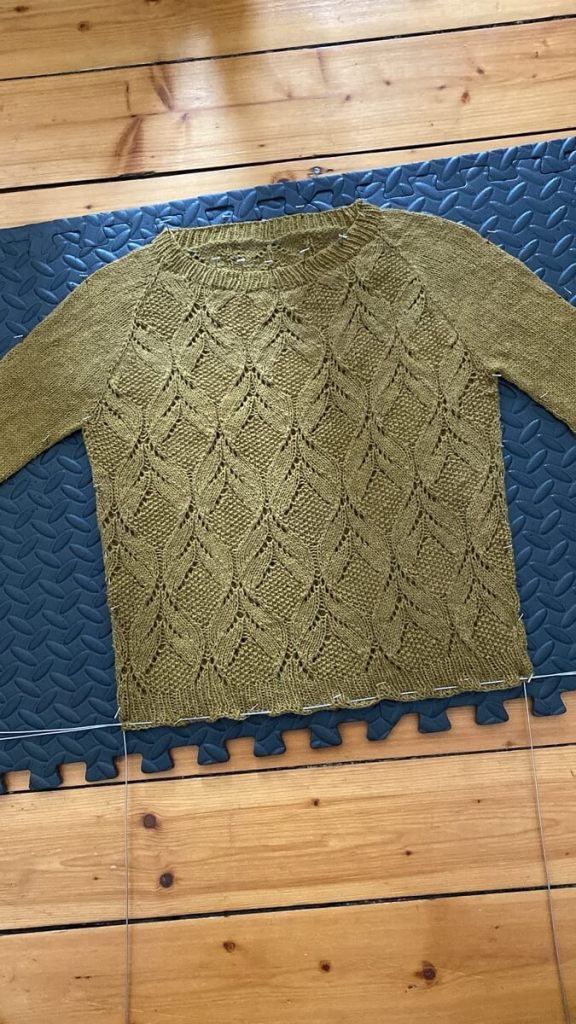
Here’s the jumper, all finished, after I was set back two whole days of knitting.

A knitted Poet jumper is blocking on wires and a blocking mat on the floor
Here is my Poet, blocking

You’d think my knitting snafus were over, but it seems I wasn’t done frogging… I started on my Ripple Halter and, a couple of inches before being finished, noticed I was one stitch off. Normally not a big problem, but this is a 2×2 ribbing which only remains correct if the right number of stitches are maintained, so I definitely had a problem.

I’d done it once, I’d do it again! Frog, frog.

Marshmallow the cat looks at my hand as my knitting project is frogged
Marshmallow offers her support…

This was also a scary one, because I had 8 markers I needed to put back in the correct place to be able to follow the pattern. I managed… somehow. Three more days of knitting, gone. It’s all part of the handmade process though, right?

The spinning

My spinning mojo has also returned. I wanted some textured art yarn and set about preparing the fibres to make it happen.

Once my Leicester Longwool locks were dry, it was time to spin.

Now I need to decide how to ply this. I think I might dye some wool top neon green, spin it  thin and use it to create a textured, thick and thin art yarn. What do you think? Also: am I mad for frogging days’ worth of knitting for what a lot of people deem “small mistakes”?

Ever wondered what the difference is between wool top and wool roving? I wrote a blog post on it on my own website and would love it if you’d read it. Thanks so much!

Upper Canada Village trip

Upper Canada Village trip

05-06-2023 Upper Canada Village trip after the morning shopping with Sharkboy and Glenn. (https://feltingandfiberstudio.com/2023/05/15/more-shopping-for-the-mers-again-looking-for-hair/)

When last we chatted we had left the fibre festival in Spencerville and headed a bit further south and east heading to Upper Canada Village (UCV).

The Village has an interesting history.  The plan was to make the St. Lawrence River deeper and thus navigable, to larger oceangoing ships, thus providing them access to the great lakes. Unfortunately, this would require the flooding of 10 small villages that had grown up along the river’s edge.  To save some of the historic architecture from these soon to be flooded areas, some of the buildings were moved to two new locations. Some went to Ault Park and over 40 structures went to Upper Canada Village, whose construction began in 1958. The buildings included several working mills (woollen mill, grist mill and sawmill) and trades buildings (blacksmith, tinsmith, cabinetmaker, cooper, bakery, cheese-maker) as well as a doctors home, chapel, livery stable, taverns/dining room, and two farm complex.  The village is set up to represent life in the 1860s.  There is a large team of costumed interpreters working at the village to help show you what the 1860s were like.

On the Saturday that we visited Up UCV had decreed free entrance to the village in celebration of the Coronation of King Charles, so it was very busy. We were lucky and found a good parking spot. I think shark-boy was miffed since he had not found locks to make his hair at the fibre festival, so he stayed in the car to sulk and we went off to have fun looking at everything without him.

1) this is the vew Just inside the village of Upper Canada, that is the sawmill over to the left.1) Just inside the village of Upper Canada, that is the sawmill over to the left.

I knew I had limited walking and didn’t want to tick off my back so we consulted the site map and made a plan. The Woolen Mill, the Blacksmith shop, the Weaving and spinning house, the dressmaker’s shop and the stables. I didn’t think I could make it to the farms to see the oxen and sheep.

2) The map of UCV showing the main spots we wanted to make sure to see. Woolen mill, Blacksmith shop, Weaving and spinning house, Dressmakers, Livery stable.2) The map of UCV showing the main spots we wanted to make sure to see.

Our first stop (not just because I really wanted to see it, but it was also the closest building), was the Woolen mill (Asselstine Woollen Factory). This was a two story building, with the downstairs levels accessible to a walker or wheelchair. Providing fibre UCV has its own flock of sheep, which they sheered and the fleeces used on site. I did not see the sheep, so was unable to ask the interpreters what breeds were prevalent in 1860s Canada.

 3) Large mounds of fleece (possibly raw behind the rope and washed closer to us), on what might be skirting tables 3) Large mounds of fleece (possibly raw behind the rope and washed closer to us), on what might be skirting tables

4) Washing tub were located on the other side of the room from the tables with fleece. 4) Washing tubs were located on the other side of the room from the tables with fleece.

Between the fleeces and the washing area was a stairway to the second floor. That just will not be happening today! So, I went around to the other side of the ground floor at the back of the building. We passed these fabulous kettles for dyeing fibre or spun yarn as we found the way in to see the rest of the lower level.

 5) dye kettles sitting upside down along the foundation of the woolen mill 5) dye kettles sitting upside down along the foundation of the woollen mill

At the back end of the lower level of the mill is an industrial water-driven loom, a fuller, and the intake of water to run all the machines.  (I understand on the next floor are the spinning and plying machines to create the yarn.)

6) Water powered industrial loom with fly shuttle located on the ground level of the mill6) Water powered industrial loom with a fly shuttle

7)   This is the fulling machine. Notice the rows of teasels to raze the fabrics nap. Teasels are the thisle like tops of a plant that have small babrs that bring up the nap in the fabric making it fuzzy 7)   This is the fulling machine. Notice the rows of teasels to raze the fabric’s nap.

  8) The teasel row close up. we see this plant along the highways in areas that had weaving mills (The Traffalger exit in Oakville was a good spot to find them)8) The teasel row close up

9) This blanket has been rubbed by the teasels, which brings up the nap or fuzziness.9) This blanket has been rubbed by the teasels, which brings up the nap or fuzziness.

 10) At the farthest end of the building was a display of dried teasels and oilcans. To the right, hidden behind the timbers, is the intake of water to power the mill.10) At the farthest end of the building was a display of dried teasels and oilcans. To the right, hidden behind the timbers, is the intake of water to power the mill.

11) The intake for water that runs the mill. I didn’t see anyone to ask how they kept the water from getting past the wood and flooding the  lower level of the mill. 11) The intake for the water that runs the mill. I didn’t see anyone to ask how they kept the water from getting past the wood and flooding the lower level of the mill.

12) All the machines are belt driven in the mill. shows one of the belts that would opperate the fuller if it were to be engaged.12) All the machines are belt driven in the mill.

While we were there admiring the equipment, the machinery started and the belts began to turn. Since the loom and fuller did not run, I suspect they were working on the spinning or plying machines upstairs. Also, likely, why we didn’t see any mill workers in the lower level.

13) Our second stop, the blacksmith shop this was a one storey building with a large opening on one side13) Our second stop, the blacksmith shop

Our next stop was at the village Blacksmith. He was in the process of repairing part of one of the wagon harness attachments. (I was a bit vague on how it would all go together once completed.)

14) Working over the anvil, the blacksmith is making the end of what seems to be pin with handle. This end will have a faceted face to add a bit more decoration as well as be functional. the blacksmith's head is down focusing on his work and the hamer. here is a relected glow from the hot iron14) Working over the anvil, the blacksmith is making the end of what seems to be a pin with a handle. This end will have a faceted face to add a bit more decoration as well as be functional.

15)  It was a well-equipped blacksmith shop, having 2 anvils (similar in weight to Glenn’s) 2 swage blocks, and there is a foot vice attached to the work table just left of the picture. a wider picture of the forge, bellows, anvils and other equipment. the blacksmith is working the leaver that operates the bellows15)  It was a well-equipped blacksmith shop, having 2 anvils (similar in weight to Glenn’s) 2 swage blocks, and there is a foot vice attached to the work table just left of the picture.

He used a piece of chalk on the floor to draw his pattern and get the correct proportions as well as explain to his audience what he was doing. It was like having a giant working blackboard at his feet. I wonder if we should draw on our work tables when we felt?

 16) When he had the pin end made he sketched out the handle that would be attached to the pin. the blacksmith is crouching while drawing on the floor. 16) When he had the pin end made he sketched out the handle that would be attached to the pin.

17) He used the pin to check the size of the handle to be added to the pull pin. He has already flattened one end of the bar and punched a hole through it (to attach it to the pin.) he is using the dawing to estamate the leng he will need to make the pull for the pin.17) He used the pin to check the size of the handle to be added to the pull pin. He has already flattened one end of the bar and punched a hole through it (to attach it to the pin.)

We saw him demonstrate upending, punch, drift as well as bending over the horn and a few other ways to reshape mettle. When Glenn was happy and had his fill, we wandered on to see the weaver’s house (McDiarmid house built in 1864).

18) McDiarmid house built in 1864, 2 story log hune house. there are simetrical windows on the ground floor and one above in peek directly above the door.18) McDiarmid house built in 1864, 2 story log hewn house.

This house has a handloom and a number of spinning wheels. We recognized Shirley, the spinner/weaver demonstrating here. She had a few die-stuffs on display, the most popular was the bug cochineal which makes a beautiful red colour.

19-20) Shirley talking to vistiors to the left of the image, waring an 1860's dress she is pointing out difernt samples of natural dies , spinning wheel in forground is a saxony style, there is a Great wheel behind it. 19-20) Shirley talking to vistiors waring 1960's dress and sitting at her saxony style wheel 19-20) Shirley talking to visitors

The 2 side rooms were set up as bedrooms. Each side room had 2 wheels (all different) as well as the 3 wheels in the main room. There is a large barn loom which presently does not have a warp on it. There was also a small tape loom on the far side of the room.

21) Tape loom, drop spindle and nitty notty in front are some of the natural die samples. 21) Tape loom, drop spindle and nitty noddy in front are some of the natural die samples.

As more people came in, we left Shirley to chat with them and headed off to find the dressmaker’s house.

22) this is one of the Views on the way to the house of the dressmaker. (Old farm building with log rail fence and man in 1860 attire in foreground.) We saw a number of different log rail fence styles and I wish I had taken the opportunity to catalog all the variations.22) this is one of the Views on the way to the house of the dressmaker. (Old farm building with log rail fence and man in 1860 attire in the foreground.) We saw a number of different log rail fence styles and I wish I had taken the opportunity to catalog all the variations.

23) The dressmaker’s stone two-story house and side yard those trees may be apple trees.23) The dressmaker’s stone two-story house and side yard those trees may be apple trees.

24) The dressmaker, with a display of some of her wares on the table before her. There are bonnets and a crinoline in the corner cabinet behind her.24) The dressmaker, with a display of some of her wares on the table before her. There are bonnets and a crinoline in the corner cabinet behind her.

25) This is a device that sets Crimp in fabric. It is usually used in pairs, one is heating while the other is in use.  It requires the fabric to be damp as it runs through to set the ridges.25) This is a device that sets Crimp in fabric. It is usually used in pairs, one is heating while the other is in use.  It requires the fabric to be damp as it runs through to set the ridges.

26) Dressmaker is holding a sample card showing Handmade Dorset buttons examples made over rings and one over a wooden base.26) Handmade Dorset buttons are examples made over rings and one over a wooden base.

27) Button hole scissors, Has a notch and screw between the grips, to set the length of hole required for the button. I might like buttons better if I had such high-tech scissors.27) Buttonhole scissors, Has a notch and screw between the grips, to set the length of hole required for the button. I might like buttons better if I had such high-tech scissors.

I enjoyed looking at pictures of the upper floor with the tricky turning staircase. I appreciated the inclusion of pictures so I didn’t have to try the stairs. It would not likely have gone well! with a new surge of visitors to her shop we made a retreat to allow them space and headed back towards the park entrance, and our final stop at the livery stables.

28) At the livery barn, the working UCV horses live for the summer. This one is being harnessed to pull a barge.28) At the livery barn, the working UCV horses live for the summer. This one is being harnessed to pull a barge.

UCV have a small herd of pure-bread Canadians. This breed was a popular working horse used for multiple types of farm jobs (Similar to the Morgan Horse in the states). This one is getting tack so he can go pull a barge along the edge of a channel. Other horses were pulling a wagon with seats today and often pull other carriages and delivery carts around the village. They also power a saw and till the fields of the main farm (the oxen, who are at the tenant farm, also can pull and plough but I did not see them today)

29) Another way to get to see the village is by wagon with seats pulled by horses. Two more of the villages Canadians are providing the horsepower.29) Another way to get to see the village is by wagon with seats pulled by horses. Two more of the villages Canadians are providing the horsepower.

30) As you can see Canadians are not huge horses being built more on the small but strong theme.30) As you can see Canadians are not huge horses being built more on the small but strong theme.

31) Here he is pulling the towrope while shewing off some Canada geese from the shoreline path.31) Here he is pulling the towrope while showing off, some Canada geese from the shoreline path.

I was told that not all of the village horses like to pull the barge but that this one does.

32) The barge with rudder in the back, filled with tourists the horse power is on the shore line with the tow rope. Across the river are some very not 1860’s houses on the American side of the water. I bet they have a fabulous view of the Canadians’ side and all the historical happenings.32) The barge with the rudder in the back is filled with tourists. The horsepower is on the shoreline with the tow rope. Across the river are some very not 1860s houses on the American side of the water. I bet they have a fabulous view of the Canadians’ side and all the historical happenings.

After a long walk through the park, we took a quick look through the gift shop and then back to the car.

33) Shark boy was studying the map but luckily does not have the appendages or height to operate the vehicle and leave without us.  Sharkboy is pointing at the way home, he seems to suggest takeing HWY 416 north.33) Shark boy was studying the map but luckily does not have the appendages or height to operate the vehicle and leave without us.  (There I finally have a felting-oriented picture!)

May 6th, was a great day, shopping in the morning, with lots more photos while visiting UCV in the afternoon. I was not as sore as I feared by the time I got home. But on the morning of Tuesday, May 9th, I got in the car to head into the guild, just to do some extra library work and maybe teach inkle weaving and got caught in a battle between my seatbelt and my jacket. There was a popping noise in my low back and a lot of pain but I did get the seat belt done up and made it down to the studio! I headed home early since the back just would not settle. I saw my doctor but when my back kept getting worse, not better, Glenn and I had a trip to the emergency room and got new drugs. After a week stuck in bed, I was ecstatic when I could get out of bed on my own and get as far as the bathroom (it’s a very small house that really isn’t as impressive an achievement as it sounds!)  I have missed being online for most of 2 weeks and have likely made too big a blog post again to make up for that! There is so much to catch up on! But I will try to take it slow and pace myself. (Being stuck in bed on heavy meds has given me a few felting ideas I would like to try! But not today.)

If you are ever in the southeast end of Ontario Canada, I hope you will take the opportunity to visit UCV (Take walking shoes and a good camera). It is a fabulous representation of the 1860s, it was both educational and fun. I hope I will be able to go again and see the farms that I missed on this visit! Then I will be able to tell you all about the sheep!!!