Browsed by
Category: Dyeing

Next Steps for My Cowl

Next Steps for My Cowl

With a few weeks until the Christmas markets, I finally got back to my cowl.

This is as far as I had gotten before I had to put it aside. It took me forever to get the silk wrapped around the template properly and as you can see I had to use painters tape to do it.

The first job today was to sew the center together. I used some nylon thread and large basting stitches so I can pull it out at the end.

I put some tape on the one end of the thread so it should be easy to find when it is finished.

Time to add the wool, 3 shades of purple.

The next thing should have been cutting up the yellow/orange/red prefelt into some leave and put them on the cowl. But that would too easy. I decided I wanted to put some silk on top of everything. I thought about some silk hankies but remembered I had a big bag of silk lap. Silk lap is similar to silk hankies but much bigger and many layers.

As you can see the silk is bright white. I will have to dye it. I am not sure what would be the best colour so I cut several strips of the lap to dye.  I was thinking different shades of green but maybe copper or gold would be better. Maybe a combination s of all 3. What do you think?

First I had to find the end, easier said than done.

Even with many layers, it is still see-through.

Silk takes more preparation to dye than wool and other fibres. Silk is hard to get wet. I added a little dish soap to help the silk get wet. It will have to sit at least overnight to be properly wet so I can dye it. I will show you next week when it’s my turn to post again.

And a reminder about the holiday card exchange. You have until tomorrow night (Oct 24th at midnight) to sign up on the forum. holiday-card-exchange-2020 link  If You have signed up chec the forum on the evening of the 25 to find out who your partner is.

Burning the fuzz off a basket and then dying it.

Burning the fuzz off a basket and then dying it.

I thought I would try burning fuss of some felt, a bergschaf wool basket to be precise. My son gave me his cool little cigar lighter he picked up. It worked for about 5 seconds then was out of fuel. no problem we will just get some butane and fill it. Well, you would think that was easy but no.

So I will try a candle. We really only have beeswax candles so I got a tealight and tried it. It worked  (it looks more scorched than it is)  but I spilled wax on the basket and that’s not good. Good thing I decided to try the inside of the handle where it won’t show so I will not have to look up how to get beeswax out of wool. I seem to remember something about ironing with paper from my grade 7 batiking class. We will not mention just how long ago that class was.

Next was to see if Walmart has a little torch in the kitchen section for doing the tops of Creme Brulee. No, they do not. How about some butane? No, you have to order that on the online platform. No flammable gas in the store but they will ship you pressurized gas in the mail. No time for that, buy a BBQ lighter. They have that. I had to return that seems it won’t light. Next, let’s try Canadian Tire. Yes,  according to the website they have butane and even have a little torch on sale cheap ($9.99 marked down from $39.99). No, they are sold out even if the app says there are 2 left. And where is the butane? Nowhere to be found. Another fail. I am starting to think the universe is telling me not to do this. But there are BBQ lighters at the cashout. Let’s try again, I grabbed one and off I went.

This BBQ lighter works, now I can give this a try.

I worked well. A little hard to keep it lit because of all the safety features on lighters these days but I managed. I was wishing to the flamethrower lighters of my teen years. Just not the same waving a phone light. Not to mention you cant singe hairs of wool with them.

It wasn’t easy trying to get a picture of the singed hairs. If the pot had been white maybe it would have been easier but many tries later I got this good one. Keeping the torch moving is the key to not singing it. and the hairs shrivel quite fast.

The problem is it looks like it’s nice and hair free and then you brush off the burned bits and it just raised more hairs. I tried to be gentle but still. after a second pass, it was better but still, there were hairs. It’s too bad it didn’t work as I wanted because even though is it a bit stinky it was fun to do.

Oh well moving onto the next step, dying the basket. This time I picked magenta and purple.

First into the dye pot upside down to do the lighter colour on the top. it cooked loner than usual as when I went to take it out I realized I hadn’t added any vinegar. Oh well, no harm done.

Then the other way up to do the darker purple. You can see the wax I didn’t get off, on the top. A very effective resist.

I was very happy when I rinsed the basket, there was no bleeding at all.

I rolled up the handle to dry in the right shape this time. So there is a happy face instead of an alien this time.

This is a nice close up that shows the colour changes nicely. When it is dry I will shave it.


Here is t is off the ball. I will add some stitching but that’s a job for Sunday.


By now, with basket 3, I am sure you are sick of hearing about may baskets. I promise not to do another basket post next week when it is my turn to post again.


Bubble Texture

Bubble Texture

My best-laid plans have gone awry, so I am going to show you a short piece I did back in 2012. Texture seems to be a popular topic so this should fit right in. Although this is an older post if you want to comment or ask about it you can.

People seem to be interested in how to make bubbles in felt. I know there is more than one way but this is how I did it. This is the storey of my bubble hat. I had made a renaissance hat form Chad Alice Hagen’s hat book. I t was to show a group of ladies that were taking a hat class with me. It is a big hat made on a resist that is shaped like a big droopy mushroom. When you finish it you make wrinkles in it and clothespin them till it dries. The problem is it looks great if you push it all forward and take a picture but from the back, it doesn’t look very good. I am sorry I don’t have a picture of it at that point.

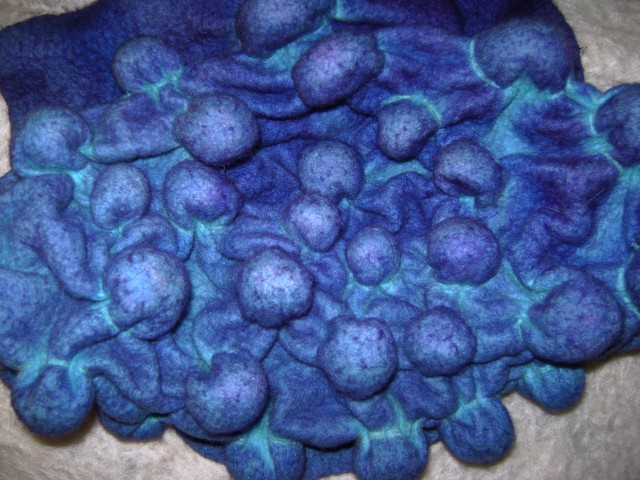
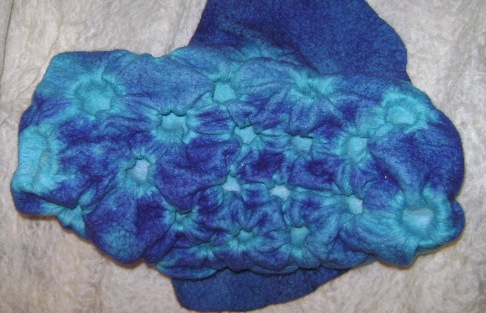
What I did was use a shibori dying technique. I used felt balls but marbles or crumple tinfoil will work the same. I started in the middle. You pull the felt around the ball and tie it off as tight as you can. Move out from there repeating the wrap and tie. When it was all done I dropped it in a simmering dye bath. I let it boil for about an hour. When using this as a dye technique it is usually done on a non-felting fabric so you open it up later and flatten it out you have a die pattern. When you do it to felt at a boil it felts more and the bubble shapes stay in. Making bubbles takes a lot of felt. The hat would fit my dog now. If you put your hands in like a puppet it makes s great Muppet monster.

Basket Mark 2 Finished.

Basket Mark 2 Finished.

This week I finished the basket. All it really needed was to have the handle finished and that would have been fast and easy. But a white basket is not only boring it does not fit with me. I can’t keep anything white clean for long.

So faze to of the basket: dying.

I have a turkey fryer/corn cooker for dying outside. After clearing a spot on the porch for the dye pot and my son cleaning all the bugs and spiders and webs out of the hose and burner I got some water heating. Usually, when you are going to dye wool you wet it first. it gets you a more even take-up of the dye. I didn’t want that in particular so I popped it in dry.

you can see I only put it in partway. Ther is about half the bottom of the basket sticking out. This is limy green. after it had cooked for about 45 min just under a boil the water was clear and I removed it and added a dye from ProChem called Mallard. It’s a blue-green and put the basket into the pot the other way up. I forgot to take a picture of that, sorry.

Once the dye was exhausted I rinsed it and blew the beach ball up in it again, another alien.  I am really pleased with the way the colours came out.

Since I had the dye pot hot I dyed some wool too.

My original idea was to use a piece of a tree branch in the handle.

It was ok when I was holding it but as soon as I put it down this happened.

It dropped right to the bottom. So much for the cream buns you just bought. It is much too heavy. Looking back at the pictures I had seen with wood in the handles, they were all small and the wood was mostly driftwood, which is much lighter. Those baskets seemed to be more decorative than useful.  I went back to just rolling all the excess wool up into the handle. It makes a nice sized comfortable to hold handle.  You can see the colour mixing better now its dry.

when I let go of the handle It still falls to the side but not nearly as much, so the cream buns are safe.

You may have noticed that one side of the basket stretched out more than the other. I think it was from the ball being blown up in it. I should have rewet it and fulled it some more but I didn’t want to. I was thinking of how to fix it or make it a feature rather than a flaw.

I pinched it a couple of different ways and that would have worked but I didn’t really like it. the heck with it, it’s just for me.

The basket part feels a little light even though there is 200grams of fibre in it.  It was a bigger resist but I reasoned to myself that there is more wool in 200 grams of Corriedale then there is in the same weight of Fin. I didn’t put any yarn in it, mostly because I forgot. I wanted to prevent the basket lip form stretching out any more. I tend to overfill my baskets and bags. Off to search my handspun for some appropriate yarn. I found a yarn that is predominantly the same colour as the Mallard on the bottom of the pot and did some decorative and structurally helpful stitching. I am pleased with the results.  Sorry about the pictures. I was trying to keep my arm out of the way and get far enough back to get the whole basket.

I think there will be more baskets in my future.

Sublimation printing with Dawn Dupree

Sublimation printing with Dawn Dupree

This is a guest post by Kim Winter of Flextiles.

A couple of weeks ago I went on a sublimation printing workshop with Dawn Dupree, a well-established textile printer based in south London near me. She specialises in multilayered collage, often made using sublimation printing techniques,  like those below.

Sublimation printing uses a heat press and solid ink, usually painted on paper, and only works on synthetic fabric. You put the inked paper face down on top of the fabric, sandwich it between newsprint to prevent the ink from getting on the heat press, then press it in a heat press for around 30 seconds.

The heat causes the ink to sublimate to a gas and also opens the “pores” of the fabric, allowing the gas to penetrate. As the fabric cools down, the ink returns to a solid state and becomes part of the fabric. Unlike with heat transfer printing, the colour does not sit on top of the fabric so doesn’t crack or peel off.

You can buy ready made dye papers in different colours, and you can also make your own papers by painting them with dye and leaving them to dry. The colour of the paper is usually very different to the final colour on the fabric – the fabric is much brighter! So it’s better to do some sample testing if you are after a particular colour.

You can create collages in several ways. The simplest way is to cut the dye paper into different shapes, or use stencils to create a negative outline. You can also use transfer the dye to a photocopy in the heatpress and then use the photocopy to create an image on fabric. Carol’s pieces below, based on the beautiful work by her daughter Alex, used these techniques.

You can also transfer the dye to other items, such as lace, doilies, or yarn, like Gabriela and Maritza did below.

With the heat press you can also add foil to highlight various parts. Catherine’s multilayered piece below included foiling.

I wanted to see how shibori techniques worked in the heat press. So I took a piece of Vilene and folded it in a series of knife pleats in one direction and then the other. I printed this folded piece in one colour, and then unfolded it, repleated it along different folds, and printed with another colour.

Below you can see the folded Vilene on the right after printing with two colours. The purple dye paper is on the left.
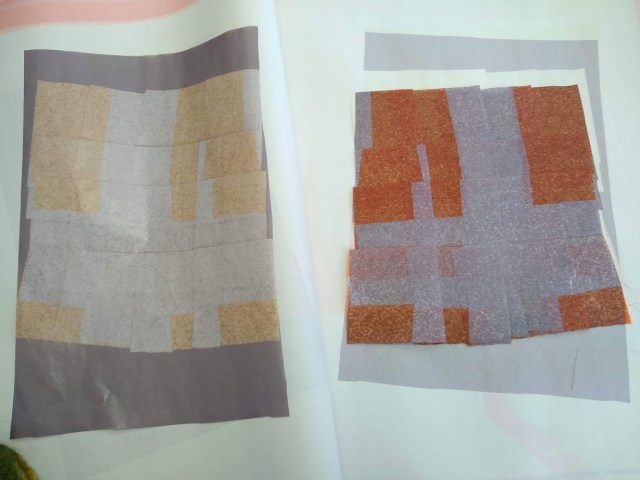
Below is after printing withe four colours:

And this if the final piece after printing with five colours:

I also tried stitching. I stitched a piece of white polyester with five rows of running stitch, pulled up the stitches into pleats and then printed it with pink dye paper.

This is what it looked like when opened up.

I removed the stitches, pressed it and restitched in different places, and printed with a second colour.

I repeated this twice more. Then I tore the piece in half and foiled one half (the piece at the bottom).

I noticed that the papers I used for printing retained a very clear image of the stitched fabric. So I used them to print on other pieces of fabric, which looked amazingly 3D.

I hope you enjoyed this post, even though it doesn’t include any felt! Please note that the post is being scheduled to publish while I am on holiday, so I may not be able to respond to comments immediately.


A New Hat

A New Hat

I have been working on a new “pillbox” type of hat. I got this great lattice yarn and wanted to use to add some interest to the hat. I got this yarn at Value Village, a big chain second hand store. They had over 100 bags of  4 skeins each for $3.99.  It was all new with the labels on them.  the black/grey is what I used on the wonky hat wonky hat and the green/purple/orange is what I used for this one.

This kind of hat is made in 2 pieces.

I used a nice orange wool that isn’t to bright for the base then I added the lattice yarn. It worked much better when the wool and the lattice were wet.

After the usual rubbing and rolling and whatnot they are done.

Checking the fit before sewing them together is important, can you guess ow I know? LOL


And here is the finished hat. The top is sewn to the bottom.

This hat works inside out too. It would need steam ironing to make the top seam fold properly.


Silk Yarn Dying

Silk Yarn Dying

This week I decided to do some yarn dyeing. I bought some ends of cones someone brought in to the guild. They are perfect for me as I don’t need large amounts of any yarn.

I couldn’t find my niddy noddy so I just wrapped the silk around a plastic box of curls. This is the largest cone I got. There was only one so I guess that’s why no on else wanted it. It is quite fine and it is a single yarn. I liked it because has little nubby bits. The other cones I got were almost empty.


I did 3 kinds of silk or at least I hoping the other two were silk. More on that farther down.

You can see  the other tow yarns in this close up; there is one with slubs and one that is super shiny and has little loops.

I planned to use MX or fiber reactive dye for these. I wanted to do them with more than one colour so I soaked them in a soda ash bath. I was surprised at how dirty they were.

Next I made up small amounts of dye and dipped the yarn into them.

I made sure they were wall soaked in the dye then squeezing the excess out with a gloved hand. Then they are places on some plastic wrap them up.

They need to sit a couple of hours before rinsing. Two of the ones with purple on them took a lot more rinsing, one of the silk noil and one of the shiny ones.  Not sure why.

This is the silk noil. The grey areas were turquoise. I am assuming it is grey because of the original colour of the yarn. You can also see it got some twist energy back and has little twists now. this is the one from the first picture. The other two were very white.

This is the one with the slubs. I was not sure this was all silk. I think that one of the ply’s is not silk. It must be a cellulose fiber but it did not take the dye quite the same. The fluffy slubs are definitely paler.

This is the last one.  I really like the lavender that happened because I forgot to wipe the purple off my gloves before squeezing the excess dye out the  turquoise part.

Last night with the help of guild friends I put them all into center pull balls.

All in all a very satisfying dye session. I am sure they will look very nice on some felt. I may use some of the silk noil to ply with something else. I am not sure  I will have to see.


I’ve got rainbows on my mind

I’ve got rainbows on my mind

First of all, happy Thanksgiving to everyone reading this in the US! I hope you had a nice celebration.

Today I’m sharing some rainbow-y fibre I created, plus a “throwback” item that I hope you’ll like.

Being an indie dyer means I get to play with dyes fairly regularly, but it had been some time since I adventured into the world of saturated rainbows. I think it was the grey London Autumn that got me inspired, I just needed to get a colour fix. Off to the dye pot I went.

IMG_3780

One of the things I’ve been a little obsessed with lately is how yarns look when they’re in skein format – I love it when colours look cohesive and have a certain progression to them when displayed, so I went for a red “bottom” that would change as the eyes look up. Hopefully you’ll see that this was done consciously.

I knit this into a hat (complete with a pompom) that I think looks very cheery. It’s going to be a Christmas present so I hope the recipient likes it.

IMG_3887

I hope you’re not fed up with bright colours yet…

DSC_1358

Although not technically a rainbow, this wool top came out super bright and happy (to my eyes at least). If you’ve ever dyed wool top or roving you’ll know it can be an adventure to control where the colours go. This is superwash wool (it doesn’t felt) so it wasn’t as difficult to get “right” as non-superwash fibres, but I’m still perfecting my methods. Suggestions are welcome!

This being the Felting and Fiber Studio, there should be some felting, so here is a little Piglet I made a couple of years ago and gifted to a friend. I really loved creating this little guy and think he came out really well. I got to see the sculpture again a few days ago at a friend’s house.

IMG_3863

Have you done any hand dyeing or needle felting lately? Share your experiences with me in the comment sections.

Shibori Shrug Jacket

Shibori Shrug Jacket

Heres another throw back post. I thought if I do not remember doing this maybe you won’t either. I hope you like it.

After seeing Ruth’s jacket it reminded me I had made a small one for one of my daughter’s dolls years ago. I thought I should give it another try but life size this time. I thought about doing it seamless but decided that it would make something that is a simple design into something complicated. Although I am not a great sewer I was sure sewing 2 straight seems on my machine should not be beyond me.

There are quite a few pictures so I have put them in a gallery for ease of viewing. If I could figure out how to post pictures side by side or in groups I would but that is beyond my skill level.

First I made a large piece of nuno felt. I used silk gauze and merino wool. After it was finished I put it in a red dye bath. It came out quite nice. It’s hard to tell from the picture because my camera did not like the red at all. The one you see was the best of a bad lot.

The next thing to do was the shibori. I finger pleated the middle of the piece starting at one short end. I very carefully held it flat and tight while I tied it. The first tie is the hardest one. After that you just pleat it up tying every couple of inches. You don’t want to be too neat about it. If the pleats are to perfect you get straight lines. You want your pleats to be tight so some of the material will resist the dye in the second bath. This type of shibori is supposed to make a bark like pattern. I put the tied up piece in a purple dye bath hopping for a nice red purple to appear on my cloth. It came out black. After it was dry the gauze side had more of a purple look but still very dark.

I sewed up my jacket. I made the material far too wide so the jacket ends up long. The short sides overlapped a lot when folded up. I had to have long “lapels” to make it work. It is not a mistake it’s a design feature, just ask me :O) It is still to long for me. I think it may look good one someone who is tall and thin. Two things I am not.

All in all not a bad try. I’ve made another piece of nuno felt to try again, I made it narrower this time. Now I have to find the time to sew it up.

Snow Dyeing with Acid Dyes

Snow Dyeing with Acid Dyes

I have done snow (or ice) dyeing for a while now but I always used Procion MX Fiber Reactive Dyes. I did a quick how to post about it here.  But I have never tried snow dyeing with acid dyes. My group did a session of snow dyeing a couple of weeks ago and we used fiber reactive dyes. I dyed 10 silk scarves to sell at the store. I had 10 more scarves left when I got home but I had left my dyeing supplies at my friend’s house. What to do? I decided to try it with acid dyes. I didn’t find much online information about using acid dyes with snow except several people who said you couldn’t use acid dyes because the items needed to be steamed. Well, I’m never one to take someone else’s word for it. I have to experiment and see for myself.

Here’s my set up on the kitchen floor next to the heat vent. I used aluminum baking pans and put a rack on the bottom of three of them. The rack keeps the scarf up out of the melted snow and dye. The dark blue one in the foreground didn’t have a rack. You can do it either way but the rack keeps the color separation a bit more evident in the end result. I soaked the scarves in vinegar water first and then scrunched them up and laid them on the rack or the bottom of the pan. I then covered the scarves with snow. We’ve had plenty of that this year! Then I sprinkled the acid dye powder on top. It’s important to think about your color choices on these if you don’t want to come up with a yucky brown mess. I tend to stick with colors that are closer together on the color wheel. When you use black, it tends to separate out into its component colors so it is a bit unpredictable sometimes.

Now you must have patience and let everything melt. It’s easiest if you do this in the afternoon and let it melt overnight. Once it was all melted, I just picked up the scarves and put them into a gallon bag keeping like colors together. I had 4 open topped bags that I then put in the steam pot and steamed for 30 minutes. It also works best if you let the bags cool down to room temperature but I was out of time because I was heading out of town in two days. So I rinsed them in the sink until no dye was coming out, soaked them in hot water plus textile detergent, rinsed again and ran them through a delicate cycle in the washing machine and ironed them dry.


And it worked! I was very pleased with the results. You can’t really tell much difference between the acid dyes and the fiber reactive dyes. I had a few more variations than the photos above but couldn’t get good photos of all of them. These photos are fairly representative of the colors and patterns that you can achieve with snow or ice dyeing.

Have you tried any snow or ice dyeing? We’d love to see your results. Come show us over on the forum.