Browsed by
Category: Demo

The Codification of Stitch

The Codification of Stitch

One of the UK’s major textile events, the Knitting and Stitching Show, is held annually in November in the Harrogate Convention Centre. It’s packed with “must have” products and showcases inspiring work by a wide variety of textile artists. Within the show there is a dedicated exhibition area called the Graduate Showcase, which highlights outstanding textile art from recent UK BA undergraduate courses. This initiative, run in partnership with the Embroiderers’ Guild, provides a platform for emerging talent in the textile art world and it was here last November that I first saw the work of Charlotte Farrant.
Charlotte hadn’t originally planned a career in textile design, in fact growing up she had formed a fascination for mechanics and saw herself becoming a mechanical engineer. At some point Charlotte discovered she also had a love of embroidery and enrolled in the Royal School of Needlework, graduating with a first class degree. 

Charlottes “Codification of Stitch” is an innovative coded embroidery system developed by the textile artist herself and it is used to form hidden messages within the garments she designs, transforming textiles into wearable narratives. Specific embroidery stitches represent letters, forming hidden messages amongst the exquisite, decorative Goldwork, Blackwork, Whitework and Raised Work.
 
It was her fabulous “coded” Ann Lister black coat that first caught my attention on her stand at the show. In 2025, in collaboration with the Anne Lister project, Charlotte designed a range of costumes re-imagining the BBC cast of Gentleman Jack and bringing them in to the 21st century.
 
I hadn’t heard of Ann Lister but I’m guessing plenty of you will have, especially if you’ve seen her life story as portrayed by Suranne Jones in the BBCs series Gentleman Jack. This woman was an ardent diarist and from 1896 to 1840 she wrote a five million word diary, approximately one sixth of which was written in code. She combined the Greek alphabet, zodiac, punctuation, and mathematical symbols allowing her to document, but also conceal, the most private aspects of her life. It’s fitting that this beautiful coat should also conceal its message which is a quote from Ann in August 1823. It reads “I am not made like any other I have seen, I dare believe myself to be different from any other who exist.”
Ann Lister Coat
 
Sampler for coat

Another “Ann Lister” inspired piece on Charlottes stand was a waistcoat inspired by the diarists love of nature and the coded message on this garment reads “We are not alive if we’re not taking the odd risk now and again.” 

Ann Lister Waistcoat
Detail of waistcoat

There was also a selection of beautiful intricately stitched, coded brooches on display, each with a printed label providing its deciphered message.

Check out Charlottes website charlottefarrantembroidery.com where you can see her portfolio of designs as well as her shop selling Coded embroidery kits, brooches and many other embroidered coded art works.

Throughout history textiles have been used not only for protection and comfort but also to communicate our personal values and identity. Long before the written word came in to use Ancient civilisations would use specific colours and symbols to convey their environment, spiritual believes and culture. In this way meaning could be woven, felted or stitched into rugs, blankets, clothing, etc. delivering visual messages that could be easily read by the people around them. Examples include the felted rugs created by ancient nomadic tribes which would embody powerful symbols across different cultures signifying the wish for good health, long life, prosperity, etc.

Examples of just a few of the Symbols used in Middle Eastern rug making.

On the other hand, hidden “coded” messages in textiles have been used for a very different, but very important role in history. While imprisoned Mary Queen of Scots embedded complex and personal symbols within her embroideries to express her frustrations, assert her claim to the English throne, and comment on her unjust captivity. This panel depicts a grapevine and a hand holding a pruning knife. It references Mary’s claim to the throne, suggesting the need to cut away the fruitless branch of the Tudor tree represented by the childless and ‘illegitimate’ Elizabeth. The point is driven home by the Latin motto ‘Virescit Vulnere Virtus’ (virtue flourishes by wounding). (source:vam.ac.uk)

Embroidery also enabled Mary to communicate with her supporters by sending coded messages hidden in her needlework. 

In the realm of espionage, traditional handicraft skills were to take on an even more covert dimension during the World Wars when prisoners, spies and resistance members used embroidery to pass on information under the noses of their enemies. After all, who would suspect that something as innocent as an embroidery or tapestry could offer any threat from the enemy? Morse code and binary code were easily represented using a combination of long and short stitches, or French knots and seed stitches, and these would go undetected when hidden amongst other decorative stitches. Other methods required the person receiving the work to “undo” the embroidery as messages were hidden in the padding of trapunto or concealed beneath a second layer of embroidery. 

Knitting was another innocent looking but very useful craft when it came to espionage. Morse Code knitters employed single purl stitches for dots and sequences of three purl stitches for dashes. Their sequences translated into short and long coded signals. Some knitters used knots to conceal Morse code by tying specific configurations to represent dots and dashes, or varying the distances between their knots. These encoded messages could then be discreetly passed across enemy lines or integrated into knitted items such as hats and scarves to be decoded by the recipient. Written messages were also known to have been passed on, hidden in balls of wool!
This practise wasn’t exclusive to the allies. Using a system similar to Morse, German agents based in the UK also passed encoded messages using knotted yarn which was then knitted in to garments. 

Although an extremely dangerous occupation it’s said that the practise of covert knitting became so prevalent during WWII, some countries actually banned the posting of knitting patterns aboard, fearing they may carry coded information to the enemy. 
During times of war, a knitter was often more than just a creator of warm garments; they were also keen observers and messengers, their needles clicking away as they kept watch. (Source: Timoneillstudios.com)

Image Source: ww2wrecks.com

I will leave you with an embroidery created by one Major Alexis Casdagli. Alexis was captured and spent four years in a German POW camp where he passed the time in the innocent pursuit of cross stitch. He also set up a stitch school, teaching other POWs to embroider. Of the many embroideries he made this piece was so admired by his captors that they proudly hung it in the castle where he was being held and subsequently had it displayed in three other camps.

The prisoners must have found it very amusing that the guards had no idea of the defiant message hiding in the Morse dots and dashes stitched around the borders which read “God Save The King” and “Fxxx Hitler”. Fortunately it was never deciphered during those four years and so the embroidery, and the Major survived the war. He told his son on his return that the Red Cross saved his life but embroidery saved his sanity! 


Making Bubbles

Making Bubbles

This is an old post from several years ago of some fun bubbles I did with a friend. I thought you might like to see it again. This last weekend was our guild sale, and I have nothing to show you felt wise. Jan has so many pictures of the sale to show you, I will leave that post to her. I have such fond memories of this friend and our felt journey.

A while back, I went to a felting friend’s for a few days of fun.  She showed me how to make bubbles and cut them open to great effect. Here are the pictures of what I did.

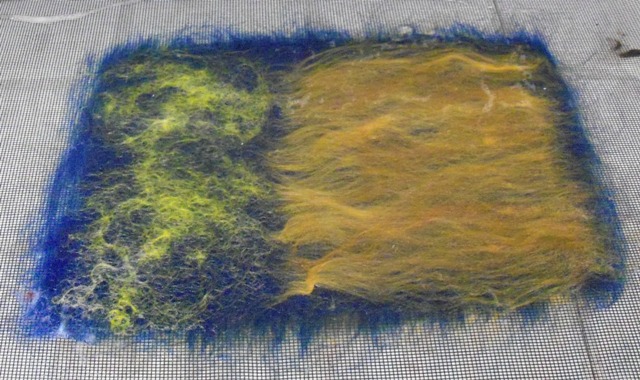
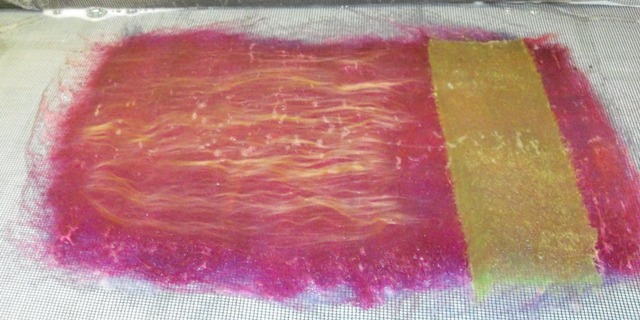
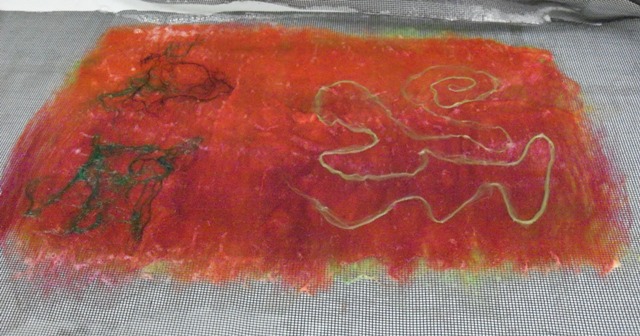
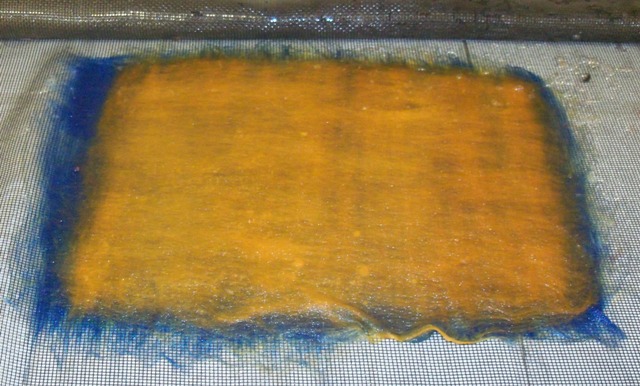
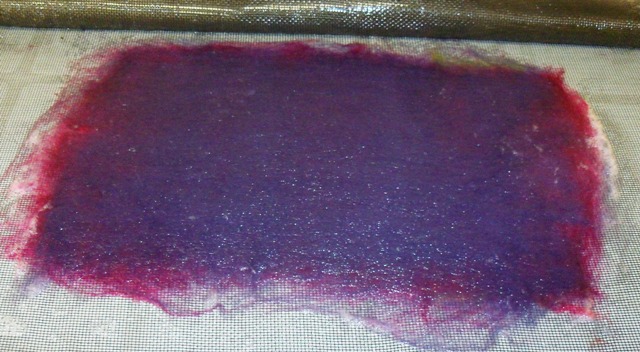
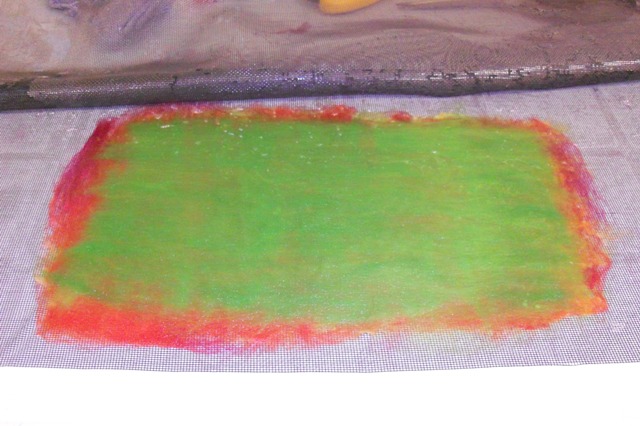
First of course, I laid out some wool to felt. But these are samples, so plain felt won’t do. I added silk threads, a silk square, some silk roving and other wools to see how it would all go. This is the underside.

This is what the top side looks like

Then, of course, there was the usual rolling and fulling.

rolling rolling rolling

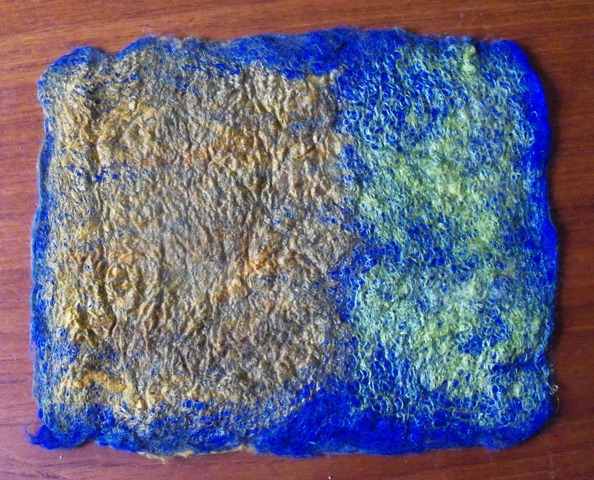
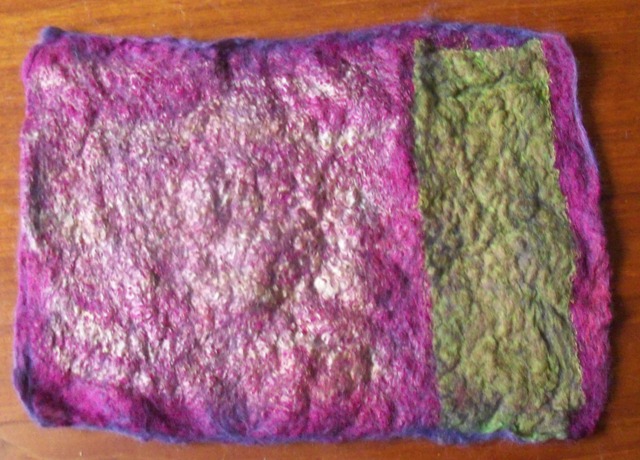
Here they are all finished and ready for the marbles.

The next step is to put marbles in while it is still damp. You pull the felt tightly around the marble and secure it with an elastic, and now it looks like a bubble. We used the elastics they use to put braids in horses’ tails and manes because they are small, stretchy,  strong and cheap.  You put in as many as you like and whatever sizes you like. You can also use felt balls. The felt balls are good if you want to leave them uncut. Marbles are too heavy for that.

Here they are all tied up.

Felt with marbles tied in to make bubbles

Here they are cut.  I cut the tops off, I cut x’s and star patterns, and some I turned inside out. If you cut more off, you see more of the inside, and you can stretch them flatter, too.

Bubbles cut open

You can see how the underside becomes the inside of the bubbles. These samples started out about 6×8 inches, and the finished pieces are about 1.5 by 2.5 inches. They take up a lot of room. I only have 2 of them left; my friend’s dog ate one. I think I will glue them to some leather and make brooches out of them. They are lots of fun to do. I made some wrist cuffs with this method, and I will blog about them next week.

This and That.

This and That.

It is almost Fall. You can feel it in the air, and a few trees are starting to change. Usually, we like to hang on to summer as long as possible, but I am happy the dry, searing heat of this summer is finally gone. Yes, I am touching some wood as I say that.  It’s been a busy 2 weeks with school starting and the market picking up. Suddenly, we were out of meat pies, and I had to get baking. That doesn’t leave much time to felt. I did manage to get to the Almont Fibre Festival to help with the demonstration.

I put all my sheep key chains together

I am wondering about putting some wax or something on their ears to make them a little flatter and protect them. My thread wax is too hard. I wondered about some of the solid lip balms. It’s mostly wax. I think that might be too soft. I’m not sure what to do. I don’t want to use glue because it will make them too hard, or the PVA (school) glue can take up water and get tacky. Any suggestions?

I am packaging them so they stay neat. I had to get bigger bags for them. The ones that came with the card were not big enough. I have a shrink wrap machine that has a hot wire cutter, so I will cut the bags down so they fit properly.


While searching for some lost samples, the book resist thing I did about 10 years ago surfaced. The idea I had was to weave the ropes into a basket. But not thinking it through, I made 6 lobes and strings. You need an uneven number for the weaving to work. I took it to a social, thinking I had a good idea of a way to weave it. It didn’t work. Partly, it was not cooperative and partly (mostly?) I was impatient. Anyway, everybody had fun looking at it and playing with it. The general consensus was that it wants to be a jellyfish. So, I need to create some long, wavy, ribbony pieces, and possibly some long curls for the middle to hang down inside the long tentacles. I wonder if it will take me another 10 years. LOL


We would love to hear from you. If you would like to leave a comment, the comment button is at the top of this post, just below the title.

Twist 2025, Part 1 new booths of interests

Twist 2025, Part 1 new booths of interests

Twist 2025 new booths of interest

Some of you have joined me in previous years on the trip to Twist Fibre Festival in Saint-André-Avellin, QC. It’s about an hour and 15 minutes from home, a bit longer with construction detours this year. It is worth the drive in shopping opportunities and usually has lovely scenery. (We had some of the smoke from fires much further west so it was too hazy for the views overlooking the river). Twist is also the largest of the close fiber events to Ottawa.  Please join me as we take a peek, first at the demos and a new booth that I hope will catch your interest too. We will take a look at more of the event in the next post. Don’t forget to meet me at La Toquade restaurant for after shopping Dinner of comfy duck sandwiches.

photo montoge of line up getting into Twist on friday morning (it was very hot) and close ups of the decorations by the sign which is a sheep on a rocket1)Lining up to get into Twist 2025

Demo Hall way,

There are two halls (Gym and Arena), one on either side of a main hall, which also leads to the back of the building, where more vendors in a large tent were located. The hallway is where the demos from various fiber arts groups are located, including the local weaving guild and our neighbour guild across the river. Let’s take a quick peek before heading into the main hall. I was sure I had taken pictures of the knitting guild, and author and one other group at the end of the hall by the tent but I don’t seem to see them. This year we had examples of weaving, spinning, and a bit of felting at the guild table.

OVWSG Demo table table loom on table OVWSG Demo table Suport spindle spinning2.1-2.2) OVWSG Demo table

Gatineau Guild of weavers banner and table display2.3) Guilde des tisserandes de Gatineau; our neighbour guild on the other side of the Ottawa River

lace makeing pillow with hands moving bobins2.4) The Lace makers guild

Association des Artisans de Ceinture Flechee de Lanaudiere banner Association des Artisans de Ceinture Flechee de Lanaudiere table of finger woven bands2.5-2.6) Association des Artisans de Ceinture Flechee de Lanaudiere

While at Twist fiber festival, I spotted a few new booths which caught my attention and I thought you would also find interesting. So I am going to focus on one of the booths today but we will look at the rest of the event hopefully in the next post.

New Vendor has felt

At this point, we had arrived, said hi to the morning demo team, and started looking for booths selling fiber or (Needle) felting supplies.  It was close to opening time, and was still quite busy with a rush of shoppers.  I had to wait to get into the booth. The little I could see from outside had me curious as to what else might be in there. I was sure it would be worth the wait.

glimps of wool felt between people stopping and walking in front of where i was trying to see in3.1)I see wool! Yes, that definitely looks like wool. I wonder which booth this is?

As the crowd parted, I could see the signage “Field & Fleece” and “WoolGrown”.  Behind the sign was a 3 foot tall roll of felt!! As well as bags of fiber (I think I overheard the bags of fleece were mixed rideau-arcott sheep fleeces?)

montage of photos, signage and bags of wool, lamb covers, wool pellets for gardening3.2) When the crowd parted and I could see part of the booth!

rolls of various lenths and widths of horticultural felt.3.3) Precut lengths of felt, some have holes cut out for planting plants, others are solid.

samples in booth of poducts made from this felt, jacket bag, art, and small bags of fiber 3.4) There were examples of wool Felt use; Jacket, purses, art, small batts in bags

There were also small strips of wool rolled up on the table. They were selling them to start seeds in. I looked at them and saw name tags!!!

3" and 4" widths of felt in long strips, they are to plant seeds but i am going to make name tages 3.5) wool strips  for sale in the booth

The strips were being sold as “Seed starting wool strips the eco-friendly evolution of the innovative seed-starting method known as the “Seed Snail.”” The concept seems to be to un-roll the wool strip about 4” x 4’ long, add moistened potting soil mix, roll up the dirt with wool, making something that looks like a less tasty cinnamon roll. Plant the seeds at the top of the roll, so the roots will grow down between the circles of wool. That sounds like an interesting concept but I still see name tags when I look at these rolls. There were a few different widths so I selected a few of the wider (about 4”) and a couple of the cheaper 3-ish” ones.

If you noticed the little square about an inch thick by about 4 inches, I picked up one of those too. I will try it out as a felting surface later.

Since I had finally got to the front of the booth and had already found a small selection of items, I kept looking.

ceramic sheep bole with blacksmith made masonre nails. (to use for mordenting dies)3.6) OH my! What is that?

Not the prins, look in the cup! I was just apologising to Glenn, as we drove here, that I suspected the booths selling blacksmithing items or supplies would again be rather thin.(ok, None. I am sure it’s just an unintentional oversight that will be fixed at some point in the future.) Those rusty items are square-headed nails, and look like blacksmith-made objects! I asked about them and was enlightened that they were the “nails” from a brick wall that had been taken down and she didn’t have the heart to toss them. She was selling them for dyers to mordant their dye baths. I bought a little bundle for Glenn so his day was not just carrying my packages and taking naps on a bench while I shopped or photographed.

Since you have seen the extreme relaxation (napping) demonstrated at various fiber festivals I should not deprive you of another sighting.

Husband sitting on bench sleeping peicefuly while shopping happens behind him4.1) Fibre festivals are a good spot for extreme relaxation.

Mer-Boyfrend self-feling his own abbs Mer-Boyfrend self-feling his own abbs another vew4.2-4.3) The Mer-boyfriend got impatient and started to work on his own abbs. I spent too much time explaining why I was making another mer-person to people stopping to ask what I was doing and how did it work? (Yes, I got another voodoo comment too!)

I filled in at the OVWSG Demo Friday afternoon, as the demo started to pack up, I “rushed” back to buy the roll of felt but they were unfortunately closed…. Drat. Ok almost everyone is faster than I am at the moment.

While we are still in town, we can go enjoy the comfy duck sandwiches at the La Toquade Restaurant. It’s part of the enjoyment of going to twist, and I think about this sandwich for a year between twists, so let’s go see it they are still as memorably delicious as it was last year. (Oh yes it was!!)

on a long rectangle plate, good fries, a small salid with rasbary balsamic vinagret, frenchfrie dipp and the amazing sandwich ingredients listed below photo5)“Club sandwich au confit de canard- Servi dans un pain abricot-raisin-tournesol garni de bacons, oignons, pommes vertes, céleris et mayonnaise maison et un choix de frites ou de salade mesclun” / (Google helped and translated the above to English for me: “Duck Confit Club Sandwich – Served in an apricot-raisin-sunflower bun topped with bacon, onions, green apples, celery and homemade mayonnaise and a choice of fries or mesclun salad”.  the dip for the very tasty french fries was “choix de mayonnaise maison” and the small salid had a fabulouse rasbary baslamic vinigret. Desert was Mousse au chocolat (I think that has to be one of the best types of Moose). If you make it to twist, this may tempt you to stay in town for dinner or a late lunch.

After a delicious dinner, we headed for the highway, through rolling hills and past a very picturesque stream, which I keep meaning to stop and take pictures. Unfortunately, shortly after getting on the highway, we found the highway was closed, so wound up enjoying rock cuttings and farm land while following a very round about detour. (We eventually found out the road was closed for paving.)

pick up truck (licence plate obsured) has bound (tied up) small couch in back.6) I suspect I have been watching/listening to too much US political news on you tube. We saw this in front of us on the detour. Can you guess my first thought as to who must be having a quick getaway visit to Canada?

We did make it home after enjoying parts of Quebec we had not seen before. I spent the rest of the evening reviewing Fridays photos and posting some on the OVWSG Group FB page, I did a bit of investigating on the internet since I regretted not buying one of the rolls of felt.

WoolGrown Company web site: www.woolgrowncompany.com

WoolGrown Company on Face book: www.facebook.com/profile.php?id=61568471715075

This is a Canadian company, based in southern Ontario. It is a lot closer to drive to Twist (Just over 1 hour east), than to drive west, well past Toronto (Over 6 hours south-west of Ottawa). (Which is why I was trying to get back to twist on Sunday.)

As I heard at twist and saw on their web site, they were looking at ways to diversify their farm production (sheep farming).  On their web site i found links for Wool pellets for mulch, Garden & Horticulture Felt (which was the felt I purchased on Friday, but not the option with holes precut in it for plants) and Sheep Tea Pouches. In their booth, were also examples of; felt art, Felt Jackets, Felt Bags and felt Pots as well as the felt itself.

I tried messaging the company on their Facebook page (but they were likely very busy recovering from day 1 of twist) since I knew going back on Saturday was not an option. I would have to hope to be up and running… er, walking… ok rolling on Sunday.  Glenn said he was up to joining me again, (he was hoping for more Comfy duck), so off we went back to Twist early Sunday morning.

large roll of felt (hordicultural) 3' tall and very long. sitting partly behind sign saying Feild and Fleece7.1) 3 foot tall roll of wool felt!

Ah good they have not sold out, but as I got closer, there was a lot of stock missing. The 10 foot by 1 foot rolls were gone and so were the other sizes I had seen on Friday (Drat). Luckily, Sunday morning at opening was not as busy as Friday, or I heard Saturday had been, so they said they could cut me a piece from the big roll.

mesureing out 4 feet of the lenght from the roll mesureing out 4 feet of the lenght from the roll7.2-7.3) I got 4 feet of the big roll.

I am hopeful I will be able to use this with my picture felting students. I need cut pieces that are a bit bigger than 5”x7” finished picture size.  I want my students to feel the difference 100% wool felt feels, when compared to the cheap part wool, to full acrylic non-woven options for picture felting bases.

close up of some of the pices i purched from this vendor. 8.1) “Horticultural”, as you can see there is some kemp and a bit of VM. Even so, it looks like it will make a good base for picture Needle felting.

Let me show you some of what I wound up with from this vendor, I will show you the rest later. I am looking forward to investigating this wool felt, hopefully soon.

Today (which will be yesterday as you read this) we headed south of Ottawa to Kemptville for a much more intimate fiber festival. I had wonderful chats about felting and fiber and thoroughly enjoyed myself. (Glenn read a book and had another nap, I told you fiber events were extremely relaxing, soon all husbands will want to attend with us, just for the quality napping!!) I would like to show you a couple of interesting displays and booths there too, but let’s finish off visiting Twist next. Don’t forget to save a bit of virtual or actual money for shopping at Almonte Fiberfest on Sept 6th 2025 if you are in the area!!

Demoing Felting Question: “How does that work?”

Demoing Felting Question: “How does that work?”

Demoing Felting Question: “How does that work?”

Summer is the season of planned and spontaneous demos.  Whether it’s planned, demonstrating felting at fairs, craft shows, fibre or yarn stores, or less planned, felting sitting in front of your home, or waiting at a doctor’s office,  it’s an opportunity to introduce others to the fun of felting. I wanted to chat about this today, since I have recently overhead others say they haven’t signed up to do guild demos because they don’t know what they will get asked at the demo. Also, they have never demoed before and feel that they need to be really good to demo.

Demos are an opportunity for us to show others what cool things we are doing. We don’t have to be masters at what we are showing, but we have to be enthusiastic (without scaring the public) and look like we are having fun. Seeing someone who is enjoying what they are demoing is likely to inspire someone to try whatever they are doing. It is also good to see someone who is just starting to let others know they can do this, too.

jan working on felted pictue of 2 sheep in front of large burlap bails of wool at wool growers co-op 2019 1) 2019 Wool Growers Co-Op Demo

If you have never demoed before, try a group demo where you are not alone and have others who can answer questions and take the lead.  You can also just bring your felting with you when you will be waiting somewhere for a while, like the doctor’s office or emergency department, most people will just smile and watch. (They are usually happy to have something to distract them from why they are there. It’s a good way to get used to being watched while you’re working.)  Spinning is particularly popular with people in the emergency waiting room.

I have found that at most big demos, I have to start talking to people before they will approach. When I first started to demo, it was weaving I was showing. If someone seemed curious, but not brave enough to ask what I was doing, I would ask what type of loom they had at home (even when I was reasonably sure they had never seen a loom before). They usually laughed and started talking to me, often about their grandmother’s spinning wheel! (We will not discuss today anyone loudly saying “look she is making wool!!” while I am spinning, or “Look she is spinning!!” when I am weaving. It’s a bit trickier, so getting Sleeping Beauty’s spindle wheel confused with Rumpelstiltskin’s flax wheel is slightly understandable.) Nevertheless, it was an opening, and I could tell them about the magic of watching cloth appear as you change the order of harnesses, which changes the pattern.


Now let’s consider what seems to be the most scary for new demo-ers, what am I going to get asked?

First, you are not required to know everything to demo! If you get a question you don’t know the answer to, admit that, and suggest they contact the local or online group. You don’t have to be an expert! Enthusiasm and looking like you are having fun will inspire others to try. That said, whether I am demoing needle felting in 2D or 3D, I most commonly get a few questions repeated as I am working.  Let’s take a look at some of the most common questions.

The first is “How does that work?”

If you don’t know how the needle’s barbs grab the fibre and push it into the felt or ground fabric, it does look like magic.  I try to show them the barbs along the working part of the needle. If you have a course needle, it’s easier for people to see or feel the barbs (32g or courser).  If they are having trouble seeing, I let them hold the needle, warning them the end is very sharp, and have them run their fingernail over the area where the barbs are located.

*I did have one person tell me they had tried using a needle to felt and it hadn’t worked at all. After I showed her the barbs on my needle, she admitted she had tried a sewing needle. I can see why she was having trouble getting the wool to felt.


Doer felting needle 32G diagram2.1) Doer felting needle 32G

Doer needle chart to help ordering triangle needles2.2) Doer needle chart for triangle needles

2019 small muskox landscape, Demoing at a social, under drawing and adding wool, finished image2.3) 2019 small muskox landscape, Demoing at a social, under drawing and adding wool, finished image


Common 3-D Question:

When I am working on a 3D piece, I get asked variations on “how do you move the wool where you want it to go?”.

First, the wool moves in the direction that the needle is travelling. Poke in the direction you want the wool to move. While also being aware of the position of your barbs, and thus your working depth, so you are getting the barbs to entangle or move the fibre to the location you want it to be.  It’s easy to say, and sounds simple, but I have seen beginner felters poking vertically (up and down), while trying to move the wool horizontally. It would be more effective if they poked the needle horizontally (moving left and right) or rotated their shape to align with the direction the needle is moving.

You can get quite devious with this concept.  While working on a sheep broach, I had the face quite sheepish, but the nose was not as firm as I wanted.  Who wants a soft-nosed sheep, that is just flaccid, or a limp-nosed un-sheepish aardvarkish-sheep?  If I poke from the outside, into the nose, I will distort the nose, and I will have to add more wool and reshape it.  There is a second way to firm up under a surface structure that you are already pleased with, if you have not finished sculpting the back side. You need to know where the first barbs are on your needle and how far to push the wool so the needle does not emerge past the finished surface.  In this case, I worked from the back of the head, pushing fibre through the sheep’s head broach towards the nose, from the back, to firm up the nose without changing the outer surface. It’s sneaky, but it works.

diagram working from the back of the head to firm up the nose without changing the external shape3.1) Moving the wool to firm up the face if needed.

2020 demoing for delivery guy while i was sitting by my side door. image shows the front edge of a manta wing adding black figer and sculping intersection betweeen colours i am useing a pen tool wiht 2 needles (can hold up to 3 needles) 3.2) 2020 demoing for the delivery guy sitting by my side door

I also usually explained that needle felting sculpture is both additive (like clay) and Subtractive (like Stone). Usually, you use some of both concepts when you sculpt with wool.

Additive:

  • You can make a shape and then add it to your creation. Sara from Sarafina Fiber Arts (lots of YouTube videos, including the Mermaid feltalong) works a lot this way. It has the advantage of being easy to explain what you are doing and is repeatable by other felters.
  • You can build up a body by layers of muscle, which is a great way to study musculature, but not a fast way to sculpt. Most sane people just add the general superficial musculature in a simplified form. You can also just go for cute and make more of a caricature of what you are making.

diagram showing felting across a cercle then folding the cercle along the felted line then felting along the fold to give a shape with a loose edge that can be attached to the maine shape. 4.11) A circle of fibre, needle felt across the diameter, then fold in half. Felt along fold line and as far down as needed, leaving an unfelted fringe giving an edge to attach to the main shape.   Sara creates most of her sculptures this way.

adding fins that have been pre-shaped and the attachment edge left loose to allow it to be (sharkboy under structure and 2 fins)4.12) adding fins that have been pre-shaped and the attachment edge left loose to allow it to be secured to Shark Boy

Subtractive:

  • If you poke in the same spot repeatedly, the fibre under that spot will entangle and compact. Visually, you will see the area that is being poked indent. Which looks like you have removed the wool above the dented area, while in fact it’s just compacted the fibres and moved them in the direction the needle was pointing.

diagram shows stabbing repeatedly in the same spot will both indent and compact that spot relative to the surrounding area.4.2) Stabbing repeatedly in the same spot will both indent and compact that spot relative to the surrounding area.

Hybrid – working with loose fibre (using both additive and subtractive methods to sculpt):

  • I often use loose fibre, use a few pokes to attach it to the area I want to sculpt and then, by careful poking, shape it into what I want to see. I tend to do this more when I am building up the under structure. But sometimes for adding detail, too. This is not as fast as remaking a shape and adding it, but it’s a lot of fun.

Miss Manta demonstrating adding loose wool and sculpting it into place. tail detial corner of mouth and scoops being sculped with loose fiber4.31- 4.32) Miss Manta demonstrating adding loose wool and sculpting it into place.


Common 2-D felting question:

When I am working on a picture, people will stop and watch me add small wisps of fibre, layering them to get to the depth of colour I want.  “Oh, I would never have the patience to do that!” OK, that technically isn’t a question, but that gives me the opportunity to talk about the various ways you can approach making a picture with needle felting that they could use.

Like a pastel: (usually a good approach with landscapes)

  • Working from the background towards the foreground.
  • It is easier to overlap images and create depth.
  • This usually makes the most sense for most images as an order of working.

Treating wool/fibre like a watercolour: (slow but impressive results)

  • Slowly layering tiny bits of fibre like washes in water colour painting. The transparency of the application allows the upper layer to be affected by the under layers. If you have lots of patience or just like to putter on a project, this may be your choice.

Like an acrylic (paint by number or colouring books): (much quicker than working like a water colour)

  • If you use a small window to isolate part of your reference image, you can match the colour you see in the little window, mix that colour, and then add it. Move to another spot and match and add that colour. You can think of this more like a paint-by-numbers kind of approach.
  • You can mix larger amounts of colours that occur in various parts of the image, which gives the image cohesion and it’s faster than mixing the same tone multiple times.
  • This is quicker than working like washes of watercolours.

Using a bit of each approach:

  • If you use the work order (like a pastel) from the background /mid-ground /foreground
  • Use colour matching to lay out the main parts of the picture, then
  • Use wisps of colour for blends and highlights in the blocks of colour.

displaying fox picture and working on sheep image. 3-D dragon with hand died silk wings in background more of table display, to right huge fish cat cave eating Struffed cat, table drape has name of guild and just out of from is web site and QR code for contact info5.1-5.2) 2018 Makers fair demo


I also get asked about “What fibres are you working with?”

This gives me the opportunity to talk about different properties of fibres. We can use lots of different kinds of fibre, sheep, alpaca, lama, Dog, Cat, Yak, silk, even plant and manmade fibre.  I can show on the fox picture that some of the cream coloured fibre is cat hair. That there is silk in some of the highlights, and the whiskers are horse hair, but I am looking for the outer guard hairs of a muskox, which I think will work better. Most of the rest is various breeds of wool.

  • Different types of sheep have different wool properties. (light reflection/ texture/crimp) fibre preparation; carded or combed, can also be used to affect your picture)
    • Merino absorbs light, so it works wonderfully for shadows
    • Bluefaced Leicester has a higher light reflection, so it works well for highlights
    • Shetland and Coriedale are what I tend to use for most of the image
  • We can also use fibres from other fur-bearing animals; dogs, cats, llama, alpaca, muskox, yak, bison, angora goat or rabbit, etc.

“Where do you get your fibres”? It is usually the next question.

  • Local yarn or fibre shops, online, and local farms.
  • Try to give a few options that are near to where you are demoing, if possible

2017 Ann demoing Blending board at the carp fair. explaining what happens with leftover bits of fiber she dosnt use up in projects. the blending board was poplular with adults and kids watching 6.1) 2017 Ann demoing the Blending board at the carp fair

If the demo is at a fair or large event, remember you may only get a few minutes of their time,  so give the brief version of an answer (I have trouble with this. I can be verbose, I know you are shocked to hear that!). If they don’t look like they need to leave, you can either go into more depth or ask them if they have more questions. If they look interested, but rushed (kids are trying to drag them away to the rides), try to have contact info for the local group that they can track down later. A business card is great to hand out, or a sign with the contact info that they can take a photo of and consult later is helpful too.

2019 Farm show demo, part of table display shows table drape with contact info and name of guild. also a strong selection of felting6.2) 2019 Farm show demo, part of the table display

2025 Dickonson day demo, Amanda getting help with her spinning this kid was facinated by the wheel. adults can also be captivated but are usualy more reserved about trying it out.6.3) 2025 Dickonson day demo, Amanda getting help with her spinning


Synopsis:

Smile, engage people by asking them questions, show them what you are doing, and have a contact for more information (it can be an online option if you don’t have a local guild/group). If you don’t know the answer, say so and suggest they contact the local group for more information.

The three important concepts for needle felting are

  • Rule 1) the sharp end of the needle goes in the wool, not your finger (following this rule saves on bandaids)
  • Rule 2) the needle goes into and out of the wool in the same vector (no changing direction as you poke), and
  • Rule 2.5) The direction you poke is the direction the wool will move.

I hope this gives those who have not tried demoing yet some encouragement. It’s lots of fun and you get to meet future fibre people! Have a wonderful long weekend, Monday!  The next long weekend will be Labour Day Monday,  September 1st, 2025! Have fun and keep felting!

Summer Needle felting Demo, July 12 2025

Summer Needle felting Demo, July 12 2025

Summer Demo at the Glengarry Pioneer Museum

I have spent the week, investigating possible new cars, trying to fix the cell phone that had just been Fixed with a new sim card, so I can chat with my car’s Doctor and my bank. After one call out it is again refusing to let anyone talk to me. (it’s not that I get a lot of calls, but some day the visa purchases I am told I made, while I was sleeping, will be delivered.  What will I do with all those amazon iPhone? I wonder who is getting them and who’s visa it is that keeps paying for them?

Was it a few weeks ago I was out at the father’s day Blacksmithing event in Dunvagen Ontario. While there, felting and taking pictures of blacksmiths, I was asked if I could come demo felting for their fiber and fabric event in July. I said I was interested but would have to confirm closer to the event.  I am still not back to feeling like myself yet.

flyer for the event 1.1) the add for the Glengarry Pioneer Museum event.

So beside the phone and the car,  I spent part of this week trying to find my demo stuff to do a display of both 2 and 3 D needle felting.  (I should probably have found Miaka’s giant fish to sow wet felting,  but as I said I am still not quite back to normal and seem to still be forgetting to think of things.)

Of course I need to take the Mer-Boyfriend I was working on too. Now where did he wonder off to? he went into the guild a couple weeks ago, I am sure he came back. What is it with Mer-Teens wanting to play hide and seek in my house?? We searched the bags that go back and forth to the guild, no, I looked in the office, the bedroom and was trying to search the living room. Glenn even checked the basement. I was so disappointed. Maybe he had found Miss Mer and they were hiding together? Maybe I should collect the rest of what I want to take and then look again.

I got the Moose bag with the landscape and the bags of fiber to work on it from the hall and added it to the commercial felt bin with handles. Glenn said he found the sample punctures down stairs. I found the green tool bag and extra foam garden needling pad to work on. I found the bag of core wool of carded roving from World of Wool and wound a couple big balls of wool from it. (I am going to have to get some more soon I hope Ann needs something from them!) I had Glenn’s moose bag hanging in the bedroom, when I grabbed it, it was lumpier than I remember it being…. I looked in and guess who was hiding inside? Mer-Boyfriend!!!

map from Ottawa to Dunvagan Ontario. about an hour driving.1.2) a bit of a drive with all the construction on the highway

Saturday July 12 2025, Glenn loaded the car and we were ready to go. oh my, its seems a bit warm out! As you step out the door it feels like you are wrapped in a very worm wet wool blanket, except for the wet part that would sound nice, but the blanket is wrapped around the head too and you are trying to breathe through it. Not so nice, really. If only my car would consider letting the AC work, well I still remember cars without AC so rolled down the windows. The drive was not too bad once we were moving and we arrived with time to set up.

Other than hot it was a beautiful sunny day, booths were scattered around the museum grounds and buildings. I had a fabulous spot on the covered porch at the corner of the building and very close to the handy cap parking! We loaded up the grey box on the walker and threw the black car blankets on top. Glenn brought the other bags and we quickly set up a display. I turned the commercial felt box on it side so the opening was towards the back of the table where I would be sitting. This gives both a spot to hide stuff, like my camera, extra work tools, and wool, as well as give height to the display. I used it to lean the Mer’s against as well as one sitting on top of it. it also supported the two moose bags and the picture of the winter round bales. I had miss manta and Sharkette sitting in front of the work area and the little aluminum folding table from the car had the fox face picture.

setting up felting demo display felting display 2D and 3D Close up of the Mers (Mer-Persons)2.1-2.3) the Mer’s getting ready to People watch and hoping for a tennis match.

When I have the Mer’s comfortable,  we can made a quick tour around to see some of the booths before people started to arrive.

Glenn took a few shots of the demo as I was working and chatting. They will show the display better and prove I was actually there!

old chair beside display of felting2.4) Glenn had the cool chair and a book on architecture as well as my old camera.

Ottawa Valley Hay rolls in winter2.5) Winter hay in the Ottawa valley

manta ray and sharket in forground jan in background Mr. Mer, Sharkboy, Jan in back ground2.61-2.62) Proof I was there (I never seem to be in the photos!!)

Fox face clsoe up needle felting in a way similar to watercolour2.7) Fox and my sturgeon reference photos

open sided barn with quilts displayed inside closer vew of a few of the quilts3.1-3.2) There was a quilt display in the open sided barn

I was hoping to get back and take some close ups, But kept having people stop and ask lots of questions about needle felting. I hope I got them inspired to try it.

first people ariving for the event table and sign and people4.1) Oh no I better hurry, the first few people are arriving. (Glenn is manning the demo so we can go take a quick look around.)

Most of the venders were under tents.

Booth with sewen items4.2) Sewing

Knitting and sewing itums4.3) Knitting  and Sewing. I think the pom-poms will melt shortly!

pop up tent with Alpaca yarn underneeth4.4) HUM selling alpaca yarn and teddy bares. I didn’t see any fiber but I tried to get a quick look.

closer vew of yarn and alpaca bare display4.5) a close up of some of their stock

Chrochay itums4.6) Just past the building with the forge there was a booth with crochet. I got distracted looking ahead, and almost missed her!

looking ahead towords more log buildings with tents with booths 4.7) There are booths hidden under the trees and by one of the log buildings.

Oh there are more booths hidden by the open carriage barn! I almost missed them too, lets look over there first.

There must be fiber here somewhere!

a large display of sweadish weaving 5.1) Swedish weaving. it’s a type of needle weaving on already woven fabric. The patterns were very interesting.

close up of sign and some of the patterns5.2) Swedish Weaving Guild of South Glengarry and Area

tables of booth beneath large trees 5.3) I think this was a display of Lace but I didn’t ever get a chance to get back and look. They had a lovely shady spot!

Rug hooking demonstration and display table beside5.41) this was a display of rug hooking

Rug hookers display table close up5.42) some of their display

crocheay anagarumi5.51) Anagarumi gnomes, bees, and sea creatures!

anagarumi bees and cow5.52) close up of the bees and the Cows I didn’t notice!

braded ruggs5.61) Braided rugs, the one on the end I particularly liked the colours chosen

braded rug display with cool old sewing macheen 5.62) cool sewing machine

the Embroidery guild display of work5.71) the embroidery guild display

the embroiderers and more of there work5.72) the embroiders enjoying the shade

AH HA!! I found fiber people!

2 seated drop spinners and one seated carder 6.1) Drop spindles and fiber prep!

I found out later there was a drop spindle competition between three of the guilds represented here today.   Think I was told it was The Twistle Guild of Glengarry, the Kingston Handloom Weavers & Spinners Guild and the Ottawa Valley Weavers and Spinners Guild (OVWSG).

I better get back to work soon or I will get fired before I get started!

Oh there is one more booth on the way back, it advertised bespoke Tartan kilts! (But no modeling display!!!) Sorry I got distracted by the tartan sample books and missed the kilts on the table.

books of tartan samples Historical recreations of tartens7.1-7.2) tartan sample books

Ok, now to demonstrate needle felting. I am focusing on making the flattish bottom of the sturgeon so I will have to build up on either side of the wrapped armature.

Mer-Boyfriend in progress. focusing on underside of fish parts8) Mer-Boyfriend in progress. focus is on under side of fish part of body

I explained multiple times why i was making a Mer-Boyfriend to lour the missing teen-Mer back to the office.

I was doing quite well with chatting and working on the under body,  then realized there were booths in the school house too. Since the people seemed to be elsewhere it’s time to take a quit trip to the bathroom then on to the schoolhouse!

Oh this is where the fiber people are!! Two of the booths have drop spindles, one selling Ashford and the other had their own design. Quite hefty but I tend to like heavy whorls (I was tempted) I got distracted by second hand quilting hoops and bought 2.

spinning tools and wooden knitting needles more tools and qui;t hoops in the back ground9.11-9.12) Tools

one of vendors showing how to use a drop spindle9.21) Drop spindle demo to a customer she had batts on the shelves at the back too

bags of fleece some washed and some raw in various breeds9.22) washed and unwashed fiber various breeds

Here is the winner of the 2-hour drop spindle competition. They were each given, the same amount, of the same fiber, and had to spin the longest even amount (?).  I am not sure if they had to ply it, or if they were spinning singles.

the drop spindle compatition winner was from the OVWSG10) this is the competitor from my local guild who won!

Mer-BoyFriend is progressing11.) odd I was sure I took a lot more progress pictures as I was working.

It was close to 3pm and I wanted to make a quick run (ok running is not really quick and it doesn’t look like running…) but I had wanted to go take pictures of the quilts and see what the yarn seller beside the wall-less barn was selling.  I had a couple more people come up, just as I was wheeling away from the table with my camera who had questions about needle felting. By the time they had run out of questions, I looked up to see this.

the quilts are being taken down close up of the one i had been admiring as i worked12.1) the quilts are disappearing!

Which quickly became this:

packing up the venders and quilt display12.2) 4pm and packing up

Oh well, maybe next year?

I did have a lot of great conversations, including with the photographer I saw at the blacksmithing weekend. He gave me a few more tips on the new camera (we both were admiring each other’s lenses)

I got an invitation to demo in Van Kleekhill but I found I was still feeling the drive, so it’s probably too far out for me yet.

I packed everything away and Glenn got it into the car. Which was quite warm… I think that the temperature outside the car said 38c. it seems hotter in the car… let’s roll down the windows. On the porch there were occasional little breezes blowing through, but when the breeze drops and now we are in the car, that blanket we are breathing into seem to be even wetter and warmer than this morning!

We stopped at the gas station before getting on the highway home, to buy cold peach drink and a Fresca.  Ah that feels so nice.  Window down as long as we are moving it feels a bit better.  Just wait a couple months and we will be complaining about the cold.  I guess we have got to enjoy the lack of snow banks while they are missing!!

The hot weather is grate for washing fleece when you don’t have hot water outside. So it’s not all bad! However, it has taken about 3 days to get the washed fleece to dry. I have now started the third batch of the giant white fleece and it got an extra rinse in the heavy rains with the thunderstorm yesterday!

In case I was feeling up to staying for the social tonight at the guild I brought someone to work on. The Mer-Boyfriend seems to be in a rush to get more work done so I had better get back to work before he wants to felt me! I did get a good chunk of library work done, but I was feeling wiped again by the early afternoon so did not stay for the rest of the social. Mer-Boyfriend got his hands on the felting needle I had been using on the weekend. He was all set to do a bit of work on himself!

Mer-Boyfriend with felting needle stuck in his low back13.1) still a lot more work to do on the under structure

Mer-Boyfreind getting ready to self felt!13.2) I had better get that needle away from him soon!

I hope you enjoyed the drive out to Dunvagan, Ontario, and that it wasn’t too hot for you. (the car said it was 26+humadex on the way out and 36+humadex as we headed home.) Have fun and keep felting!!

Felted Cat Cave, a quick how to -revisited.

Felted Cat Cave, a quick how to -revisited.

I am supposed to have the summer off. So far, I don’t seem to have stopped running. So I have nothing new to tell you about. So I am going to share this with you again. I hope you enjoy it again if you have already seen it.  I am at a Demo today. I plan to take lots of pictures and blog about it on July 23. It sounds so far away, but I am sure it will be here the day after tomorrow.

I have been wanting to make a cat cave for some time now. I decided it needed to be bright. I picked some Blue Faced Leicester wool so it would be strong and dyed it chartreuse. Then I picked some purple and magenta for the spikes.

Spikes and Wool

I wanted an oval cat cave. I used my oval hat form to get the shape and gradually sized it up.

Drawing the Resist

I laid out 4 layers of wool for strength and even shrinkage. I put the first side aside, and after laying out the second side, I poked holes to put the spikes through.

Spikes in the Wool

After wetting it all down, I wrapped each spike in plastic wrap so it would not get felted down flat.

Spikes all Wrapped Up

I covered it with a sheer curtain and rubbed both sides for a while and rolled it for a while, and then wrapped it up, put it in the dryer twice, changing the position of the felt each time.  It was starting to shrink, so I cut out the resist and switched to rolling it in a stick blind. I find the stick blinds to be very aggressive and shrinks the felt quickly.  I did do some throwing, too. Finally, I rinsed the cave out in a bucket of alternately hot and cold water, being quite aggressive with it. I then had to stretch the top so it would be domed. I steamed it to heat it and make it easier to stretch. Mostly, I used a wooden spoon to push in a sliding motion to get the shape. Here it is on top of the resist, so you can see how much it shrank.

Finished Cave on top of the Resist

Here it is in use; it didn’t take long for one of my cats, Wu, to take up residence.


Cat in Cave

As a footnote, Wu (the queen of all things) is no longer with us. This is one of my favourite pictures of her. She really liked the cave; we buried her in it, here on the farm.

Extra busy on Fathers day! Sheering demo and Blacksmithing!!

Extra busy on Fathers day! Sheering demo and Blacksmithing!!

Happy Father’s Day for those who are celebrating today!

Today, which will be yesterday, by the time you are reading this, tomorrow, was a bit overbooked. I hope you will come along and check out the day.  At 8:30am, We were to be at the log farm, where Ann has a stall at the farmers market (Yummy goodness!!!). the Farm has barns and other out buildings past the trees and fields beyond the market area.  Today was sheering day for their sheep! They had been very generous and given us previous sheerings form their flock so I really did want to go demo for them.

We packed up the Mer-Boyfriend, the mostly finished picture of the sheep and the moose back with landscape. I could not find where Glenn had put my Core wool from WOW so grabbed the last of a bump of coreidale. No not what I want its combed top not carded roving. Drat.

It was quite the hike for me into the farm but the ground was flat until we reached the farm. We saw lots of grape vines and little apples on the way.

path leading to old farm buildings trees on one side 1.1) the end of the path heading to the farm

aples and grapes1.2) apples and grape vines with tiny buds of grapes

It has some old log buildings and lots of different types of animals. Including the volunteers of honor the adult sheep. They were quite loud so someone may have tipped them off the Shearing was happening today.

chickens, ducks, cat bunny and turky2.1) some of the animals on the farm

sheep in frield and standing by fence2.2) The guests of honor, one of whom thought my walker wheel a tasty snack!

For very early on a Saturday morning there was quite a crowd to watch the sheep loose there winter coats. A new volunteer was brought forward about every 20 minutes until noon.

crowd at sheering 3.1) shearing in front of an audience.

While this was going on we were next door in a 3 sided barn, I was a bit farther back and could not see the sheering happening until I went out to take a peek.

demoing drop spindle, 4.1) Demoing spinning and felting

samples to touch4.2) touch samples of various fibers

display table by guild4.3) the sample table

demoing inkle weaving and electric spinning wheel4.4)  Inkle weaving and electric spinning wheel (with portable battery power source)

stuffed sheep looks like its being added to the flock5.1) sheep may be having an Instagram moment after a strange seep trys to sneak into the herd

Post sheering the sheep were looking for food.

feeding sheep grass5.2) small girl in yellow dress gives hands full of grass to sheep wating at fence

snoozing and resting lambs 5.3) The lambs having a nap after the sheerer relieve there moms of all there fleece

Just past the sheep were the Alpaca. They had already been sheered

3 alpaca eating along fence 5.4) Alpaca

It was after noon by the time I packed up my felting and we headed back to the car. Unfortunately we  had another place to go today and a long drive through traffic to get there.

snow ball bush? prity white flowers 5.5) some form of snow ball bush I think, it was very pretty and there were variations near the farm

5.6) it was a very pretty walk but it felt like it was much longer on the way back.

They may have snuck in more trees while we were demoing? We passed Ann on our way out, she still had some of the cookies and a few tarts. We would have got a beef and mushroom pie but I knew it would have to sit in a hot car for the rest of the day so not a good idea. (The AC seems to have stopped working, oh no back to the old fashion windows!)

Ann selling a cookie!!5.7) Ann at the Farmers market

Did you want to follow us to our next and more appropriate fathers day location? We are off to well past Ottawa heading towards Montreal to the town of Dunvagen (still in Ontario). The Glengarry Museum is located there and they have an annual Blacksmith group teach a workshop on father’s day weekend. This year they are making scissors.

Since we had been at the sheering this morning we are running late to watch the making of scissors. We arrived and they had made the blades ends and were doing the offset and starting to do the tapper for the handles. Glenn went to check that out and I headed for the ramp to the school house where the lady with alpaca fiber usually is. I missed the bag of black and the dark brown but got a bag of a light creamy badge.

seller of alpaca products and fiber7.1) Alpaca seller

Pottery seller 7.2) Pottery vendor

reson figures7.3) Sassy by Nicci had figures made of resin. I like these little guys

bat house and bee house7.4) this woodworker had bird houses, as well as these bat and bee houses

vender tent with weaving7.5) This one had some weaving

7.6) horns and horn cups. They are finished so you can drink hot or cold drinks or pop in them.

blacksmith display7.7) There even was a vendor selling blacksmith made stuff. Do you see the woven centure fleshay belt?

Now to the main event the usually very photogenic blacksmiths. There were 2 groups, one in the log building with a forge. They were again working on making a musket. (I think it was a musket it was a gun barrel of an old design.)

8.1) smithing a gun barrel

The other group of blacksmiths were taking a workshop on making a pair of scissors.

Building the class was in9.1-9.2) the blacksmithing class

We arrived as they were discussing forging the handle loops. They could decide the shape and cross section to fit their hands.

looking at sample of sizors9.3)  inspecting samples of scissors looking at the handle loops

outlining sample sixor handle to make matching pair9.4) The instructor traced a sample scissor handle on his anvil so he had a pattern to work from

I gave Glenn my old camera and he was having fun trying it out.

New camera is used to take photos of samples of sizor making 9.5) Glenn trying out his new camera

samples of sizor makeing 9.6) some of the sample scissors and scissor parts

balencing stock on knee to trim to correct lenght9.7) this is one of the students, we saw her last year. She had an ingenious way of working when she ran out of hands.

cutting mettle to lenth requiered by using guiliteen tool9.8) a guillotine tool in the hardy hole

On our way to the museum, we got stuck behind an agricultural parade going very slowly. I am pretty sure we saw the same Vehicles in the field behind the museum. One tractor pulling swirling round rakes that gathered the hay and the second tractor pulled a strange machine that made hay bales that it gathered then dumped behind it.  It was fun to watch them work too.

raking and bundleing the hay into bails by 2 tractor pulled macheens10.1) the field behind the museum

It was a fun day, lots of driving, now I’m sore and its getting close to bed time. I want to leave you with traditional blacksmithing imagery, coal and flames ready to bend mettle to your will. I think I will stick to bending wool to my will but its fun to see the skill involved to move mettle where you want it to go and make useful things, like scissors.

two vews of fire in the forge. cole and glowing embers 11.1) lovely fire in the forge. just remember not to breath the green smoke!!

I hope you have a wonderful father’s day and get to do some felting ether wet or dry! maybe you made something cool for your Dad?

CanGames and Felting Convention 2025 Part 1

CanGames and Felting Convention 2025 Part 1

The long weekend in May is finally here.

I had a plan, and my reference photos. I packed a cool commercial felt box from Dallerama with a bag of tools and extra needles, a wire armature,  one  (about 1kg)  of the 2 bags of core wool from the last World of Wool order and a couple drop spindles.  Glenn loaded the felt box, a few bottles of pop, my meds and my audio books and all the board games he would be selling into the back of my car.

Off we went to the Rideau Curling Club. We got there in time to get one of the last three parking spots on site! There was more parking arranged for down the street but carrying boxes of games and a box of felting supplies was much easier close to the building.

You may remember from previous photos that the curling club is an old building, long before accessibility was a thing architects worried about. So, it’s not the most accessible building. They have tried to retrofit as best they can. There is a removable ramp to get up to the main area, which overlooks the curling hall. There is another ramp that allows access to the curling hall floor, but the door dose not open wide enough to get my walker through (it is one of the bigger walkers available). There is now a handicapped washroom added to the main level, which is grate since the others are upstairs! (I miss upstairs).  All the extra effort to get into the curling hall is worth it, so let’s go have a look.


curling club and Can games info booklet1.1) CanGames (and Felting) Convention at the Ridea Curling club, CanGames info booklet, strangely the felting component was not mention again this year.

4 full boxes of games to sell saterday 1.2)  overlooking 4 boxes of games for the second hand game sale and looking into the curling rink full of tables ready for gaming.

We were early so Glenn filled out the list of games he was putting into the sale, I pulled out my reference photos and started wrapping the human parts of my next mer-person, The “Boyfriend”.  I had one of the volunteers and another attendee wonder over and check out what I was doing. They were both felters! I later met a weaver who was learning to spin, she would drop by and see what I was doing tomorrow after her shopping trip to Wabi Sabi. As gamers dropped by to see what I was doing, I asked if they thought an orca or a sturgeon would be a better boyfriend? There were slightly more Orca suggestions but the sturgeon votes were very persuasive, that it would not be good to have a boyfriend that is likely to eat Miss Mer’s family! i will keep asking anyone who expresses interest.

the armature and the start of wool on torso head and arm/hand2.1) The armature and core wool from world of wool and Adding the under layer to the armature. Used Tacky fabric glue for tips of fingers

By the time we could enter the floor of the curling rink, I had the Right hand well in hand, but the arm still looks way to skinny.  We got my little table set up and I decided to start the left hand.

right hand wraped with wool  2.2) I am happy how the right hand is coming along.

misscounted the fingers somehow? 2.3) this is not the usual anatomically expected number of fingers!!

fixing extra finger problem 2.4) Ok I think I need to recount those fingers.

I seem to still be having a tiny problem with post anesthetic brain….it seems I can’t count yet.  It usually takes a while for my brain to clear, but i guess not yet.  Oh well I can fix that.

mer-person checks hands for correct number of fingers 2.5) all better now! 2 hands, the same number of fingers. I think he is checking I got it right this time.

work aria at convention2.6) Ok now I have that fixed let’s take a quick look around. I am in the back corner between the open gaming tables and one of the venders.

articulated purple dragon and dice towers, skull and raven and plege doctore with lantern 3.1)  the booth behind where I was working “3dbatch”, had 3-D printed items.

I thought Leonor may enjoy the raven dice tower with skull. There were two little dragons I had been admiring, in this booth as well as little articulated drawing figures. There were also dioramas for gaming that were quite impressive, well if you are a gamer. Actually,  even if you are not it’s still pretty cool.

more areticulated dragons in verious verions of the base design 3.2) the 2 little blue dragons cot my eye. Someone was looking at one when I left for a moment but both were gone when I came back. Glenn was there and I told him of my disappointment, luckily they seem to have found a new home in my bag of maple candies and one seems to like the taste of hand spun yarn. There were bigger ones on display at the booth too. (They might have wanted to eat the whole wheel!)

dungen archatecture with amazing details 3.3) The detail in these dungeon areas fascinated me.

The detail was amazing, one had a chapel building that lifted off and revealed a crypt, if you lift the lid there is a stairway to a lower floor. The floor tiles lift away so you can play in the lower area too. I remember little mettle figures and graph paper was what we played with in late 1970/80’s.

Now that you have seen what is behind me, let’s take a quick peek at the other part of this felting …er  gaming convention.

the lower curling rink hall looking back at the loby and the upper gallery4.1)  Lets take a quick look around the curling rink, there is more gaming happening in the basement, the loby  and upstairs. (I did not make it upstairs or to the basement)

Do you remember watching the Chariot Race last year? I wasn’t feeling up to playing this year but did enjoy wandering over to check out the fun and carnage.

chariot race game Cangames 20254.1) And they are off!! Look out for the first corner!!!!

The chariots are racing on a track that starts out wide12 squares and shrinks to much narrower4 squares. Each chariot has a number and that is dawn randomly to get the order of movement. The charioteers have to write down what speed they are going to go then roll a dice to see how far they are traveling. If you pass another chariot you can try to whip them or they can try to whip you. If  two wind up in the same square, well, you can see what happens!

Back to work for a bit,  I will go back to check on the chariots a bit later. I suspect there may be a bit of carnage, its is usually a very fun game.

work area at convention games happeing in background4.3) there were still tables open but there had been a few cancellations of games and it was early on Friday night (the convention had started at 2pm). Saturday will be the busiest day.

If you were curious, Here is my work set up. we brought the folding table the box of fiber and tools, a bag of drinks and munches and  I have way more core fiber than I will need. I kept working on firming and building up the human body, until my curiosity at how the race was progressing overcame me.

Lets check in with the Chariots. The carnage at the first corner was the worst I have yet seen! Never gallop your horses in the corners! If you were betting on the youngest charioteer to win you were right!

the Chariot race from CanGames 2025  4.4) the Chariot races

Now back to work!

contiuing work on the mer person much more to do5.) at the end of Friday I had had the beginning of an under-structure but lots more to do. (his head is too thin, have to add more biceps…..)

Its time to go home get some sleep and get back in the morning. I am sure you are as tiered as I was so lets have a little nap before heading back for Saturday. It will be a busy day with the second hand game sale, possibly some spinning and of course more felting! But for now its time for a nap. Thanks for coming with me so far and i hope to see you there when i go back next post! Maybe we can find a sheep game to play?

Self-Felting; a Fictitious Fun Felting Class for The Fur-bearing Who Lack Thumbs

Self-Felting; a Fictitious Fun Felting Class for The Fur-bearing Who Lack Thumbs

Here’s a quick update: I am improving, but it’s two steps forward and a step and a half back.  Unfortunately, the two blog posts I have been working on are just not ready to go yet. So I wanted to tell you about something a bit different, I have been working on. It is felting adjacent and made Glenn laugh a lot.

The local guild is working on recruiting new teachers for our workshops. One of the barriers suggested to the acquisition of new teachers is “the paperwork requirements are intimidating”.  I am easily intimidated by forms, but I didn’t find this process at all scary.

The request was:

  • Craft CV (basically, what’s your background in your craft and how long have you been doing it?)
  • A lesson plan for your first workshop. Giving a suggestion of what you will be teaching, outcome goals for the students and a very basic idea of how you will do this.

Later all the teachers will fill out a spreadsheet that is used to create the schedule, and the web pages.  I made a yearlong catalogue of workshops to be displayed at demos and the guild sale. I used the information the teachers provided, and the schedule the team put together to produce it. After I had all the cut and paste and layout done, there were always lots of spelling mistakes that would be attributed to me….. I cut and pasted! Not my spelling problems!!  Since the pandemic, we are no longer doing a full catalogue, but I am no longer in trouble for other people’s spelling problems.  I do miss the fun of layout.

Now, on to the point of this very odd post.

I wanted to help by giving a non-intimidating sample form, for “New teacher”, of a new yet fictitious felting class. After writing this, I had this odd idea that actual felters might enjoy reading about this very unlikely felting workshop I created as a sample to make the forms less scary for potential new teachers. I have simplified the wording of the original questions again to reduce fear.

__________________

This is a craft CV ( which is just a fancy way of saying “what you have been doing in your craft”). It’s a way to find out about the potential new teacher’s background in what they want to teach. (it doesn’t have to be a stuffy list of all relevant education and exhibitions!) So let’s see what Miaka has to say about herself and her felting background. She has added some extra remarks beyond the questions that she hopes the teacher acquisition committee will take into consideration.

Fiber CV for Miaka Scott-Martin,

Education: Home schooled and self-taught felter.   I have been the Center of the universe for many years, directing my staff in its running. Unfortunately, my staff are not too bright and refuse to do my carefully explained bidding.  I use my love of felting to relieve this stress and utter disappointment.

o             When did you start the craft you are going to teach? In my teens.

o             Have you taken workshops on this topic, or are you self-taught? I developed this technique myself.

Craft experience: I watched my mother weave, felt and spin and assisted in some of these activities. Then, in my teens, I started to experiment with techniques of self-felting. After years of experimentation, I have come up with a style of felting suitable to those of us inflicted by a lack of thumbs.

My technique is suitable for most fur-bearing people who shed. It is easier if you are also able to purr. I practiced my felting for close to 20 years.

Teaching experience: my full-time job has me instructing and supervising the staff, but I must be patient with their inadequacies. I have extensive experience successfully instructing the big barking bad smelling new sibling on how to be the perfect cat.

o             Do you have teaching experience (with adults)? Great success with other fur-bearing people, the furless ones have proved a bit dim.

o             If you do not have previous teaching experience, you can partner with a guild teacher in your field to help give you experience.

Shows and exhibitions: This is not essential. Guild members can participate in guild shows and exhibitions if you would like the experience.

o             Have you participated in any art shows or exhibitions in your field? Alas, with my busy schedule of keeping the universe running, I was unable to enter any shows or exhibits even though I was a family member of the guild my entire life.  I was also unable to make anyone understand my superior typing style of body slamming the keyboard, so all the needed letters were there; you just needed to sort them out on your own.

Portfolio: Show examples of their work in the field of their workshop. (shows that the prospective teacher has not just taken a workshop on a topic, and after one piece is wanting to teach the topic.) Some teachers have a web presence and we can be directed to see their work there.

o             Do you have a portfolio to show us or a website to direct us to? Due to the ephemeral nature of my work and the horror of passing vacuum cleaners, most of my art installations have not survived. Please talk to my mother (one of the Guild librarians) for further details on them. I was particularly proud of my master-work, “Self-felting on white Dining room chair cover”. Alas, this great work too was lost to the horrid vacuum.

o             Please provide a good quality digital photo of yourself for web publicity and teacher bios.

Possible teacher photos:

small black and white cat sitting on cow hide in a spot of sunlight1) Miaka, taking a break from work,

small black and white cat leaning out the back of a cardbord sports car. licene plate says Miaka Rules and has a helow kitty skull and crossbones beside the licence plate car made of the finest cardbord box. 2) Miaka, looking out back of her sports car,

small black and white cat lownging in a patch of sunlight staring at vewer. 3) Miaka, center of the Universe, “Don’t interrupt me I’m Busy!”

____________________________________________________________________

New instructors were asked to write a very basic lesson plan of their workshop, giving an overview, goals and objectives. This gives the committee an idea of how the topic will be covered and that the teacher has thought through and has an organized presentation. This is Miaka’s plan to teach her workshop on self felting.

Outline of lesson plan for workshop

1 day  workshop with longer homework project

Class size; maximum number of fabric-covered chairs that can sit in good direct sunlight. Any Students who are too big to lounge on a chair are required to bring a blanket or pillow that they will fit on.

Prerequisites for this workshop:

  • No experience in felting necessary
  • Must have shed-able fur

Housekeeping

  • introduction of the teacher and what the workshop is about
  • where the washrooms are
  • point out the coffee maker, microwave and fridge
  • Mention local food sources.
  • Gets students to say their names and felting experience

Overview of the course

  • what students will be expected to do and learn
  • What the final project will be.
  • Notes can be given at the beginning or end of the workshop
  • Contact information for the teacher in case the students have questions

Introduction to felting,  (fibres and how it works)

How to grow your own fiber (good diet, lots of naps, dual coat, good grooming, etc)

Tools required

  • Sunny spot with a comfortable sitting item (Chair, couch, other fabric covered object)
  • An un-sunny spot can also be used, but it’s not as warm. This is sometimes the better location to felt, depending on your home cleaning staff.

Shedding

  • Practice shedding with suggestion from the teacher. (use of music, turning and repositioning regularly, long yawns and brief naps may be helpful)
  • Some find shedding easiest at certain times of the year, others are more fortunate and can shed whenever and on whatever they like.
  • Professional shedders can shed a single colour to stand out most on what someone else is wearing.

Self-felting

  • Regular turning and repositioning with constant purring will improve speed of felting.
  • Drool may also be applied but is not necessary for felt integrity.
  • This is not a quick process, and may be best achieved on a fabric surface not regularly used by others.

Problems you may encounter

  • BEWARE of the Vacuum, which can ruin months of good shedding and felting! I suggest “vomit in shoe” revenge if this happens.

Inspection and Positively critique the sample felting produced today.

  • Be positive and make suggestions for use on their masterwork home project. Answer any questions the students may still have.
  • Fill out the workshop questionnaire, since the students lack thumbs, their staff may assist them.

homework student master pieces

  • Students will practice what they have learned in the workshop at home, in a location of their choosing.
  • Suggested time line is working over the summer and have your self-shredded felt ready for the September show and tell meeting.
  • Students will bring in their finished felt for show and tell to a guild meeting. (get your staff to drive you back on the meeting Monday)

________________________________________________

After a teacher has done their CV and Sample lesson plan, the teacher acquisition committee will review the information provided and, if accepted, will pass along to The Workshop Coordinator a list of new teachers. The Coordinator will send out a spreadsheet of questions to fill in for each workshop that the teachers are offering for the time frame she has requested. That looks a bit scary but the questions are not too hard. Like, what time do you want to start your workshop, when do you want it to end? After teachers spend a bit of time answering all these odd seeming questions and sending it back, the workshop team will create the schedule.

  • Fill in the spreadsheet sent to teachers, it will have questions about the workshop and your teaching availability, and what level of students you want to teach.
  • You will also be asked for a couple of high resolution (good number of megapixels) photos for your workshop. What you are making is ideal. Miaka has elected to show an example of shedding for both cats and barking cats, as well as a shot of her wanting to felt but not having thumbs.
  • Availability: Let the coordinator know when in the next workshop time period you will be available. Eg: evening workshops, but not Friday, weekends good, not in March or September. Have holiday plans for April 1 to 4th so not available.

Workshop description (this information is used to publicize the workshop, on the web, at demos, or at guild meetings) Here is an example of what Miaka’s workshop might look.


Title: Self-Felting: for those who are lacking opposable thumbs

Instructor: Miaka Scott-Martin
Level: Beginner (B)

Prerequisite: no felting experience necessary, must have own fur, ability to purr is an asset.
Cost: (to be determined by Workshop team, by the number of hours the class runs)

Class size: 10, determined by the maximum number of fabric covered chairs and good direct sunlight. Students who are too big to lounge on a chair are required to bring a blanket or pillow that they will fit on.
Venue: Studio


small black and white cat hiding partly under a white comferter while looking at two needle felted sheep4) Don’t let the lack of opposable thumbs get you down and keep you from enjoying the wonders of 2-D felting

Description: 

Have you always wanted to felt, but lack opposable thumbs? This is the workshop for you! We will be creating a self-made 2-D felt. Taught in the guild studio, we will spend the day covering the topics of growing your own fiber, how felt happens, strategies for shedding, and where to shed for best felting outcome. We will make a small sample in class, then produce your masterwork at home. The teacher will provide notes and be available to answer questions if you have trouble during your homework.

Start your self-felting fun today!!!

Example of group self-felting project, in progress, tragically destroyed by a passing vacuum

This slideshow requires JavaScript.

5.1) Barking Cat and 5.2) the Center of the Universe,  collaborative felting project in progress


Students should bring: On the day of the workshop, bring your own un-brushed fur (to produce the best effect, avoid the brush for a few days to a week before the workshop)

Materials fee: $3 includes all the materials required for the workshop. To be paid to the teacher.

___________________________________

I hope you have enjoyed reading about Miaka’s proposed self-felting workshop, even if you are not self-producing your own fiber to self-felt. There may be a fur-bearing instructor near you, who is willing to provide a similar workshop that you could investigate.

As to her technique, the purring defiantly helps the felting, but I’m not convinced you have to listen to progressive new opera for the best results. This is a slow, careful build up of fiber, and requires time to get just the cohesive layering you are going for. It requires long periods of napping and body readjusting to perfect the felting process. This technique is not advised for those with fur allergies or those who lack fur. <Grin>

Miaka lived to just short of her 20th birthday. Luckily she got her Giant fish cat cave, which I told you about before, early and got to enjoy it for a short time. She continued her self-felting projects, experimenting with various work surfaces, into her very senior years. I am sure if she had run this workshop, it would have been successful, (I would have helped her with notes and photos).

large wet and needle felted fish held up as it were a fishing toffy fish. it is shades of grey finn wool with bits of blue grey silk fiber.6.1) The Giant Cat cave fish, to give you an idea of the size of it

small black and white cat (Miaka)curled up between the fins of her gient fish cat cave. she is blind by this point and had truble finding the mouth enterence.6.2) Miaka, curled up beside her Cat Cave fish. Tiny cat giant fish!


If you have the opportunity to share your knowledge with others who are interested in any of the fiber arts, please do. That could be formally as a teacher or informally at a social or chatting at a fiber fair. Sharing knowledge keeps the techniques from being lost or forgotten. Often when teaching, you will have a student try something that is brilliant and you will also learn from them.

Hopefully this hasn’t been too strange a post, I will endeavor to make more sense in my next one.

Have fun and keep felting!