Browsed by
Category: Guest Writer

I’ve got rainbows on my mind

I’ve got rainbows on my mind

First of all, happy Thanksgiving to everyone reading this in the US! I hope you had a nice celebration.

Today I’m sharing some rainbow-y fibre I created, plus a “throwback” item that I hope you’ll like.

Being an indie dyer means I get to play with dyes fairly regularly, but it had been some time since I adventured into the world of saturated rainbows. I think it was the grey London Autumn that got me inspired, I just needed to get a colour fix. Off to the dye pot I went.

IMG_3780

One of the things I’ve been a little obsessed with lately is how yarns look when they’re in skein format – I love it when colours look cohesive and have a certain progression to them when displayed, so I went for a red “bottom” that would change as the eyes look up. Hopefully you’ll see that this was done consciously.

I knit this into a hat (complete with a pompom) that I think looks very cheery. It’s going to be a Christmas present so I hope the recipient likes it.

IMG_3887

I hope you’re not fed up with bright colours yet…

DSC_1358

Although not technically a rainbow, this wool top came out super bright and happy (to my eyes at least). If you’ve ever dyed wool top or roving you’ll know it can be an adventure to control where the colours go. This is superwash wool (it doesn’t felt) so it wasn’t as difficult to get “right” as non-superwash fibres, but I’m still perfecting my methods. Suggestions are welcome!

This being the Felting and Fiber Studio, there should be some felting, so here is a little Piglet I made a couple of years ago and gifted to a friend. I really loved creating this little guy and think he came out really well. I got to see the sculpture again a few days ago at a friend’s house.

IMG_3863

Have you done any hand dyeing or needle felting lately? Share your experiences with me in the comment sections.

More from the Knitting & Stitching Show in London

More from the Knitting & Stitching Show in London

The last time I wrote I shared some of the artwork I loved at the Knitting & Stitching Show. This time I’m sharing a bit more, with a special focus on my favourite artist this year.

*** Please note: this post will have verbal references to eating disorders in the context of an art exhibit, which some might find triggering; none of the artwork has any explicit imagery related to this mental health issue. ***

Remember Libby Vale, the artist with the “Ironing Bored” in my last post? She also created a doll that reflected our modern human self-absorption. Note the bag full of Stuff You Don’t Really Need in the her hand. This doll was posable and each day would look different.

IMG_3555

I love seeing textile art in 3D so these textures drew me in. I forgot to record who made them.

The next artwork reminds me of Zed’s creations. Do you agree?

More 3D art. I’m always drawn to wire creations, they look so ethereal.

IMG_3577

Now comes the exhibit that touched me the most. As someone who has struggled with an eating disorder in her teens, this was very powerful to me. The work of Caren Garfen gives voice to her former self and to those who can see themselves reflected in her words and creation.

IMG_3585

This size 0 dress tells the story of Anna. It was painstakingly stitched with human hair.

IMG_3578

A reflection of mood.

IMG_3582

The angry voices of the loved ones who don’t know how to deal with an invisible illness

IMG_3606

Caren created a dollhouse reflecting the mood of an anorexic. Everything inside it has a relation to eating. In the middle sits the artist, underweight, with a food-related unfinished artwork, looking lost.

IMG_3609.jpg

Finally, a piece of her handmade patchwork blanket. Knowing when to ask for help is what people with a mental illness struggle the most.

I hope you enjoyed this post, even if the last theme was a little heavy. Art isn’t just about the positive side of life, and its role needs to also be one of awareness about what surrounds us. If sometimes you feel you’re struggling – you’re not alone.

A brief glimpse into the Knitting & Stitching Show in London

A brief glimpse into the Knitting & Stitching Show in London

This weekend the biggest fibre and fabric-related event in Europe happened right here in London. Every year I volunteer for my spinning guild and, in return, I get a free pass for all days.

Although the Knitting & Stitching Show is mostly about the sales, there’s always a section dedicated to textile arts. Established artists as well as art school finalists exhibit their work every year, so that’s what I’m sharing with you today.

IMG_3593

Let’s admire this larger-than-life crocheted cow by TOFT. They also had a giant lobster and other animals. How many hours went into each?

IMG_3603

The artist Jenni Dutton had an exhibit about her Mother, called Dementia Darnings. You can imagine by the title how poignant each portrait was – we see this woman depicted from a young age to her final, frail days. I was very moved by it.
Look closely – can you tell how each work was created?

IMG_3602

It’s yarn. You can see it hanging down on the portrait above. Isn’t it wonderful? All this hard work, you can tell the artist loved her mother very much. I felt like hugging her for this dedication.

Next, quilts. I’m not a particular fan of the “traditional” ones but when this technique is applied to create something unusual, you have my full attention.

I’m afraid the pictures don’t do these works justice. Both artists are American I think you can feel a lovely sort of vintage US vibe to these images.

Finally, something that made me smile, by Libby Vale.

IMG_3564

Ironing is definitely not on my list of priorities, so I connected perfectly with the sentiments depicted in this board!

There was a lot more to show, but I’ll leave that to my next blog post. I hope you enjoyed my choice of art. Have you ever been to the Knitting & Stitching Show, or a similar event where textile art is shown? Let me know all about it in the comments section.

HOW TO MAKE PRE-FELT

HOW TO MAKE PRE-FELT

Pre-felt is quick and easy to make.  It’s used to make definite shapes in a layout – a shape that’s cut from pre-felt is called an ‘inlay’.  Pre-felt is firm enough to cut but loose enough to felt into other fibres.

Pre-felt can be bought ready-made, but if you make your own you can have the exact colour, plain or blended, that you want.  You can also add other fibres on top as embellishment.

We’ve used merino wool tops but any wool fibres can be used.  Shown below: merino wool tops blended colours and plain.

merino wool

To make a small piece of pre-felt you will need: merino wool fibres, a round-stick sushi mat, small-bubble bubble-wrap, net, 2 rubber bands, soapy water in a mister/spray bottle, a bar of soap, and an old towel.

Spread an old towel onto your work surface then put a round-stick sushi mat on it.  Place a piece of bubble wrap – bubbles down so they will not be against the wool fibres – onto the sushi mat.

Place a tuft of wool fibres, with the fibres running horizontally, onto the bubble wrap, shown below left, then add a second tuft of fibres slightly overlapping the first. Continue laying tufts of wool until you have completed a row, shown below right.

first tufts and first row

Then add more rows, each row slightly overlapping the one above it, until you have completed the first layer.

first layer complete

Start a second layer by placing a tuft of wool fibres, with the fibres running vertically (i.e. at right angles to the first layer of fibres),  on the top left corner of the first layer, shown below left, then continue laying tufts  until you have completed a row.  Then lay more rows until you have completed the second layer, shown below right.

second layer

Cover the wool fibres with a piece of net, then spray warm soapy water over until the fibres are saturated (but not swimming away!)

apply warm soapy water to the fibres

We prefer to use Olive Oil soap flakes dissolved in water because it’s low-sud, but you can use any soap flakes or dish-wash liquid.

Push down gently on the wool, with flat hands, to encourage the wool to take up the water and to eliminate air pockets.

flatten the fibres

Hold the net with one hand then carefully draw a bar of soap all over the net.  We prefer to use a bar of Olive Oil soap but any soap will work.

draw bar of soap across fibres through the net

Slowly peel the net off…

carefully peel away the net

…then cover the wool fibres with a second piece of bubble wrap, bubbles up so that they are not against the wool.  Gently press down all over to flatten the bubble wrap onto the fibres.

flatten the bubble wrap against the fibres

Roll it all up snugly in the sushi mat…

rolling up the fibres in the mat

…then drain off any excess water.

draining excess water

Put 2 rubber bands around the sushi mat to prevent it unrolling.

rubber bands to hold sushi mat tight

Using light pressure, roll the mat 100 times.

rolling the sushi mat

We count 1 roll on the sushi mat as going from fingertips through to wrist then back again.

Unroll the mat, smooth and flatten the bubble wrap and fibres, turn it through 90°, as shown below, then roll it up again in the mat and replace the rubber bands.

turn the pre-felt through 90 degrees

Using light pressure, roll the mat 100 times. Unroll the mat, smooth and flatten the bubble wrap and fibres, turn it through 90°, then roll it up again in the mat and replace the rubber bands.

Repeat twice more so that the pre-felt has been rolled 400 times (100 times in 4 different directions).

Remove both pieces of bubble wrap then place the wool fibres directly onto the sushi mat.  Roll it up, then using light pressure roll it 50 times.

Unroll the mat, turn the wool fibres through 90°, roll the mat up then roll again 50 times.

Repeat twice more so that the fibres have been rolled 200 times (50 times in 4 different directions).

Don’t worry about neatening the edges during felting – they end up looking lacey/cobwebby and can make interesting inlays.

lacey edges

This amount of rolling should result in a soft pre-felt that can be cut, wet or dry, into the shapes you want.  It will give you a solid block of colour but the edges will blur into the background fibres.

To achieve a firmer pre-felt, roll it more.

Two pieces of rectangular, turquoise merino pre-felt (inlays) were felted into yellow merino wool fibres, shown below.  The top one is a soft pre-felt and you can see how the edges have blurred during felting, whereas the other, shown below it, is a firm pre-felt and the edges are distinct.

differences in pre-felt

If you are going to use the pre-felt straight away there’s no need to rinse the soap out, but if you want to keep it for longer, it’s advisable to rinse the soap out.

The pre-felt is delicate, so take care when rinsing it.  The easiest way is to rinse it through the sushi mat until the water runs clear.

rinsing the pre-felt

Keep the pre-felt rolled in the mat, place it on an old towel then roll it a few times to remove most of the water.  Place the pre-felt on a rack to dry.

Tips:

If you want to make a lot of pre-felts, save rolling time by using a large bamboo mat with several lots of fibres.  You can keep them apart or lay them close together then you will get some interesting pre-felt from the joins.

multiple pre-felts

If you’re making a lot of pre-felts for your stash you won’t know whether you will need soft or firm pre-felt for future projects, so make all your pre-felts up to the soft stage then rinse and dry them.  When you want to use them you can then choose to leave them soft or wet them to re-work to the firmness you need.

Liberty Bodice

Liberty Bodice

This is a guest post by one of our forum members Antje Ream. 

Many women of a certain age will remember ‘Liberty Bodices’. These were the vests of the day. At the age of 7 or 8 I was not a fashionista, not like so many children today. We had more serious things to do like play doctors and nurses with our dolls or build dens with bed sheets over washing lines etc. All I remember about them was that they kept me warm but more importantly they had EXTREMELY fiddly rubber buttons down the front. Some bodices even had them on the side.

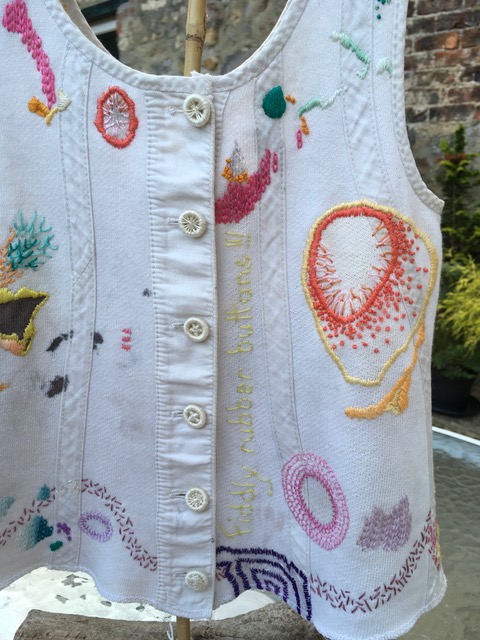
As already mentioned I am of a certain age, but to my surprise one of my bodices resurfaced a couple of years ago when my late father asked if I remembered this ‘cloth’. He had been using it for decades as a shoe polishing cloth.  Although badly stained it was still complete and somehow it set my creative juices going….which meant dad had to find ‘another’ cloth! Sadly the rubber buttons totally dissolved when I laundered it.

Above I’ve started stitching, although I didn’t like it. Nearly two years later and the juices had found the right recipe. I’m sure I’m not alone in this regard. I started to stitch around the stains using different colours and types of stitch, but nothing tooooooo complicated. It helped me remember many happy times growing up.

From my avid explorations and research on (read that as addiction to!) Pinterest I gleaned some useful ideas, combined with input from my EPH (Ever Patient Husband – he is a brilliant hobby painter so has a good eye) and others, I finally completed my slow stitch piece. The last few days were not quite ‘slow’ stitch as I wanted to enter it into a village show. Then came the method of presentation problem.

Using a piece of polished driftwood, I roped my neighbour into helping me create the stand – the night before!

I titled the piece….Polished Childhood. I could say more about the colours and continuous line of stitches but I’ll leave that to your imagination. Unable to replace the original buttons I recreated them by making individually patterned ‘Dorset’ buttons and stitching a comment about the rubber ones as a reminder. Dad would have loved the result and we would both have laughed and giggled at all the memories. Writing this has just made me realize the bodice is a tribute to him (and my still active mum)….totally by chance.

EPH and I arrived at the show just at packing up time….WOOHOO……..a red ticket I will certainly treasure!

Thanks for the wonderful post Antje! I am sure it will bring smiles to the faces of those who remember wearing the same type of bodice.


West Carleton Fibre Guild’s tour of the Puppet exhibit

West Carleton Fibre Guild’s tour of the Puppet exhibit

Although the Ottawa Valley weavers and spinners guild is the largest guild in eastern Ontario, we also have many smaller neighbour guilds. One of the closest neighbours is the West Carleton Fibre Guild who hold their meetings on a Tuesday afternoon in Dunrobin, Ontario (just a bit past the west end of Kanata).  But the September’s meeting was special.

1 door of the museum

Back door of the Almonte Textile Museum


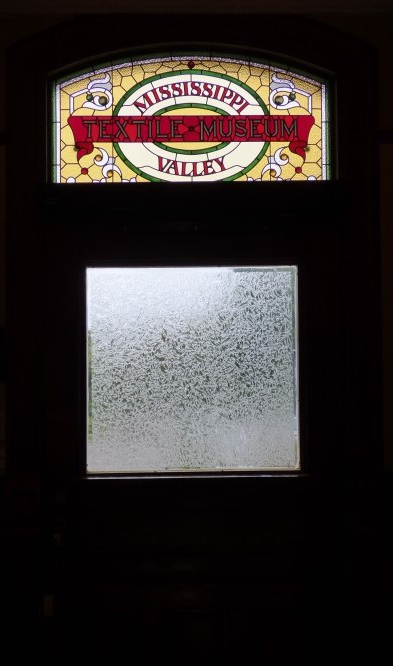
They had a field trip to the Mississippi Valley Textile Museum in Almonte. The trip was planned so they could have a special tour of the Puppet exhibit by Noreen Young.  At present there are 3 exhibits at the museum.  There permanent display of Mill equipment and modern weaving looms, a spectacular quilt exhibit and Noreen Young: a Puppet Retrospective.  With 150 examples of some of her life’s work in puppetry.  She is internationally known and has received the order of Canada for work with producing, writing and puppeteering in many children’s and educational programs.


2 Poster for the exhibit            3 fist puppet in the exhibit

Poster for the exhibit.                                   First puppet in the exhibition (a rod puppet with detachable legs

4 Noreen with her first puppet Noreen with her first puppet

She gave us a tour through the exhibit explaining different puppets and giving anecdotes of her work with them.  She was asked if she had a favorite and told us her Granny character, Mrs. Gertrude Diddle and Gloria Gopher she was particularly fond of.  She took some down from the display and showed us how they moved and what they voice sounded like.  She did the voices for most of her puppets but occasional had to lip sink to a voice actor which was harder.

Almost all her puppets were to be worked with the puppeteer below holding one arm up to operate the mouth and the other hand controls the rods to move the hands. She showed us how it was important to make the puppets bob as they moved or it looked like they were skating along or floating in the air witch just wasn’t right.


Her earliest work was in the 60’s “Hi Diddle Day” 1967 to 1976. These puppets are in a glass display case with a couple more the puppet cast.  Not all the puppets are in display cases though.


Displayed on shelves with monitors showing bits of the program they were used for beneath them were the Puppets for “under the Umbrella tree” which ran on CBC, Disney and Canal Famille from 1987-1997.

7

8

She explained about the studio being an old garage and having a lower ceiling than studios usually had.  So the puppeteers had to sit on rolling boxes since they could only raise the live actor up a certain height before the ceiling was a problem.  For most shows she said the puppeteers stood on the floor with the live actors raised on platforms so they could interact with the puppets.  The head bands the puppeteers are wearing holds their mikes.  This insures the mike is always the same distance from their mouth as they switch between looking up at the puppet and down at their scripts.


There were puppets from series I didn’t remember but am now sorry I missed. “Bats” from a 1987 Pilot.

12

Also “Wacky Palms” from 1994 about a small boutique resort in the Bermuda triangle.  Run by a cow with a theatrical past and with an eclectic staff.  Strange things happen when a time portal opens and havoc is unleashed upon the hotel.

13

She said that some of her most effective puppets had elements of movement such as the feathers for hair, parts that dangled or the way the fabric moved with the puppet.


Noreen was also known for her Caricatures of real peoples.  Her Prince Charles from 1975, created for “What’s new” a kids news show for CBC, is very recognizable.  She also made a copy of the mayor of Ottawa.


222324

She has made caricatures of may Almonte area people (about 50 on display) who have been used in various puppet shows in the area.  She was the artistic Director for “Puppets up!”; an annual international puppet show from 2005 to 2016. International puppet shows from across the planet performed in the tiny town of Almonte.

There are some puppets that can be interacted with.  It will take 2 people to run them one is the head and hands and a second person runs the feet.

She did puppets for and educational spot about food nutrition.

This is the Granny Bride puppet she made for a friend in 2000.

30

I didn’t recognize this group of puppets but it looks like an interesting cast.

31

Her last work was with a puppet opera called “sleeping rough” which was performed in Ottawa 2018 as part of the series music and beyond.  (https://www.youtube.com/watch?v=RVQGUjLM-WU&feature=share )


Most of Her puppets are made by sculptor the head in plasticine then casting it.  She uses the cast to create the flexible, expressive rubber faces she uses in her puppets.

She has given 3 workshops on making puppets during the run of the exhibit and has another lecture to do before the exhibit closes. My husband was lucky enough to get a spot in one of her workshops.  She said he was very well prepared and had amazing focus making his puppet Blacksmith.  He said he had a blast and was very glad he had gone.

40
Glenn Martin Blacksmith puppet


This exhibit made me smile!  I couldn’t help but feel happy looking at all the puppets many I recognized. I am sure you would enjoy seeing them too.  Keep an eye out for Noreen she says she drops by regularly to the exhibit.


The Exhibit runs to September 22 2018 so if you have a chance jumps in the car and ask the GPS to take you to the Mississippi Textile Museum https://mvtm.ca/?exhibition=noreen-young-retrospective


MISSISSIPPI VALLEY TEXTILE MUSEUM
3 Rosamond Street East, Almonte, Ontario K0A 1A0

Phone: (613) 256-3754
Email: curator@mvtm.ca

Fall/Winter HOURS

  • Tuesday to Friday 10am – 4pm
  • Saturday noon – 4pm
  • Closed Sunday & Monday

Museum Admission: $7.00
Members admitted without charge. Children under 12 are always free.


Joseph Banks Challenge

Joseph Banks Challenge

This weekend sees the launch of the latest body of work by Lincolnshire based textile group LINQS.  The group, which welcomes any gender and any ability, is now in its fourth year.  The only criteria for becoming a member is that you must reside in the county of Lincolnshire.  Members are given an annual challenge to make a quilt, or quilts, based on a particular famous person, place or theme.  It was being invited to join LINQS in 2014 that first got me started on the path to textile art so I have a lot to thank them for!

Our first challenge was Inspired by David Hockney.  The group had a terrific response from local ladies and secured a national tour with Grosvenor Shows with our quilts being displayed up and down the country.  Our work visited venues from Ardingley in the south to Edinburgh in the north and various places in between.

These are just a tiny number of the quilts in the first exhibition…..

By Wendy Skinner
By Mary Jackson
By Textile Lincs
By Carol Parkinson

Being completely new to this medium I was fired with enthusiasm and produced four quilts.  The first was a small black and white take on the painting “Woldgate Woods”….

My next attempt was based on a photograph taken by the river in Horncastle, keeping with Hockneys recurring theme of “trees”.

The third one was my take on a 1954 mixed Media self-portrait….

By now I was gaining confidence and moved on from making small quilts (30cm x 40cm) to making my fifth quilt which was 30” x 40”…..

The following year it was decided that in future we would make our person, place or thing “Lincolnshire” based and Isaac Newton, being born in the county, was selected.  These are a few of the quilts from that show created by four of the members…..

By Karen Lane
By Mary Jackson
By Jean Proud


By Pat Cave

Our third challenge was to make quilts inspired by the famous Botanist and Explorer Sir Joseph Banks whose family estate was at Revesby.  The first showing of this body of work will be this Friday at “The Village”, Lincolnshire’s only living museum, which is in Skegness.

Banks became the president of the Royal Society in 1777, where he remained until his death in 1820. He was known as a prominent endorser of travelers and scientific men. Many voyages of discovery were approved and carried out under his supervision. He was the first person to introduce the Western world to acacia, mimosa, eucalyptus and Banksia, a genus named after him. About 80 other species of plants were also named after him.

While researching Banks I came across an image of a Banksia Seed Pod which had been charred in a bush fire.  Anyone who knows my preferred colour palette will recognise why this provided the inspiration I needed for my Banks quilt!

I began by making a background using cotton fabric and painted tea bag paper……

Next came the individual “pods” (no idea of the proper technical term for these bits!) which were cut from painted interfacing free machine embroidered and wadded with thick felt…..

The main body of the Seed Pod was wet Felted Norwegian fibres, free motion stitched before adding the “bits” on top.  My finished piece measures 48cm x 30cm.

I can‘t show you anyone else’s work as I don’t have photos as yet but if you are in the Skeggy area this weekend why not drop in and see them for yourself.  For everyone else I will post an update very soon.

Painting with wool

Painting with wool

For today’s blog post, I am sharing with you a workshop I went to, where Dani Ives was teaching how to paint with wool. If you haven’t heard of Dani’s work, I highly recommend you check out her website.

Dani+Ives_Luna+Portrait
Portrait of Luna, copyright Dani Ives (taken with permission from the author)

Before we get started, what exactly is “painting with wool?” It is a 2D needle felting process whereby you pick a theme, copy the design onto flat wool sheets or another type of fabric, and then proceed to “paint” it with different colour wools using felting needles.
This term was coined by Dani Ives when she realised she was essentially using wool the same way painters use paint to represent an object.

IMG_3267
My “classmates” before we started

I was asked to bring an image to reproduce. My main goal with this workshop was to learn how to do 2D pet portraits, so I decided to be ambitious and chose a photo of my cat Marshmallow.

Marshmallow png
I’m being ambitious but not overly so – her eyes are closed

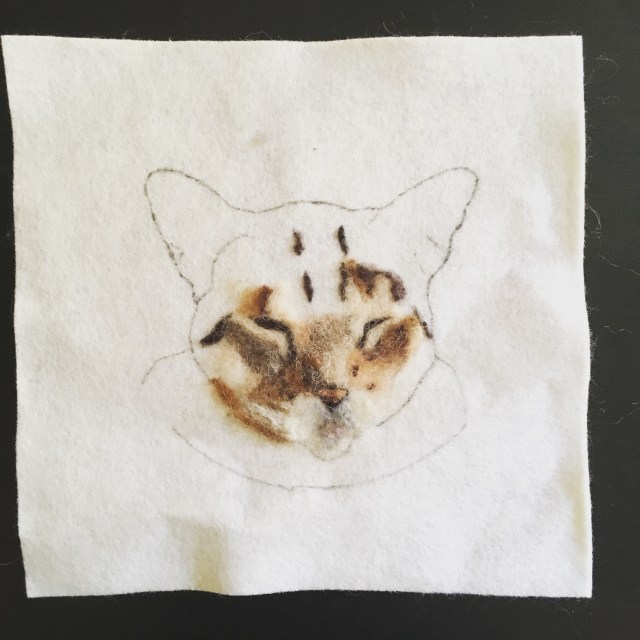
After transferring the image onto the felt fabric with an ordinary pen, it was time to pick the appropriate colours to use. I confess this is the part I have the most trouble with, because you have to think of the colour not only “as is” but also have a little sense of how it will look after it’s been blended with the others around it.

IMG_3268

We then proceeded to apply the wool onto the surface and needle felting it in place. You need to keep the reference photo at hand and look at it often, as it’s very easy to get carried away and start using artistic licence – you don’t want to do that when you’re going for a faithful reproduction!

IMG_3273
There’s more hours put into this than I want to admit

This is a slow, laborious process. Obviously you will get quicker as you become better but I sure took long to reach the above phase.

IMG_3315

This is my current progress. It’s slowly coming together. I can’t wait to see this finished.

Finally, I had to share my fangirl moment, a picture of me with Dani Ives herself!

IMG_3270

Have you ever done any 2D needle felting? Let me know how it went for you in the comments section. Thanks for reading!

Autumn Necklace

Autumn Necklace

Although we’ve got baking temperatures and scorched grass outside, indoors I’m amassing quite a collection of Autumn leaves made from Lutradur!  I’ve decided its time to start thinking about what I’m going to do with these leaves and incorporating some of them into new pieces of work.

This particular leaf has been painted with Dylan bronze fabric paint to give it a metallic look.

The leaf, top right, before painting.
Bronze painted Lutradur leaf

I decided to incorporate it in a very simple choker type necklace.  The leaf is quite intricate so anything fussy would distract from the detail.

I began by cutting out a 4cm wide crescent shape from a piece of white superfine Merino prefelt 20cm x 29cm.

This was overlaid with Oyster Merino on the left and Antique on the right.


I made the felt quite thick and really worked it hard to shrink it and firm it up which resulted in a very textural effect and a subtle change from one colour to the other.  The leaf was sewn in place using a bronze coloured linen thread.  There is a chain fastener across the back but for now you will have to take my word for that…….I didn’t think to photograph it and I’m writing this post sitting in my B&B in Scotland while the Necklace is back home!  I will take a picture and add the image when I get back.

Chico the needle felted dog

Chico the needle felted dog

Hello, Leonor here. My guest post for today is going to be a simple “show and tell” as the weather here in London is too warm for complicated thoughts!

Some of you might be aware that I am a fibre artist by trade. Anything wool and I love it. I got into this business a little by accident, and making custom needle felted dogs was even more unexpected – basically, a friend asked me for a mini of his whippet, I took the challenge, and the rest is history!

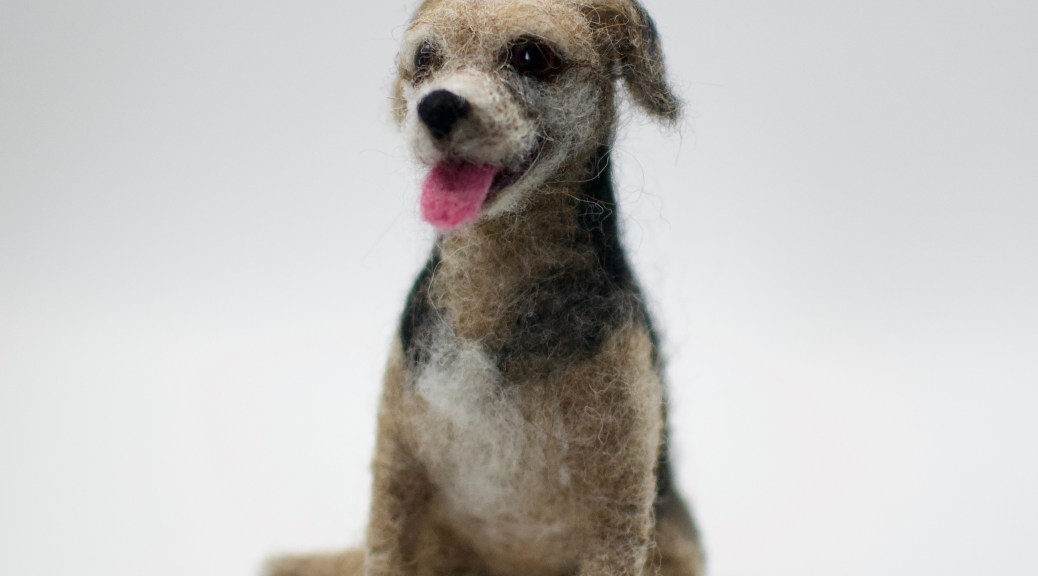
I’ve now been playing with wool professionally for around 5 years, and I must confess there was one hurdle I was yet to conquer in my work – creating an open mouth. I’d tried once and it didn’t come out right, so I more or less gave up on it. That is, until I made Chico!

DSC_1102

At first I was going to make his tongue out of polymer clay (the idea of finishing it off with a nice layer of glossy varnish to mimic moisture was very attractive to me) but then I decided not to. I liked the idea of a 100% fibre sculpture better.

DSC_1106

I made the lower jaw separately, making sure the upper section was thin enough to accommodate both parts without looking weird. I added a layer of black around the edge to make it more realistic, and then a little white on the back for teeth. The tongue was made using two shades of purplish pink blended together. I made two mini tongues and chose the one that fit best.

DSC_1110

I received a few reference photos to make this little guy, my favourite was one where he was sitting with his leg to the side and smiling. I just had to make him this way.

DSC_1115

I love the detail of paw pads, the feet immediately look real. You can’t really tell from this picture, but Chico is er… anatomically correct. I like a realistic sculpture!

DSC_1114

Below is a picture of the original Chico. The mini version is off to a Spanish island as a surprise for the whole human family. I hope they like it!

unnamed

Have you ever created a needle felted animal? What wool did you use and how did you like your experience? Let me know in the comments section.
Questions? Happy to help, just leave a comment!