Browsed by
Author: Marilyn aka Pandagirl

Small but Tricky

Small but Tricky

Since we’ve been traveling a lot this winter, I wanted a small project to work on. I’ve had a  frame for a small coin purse sitting around for a while. So, I decided to try that.

Unfortunately, the first one I made was too thick.  I had used three layers, the middle layer corriedale. I set it aside and when I returned I tried again.

I like the idea of using silk inside.  I had some yardage from a shop in Florida I purchased last year.  It was close enough to the turquoise batt I had on hand from another project.

20160325_155259

The first one was also a bit larger than I wanted. I’m always looking to lighten my handbag.  So, I had adjusted the resist to be a little smaller and used two layers. I also cut the silk to overlap so there wouldn’t be any gaps with the silk.  Of course, there is no guarantee it won’t shift during felting.

20160123_154933

I used mulberry silk to embellish it.

When I finished felting, I carefully cut the sides to match the curve of the frame.

20160325_155601

Then came the challenge — getting the felt into the frame and staying long enough to sew it on.  I tried Gorilla glue, but that made a mess and didn’t work.  I ended up using a blanket stitch around the edges then a nail file to push it into the frame.

The frame had holes on one side and a longer solid piece on the backside.  In order to get the needle through to the back, I had to run it on an angle while making sure the felt stayed in place.  Very fiddly!

Doing the second side was more of a challenge because the felt kept slipping out. I did manage to finish it without throwing it to the ground or out.  It seems to be fairly sturdy despite using a single cotton thread.

20160326_120537 20160326_121101

I’m pleased with it, but it was a lot more work than I had anticipated.  I have trouble with working small in tight spaces.  My hands were not happy. We’ll see how well it wears.  But I can guarantee there are no more coin purses in my future unless I design my own without a frame.

20160326_121301

Have you made these?  Is there a trick I was missing?

Workshop with Vilte Kazlauskaite in Slovenia

Workshop with Vilte Kazlauskaite in Slovenia

Our guest artist/author today is Nada Vukadinovic also know as Halay on the Felting and Fiber Forum.  She has generously offered to share her workshop experience learning a Fiber Inlay Technique.

A few weeks ago I attended a workshop in Maribor, Slovenia, given by internationally renowned textile artist and felter, Vilte Kazlauskaite from Lithuania. Her work is fabulous. You can see her creations here: http://vilte.tumblr.com/

She held three workshops, but I was able to attend only one. It was called Fiber Inlay Technique. Quite intriguing, I had no clue what this could mean and I was very excited to learn about it.  I attended only one afternoon workshop. On  the previous day attendants learned something about  fabric manipulation in nuno felt, and the last day was devoted to the creation of a vest.

We were working with two types of silk: ponge and chiffon and were expected to create a piece of work, either a shawl or something similar, a flat piece anyway. I decided to make a square piece which I will probably use for a cushion.

First we were asked to draw a pattern on a piece of paper in the form of a mosaic that we would like to appear on the finished work, e.g. a bird, or something abstract.

I decided to draw something simple.

photo3

We used different sorts of fiber (mulberry silk, viscose, bamboo, and flax.)

photo6

photo16

When we were finished laying out fabric and fibers we began rolling and rolling. When we noticed that the wool has penetrated through all the layers of silk, we started kneading the piece and then rolled the project without the rod. The shrinkage percent was from 40-50%.

This is what we got in the end:


photo14 photo15

Unfortunately, we were working only with white silk and some blue and white fibers, but I imagine it would be interesting to play with different colours, especially different colour fibers.  The fiber I personally used for the first time was flax and  fell in love with it.   I am already planning  to buy some and dye it.


photo8

To put fiber inlay technique in a nutshell, it means lots of silk and different fibers. Here are some more photos showing Vilte’s work: beautiful textures.

photo1

photo10photo12 photo13

And here is some yummy hand dyed silk.


photo9

Vilte uses natural dyes only.

It was nice to learn something new. Here in Slovenia we don’t have many opportunities for learning new felting techniques, but the situation seems to be improving. We are planning to invite another master from Ukraine and are getting quite excited about it.

Thank you Nada for sharing this exciting technique with us!

A Different Easter Basket

A Different Easter Basket

We were recently in California for our Granddaughter Lisa’s first birthday.  I had intended to make an Easter basket before we left but it didn’t happen.  So, when I returned home I decided to make more of a bowl using the colors from her party.

20160313_120239

I made a batt using a light turquoise with touches of pink, purple and blue.

20160320_154113 Then I embellished the bowl with pink and gold mohair yarn and mulberry silk. (She likes bling.)

I used a resist thinking I could stretch it out on a ball to smooth, but it was a bit too small for the balls I had.  I tried blowing up a punch ball, but that didn’t work either.

So, I ended up stuffing it with plastic bags and it turned out nicely shaped.

20160321_123854 20160321_123859

I was pleased with it when it was dry.

20160322_113050 20160322_113003

Here is a closeup.

20160322_113011

Lisa’s favorite snack is what her parents call “puffs.”  Those nuggets that melt in the   babies mouth.  So, I stocked up, stuffed some in plastic eggs and sent the rest in the package along with a stuffed bunny.

20160322_113655When she gets a little older, I’ll make her a proper basket.

The basket arrived in time, I’m just a little late posting. She did enjoy her puffs and playing with the bunny and eggs.


Yak, Mongolian, Churro and Zwartbles Fibers

Yak, Mongolian, Churro and Zwartbles Fibers

Our Guest Artist/Author today is Zara Tuulikki Rooke sharing her experience with some exotic fiber samples.

The Felting and Fiber Studio Forum is an excellent place to exchange ideas and experiences with other felters and fiber enthusiasts around the world. In addition, I have also done a couple of fiber swaps with other members on the forum. I have sent wool from our Swedish sheep breeds and have, in return, received a wonderful variety of fabrics and different types of wool and other fibers that can be used for felting. Now I have tried felting some of the exotic wool that I have received from Nada, Zed and Marilyn.

Nada, who lives in Slovenia, very kindly sent me Yak wool, which she got directly from nomads from Tibet. Apparently, Yaks have three different types of fibers; long and thick hairs forming the outer coat (79-90 microns), an intermediate type (20-50 microns), and a very fine and dense wooly undercoat (16-20 microns). The softness/fineness of the yak undercoat is comparable to the better known cashmere wool (which is a fine undercoat of goats). This particular carded batt also included some coarser fibers, but most of it was very fine wool. I laid out two thin layers of wool, on a 20 cm x 20 cm ( 7.87 x 7.87″) surface, put on a piece of cotton gauze, and attempted to felt it.
1 Yak

The Yak wool was surprisingly easy to felt. It quickly shrank down to a compact square of 10 cm x 10 cm (3.94 x 3.94″), and the fabric has felted in firmly. The coarser fibers give the felted piece a hairy appearance and reduce the softness, but I can imagine how luxurious pure, soft undercoat wool from Yak must be.
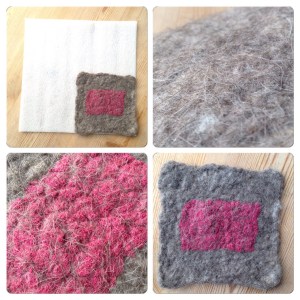
2 Yak

Zed, who lives in England, sent me some carded wool labeled “Mongolian.” A search on the Internet showed that there are quite a few local breeds of sheep in Mongolia, and crosses with imported breeds with finer wool. I found an article titled Sheep breeds of Mongolia describing 15 of their indigenous breeds of fat-tailed carpet-wool sheep. Our Swedish native breeds belong to the group Northern short-tailed sheep, while the sheep in the group fat-tailed sheep are adapted to harsh environmental conditions and are common in Africa and Asia.
Sheep breeds of Mongolia link:  http://www.fao.org/docrep/U4900T/u4900T07.htm#TopOfPage

I didn’t get any closer than that in the identification of the wool, but the carded wool feels like a mixture of coarse and slightly finer fibers, mostly black or dark brown (perhaps sun-bleached) with occasional white fibers. To be able to compare this to other wool, I chose the same method as I have used to make previous samples, i.e. 10 g of wool laid out in four thin layers to cover an area of 20 cm x 20 cm, and on top of it a piece of gauze. The wool was very easy to felt and full, and shrank to 12.5 cm x 12.5 cm (4.92 x 4.92″). Compared to Swedish wool, the felted piece feels similar to those I felted with wool from our landrace breeds Klövsjö and Åsen, although slightly rougher to the touch.

Previous samples can be seen here:  http://feltingandfiberstudio.com/2015/11/25/different-types-of-wool-from-a-swedish-felters-perspective/

3 Mongolian

Marilyn, who lives in the US, sent me wool from the American breed Navajo-Churro. The breed has its origin in the Spanish breed Churra, which the Spaniards brought with them when they colonized, what is now, the southwest of USA. Navajo Indians got hold of the sheep and saw a value in the wool, from which they made carpets and other weaved textiles. The breed’s origins, near disappearance and subsequent rescue, and its significance for Navajo culture and textile crafts, is a really interesting read. More on that can be found at The Navajo-Churro Sheep Association and The Navajo Sheep Project.

The Navajo-Churro Sheep Association link:  http://www.navajo-churrosheep.com/sheep-origin.html
The Navajo Sheep Project link:  http://navajosheepproject.com/churrohistory.html

The Navajo-Churro have a variety of colors, and three types of fibers. About 80% of the fleece consists of undercoat wool (10-35 microns), and the rest is coarser outer coat hairs (35+ microns) and less than 5% kemp (65+ microns). This wool was also easy to felt and full, although it didn’t shrink quite as much as the above. The final size was 15 cm x 15 cm  (5.9 x 5.9″), and it has quite a hairy appearance. In the photos below you can see the pure white kemp fibers that do not felt. But I like the rustic look and the different tones in the brown wool.
4 Churro

Zed also sent me some wool from Zwartbles sheep, which is a breed from the Netherlands, primarily used as meat and dairy sheep. The wool is black to sun-bleached brown, and the sheep have a white blaze on the face (hence the name “black” + “blaze”) and white socks on 2-4 legs. Pictures and more information about the breed can, for example, be found on The Zwartbles Sheep Association link.

http://www.zwartbles.org/

The wool is described as medium to fine (around 27 microns), thick and springy with a good crimp, and popular for spinning and felting. The latter surprised me, because to me this wool personifies all the descriptions I have read about wool from meat breeds, which are generally considered difficult to felt. It is really spongy and bulky, without any shine, and even makes a slightly crunchy sound when you handle it. I would describe this wool as something that should be excellent to use as pillow stuffing. But maybe it works well for needle-felting, and I actually found some examples on the internet where people vowed that it was good for wet-felting. So, I had to give it a try. It was not easy to press the wool down and start the felting process with soap and water, but after a while, the fibers began latching into each other. Then I tried fulling, with a little rougher handling, and then it started to disintegrate completely. The very loosely felted and spongy piece is the same size as it was from the beginning, and I am astonished that piece keeps together at all. Different types of wool definitely have their different uses, and this would not be my first choice for wet-felting.
5 ZwartblesZara, thank you for your insightful and detailed analysis of these fibers!

A Parting Gift

A Parting Gift

My favorite physician is retiring this month and I wanted to give him a special parting gift.  So, what better than a good bottle of wine with a handmade cozy?

I had made a wine cozy/gift bag a while back, but the resist was just a bit off.  I took Lyn’s advice and straightened the lines and rounded the bottom slightly.

20160227_145820

I made some Nuno prefelt for the leaves and rolled a variety of grapes in preparation.

20160227_145944 20160227_150157

I didn’t want to replicate the whole first design, so I decided to have the grapes hanging from an old worn fence.  Of course, I forgot to take pictures after I laid out the background and began adding the design elements.  My bad.

Unlike the first one I did using corriedale as the base, I used black prefelt.  Then added some light gray batts from my scarflette, a little mulberry silk and a darker gray for texture in the fence.    Then I added the grapes, leaves and vines and began rubbing.

Some of the vines and grapes were stubborn so I had to do a little needlefelting to fix them after the fulling.  Also I think because of the prefelt, there wasn’t as much shrinkage, so I had to keep fulling to get a good fit.

For the turnover top I used a little green batt on the inside and attached the leaf and vine.  I made a few holes and wove the vines through the top to tighten it slightly.

Again for the bottom, I took Lyn’s advice and bashed the heck out of the bottom to get the rounded shape I needed.  Thanks Lyn!

Here are some views and a close up.

20160301_164913 20160301_164901 20160301_164851 20160301_164926(0)


Ooops!

Ooops!

We’ve talked a lot lately on the forum about projects not turning out as planned.  Sometimes we have happy accidents like my scarflette that turned out better than I had planned.  However, that’s not always the case.  That’s why we all have UFOs.

Last year I decided to design a credit card wallet. I spent a lot of time measuring and making resists and batts, cutting prefelt and designing a master pattern complete with shrinkage built in.  I wanted it to be functional enough to be able to put most of the things I use in one place.

20150429_161653 20150428_113623 20150429_163547I didn’t have a wallet to use as a model, so I winged it.  I used the prefelt as the base and began adding resists then the batts on the inside.  To keep track of where my folds and placements were I used pieces of threads to help keep everything in line.

On the inside I wanted three long pockets, then eight credit card slots. There is one resist under the red batt.

20150430_154427Then I added the second lower pocket offset about a half inch, and began putting the credit card slot resists in.

20150501_151307

20150501_152541Once I finished adding the slots, I turned it over and added resists on the front. I wanted a license holder and a pocket.

20150501_160550Then after covering in black merino and decorating with some red silk throwsters waste, I began the felting and fulling process.

The hardest part and one of my big mistakes was cutting out the resists. I decided to use an Exacto knife to cut the top large opening.  Guess what?  Yes, that’s a pen sticking thru.  I couldn’t figure out how to take a pic with my finger thru it.

The lower hole is where I wanted the pic ID to be.  Unfortunately, it wasn’t large enough to put in the whole ID and cut out a window to view it.

20160226_12570820160226_125521

The pocket on the front was also too small an opening to put anything in there that wouldn’t fall out.

20160226_125849

On the inside the larger pockets were functional, but I made a mistake with the credit card pocket by making each row a little deeper.  Duh, what was I thinking?  All credit cards are the same size!

20160226_125616


There was room for cash and a checkbook and coupons, if need be.  However, the credit cards were a disaster.  I couldn’t reliably put them in there and think they’d stay put.

20160226_125503Folded over it doesn’t look bad on the front.

20160226_125843 The back is a different story.

20160226_125849

I had considered trying to save it, but I don’t believe it would be worth the time since many of the proportions are off and there a gaping holes. However, I did learn a lot from the experience.

  • Try not to make the project too complicated
  • Use a model for size proportions
  • Never use an Exacto knife to cut out a resist

I hope this may help others when they are planning a big project in the future. 🙂


Combining Weaving and Felting by Fiber Artist Cathy Wycliff

Combining Weaving and Felting by Fiber Artist Cathy Wycliff

For many years I have been a lover of textiles, but I never wanted to knit or weave. Too fiddly….knit, purl, knit, purl. Or weave to a pattern but first figure out the sett, the epi. No, not me.

And then last year, I saw Meta vd Knijff’s small homespun weavings on felt on Flickr. Meta also uses natural dyes and paints and takes cool photographs as well. Meta is an artist in the Netherlands who I discovered on Flickr. So, back to the weavings on felt. I thought, hmmmm, if I could do that with weavings, then maybe I would like to weave. Then I discovered Saori weaving quite by accident, somewhere on the world wide web and subsequently took instruction.

I discovered that weaving doesn’t have to have patterns, that weaving can be creative and free, and what’s more–I could combine it with felt.

Over the period of a week or two, I made a bunch of small sample weaves, no plan in mind whatsoever. Then I grabbed some pre-felt I had in my stash, some homemade and some commercial. I fooled around placing the small weavings on pre-felt.

IMG_1527sm

IMG_1526sm

IMG_1532sm

IMG_1537sm

Most of the weaving samples are cotton and/or wool, and all are woven on black thin cotton warp. There may be the odd novelty yarn thrown in there, since when I was weaving samples, I was not thinking about combining them with felt. I chose 3 samples to felt with: the largest is multi-colored, all cotton warp with all cotton weft. I chose a large bright turquoise commercial pre-felt batts called “Maori” from Opulent Fibers, which I recall being Corriedale. I used small pieces of the same prefect batt to cover parts of the all-cotton weaving.

The second largest piece was a weaving I made with mostly wool and some cotton weft. I used as pre-felt a piece I had cobbled together with my naturally dyed wool, half madder and half logwood. I did not use any wool wisps to cover parts of this weaving.

The last and smallest piece was a small sample weaving I made using partial wool, cotton and nylon weft on cotton warp. I placed the weave onto cider merino ( handmade by me) pre-felt–again no wool wisps to cover.

I felted all of them in the usual way but not rolling as long as normal because I had used pre-felt as the base. Besides, I was impatient to see how they turned out! All of them successfully felted, although I did use a bit of needle-felting to secure some areas, mostly with the largest all-cotton weaving. I think that will make a nice wall-hanging for someone who likes a lot of brightness in their decor. Unsure about the medium-sized one, perhaps a small wall-hanging or pillow-cover? And the third piece I have fashioned into a cuff with vintage buttons. The inside is soft as merino should be!

IMG_1546sm IMG_1557sm

IMG_1558sm

Any weavers out there? You really don’t need a floor loom if you would like to get started weaving. You can even use a table loom, a pin-loom, or just hammer some nails into an old wooden photo frame, and you’ll be ready to weave and felt!


Thanks Cathy for yet another fiber technique to try!

Scarflette with Locks

Scarflette with Locks

I was inspired by Nada’s scarflette a while back and thought it would be a perfect way to use some of the locks I received from Zara.

I dyed some Merino, Corriedale, Romney and Cheviot wool along with some silk habatoi and silk mulberry using Silver Gray acid dye. Then made some batts with the wool and silk.

20151212_115243

I pre-washed some of the locks using Zara’s method posted on the forum using netting and soaking.  I wasn’t sure what color I would use, but chose dark gray Gotland locks.

zara

It was a simple scarf  layout, but not a simple process.  I had never used locks, so I wasn’t sure how to space the locks. I anticipated a 30% shrinkage.  I needle felted the locks between two layers of batts using similar sizes and shapes. I also wanted a silk nuno close to the skin. I wet down the batts then added the silk on the back then proceeded with felting being very careful not to let the locks migrate or felt.  I worked slow and was attentive to the locks.

20160120_125915

What I didn’t expect was that not all the silk would get nuno felted.  I even added some fiber at the beginning of the process to those areas. No deal.  I worked diligently on those areas, but no change.

I was ready to throw it in the lost pile.  The locks were fuzzy, some of the silk wasn’t felted.  I left it for a couple of days and decided I’d make it work.  I knew it was fruitless to try to continue to felt.  The felt was solid. I originally had the design drape to one side and was going to cut the ends at an angle, but I folded over the nuno side to create a collar and liked that better.  The silk was a bit larger so I just let it ruffle over the edges.

20160125_111715I had to do some stitching to hold the silk on  in places.  But its pretty much invisible.

20160125_11140320160125_111425Originally, I envisioned a cool button on the front, but ended up with a snap on the inside. The button I had purchased would be hidden by the overlap.

20160125_111516

I wetted the wild locks and used a little leave in conditioner on them.  Not perfect, but my husband walked by while it was sitting on the counter and remarked on how beautiful it was.  (I never mentioned what I was working on or my disappointment. So, I guess it wasn’t a failure.)

I need to work on my locks skills.  I have no idea what happened to the nuno especially since my ginkgo piece turned out so well. Or why the locks turned fuzzy.

Any ideas?


Dyeing with Avocado Skins Part 2

Dyeing with Avocado Skins Part 2

My next step was to use the avocado skins for dyeing.  Again, the instructions varied.  Some said to tear the skins, others use whole.  I went with using the whole skins.

I used approximately the same amount of wool, thick and thin yarn, silk habatoi, silk gauze and cotton voile.  What I did differently this time was to put everything in before it was heated.  I felt this would save some time waiting to put in the wool after cooling. I’m not sure this changed the outcome.

I let the pot come to a boil,  left it to simmer for almost an hour.  Then let it sit overnight to cool.

The results were interesting and different from the pits.  The color was like a latte for the wool and silk.  The cotton was a very pale pink.

20160123_114840 20160123_115531 20160124_115819 But I couldn’t stop there.  I had saved the dye pot from  the pits and used half and half with the skins and pits.  I also presoaked the wool, silk and cotton in an alum mordant for several hours.

20160124_120502

Again, I added the fabrics and wool before heating, heated to boiling then simmered for almost an hour and left it all sit overnight.  I wondered if the colors would be brighter and more intense with the addition of the alum.

Here are the results:

20160125_112754

The result a little more coppery except for the cotton.

Now here they are next to each other.  From left to right – pits, skins, pits and skins with alum.

20160125_113312I thought it was interesting that the silk gauze was the deepest color in the mixed batch.

They are all lovely colors. Now to figure what to do with them.  And yes, I’ll continue to save my avocados.

Dyeing with Avocado Pits Part 1

Dyeing with Avocado Pits Part 1

I don’t know where I ran across the blog on dyeing with avocado, but I eat a good amount of it and always feel guilty throwing it out.  My Son Brad and his wife Mari compost, but we don’t maintain a big enough garden to justify a compost heap.   So, when I read the blog and did some further research, I started freezing the pits and skins.

When I had about ten or eleven of them, I started my dyeing project.  There were several posts on how to dye with the pits.  One said to use the whole pit, another said to cut them.  I had started cutting them so I went with that.

20160120_121901

I prepared some merino (76 gm, thick and thin yarn 4-8 gm, silk habatoi -1/4 yard, silk gauze 1/4 yd and cotton voile 1/8 yd) by washing with synthropol and rinsing then soaking.

I put the pits in about 2 gallons of water and brought it to a boil, added the fabrics, then simmered for an hour. I let it cool down then added the wool and let it sit overnight.

20160121_111822

Here is what the liquid looked like.

20160121_113702

After rinsing and letting it dry, here were the results:

20160122_110441Close ups:

20160122_110547 20160122_110538 The silks were a pinkish coppery color and the wools a lighter version.  The cotton voile was a brighter pink.

Have you ever tried this?

Next up is the avocado skins.  Stay tuned until next week…