Browsed by
Author: Marilyn aka Pandagirl

More WOW Samples

More WOW Samples

I tried more samples of the fibers Cathy and I had ordered from World of Wool back in February.

I chose six of the fibers to try.  Three dark, three light. I used two layers in each of them.

2015-05-15 14.05.03Its not obvious from the fiber layout, but there were some big differences in the feel of each.

From the top left to right:

Black Welsh                            White South American with Rose Fiber embellishment

Light Gray Swaldale               White Faced Woodland

Gray Massam                            White South Down Top

The Black Welsh was coarse to the touch. White South American  was very soft with a longer staple. The Swaledale was soft and variegated.   The White Faced Woodland was soft. The Grey Massam was soft as roving.  The White South Down top was soft and had some black fibers running through it.

After felting to a prefelt stage:

2015-05-17 15.58.04

The Black Welsh was softer  and lighter than expected.  The White South American was soft, and more compacted than the others.  It felt more like merino. The Rose fiber melted right into it.

The Swaledale was bristly to the touch, but light and only slightly spongy. It wasn’t as variegated once felted. The Woodland was the thickest of the samples slightly coarse and very spongy.

The Massam was flatter and firmer than all of the samples and coarse but had soft finish, very hairy. The South Down Top  was spongy and not as soft as the White South American. This was the only one to show any shrinkage during the process.

Grey Massam
Grey Massam
South American with Rose Fiber
Grey Swaldale
Grey Swaledale
Black Welsh
Black Welsh

I haven’t used any of these fibers in a project yet, but am curious if any of you have and what for.  I purposely made prefelt so I could use it later and not waste the fiber.

I’m currently traveling, so if I don’t respond immediately please be patient.


3rd Quarter Challenge Entry from Lyn

3rd Quarter Challenge Entry from Lyn

Thanks to Lyn from Rosiepink for sharing her 3rd Quarter Challenge Entry with us today.

I found the first step in the Third Quarter Challenge (generating a colour palette from a photo) very time-consuming because I was fascinated by the process and just kept feeding photos into the generator!  I used http://www.palettefx.com/

Eventually I chose a photo of a photo that I took on last year’s holiday.  Her Majesty The Queen and Prince Philip are pictured in a room in the castle on the top of St Michael’s Mount in Cornwall, and the photo is displayed on a table in the same room.

I decided to make felt beads, so I chose five colours from the palette then blended many different colours of merino wool tops on my large hand-carders to achieve them.  I didn’t blend them to the max because I wanted the colours to be a little mottled. I’d printed the colour palette onto paper then used it as a blending guide, but the blues, although a good match for my printed guide, look different in the photo below to those in the image above, but printed versions are not always faithful to screen versions!

I planned to make a large multi-coloured felt ‘bead’ to cut into segments to make many beads.  I didn’t want smooth regular lines dividing the colours, so the wool fibres were put down roughly.  Yellow first.

I gently dry-rolled the fibres a little, spritzed them with soapy water, then very carefully rolled them for a few seconds using the mat not my hands.  It then looked a bit like a baguette.

I laid out the aqua-blue in a rough rectangular shape, spritzed it with soapy water, then rolled the yellow up into the aqua-blue.


I rolled it gently in the mat for a few seconds then placed it onto the summer-blue.

I carried on in the same way until I had used all five colours – ending with the darkest.
The giant felt bead was very fragile at the beginning so I didn’t want to put pressure on it with my hands. I rolled it using just a bamboo mat by flicking it backwards and forwards …

… and by rolling it, hammock-style, until it began to firm up.

I then hand-rolled it on the bamboo mat for 45 minutes, rinsed it, and put it in a warm place to dry for about 36 hours.  The finished bead, point to point, measured 14″ (35.5cm).


I used a craft knife to slice it into beads of varying thicknesses. Some cuts were made on the diagonal to produce oval beads, some cuts were straight to produce round beads, and the largest beads were cut in half.

I threaded 3 thick-cut beads and 10 half-beads onto a metal choker.  To get the placement as I wanted, I laid the beads on top of the metal then marked the curve by sticking dressmaker pins vertically into the felt beads.  I then stitched the half-beads together in their groups, so that in effect I had 7 wide beads. I made holes in the beads with a thick darning needle using the pins to guide the position of the hole.  Then it was (fairly) simple to thread the beads onto the choker.  I had been thinking about how to anchor the beads in place on the metal, but the felt is so dense that the beads stay in place on their own!

This and That

This and That

While I haven’t been very active on the forum, I have been busy with small felt projects and traveling.

Everyone had been interested in what I would do with my “denim paper.”  Well, I tore some of it up in pieces and placed them on a piece of black prefelt.  I put wisps of fiber over the larger pieces, just in case.  It felted beautifully.  I doubt I needed the fibers.  I added sides from some black felt and stitched it together to make a glass case.  I added a snap as a closure.

2015-05-20 13.29.05


2015-07-16 15.25.43 2015-05-20 13.29.37

2015-07-16 15.26.12

2015-06-04 11.50.46

Rummaging thru my UFOs I found a couple of spikes I had made in Fiona Duthie’s class last year.  I decided to make a ring holder with one attaching the fluffy end of the spike to a felt circle, covering with additional fiber, felting then forming a star shape while wet and adding beads when dry.

2015-05-21 12.05.29


I also made another clutch for my Florida daughter in law.  Yes, the Nelson women love all things teal. This has three layers using batts of merino Corriedale blend and decorated with yarn, silk hankies, silk roving and silk gauze.  The last pic is the inside lined with silk habatoi.

2015-07-16 15.23.01 2015-07-16 15.22.00 2015-07-16 15.24.39

What little projects have you completed lately?


Trunk Show

Trunk Show

My sister Lorraine is a quilter and has been involved with the Seams Like Fun Quilt Group for more than ten  years. She recently asked me to do a “trunk show” for the group.

The meetings are held at the Quilt Merchant in Winfield.  When we arrived there was a rectangle of tables.  Rather than rearrange the tables and group, we arranged a round about to let everyone have a chance to look at the pieces I brought as they were passed around.  Peggy Benzin introduced me and so the show and tell started.

I wanted to share a variety of pieces to show the versatility of felt.  First, I explained what felting was and how it’s achieved.

I brought about 35 items, a sample of most everything I’ve done. Many items have been given as gifts so they weren’t available.  The ladies were very gracious and asked a lot of questions.  I tried to give them an overview of each piece and the process and the differences in creating them.  Most of you have seen all of these so this is Marilyn’s felting journey in review for you.

My sister is next to me and is hiding behind the pieces as she showed and passed them. These were last year’s studio challenges.  The quilt group also has challenges.

Monet 2

Monet Pollack Painting with wool.

apopkaroostermoyThree dimensional big and small.

vase wine bottle pod grapes bootiefish - CopyThe ladies really enjoyed the fish.

Nuno felting.

teal gold scarf

Class project at The Fold.

placematChallenges and a variety of embellishments.

handbag

2014-10-31 14.00denim 2 book cover glass case inclusions

ipad

I enjoyed sharing my work and think I enlightened quilters to the wonders of felt.

Thank you Seams Like Fun Quilt Group for giving me the opportunity to share my felting journey! A special thanks to Peggy for taking the photos and sending them to me. And, of course, to my sister for inviting me.

group

Artist Residency — Breckenridge, Colorado

Artist Residency — Breckenridge, Colorado

Cathy Wycliff (Luvswool) shares her experience of her recent artist residency in Breckenridge,  Colorado.

Just about one year ago, I started thinking about artist residencies and how much I would like to be granted one.

I had lots of ideas in mind about where I wanted to go, and all of the ideas had to do with nature in all its beauty.

That could mean the ocean, the mountains or anyplace naturally beautiful. I started thinking about the National Parks in America and how much I have enjoyed visiting them over the years, beginning when I was just a child and the family packed up in the station wagon to begin the journey from Chicago to Colorado. We sometimes went to Wyoming and Montana as well, but we always started in Colorado.

There are many artist residencies available around the world, but I had my sights set close to home–that is, the USA.  Although I have enjoyed foreign travel over the years, I decided local would be a good start. I applied to three different organizations, and two of them came through for me (huge surprise!) and offered 2 weeks to one month artist residencies.

I completed my two weeks in the Arkansas Ozarks during April (you can see my previous post about natural dyeing on the Studio blog here   http://feltingandfiberstudio.com/2015/05/09/dyeing-with-plants/ ).  I was thrilled when I received the Breckenridge, CO artist residency offer for the full month of June, but because of obligations at home, I accepted a two-week residency.

I flew into Denver from Chicago, and then shared a Colorado Mountain van with several other passengers, arriving in Breckenridge late afternoon. The mountains greeted me in all their splendor, and after meeting the director of the Arts Council, I tucked into my studio/living space at the old Tin Shop.  Yes, you may notice from the photos that the shop looks old, and it is–from the mid-1800’s when this was a mining town. Many of the “downtown” buildings have been saved, preserved and restored–and many of them have been turned into artist studios and classrooms for the arts.

IMG_0694 IMG_0705 IMG_0732

IMG_0756

The first thing I did besides unpacking was to begin decorating the downstairs studio portion of my little house. But that would have to wait until morning, as I was struck with altitude sickness. Breckenridge is 10,000 feet and most well-known today for skiing, so that’s pretty high in the sky. I had read about this before leaving Chicago, so I was prepared with Advil, and I knew there was an Oxygen Bar in town. Some of the symptoms of A.S. include headache, fatigue, nausea, bloody nose, shortness of breath; and yes, I experienced all of them most of the time I was there.

So my art decor was not perhaps as good as it should or could have been (and neither were the photos taken with my I-phone), but I managed to spruce the place up a bit.  My main goal was to have a comfortable felting table table set-up facing the door so I could view folks as they walked in during “studio time.”

IMG_0766 IMG_0770
I would have loved to have brought my framed landscapes with me, but it was physically impossible; however, I did have business cards with my portfolio weblink available to all studio visitors.  I brought as many “soft” and light, unstructured items as I could stuff into a box which I previously shipped ahead of my arrival. Since I would be teaching a class, I also stuffed in as much fiber as I could in my carry-on duffel!

IMG_0767

The terms of the residency were very generous, with open studio time a requirement, as well as teaching one class. The rest of the time was my own.

Some of the wet-felted items I made while in Colorado include a mountain landscape, a vessel I named, “The Colors of Breckenridge,” and a large panel inspired by the Nebraska crop circles we flew over enroute to Denver.

IMG_0791 IMG_0820 IMG_0792
I also crafted a few nesting “balls” for the birds.

IMG_0768

I thoroughly enjoyed my artist residency in Breckenridge! People seemed genuinely interested in hearing about the process of wet-felting. The town of Breckenridge has done an amazing job of making the arts visible and accessible to all residents, including children. There is a full calendar of art classes, open studios, music and fun events throughout the summer. The downside was the altitude sickness which prevailed even with the help of Advil, the Oxygen Bar, and liters and liters of water. But the scenery, fresh mountain air, and the many friendly visitors I met made it all worthwhile.

Thanks Cathy for sharing this wonderful experience with us!

2015 Third Quarter Challenge

2015 Third Quarter Challenge

In keeping with our color theme for the year, this third quarter challenge is related to dyeing and blending from a picture using a color generator, then use the colors in a project.

We’ve had a very wet, cool spring so I chose a picture of a sunset at a Poipu beach on the island of Kauai where it was perfect summer weather. Thinking Spring/Summer!

I tried a few color generators  but settled on these two:  https://color.adobe.com/create/image/ and http://www.palettefx.com/

Here is the original picture:

2015-01-09 18.09.42


Then with the Adobe file:

Sunset Adobe

And the Palettefx view:

Hawaii sunset

I decided to dye some Icelandic roving with the three primary yellow oranges in the Adobe picture.   The colors at each end and in the middle. Let the mixing begin!

2015-06-15 15.58.39

Using a printout of the Adobe pic, I used my acid dyes which were already prepared and mixed each color using what I thought would come closest.  It’s really hard to tell from the color of the mix so I used coffee filters to write my formula and drop a sample at each stage.  It still wasn’t showing a huge difference.  I had already prepared the fiber, soaking it in vinegar water so I was ready to dye and hoped it worked.

I started with the middle color which the generator marked as base, then the color on the right, then the left.

Since I only have an induction stovetop in my work area, I wanted to do all the dyeing at once. So, I used zip bags and steamed them together in a large pot.

2015-06-15 16.14.042015-06-15 16.10.35

After steaming them for 30 minutes, I left the bags overnight to cool. The next morning I opened each one and was surprised that the roving was mottled.

2015-06-16 10.19.092015-06-17 13.48.21

Once the roving was rinsed and dried, I ran each through the drum carder.

2015-06-28 15.45.59

The blended batts weren’t exactly the colors I had wanted, so I took it once step further and started blending the batts with more roving to try to get the colors I needed.

2015-06-28 15.46.44Much better.

2015-06-28 15.49.17You can see the  blended colors were closer to the samples I had made with the dye.  Go figure.  I guess the white filter paper may have lightened them up.

Here is the progression:

2015-06-17 14.30.03 2015-06-17 15.31.14Number 1 (in the center) the formula was one tablespoon each red and orange, one drop blue and 2 drops black in one cup water.

Number 2 (on the right) –3 tablespoons red, 1 yellow, 1 drop black and 15 drops blue.

Number 3 (on the left) 3 tablespoons yellow, 1 red.

When I carded them I added white , black or blue to lighten or darken or mute the color.  I just adding until I thought the color was close enough.  There is no contest here, just satisfy yourself the color is close enough.

I really liked the purple and gray in the PaletteX picture.  I had some merino close to the colors so I carded the purple with white to lighten and black to darken and yellow to mute.  Then I had some steel gray merino that matched the gray.

2015-06-24 16.09.31

Now, what to make?  After a lot of thought, I decided to make an Ipad cover.  I didn’t want to replicate the picture just use these colors to to give the impression of a sunset.

I made the resist using a 30% shrinkage rate, then covered the resist with hand dyed silk habatoi added a later of gold merino I had dyed a couple of weeks ago.  The next layer was white Corriedale.

2015-06-26 11.33.14 2015-06-26 11.55.20 The final layer was the design using the colors I had just dyed and carded.

2015-06-28 15.53.21
Front
2015-06-28 15.53.29
Back
Inside
Inside

The inside ruched nicely and even mirrored the design on the outside.

Then in went the Ipad.

2015-06-28 15.56.05It is slightly larger than the Ipad.  When I calculated the shrinkage, I based it on Merino shrinkage not Icelandic.  But its okay since I can put in a pen and stylus.

So, for the challenge you can pick a picture and decide which colors you’d like to use, then dye/and or blend roving to get your colors.  There is no set number. I just got carried away. Then use them in a project of your choice – wet felting, needle felting, spinning, etc. Whatever, you’re comfortable doing.

This was challenging for me, but I learned  about color mixing and blending and just what the eye sees.  Of course, the printed version and screen version may also be different.  Just have fun with it!

I look forward to seeing your challenge pieces on the forum.


Gone Fishing…

Gone Fishing…

I don’t know if its spring or summer or something in the creative cosmic atmosphere, but it seems fish have become a theme for art lately.

Cathy (Luvswool) and I got together before she went to her Colorado residency and I went to Florida a few weeks back.  We wanted to do something different together.  We remembered the cool fish Galina ( Felicity) did a while back on  her blog and decided to try that. (Thanks for the inspiration Galina!)

We each made our resists beforehand.  Of course, we were busy chatting while deciding on colors.  It took a bit before we got started.

Cathy chose yellow and blue.  I went with my teal (I have sooo much) and purple.

2015-06-24 13.32.28

We each used three layers (one layer of domestic 56 batt in between) and tried to get the fish mouth like Galina had hers not too successfully.  I guess we need practice. We also used gems for eyes.

I made separate prefelt for fins and tail.

When I got to the prefelt stage on my fish, I cut out and attached the tail and fins. I couldn’t find the resists for my gills when it came time to take the resists out.

2015-05-20 13.27.53 2015-05-20 13.28.20

We weren’t trying to make exact fish, but have fun coming up with our own fantasy fish.

IMG_1425 IMG_1424 IMG_1423

Cathy did get the gill resist out, but it ended up too wide, so she embroidered it to close it up.  She also added some roving around the eye and needlefelted it to get it to stay.

IMG_1426 IMG_1427

I decided to work on another fish that week and ended up with two more just experimenting with colors and embellishments. I managed to get gills on the second one. I also added bottom fins by needlefelting them on. The eyes were hard to get even on each side. I got a little better at the eyes, but they’re still not perfect.

2015-05-20 15.53.05

2015-05-20 15.51.32 2015-05-21 14.49.53

2015-05-21 14.41.21

2015-05-21 14.38.37

2015-06-24 13.27.29 2015-06-24 13.28.50

I’m not sure how I’ll display them.  I originally thought I hang them in the bathroom, but I don’t think my husband would approve of flying fish.

Have you done any summer or fish themed projects?


Wooly Fun

Wooly Fun

Recently, my husband and I spent ten days in Florida with our youngest son and his family.  When we first arrived, I told our five year old grandson that I brought some wool to play with.  It was a busy ten days. On the last day he reminded me we were going to “make some wool stuff.”  His three year old brother was taking a nap so this was a good time.

Knowing the kids love bright colors, I brought a variety of merino colors to play with.  Luke chose orange, white, blue, teal and red to make a snake.  He helped me lay out the colors on a piece of bubble wrap.   He was fascinated when I mixed some soapy water — he didn’t want me to use dish soap, he was intrigued with the pieces of olive oil soap I brought.

When we finished laying out the two layers of wool, I covered it with a piece of netting and he proceeded to add soapy water with a sponge.  I had him do some rubbing before he began rolling between two pieces of bubble wrap.

2015-05-31 13.54.28

Sorry about the quality of the pics, this was a quick action packed process by an determined little boy.

We rolled it up at prefelt stage and rolled again in bubble wrap until it was hard enough.

2015-05-31 13.56.59

2015-05-31 14.00.52

2015-05-31 14.12.38

I laid it out on the porch to dry (with 90 degree weather it didn’t take long.)  Then I stitched on the eyes.

When Josh got up from his nap he went outside to play.  Within minutes he walked in with the snake in hand asking “why isn’t the snake moving!” I’m glad it was a wooly snake and not a real one!

2015-05-31 15.24.41

Since Josh didn’t have a chance to make his own, I made one for him when I got home using his favorite color green for the head.

2015-06-02 11.14.06 2015-06-10 10.04.00What wooly things have you made lately?


Featuring Tips on Beading from Artist Mary Stori

Featuring Tips on Beading from Artist Mary Stori

Mary  Stori is  a new forum member, but has extensive experience in quiltmaking and fiber art.  She introduced herself to us in January as “‘ a wanna be felter living outside of Asheville, NC.  For the past 25+ years I’ve traveled the national and international quilting circuit as an author, lecturer, workshop leader, cruise host…..bla, bla, bla.  The focus of my work began with wearable art, fine hand quilting, whimsical and highly embellished quilts.”

She attended a class with Chad Alice Hagen a few years ago and is now “hooked.” Her focus went from quilts to felt.  But one thing hasn’t changed — her love of embellishments, particularly beading which she has authored several books on. So, with her permission I have put together some of her tips from her blog on beading.

Storage

I’m often asked how I organize my beads……this method works well for me.

First of all……you won’t use them if you can’t find them, so take the time to gather them from all your hiding places, organize them, and then put them in a convenient place…no matter how many or few you have.

A location away from sunlight, heat, and excess moisture is best.

bead storage 1

Because there are no closets in my studio, my teaching materials are stored in a large walk in closet in a guest room nearby. The bulk of my workshops in recent years have focused on beading techniques or projects that incorporate beads. Therefore, I purchase a LOT of beads in bulk from a distributor for my classes. They generally come as strung kilos, which I repackage into kits and store in boxes and plastic bins.

Above is my own personal stash…… One entire side of the closet is fitted from floor to ceiling with shelves…and almost all are used to store my embellishments. I could consolidate them if the space was needed for other things, but as it is now, I’m easily able to walk in and quickly find what I’m looking for without having to dig through dozens of items stacked on top of each other.

floss cases2

I like to use plastic fishing tackle boxes, or embroidery floss containers. Beads are stored by style and color in see-thru plastic tubes or small bags. Here you see some seed beads.

hardware storage unit 3

Besides using beads, I utilize many other embellishments, trinkets, charms, buttons, found objects into my work. This unit has plastic pull out containers with large divided sections which are more suitable for these items. It too goes on my shelves in the closet.

slide.012 4

If tubes or small bags aren’t handy for you….try storing beads in small containers such as film canisters, pill bottles, or metal breath mint cases. If you glue a bead to the lid….you’ll always be able to quickly know what’s inside!

slide.016 5

Another big key to beading……is making your environment comfortable during the task. A table top or floor model Ott light will save on eye strain. As will a pair of ‘cheater glasses’. I always tell my students that one of the biggest secrets to successful beading is ‘spacing’….and the ability to see the bead and to judge the placement of the needle into the fabric is vital.

slide.017 6

Self-explanatory!

Bead Test

Many people are unaware that beads may not necessarily be colorfast. For instance, this beautiful blue bugle bead below may appear as if it’s blue glass. Not so……it’s clear glass that has been dyed or painted blue. Often the color remains secure on the bead, other times not. So…..if you think there’s a possibility that your project will be washed, become damp, or even require high steam for pressing…..take a few minutes and test your beads for colorfastness.

Most of the time, there isn’t a problem, but for that heirloom project….you’d be devastated if during a final steam pressing, the bead color ran into your fabric. The pricier beads may be just at risk as the less expensive ones…..you can’t tell by looking.

Here’s how to test:

– Fill a shallow dish with hot sudsy water….drop in a few beads….let it sit for 15 mins.
– Remove them…rinse and let dry on a paper towel.

Note….sometimes color will be visible in the water, other times….the color will slowly eek out as it dries. As you can see….this blue bead has run…..red is another color I check carefully.

Don’t let this scare you…….we are all aware that colorfastness can be an issue with fabrics……now you know that beads carry the same risk. Even if the bead color doesn’t run….sometimes the fancy coatings……that make a bead’s surface shimmer with various affects, (like rainbow) can dissipate……and the bead will lose its luster.

I’ve tested very, very few beads that I decided not to use……or that I’ve used with caution……beading is worth any effort….hopefully with this hint….all your projects will continue to shine brightly!
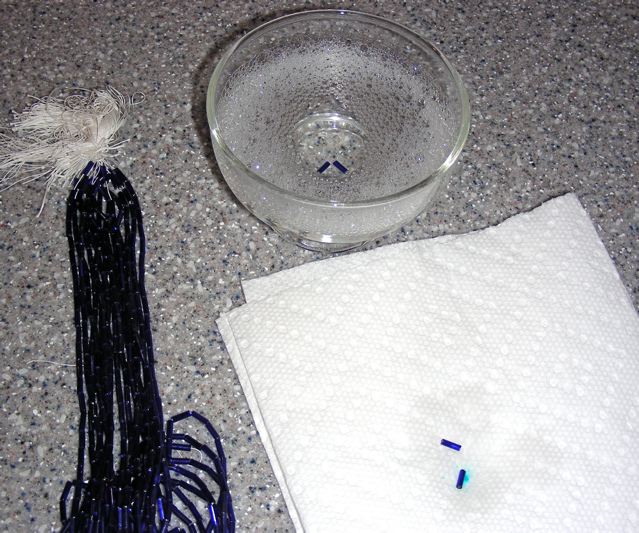
bead test

Beading Tip

I’m a stickler for good quality construction…..for me it’s not all about fast, rather…it’s about great design that has been executed to the best of my ability. If precautions aren’t taken, beading can cause fabrics to distort. Therefore, I ALWAYS secure my work in a Q-snap frame.  The only exception is when I’m beading the bindings/edges of my quilts.

DSCN2315

Q-snap frames are simply PVC tubes which come in a variety of sizes. This one is 11″ x 11″, my choice for smaller projects. The work is attached using clips that snap over the frame. Though you could use a round embroidery hoop…..I don’t because it pulls the fabric diagonally which can stretch the bias. I’ve found it’s best to keep the fabric ON GRAIN by using a square or rectangular frame when beading.

As for felt, unless the felt is super thick and sturdy, I always secure fabric (of any kind) in a Q-snap frame for beading and embroidery. However, I generally avoid using the plastic clips…….instead I attach the material using muslin sleeves or pin the fabric around the frame to avoid damage to the fabric and beads. There’s nothing more unattractive than distorted, stretched out wool!!!

DSCN2314

However, as the beading design develops, requiring repositioning of the fabric, I avoid using the clips in places where they could damage the beads. Instead, if the piece is large enough as it is in this sample, I wrap the excess snugly around the frame, and secure the layers together using straight pins or by thread basting. This keeps the fabric on grain, and well stabilized to assure good thread and fabric tension.

DSCN2313

My ‘artist’ inspired piece is now in the beading phase…. The piece is attached to an 11″x17″ Q-snap frame…note I used 1 clip at the top, where it didn’t interfere with the beads.

I also want to mention that I’m beading through 2 layers only…..the quilt top which has been stabilized with batting. This approach will hide and protect the threads once the backing is added later.

You can find more information on Mary’s website and blog.  She’s also the author of “Beading Basics,” “All-in-One Beading Buddy,” & DVD – “Mary Stori Teaches You Beading on Fabric” & “Embellishing With Felted Wool”

web: www.marystori.com
Blog: www.marystori.blogspot.com

Thanks Mary for sharing some of your beading tips with us!

Stepping Out of My Comfort Zone

Stepping Out of My Comfort Zone

Lately, I’ve tried to step out of my comfort zone with color and fiber and try some new things.

While this first example doesn’t look like it’s outside of my usual color palette, I did use some silk for nuno on this clutch and some coarser fibers like Corriedale that I made for my daughter in law.  The nuno is not as noticeable as I’d like, but I think it still adds a nice texture to it.

2015-04-13 11.21.45 2015-04-13 11.22.27 2015-04-13 11.22.42

Revisiting pods, I decided to really jump out of my comfort zone and use bold primaries on a black background. (It is a bit like some of Pollack style pictures I did for last year’s challenge.)

2015-04-14 16.28.52 2015-04-15 12.33.13 2015-04-15 12.33.19


Another project I’ve worked on was  hand dyed silk I made a while back.  I decided I didn’t want a long scarf so I cut the piece in half.  I used very little wool wisps on one side.  The joke was on me when I was finished felting.  It could be a scarf for a doll!  It had been a while since I did nuno and evidently forgot about the big shrinkage rate for silk gauze.  I do like it though.  I think I could wear it as a collar if not a scarf.

2015-05-11 15.36.46 2015-05-11 15.37.52


Most recently, I decided to play with some neutrals and coarser wools.  Cathy (Luvswool) was nice enough to give me some of the Domestic 56  wool she had dyed in Arkansas with plants. I really liked the colors. I made a batt with cream and brown Corriedale and another with some of the  hand dyed Domestic 56 for added color. I used a resist open at the top and bottom. The cream and brown became my inner layer.

2015-05-09 14.21.55 2015-05-09 14.11.55


I really liked the subtle colors against the neutrals.  The coarser fibers also added to the texture for a natural open look.

2015-05-13 15.27 2015-05-13 15.28


Having progressed through these projects, I have a whole new outlook on textures and colors that I hope to incorporate into my future art.

What have you done outside your comfort zone lately?