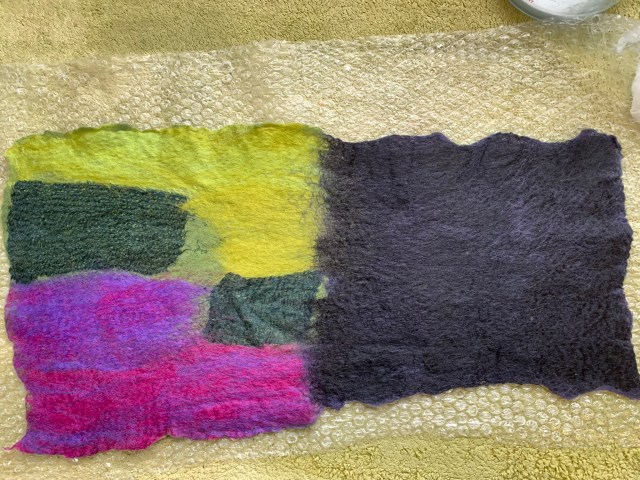
I’m a passionate wet felt-maker living by the sea in Whitstable, Kent, UK & working out of a small studio in Faversham, Kent. I draw a lot of inspiration from the beautiful coastal scenery and local wild birds which can often be seen in my felt work.
For various reasons, I’ve not done much felt-making recently and I’m now in the very fortunate position of finding myself on holiday / vacation in California when this post is due. So, I’m going to talk about some of the creatively-inspiring things I’ve seen while I’ve been here, and then show you a little felting I’ve done as a result.
As I’ve been on holiday I’ve been looking at and mulling over some of the things around me that I find inspiring when I’m deciding what to felt. Visiting California, these have fallen broadly into three categories: coastal, botanical & textile.
COASTAL
For the first week, I was staying in Redono Beach, just south of Los Angeles, so there was an obvious coastal connection. As I walked along the beach each morning I looked at the ocean and things that were washed up at the water’s edge.
I found two “sand dollars” (actually skeletons of flat, burrowing sea urchins) which were beautifully patterned so popped them in my pocket for further consideration.
Left & bottom the 2 sand dollars I found
There was lots of interesting sea weed – I quite fancy wet felting some sea weed – though you’ll be glad to hear I didn’t pocket that.
Seaweed that looks like a small tree with rootsA pile of seaweed
And I found the usual bits of shell, pebble & sea creatures. Plus a nice view of a little egret
A piece of a shellfish or crab
A little egret at Redondo beach
BOTANICALS
Around LA there were some lovely plants & trees. I found the bark of some trees and stems of cacti or succulents in Huntington Botanical Gardens especially intriguing.
These could inspire some really interesting 3D felt pieces.
I also loved these bougainvillea at the Getty Center.Metal rods support or encourage the plant to grow up inside their structure, then the stems, with their bright pink bracts & tiny white flowers, cascade out of the top looking like giant bunches of flowers. I think there’s a felted vase idea in there somewhere.
Bougainvillea at the Getty Center, LA
I gathered these in the garden of the next house we rented in the country near Solvang. I’ve wet felted seed pods, including eucalyptus, before. It was interesting to see the remains of the flowers on the tree on little green pods, then (I assume) the dried version, followed by the matured pods.
Flowers & seed pods, eucalyptus
Maybe I’ll do some more eucalyptus pods some time.
TEXTILES
Also at the Getty Centre was this bust of a Sudanese man by Charles Cordier. This is a bit of a cheat in that it’s a representation of textiles but I marvelled at the way the artist had managed to make the hard marble-onyx look so much like softly draping fabric.
At The Broad modern art museum I found this enormous draped piece, “Red Block”, both extremely beautiful and very poignant. Created by Ghanaian-born, Nigeria-based artist El Anatsui, you can read the gallery’s text (below). Made primarily from reused gin bottle caps it is lovely in itself. As the text describes it, it also references traditional kente cloth, cultural appropriation and the damage caused by alcohol, colonialism & global markets, among other things. I also liked that the decision on exactly how to hang it is up to the exhibition’s curators. Presumably it would be different in every place it’s shown, reflecting the curators’ interpretation.
By artist El Anatsui
The Broad also had two textile pieces I found interesting. A large fibre-based work by Channing Hansen…..
Photos
8-Manifold, 2017, by Channing Hansen
….and a huge felt piece by Robert Morris
On to the Museum of Contemporary Art, I found this work, “African-American Flag” thought-provoking.
African American Flag, 1990 by David Hammons
As was this huge wool tapestry by Goshka Macuga.
Goshka Macuga Death of Marxism, Women of All Lands Unite, 2013
Visitors to The Broad were encouraged to stand quite close to these giant canvases by Rothko, which positively vibrated with colour.
I thought these could provide a good stepping-off point for wet felting, given how layered the colours are. Though it would take a lot of wool, space and elbow grease to achieve anything like the experience of standing in front of the Rothkos.
I had hoped to find some unspun wool while I was out and about and maybe get in a little recreational felt-making but it wasn’t easy to find.Lots of yarn but no unspun wool.Then, visiting La Purisima Mission in Lompoc, I found some small samples of Navajo Churro wool available in their gift shop, taken from their own flock. There wasn’t much of it & the colours were limited (3 shades of grey) but I bought a little, thinking back to those grey sand dollars.
Navajo Churro wool, carded slivers
I gathered together some very basic equipment and cut out a sand dollar shape from scrap bubble wrap to act as a resist.
I’m always happy to remember that you really don’t need any fancy equipment to make wet felt. Just these bits & pieces, some dish soap, warm water & my beach towel.
Felting tools
Here’s the wool laid out and wetted down ready for felting.
TopBottom
And here is the result.
Top
The wool is fairly course and felted well though the floor looked like I owned a very shaggy dog afterwards. There was quite a lot of shedding. The patterns aren’t as distinct as I’d have liked because I couldn’t get quite enough colour differentiation but that’s OK. I might do a little needle felting on it when I get home, or I might just leave it as it is.
I hope you enjoy my trip around California.I certainly am!
In my previous blogs this year, I’ve charted my progress in preparing for a big exhibition of my work in a Michelin starred pub/restaurant (The Sportsman, Seasalter) along the coast from where I live. Making the work was a big undertaking. Since I last wrote, I’ve set up the six-week exhibition and as I press the button on this blog, it still has a few days left to run.
I confess I’ve done no felt-making since I set up this exhibition so I’m going to show you what I have of this event, plus a few photos of another exhibition I had at the same time.
I’m apologising in advance as these aren’t great photos. I took them more as a record for myself rather than trying to capture the feel. The light is very yellow and they don’t do the venue justice. Once I’d set up the pictures, I had a lovely private view with about 35 friends and family. Alas, I took no photos of that as I was thinking about being the host. I did, however, get a nice picture of my daughter and husband in that uncomfortable space when you’re waiting for things to start and worrying in case no one comes to your party
Waiting for the party to start
The Sportsman has 3 linked dining areas & a corridor
These are some images from room 1
Room 2 is the largest room
Room 3, which backs onto the kitchen garden
And finally the corridor
Looking at these, I haven’t included everything but I hope you get the idea.
I’m delighted to say that 6 pictures have sold.
While the Sportsman exhibition was in progress, I also had a week in the hut in Whitstable harbour. I was a bit short of felt pictures so I included some 3D work and some of my photographs.
I’ve been thinking about what to do next and pondering some more 3D work. For now, I’m really happy to have got these exhibitions done.
In my last post I was talking (among other things) about a 6-week residency I have in a local Michelin-starred restaurant that starts on 2 April. Here’s a link in case you missed it or want a reminder.
In this blog I’m offering a quick look at the pictures I’ve made (or am part-way through making) since then. I don’t have the space (or time!) to describe the making processes in a lot of detail but do ask questions in the comments section if you want to know more about something.
The restaurant owners suggested I’d need about 40 pictures to fill the 3+ rooms. I don’t have a lot of spare pictures kicking about – my felt picture making is usually fairly hand-to-mouth – so I really have my work cut out to make enough new work to fill the restaurant walls.
At the time of my last blog, I’d made 1 large and 3 smaller pictures. I then did a series of 4 slightly impressionistic ‘estuary water’ smaller pieces. I live on the north Kent coast of SE England and although it looks like ‘sea’, the stretch of water at the bottom of my road is technically the Thames estuary.
Top left to bottom right: Spring, Summer, Autumn & Winter
Spring is lightly pre-felted cobweb felts in blue and white laid on a pewter-coloured layer of wool that has a green layer underneath it.
For Summer I made some prefelts which I cut into shapes to try to give the impression of the shifting colours of calm water.
Dry layout for ‘Summer’; a combination of merino prefelt and tops
Autumn is altogether more turbulent with a lot of pewter-colour in the water. The estuary is often quite murky-looking. I’ve used either or angora or wool locks for the small wave crests.
And winter, like spring, is white and blue cobweb prefelt on a pewter background, but this time with more of the pewter showing and with pewter for both base layers, no green.
While rummaging through my extensive fibre collection, I came across a lovely hank of hand-dyed wool and silk fibres that I’d bought while on holiday in the USA. I decided to use this for a larger water picture.
Large sea pattern 2: final picture waiting to be framed, the layout and the fibre. The colour representation isn’t very good – the colours in the finished picture are warmer than they look in the photo.
I thought it was time to have a go at a larger bird picture. I’ve previously featured lapwings in a felt picture and thought I’d like to have another go at those. Lapwings are beautiful birds with iridescent feathers that appear to change colour depending on the light. I’d seen a large flock of them at a nearby nature reserve at Oare Marshes. Sorry the quality of these photos is poor, and you can’t see the birds’ colours, but I wanted to show you the lapwings I saw and what their environment looks like.
I started off with some nuno prefelt for lapwing 1 to try to capture that iridescence. These are mostly silk but the black is velvet devore, which I thought might work for the neck feathers. I laid out a bird-shape in white then cut the coloured prefelt to make wing feathers. While I was on a roll, I made another 2 lapwings, testing out different ways of trying to capture the birds’ colours.
Left to right: the layouts for lapwing 1, prefelt for lapwing 1, lapwing 3 and lapwing 2.
Here are the wet-felted bodies that I will needle felt into 2 backgrounds as I add the features: eyes, beaks and legs.
Top to bottom: lapwings 1, 3 and 2.
Oare Marshes is a fantastic place to see birds – with a great variety of migratory, overwintering and breeding wetland birds. However, as you can see in my photos, it’s not a conventionally ‘pretty’ place. I want to locate the birds properly so there’s a challenge in making a picture that is appealing while also being representative of the nature reserve.
This is the background for the solo lapwing (lapwing 2!). I’ve used 2 different sections of recycled silk scarves for the land section and merino wool for the water – with a few strips of one of the scarves to look like pebble and mud outcrops. Next comes the lapwing which will be needle felted into place and have its features added.
And here is the final picture
Lapwing, Oare Marshes
For the other two lapwings I decide to focus on the water rather than the land. Here’s the finished picture, with the lapwings needle felted into place.
I really love watching the birds that visit or live along the coast here. Oystercatchers are very distinctive black and white birds with bright orange eyes and beaks. This is the layout of a coastal background for an oystercatcher. The foreground is made from cut-up prefelt pieces that I’ve made, including some recycled silk fabric; the background is a piece of a beautiful charity shop silk scarf, and I used mostly kid mohair for the wave foam, with a few wool locks.
Here’s the oystercatcher’s body, needle felted into place, then given its eye, beak and legs. The beak is some orange felt I’ve made previously and the legs are recycled tapestry wool. I like how the kid mohair has a wiggly texture.
With an eye on getting the picture numbers up, I branched out a bit and decided to make some smaller monochrome pictures using a commercial merino and silk prefelt with a recycled wool scarf for the foreground. I then printed tree silhouettes onto them.
Once I’d pretty much used up the wool fabric, I tried out some pieces of monochrome silk. This is work in progress as I haven’t yet printed trees onto the other pieces. These aren’t my usual style but it’s good to mix things up a bit and they are comparatively quick to make. I may not put all of these into the restaurant but it’s good to have some options.
In the interest of continuing to mix things up, I then made a larger sea pattern, trying to capture the light and reflections that dance across the water.
And then, most recently, another big bird picture, this time of a curlew. Curlews are the largest European wading birds. They have long, curved beaks and very patterned feathers. Like oystercatchers, curlews can often be seen within a very short walk of my home. The best time to spot them, and lots of other birds, is as the tide starts to go out. They feed along the line of the retreating water. They have a very distinctive call and you can often hear them before seeing them. Unlike oystercatchers, curlews’ (and lapwings’) UK conservation status is ‘red’, which means they are either globally threatened, have a long historical UK population decline or there’s been at least a 50% decline in the UK breeding population over the last 25 years.
Here’s the final curlew picture: cut up prefelt for the pebbles; blue cobweb prefelt over a pewter background for the water; the bird wet felted separately then needle felted into place and given an eye, beak and legs. The beak is made from short lengths of variegated wool yarn and the legs from tapestry wool. The yarn, tapestry wool and silk fabric in the pebbles were all bought in charity shops. I really like the idea of recycling whenever I can, and it’s great that the charities benefit as well.
In the last couple of days I’ve been making 3D oyster and mussel shells. I haven’t decided exactly how I will use these yet, some kind of pictures.
Today I made a light background for one of the mussel shells. It’s still damp in this photo. I think the sea foam area will become lighter as it dries.
I’m still a long way from 40 pictures, although I did have a few already made before I started this picture-making marathon. Now I’ve more or less cleared my diary and I’ve got the rest of March to make more pictures, and to frame them all. I wonder what I’ll do with my spare time?!
I’d be really interested to know what you think so please do leave comments if you have them.
In December I was trying to supply lots of different places with felt things. In truth, I was a bit over-stretched. I decided to focus on making plant holders, with a few tea light holders and a couple of vases. Oh, and some cards. Here’s an overview of the things I made.
PLANT POTS AND VASES
First I made four plant pot covers from merino wool and silk pre-felt and incorporating different pieces of vintage lace
Strips of vintage lace laid verticallyVintage lace flowersTatted flowers from a vintage dressing table setA broad strip of vintage lace with textured flowersPlant pot covers with different types of recycled vintage lace
Next a couple of vases, also with a pre-felt base
Strip of broad vintage laceRecycled crochet pansiesThe left-hand one works both as a vase and a large tea light holder. For the vase on the right, I attached the pansies to the felt by felting over the strings that joined the flowers. I had to add a couple of stitches to the flowers on either end to secure them as there wasn’t any string to work with
On to some plant pot holders. When cutting the resist out of the vessel, I use the smallest hole I can that will allow me to fit the plant and its pot inside. All of these have a water proof plant pot holder inside, plus the plastic pot with drainage holes that the plants are supplied in. I like to start by looking at a plant and ‘asking’ it what sort of pot cover it might like.
A festive plant pot holder with green merino and red locks reflecting the leaf coloursA large nuno felted plant pot holderLayout of the under-side of the vesselLayout of the top of the vesselTop view finished pot holderSide view of finished plant pot holderRecycled silk from a very sheer silk beach dress I found in a £1 charity shop bargain binNesting bowls inside each otherNesting bowls separated out
These nesting bowls were made using a carded merino and silk batt and are very lightweight
A display of my work in Creek Creative gallery, Faversham
One of the galleries where my work was part of a month-long Christmas local makers market
PICTURES
Now we’re into the new year and I really have to focus on making some pictures. I mentioned at the end of my last blog that I’m delighted to have the opportunity to fill the walls of a lovely local Michelin starred pub / restaurant (The Sportsman in Seasalter) with felt pictures for 6 weeks in April / May this year. The ‘fill’ bit is something of a challenge. I tend to make enough work as I go along for my normal sales and exhibitions. Making an extra 35 to 40 wet felted pictures for this exhibition will take a lot of work. I’m finding the prospect of making all those pictures both exciting and rather daunting.
In preparation for the picture making, in November I ordered 2 batches of solid beach handmade frames from my lovely local frame maker: 10 at 63 x 63cm (approximately 25 x 25 inches) and 10 at 35 x 35 cm (approximately 14 x 14 ins). I will have to order more soon but I thought this would give me a good start. I had some serious studio-tidying to do last week before I set about the pictures… and finally I was ready to start. Where to begin?
First I made a ‘big wave’ picture for one of the larger frames. I say ‘big wave’ in inverted commas as the waves round where I live are generally very small so we’re not talking surfing potential. I’m endlessly intrigued by wave and sea patterns and have made this type of picture several times before. They always end up looking very different. I’ve taken lots of reference photos such as this one……
Example of a wave reference photo
…..that I use as a starting point.
Here’s the layout using lots of colours of (mostly) merino wool for the water; merino and kid mohair top, silk hankies, mohair and sheep locks and some vintage lace scraps for the wave; and hand-made pre-felt cut into pebble shapes for the beach. These were laid on 4 layers of merino for the base. I’m not really sure why I did 4 layers – it makes a lovely firm base but it’s a lot harder work to felt than 2 layers and as this is going behind glass, it was a bit over-kill. I’ll try not to do that again.
Once it was felted and dry, I used a small metal tool to pick up some sections of wave, to make it more 3D. Here’s the final picture and the picture sitting on top of its frame, waiting for me to get round to framing it.
Finished picture ‘ blue sea, big wave’Picture lying on top of its frame
I’ve worked on this for more than 12 hours spread over 4 days, not including making and cutting the pre-felt pebbles, which must have taken another couple of hours, and I’ve still got the framing to do. I’m very conscious of how many pictures I’ve got to make, so I decided to go smaller and quicker for the next 3.
One of the ways I can speed things up is to use recycled silk fabric to provide the pattern (and texture) for the water and the beach. As an avid buyer of silk scarves from charity shops, I have 2 huge bins of material to rummage through and upcycle.
Picture two – which I’ll call leopard print – I chose a sheer leopard print scarf for the beach and a small blue striped one for the water. Because the blue scarf is not very wide, I have to join two pieces of fabric. To reduce the visibility of the join, I first cut into one of the pieces so that the join would be staggered. You can see it in the layout but hardly at all by the time it’s fully felted.
Joining the silk picture layoutfinished picture finished picture sitting in its framePicture two – leopard print wave
I’m reasonably happy with this, though I think the wave is a bit too solid-looking.
Picture three – ‘dark blue sea’ – I go with a rather lovely dark blue patterned scarf for the water and a pale patterned beige one for the beach.
layoutfinished picture Picture three – dark blue sea wave
Again, reasonably happy with this. I like the sea effect and the less solid wave but the blue cobweb felt strip I put in front of the wave to look like the remains of a previous wave is a bit dense and straight.
Picture four – ‘reversible silk’ – I’m rummaging around for a different piece of silk to use for the water. I find one I like but I’m not sure quite how it will felt. It’s also reversible and I’m not sure which side to use. I decided to make a very small sample to see how it felts and it occurs to me also to see what happens if I cut strips to alternate the two sides of the fabric.
Here’s the sample layout. I’ve run out of merino wool in this pewter colour but fortunately have some Corriedale. I felted it very quickly and forgot to take a picture of the finished sample but it was enough for me to conclude it felted well and it was worth trying the reversed strips thing.
Quick sample layout to test the silk and laying out in strips
The beach fabric is also a little different – with a bigger and higher contrast pattern.
Here’s the layout and near-final picture. I say near-final as I only finished fulling it yesterday afternoon. It’s still damp (I think the silk will become a little lighter and shinier when fully dry) and I haven’t yet picked up any of the fibres in the wave.
Reversible silk sea big wave layoutReversible silk big wave near final picture – not quite dry
This is my favourite actual wave so far – I definitely like the variation in colour and greater impression of transparency. I’m pleased with the way the cut up silk worked for the water too. I’m not yet decided about the beach pattern – interesting or too much?
And finally, a photo of the large and a small picture side-by-side, so you can get some idea of scale
I’m framing the three small ones without glass and the large one with. People react differently to this. Some like to see (and feel) the texture and not have the reflections you get with glass. Others worry about dust. A few (me included) worry about moths. Most of the pictures will be behind glass but a few won’t. I’ll review this as I go along
By the time I write again in March, I should have lots more pictures made. Wish me luck! I will be making some large ones with sea birds but these take so long, I’ve decided to make some less complex ones first to see how long I’ve got to spend on the most time-consuming ones. I’m having to step-up my levels of planning and organising to try to make sure I have enough work to fill the venue.
Happy new year everyone. I hope it’s full of joy, peace and creativity.
I was recently showing some felt pictures in my little harbour hut gallery in Whitstable.
Hut 23, Whitstable Harbour Market
I had two sea pattern pictures and someone was very taken with them, but neither of them was exactly what he wanted. He liked the overall ‘troubled sea’ impression of Sea Pattern (on the left), and the ‘frilly bits’ top and bottom, but he preferred the size in the frame of Summer Sea (on the right).
Sea PatternSummer Sea
After some discussion he (Peter, we were on first name terms by this time) decided he liked the idea of commissioning a picture from me. Now, I’ve written once before about my qualms about taking commissions, link below if you want to take a look.
The long and short of it is that I find it very difficult to know what someone else sees in a picture, which means it’s difficult to be confident I can produce what’s in their head. Even aside from whether I can translate what’s in my own head into felt. My conclusion when I was writing previously was that I would take a commission for a picture I’d happily make anyway, on the understanding that if the person didn’t like it, I’d take it into my stock and they wouldn’t have to buy it. So, for example, I’d happily do a picture of a local coastal bird in its environment, but I’d be reluctant to take on anything I didn’t have a feel for and/ or wouldn’t want to make or offer more widely.
This commission fit my criteria so I asked Peter to describe in some detail what he liked about his favoured picture compared with the other one. He liked the less calm, more turbulent feel of the winter sea pattern. I agreed to take the commission and took a 50% deposit as I think it shows good will on both sides.
These pictures are made by creating two lightly felted cobweb felt pre-felts (one in white and one in blue) then laying them onto a (predominantly pewter-coloured) background and felting them together. I’ve developed this technique over a number of years. They’re quite difficult to control but I enjoy the results.
When it came to making Peter’s picture, I first made some blue cobweb pre-felt. I laid out two layers of a pewter-coloured merino wool background with a few greenish wisps on the surface for a bit of extra colour. I then put the wet blue cobweb pre-felt on top. I say pre-felt but it’s very lightly felted – only one step beyond wet wool – so I can pull it about to fit where I want it to go. That’s one of the things that makes it difficult to control.
First layer being laid out Base layers with blue cobweb overlay
Rather than making new white cobweb pre-felt I used some I’d made previously – which is where I think I went wrong. I realised in laying it out I didn’t have quite as much as I’d have liked. The client wanted some turmoil, which I interpret as a lot of white, and I was in danger of making a picture more similar to the summer sea pattern.
Final layout
Indeed, although I like the resulting picture – which I’m calling Autumn Sea – I decided it wouldn’t do for the commission so I had another go.
Finished picture – Autumn Sea
I do sometimes get carried away with what I like or am interested in trying and forget what I’m supposed to be doing
This time I would include more white, so I made a new batches of both white and blue cobweb pre-felt.
Laying out wool for blue cobweb felt
Here you can see the dry background: pewter with some wisps of green and blue.
Dry base layout: pewter with blue and green
And here it’s laid out with first the blue and then the white cobweb added, waiting to be felted.
Picture laid out ready for wet felting
And finally here’s the finished picture
I sent Peter a couple of photos, fingers crossed, but reminding him that I’d return his deposit if he wasn’t happy. Fortunately, he liked it and asked if he could name it. So, it’s called ‘Upon Reflection’ and it’s waiting for me to frame it so Peter can arrange to pick it up.
Acorns
As a small aside, last month I participated in something called ‘East Kent Open Houses’. People in this area open their homes or studios for 3 weekends in October to show their art. I have two friends (Sue, a potter and Irene, a glass fuser) who I often exhibit with so we decided we’d show our work together in Sue’s lovely conservatory. Here’s a link to a video on Instagram if you’re interested in seeing what it looked like. The potter is @suemortonceramics and the glass fuser is @irenesouthonglass.
We shared the stewarding which meant I had quite a few hours with nothing specific to do other than sit in the lovely conservatory and wait for visitors. I’m way behind getting anything made for the upcoming seasonal markets so I thought I’d make some acorn tree decorations. I first made these a few years ago when I’d visited a park that had a gorgeous oak tree with large acorn caps. I’d picked them up without knowing that I’d go on to making felt acorns for them. So, I popped into the studio and grabbed my needle felting gear along with a few different wools as I thought I’d experiment to see how much they varied.
I tried 4 different wools: merino tops/rovings, merino & silk batt, Cheviot carded sliver & merino & silk pre-felt. The first ones I fully needle felted. They all felted well.
Felted acorn shapes along with natural acorn caps
You can’t see a lot of difference in the photos and indeed there wasn’t a lot of difference. As the Cheviot carded sliver was by far the cheapest of the wools and produced good results, I decided to go with those. I also decided I got the best results if I knotted the end, lightly needled them into shape until they held their form then wet felted them.
Knotted end ready to roll shape and needle feltLightly needle felted ready to wet felt
Needle then wet felting gave the smoothest finish and was also quicker than the fully needle-felted ones. Ultimately, I think I just like wet felting more than needle felting. I’ve glued on the natural dried acorn caps and a hanger, so these went off yesterday to a pre-Christmas fair of cards and decorations at Creek Creative Studios in Faversham, Kent. More info on their website https://creek-creative.org/
Felted acorn tree decorations on a stand ready for sale
And finally – an exciting challenge for 2024
There’s a fantastic Michelin-starred restaurant near where I live called The Sportsman. Looking on their website they say they took over The Sportsman in 1999 with the intention of serving good food in relaxed and informal surroundings. It’s a good description. A link to their website, if you want to know more. http://www.thesportsmanseasalter.co.uk/
It’s not a ‘posh’ place. More like an old pub in a beautiful slightly out-of-the-way spot by the sea. As well as serving fabulous food, they also display local artwork on their walls. I contacted them a short while ago to see if they were interested in a display of my artwork. I sent some photos and they invited me to bring some work with me and come along for a chat. Happily, they liked what they saw and have booked me in for 6 weeks from 1 April next year. All very exciting but I hadn’t realised quite how much space I’d have to fill. They casually estimated about 35 to 40 pictures should do it. Gulp. So, I now know what I’ll be doing in January, February and March…..
Summer is a busy time for me for sales, exhibitions and other, non-fibre related things, so when I looked back at the actual felt-making I’ve done since my last blog here in June, I realised the answer was ‘none’! Oh dear, this could be a very short blog. One thing I have wrestled with for some time, though, is whether to sell photographic prints of my felt pictures.
I have slightly (OK, very) purist tendencies when it comes to felting and I’ve previously resisted the idea. Textiles are 3D and photographs are essentially 2D. I do sell photographs, but of my beautiful local area. I’ve always made an exception for greetings cards, and the number of people who’ve bought cards with photos of my felt pictures and told me they’re going to put them in a frame has finally worn the purist down.
I had an exhibition in a local gallery called ‘The Fishslab’ in early August. It’s a lovely gallery and, as the name suggests, used to be a fishmongers. It has a huge sloped marble slab in the window that was used to display and sell the fish while the marble kept it cool. The front window lifted up so customers could see the fish from the street and, presumably, buy them through the window. Here’s a photo standing outside the gallery from a previous exhibition where you can see the marble slab that is the base of the window display and the handles on the window.
So, I ordered 12 small prints of felted pictures I’ve previously sold, printed on foam board, and included them in my week in the gallery. The prints are 20 x 20 cm.
20 x 20 cm photos of felt pictures on foam board
Priced at £20, I sold 9 of the 12 in the week, so I had to conclude there’s an appetite for these. About the same time, the print company I use for my photos had a super-special offer on 60 x 60 cm photo canvas prints, so I ordered 5 of those featuring felt pictures as well.
I’ve just spent a week in the beach hut gallery I sometimes have my work in. So, I displayed the canvases, along with my felt pictures and photo canvases.
It was a quiet week and although there was a bit of interest, I didn’t sell any. One thing I did notice, though, was that people kept touching the canvases to see if they had a texture. Annoying, but interesting. Happily, I took a commission for a felt picture (I’ve blogged previously on my mixed feelings about this too, you can see the link here, if interested https://feltingandfiberstudio.com/2021/09/20/do-you-take-commissions/) so I didn’t mind the otherwise low sales but I’m still left feeing a bit uncomfortable about printing photos of textiles. I will see what happens in future sales / exhibitions.
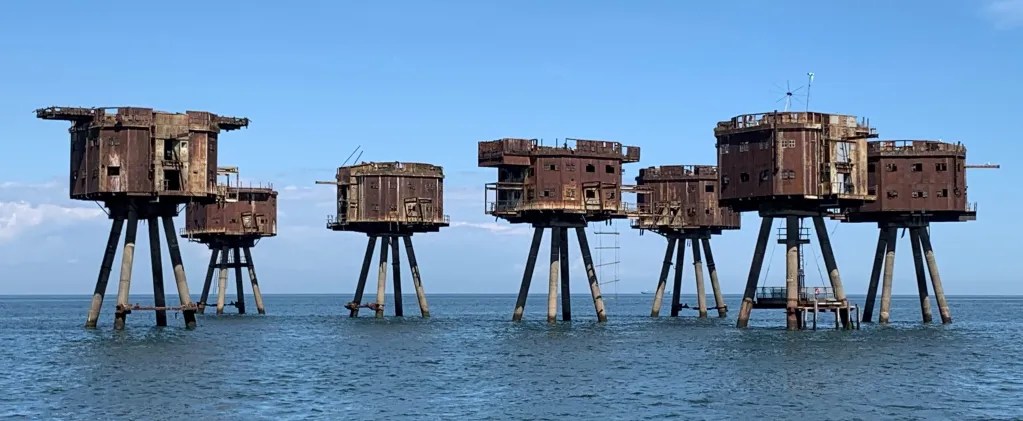
I’ll finish now with another of the many things I’ve been doing recently other than making felt. As I’ve mentioned more than once before, I am lucky enough to live in Whitstable, on the coast in south-east England. It’s a beautiful place and we get a lot of visitors on day-trips as well as longer vacations. There’s a Thames sailing barge called The Greta that in summer moors in the harbour where I often work. Built in 1892, she used to carry grain, malt and building products, and then beer, up the Thames estuary into London. She also took part in one of the most famous operations during World War 2 as a member of the makeshift flotilla that rescued thousands of troops during the evacuation of Dunkirk in 1940. Apparently, she’s the oldest active ‘little ship’ from that era. Anyway, some of my harbour colleagues go on an annual trip on the Greta to visit another World War 2 site, the Maunsell Forts, which are about 6 miles out to sea. These were part of a world war 2 sea-defence system designed to shoot down enemy aircraft that would fly up the Thames estuary from the coast to bomb London during the war. They were later used as a base for pirate radio stations broadcasting in the 1960s. Previously I’ve refused offers to join my friends on this trip as I’m a terrible sailor and believe I could feel nauseous in the bath. This year my desire to do the trip overcame my reservations and we set out on the calmest, most lovely day.
It was a fabulous day and I will definitely do the trip again. The final picture here shows the harbour village where I sell my work. I’ve never seen it from this angle before.
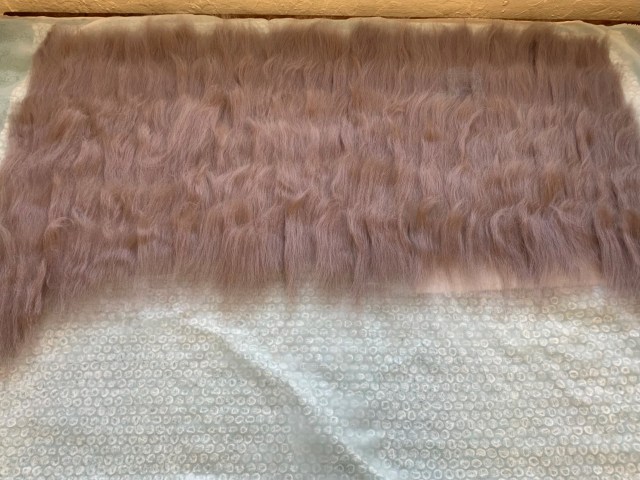
I was looking around my studio wondering what to write about in this blog. I was remembered Ruth Lane’s recent comment in her blog here about using up supplies. I have a carded batt of merino / A grade mulberry silk from World of Wool that’s been kicking around for a while. I can’t remember if I bought it for something specific that didn’t get made or if I bought it on spec. I was interested to find out how it felted and what I might do with it so I decided to make a small test vessel.
I cut out a circular resist using a small mat as a template then started laying out the fibre outwards towards the edge. Apologies that these pictures are mostly white on light colours – I was thinking more about the making than the photography. I laid the second layer in a circular pattern before flipping it over to smooth the overlap onto side 2. After 2 layers on the second side, I flipped back and laid 2 more layers on side 1, followed by 2 more on side 2.
The resist & its templateFirst layer side 1 startFirst layer side 1 completedLayers 1 & 2 side 14 layers each side, ready for wetting out
After wetting it down I spent a lot of my time working the edge by pulling the voile over the edge so I wouldn’t get a ridge around the middle of the finished vessel. It felted quickly and I was soon able to start fulling – initially without removing the resist.
Working the edges FullingWorking the felt
Once I’d cut out the resist I found, in my vast collection of miscellaneous wooden objects, that the handle of a wooden pestle (as in mortar & pestle) was the perfect size for getting inside the vessel and working it from the inside.
I spent a while fulling it as I wanted it to be smooth and very firm.
Wooden pestle handle for fullingPacked & dryingvessel on original templateThinking about the green colour insideFinished merino / mulberry test vessel
I packed the vessel with strips of recycled bubble wrap that I keep for this purpose – you can see it green inside. Looking at this green bubble wrap made me wonder if I could make a vessel with a coloured interior but retaining the pale colour outside. I thought maybe if I used silk rather than wool to add colour I’d get less colour transfer, so I thought I’d give it a go.
While pondering this, I decided to try using the same resist as the test vessel but to make 2 small bowls rather than one vessel: so, cutting it in two around the middle rather than making a hole at the top to remove the resist. I dipped into my big boxes full of second-hand silk scarves bought in charity shops and chose a plain turquoise and a patterned blue one.
Carded merino / mulberry silk batt & two silk scarves ready for recycling
I put a circle of silk on the resist and decided to run a small line of coloured merino tops around the edge: partly as I was interested to see how it would look and partly as I thought I might not know where to cut when I was ready to remove the resist and separate the little bowls – I’ve made that mistake before!
I put a circle of the blue patterned silk on the second side. The merino and silk fibre layout was the same as the previous vessel. This time I also remembered to do the circular layer first followed by the radiating layer – I’ve learned that one before and obviously temporarily forgot for the previous vessel. It makes following the resist with the circular layers much easier and I prefer to try not to overlap that layer if possible – again it reduces potential ridges and produces a better join if you only overlap the radiating layer, in my opinion. I’m sure some of you will disagree but that’s one of the many things I love about wet felting: with experience everyone works out the techniques and tools that work best for them.
Process shots of the bowls
I was interested that I could see quite a lot of the inner colour throughout. I quickly began to suspect this was more about the amount of dye bleeding from the turquoise silk as about seeing the silk through the wool. I was getting a lot of turquoise in the felting water.
Again, I fulled them thoroughly. During the fulling, I decided I liked the silk on the outside better than the inside so here they are, still wet.
Bowl insidesBowl outsidesThe finished small bowls
And here are the 3 items. You can see how green the wool of the little bowls is compared with the vessel. I’m pleased with the bowls’ blue rims – I like this effect – but the vessel is my favourite. In each of the test pieces the fibre has felted beautifully: it’s very firm and extremely light – it has an almost papery quality about it that I find really appealing.
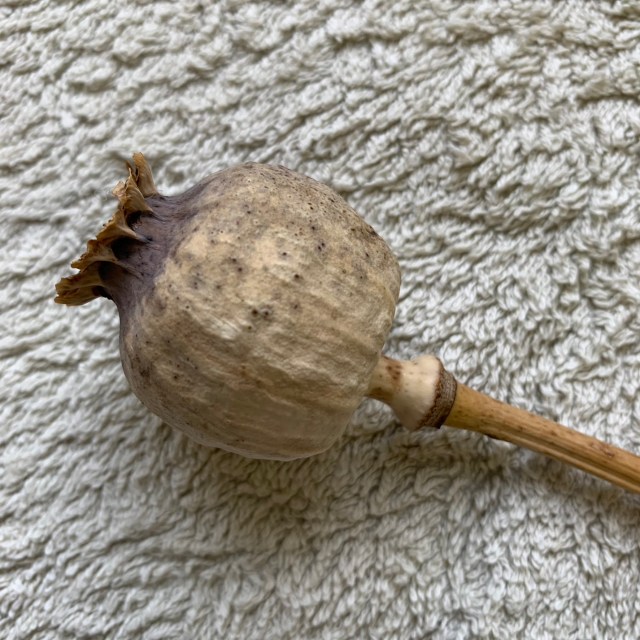
My imagination is now firing about what I could make next with this fibre. I have a dried poppy seed head sitting in a vase next to my desk. The felt reminded me of the texture and colour of the seed head. I’ve felted poppy seed heads before – one of my favourites. Another thing I have in the studio is some vintage cotton lace I was unable to resist when I saw it in a local second-hand shop.
Dried poppy seed headVintage cotton lace
I thought maybe that the lace would add a subtle surface texture so why not have a try? This time I made a small square sample using just 2 layers of the wool / silk mix batt with strips of lace in parallel lines.
Layout: fibre and laceFinished squareClose up of surfaceTest square of the batt with strips of vintage lace
Although it’s subtle, I really like the effect. As you can see in the close up shot, the batt has quite a bit of vegetable matter which in this case adds some interesting specks, enhancing the natural look.
I was running out of time but decide to start the poppy seed head. The merino fibre length in the batt is very short which makes the layout quite slow but very precise. In the first photo you can just see the strands of lace which I’ve laid out on top of 4 layers on the under side and are waiting for me to finish the final 2 layers on the top side before bringing them over.
The second photo shows how far I got yesterday before I had to stop. This is a multi-resist piece that will take a while to make. I’ll show it finished in my next blog.
I enjoyed letting the fibre lead my imagination in what I might do next. I’ve done mostly production felting recently – making multiples of things for shops and sales – so it was great just to see where things led me and enjoy felt-making for the sheer fun of it. I’m looking forward to getting back into the studio soon to finish the poppy seed head.
I’ve recently made a new felt picture of lapwings so I thought I’d show you how I went about it.
As you’ll know, if you’ve read my other blogs here, I live on the East Kent coast in the UK and am particularly fond of the local birds. I’ve seen some beautiful flocks of lapwings including at a small nature reserve just along the coast at Oare. I’ve not attempted lapwings before though they are really beautiful birds, so I thought I should have a go.
I’ve only seen lapwings in quite large flocks – I’ve never seen one on its own – so I thought I should have at least 2 birds in the picture. I did a quick sketch to help me decide on the size and stance of the birds
I started with the background. The birds at Oare were on the wet, grassy edges of a lake, very near the sea. Here’s the background laid out & ready to start felting.
I spent a while thinking about how to represent the lapwings’ lovely iridescent feathers and decided on lots of prefelt.
I had some blended greenish wool that was perfect for the main feathers though I had no idea where it came from or what it was. As I made some prefelt I tested out the shrinkage – mostly just to be sure it would felt rather than getting a specific shrinkage.
Then I set about prefelt for all the other lovely colours. The dark green sections are scraps of recycled silk from my favourite source: a charity shop scarf. The others are mixtures of different merino wool colours. I was particularly pleased with the dark section on the right which was a bottom layer of blue and top layer of charcoal grey. It was just the effect I was hoping for. With hindsight I should have used silk for the light green & pink / purple too as that would have given me more shine.
Here’s the prefelt cut up & arranged in a bird shape.
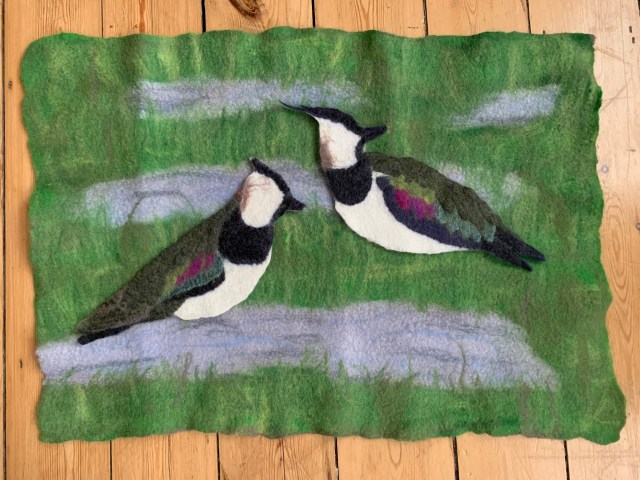
And here are the 2 birds once fully felted but still wet
And here I am deciding how to position the birds on their background.
I needle felted the birds into the background then added eyes, other face details, legs (using recycled tapestry wool) & head plumes. If you look closely you can see I also fiddled a little with the background: needling in extra strands of grass to soften the edges of the water.
The lapwings went straight into an exhibition with 4 other big pictures plus some smaller pieces at my local gallery: the wonderful Horsebridge Community Arts Centre in Whitstable. Here’s my display (not a great photo, sorry).
And I’ll finish with a quick shot of a beautiful painting I bought at that exhibition.I’ve been looking for something to hang over my bed for ages and I thought this was perfect.
Painted by my friend, the artist Josephine Harvatt. The title “When you wake up it’s a new morning”is particularly apt for over the bed. I love it. If you want to see more of Josephine’s beautiful work, here’s an Instagram link.
I’ve recently finished a felted picture – mostly wet felted but with needle felted elements. ‘How long did it take to make that?’ I’m often asked when people see my work. I find it difficult to answer precisely. ‘Quite a long time’ isn’t very helpful so I usually say something like ‘About four days’. I don’t really know if that’s true. It’s my best guess. As the felt-makers among you will know, most people have no idea how much work can go into making felt, so as I was making my latest picture I thought I’d try to document the stages and see how long it all takes. That’s what I’m going to show you here, plus take you on a little visit to the town where I work.
I’ve already decided to make a picture of a turnstone feeding at the water’s edge so I set about making prefelt sheets for the pebbles. I live on the North Kent coast and love watching the local water birds: how they look, move and interact with their environment. It’s mostly pebble beach on the stretch of coast nearest to my home so pebbles are a good place to start.
First a piece of natural grey merino prefelt. Then a piece of mixed browns
It takes a surprisingly long time to cut all the pebble shapes
Here’s the grey cut up and an offcut of nuno prefelt which I’m gong to add into the mix.
And finally a sort of orange / yellow piece.
I use prefelts as they give the pebbles more definition than if I just add blobs of wool. I’d guess all of the above is about a day’s work.
Now I can start the layout. This is going to be quite a big picture so will take up pretty all the space on my standing work desk. Here’s the first layer – natural white merino.
The second layer starts off with pewter for the water. While I’m working on the water section I add some dark blue low lights.
After I complete the second layer with more natural white merino, I lay out different coloured wool on top of the pewter and dark blue. I’ve previously carded pewter wool with a variety of light blues and greens using large hand carders. I haven’t even thought about adding that time to my calculations. I use this for the top layer of the water, mostly covering the dark blue which I want to add depth without being too prominent.
Here you can see that I’ve also added all the cut up pebble shapes to the bottom of the picture, plus some scraps of silk cut from old scarves, leaving a white section where I will add the wave.
For the wave I’ve chosen mohair because it has a slight shine and I hope it will be wiggly when felted. Along with the mohair I add lots of silk hankies and wool locks: I’m trying to get lots of texture into this section.
There’s also a piece of sort of knitted yarn that I picked up in a charity shop a while age. It’s meant to be knitted into a scarf (according to the label) but I lay a line of it under the wave, hoping it will look like the foam from a previous wave. I also pop some offcuts into the wave for more texture. I finish by adding a few locks to the water to look like small cresting waves and I’m at the end of day 2.
A couple of days later I start the wetting down. Because it’s large, I decide to work in three sections, starting with the pebbles. I like to use voile netting over and under the wool – which you can see in this photo.
I spend a couple of hours prefelting the picture, working both sides. Here’s the back. I can see the pebble outlines pushing through the white so can be confident the layers are starting to felt together. At this point I decide to take a break and go for a wander outside.
I work in a small rented studio in the historic town of Faversham, about 8 miles from where I live, in Whitstable. The studio is in a former industrial building (originally a late-Victorian brewery bottling plant) which is now a lovely not-for-profit gallery, café and shop called Creek Creative Studios. It also includes 32 small studios filled with a good variety of busy individuals including painters, jewellers, potters and glass workers on the ground and lower ground floors; writers, illustrators, stringed instrument specialists, web designers and other small businesses on the upper floor.
Faversham is a gorgeous medieval market town so wandering about at lunchtime (and of course checking out the charity shops) is one of my favourite pastimes. It’s a lovely sunny day so I thought I’d share a few photos with you.
Top left is the historic market place with its stilted guildhall. Top right is the Shepherd Neame shop: there’s a long history of brewing here and Shepherd Neame is Britain’s oldest brewery. Some days it does mean the town is rather ‘aromatic’. Second right is the lovely Yarn Dispensary. Originally an apothecary, the building dates back to 1240 and has a beautiful, separately listed wooden apothecary interior. It also sells a delicious selection of yarns. Bottom left is an old pub; next is the old water pump in the marketplace and a couple of the other buildings that surround the market place. There’s still a market here 3 days a week plus regular monthly ‘best of Faversham’ and antiques markets at the weekends.
Back at the studio I spend the rest of the day rubbing and rolling the felt until it’s fairly firm. Because it’s a picture and going behind glass it won’t endure much wear and tear but I still like to ensure it’s properly fulled. End of day 3.
I leave the background to dry and return to it about 6 days later, as I start to think about the turnstone or turnstones. Working from my own photos, I roughly sketch a couple of birds and cut them out so I can see how they might look.
Although I like the 2 birds they are a bit small (the waves round here aren’t that big) so I decide to go for one pecking bird but bigger than the sketched one. First step is to make some prefelt for the feathers.
Here it is as I’m starting to wet it down (left) and as a light prefelt (right – apologies for the poor quality of the second photo)
I cut up the feather prefelt and lay out a general bird shape. At this stage I am leaving the head large and a bit vague. I’ve learned that it’s better to make it too big and cut it to size later rather than trying to get the exact size and shape and risk having to add more wool or felt.
Here’s the bird felted and with a lightly trimmed head. Sorry it’s not a great photo as it’s electric light and I’m casting a shadow but I hope you can see it well enough to get the overall idea.
From layout decisions to the felted bird has taken most of day 4.
The next stage is to needle felt the bird into the background and needle in the eye and legs as well as refining the beak. For the legs I used some of the orange-ish prefelt I made for pebbles, adding strands of wool on top.
Using a broken needle I pick at the wave to raise some of the texture from the silk hankies and wool locks. I’m not sure whether it’s visible in this photo but it does make a difference in the actual picture.
I didn’t take progress shots of the needle felting but I’d say it took a good half day. It’s difficult to know when to stop fiddling around with it and declare it finished.
So, here is the final picture before framing.
And a shot in its frame.
Frame size is 63 x 86 cm (approximately 25 x 34 inches)
I used an adhesive hook tape – like the hook side of Velcro – which I stick to the mount board. The hooks hold the felt in place without impacting the fabric.
So, it looks like my 4 day estimate was a bit low. Next time someone asks how long it took me to make this picture I could say ‘About 4 ½ days, oh, plus the carding, the nuno prefelt and the framing….’ . Maybe I’ll just settle for ‘About 5 days’.
Do you try to work out how long you spend making things or just go with the flow?
A wonderful 4-week holiday in Australia, Christmas markets and hosting lots of family visitors mean I’ve done very little news-worthy felt-making since my last Felting & Fiber Studio blog. ‘Production felting’ is my own term for making lots of similar things for shops and markets. I did a fair bit of this in November and December: mostly printed tea light holders, printed wool ‘pebbles’ and Christmas cards. These were my 2022 cards: handmade felt with hand-printing. I extracted the tree from a larger, royalty-free, public-domain image and added the heart before printing onto fine flat felt.
My 2022 handmade Christmas cards
I sold these through various outlets and sent a small number myself.
I’ve enjoyed making felt ‘pebbles’ for some years. Since learning to print on felt from Lindsey Tyson, I’ve been able to adapt photos of some of my Mum’s watercolour paintings to print onto the pebbles.
So, as I don’t have a lot of new stuff, I thought I’d contribute a few of my past makes and current thoughts as ideas for the first quarter and year-long challenges.
Alas, I left the base alone for a long time during a pandemic lockdown and it was attacked by moths. In a way, being eaten by moths was rather fitting: lifecycles in real life, but the moth holes meant I ended up cutting it up to make bookmarks (after some very hot washing). I did, however, recently sell the tree stump on its own and it now lives in Canada.
Pondering future projects for the tree challenge: I have a very tall, beautifully coloured ‘silver dollar’ eucalyptus tree in my garden.
The eucalyptus tree has potential for lot of other projects, including maybe using the leaves for eco printing onto felt. Eco printing is something I’d like to try, though whether I will get round to it remains to be seen. I don’t recommend any breath-holding for this.
Contemplating Caterina’s quarter-one challenge of making something practical that you can’t buy: one of my favourites is this case I made for my iPad mini. Nuno-felted with sections of recycled sheer silk scarf.
I know you can buy iPad cases but I like that this one is unique and fits perfectly without any fasteners. Because it’s an exact fit, the iPad stays put until you need it, then slides out easily. It’s getting rather battered now as I carry it around all the time so maybe it’s time to make a new one.
Felted vases and plant pots are also both unique and practical. Here are a few. I like that you can co-ordinate them to your décor, or to a specific plant or flower, or just go for colours and patterns you like.
And finally, here’s something that meets both last year’s challenge to complete some UFOs (un-finished objects) and this quarter’s challenge to make something that you can’t buy.
Here’s a pair of earrings that I started making a while ago using hand-dyed 14.5 micron Merino wool. I incorporated the earring post into the felt and some black sequin fabric inside using resists. These were inspired by the work of Aniko Boros and Judit Pocs.
The sequin section is more sparkly than in the photo
As you can see, I got quite a long way along, but while I finished fulling the one on the left, I stopped with the right-hand one in the pre-felt stage. I’m not completely sure why: probably it wasn’t quite what I had in mind. But it surely can’t take more than about an hour to finish that one, so I’m promising myself here that I will complete that second earring. The world will be minus one small UFO.
I hope I’ve given you a few ideas about different ways of taking on the challenges. How are people getting on with them? If you make something in response to these or any of our previous challenges, please do post your photos on the forum. We all love to see and be inspired by what other people are making.