Browsed by
Month: March 2014

Free Motion Machine Embroidery

Free Motion Machine Embroidery

We were having a discussion on the forum recently about using free motion machine embroidery on felt. I thought it would be interesting to show a variety of techniques that I have done recently (and not so recently) using my sewing machine and the darning foot. I love to stitch on felt as it gives such a nice texture with the tight machine stitching and the “puffiness” of the felt.

This slideshow requires JavaScript.

When I first started stitching on felt, I used a method where the design is drawn out first on soluble fabric and then stitched on to the felt. It is an easy way to start as you can get your design figured out and then just follow the lines on the soluble fabric. I did a tutorial on how to do this demonstrating the mountain goat stitched on felt. I use a clear darning foot when I’m doing free motion embroidery because it is easier to see where you’re going. I also did a tutorial on how to stitch a red felt scrap bowl. Free motion stitching does take a little practice but if you start with a simple pattern such as little circles to make a background pattern, it is fairly simple to try. Just put your feed dogs down on the sewing machine, attach a darning foot and set your stitch length to zero. I find it easiest to try a sample on heavy interfacing to start and then you won’t feel like you’re wasting “good felt”. Start stitching with a moderate speed and move your interfacing slowly under the needle. Think of your needle as the pencil and just doodle around on your interfacing. Try writing your name or drawing a leaf shape. The more you practice, the easier it is.

This slideshow requires JavaScript.

I have also done a lot of free motion stitching on other projects besides felt. One year, I was in a book page swap and used a lot of free motion stitching on the book pages that I traded with other people. You can use water-soluble fabric to stitch on and then make “thread lace” or three-dimensional effects with thread. I have used a variety of techniques, some in which the entire piece is thread, some the fabric is painted first and some the fabric painted or dyed afterwards. Have you done any free motion embroidery on your sewing machine? We’d love to see what you’ve done. Come join us on the forum and show us your work.

Fiber — An Adventure in Textures

Fiber — An Adventure in Textures

Hi, I’m Marilyn.  I’ve recently accepted the invitation to be the fourth moderator of the Felt and Fiber Forum to replace Karen who left last year.

Paper sculpture "Change"
Paper Sculpture “Change”

As long as I can remember, Ive been fascinated with texturesthe grooved trunk of a tree, the delicate petal of a flower, the juxtaposition of smooth sand and a raging ocean wave.  Im a hands on person and have reveled in creating textures in a variety of mediums involving fiber.

As a young girl, my aunt taught me to sew which was great since I was able to make my own clothes to fit since I had long arms and legs. Later, when I had two boys of my own, I made their clothes.

Throughout my young adult life I continued to sew, design clothes, crochet, embroider, knit, played with string art, quilling and macramé. I also was interested in drawing and watercolor.  But 3D texture was always the draw for me. And water. For many years I made paper, my specialty being textured paper sculptures. Of course, paper is fiber and requires water to process. I had wanted to be an artist, but coming from a practical family I was encouraged to go into business instead.

Stained Glass Vase
Stained Glass Vase

My college education was interrupted, but when I returned after my sons were born I waffled about my major. Most of my credits were in business so if switched to art I would have had to start over. My husband Craig gave me excellent advice. He was a marketing major in college and told me that no matter what career path I chose I would always have to market myself and a product. So marketing became my major.

It was more creative than I imagined and I was able to combine my knowledge of art and design as well as my love of writing into a career in corporate marketing.

I discovered felting when I retired a few years ago. It was instant love.  Like all of my other creative endeavors, I researched and learned on my own.  But now thanks to the wonders of the Internet and You Tube it was a much quicker and easier process.

Hand Stitched Eyeglass Case

When I found the Felt and Fiber Forum/Studio, I knew I found a home.  Ive learned so much from the wonderful cyber collective of felt and fiber artists from across the globe. I enjoy the camaraderie and look forward to sharing my knowledge of art, marketing and my creations.  And, of course, continuing to learn and be challenged by all of you as well.

Apopka Lake, Florida
Surface Design Using Resists

Surface Design Using Resists

Like Ann, I haven’t been very well lately and haven’t had chance to do anything other than tidy up the mess I let accumulate while I was writing my notebook tutorial 🙂
We always seem to be talking about surface design on the forum: stitching, embroidering, embellishment fibres, beading etc. And there have been quite a few projects using resists lately too: Lyn’s pod that she posted about last week, Nada’s resist Slipper tutorial, and Carole from the forum showed us her gorgeous sculptural vessels with lots of surface design and embellishment.  A couple of months ago, Nada reminded me of some projects I’d done using resists to create surface design, so having nothing new to post about, I had a look through my photostream for some examples and hope you don’t mind revisiting some old stuff!
I think this was the very first piece I made using resists to create surface design. I wanted to have a go at trying out lots of different ideas at once, so made a piece using six resists to try out different cuts/shapes.

resist sample (1)I wanted to try out using resists with more contrast between the top layer and what it revealed underneath. This one has green/brown/mossy shades revealing slashes of orangey brown shades of wool with embellishments of silk noil, bamboo, silk hankie and  soya fibre.

orange and green (1)This burgundy piece is cut away to reveal orangey mustard shades with soy bean fibres.

burgundy and orange (2)I think this next piece is probably one of my most adventurous. The resists and cuts were fairly straightforward, but it was quite big, very thick to make it stiff enough to support itself, and I used a flat resist – not somethng I ever have much luck with for a 3d shape!

danglie (2)This last piece is one of my favourite vessels. I love the colours and textures and was really pleased that it came out just how I’d imagined!

vessel (2)If you’re interested in using resists in felting, Ruth wrote a post early on about using flat resists for different hat and vessel shapes. Also, Lyn and her daughter Annie have written a brilliant PDF guide to making 3D vessels using flat resists.

I had a Bad Cold

I had a Bad Cold

While I was sick I didn’t do any felting. I just didn’t have the energy. I have been knitting and reading cheesy books.

This is the knitting:

my knit shawl

It is a shawl. I have been knitting it on and off for a year. I am a slow knitter. I got the idea at an “Art in the Park” event. Someone had a bunch of similar ones for sale. You knit, knit knit  and every so far you add in two fancy yarns. I am not sure how long it should be. I think  I will make it really long so I can throw it over my shoulder. That might take another couple of years.

The other thing I did was reach some “bad” novels. You know the guilty pleasure kind. They are the Sookie Stackhouse vampire novels. They are not deep reading but they are great fun to read. I read 8 in the last 2 weeks.

I am feeling much better now and hope to get back to some felting soon.


Felted Slipper Tutorial Using Ear Shaped Resist by Nada V.

Felted Slipper Tutorial Using Ear Shaped Resist by Nada V.

Our guest post today is by Nada V. She is a forum member and had showed us a different type of resist template to make shoes/slippers. It seemed almost magical so we asked her to do a tutorial to show how the template worked. She kindly agreed and here is her wonderful tutorial.

******

In this tutorial I would like to present a step-by step procedure for making felted slippers. For a pair of slippers you will need approx. 300 gr of wool (coarse wool 31 mic) and two templates.

fiber

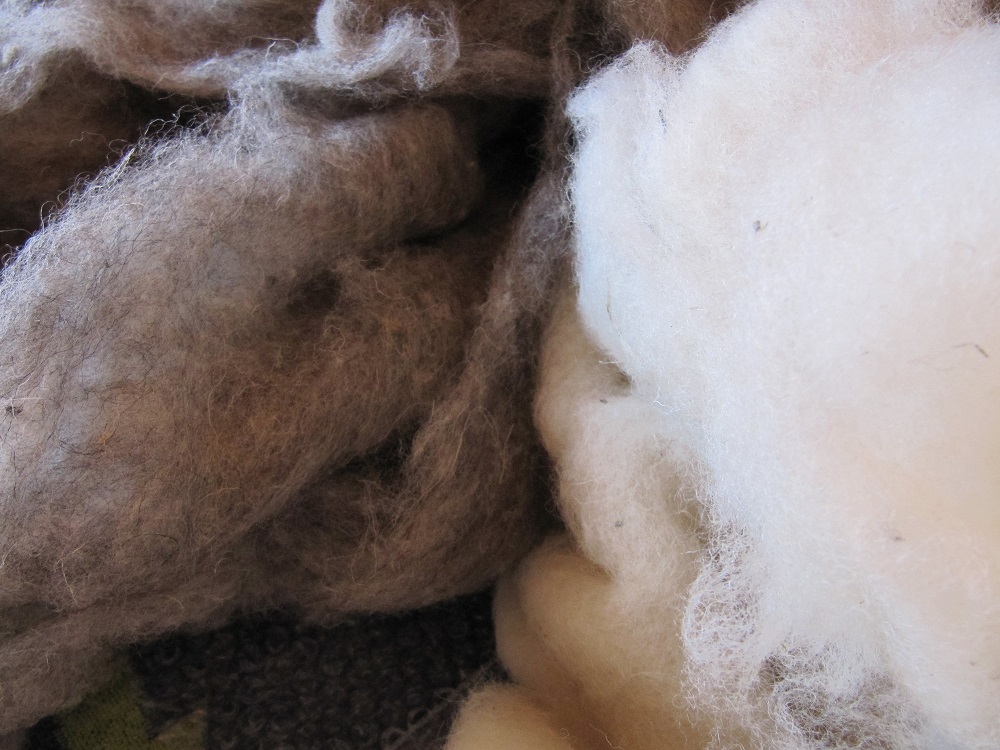
I was using local wool. It is very coarse with some rather wiry fibres.

template


The picture of the template is shown above.  You need to adapt it to your feet. I wear size 40 and this template is 31 cm long and 15 cm wide. As you may notice there are two ears on the template: one is positioned higher than the other one. The ear which is positioned higher on the template represents the inner side of the foot facing the other slipper. The size of the template also depends on the shrinkage rate of your wool. You need to consider this factor before you draw your own template.

Prepare your workplace: a towel, bubble wrap, soapy water (quite hot) which you can put in a ball browser or squeeze bottle. In dealing with coarse fibers and thick layers like in this case. There are many ways of wetting your work. I prefer to use olive oil soap which I simply hold in one hand, and a kitchen sponge in the other. I keep a bowl with hot water on the side , dip the sponge in it and squeeze the water out so that it runs through my fingers while I am rubbing soap and let the water trickle down.

laying wool

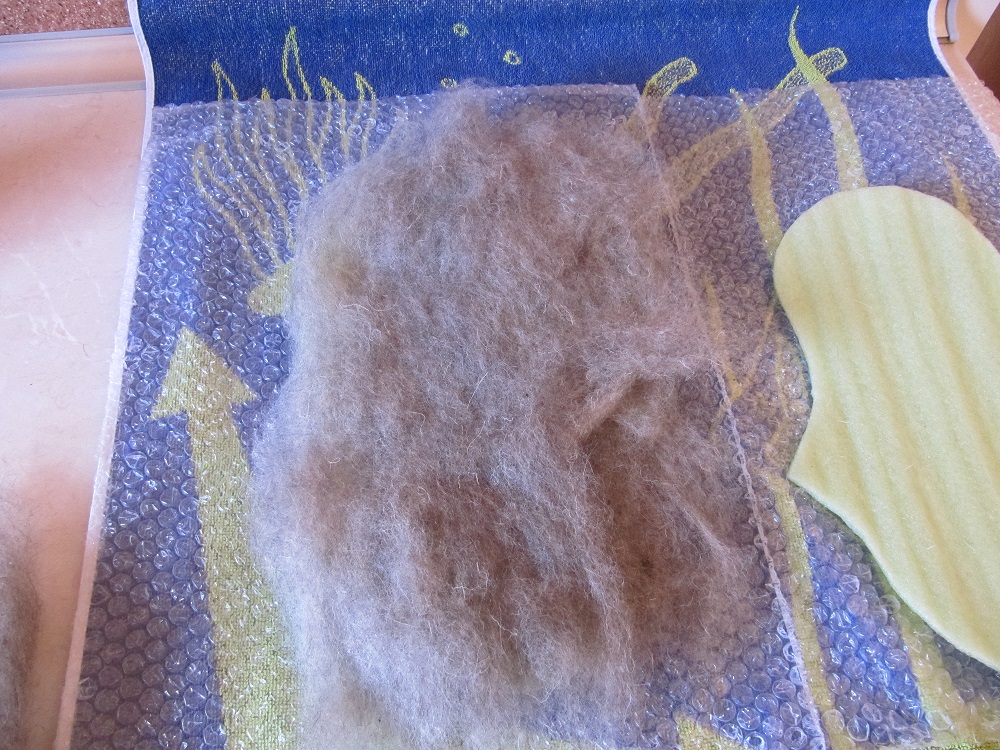
Start laying out wool: make sure that you make a total of minimum six layers, each placed in the opposite directions.

wetting


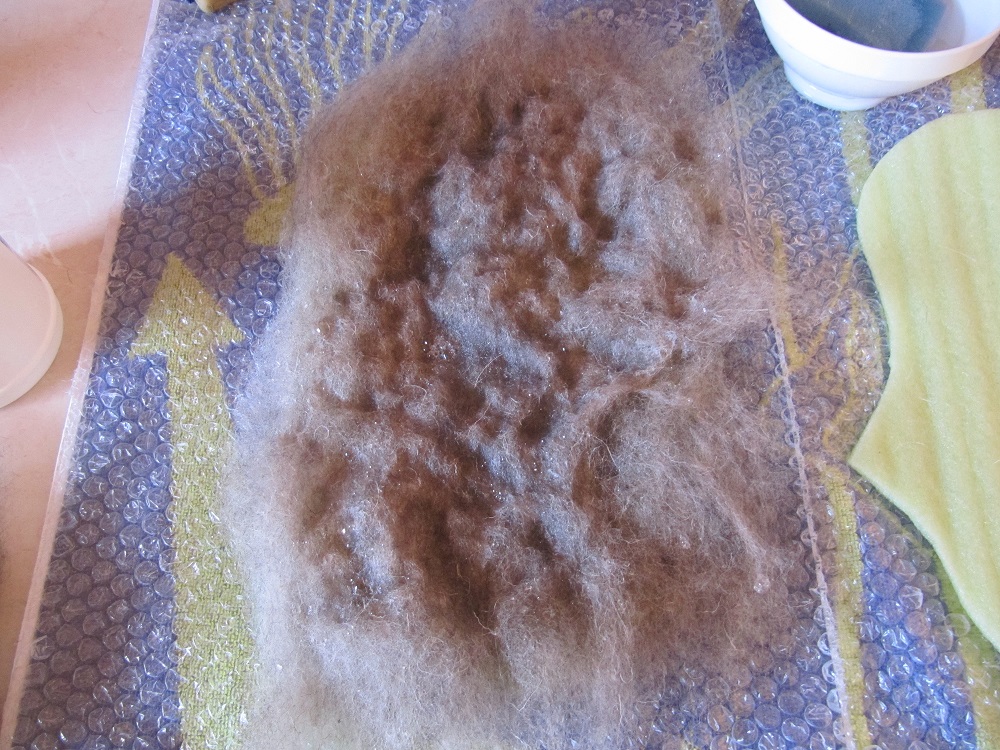
Place the first layer on the template and wet the wool well with soapy water.

pressing

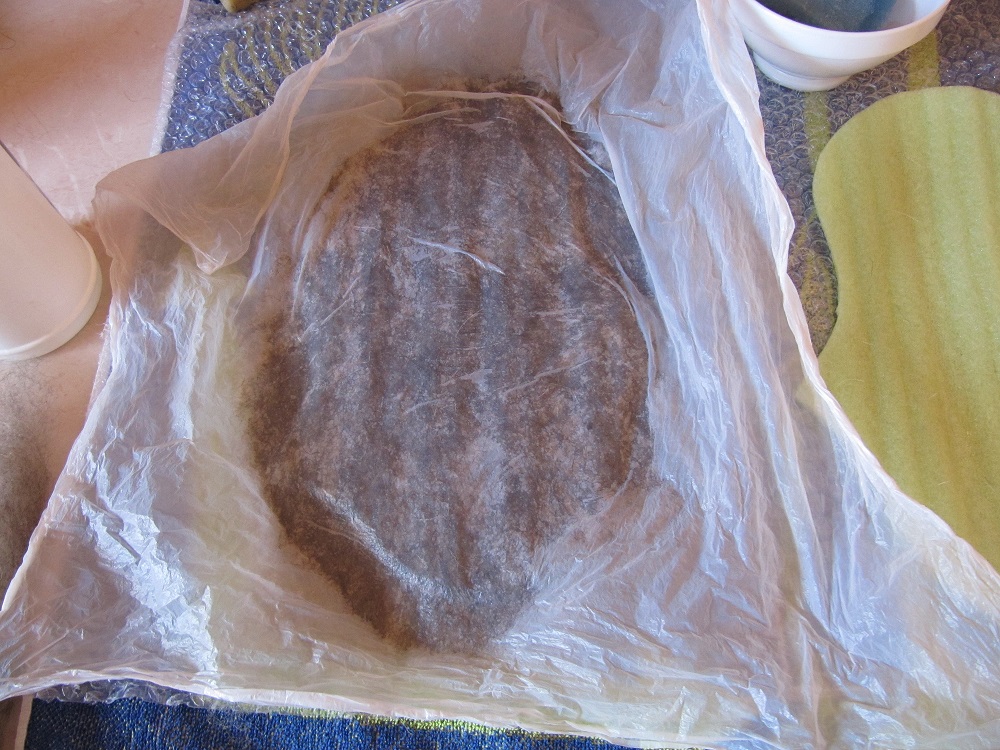
Cover your work with a plastic sheet and press down to spread the water evenly through the fiber. Do not rub, just press. This is important since some types of wool start felting quickly.

folding back1


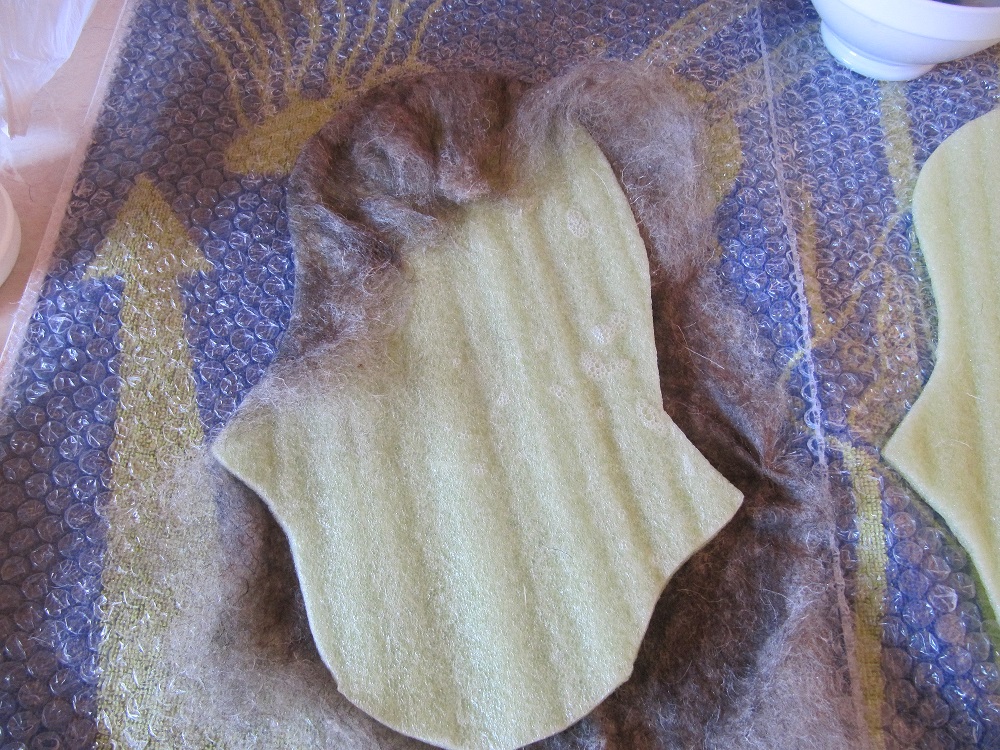
Flip the template carefully over and fold back excess wool (as seen in the picture).

folding back


Do the same with the other slipper and continue until you have formed six layers of wool. During the process of laying wool, do not rub and felt, just wet the fibers and press them down. I try to comb fibers with my fingers working from edges towards the middle and if some folds start forming I just gently rub and straighten them.

folds

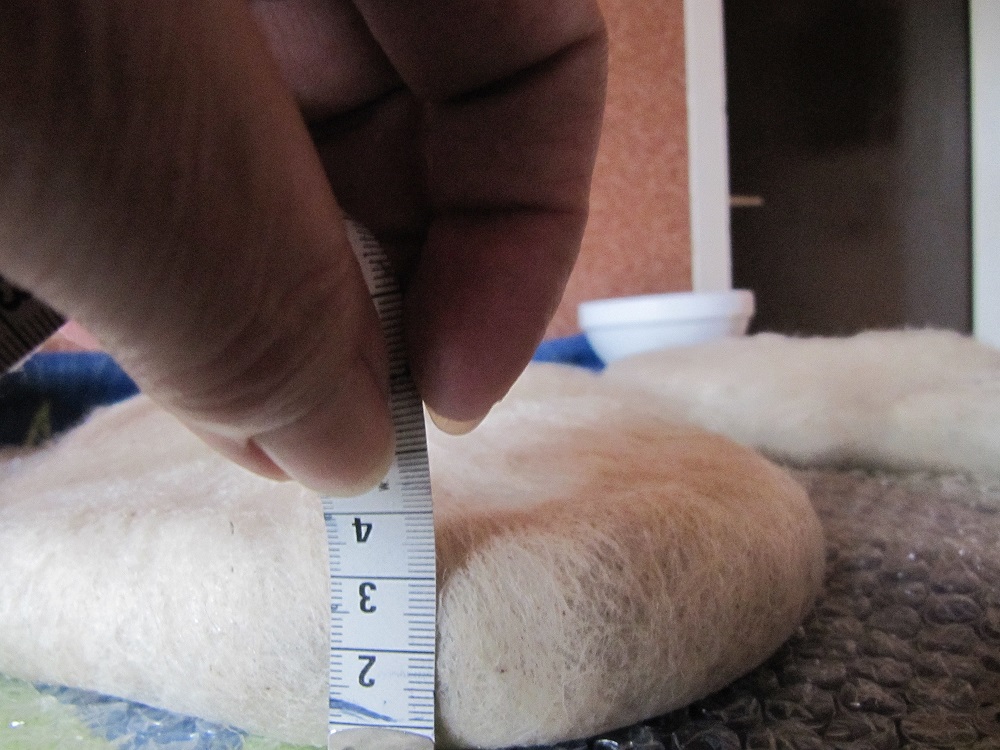
Thickness of layers is a relative thing. For this reason a good rule of thumb is that the final thickness of your work, after wetting and folding should be approx 3-4 cm ( i.e. 1.1 to 1.5 inches).

thickness


In my case I started laying grey wool (4 layers) and continued with white wool ( 2 layers)simply because I didn’t have enough white wool. After wetting you need to make sure that your templates are in the right position. Remember, the ear which is higher should be facing the left slipper from the inside like in the picture below.

embellish

Now you can start applying embellishments. Use your imagination as you wish. I used some black yarn to make branches and red pencil roving for flowers. I wanted to make sure that the flowers do not move and needle felted them into work.

cover net

After the stage of wetting the work you can start felting. During this phase I like to use a tray to catch excess water. Cover your work with a mesh and start rubbing gently the upper side where your embellishments are, making sure that they become fixed enough to the base and will not move when you turn your work over.

excess watter


Turn your work and start felting on the opposite side. I start pressing gently, increasing the pressure as I proceed. Be prepared for long felting. Even though my wool felts well, the total time I spent on felting was one hour which is because the layers are very thick. (Those of you who are using a sander may perhaps complete this stage in shorter time, I’m not sure). Always work from the sides towards the middle thus making sure that you don’t lose the shape. If folds start forming in the middle, rub them gently in circular motion and straighten them. During work it may happen that there is too much water, and of course, our slippers must not swim in water. From time to time I lift my work and drain excess water and continue adding hot soapy water for rubbing as necessary.

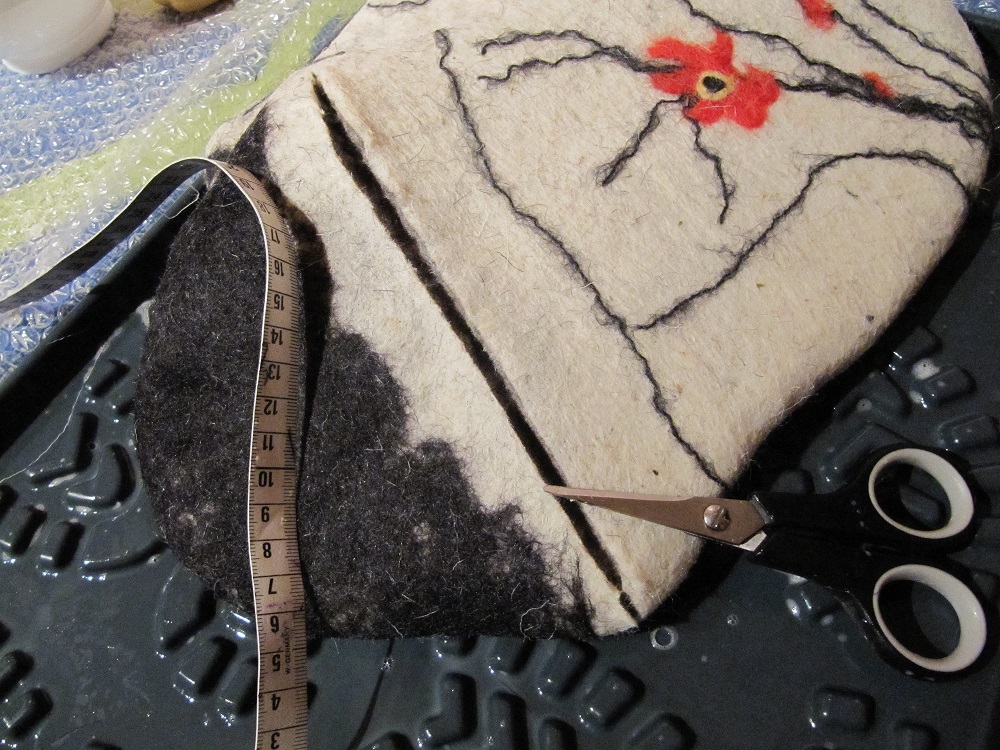
cutting


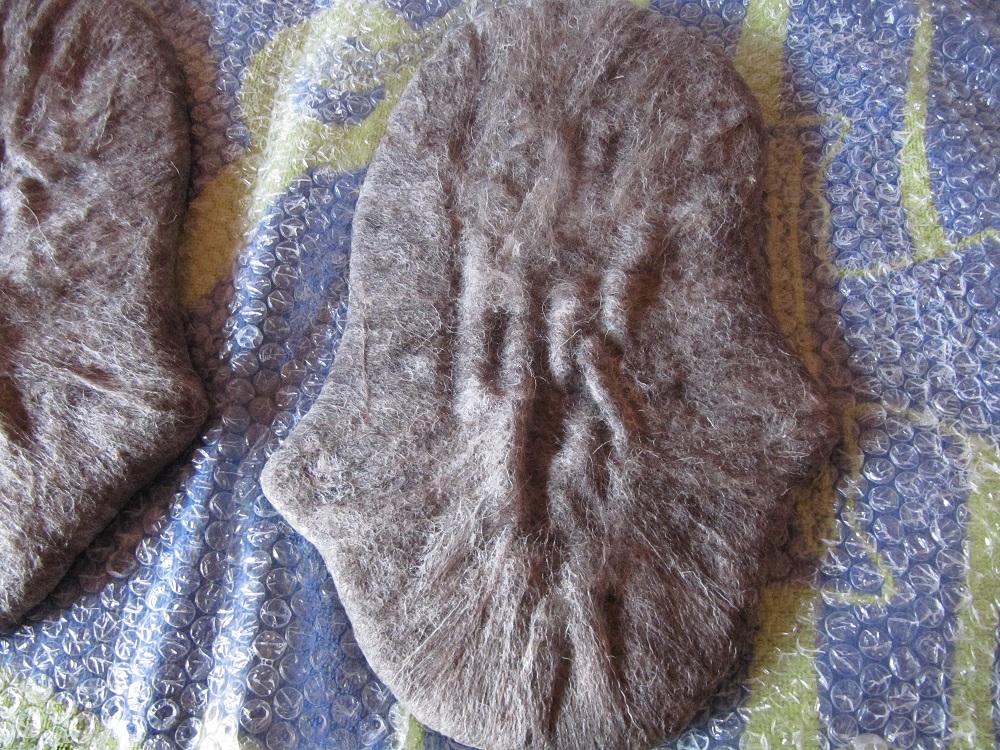
When you have a feeling that no more felting is needed and that your felt is stiff enough take sharp scissors and make a slit across the slipper – from the tip of the ear to the opposite corner, as shown in the picture.

remove resist


Remove the template.

yettishoe


Don’t be frightened when you see that you got a large shoe. In the following stage you need to work on shrinking the slippers.

rub edges


I like to rub the edges of the opening first so as to avoid separation of the layers on the edges.

wash sink


Transfer your work to the sink and soak it in hot water and squeeze the water out. Shock your felt with cold water and squeeze the water out again.

kneadroll


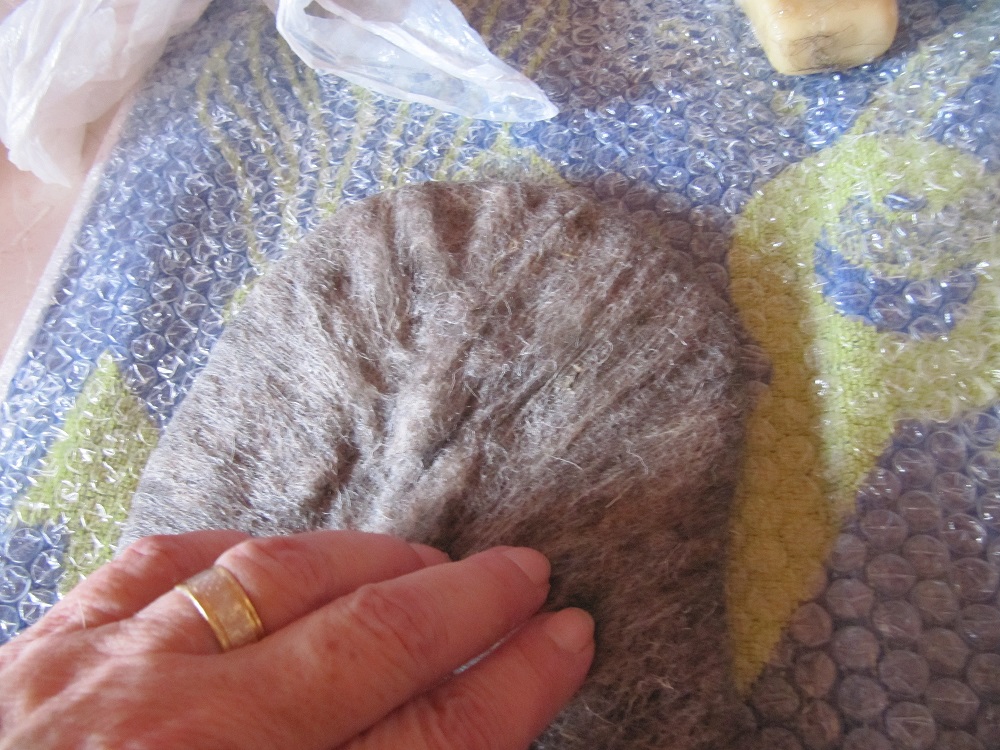
Move your work to your tray. Use more soapy water and start rolling and kneading your slippers so that they start forming a real shape. You don’t need to be gentle at all. Roll and knead them in all directions so that they shrink evenly. This may take you quite some time.

rubinside


Rub them inside and outside.

kneadroll2


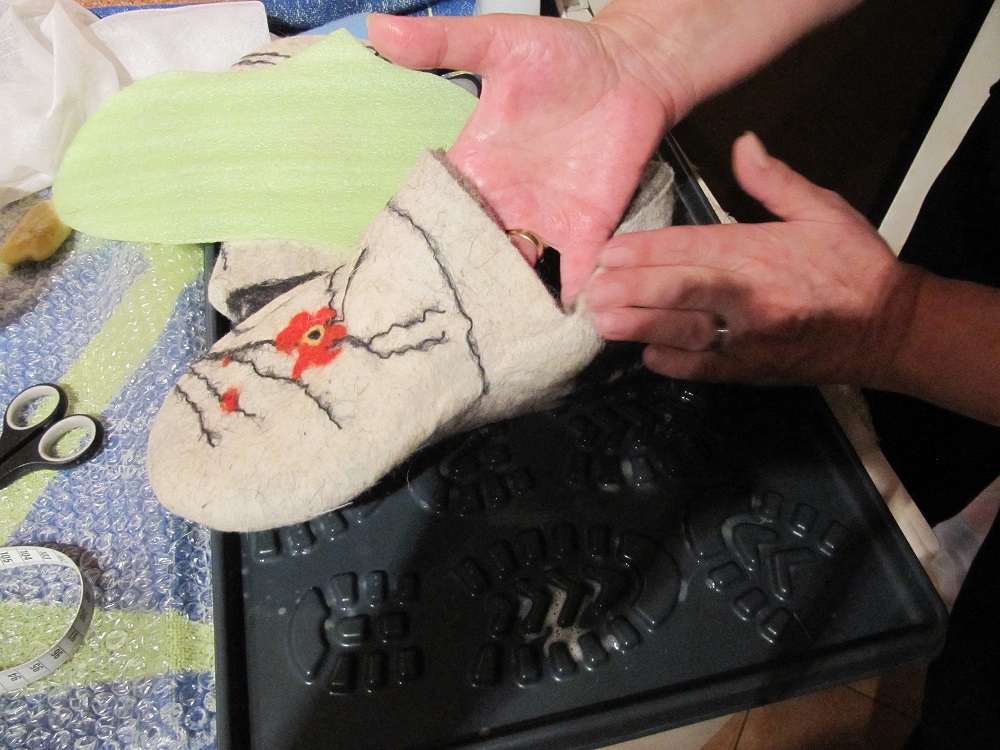
If you think that the felt is not shrinking enough, apply the shock treatment again (hot and cold water). In my case I applied this shock therapy three times. Use your hands for shaping a shoe-like form and only when you feel that you are close to the final shape and size, take a pair of plastic or styrofoam lasts if you have them, otherwise you need to complete the work with your hands.

fitting on last


I bought my lasts from Wollknoll Germany at a reasonable price (8 EUR) and think this was a good investment.

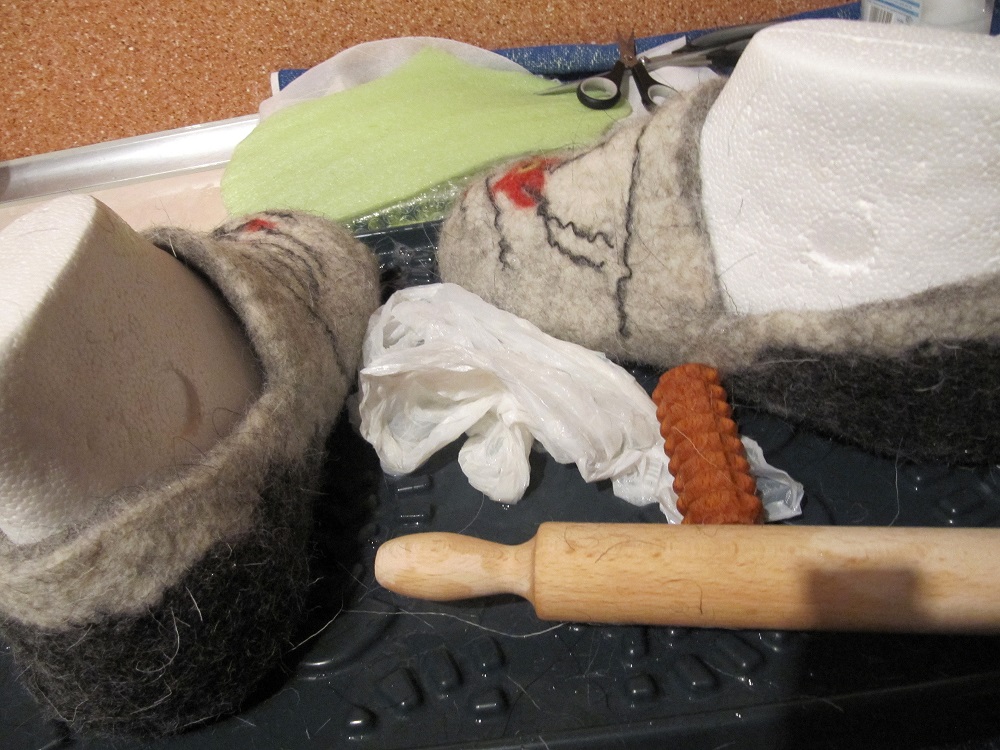
tools


Use any tools that you normally use for fulling. I was using a roller pin for pounding (spanking) and a small roller for rubbing and straightening the surface.

pull sock


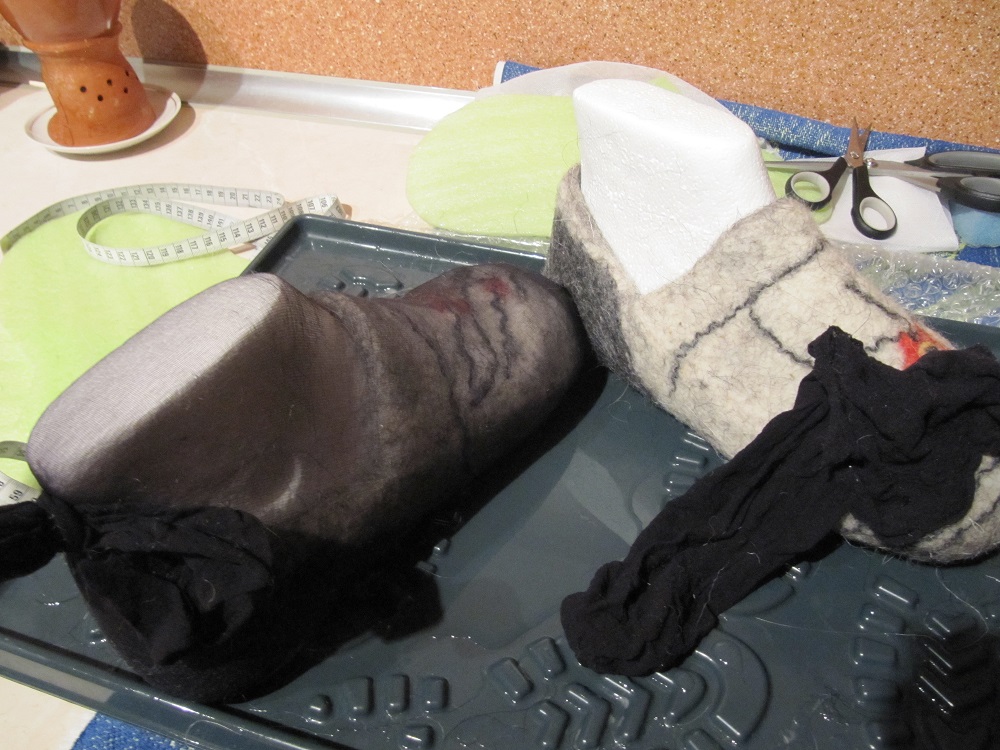
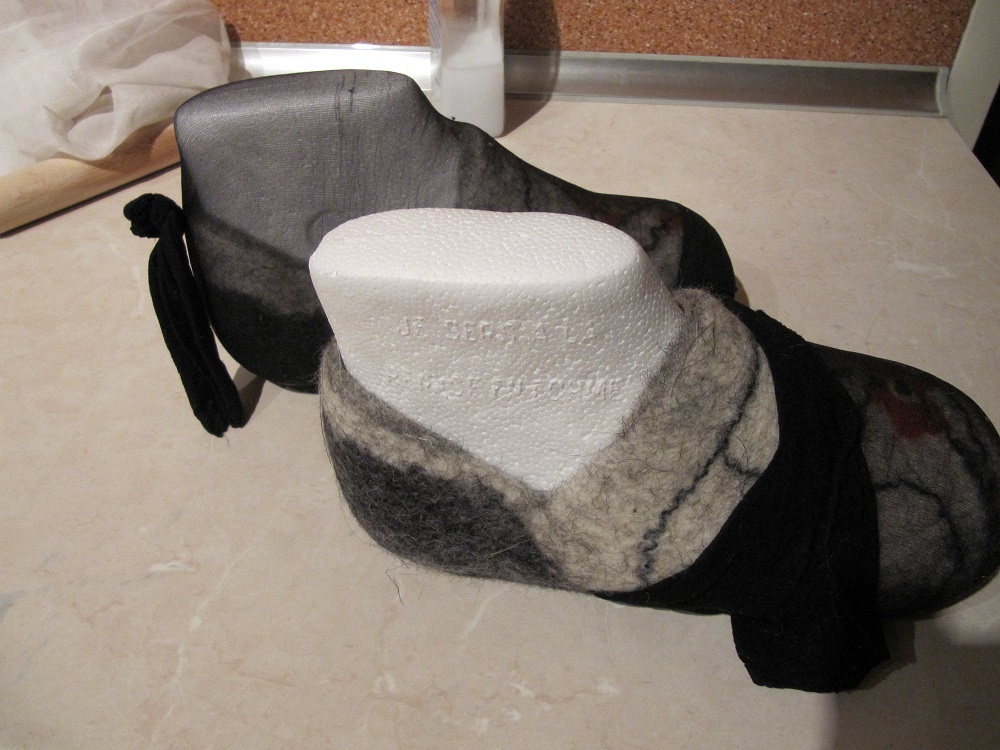
When your slippers completely fit the last, take an old pantyhose and pull it over your slipper and tie a knot so that the slippers cannot move during machine tumbling.

from the machine


Put the slippers into your washing machine (300C if little shrinkage is needed or 400C if you feel that more shrinkage is needed). I use the programme for delicate washing with short spinning. Remove the last and let your slippers dry.

final product


This is what you should get in the end.

final


If you look carefully you’ll see how hairy my slippers are. Our wool is really course and some sharp fibres are sticking out. When the slippers dry up, I’ll simply shave them. To completely finish the slippers, attach a sole (I like to use leather) and voila, your new slippers are ready. This project will take a whole afternoon to complete. It is a lot of work but you will enjoy the result. It took me five hours in total.

Cheesecloth Meets Merino Wool

Cheesecloth Meets Merino Wool

Today we have a guest post from Lyn.

***

I was lucky to win some of Ruth’s hand-dyed cheesecloth in a recent giveaway post – scrummy isn’t it?

hand dyed cheesecloth - Ruth Lane - small image

I really liked the pattern in the dark green piece, top left, so I cut a 27cm circle from it, then placed it on top of 2 layers of white merino wool fibres that had been laid out to form a rough, slightly larger circle.

I used white merino so that after the nuno process the colours of the cheesecloth would remain the same, although they would be slightly muted because of the migration of the white fibres.
To reduce the dulling effect of the white fibres,  I very carefully shaved the superfluous fibres from the top of the dry nuno felt. Shaving is a tricky process as the ruched fabric can easily be damaged.

shaving the felt - small image
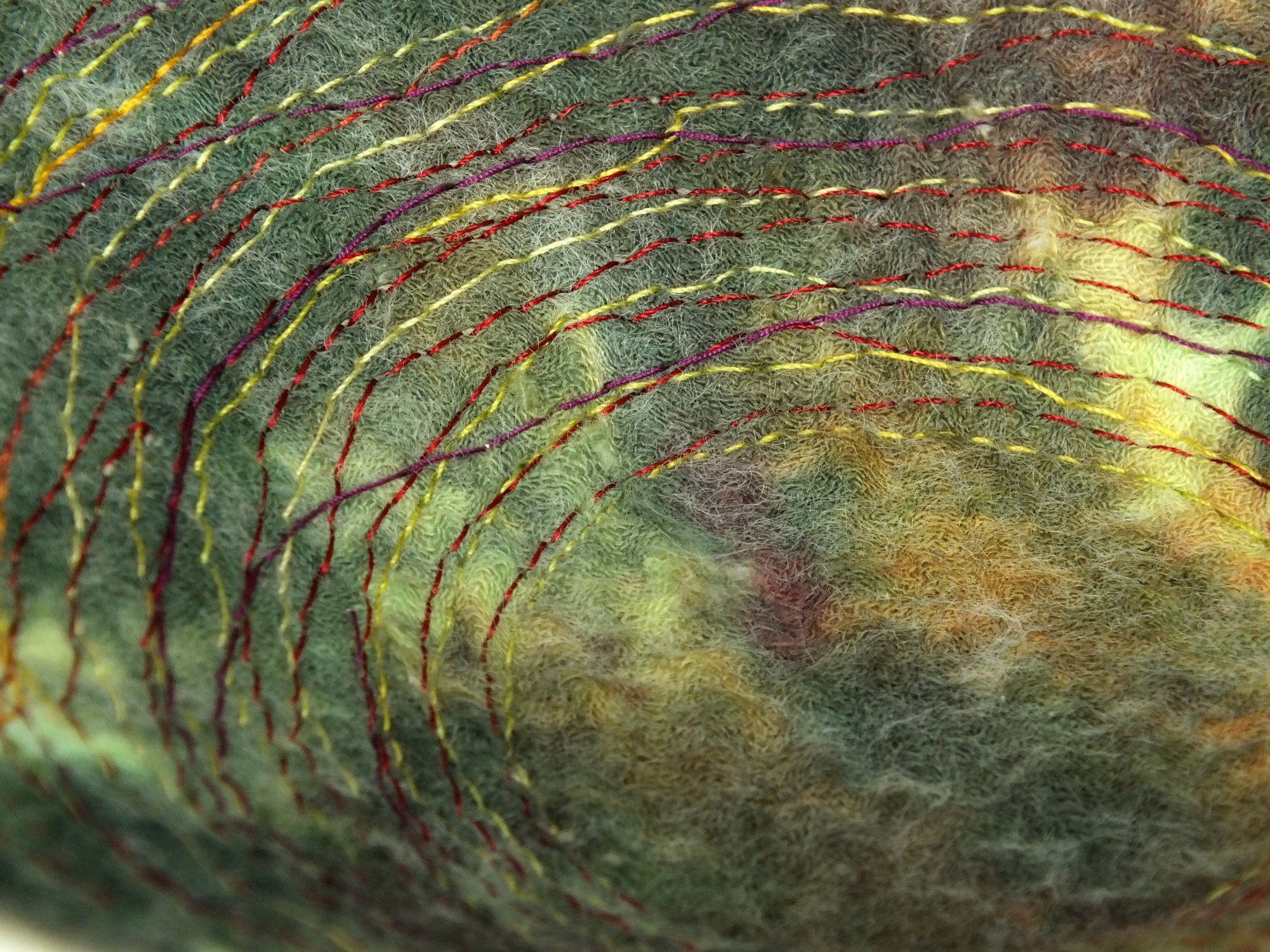
I then messy-stitched the piece of flat felt into a rustic bowl.  I love this kind of stitching and it’s best described as stitching done with your eyes shut – different coloured threads, short stitches, long stitches and rows of stitches that meander wherever they choose.

rustic stitching - small image
I thought the centre of the bowl looked pretty without stitches, but it wanted to buckle a bit, so I cut a circle of stiff, iron-on interfacing – the exact same size as the centre of the bowl – then ironed it to the underneath of the bowl.  I used the base of an upturned tall glass tumbler as an ironing board.

The finished rustic bowl:

rustic nuno and stitch bowl - small image

Nuno felting is an easy way to add interest to a plain item.  This pod was made with a 20cm circular resist.

pod with cheesecloth - small image
I used four layers of merino wool on each side of the resist, then placed a circle of cheesecloth on the top of the side that would have the hole cut into it.

cheesecloth on last layer of pod - small image
The cheesecloth added colour and texture to the top of the pod.

pod with cheesecloth close-up - small image
Thank you Ruth.  I’ve now got two lovely items and plenty of cheesecloth leftover for my stash.