Browsed by
Month: March 2013

The History of Felt

The History of Felt

I was actually supposed to present my first video today but after staying up half the night and still not getting the video completed, I decided that the video debut will have to wait. Hopefully, I will get it uploaded and posted next week. So instead, a little felt history.

My local group has been doing a little historical art study each time we meet. This month we were studying the iron age. I remembered that the first pieces of felt were found around or before this age so I decided to research further into the history of felt. I found a very interesting article by Berthold Laufer in American Anthropologist called The Early History of Felt. Here is the link. The article is about where the earliest felt making was found and the possible area where felt was first made. It is interesting that felting was commonly practiced in Asia and Europe but was absent in Africa and aboriginal Americas.

Felt Boots from Pazyryk Tomb

Some of the earliest felt pieces were found in Siberia, in the Altai mountain region, in what’s called the Pazyrk Tomb. These pieces are all dated in the era from 300 – 238 BCE. The University of Washington in Seattle has a project called the “Silk Road Seattle” with a very informative website. I found all of these photos of felt items from their site although these are items from the State Hermitage Museum in St. Petersburg, Russia. I haven’t had time to explore the site fully but it looks very interesting as it talks about various textiles and practices along the silk road.

Felt Boots, another view.

As you can see, these boots are very highly decorated, stitched and beaded. These were boots that were in a tomb and were probably made specifically for the funeral and burial process.

Felt Hat

What amazes me is the amount of intricacy in the felt and the styles. I see hat shapes similar to this in Montana all the time.

Felt Swan

I have photos of this felted swan in my book so you might have seen this before. I am again so impressed with the artistry and technique involved in the making of this piece.

Saddle Blanket with Gryphon Attacking a Mountain Goat

This is a saddle blanket. Look at the intricacy of the designs and the bright colors of the wool. I love how the weather in Siberia has allowed the pieces to survive so we can see what the people in the Iron age were capable of producing in felt.

Portion of a Saddle Blanket

Look at the wonderful inlay work in this piece. Think how long ago this and the other pieces were made. Felt has a very rich history and I love that the process is nearly the same as it was many years ago.

 

Bird House Time

Bird House Time

Spring is on the way and its time to start thinking about birdhouses. I have an Easter show. Not much in the way of felt really sells at this sale, it’s mostly about food. Bird houses are the exception. Here they are ready to put to the decorations on and then be put together for felting.

bird houses ready to decorate

This one has its decorations started

start decorating

That is as far as I made it. they have been sitting there for most of the week waiting for me to get back to them. I have hopes for this weekend and when they are done I will show them to you.

the wool I used I died myself. It is sold as washed gray Romney but it is really brown and white. If you card it without dying it, it does end up looking gray.

Undied ronmney

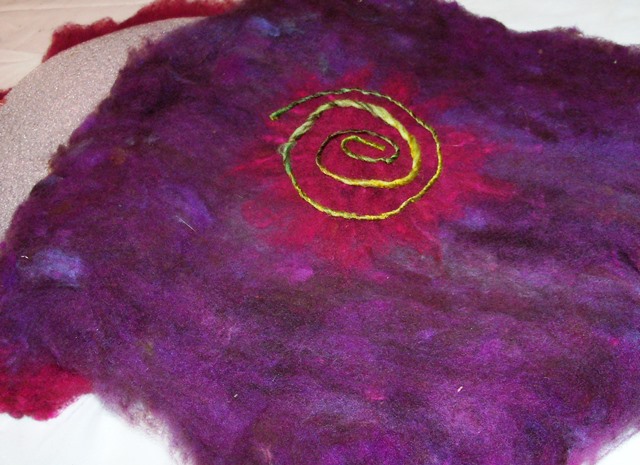
Here is what it looks like if you dye magenta, purple and chartreuse.

dyed romney 2

I love the way the “gray” wools dyes. all the mixed shades you end up with. A spinner friend says its called depth of colour, so it’s not flat.  I wish I could find other breads of wool that were that varied in colour to dye.


Road Trip Inspiration

Road Trip Inspiration

On my way home from Washington, I was working in my studio journal and thinking about all the inspiration you can get from a road trip. Even when the scenery isn’t all that exciting, there is always something that peaks my interest.

MINOLTA DIGITAL CAMERA

These were my notes on what was popping into my brain as we were driving along. Luckily, my husband likes to drive and will drive for most of the trip. One of the things I really noticed when driving over to Washington this past 18 months for stitch class was the change in seasons. Since we were going once a quarter, we got a different perspective every time we drove over. The difference in the colors is amazing. Even in winter, there are a variety of colors because many of the deciduous trees have different colored branches ranging from red, orange, yellow to gray and white.

Another thing I noticed this trip was the different shapes of road signs. We had just been working on geometric patterns in our machine stitched books and I thought it might be fun to use the road signs shapes to create a design.

MINOLTA DIGITAL CAMERA

Here’s a not so good photo of us driving along. You can see a bridge coming up. The bridge connecting bits reminded me of the insertion stitches we did for binding small books. I need to get a better photo of the different bridge shapes because I thought it would be really cool to make a piece with insertion stitches based on the shapes in the bridges.

MINOLTA DIGITAL CAMERA

I then started noticing other geometrical elements such as the supports for power lines and   telephone poles. I never pay much attention to those things but they have some interesting shapes. You can also find many types of circles as you drive along such as rolls of hay stacked together, tires, hub caps and farming irrigation devices. When the vents on the car start intriguing you, you know you’ve lost it! 🙂

MINOLTA DIGITAL CAMERA

So next time you’re on a road trip, take along a notebook and jot down what you see that you might could use for inspiration in your work. The more you look, the more you see.

Beyond Nuno Giveaway Winner…and about the Studio Site

Beyond Nuno Giveaway Winner…and about the Studio Site

The Winner of the Beyond Nuno Giveaway is … Wendy who commented on February 25th. Congratulations, Wendy 🙂 Please will you leave a comment on this post so I can email you with the download details, Thanks 🙂  Thanks a lot for entering and for leaving such nice comments, everyone 🙂

Beyond Nuno giveaway winner

A Guide to The Felting and Fiber Studio Site

We’ve had a lot of new visitors to the Studio site recently, and lots of new members on the forum, so I thought it might be time to do a reminder about everything we have to offer here on the Studio site. Before we started the blog just over a year ago, the four of us spent about 6 weeks working on the site, filling it with as much info as we could. We wanted to build the site into a valuable ‘One-Stop’ resource for anyone interested in felting and fibre.

Studio About us2The ‘About Us’ page tells you a little bit about why we started the Studio site, and there are sub pages for each of us with some info about ourselves and our interests.

Studio Felting Pages

In the Felting section there’s a short introduction about the many different kinds of felting. The main pages for Machine, Needle, Nuno and Wet felting all have more in-depth information, and each has a gallery page with many different examples of that particular type of felting.

Studio Mixed media

Mixed media simply means artwork that is made with more than one medium, but for the purpose of the site we use it to mean artwork made mainly with felt or fabric combined with other materials. This section features pages about Beads and Beading, Hand Stitching, Machine Stitching and Surface Design. Each page’s gallery features many examples of artwork.

Studio Fibers

The Fibers section is packed full of information about wool and other animal fibres. The main Fibers page explains some of the different terms that are used to describe wool in its various stages of processing. The Wool and Other Animal Fibers page has a lot of information about wool, animal fibres from animals such as Alpaca, Angora goat, Llama and Camel. There is also an explanation of the Micron and Bradford Count systems of measuring a fibre’s fineness or coarseness; and a PDF guide to the most common sheep breeds and their Bradford and Micron numbers. The gallery page features photos of different animal fibres. Preparing Fibers has a guide to processing your own wool, from washing a raw fleece to carding it into fluffy batts ready for felting or spinning. There is a photo set and detailed description.

Studio other Fibers

The Other Fibers section has lots of information about the non animal fibres we commonly use in felting, such as silk and organza fabrics; fibre prepared into tops like bamboo, banana, viscose, and the more unusual fibres like crimped nylon, plastic and Angelina fibres.

The Silk page shows the many different silk products available, for example, silk carrier rods, silk hankies and silk throwster’s waste and the gallery page features many uses of these. The Man-made fibers page and its gallery have examples of fibres and their uses including commercial art yarns and  some nuno felt examples with synthetic fabrics. The Plant Based Fibers page has many examples of these gorgeous luxurious fibres and felted pieces using them.

Studio tutorials

The Tutorials section is another area with a wealth of information. There are free Dyeing, Felting, Fiber preparation and Mixed media tutorials all written by one of us, including a video on how to make your own roving using a diz, PDFs on Degumming silk and dyeing it; Stitching on felt, making mixed media wall art, using a sander for wet-felting, a beginners guide to using a drop spindle and dyeing with food colouring.

And if you can’t find what you want there, there are also links to outside sites in the Links/Resources section, including rosiepink’s free felting tutorials and their fantastic e-book showing how to make amazing felt artwork and Ruth’s book The Complete Photo Guide To Felting.

So, make yourself comfortable and come and have a look around the site.  We’re always happy to read comments and listen to suggestions for adding more to the site, or to requests for articles or tutorials. Maybe you are a fibre artist with an interesting skill that would make a great feature or you’d like us to link to a tutorial, if you have anything felt or fibre related you want to tell us about, we’d love to hear about it 🙂

Remaking my Boots

Remaking my Boots

If you remember I am taking a felt boot class. http://feltingandfiberstudio.com/2013/02/12/felt-boots-progress/

The boots looked pretty good when done but I wasn’t happy. I kept putting of finishing them and so I sat down and had a good look at them to see what I didn’t like. Well, the way the resist is made just didn’t work. I ended up with the extra to account for your calf in the front not the back. So when you put them on you end up with a big fold in the back of the ankle.

gray felt boots wrong

Also because you make the tongue first and then wrap it around the front of the resist it gets felted in at an angle and that doesn’t change as you felt so when you pull the tongue up along the front of your leg you get a big fold that would be uncomfortable.  Her boots look fine and I haven’t seen any questions or complaints on the class blog so maybe if you don’t have big calves you don’t have this problem.

I decided to make another pair. I cut the resist at the ankle and turned it around. I also added a little more in the depth of the foot. I think I would rather trim it than only just have the fit.

boot new layout

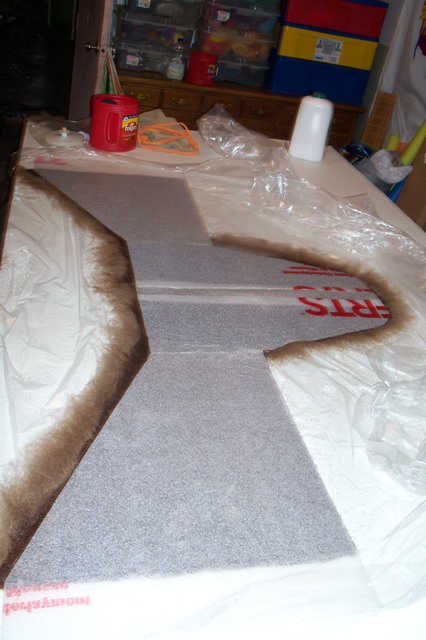
I have finished the initial felting. Now they just need some more time and elbow grease to finish them. Theses ones are in a natural brown Finn wool.