Browsed by
Tag: surface design

Ingeo, Corriedale and Texture

Ingeo, Corriedale and Texture

I’m doing a craft fair next Sunday, 6th July at Victoria Baths, in Manchester, so I haven’t had chance to do any felting this week yet, so these two pieces are from a couple of weeks ago. This first one is dark brown Corriedale wool tops and Ingeo Fibre. Ingeo is a bit different to other fibres I use, it isn’t shiny as such, but it does have a sheen, and there’s also a soft almost ‘fluffy’ feel to it, without it actually looking fluffy. Lyn found this link for how it is made.

OLYMPUS DIGITAL CAMERAHere’s a closer view:

OLYMPUS DIGITAL CAMERAHere’s a Supermacro close up:

OLYMPUS DIGITAL CAMERAAnd here’s a supermacro of an area where the fibre were laid more thickly:

OLYMPUS DIGITAL CAMERAA while ago Marilyn sent me some fibres, one of them being some Domestic 56s wool tops, I tried them out on a texturey piece I made, mostly for the base, but also to add some texture between the base and top layer of 18.5 mic Merino. I liked the way they felted, similar to our English 56s.

OLYMPUS DIGITAL CAMERAI also used some Bluefaced Leicester Noil between the 2 layers. This is lower across the surface:

OLYMPUS DIGITAL CAMERASome of the embellishment fibres I used were soy staple fibre, viscose and flax

OLYMPUS DIGITAL CAMERAI also used milk and bamboo fibres.

OLYMPUS DIGITAL CAMERA

A Sneak Peak at Surface Design Class Samples

A Sneak Peak at Surface Design Class Samples

I’ve been talking about Fiona Duthie’s Surface Design Online Class for months.  Ruth Lane first announced a class giveaway on February 19 on the Felt and Fiber Studio Forum.  I entered, but didn’t win.  However, I signed up immediately after learning I didn’t win because I was intrigued by what the class had to offer.  The class was a big commitment for me — six weeks long and more than 21 different techniques to learn plus a final project.

Over the following few weeks, I found I wasn’t the only one from the Forum to sign up. Cathy (Luvswool) and a few other members also registered.  Since Cathy and I live in the Chicago area, we started excitedly messaging about our preparations, supplies, resources and after the class started our plans and progress.

Part of the class agreement was not to share Fiona’s techniques because this is how she makes her living, but we are free to share our class work.  So, today Cathy and I are sharing several of our favorite samples.

I had never taken an online course so this was a totally new experience for me.  However, Cathy has taught online, but I think we both agree this was a unique experience.

Here are Cathy’s favorites:

Cathy’s Wool Breed Inclusions


Cathy's Pockets and Loops
Cathy’s Pockets and Loops
Cathy's Spikes
Cathy’s Spikes


Cathy's Nui Shibori
Cathy’s Nui Shibori

Now a few of my favorite samples:

Marilyn's Carvings
Marilyn’s Carvings
sdo 5 anemones
Marilyn’s Anemones
Marilyn's Tiles
Marilyn’s Tiles
SDO 4 spikes flower
Marilyn’s Spikes and Iris

Since I’m always looking for functionality, I chose to use the spikes above as ring holders in case you’re wondering why there is jewelry hanging around.

These are just some of the wonderful techniques we learned during the class.  It was a great experience doing the assignments then seeing the different interpretations of the techniques by other students on our weekly discussion site.

For more information on Fiona’s workshops check out her website http://www.fionaduthie.com/

Of course, I couldn’t complete the course without including a panda and bamboo in a sample (which are not felted, just the background.)

Marilyn aka Pandagirl's Loops and Pockets
Marilyn aka Pandagirl’s Loops and Pockets

Thanks to Cathy for sharing her work today. Anyone else who is taking the class, please contact me if you’d like to share your samples or post them on the Felt and Fiber Studio Forum.

What new techniques have you learned lately?


Surface Design Using Resists

Surface Design Using Resists

Like Ann, I haven’t been very well lately and haven’t had chance to do anything other than tidy up the mess I let accumulate while I was writing my notebook tutorial 🙂
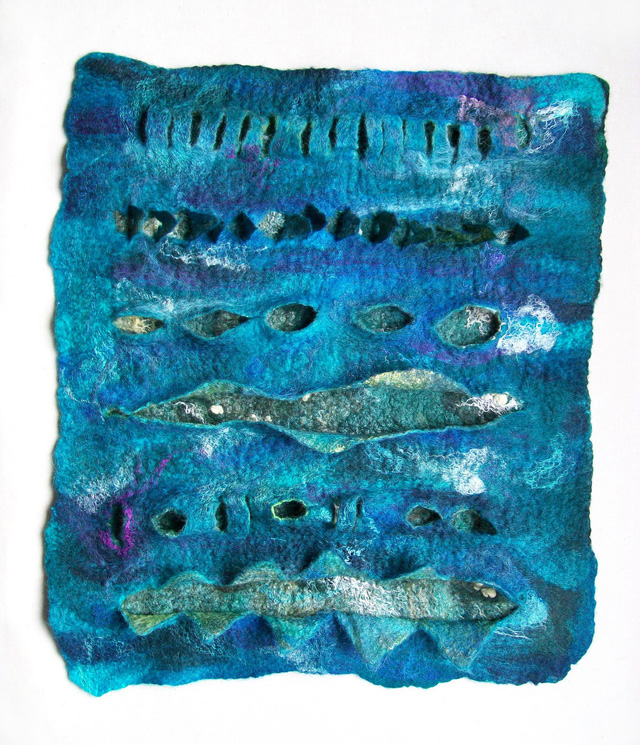
We always seem to be talking about surface design on the forum: stitching, embroidering, embellishment fibres, beading etc. And there have been quite a few projects using resists lately too: Lyn’s pod that she posted about last week, Nada’s resist Slipper tutorial, and Carole from the forum showed us her gorgeous sculptural vessels with lots of surface design and embellishment.  A couple of months ago, Nada reminded me of some projects I’d done using resists to create surface design, so having nothing new to post about, I had a look through my photostream for some examples and hope you don’t mind revisiting some old stuff!
I think this was the very first piece I made using resists to create surface design. I wanted to have a go at trying out lots of different ideas at once, so made a piece using six resists to try out different cuts/shapes.

resist sample (1)I wanted to try out using resists with more contrast between the top layer and what it revealed underneath. This one has green/brown/mossy shades revealing slashes of orangey brown shades of wool with embellishments of silk noil, bamboo, silk hankie and  soya fibre.

orange and green (1)This burgundy piece is cut away to reveal orangey mustard shades with soy bean fibres.

burgundy and orange (2)I think this next piece is probably one of my most adventurous. The resists and cuts were fairly straightforward, but it was quite big, very thick to make it stiff enough to support itself, and I used a flat resist – not somethng I ever have much luck with for a 3d shape!

danglie (2)This last piece is one of my favourite vessels. I love the colours and textures and was really pleased that it came out just how I’d imagined!

vessel (2)If you’re interested in using resists in felting, Ruth wrote a post early on about using flat resists for different hat and vessel shapes. Also, Lyn and her daughter Annie have written a brilliant PDF guide to making 3D vessels using flat resists.

Beyond Nuno Giveaway Winner…and about the Studio Site

Beyond Nuno Giveaway Winner…and about the Studio Site

The Winner of the Beyond Nuno Giveaway is … Wendy who commented on February 25th. Congratulations, Wendy 🙂 Please will you leave a comment on this post so I can email you with the download details, Thanks 🙂  Thanks a lot for entering and for leaving such nice comments, everyone 🙂

Beyond Nuno giveaway winner

A Guide to The Felting and Fiber Studio Site

We’ve had a lot of new visitors to the Studio site recently, and lots of new members on the forum, so I thought it might be time to do a reminder about everything we have to offer here on the Studio site. Before we started the blog just over a year ago, the four of us spent about 6 weeks working on the site, filling it with as much info as we could. We wanted to build the site into a valuable ‘One-Stop’ resource for anyone interested in felting and fibre.

Studio About us2The ‘About Us’ page tells you a little bit about why we started the Studio site, and there are sub pages for each of us with some info about ourselves and our interests.

Studio Felting Pages

In the Felting section there’s a short introduction about the many different kinds of felting. The main pages for Machine, Needle, Nuno and Wet felting all have more in-depth information, and each has a gallery page with many different examples of that particular type of felting.

Studio Mixed media

Mixed media simply means artwork that is made with more than one medium, but for the purpose of the site we use it to mean artwork made mainly with felt or fabric combined with other materials. This section features pages about Beads and Beading, Hand Stitching, Machine Stitching and Surface Design. Each page’s gallery features many examples of artwork.

Studio Fibers

The Fibers section is packed full of information about wool and other animal fibres. The main Fibers page explains some of the different terms that are used to describe wool in its various stages of processing. The Wool and Other Animal Fibers page has a lot of information about wool, animal fibres from animals such as Alpaca, Angora goat, Llama and Camel. There is also an explanation of the Micron and Bradford Count systems of measuring a fibre’s fineness or coarseness; and a PDF guide to the most common sheep breeds and their Bradford and Micron numbers. The gallery page features photos of different animal fibres. Preparing Fibers has a guide to processing your own wool, from washing a raw fleece to carding it into fluffy batts ready for felting or spinning. There is a photo set and detailed description.

Studio other Fibers

The Other Fibers section has lots of information about the non animal fibres we commonly use in felting, such as silk and organza fabrics; fibre prepared into tops like bamboo, banana, viscose, and the more unusual fibres like crimped nylon, plastic and Angelina fibres.

The Silk page shows the many different silk products available, for example, silk carrier rods, silk hankies and silk throwster’s waste and the gallery page features many uses of these. The Man-made fibers page and its gallery have examples of fibres and their uses including commercial art yarns and  some nuno felt examples with synthetic fabrics. The Plant Based Fibers page has many examples of these gorgeous luxurious fibres and felted pieces using them.

Studio tutorials

The Tutorials section is another area with a wealth of information. There are free Dyeing, Felting, Fiber preparation and Mixed media tutorials all written by one of us, including a video on how to make your own roving using a diz, PDFs on Degumming silk and dyeing it; Stitching on felt, making mixed media wall art, using a sander for wet-felting, a beginners guide to using a drop spindle and dyeing with food colouring.

And if you can’t find what you want there, there are also links to outside sites in the Links/Resources section, including rosiepink’s free felting tutorials and their fantastic e-book showing how to make amazing felt artwork and Ruth’s book The Complete Photo Guide To Felting.

So, make yourself comfortable and come and have a look around the site.  We’re always happy to read comments and listen to suggestions for adding more to the site, or to requests for articles or tutorials. Maybe you are a fibre artist with an interesting skill that would make a great feature or you’d like us to link to a tutorial, if you have anything felt or fibre related you want to tell us about, we’d love to hear about it 🙂

Around the Web

Around the Web

I hope you are all staying sane in the madness around the holidays. Here are a few fun things I’ve found around the web this week. I hope you enjoy them. The list is a bit short as I’ve been busy with lots of holiday stuff at the store 🙂

fibres around the web

Giggle with the Goats

surface design around the web

Free Downloadable Labels from Alisa Burke

Felting around the web banner

Felted Calendar Covers by Jana

mixed media around the web

DIY Cat Toys by Design Sponge

Eyeglass Case to Sewing Kit by Tea Rose Home


stitching around the web

Betz White’s Appliqued Felt Christmas Scenes

Nylon

Nylon

Part Two: Trilobal Nylon top

Another Nylon fibre I’ve been using recently is Rainbow Trilobal nylon tops. Trilobal nylon is incredibly bright and shiny, sparkly even. Just like other nylon, it can be dyed with acid dyes. The Rainbow top I used was from World of Wool. I’ve used it ‘as it comes’ for surface design on a few felt pieces, but for this piece, I separated the individual colours and blended the nylon with merino of similar shades.

It felts really nicely, and gives an interesting texture to the felt, aswell as a shiny, sparkly look. Like other nylon fibres it is really inexpensive and a great way for adding interest to felt.