Browsed by
Tag: hand dyed

Dying Background Fabric for Golden Grove

Dying Background Fabric for Golden Grove

One of my goals for 2025 has been to finish pieces and have them ready for framing at the same time that the piece is complete. I seem to have missed this by a long shot with Golden Grove. I looked it up in my posts and I finished working on this piece in March. I didn’t have a piece of background fabric for matting so it got set aside.  Now it’s December and I have things to take to the framer so I am doing last minute dyeing, stitching and lacing to get everything ready to frame. I thought I would show you a basic dyeing method for cotton fabric using fiber reactive dyes (Procion MX).

The first step is to mix up soda ash and water to soak the cotton fabric in advance of dyeing. I used one cup of soda ash to one gallon of water. I use the soda ash water for many dye baths and it keeps well at room temperature. I let the fabric soak in the soda ash water for 30 minutes.

I am not a precise dyer. I don’t take the time to try and create a specific, repeatable dye bath. I do have some work I have done for classes where I keep track of amounts, color results etc. but I tend to add some dye to a cup of water until I get the color I want. I put down a wet paper towel, put a cup of water out and then add however much dye powder seems right to me. (Please remember to use proper safety precautions such as wearing gloves and face mask and use containers, measuring devices etc. that are only used with dyes.) I mix the powder into the water and then test the results on a clean paper towel. I used two different colors of red and a black dye. And if you’re paying attention, you will see that one of my dyes is an acid dye. I have used a combination of both fiber reactive that is used for plant fibers and acid dyes which are used with protein fibers. In my experimentation, I haven’t seen much difference between the two dyes as long as you use an acid (vinegar or acetic acid) for protein fibers and soda ash for plant fibers.

Here’s my first attempt. It helps to remember that you lose some of the dye intensity when it’s rinsed. I put a little dye on a clean paper towel and then looked at it near my completed piece. This seems a little too light so I needed to add more black.

And looking again after I added more black. The test on the right side of the paper towel was the final color.

Next up was to wring out the cotton fabric that had been soaking in the soda ash water. Then I poured the dye liquid into another container and added the fabric. You can also do this in a gallon plastic bag. I wasn’t worried about getting a solid dye on the fabric. More dye would have been needed for that.

The next step is to let the fabric “batch” or sit in the dye bath. Normally, I leave it overnight but I didn’t have time for that here so I let it sit for 4-5 hours. I didn’t go back and move the fabric around which would have given a more solid dye but I wanted some variations so I left it. Then on to rinsing. I rinse three times in cold water to get the soda ash out. You can feel it when you’re rinsing, it feels slick. Once that slick feel is gone, it’s time for textile detergent and hot water. The textile detergent is just a few drops into the hot water and then add your fabric. I usually let that soak for a couple of hours and then put it in the drain and spin cycle of the washing machine.

Dyed fabric with dark reds/black dye mixture.

Once it’s out of the washing machine, I iron it when it’s still wet and you can see I got a lot of variation. But I wanted that to look like sunlight through the trees and I was happy with the end result. Too bad most of it gets covered up.

Golden Grove stitched to background hand dyed fabric stretched over matte board.

And here’s Golden Grove stitched down to the dyed fabric and then laced on to matte board. It’s ready for framing (only 9 months behind schedule).

Have you tried dyeing? I really enjoy creating custom colors and getting a piece of fabric that is unique. If you haven’t tried it, you might want to give it a try.

Dyeing some yarn

Dyeing some yarn

A year ago a friend who also owns a small fibre business asked me to dye her some Autumn-inspired rainbow yarn for her to knit with for her own client. I was happy to oblige, and very pleased with the end results. This is the picture of the leg warmers she made. Her name is The Crimson Rabbit on Ravelry and here is her profile.

_DSC2239_medium2


Now, repeating a colourway when you have no written data on how you accomplished it the first time can be a bit tricky, but not impossible. If you’re used to the same dyes you sort of develop an eye to recognise them, and this is more or less what happened in this instance.

You can see the yarn starts out a very light yellow and progresses to a slightly more orange-toned one. I mixed some dyes up, eyeballing the colours and dipping a corner of kitchen roll tissue in the liquid to determine when I was happy with the mixture. I did the same for each colour. I was lucky I recognised the yellow-brown dye at the end or I’d be in a lot of trouble to reproduce that particular one.

IMG_4107

This is what the skeins look after they’d been steam-set and dry. I think it looks quite similar from the original one, don’t you? Winding these two skeins back to functioning yarn took me (I kid you not) around two hours. I had divided and tied up each section previously by weight, and boy it’s a lot more work to put it all back together…

Now, since I know my post is a little late (sorry about that) and a bit on the thin side, allow me to share a couple of images of the park near me when the cold arrived. Our friends over in North America will no doubt think this type of cold is cute, but I sure felt it in my bones…

IMG_7399

IMG_7405

Finally, another exciting commission: a raven! I was asked to make this and it had to specifically be a raven, not a crow. Not sure exactly how to tell the difference between the two, I did some internet research and, a few documentaries and image searches later, I think I’m a bona fide corvid geek now…

IMG_4100

What exciting stuff have you been up to in the fibre world? Share away, I’d love to hear it.


Ginkgo Anyone?

Ginkgo Anyone?

A while back I dyed some silk and wool experimenting with making browns with acid dyes.

20151212_115844

I wasn’t sure what I’d use it for, but I fell in love with the coppery silk habatoi.  I made batts with the wool.

20151130_152828

I had purchased some alpaca yarn this summer and wasn’t sure what I would do with it.  For some reason it called to me even though it’s not my typical color way. But putting it next to the cooper silk, I had to come up with something to do with it.

20151025_154142

I made felt base and placed the silk over it to nuno felt.  I still wasn’t sure how I would attach the yarn.  But then Ruth posted a blog about couching. Bingo!


20151212_12160520151213_153001

I decided to make gingko leaves using the couching method of attaching the yarn.

It was a long process. I first had to outline the shape with stitching ( I tried white pencil and other pens, but this worked best.)

20160109_155618

Then I pinned the yarn to the shape and began the couching process.  Because the yarn was variegated it created some interesting color contrasts along with the variegated nuno background.

20160109_161041Then used straight stitching for the veins.

20160113_122100The yarn was two ply and I thought that the veins for the secondary leaves should be less obvious so I separated them to make the veins  ( long process). Here is the progress –

20160123_152845 20160123_152917 20160123_152812

Why gingko?  I like the shape and also have a metal vase in my bedroom water closet that has the gingko leaves embossed on it.  I thought this would  tie the picture together with the vase.

20160124_125700The wall color is a purple haze which I thought would be a nice contrast.  while the leaves aren’t perfect, I’m pleased with the result.

What new fun projects are you working on?


From Batts to a Handbag

From Batts to a Handbag

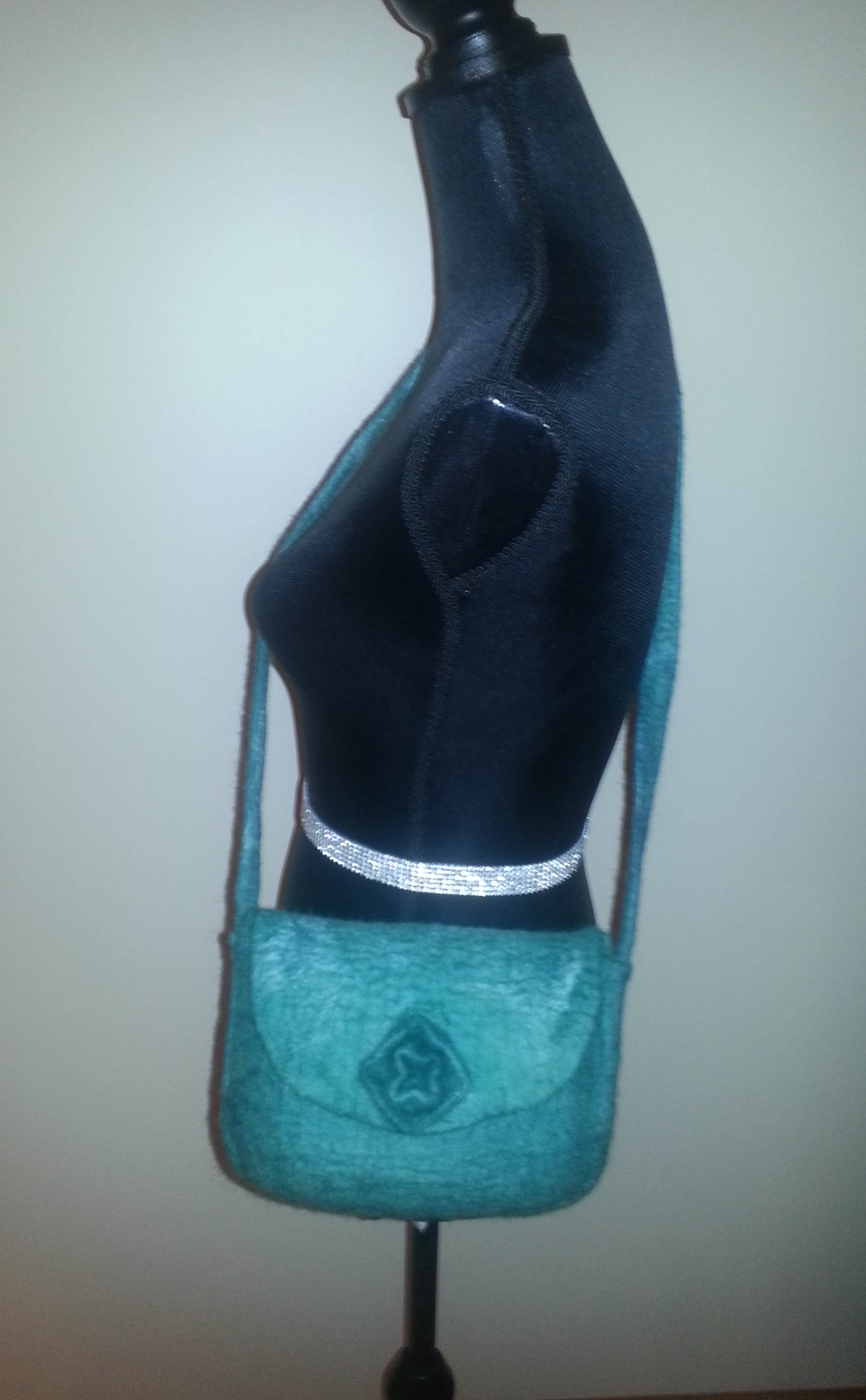
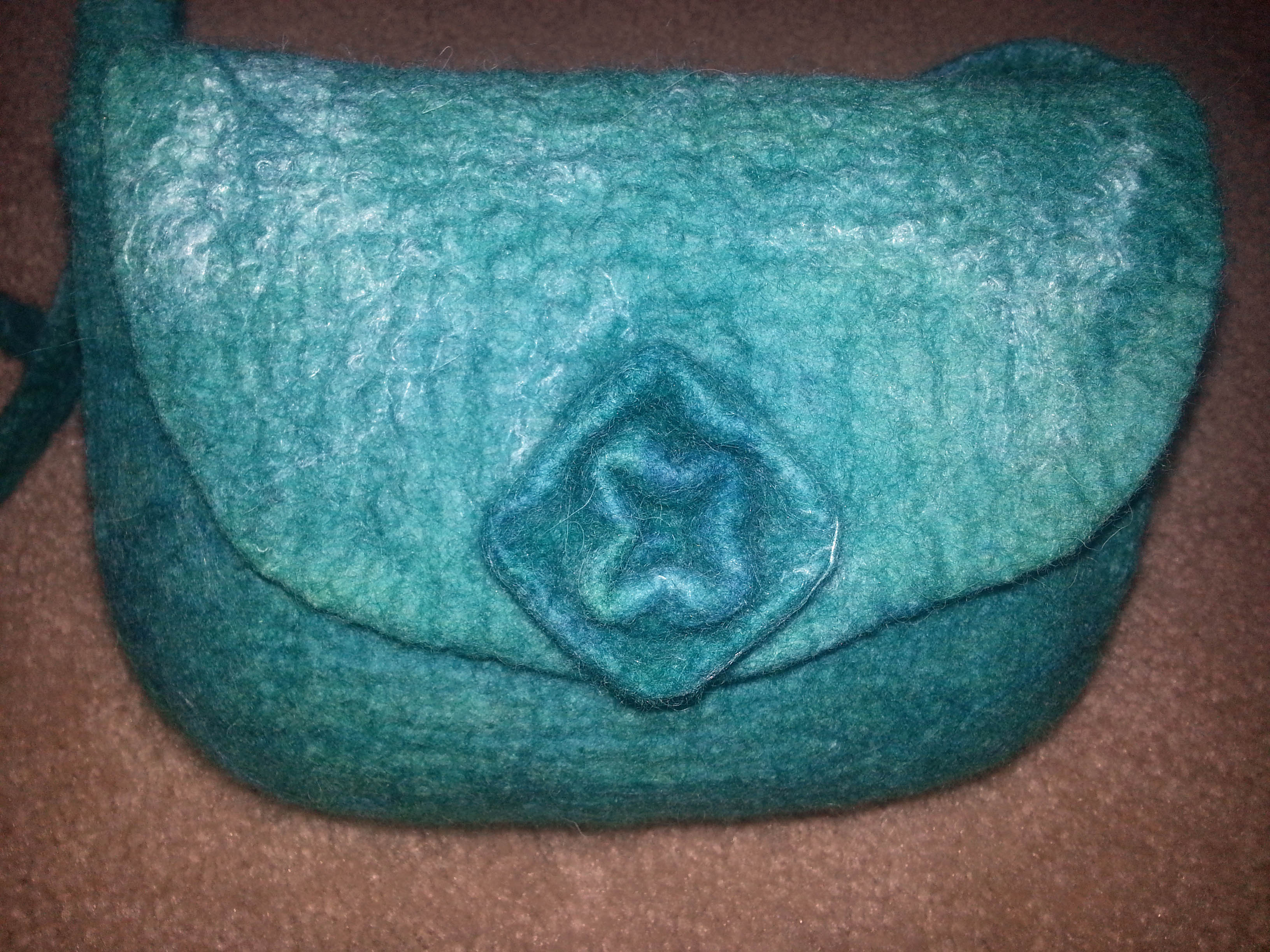
After my four days of dyeing experiment, I carded a bunch of batts with the different fibers I had dyed.  I decided I wanted to do something a little challenging using the batts. So, after doodling around with a few ideas I settled on a handbag using a couple of the techniques I learned in Fiona Duthie’s Surface Design Class.

I didn’t have a pattern. So, I used the general shape of the purse I carry now and added 30% for shrinkage and made a template. It took a lot more planning than I had anticipated so I got very engrossed in making sure I had everything organized and followed each step in the right order. Unfortunately, I worked intuitively and forgot to write down the procedure and take pictures at each step.

I wanted to use fiber for the shoulder strap, but I also wanted it to be strong and not stretch.  I made the shoulder strap first using a tightly woven scrim cut with the grain between layers of wool.  I left long ends unfelted and wrapped plastic at the ends to try to protect it from the water, not that it helped. This would be the part I would felt to the bottom and sides of the handbag so it would be all one piece.  Then I  used a dowel to roll the strap until it was partially felted.

handle end rolling handles


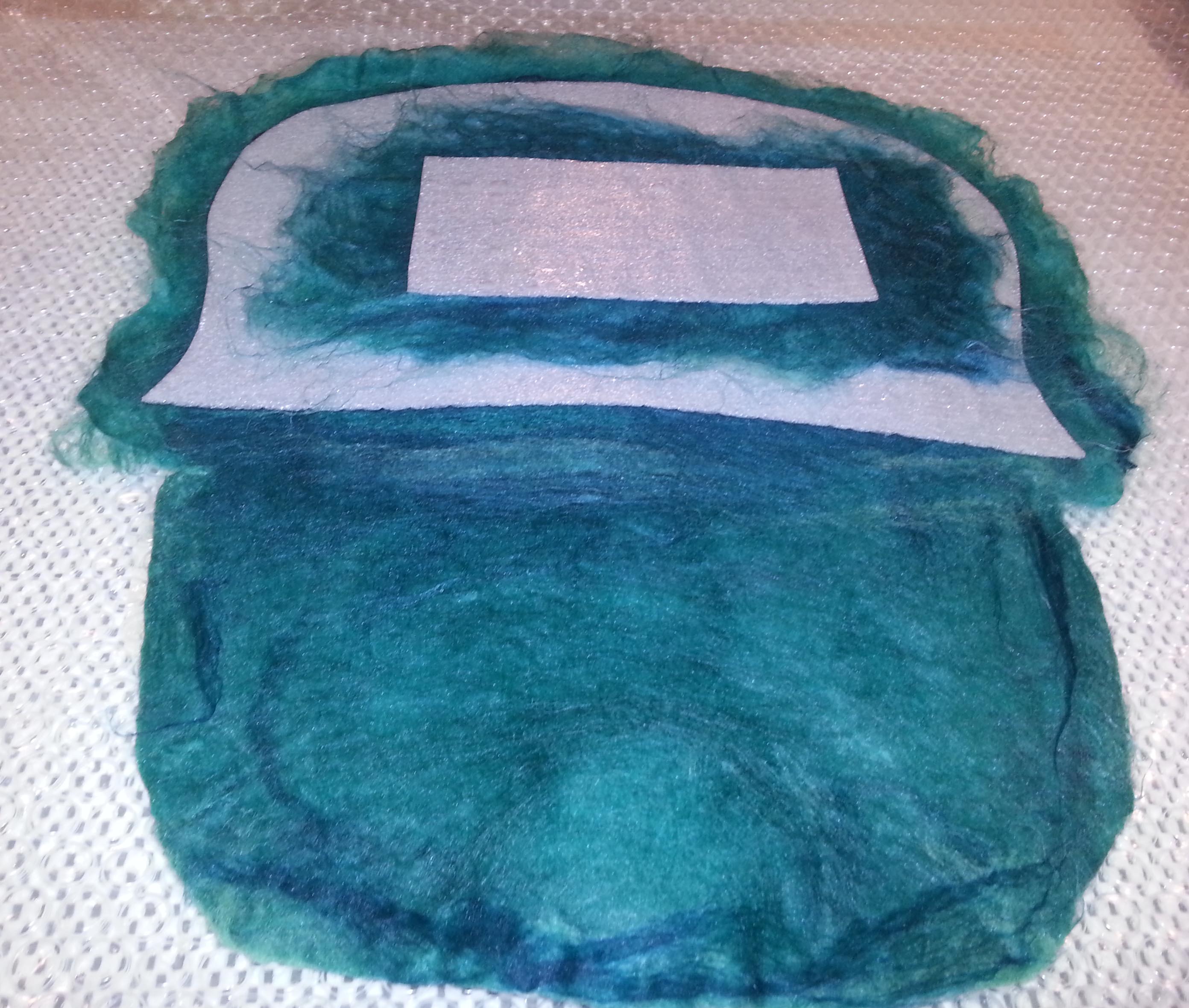
Here is one side of the purse with scrim lining between the wool layers, resist and a resist for one of the inner pockets. I wet one side then proceeded to lay out the other side working backwards from inside out. Laying out more pocket resists, the back and back pocket. I know that sounds strange, it was a little mind boggling.

layout

The decoration for the flap had to be done first before attaching it to the bundle to felt. The middle was felted by hand and the circle of fiber around it was left unfelted in order to add additional  fibers to felt into the bundle.

decoration

The handles were laid out on the bottom and the sides then worked on the sides first to ensure they held together during the felting process.

It was quite a thick bundle and once it was felted enough, I cut out the resists and continued to full and shape it until it sat up by itself.  When dry, it had that “thud” of being completely fulled.

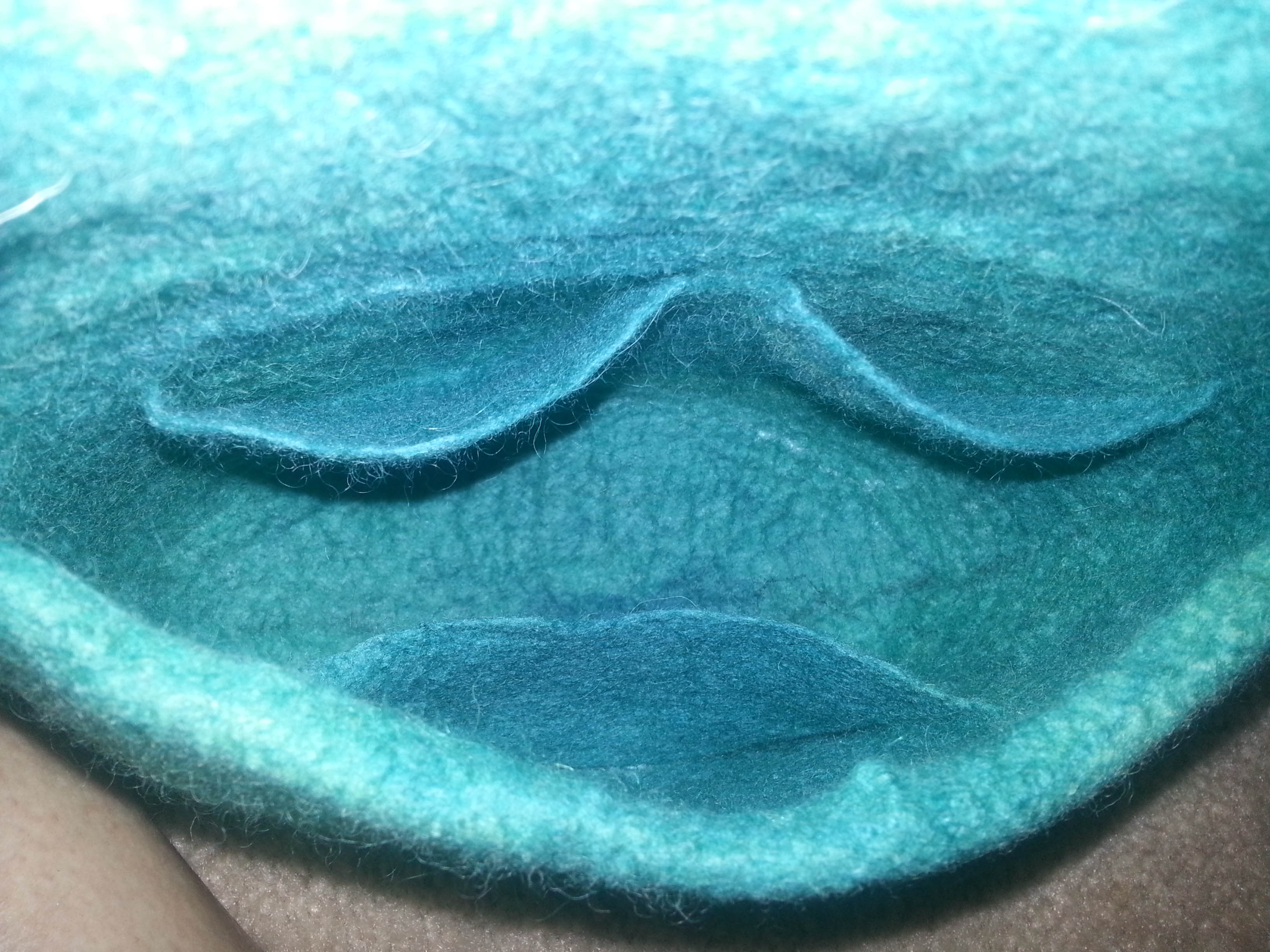
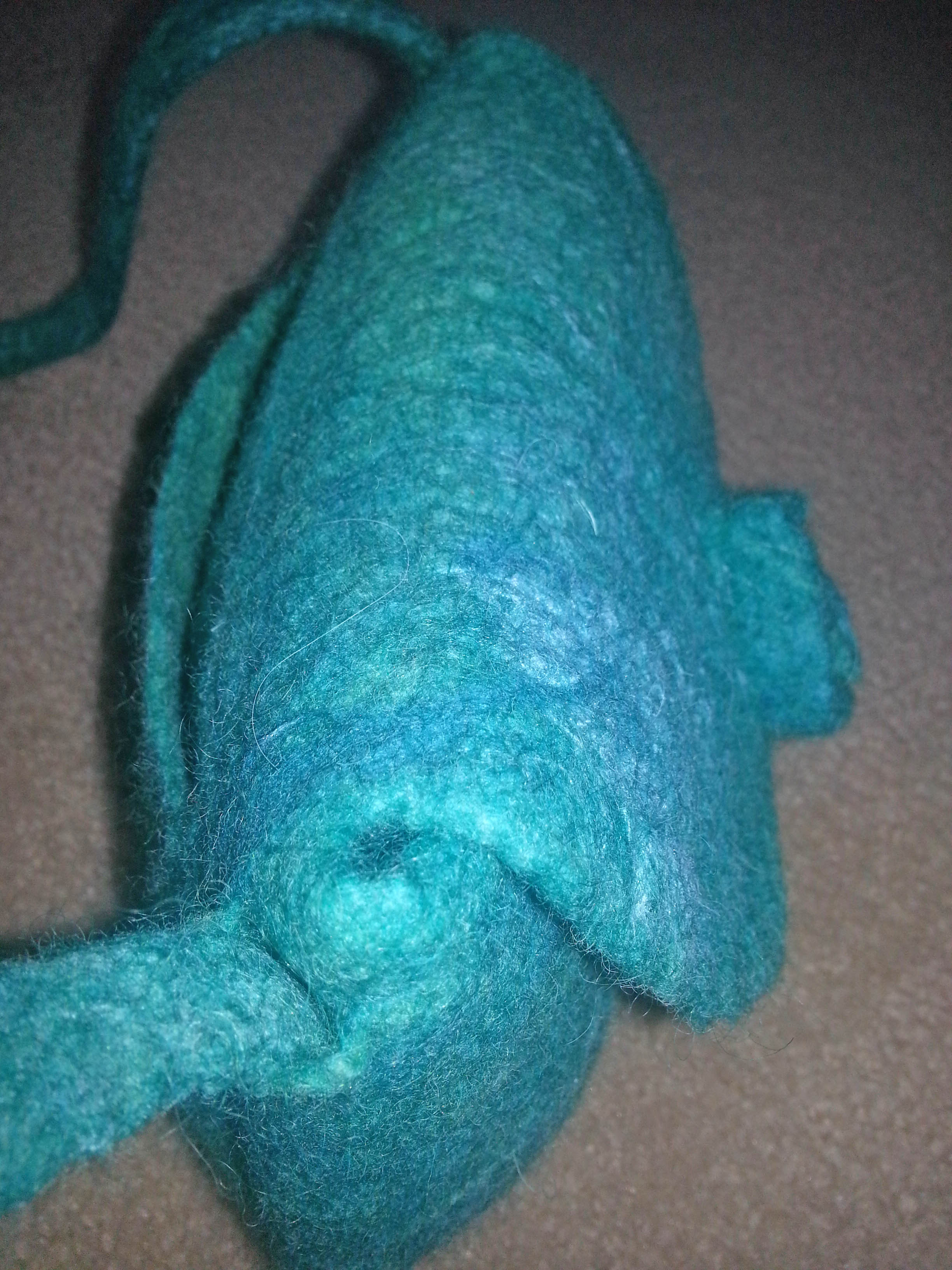
hangingcloseup front Three inside pockets.

insideOne back pocket.

top view

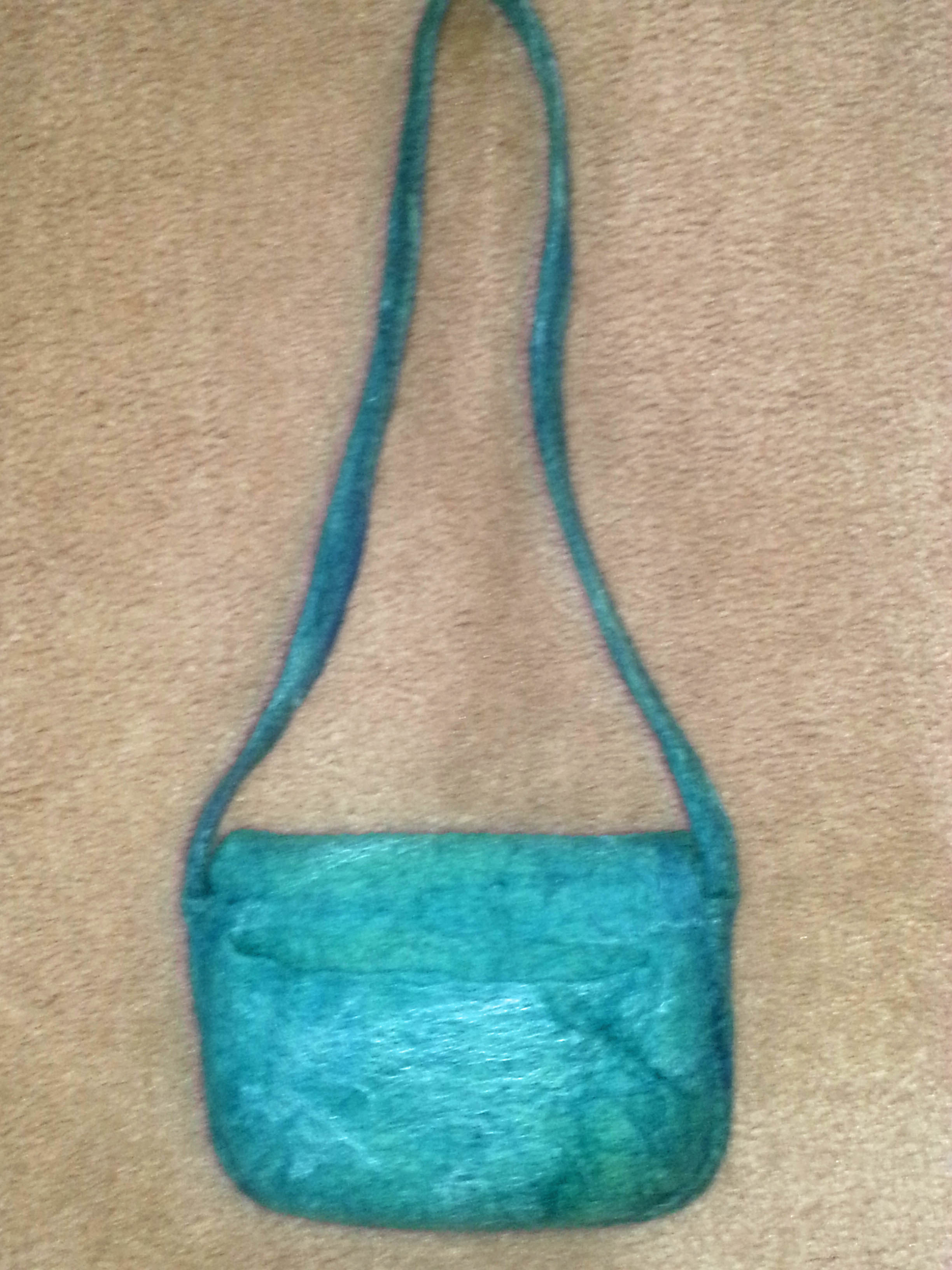
backI wonder if I could duplicate this again?  Maybe if I do I’ll write a tutorial.  The one thing I would do differently is to put the shoulder straps on the inside of the bottom and sides rather than outside.  That would be another challenge. What do you think?