Browsed by
Category: Classes

Further revelations on Onion Skins and book review on Pigments (plus new course announcement!)

Further revelations on Onion Skins and book review on Pigments (plus new course announcement!)

I’m hoping the featured image will make you curious!

Before I start into my post I want to mention my new course on wet felting which was recently launched with the Felting and Fiber Studio. It’s designed for felt makers who are new to using resists.

It’s fully supported by ‘how to’ videos and PDFs and we work with the simple circle. You will learn how to make a vessel and at the end I discuss with you the possibilities of how you can take it further.

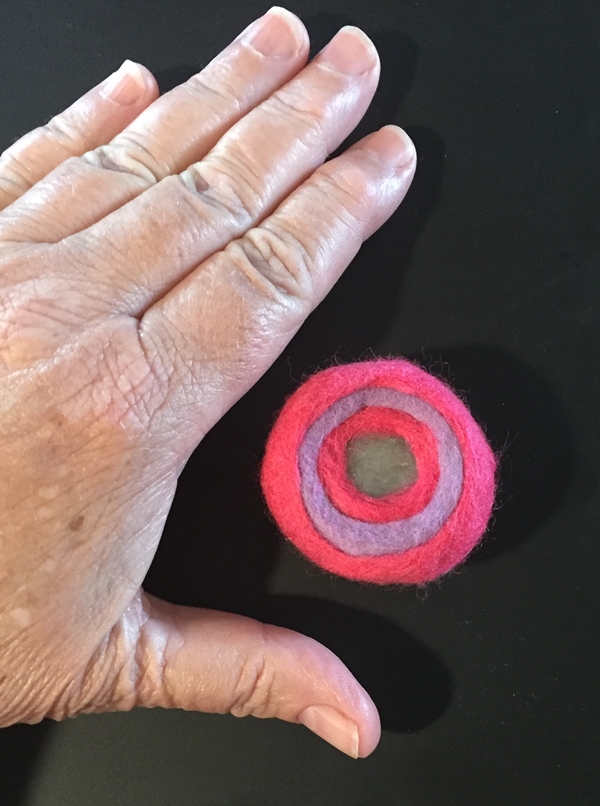
So, you start by learning how to make something like this ….

Then I discuss a few variations that can be made with the circle and you could choose after the course, to make something like this ….

I discuss how to make this sculpture on the new course

This course is permanently open so if you fancy it you can register anytime. Curious? Then feel free to head over to https://feltingandfiberstudio.com/classes/online-course-wet-felting-a-vessel-using-a-simple-resist/ to find out more.

Promotion over! Thanks for your patience, Now let’s move on to my post.

Onion skins were at the centre of my last post – I talked about making pigment out of the dye. I mentioned that I would return and show you a little bit more of what I did with some of the dye. Here is the link to the post in case you missed it: https://feltingandfiberstudio.com/2025/08/18/is-this-compost-or-dye-material-actually-its-both/

I had set aside around half of the onion skin dye pot to try out on some fabric (I used the rest to make the pigment). I decided to experiment with a little margilan silk and some woven wool fibre. I mordanted these fabrics first, using an alum solution. The alum attracts the dye particles and the colour is less likely to wash out.

Margilan Gauze dyed with yellow onion skins.
Woven wool sample dyed with yellow onion skins


I love the vibrancy of the results. I would describe the wool sample as deep orange while the silk sample turned out more of a golden colour. It is quite the challenge to get the photo to reflect the true colour of the fabrics. I now need to work out what to do with these two fabrics. To be honest, there is not a lot of either and I don’t have a toning fibre to use behind the margilan – I think I will have to make up another batch of the onion skin dye.

Once I finished dyeing the few bits of fabric, I transferred the remainder into a 5 litre container. I basically forgot about it and only remembered it when I came to put together this post. So it has been sitting around for two months.

Now I need to digress a bit. Our lovely little pooch, Archie developed a lump on his elbow a number of months ago. We have been keeping an eye on it as his vet warned that it would become impossible to remove if it grows much bigger. (there would not be enough surrounding tissue to easily sew up the wound). As fate would have it, it grew and Archie went ‘under the knife’. He was discharged wearing his ‘cone of shame’ which we quickly swapped for an inflatable version – much more comfortable for Archie and for the humans too – less bruising on our lower limbs. The only downside was that the cushioning around his neck caused him to snore. He sleeps in the bedroom with us and this was cute for about five minutes….. The cone was tied with an elastic bandage. I was having fun playing with the weave and thought it might be fun to felt with.

Archie in his blow up collar and sore paws

I made a bangle. First I laid down the bandage and wrapped it around a resist which matched the length of the bandage. Then I laid down layers of merino fibre – 6 thin layers in total. I felted it to fit my wrist and shaped it. The whole purpose was to see how it would take the old onion skin leftover dye. I did a cold mordant – I soaked it in 10% of its weight in alum and left it overnight. I rinsed it out and popped it into the dye bath, slowly bringing it to the boil.

Here is the result. The colour is a lot lighter than its first run. That said I decided to speed up the process as the smell of the dye bath was pretty awful. In fact it was pretty disgusting. I endured it for around one hour and then my nostrils got the better of me. I poured off the majority of the dye bath and then left the bangle to cool in the rest. I also lit a scented candle (it really did take away the stink – good to know going forward!)

Bangle made with merino and elasticated bandage dyed with yellow onion skins

While I like the colour, I think I will use it as a base to play with stitches. So I may be back to you on that.

I mentioned in my last post that I had just ordered a book on pigment making and that I might review it, if readers would like that. I know I am stepping away slightly from textiles and felt here but it is possible to combine pigment and textiles (alcohol inks anyone?). I was feeling quite excited as I had ordered the book and it was on the cusp of delivery. I got a positive response so here it is.

The book is called ‘Natural Watercolor Paint Making’ and it is by the artist Joanne Green. Some of you may already follow Joanne on Instagram (#joanne_green_art). I love watching her magically transform plant matter into pigments and then reconstitute it into a paint which she uses in sketches of the plant which has formed the basis of the actual pigment. Very clever and a great pleasure to watch.

Cover sleeve of Joanne Green’s book

Joanne’s book is beautifully presented and very readable. It’s a bit like sitting with a knowledgeable friend having a chat over coffee. The materials and supplies list is very comprehensive and I found that there’s really nothing on the lists that could not be sourced. With regard to the topics covered, I think the easiest way to show this is by sharing the contents pages. As you can see, there’s a whole section devoted to step by step instructions on how to make the lake pigment from the moment you have produced your dye bath through to turning your powdered pigments into watercolours and how to store your new treasures. Joanne is living in Canada but I can easily access many of the plants she uses in her recipes in Ireland.

Source: Natural Watercolor Paint Making; Joanne Green

Photography (primarily by Canadian photographer Tegan McMartin) – is sumptuous and a pleasure to view. It’s interspersed with Joanne’s tiny watercolours that are a feast to the eyes.

Source: Natural Watercolor Paint Making; Joanne Green

I am so pleased that I made the leap and purchased this book. I found it easy to source too. If you are a fan of Joanne’s social media postings or are curious about producing pigments, then it is a worthy purchase.

Registration Open for Felt Hats and Felt Bags Online Classes

Registration Open for Felt Hats and Felt Bags Online Classes

Teri’s online classes are open for registration today. The classes will begin on July 17. Teri teaches two great classes, one on how to felt concertina style hats and the other one on how to create felt bags. Both of these classes will teach you methods of improving your felting techniques so if you have felted around a resist before such as to make a felt pod, you should consider taking the next step on your felting journey.

For more information and to register for the felt hat class, click here. 

Have you taken a look at other student’s hats that have taken Teri’s class? There are some really fun hats and the variations are quite creative. Take a look at the student hat gallery here.

Teri’s felt bag class is an excellent way to learn how to create a variety of shapes of bags, as well as features such as straps, multiple compartments and pockets. You can find more information and register here.

And the student gallery for felted bags is here.

So what are you waiting for? Jump in and learn some new felting techniques.

Or if you’re just starting out and want to learn the basics, try our Wet Felting for Beginners class. This class can be taken at any time with unlimited access. For more information and registration, click here. 

Learning and Experimentation with Online Classes

Learning and Experimentation with Online Classes

Have you wanted to be a little more experimental in your fiber art practice? Do you want to learn new techniques and add embellishments to felt or other fabric? Why not try an online class all about embellishing felt? Anyone from anywhere in the world can take these courses, no need to show up at a certain time (you can even wear your pajamas) and the classes are 6 weeks long so you have plenty of time to learn a new technique and try out an experimental approach. My online courses are 4 stand alone classes under the title Embellishing Felt with Surface Design Techniques – A Mixed Media Approach.  You can take just one or work through all of them. The classes are only $45 US for 4 weeks of video and written PDF’s plus 2 weeks extra time on the class website with full instructor support. Registration is now open and the class begins on May 16, 2025.

The first module is called Nuno Felting with Paper Fabric Lamination. The bark I created above used this technique.

You will learn the technique of Paper Fabric Lamination and then how to use these pieces in nuno felting. As you can see from the examples above, there are many possibilities with this technique. Click here for more information and to register for the class.

The second module is Experimental Screen Printing on Felt.

You will also be able to use these techniques to screen print fabric such as silk to use in nuno felting. These same techniques can also be used on cotton fabric to use in fabric collage or quilting.

You will learn how to create thickened dye, make your own screens and many ways to use these screens in an experimental approach. Click here for more information about Screen Printing and to register for this class. 

The third module in Embellishing Felt with Surface Design Techniques – A Mixed Media Approach is Printing, Stenciling, and Playing with Thickened Dye on Felt.

This one is really fun and experimental. Learn to make stamps, stencils and how to use a variety of objects from around the house to create your own unique surface design on felt. Develop your own style with designs you have created.

The techniques you learn in this class can be used for felt, other fabric types and even paper. The stamps and stencils can be re-used over and over and applied in different ways to create exciting patterns. Click here for more information about Print, Stencil, and Play with Thickened Dye on Felt and to register for the class.

The last module in the series is Free Motion Machine Stitching on Felt.

In this course, you will learn the basics of free motion machine stitching and how to use this specifically on felted projects. Does the thought of machine stitching seem a bit scary? If so, you should take this course to get a handle on how to use your sewing machine to create wonderful embellishments on felt paintings or other felted items.

We’ll start with how to set up the machine and some great practice techniques that will build your skill level until you feel comfortable with your machine. Then you’ll learn about machine lace, thread sketching and how to incorporate machine stitching into felt paintings. Click here for more about Free Motion Machine Stitching on Felt and to register for the class.

I hope you want to expand your fiber art skills. If so, click on any of the links above to read more about the classes, see the supply lists and to register. I look forward to “seeing” you in class!

And don’t forget, if you are a beginner, our online class Wet Felting for Beginners is always available.

This class teaches you all about wet felting. You’ll learn how to make a piece of felt, how shrinkage works and how to calculate it and the basics of felting, fulling and creating felt from wool fiber. Click here for more information and to sign up. 


Wrestling with the horns of a dilemma – Art Yarn!

Wrestling with the horns of a dilemma – Art Yarn!

For a long time, I have been promising myself that I would take a workshop to get some sort of grip on how to use a spinning wheel.  My friend Trish Kerr runs Irish Alpaca Yarns and she has for a long time been offering me a space on one of her spinning workshops – the stars never aligned as, invariably I was busy on the day.  Then, in December, the offer was once again made and, I was actually free!  The beautiful venue was not far away, Cornstown House (https://cornstownhouse.ie/) which was not far away from me.  Happy days!  Unfortunately there was a huge storm the night before but, despite fallen trees, we awoke to a clear bright day and I negotiated my way to the venue.

We were spinning using alpaca fibre.  I hadn’t realised it until then but some people who have an allergy to wool fibre can wear alpaca.  The irritant in wool apparently is the scales and alpaca does not have scales.

There were 5 students and some had previous experience.  Luckily Trish is an amazing teacher. I had warned her that, given my hideous coordination when learning something new, that this could put a serious strain on our friendship.  She laughed it off.  Trish has great patience which she got to draw on in bucket loads when it came to teaching yours truly!

We were working off Louet wheels which she supplied.  She is quite an expert on the older more traditional wheels too, and she was able to offer good advice on how to get an old wheel which a student had brought, back working again.

Trish got us all set up and was very attentive throughout the morning.   The first skill we worked on was treadling, as a first timer it took a lot of effort but after a while I had the wheel moving in a clockwise direction.  She set us up with alpaca fibre and soon we were all spinning.  Some (by this I mean most) much better than yours truly here.  But I was having fun.

Trish started us all off drafting setting us up with Alpaca yarn

The morning flew and we stopped for a delicious lunch and tour of the farm, both supplied by our most gracious hosts, Fionnuala and Dominic.  The tour was great fun, featuring  lots of Alpacas, some rare breed sheep (including one that loved to be patted, a cow and donkeys.  The farm offers Alpaca Trekking and workshops along with other events. When I explained that I primarily was a feltmaker and showed an interest in the Teeswater, Dominic disappeared for a few minutes and arrived back with some raw fleece for me to play with when I got home.

When we returned from our tour, Trish gave us a presentation on alpaca fleeces which was very interesting.

We plied our yarn in the afternoon.  Now that I had ‘mastered’ the clockwise, introducing the ‘counter-clockwise’ was, let’s say, interesting.  This is what I produced.  It is, I believe, kindly referred to as ‘Art Yarn’.  Now, I am in the horns of a dilemma.  I want to spin more but I don’t want to ever spin a nice even ply.  The general consensus in the room was that once you perfect the spin you can’t return to the Art Yarn.  Now, while I appreciate that at my learning speed, perfection is a long way down the road.  I don’t want to get there but I would like to spin more art yard and, if I’m honest, I would love a new toy in a spinning wheel.  Any ideas?

My plied alpaca art yarn

I played with the Teeswater when I got home.  Here is the result:

Last year, I wrote up a number of posts about various dyeing  workshops I had attended.  In one I dyed a lot of fabric samples and wondered what I should do with them.  I think it may have been Ruth who suggested that I could think about stitching into some.  I have never embroidered by hand before but decided to give it a try over Christmas.  Here is my first effort.  I was inspired by a photo online.  Once completed, I padded it with some cotton batting and backed it with linen.  I might frame it  at some stage but I will need to find a suitable frame.

Using the dyed fabric samples, I tried my hand at embroidery over Christmas

I totally enjoyed my day spinning, even though I was pretty dreadful at it. But I love the result and for once, I really don’t want to improve greatly at this. Long live Art Yarn!

Do you agree? Any hints and tips on how I can retain my current standard? All suggestions will be very gratefully taken on board. I’m just looking for an excuse to buy a wheel.

felting techniques class

felting techniques class

Sorry For the late post, I thought today was tomorrow.

Last weekend I had four ladies for a techniques class. This is not an advanced class, but it is also not a beginner class. People had to already know how to make felt.

First, we did inclusions. They used a piece of thicker prefelt and elastics to enclose some large glass beads (the kind they are used in the bottom of vases for decoration) and a felt ball.  Then laying out a base and top they enclosed some glass beads, a felt ball, a circular resist with a hole and a squashed tasimo pod with a resist over it.  Sorry, I forgot to grab the camera until they were at the rubbing stage. Part way through they cut some holes on top of the beads and pod.

When they were laying out I had them cover a pebble with 2 layers in different colours. I had them put a resist on top of the first layer and wrap it with the second colour. They popped them into a piece of nylon stocking to contain it all and make it easier to felt. You can see the first sample on the table in the picture below. They mostly felted the pebbles during lunch while eating and chatting. Once it was mostly done they cut a hole in the top and after healing the cut edge removed the resist and cut a smaller hole to reveal the pebble.  Similar to the one below that I made a few years ago.

felted pebble

Next was cracked mud. I had them layout two 10×10 pieces( top and bottom) they added painter’s tape in 2 widths and then added the top

Naturally, because it was a wet felting class, they had to do some rolling.

I had them cut the mud sections at different stages of felting, prefelt, mostly done and done. so they could see how that affects it. I think they could have used more felting before the fulling but we had limited time and had to move on to book resists. I had them make a four-page book resist using half circles. they managed to get it laid out and wet down but then we were out of time so they had to take them home to finish.

3 students sent me pictures of the finished pieces. The first one she manipulated to look like origami.

And this one, She says it needs more fulling but wanted to get me the picture.

The third student got creative and combined her samples into a tea cozy.

All in all a good class. I just wish I could squeeze more techniques in. But no matter how fast you want to be felting takes time.

Learning and Experimentation with Online Classes

Learning and Experimentation with Online Classes

Have you wanted to be a little more experimental in your fiber art practice? Do you want to learn new techniques and add embellishments to felt or other fabric? Why not try an online class all about embellishing felt? Anyone from anywhere in the world can take these courses, no need to show up at a certain time (you can even wear your pajamas) and the classes are 6 weeks long so you have plenty of time to learn a new technique and try out an experimental approach. My online courses are 4 stand alone classes under the title Embellishing Felt with Surface Design Techniques – A Mixed Media Approach.  You can take just one or work through all of them. The classes are only $45 US which is a tremendous deal for 4 weeks of video and written PDF’s plus 2 weeks extra time on the class website with full instructor support. Registration is now open and the class begins on January 10, 2025.

The first module is called Nuno Felting with Paper Fabric Lamination. The bark I created above used this technique.

You will learn the technique of Paper Fabric Lamination and then how to use these pieces in nuno felting. As you can see from the examples above, there are many possibilities with this technique. Click here for more information and to register for the class.

The second module is Experimental Screen Printing on Felt.

You will also be able to use these techniques to screen print fabric such as silk to use in nuno felting. These same techniques can also be used on cotton fabric to use in fabric collage or quilting.

You will learn how to create thickened dye, make your own screens and many ways to use these screens in an experimental approach. Click here for more information about Screen Printing and to register for this class. 

The third module in Embellishing Felt with Surface Design Techniques – A Mixed Media Approach is Printing, Stenciling, and Playing with Thickened Dye on Felt.

This one is really fun and experimental. Learn to make stamps, stencils and how to use a variety of objects from around the house to create your own unique surface design on felt. Develop your own style with designs you have created.

The techniques you learn in this class can be used for felt, other fabric types and even paper. The stamps and stencils can be re-used over and over and applied in different ways to create exciting patterns. Click here for more information about Print, Stencil, and Play with Thickened Dye on Felt and to register for the class.

The last module in the series is Free Motion Machine Stitching on Felt.

In this course, you will learn the basics of free motion machine stitching and how to use this specifically on felted projects. Does the thought of machine stitching seem a bit scary? If so, you should take this course to get a handle on how to use your sewing machine to create wonderful embellishments on felt paintings or other felted items.

We’ll start with how to set up the machine and some great practice techniques that will build your skill level until you feel comfortable with your machine. Then you’ll learn about machine lace, thread sketching and how to incorporate machine stitching into felt paintings. Click here for more about Free Motion Machine Stitching on Felt and to register for the class.

I hope you want to expand your fiber art skills. If so, click on any of the links above to read more about the classes, see the supply lists and to register. I look forward to “seeing” you in class!

And don’t forget, if you are a beginner, our online class Wet Felting for Beginners is always available.

This class teaches you all about wet felting. You’ll learn how to make a piece of felt, how shrinkage works and how to calculate it and the basics of felting, fulling and creating felt from wool fiber. Click here for more information and to sign up. 


Adventures in colour (Part 2)

Adventures in colour (Part 2)

In my last post I talked about a 4 week dyeing course that I attended a while ago at Sharon Wells studio https://www.sharonwellsart.com/ . The first week was dedicated to acid dyeing and we have fantastic results from it. Week 2 was all about natural dyeing, our colours were more subtle and totally restful. If you missed part 1 you can catch it at adventures-in-colour-part-1

I talk about the third and fourth sessions in this blog. I hope you enjoy!

Week 3:

This week’s session was all about the production of pigment. Sharon started off by showing us some ‘tools of the trade’; the glass mulling tool and tempered glass which, along with an old coffee grinder, she uses to grind elements into powder. We learnt about the difference between dye (dissolves in water) and pigment (disperses in water and so needs a carrier). Then we discussed types of pigment; earth and animal both of which can be ground into powder and animal, which needs a totally different process. We mixed various powers and produced test sheets using the pigments as both oil and watercolour paints. We also tried artificial pigments. It was very exciting. Here is a quick look at some of the day.

The real excitement happened when we started making botanical pigments. Sharon boiled up some onion skins and in no time we had a beautiful golden brown coloured liquid which she shared out among the group. She then dissolved aluminium sulphite (alum) and soda crystals in two containers. We added the alum to our onion skin liquid and then watched in fascination as the soda crystals reacted to the liquid when we poured it in. The pigment separated from the liquid and we were, in the end, left with clear liquid. We then strained our pigment and dried it. Here are a few photos to give you an idea of the fun we had:

  • The onion skins were left to simmer for about an hour
  • Four botanical pigments: 1. Marigold 2. 'wild Eve' Rose 3. Olive leaf 4. bluebell

The whole process had us all enthralled and ready to try it at home!

Week 4:


The final class in the dyeing series focussed on Procion Dyes . The class was led by Anne Jefferies, and Irish Textile artist and tutor. We used cold water dyes this time and worked with plant based fibre including different weights and textures of cotton, linen and silk. We also experimented dyeing a variety of different threads. Anne explained the full process and provided excellent notes so there was very little need to write which was good because our hands were very busy. Anne prepared the various solutions and we got to work using pure primary colours. We divided our samples into three lots and tied each piece of fabric into whatever shape we fancied then we got dyeing. We started with the lightest colour, yellow and dyed our first batch. Then we removed and rinsed these and retied a number of them, ones we wanted to overdye and popped these into the the dye bath to which some red dye had been added. We then added our second batch of undyed samples and watched the magic occur. We then removed all of these and set up a fresh dye bath for the blue. Here are some of the photos taken on the day:


  • Various small samples of white fabric which have been tied with string elastic bands paper clips and pegs
  • Primary colour Procion dyes mixed with water and ready to be added to the fibres
  • First colour to be used yellow in basin along with various fabrics tied in various ways and prepared for dyeing
  • table with two basins yellow dye added to fabric, participant stirring one of the basins
  • Table covered in a towel, lots of dye spills fabric samples at various stages of dyeing
  • Various white cotton silks linen and rayon threads tied to a card ready for experimental dyeing
  • Primay colours have been added to the various cotton, silk linen and rayon threads
  • Syringe is used to measure out the amount of the dye. It is being added to the red dye bath
  • fabric added to the second dye bath of red. Fabrics have been retied and added to the top bath. a second bath contains retied fabrics which are waiting to be added to the top bath
  • Bath of red dye being stirring by one person while a second person adds more fabric samples to the bath
  • Various fabrics from the participants, dyed red, blue yellow and green
  • Lots of results of the dyes samples laid out on a table
  • results of the dye experiments - closer view

Here is a slideshow of my dried samples. I can’t decide which is my favourite! Having said that, I am showing them all as some were disasters but still deserve an airing.

  • Sample with dark green, light green light blue and yellow vertical lines
  • Blue on blue sunbursts. Heavy cotton
  • Blue on blue abstract patters way too subtle to be of interest. I might over dye it. Yet to be decided
  • Light cotton. Light green with lighter green sunbursts. Pattern is a bit more uniform that other experiments
  • Blues; the top section has series of vertical lines, the bottom section is very blotchy
  • Different colour blues with some vertical boxes
  • Light green background with three yellow and blue sunburst circles
  • Blue dye on fabric no great pattern
  • dark blue and light blue blobs
  • Lines and circles on blue and green linen
  • Light and darker blue abstract finish on heavy cotton
  • Green blue and yellow sample with squares running diagonally and vertically
  • Multicoloured samples with lots of different designs on it. Heavy cotton
  • Red white and blue sample that did not take well
  • Red heavy cotton with white thick lines and squares
  • Tie dye on silk red and yellow
  • Warm colours on silk. Tie dyed to form circles
  • Silk, red dye with vertical thick lines, similar to texture of bamboo cane
  • Salmon pink dye on heavy cotton lace
  • Heavy cotton abstract blue in top left forming diagonal lines, red and purple background
  • Small sample silk abstract design in red blue and white

I loved these classes. They were a mix of great fun, camaraderie and fantastic learning. They have demystified some of the processes around dyeing and I now feel confident in trying them myself. Thank you Sharon https://www.sharonwellsart.com/ for facilitating this wonderful experience!

Adventures in colour (Part 1).

Adventures in colour (Part 1).

Ions ago, I purchased all the bits and pieces that I needed for acid dyeing.  I never lost my enthusiasm for it (in principle!).  I listened to my textile friends waxing lyrical about dyeing. If I am to be perfectly honest here, I lacked both the knowledge and the confidence to try it.  So when I came across a dyeing course which was being run over the four Tuesdays in November, well, I didn’t have to think twice, I immediately booked it.  The workshops were run by an Irish Textile Artist and all round nice person, Sharon Wells (https://www.sharonwellsart.com/).  Sharon provided all the equipment and fibres but mentioned that we were free to bring along any fibres we wished to experiment with over the course of the workshop and of course our limitless curiosity!

Week 1:

During week 1 we worked with Jacquard Acid Dyes.  Once Sharon explained the basics of what would and would not work with these dyes, she set us to work, initially teaching us how to secure hanks for the dye pot.  We were each given our own pot to work with.  Then we got down to the fun work of choosing dyes, testing fibres and dyeing.

Our first experiment was with solid colour.  We each threw a variety of fibres into our respective pots and got to work.  It was great fun watching as the colours developed.  I had chosen orange for my first test and it was just so exciting watching the different hues develop.  I have prepared short slideshows of the results of each of the experiments over the four weeks.  Details of the fibres are included in the captions.

Next, to some of my fellow participants horror, we saw Sharon cut into an old shrunk felted jumper.  We were each given squares and shown how to randomly sprinkle the dye powder onto the surface.  This time we used a minimum of 3 colours on the sample.  Once prepared it was popped into the dye pot and other fibres were thrown in not to waste the dye that came off the sample.  Here are my results.

By this stage we were all getting really excited.  This was like alchemy or as one of us said, witchcraft (which is possibly a more accurate description as we all gathered round one of the cauldrons (yes there was one, the rest were pots))  and saw the reactions of the different coloured dyes we were adding to the pot full of fibres.  We were learning (among other things) how to control where the differed colour dye permeated the fibres and how the colours mixed throughout the process.  Here’s what I produced.

Week 2:


It is amazing how disciplines have their own languages. Mordants; fugitive colours; substantive dyes – Sharon quickly demystified all the terminology – a real confidence boost – then she produced a vat of fibres which she had been seeping in the mordant for some days.  She also gave us a variety of pots which we could work from.  Then came the fun ‘show and tell’.  Sharon had been growing and collecting various flowers and plants over the summer months.  She dried these especially for the session so we each got one to work with.  We had dried containers of marigolds, rose petals, sunflower petals, sunflower heads, and ground up nettle.  I got the nettle to try.  One of the participants opted for fresh eucalyptus.  We set pulling the dye out of the plants, straining it and then to dyeing our fibres.  Here’s our progress and the results:


  • nettle powder some of which has lost its colour from the sun, the remainder is a moss green
  • The beautiful and patient dog Loki with his ball
  • The marigold petals produced a delicate creamy result which differed in shade depending on the fibre used
  • The fresh eucalyptus produced a delicate green/yellow result which differed in shade depending on the fibre used


Then as a further experiment we took dye from a couple of the dye baths and added different components to see how the dye reacted.  We used tin, chrome copper and vinegar.  The results were surprising.

Top is the rose dye
middle L/R vinegar, tin, chrome, copper
Bottom is the Sunflower petals


I was disappointed with the colour of the nettles which were a murky colour.  Also the powder from the nettles made the fibre really grainy and unattractive.  I thought I would see if I could use fresh nettles from the garden.  Sharon had offered me some mordant to bring home for this experiment and like an idiot I forgot it.  So, based on an earlier comment she had made during the class I decided to try using aluminium foil as a mordant.  I steeped the fibre overnight and made up the dye which I strained.  Then I dyed the fibre.  The result is a beautiful soft green which I am very pleased with.  I am not sure that the mordant took as only time will tell if the fibre loses its colour but it did not happen when I rinsed it.  The grains from the original nettle powder were still scattered throughout the wool fibre so I took my carders to the Kerry sheep fibre.  Although I have yet to be convinced that natural dye is an avenue I want to pursue further I really enjoyed the day and the learning.

  • a sample of the fresh nettle dye looks green brown, like weak tea

I have so much to share from these four weeks that I will save weeks 3 and 4 for my next blog post. A million thanks to Sharon for facilitating such an interesting set of Tuesdays last November.

Samples for my Valentines class.

Samples for my Valentines class.

I was asked to give a Valentine-themed workshop, specifically hearts. No surprise there. This is a short evening class. I am teaching in person in Ottawa at my guild on Feb 7, 2024. https://www.ovwsg.com/events/event/2407-felted-hearts/I had no pictures to put with the workshop so I had to create something. I decided on heart-shaped baskets with rope handles.

I started by finding a heart shape on the internet and sizing it up to about 6 inches across. I decided to do one this size and one bigger to end up at 6 inches.


they will fit nicely onto my rolling mat. I need to keep an eye out for a bigger one of these. This one is supposed to be for drying dishes. It might do for one person for their lunch dishes.

I decided on one in red and one in this year’s Pantone colour of the year coral pink. The colour doesn’t show well wet but you will see it when it’s dry

Next was adding embellishments. Coral pink is one of my least favourite colours so I added some sari silk in the colour Salsa. It is primarily red with bits of other colour in it.

The red looked pretty plain so I added a pale pink heart

Next of course was all the rubbing and rolling and cutting it out and rubbing and rolling and fulling. The red one is now 6 inches across and the pink one is 4 inches across.


I rolled a couple of snakes for handles. The idea was to poke holes in the hearts to poke the snake ends through and tie a knot. the pink one was okay, but the red one wasn’t long enough so I just felted the ends in. Jan thinks they should have a bell on the tip but I am not sure. I think I will offer them to the student but I don’t think I will add them.

And here they are on Jan’s new photography backdrop which I am sure she will be telling you all about in a later post.

Tada!

I like the picture of the pink one best. The angle is good. The red one is more from over the top of the heart. The chocolate hugs are some Jan gave me as a librarian present. Perfect for a Valentine’s photo shoot.


Making sheep

Making sheep

Last time you saw all the lovely Bluefaced Leicester curls I dyed. It’s here if you missed it. https://feltingandfiberstudio.com/2023/11/23/felted-sheep/  The next step was to take them to class for the students to use.

I had 6 lovely ladies. All but one ad not felted before. This is a short class 7:00-9:00 in the evening. so it moves quickly and I didn’t get a lot of pictures. I often forget to take pictures until someone else takes out their phone to snap a few.  the first thing we talk about is the legs. I show them how to go about needle felting them. then I explain how to wet felt them. Then I showed them the snakes I made so they could all have legs without making them. everyone is thrilled. It is a boring and surprisingly time-consuming job even wet felting them.

sorry no pictures of any of that.

First, they have to make the bodies. We are using corriedale wool. It felts up quicker than merino.


and then onto the heads

And attaching them


They added the legs and the ears. Sorry, no pictures of that.

And then they start adding curls. s o this was the end of the class. some finished and some went home with a needle and a handful of curls so they could finish them up later.

and lastly this cute one with a heart on his hip.

Everyone seemed to have a good time and I may have a few new addicts.