Browsed by
Category: exhibition

The Wool Revolution

The Wool Revolution

As avid wool enthusiasts (including a few shepherds) most of us are all too well aware that the cost of shearing a flock of sheep is rarely ever covered by the sale of the fleece. In fact the financial return on many fleeces is so poor, I know many farmers end up composting what should be a valuable and eco-friendly product.

Woven and felted wall hangings

Part of the problem is that many of these under-valued fleeces are typically at the coarser end of the spectrum, shorn from sheep bred for the meat industry. In some cases the situation is further compounded by farmers deliberately selecting sheep with coarser wools for their breeding program because their logic dictates, coarser wool = a heavier fleece per sheep and since wool is sold by weight, a heavier fleece = more $$$.

If, like me you make mostly wearables from wool, you probably see the fault in that logic, I know I value the lower micron wools far more, cheerfully paying a premium for them because they are less “scratchy”. However, this doesn’t mean there isn’t a place for the coarser wools too and as felt-makers and spinners perhaps we should not be so quick to dismiss them….

These coarser wools, also known as “strong wool”, have traditionally been used for various industrial applications that require padding that is fire resistant, for home insulation products, even the pads that piano hammers rest on.

In previous decades, one of the largest buyers of strong wools used to be the carpet industry, unfortunately the move towards synthetic carpets has seen the use of strong wools for carpets go into a steep decline. Currently there is a drive in New Zealand to support rural schools to replace their flooring with wool carpets, rather than the imported nylon carpet tiles the government wants them to use.

Large felted wall hanging

I fist met Liz Mitchell MNZM when she joined the Auckland Fun Felters (AFF), just a month or two after I did. Already a wool enthusiast, she was on a mission to discover new ways to use this fabulous, natural material and her enthusiastic interest quickly evolved into a dedicated promotion of strong wool.

Felt illuminated

Liz has had a very interesting textile career, as a fashion designer, with her own label, she was primarily focussed on hand-made couture and in 2005 was awarded the New Zealand Order of Merit for services to the fashion industry and to this day she is one of the best known names in New Zealand fashion.

A series of large wet-felted vessels

In recent years Liz has expanded her repertoire to include working with architects and interior designers to use strong wools, still in their natural colours, for a mixture of wall hangings, rugs and soft furnishings. Her diversification from haute couture to interior design is beautifully documented in her current exhibition, “This Raw Material” on show at the Corban Estate Arts Centre in West Auckland.

This exhibition is open until 9 December 2023 and is well worth a visit, I particularly enjoyed the interactive room where you are encouraged to touch, feel, sit on and even smell the pieces. When was the last time you went an art exhibition where they encouraged you to sniff the exhibits?!! 🙂

Biker jacket and hot pants – Agate wool Jacquard

We were all very proud to hear Liz has secured a grant to set up a “Wool and Natural Fibres Textile Hub” in Auckland, which will serve as a hub for wool research, education and creative exploration. An endeavour I am very keen to support. She has also set up a Wool Revolution PledgeMe to raise funds to support the new Hub.

Winter White Wedding Dress – NZ wool felt
Detail on Wedding Dress
Getting ready for the sale

Getting ready for the sale

So this week is the week before the sale I posted a few days ago. Jan, Carleen, Bernadette and I are all very involved in the planning and running of the sale. We are running around getting the organising done and trying to get our stuff ready too. Bernadett has a booth with another friend, she has to fill. The other 3 of us are in the co-op booth. It’s a booth for guild members who don’t have enough stuff to get a whole booth to themselves.

I have 3 things to put in the booth. Felted soap.

I have bags of sari silk in several colours

And lastly some spinning kits. I have only 6 of those the wooden wheels I use for them were back-ordered.

So now I am down to making signs and making sure I haven’t forgotten to do something critical to the sale. The weather has turned cold so that should help people start thinking about buying Christmas presents. Fingers crossed for a great sale for everyone.


September Adventures

September Adventures

September has been a busy and exciting month in contemporary textile art (specifically felting art) in Ireland so I thought I would feature what I got up to, I will call it my September Adventures.

Weather wise, the month started as we hoped it would continue (it didn’t by the way) with a return to fine warm weather – something we had not seen since last June.  So I took the opportunity to visit our National Botanical Gardens (https://www.botanicgardens.ie/) which are situated on Dublin’s north side.  The gardens (there’s free entry, if you ever visit Dublin, Ireland) opened in 1800 and are an oasis of calm with restored glass houses, magnificent specimens, bee hives and, of course, a tea room.  There’s also a pedestrian access to the historical cemetery next door which I suspect is not seen too often.    Glasnevin Cemetery also houses a genealogical archive for anyone wishing to trace their Irish ancestors (https://www.dctrust.ie/genealogy/home.html).

But, I digress.  Let’s go back to the gardens.  My visit coincided with their annual exhibition ‘Sculpture in Context’.  The exhibits feature artworks in various media including ceramics, wood, metal.  I decided to focus purely on the textile element of the exhibition and to photograph any pieces I came across as I wandered around.  I was aware that some of the members of Feltmakers Ireland had pieces accepted for the exhibition; Clare Merry (http://www.merryland.ie/index.htm) an exceptional artist who quietly creates her pieces was featured.  If you would like to see some of Clare’s work please check out her website, which, she tells me, is not really up to date, or Google her and feast over the images; Fiona Leech (https://www.instagram.com/feltathome/?hl=en) had three beautiful pots which were originally housed in the cactus house.   Annoyingly two of the three pots were stolen within a matter of hours of their arrival and the remaining one was moved to a safer spot in the garden’s gallery.  I thought I would show you the three pots as they were originally grouped together.

Fiona Leech’s three pots (source: Fiona’s Instagram page)

I searched but could not find Leiko Uchiyama’s beautiful work but here is a link to her website if you would like to check her out: https://www.leikofelt.com/my-felt-work/  I found two other exhibits from members of the guild.  Their featured work while not through the medium of felt were equally stunning.  Congratulations Mel Bradley (https://melbradleysilks.ie/)  and Mette Sophie Roche (https://metteroche.com/)

I put together a slideshow of my textile finds in the gardens which I hope you enjoy.

We had our first meeting after summer in Feltmakers Ireland and as usual the committee put an incredible amount of preparatory work into making it successful.  It was a busy morning as everyone beavered away felting flowers to create a tapestry as part of the 20th anniversary celebration for the guild.  Much to everyone’s delight, the guild’s founder Elizabeth Bonnar joined us. I thought I would feature Elizabeth here as without her it is doubtful that there would be such a vibrant community of feltmakers today.   Here she is with her granddaughter and with the committee.

Feltmakers Ireland founder Elizabeth Bonnar and her granddaughter
Feltmakers Ireland committee with founder Elizabeth Bonnar (3rd from left)

Here are some photos taken on the day.

The finished tapestry was revealed at Feltmakers Ireland ‘Bountiful’ juried exhibition which opened on 30th September.

Feltmakers Ireland members: The Floral Tapestry to celebrate 20 years.

The exhibition also saw the launch of the new book “Exploring Irish Wool for Feltmaking”  The book is the product of a collaboration between many members of Feltmakers Ireland guild, sheep farmers, shepherds, shearers and suppliers and not forgetting the various washers and carders who took the raw fleeces, converting them into usable fibres for testing.  I think this approach was quite unique and it will certainly be a worthwhile and useable addition to any textile maker’s reference library.  Understandably it was a huge project so congratulations are due to all, especially Annika (Berglund), Breda (Fay) and Sinead (Doyle) who collated all of the findings into an invaluable resource on Irish wool.  It’s so full of well written practical advice and it was made extra special by the presence of one of our Government Ministers, Pippa Hackett an ardent supporter of the project, who officially launched the book and the exhibition . Here is a quick look at the contents page to give you an idea of the scope of the book:

Exploring Irish Wool Contents page

An added bonus is that feltmakers/wool artists can now make direct contact with numerous artisanal suppliers so there is no excuse for any of us not buying closer to source and of course for anyone overseas who wishes to use Irish wool fibre in their work purchasing from source.

It is available to purchase from the following link and I understand will also be available in eBook format shortly:  https://feltmakersireland.com/exploring-irish-wool-for-feltmaking/

I hope you have enjoyed my September adventures.   It has been an exciting month.  Once again I would like to thank Feltmakers Ireland and their hard working committee who work tirelessly to maintain this vibrant community – it makes such a difference that, as textile artists, we can gather together and create regularly. I take my hat off to Elizabeth Bonnar and her decision to found Feltmakers Ireland twenty years ago; the catalyst for lifelong friendships, masterclasses, collaborations, exhibitions, networks and travel.

To complete September’s birthday celebrations, I thought I would produce a slideshow of the Bountiful exhibition which is running for the month of October in Phoenix Park, Dublin Ireland.  I took photos on the day so I apologise where the light may be shining on the artwork.  There are over 30 pieces of art and it will give you an indication of where Ireland’s vibrant felting community is at in its journey.  I hope you enjoy it!

Local Heraldry

Local Heraldry

Ever since I had visited Kew Gardens as a child and seen the statues of the Queen’s Beasts lined up outside the great Palm House, I have been fascinated with heraldic animals and heraldry generally.  [https://www.kew.org/read-and-watch/the-queens-beasts]

When we moved to Sturminster Newton, every day I came home over the mediaeval bridge I saw the Town’s Coat of Arms.  We have a large (about 10ft high) coloured display of these Arms marking the entrance to the town.

In 2007, when I’d reached the age of 60 and reduced my working days to just 3 days a week, I was looking for something to keep me occupied.  By that time, I had met our Town Crier, who when not Crying worked in a local store.  Kevin Knapp was a popular figure, regularly opening events and leading processions in the town.  He had also won numerous Crying competitions.

2 images of Kevin Knapp. On left he's leading the Town's 2008 Remembrance Parade. On Right he is posing in front of the Sturminster Newton Mill
Town Crier Kevin Knap – Left: Leading the Town’s 2008 Remembrance Parade. Right displaying his costume in front of Sturminster Newton Mill

Having inspected Kevin’s Crying uniform, I realised that he had lots of different badges, most relating to awards he had won but also the County Arms, but not the Town’s.  I thought that this could be a project to keep me busy, having consulted Kevin who said he’d be pleased if I could make a badge of the Arms for him.

After a visit to the Town Council offices, where I had discovered that the original Letters Patent – the deed granting the right to use the Arms – were held, I asked the Council formally for permission to photograph the Deed and to make the badge for Kevin. Once I had received permission, I went, with my husband, to the Offices and we photographed the Deed. That wasn’t easy as the Deed was housed in a purpose made, glazed, cabinet which hung on the wall in the Council Chamber. Eventually we managed to get a reasonably clear picture without too many reflections on the glass.

Image shows hand written Deed - Letters Patent - with images of the granted Arms and Badge painted on it
The original Letters Patent showing the Arms granted top left and the Bull’s Head badge bottom centre. The other Arms shown are those of the three Heralds who made the Grant.

The Letters Patent, couched in the archaic style of the Norman French which characterised early English deeds (though thankfully not totally in that actual language) was dated 1st September 1961. It evidenced that three English Kings of Arms – Garter Principal King of Arms,  Clarenceux King of Arms and Norroy & Ulster King of Arms. authorised by the Duke of Norfolk – Earl Marshal and Hereditary Marshal of England – granted to the then Sturminster Rural District Council “such Armorial Assigns and in the same Patent such Device or Badge as may be proper to be borne and used by the Sturminster Rural District Council and by its successors constituting each for the time being the local authority for such place and district on Seals or otherwise according to the Laws of Arms” (note the lack of punctuation – typical of legal documents in this country even today); hence the right of Sturminster Newton Town Council to use the Arms and also the Bull’s Head Badge. The Badge’s primary use would be to mark the Council’s property (including, some 800 odd years ago, it’s serfs, servants and men at arms!)

Image of a Bull's Head within a ring with "sun's rays" around the outside, all in Gold with black outline
The Bull’s Head Badge painted on the Letters Patent

The actual words of the Letters Patent describing exactly what was granted are: “Vert [green] a Saltire [diagonal cross on a shield] Wavy Argent [silver] between in pale [one above the other] two Crosses Moline [having jagged ends] and in fess [horizontally] two Garbs [sheaves of corn] Or [gold] And for the Crest [device sitting on a helmet] Out of a Coronet composed of four Ears of Wheat and four sprigs of Oak fructed [with fruits] set upon a Rim Or [gold] a Mount Sable [black] thereon an Heraldic Panther statant [standing on all 4 feet] guardant [shown full face] proper [lifelike colours(!)] Mantled [with cloth on helmet] Vert [green] Doubled Argent [on the reverse silver/white]” and the “Device or Badge”: “Within an Annulet [hollow roundel] Reyonnée [with sun’s rays] Or [gold] a Bull’s head caboshed [without a neck] Gold”. The Arms and the Badge were also drawn on the Deed for further reference.

Having got all this information from the Deed I started to prepare a working drawing indicating what stitches, yarns and cords I would be using.

A drawing of the Coat of Arms in outline with lists of goldwork stitches and indications of where these are to be placed
Working Drawing – you may be able to decipher my scrawl of what I was intending to do at that stage.

In doing so, I realised that the Heraldic Panther was a very odd creature: it appeared to have orange flames coming out of its ears and mouth and it was spotted – red, blue and green spots!

drawing of heraldic Panther, yellow body & face, with large blue red and green spots on the body and flames coming from ears and mouth
The Heraldic Panther painted on the Letters Patent

So I headed to the library to see if they had any reference books which might throw some light on this.  Luckily there were several in the catalogue, but none at our local branch, so I would have to wait for one to arrive.  When It did I was able to find that the flames were a mistake made by the artists painting the arms on early Letters Patent.  In the book there is a reference to the Garter King of Arms writing in the early 17th century regarding the Heraldic Panther: “this beast … is admired of all other beasts for the beauty of his skyn being spotted of variable colours; and beloved … for the sweetness of his breath that streameth forth of his nostrils and ears like smoke, wch our paynters mistaking corruptly do make fire.” Further reading indicated that the origin of the panther was likely to have been a cheetah, hence the (guessed at coloured) spots.  You will note that I was down another rabbit hole!

Well our panther was shown on the Arms as having flames coming from his ears and mouth, so that’s how I’d got to depict him.  It was also then that I realised that the Arms as granted were not exactly the same as the Arms currently used by the Council.

You will see that in the current version of the arms, the Bull’s Head Badge appears five times on the mantle, which has been altered to enable the badges to fit. (The mantle represents the cloth which the Crusaders wore over their helmets to ward off the rays of the sun)

Apparently the then Sturminster R.D.C. decided to use it to decorate the actual Arms instead of to mark it’s property (and/or servants!)

After some manipulation of the photograph of the Deed I managed to get a reasonably clear image of the Arms and could make a tracing to use to transfer the design to the background I had prepared

During the time that I’d been waiting for the book, I contemplated the fact that the actual badge would be very much smaller than the original tracing and I’d be lucky to be able to carry out all the various stitches I’d originally envisaged, and I wondered if I might make some of the badge in felt.  I needed to make a “sketch”.  Using a piece of old blanket as a base, I transferred the design and filled in some of it in needle felt.  I thought that this would work.

image of partial needle felted coat of arms
The partially needle felted “sketch” of the Arms

It would certainly make life a bit easier as I was not very experienced in gold work and doubted that I could do a good enough job in the smaller scale. As it was I managed to lose the “jagged” ends of the two gold crosses and the Saltire was not really “wavy”. It was supposed to be a nod to the river Stour, which divides Sturminster from Newton (which despite it’s name is in general the older part of the town).

In the end I felted the Helm, with the gold Rim and the Panther. I also padded the sheaves of corn. Here’s a progress picture and another with felting needle which will give you an idea of the actual size of the whole thing.

Once I was reasonably happy with the shape of the helm, I painted it with artists’ gesso and then (when it was dry) sanded it as smooth as I could get it.  Then I painted it with some of my husband’s metallic enamel paint to represent steel. (Can you imagine what a squire’s life must have been like sanding and polishing a suit of armour and weapons made of steel to get rid of and keep it free of rust? – no stainless in those days.)

It did take some time to complete the badge – some 4 years in fact although I wasn’t actually working on it all the time.

Image of finished Coat of Arms with full coloured green satin stitch, silver and gold work.
The finished Badge

Oh I nearly forgot – the motto “Quis Metuit?” means Who’s Affeared?  It is apparently used by many local authorities – I’m not sure why though and, for once, the question defeated Mr Google.

The Town Council, in the form of it’s Leader, formally presented the badge to Kevin on 30th November 2011.

Image of three people - Left Charles Fraser, the Author and Kevin Knapp, he being presented with the completed badge.
L – R: Charles Fraser, Town Council Leader; Me; Kevin Knap at the presentation of the Badge. The picture above my head shows Sturminster Newton Station as it was in the days of the Somerset and Dorset Joint Railway.

Kevin decided that rather than attach the badge to his coat, he would affix it to the back of the roll containing his Cry so that it would be visible when he was reading from it.

Sadly Kevin died on 9th October 2018.  His wife donated his costumes (which she herself had made) to the town’s Museum.  I’m not sure what happened to the Badge though as the Museum doesn’t have it.  The position of Town Crier remains vacant.  If you are interested, I’ve found an obituary for Kevin published by the Bournemouth Echo.  https://www.bournemouthecho.co.uk/news/16998263.kevin-knapp-died-earlier-month/


Prints of textiles?

Prints of textiles?

Summer is a busy time for me for sales, exhibitions and other, non-fibre related things, so when I looked back at the actual felt-making I’ve done since my last blog here in June, I realised the answer was ‘none’! Oh dear, this could be a very short blog. One thing I have wrestled with for some time, though, is whether to sell photographic prints of my felt pictures.

I have slightly (OK, very) purist tendencies when it comes to felting and I’ve previously resisted the idea. Textiles are 3D and photographs are essentially 2D. I do sell photographs, but of my beautiful local area. I’ve always made an exception for greetings cards, and the number of people who’ve bought cards with photos of my felt pictures and told me they’re going to put them in a frame has finally worn the purist down.

I had an exhibition in a local gallery called ‘The Fishslab’ in early August. It’s a lovely gallery and, as the name suggests, used to be a fishmongers. It has a huge sloped marble slab in the window that was used to display and sell the fish while the marble kept it cool. The front window lifted up so customers could see the fish from the street and, presumably, buy them through the window. Here’s a photo standing outside the gallery from a previous exhibition where you can see the marble slab that is the base of the window display and the handles on the window.

So, I ordered 12 small prints of felted pictures I’ve previously sold, printed on foam board, and included them in my week in the gallery. The prints are 20 x 20 cm.

20 x 20 cm photos of felt pictures on foam board

Priced at £20, I sold 9 of the 12 in the week, so I had to conclude there’s an appetite for these. About the same time, the print company I use for my photos had a super-special offer on 60 x 60 cm photo canvas prints, so I ordered 5 of those featuring felt pictures as well.

I’ve just spent a week in the beach hut gallery I sometimes have my work in. So, I displayed the canvases, along with my felt pictures and photo canvases.

It was a quiet week and although there was a bit of interest, I didn’t sell any. One thing I did notice, though, was that people kept touching the canvases to see if they had a texture. Annoying, but interesting. Happily, I took a commission for a felt picture (I’ve blogged previously on my mixed feelings about this too, you can see the link here, if interested https://feltingandfiberstudio.com/2021/09/20/do-you-take-commissions/) so I didn’t mind the otherwise low sales but I’m still left feeing a bit uncomfortable about printing photos of textiles. I will see what happens in future sales / exhibitions.

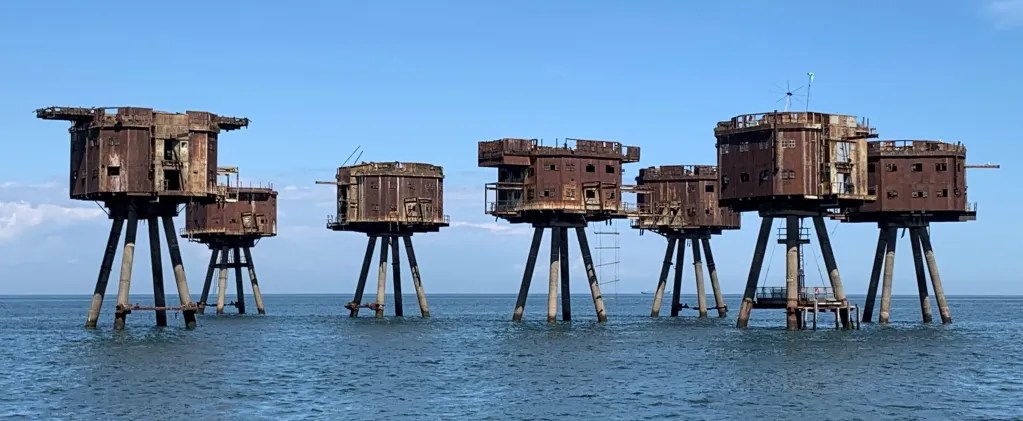
I’ll finish now with another of the many things I’ve been doing recently other than making felt. As I’ve mentioned more than once before, I am lucky enough to live in Whitstable, on the coast in south-east England. It’s a beautiful place and we get a lot of visitors on day-trips as well as longer vacations. There’s a Thames sailing barge called The Greta that in summer moors in the harbour where I often work. Built in 1892, she used to carry grain, malt and building products, and then beer, up the Thames estuary into London. She also took part in one of the most famous operations during World War 2 as a member of the makeshift flotilla that rescued thousands of troops during the evacuation of Dunkirk in 1940. Apparently, she’s the oldest active ‘little ship’ from that era. Anyway, some of my harbour colleagues go on an annual trip on the Greta to visit another World War 2 site, the Maunsell Forts, which are about 6 miles out to sea. These were part of a world war 2 sea-defence system designed to shoot down enemy aircraft that would fly up the Thames estuary from the coast to bomb London during the war. They were later used as a base for pirate radio stations broadcasting in the 1960s. Previously I’ve refused offers to join my friends on this trip as I’m a terrible sailor and believe I could feel nauseous in the bath. This year my desire to do the trip overcame my reservations and we set out on the calmest, most lovely day.

It was a fabulous day and I will definitely do the trip again. The final picture here shows the harbour village where I sell my work. I’ve never seen it from this angle before.

Fibre and Friends

Fibre and Friends

It’s been a while since I published anything, as I have been going through quite a difficult time.  But I was determined to finish the year with a blog, so this one is a bit of an amalgamation!  Way back in April, I was lucky enough to be invited on a day trip to Wonderwool 2022 by my friend Debbie.  I hadn’t even heard of Wonderwool when she invited me, but when she told me all about it, I couldn’t wait to go!!

For those of you (like me) who have not heard of Wonderwool, it is an annual wool and natural fibre festival that is held in The Royal Welsh Showground, Llanelwedd, Builth Wells, Powys, Wales.  It was first held in 2006, ‘to promote the market for Welsh wool and add value to product for small wool & fibre producers in Wales’.  The festival has grown over the years, and ‘covers everything from the start to the end of the creative process’.  There are exhibits of sheep, raw and hand dyed fibres, yarn, embellishments, equipment, dyes, books and also finished textile art, craft, clothing and home furnishings.   Basically, it’s a felt and fibre artist’s dream come true, where like-minded people can find almost anything they need, and it instills a feeling of excitement, much like a child in a toy shop (at least that’s how I felt!) Because of the covid pandemic, it hadn’t run for a year or two, but this year was to be the first event since the pandemic, so there was great anticipation of the resuming of this popular event.


Around the same time, I had been looking for a carding machine, as I wanted to start making my own wool batts to spin.  Just before my friend invited me to Wonderwool, I had found a lovely Pat Green Carder for sale on Facebook Marketplace, and I had decided to purchase it.  However, the lady selling it (Mary Rogers) lived in Birmingham, England, so I was trying to work out when I could make the drive up to Birmingham to collect it.  As it happened, Mary told me that she was planning to go to Wonderwool, and could bring the carder with her!  Fantastic, I thought… this is definitely meant to be!!  Don’t you just love it when things just fall into place?!


Having made all the arrangements, Debbie and I took the drive up to Builth Wells for the day, and boy, was I totally inspired!  When we walked into Wonderwool, I can honestly say my eyes must have lit up!  I really did feel like a child in a sweet shop!!  There was stall after stall of beautiful fibre, yarn, and all things sheep (not to mention other types of fibre, including alpaca, angora to name a few)!!  What struck me first, was the wonderful array of colour.  There were exhibitions of different fibre craft, demonstrations of spinning and weaving, with exhibitors from all over the UK.  We also had the chance to talk to a range of like-minded people, who were happy to share their tips and techniques with us.  Wow, what a wonderful time we had!


One of the exhibitors we spent time talking to, was a lady by the name of Edna Gibson, who explained that she had spent time living in Japan being taught the wonderful art of Kumihimo, an umbrella term for several kinds of Japanese braidmaking that were unknown outside Japan until about 30 years ago.  Edna told us that she was instrumental in introducing Kumihimo to the UK.   The term Kumihimo is a composite of two words, ‘kumi’ meaning coming together or group, and ‘himo’ meaning string, cord, rope or braid.  Whilst most of us will have  heard of Samurai,  I didn’t realise that the Samurai armour plates are laced together with cords, traditionally Kumihimo braids, which are also tied around ‘obis’, the sashes used on kimonos.  Edna explained that she was taught Kumihimo by a very skilled Japanese person, and brought her knowledge back to the UK.  The looms used for Kumihimo are known as ‘dai’ or ‘stands’, and are usually made from either wood or bamboo.  All the dai are set up with carefully measured threads (as many as 80 strands of fine silk are wound on each bobbin or ‘tama’).  The weighted bobbins are lifted and moved in specific repeated sequences  to produce each type of braid. Traditionally, silk was used to make braids but today, braiders also use artificial silk or rayon.

  This is my friend Debbie, with the lovely and very knowledgeable Edna.

This shows the two types of dai used.  Apologies for the poor quality of this photo, but it was taken from one of the information boards Edna had put up…

  The top photo shows braiding on a ‘Marudai’ and the bottom photo shows braiding on a ‘Takadai’.

Edna’s braiding…


As you can imagine, it was hard not to go on a full-out spending spree at Wonderwool!! There were so many beautiful fibres on offer, not to mention everything else!! I haven’t crocheted for many years, but was inspired by a beautiful pattern, by Janie Crow called ‘Mystical Lanterns’.  I ended up purchasing both the pattern and the yarn!  It’s a work in progress, but I’m enjoying the process!

These show some of the exhibits on show at Wonderwool.  Hopefully, my scarf will turn out as lovely.


There were so many exhibits and stalls, too many to include here, but this will give you a flavour of a few of the exhibits on show…

  To be honest, I was so busy choosing fibre to purchase, I didn’t take any photographs of the actual stalls!!


At the end of the day, I met up with Mary and her friend, to collect my drum carder.  It was lovely to share a coffee and a chat with her, and she was able to share the history of the carder with me.  We parted the day friends who share a passion for fibre, and agreed we would definitely meet up again at next year’s Wonderwool!  We shared a ‘selfie’ before we left…


As I mentioned, I haven’t posted for a while, due to going through a very difficult period in my life, which resulted in me not having the energy or inclination to do any fibre craft whatsoever, so I had not actually even tried out my new carder until quite recently.  But when I felt able to resume my spinning, I found it really helped me in a very mindful way.  I particularly found that spinning brought me a sense of calm and peacefulness, with positivity and joy.


My first project was back in October, hence the autumnal colours!  I put together a collection of merino fibre of different colours, with one part of bamboo in a dark shade.  I weighed the fibre first, as I wanted to make two batts of fibre that I could spin ready to weave with.


Having never used a drum carder before, this was all experimental but in the end, I was really pleased with how it turned out…

I didn’t want to blend the fibre too much, as I wanted to have the different colours come through when I spun it.  Also, I’d heard about people ending up with ‘mud’, so that was something else I wanted to avoid.  Having blended my fibre to reflect my need, I then proceeded to spin it….

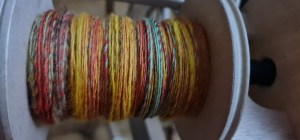
This shows the difference when using a flash (on the left) verses no flash (right).

Once I had filled my bobbin completely, I proceeded to wind it into a ball, so I could ply it from both ends of the yarn.

This is the finished yarn, once it was soaked to set the twist, thwacked and dried…

  I’m quite pleased with the results.  I also feel that my spinning has improved a bit since I posted on her last time!  I’m looking forward to weaving with this yarn over the Christmas holiday period.  Hopefully I will be able to show you the end product in my next blog!

Wishing you all a very merry Christmas and a happy, healthy 2023, from Lisa and Alex 🙂


Weaving Overshot all wrong

Weaving Overshot all wrong

Many years ago, I finally got to try weaving. I took the Beginning to Weave workshop through the Ottawa guild. At that time, 1989, the OVWSG did not have a studio space to house what guild equipment we had acquired. (The Guild had an old second-hand 100 inch loom and 6 or 7 table looms. There may have been a floor loom too but I was distracted by the 100 inches of loom, so do not remember). All the looms lived in one of our guild members’ very big basements. On weekends, she either taught weaving workshops or hosted weavers working on the 100 inch loom. It sounded like a busy basement! I remember 4 weekends of driving to a little town just east of Ottawa. I took the table loom home each week to do homework. I still remember the sound of the mettle heddles rattling as I drove down the highway, back and forth to the classes. Then I think there were two more weekends of Intermediate weaving and Dona sent me off and I was weaving!

It all starts with yarn, wind it carefully, attach it to the back beam, wind on, thread the heddles, slay the reed, tie on to the front beam, check the tension and then start to weave. It sounds like a lot of work but it is all worth it as you start to pass the shuttle through the shed and the cloth begins to appear. Weaving was like Magic! From a pile of string to POOF, actual cloth!!!

During the workshop, I found pickup seemed strangely familiar as my brain watched my fingers happily lifting and twisting threads for the various lace and decorative weave patterns. The other thing that my brain went “ooh this is cool!” was Overshot. It is a weave structure that requires a ground and a pattern thread, (two shuttles). One is fine like the warp and the pattern thread is thicker and usually wool. I was still reacting to wool so I used cotton for both.  My original goal was to draft and weave a Viking textile for myself but I put that aside for a moment, I will get back to that later.

The first thing I wove after my instruction was a present for my Mom. she had requested fabric to make a vest. I looked through A Handweaver’s Pattern Book by Marguerite Porter Davison and found an overshot pattern that I thought we both would like. I wove it in two shades of blue (Mom’s favourite colour), at a looser thread count than usual. (Originally the overshot weave structure was used to make coverlets, so were tightly woven and a bit stiff, while I liked the pattern I wanted the fabric to be much more drapey.) Even worse, I did not want it to be as hard-edged in the pattern as it was originally intended so I tried a slub cotton as a test and loved it.

1-3   Cover of Marguerite Davison’s Book, an interior page showing overshot patterns, and a close-up of “Weaver Rose’s Coverlet no.28”

So, for any sane weaver, it was all wrong! Wrong set, wrong fibre, wrong colour choices! It was fabulous and perfect. I kept the sample as a basket cover and at either the end of 1989 or the beginning of 1990, I gave Mom the yardage for her vest. “Oh this is too nice to cut” Mom Said, so it lived on the back of her favourite reading chair as a headrest until her most recent move (2015?) it never did get to be a vest but it has been well enjoyed.

I don’t have a picture of her yardage but I do have pictures of the sample I kept.

This slideshow requires JavaScript.

4-7 My demo basket with cover at Plowing match demo, Algonquin demo, Richmond fair, Carp fair and Farm show.

My sample piece, which became my main demo basket cover, has been in the background of many demo photos. This year it was used as an Old example in part of the guild Exhibition. You can see the subtle distortion of the pattern when a slub yarn is used.

Overshot sample of overshot cloth in blue and grey on Left and Inkle woven band in purple and blue with suplemental warp of fuzzy slubs.8 Exhibit from the 2022 guild Exhibition and Sale

In the Exhibition The Inkle band, hanging beside the overshot, I wove much more recently. I used an Inkle loom and a supplemental warp thread. This means weaving with an extra separate thread that was not part of the main warp on the loom.  I used a yarn with a fuzzy caterpillar-like slub.

Close up of Inkle woven band with slubs woven in Inkle band on Inkle loom. suplemental warp is weighted and hangs over back peg, 9-10 close up of Inkle woven band with inserted slubs from the supplemental warp, Inkle loom set up with the supplemental warp slubs.

You may be able to see how I wove the weird slubby supplemental warp. The yarn is weighted and left hanging over the back peg of the Inkle loom. It comes over the top peg (usually labelled B in diagrams) and floats above the weaving.  In the areas where the Caterpillar (Slub) is not present I catch the yarn with the shuttle and weave it into the band. In the area the caterpillar appears I would leave the yarn above the warp and then start weaving it in again as I reached the end of the caterpillar. I hope that explanation doesn’t sound like mud and makes a bit of sense. Using a supplemental warp on an Inkle loom is not quite normal but it is a lot of fun.

Over the years I tried out other two harness techniques that you normally don’t see with an Inkle loom. It turned into an entire 2 day, with a week in between days, workshop (with a homework assignment) and lots of samples!! I think it’s the fault of my dyslexic brain wandering off into odd thoughts again.

I was going to tell you about my original goal in learning to weave, the mysterious Fragment #10 from a Viking excavation from around the year 1000, but  I have likely confused you with weaving enough for one day. So I will save that for another chat. (don’t forget the Inkle loom I would like to tell you a bit more about that in another post too. I promise I will get back to felting in the not-too-distant future)

Travelling and Textiles – a perfect mix!

Travelling and Textiles – a perfect mix!

It’s summer time here in Ireland and the living is, well, slightly more laid back than the norm.  Having decided to metaphorically kick off the shoes for the month of July, I thought it might be nice just to “see and share ” rather than “do” and this forms the basis of my post.

Before I start on the main focus of this post (my holiday in Italy),   I just have to show you a beautiful piece that totally blew me away.  Before heading off, I visited Dublin’s Botanical Gardens.  Founded in 1795, it is an oasis of calm for any visitor and I would highly recommend a visit if you happen to be in the neighbourhood.  While there, I noticed that there was a patchwork exhibition happening in one of their exhibition spaces.  This piece just caught me, so I want to share it with you.  The artist is Ethelda Ellis and the piece is called ‘Aoife’s View’.  The curator told me that Ethelda is a medical doctor by profession.  If you would like to see more of Ethelda’s beautiful creations check out her blog: http://ethelda.blogspot.com/

Now, to the Italian holiday.  We headed to Como mid-July and, in spite of the heatwave, spent our time sightseeing and eating!  Our base was Como which is to the north of Italy, right beside Switzerland.  Lake Como is totally dwarfed by the Alps – a really beautiful place.

We called into the Cathedral, the Duomo which was magnificent internally and externally.  I reckon that to appreciate all its beauty would take months observing 24/7!  I want to share with you a small area of a tapestry which was made in 1610 and which underwent restoration in 1990.  It was impossible to get a good photo of the entire masterpiece as so much detail would have been lost.  So I settled for a little!

One of our tours took us to the tiny picturesque village of Orta which is situated on Lake Orta.  It was recommended that we visit the interior of the local church which was situated at the top of a steep street.

My journey was interrupted by the sound of a piano recital and when I investigated I discovered a rather special textile exhibition happening in the same building.  The works exhibited were by Sergio Cerini.  The artist merges his early experiences in the Italian high fashion industry with his current artworks, producing beautiful pieces which are in essence a mix of paper mache and textiles.  The description does not do justice to his widely exhibited pieces and he was reluctant to allow me to photograph his work.  He did, however pose in front of one of the pieces and others can be viewed on his Instagram page @sergiocerini

Since the 1800s, the city of Como was historically the main producer of Italian silk.  When ultimately production was outsourced to China, the area was in danger of losing connection with its cultural heritage.  The large factory was bought by the Hilton hotel chain.  These photos show early paintings of the factory, what it became at the height of the industry and where it is now (apologies for the reflection on the glass):


Rather than allow the old machinery to be lost to history, a wise decision was taken about 10 years ago to set up an Educational Silk Museum to preserve these beautiful machines.  Along with displaying the machinery, some of which dates back to the nineteenth century, the museum offers interactive videos and exhibits of high fashion clothing.  Unfortunately this section was not open during my visit but I thought it might be fun to show you some of the many machines featured.  So please, grab a cuppa, sit back and I hope you enjoy the show.  I have included captions for ease of reference.


Level 3 Advanced Studies in Experimental Stitch Exhibition

Level 3 Advanced Studies in Experimental Stitch Exhibition

The ‘Bachelor Buttons’ in the midst of setting up the exhibition. (Maureen couldn’t be there, but her beautiful work was.)

I recently completed Level 3 Advanced Studies in Experimental Stitch at the Gail Harker Creative Studies Center and we held an in-person and online exhibition. Gail’s courses are similar to City and Guilds in the UK. If you’re close to the Seattle area, there is a new session of Level 3 Stitch beginning in September. Just click on the link above for more information. (And you really don’t have to be that close, I live almost 600 miles away.)

We had a busy few days setting up the exhibition and I thought you might like to see a few set up photos.

And then it was the day of the exhibition. We had around 80 people attend over the two days in early July. It was wonderful to be able to see all the hard work accomplished by my fellow students and to share our work with other interested people.

I asked my fellow students if I could share their work and I’m happy that everyone agreed so that you can see some amazing fiber art. These are just a very few examples of their work produced in class.

Maureen Goldsmith

Maureen Goldsmith wasn’t able to come to the in-person exhibition but was able to send her wonderful work.

Covid Birds © Maureen Goldsmith

Covid Birds by Maureen is a framed wall hanging, you can see it in the first photo behind the group photo on the wall, to understand the size of the piece.

Covid Birds – Detail © Maureen Goldsmith

Here’s a detail view so you can see the stitching more closely.

Val Gleeson

Val has an interest in historical embroidery and needlework.

Pleasurable Pursuits © Val Gleeson

Her piece “Pleasurable Pursuits” is based on historical needlework studies that she pursued during the class.

Pleasurable Pursuits – Detail © Val Gleeson

Here’s a detail shot so that you can see the amount of hand stitching in this piece.

Acer Macrophyllum Book and Samples © Sheila Asdal

Sheila Asdal created a machine and hand stitched book about the Big Leaf Maple and the creatures that find shelter and sustenance in the tree.

Acer Macrophyllum Book © Sheila Asdal

Here’s a side view and front cover of the book.

Acer Macrophyllum Book – Detail of Moth © Sheila Asdal

And a detail view of the stumpwork moth she created.

Catherine Sloan

Catherine’s interests are from nature, including rocks, plants, seed heads and the winter garden.

The Winter Garden Series © Catherine Sloan

She used her original photos of her winter garden to create this handstitched series.

The Winter Garden Series © Catherine Sloan

Each of the individual pieces are about 6″ x 6″.

The Hanging Garden © Bobbie Herrick

Bobbie Herrick is also inspired by her garden. She took on a tremendous project in creating The Hanging Garden light.

The Hanging Garden © Bobbie Herrick

Bobbie’s lamp was created with machine and hand stitching and cut back applique. She found it interesting to work with light during this process as it changed the colors immensely when the light was turned on behind the fabric.

Ethereal Bottles © Alana Koehler

Alana Koehler was inspired by a row of bottles on her windowsill. As she worked through the process, she became intrigued with the difference between the hardness of glass and the translucent fabric that she ended up using in Ethereal Bottles.

Ethereal Bottles © Alana Koehler

The sheer fabric in Ethereal Bottles float away from the wall and the bottles are created with machine stitching. It is definitely ethereal in person.

Ruth Lane with The Language of Trees © Ruth Lane

And lastly, there is me. The Language of Trees is based on the concept that trees and other forest plants, have a vast communication network underground.

The Language of Trees © Ruth Lane

This wall hanging is mostly machine stitched on a dyed and painted background. The little bits of orange are words that I selected from tree poems to express the trees communicating with each other.

And because I have had a few people asking, I have also included my book about my dog Edgar. Here is “The Book of Edgar”.

Thanks to all my classmates for their camaraderie and support. Thanks to Gail and Penny for all your expert guidance and perseverance through a challenging three years of class.

Quilt & Stitch Village

Quilt & Stitch Village

I’ve just taken part in my first show after two years of Covid restrictions and it felt great to be back to normal! The event was the British Quilt & Stitch Village, an annual 3 day textile show held at Uttoxeter Racecourse in Staffordshire.

It was my first time exhibiting at Uttoxeter and I wasn’t sure what to expect. Would visitor numbers be low? Most ladies attending shows like this are of a certain age (me included!) and I know some still have concerns about mixing in large groups. This is predominantly a quilt show, would there be enough interest in feltmaking or would the majority walk straight passed? I was manning my stall alone…. would the neighbouring stall holders be too busy to relieve me when I needed a loo break? I needn’t have worried, when the doors opened at 10am the visitors flooded in and it turned out to be three very “full on” days! These are a few of the items I had on show……

I’ve recently made these collars, narrower than previous designs, with a roll edge trimmed in a contrasting colour.
For me the main aim of being at the show was to advertise my workshops and this is a new workshop sample for a Wallhanging class exploring different 3D techniques.

My pitch was next to Project Linus, a charitable organisation that provides quilts and blankets for children in need. Their aims are to “Provide love, a sense of security, warmth and comfort to children who are seriously ill, traumatized, or otherwise in need through the gifts of new handmade blankets and afghans, lovingly created by volunteer “blanketeers.” And to “provide a rewarding and fun service opportunity for interested individuals and groups in local communities, for the benefit of children.”

Project Linus always attracts a lot of interest and the two lovely ladies on that stand were swamped with visitors for the three days! Somehow they still managed to cover for me when I needed a comfort break which was really appreciated!

I didn’t get much chance to visit other stands but when Jane (Wylde Oak Artistry) came over to say hello and told me she was working with Spun-bond fabrics I had to go see her work. I loved her masks and corsets, made on the theme of body dysmorphia, and came away feeling that there is so much more I could be doing with Lutradur!

Another stand I particularly enjoyed was “Traverse”, a group of exhibiting textile and mixed media artists. Apologies for not getting close ups of their work…….it’s worth following the link and taking a look at their website.

It’s a great show, spread over three large halls as well as various other smaller buildings. Most of the photos I took were prior to opening but as you will see from the last three, we really did get visitors! Roll on Quilt & Stitch Village 2023!