Browsed by
Category: Guest Writer

Different Types of Wool, From a Swedish Felter´s Perspective

Different Types of Wool, From a Swedish Felter´s Perspective

Guest Post from Zara Tuulikki Rooke

As a felter and sheep-owner, I am intrigued by the variety of wool from different sheep breeds. As I live in Sweden, I have mostly felted wool from Swedish breeds, which are divided into three different basic types:

1)    Finull, which literately means “fine wool”. We have a breed of sheep with the same name, which produce a soft, silky and fine-fibred wool (often 20-30 microns), with little difference between the undercoat and outer coat (i.e. it all, more or less, looks like undercoat).  The fibres are quite short and have a fine crimp. Finull sheep can be white, black or brown.

2. Gobelängull, which can be translated into “tapestry wool”, and Gotland wool are our equivalents to “long-wool”. This is a slightly coarser, but lustrous wool (from 30 microns and upwards), with fewer crimps (“waves”) per cm. Coarser wool from Finull sheep, with no more than 5 crimps per 3 cm, is classified as Gobeläng. Gotland sheep have been bred for meat and pelts, and the latter has steered the selection towards long, lustrous, medium to large curls in the outer coat, with an undercoat of similar length and thickness. A fine-fibred undercoat would only lead to the pelts becoming fuzzy. Gotland fleeces can vary quite a lot, both in colour (very light to very dark grey) and in the shape of the locks. As a general rule, finer fibres have finer curls/crimp, and coarser fibres have a larger curl.  

3)    Ryaull, which can be translated into “carpet wool” (“rya” is a type of hooked wool carpet). Sheep of the breed Rya have a short, fine undercoat and a long, lustrous, wavy to straight and rather coarse outer coat. Ideally, the undercoat makes up 40-60% of the volume of the fleece on an adult sheep. Rya sheep are either white or black.

Below is a sketch showing the general difference between the three types of wool, and photos of wool from Finull, Gotland and Rya sheep to illustrate the difference.

Photo 1Thanks to rather recent conservation programmes, we also have a number of smaller native landrace breeds. These are small breeds, which have been locally isolated and are now named after the region or village where they were rediscovered. They are generally quite small and hardy, with good mothering instincts and easy lambing, and can vary in colour and type of wool even within an individual fleece. Below are photos of wool from two such breeds, Åsen and Klövsjö, which to me both look like finer versions of Rya.

Below are also three photos of white wool from cross-breeds. “Svea” is a collective name used for native breeds crossed with imported meat breeds (such as Texel or any of the British Downs). As expected, the wool on a Svea sheep can vary a lot depending on its ancestry. The photo furthest to the left (“Svea”) shows a fuzzy type of wool, which is typical for the meat breeds. The photo in the middle (“Svea x Finull”) shows wool with a crimp of Finull type. And the photo furthest to the right shows wool from an interesting new breed called Jämtland (named after the county I live in), which originates from a cross between Svea, Finull and Merino. This breed has been developed to produce fine fibre wool as a complement to lamb meat production.

Photo 2Now that we have looked at the different types of wool, it´s time to do some felting! Swedish native breeds are known to have wool that felts easily, but I wanted to compare their felting characteristics to these cross-breeds and to merino. Wool properties can vary between individual animals, and even within the same fleece, and this is not a strict scientific set-up with replicates. But I did try to standardize as much as possible. The wool was washed and carded, and I used 10g of each wool. I laid out the wool in 4 layers to cover a 20cm x 20 cm square, and on top of that, I laid out a piece of red cotton gause, a piece of wool yarn and a piece of cotton yarn. Then I felted each piece – wetted, added soap, rubbed, rolled and finally fulled it by more rubbing and tossing with hot water.

Photo 3As expected, the Finull, Gotland and Rya wool was easy to felt and full. I measured the width and height of each piece and compared that area (in cm2) to the original size (20 cm x 20 cm = 400 cm2).  The finer Finull shrunk to about 50% of the original size, while the coarser Gotland and Rya shrunk down to 42%. The latter two also result in a very thick, sturdy and rather hairy piece, where the fabric and yarn have become enclosed in the wool. These coarser wools are good for things that need to be sturdy and robust, such as slippers or rugs. They are perhaps not the best choice for nuno-felting, but a little shave would bring out the fabric again. The Finull is much softer, although densely fulled, which must be ideal for e.g. a hat or anything you would wear close to your skin.

Photo 4The Åsen and Klövsjö behaved pretty much like the Rya, with the Åsen actually shrinking a little more (to 39%), but felt a little less hairy. That makes sense, as they looked like a finer type of Rya, and consist of a mix of finer fibres and some coarser fibres (as opposed to the Gotland that more or less consists of only one type of medium coarse fibres). That the Åsen shrunk the most did not surprize me either. The wool comes from my previous ram, and his fleece often felted before I had a chance to shear it. The Klövsjö wool is from my new ram, who is still a lamb, which explains why it still feels quite soft. His fleece will probably develop into a coarser Rya-type fleece with time.

Photo 5Apparently, all the Swedish native sheep breeds, and the British long-wool breeds, have a different type of scales on their wool fibres, compared to other breeds. Their scales are smoother and laid out edge to edge. This reflects more light, making them look more shiny/lustrous, and provides less friction, making them feel softer and facilitating the fibres to slide into each other and felt together. Other breeds have rougher scales, overlapping like roofing tiles, which makes them more difficult to felt. Wool from meat breeds is described as fluffy wool, that wants to return to its previous state when squeezed, and therefore good to use as pillow stuffing, but not for felting. This difference becomes quite obvious if you try to stuff a bag with wool from a Swedish native breed versus a meat breed. The latter just feathers back and takes up space no matter how much you try to squash it down.

Below are photos of my felted samples of cross-breeds. The cross-breed with meat-type wool (Svea) did felt, but was difficult to full and only shrunk to 77% of the original size. The resulting piece also felt quite loose and spongy. The cross-breed with Finull-type wool felted a lot easier and shrunk down to 52.5 % in size when fulled (which is close to the pure Finull). The finer Jämtland (a cross between Svea, Finull and Merino) took a little convincing and careful handling to start felting, and couldn´t be fulled down to less than 72% of the original size. However, this piece felt very flat and dense, and very soft. In my opinion, an excellent choice for felting anything where softness is important.

Photo 6Lastly, I felted some merino (dyed and of unknown micron value) and some wool from a cross of dairy breeds (East Friesian Dairy Sheep x Lacaune Lait). The merino wool is, of course, unbelievably soft, but being used to the coarser and more easily felted Swedish breeds, I do find it a bit trickier to felt. The initial wetting down and start of the felting requires much more patience and caution than I am used to. I guess the fine fibres have a lot of air in between them, and it takes a while to convince the fibres to latch on to each other. I couldn´t full the merino down to less than 68% of its original size either, which is similar to the Jämtland wool. Compared to Jämtland, the merino does feel slightly more spongy, but much denser than the Svea meat-type wool, and yes, very soft. The dairy wool felt very fluffy to begin with (I have only seen it in a carded state), but felted very nicely and evenly and shrunk to 52.5% (the same as the Svea Finull-type wool). It´s a bit spongy too, but also denser than the Svea meat-type wool, and very soft. A nice wool for felting things that do not need to be so sturdy.

Photo 7 If you have managed to read this far, you must be a fibre nerd… The differences I have described above may seem small to some, but to a felter, the felting-capability of a wool, and the difference between shrinking to 39% or 77% of the original size, can make quite a difference in the finished piece. All the samples I tried could be felted, but they acted differently, especially during fulling, and produced different results. From smooth to hairy, soft to sturdy and dense to spongy. Different types of wool are better used for felting different things. Is softness or strength and lustre more important for what you want to make? Knowing your wool helps, because even if felting is fun, you don´t really want to wear through your slippers too quickly, or wear a hairy and itchy hat, do you…?

Thanks Zara for this wonderful guide to Swedish sheep and their wool.

A Peek at the Knitting and Stitching Show in London 2015

A Peek at the Knitting and Stitching Show in London 2015

Our guest artist/author/photographer today is Leonor Calaca from Felt Buddies.

If you’re in Europe and a fibre aficionado, you’ve probably heard of the Knitting & Stitching Show. It happens in a few different locations and dates in the UK, and is probably the largest fabric/fibre event in Europe when hosted in Alexandra Palace here in London.

As it happens, the Alexandra Palace (or Ally Pally as it’s also known) is only 45 minutes away, on foot, from my place; as it happens as well, I’ve been volunteering for the past two years as a member of the London Guild of Weavers, Spinners and Dyers, to work a few hours a day at a booth that serves as a hub for all such UK guilds. Not because I’m such a wonderful and helpful person, mind you, but because this means I get a free pass to come and go anytime during those 5 days (and, at £16 for entry only, I think it’s well worth my time).

Last year I got all mesmerised by the fibres and materials I saw, and almost went bankrupt. This year I decided to be good,  more sensible and buy only the things I absolutely needed, which worked to an extent. I also decided to focus more on my energy on the really good exhibitions, and that’s what I’m going to write about.

Let’s start with an embroidery. How lovely and detailed is that?

Photo 1

Art wasn’t just in 2D, the sculptures were very interesting as well.

Photo 2

A glass and wool sculpture by Helen Pailing. She aims to use remnants from the glass and wool industry and incorporate them in a way that makes them not only art, but something you can keep instead of take to a landfill.

Photo 3

The Wishing Tree by Eileen McNulty. Just look at those little details.

Photo 4

I don’t know the author of this one, but here is ‘Palace,’ made with cocoon stripping paper and silk organza. The theme of this booth was vessels.

Photo 5

Elena Thomson embroidered a sieve. Would you have thought of that? I think this would be wonderful to confuse old ladies.

Photo 6

‘Stumpwork’ by Alana Chenevix-Trench.

Photo 7

And a lovely sheep by Margarita O’Byrne.

Photo 8

Then I went to Studio Art Quilt’s Associates (SAQA) booth that just blew my mind. I had no idea these detailed works of art could be made in that technique. The theme was Food For Thought and this is ‘Mushroom Frittata’ by Jean Sredi.

Photo 9

‘Pepitas’ by Vicky Bahnhoff.

Photo 10

‘Yum! Pineapple Upside Down Cake’ by Diane Powers-Harris. Yes, this is still a quilt.

Photo 11

‘Il Mercato’ by Jeannie Moore

Photo 12

‘Elegant Edibles’ by Jennifer Day.

Photo 13

Who doesn’t love dolls?

Photo 14

This one was my favourite: what a grumpy face.

Photo 15

These two sculptures surprised me, as they’re made from a traditional paper folding technique native to the Philippines.

Photo 16 Photo 17

And I saved the best for last: a fishmongers called Kate’s Plaice! Everything you see here is either knitted or sewn, and the details just make it extraordinary.

Photo 18 Photo 19 Photo 20


The artist herself.

Photo 21

Did you go to the K&S? What caught your eye? And am I going mad for taking more time to look at art instead of yummy yarn?

Thank you Leonor for taking us on this great fibre adventure!

Third Quarter Challenge 2015 by Carole Gascoigne

Third Quarter Challenge 2015 by Carole Gascoigne

Today our guest artist/writer is Carole Gascoigne aka Craftywoman.  She also maintains a Facebook page just for fun — Bagsalicious.  Here is Carole’s contribution for the Third Quarter Challenge.

I have to say this is a first all round – first time attempting nuno felting and first time writing a blog for this felting site.

It was a treat to be asked, then came the big challenge: what to write about.

We have a quarterly challenge and this one is to take a photo, take it into a colour palette site and find the colours for a project.

cg 1

I half completed this challenge, in that I found myself trying to capture the image into a nuno scarf or shawl, rather than, as I had originally envisaged, creating something more abstract.

Armed with my 3mm silk chiffon and pre-dyed coloured fibres, I started to develop my scarf.

cg 2

Top and bottom I used merino and silk in greens and blues. To the blue part I added white viscose fibres for sheen, and turquoise locks. The poppies (sorry about the blurred pic) were first a layer of raw silk fabric cut up into random poppy shapes in salmony pinks, with pink locks and fine red merino over laid.

cg 3

All of this, the silk fabric and the fibre design was laid out on bubble wrap – bubble side up.

Then came the hard work. I hadn’t appreciated how difficult nuno was going to be. Initially, I covered my design with net and wet felted the design into place. I then rolled it all up onto a foam roller, tied it together and started rolling. I think I rolled about 400 times, 200 each way – then I removed the net.

I re-rolled about another 600 times, changing the end I started with to ensure all the fibres had a chance to be on the inside and the outside of the rolling.

When I was happy that the fibres had migrated through the silk chiffon I added more hot water and threw the piece on to a towel. I continued doing this until I felt it had been felted enough.

Here is my ‘Poppies by the Sea’ inspired nuno felted scarf.

cg4

Carole, thanks for completing the Third Quarter Challenge and sharing your first nuno felting journey with us!  It was worth the effort the scarf is beautiful!


Russian Felt Costumes

Russian Felt Costumes

This is a guest post by my friend Penny Peters. Penny is a wonderful stitcher who travels extensively so I have asked her to do a guest post for us. Penny recently visited Russia and saw some interesting uses of felt that I thought you might all be interested in. She did see the Pazyryk burial felt which I have posted about before

During a recent visit to St Petersburg I was fortunate to be able to visit the famous ethnographic collections at the Kunstkamera and the Russian Ethnographic Museums as well as archeological collections at the Hermitage. I was not permitted to photograph any of the items in the Hermitage from the Altai Burial Mounds (Pazyryk Burials) so famous for the ancient, well-preserved felt horse trappings and canopies. Good photographic images of those can easily be found online. You can search under “Pazyryk burial felt”.

I was able to photograph a unique felt wedding cloak on display at the Kunstkamera Museum. Felt cloaks once were a common item of Afghan male clothing, diverse in cut and decoration. They varied from simple cloaks worn by herdsmen to works of art signifying the owner’s social status. The most elaborate is a wedding cloak decorated with delicate embroidery and cutwork. The embroidery is comprised of tiny, uniform back stitch or knotted stitches in bands in natural wool threads. The bridegroom’s costume pictured is completed by a felt hat and luxurious shawl in gold brocade to cover the head or shoulders.

The other two felted wool costumes were located in the Russian Ethnography Museum. Unfortunately the signage was in Russian using the Cyrillic alphabet, and I was unable to understand the documentation. Having said that, both items of male attire are probably from central Russia— a very cold climate region. The coat-like garment is very plain, decorated only with a belt buckle featuring deer or reindeer and patterned knitted mittens at the waist. The short jacket is again decorated with tiny back stitches in natural wool threads.

These 19th century garments are of such classic design they could probably be worn on the street today without attracting much attention, except from us textile enthusiasts. If you have a chance to visit St Petersburg, the Kunstkamera and Russian Ethnography Museums shouldn’t be missed. The Kunstkamera houses a marvelous costume collection from around the world—especially the Northwest Coast and Alaskan indigenous people since Russian explorers were trading in that region long before other Europeans reached it. The Russian Ethnography Museum displays mostly 19th century costumes of the dozens of distinctly different people who inhabit their enormous country.

Thanks Penny! I enjoyed seeing these felt costumes and reading your explanations. Thanks for taking us on a short trip to Russia!

3rd Quarter Challenge Entry from Teri Berry

3rd Quarter Challenge Entry from Teri Berry

This is a guest post by one of our forum members ‘Teri Berry’. Teri has a wonderful blog if you’d like to see more of her work. Teri has completed the 3rd Quarter challenge in record time and tells us about it here:

Marilyn posted the 3rd quarter challenge a couple of weeks ago, initially I was disappointed because this meant I had been mulling over the 2nd quarter challenge for so long I had missed the end of Q2 (shame on me). Determined not to let the same happen again I was spurred into action. I already had an idea from Q2 that I wanted to use silk cocoons to add some three-dimensional impact, a little bit like this sample:

Teri 1

Added to this, I have been wanting to interpret a favourite photo taken by my better half on a diving trip into felt for far too many years so this seemed the ideal opportunity. Isn’t this fish a beauty?

Teri 2

As per Marilyn’s challenge instructions, I ran this photo through 2 programs, Colour Adobe and Palette Fx.

Teri 3

Teri 4

I much preferred the wider range of colours provided by Palette FX so set about dyeing some cocoons, yarn and silk while blending some previously hand dyed Norwegian and Merino wools (with a little bit of dyed trilobal nylon for some sparkle – I’m a sucker for a bit of sparkle!).

Considering the materials were all dyed in the same bath, I was surprised by the range of colours that came out of the orangey brown bath, everything from bright orange to a lovely chestnut brown. These are the carded batts:

Teri 8

I started by laying out two tones of purple, when the piece is fulled, these different tones will create subtle areas of light and dark on the face of the hanging.

Teri 9


Then laying out the batts, I love working with batts, they are so quick and easy to lay out.

Teri 10

I like to think about movement and the balance of colours and tones when laying out my wall hangings, I find repetition of shapes and colours works well. Here I have laid out 3 deeper colours and added splashes of a bright colour to create movement. I think it is important to keep stepping back and looking at your piece, if it doesn’t feel right now, it’s unlikely to feel right as you add more layers and detail.

Next I added my dyed cocoons, ponge 5 silk and felt ropes for extra texture before wetting it out to regain some control over the growing pile of fluff.

Teri 11

Then some of my dyed yarn, I was thinking about how to lead the viewer’s eye around the hanging when laying these out.

Teri 12

Looking at it again, I felt it was too dark and needed more contrast and the large bumps from the cocoons needed to be balanced by something, the solution, to add some yellow chiffon with felt pebbles underneath.

Teri 13

I made some prefelts with the left over batts, I love working with prefelts and silk papers, they permit a far wider range of shapes than I can create with loose wool tops.

From these I started cutting out shapes, laying them on the base. For me, this stage is very much trial and error; placing piece of felt, deciding I don’t like it, cutting them into smaller pieces, swapping them out for other colours, moving them around. After some time I finally settled on this.

Teri 14

And started rubbing, and rubbing, and rubbing…. I quite like the look of the plastic covered in suds with the design showing through.

Teri 15

More rubbing, and finally a bit of throwing (the large bumps created by the cocoons made this a difficult piece to roll).

Here is the fulled piece after opening up the cocoons to reveal their dyed innards, contrasting with the wool wrapped over their surface. I’m really pleased with the one that spilled out a trail of silk as I opened it up.

I was a little bit disappointed with how the edges of the orange prefelts had gone fuzzy (I should have used a firmer prefelt) so added some machine embroidery to visually sharpen the edges again.

Teri 18

Letting me loose with a sewing machine on a piece of felt is a risky move, I couldn’t stop a just “fixing” one area 🙂

After looking at it the next morning, some more embroidery was needed…

Unlike most of my hangings the felt on this one is relatively fine so instead of hanging from a sleeve or wooden rod I decided to mount it on a canvas frame. To ensure the felt doesn’t stretch and go baggy over time I fixed it to a sheet of poplin cotton with running stitch before stretching it over the frame and stapling it into place.

Teri 25

Thank you Ruth, Zed, Ann and Marilyn for inviting me to post on the forum, this has been a real pleasure. If anyone would like to see some of my other work, please feel free to visit my blog at http://teriberrycreations.blogspot.co.uk

Thanks Teri for sharing your work with us!


Artist Residency — Breckenridge, Colorado

Artist Residency — Breckenridge, Colorado

Cathy Wycliff (Luvswool) shares her experience of her recent artist residency in Breckenridge,  Colorado.

Just about one year ago, I started thinking about artist residencies and how much I would like to be granted one.

I had lots of ideas in mind about where I wanted to go, and all of the ideas had to do with nature in all its beauty.

That could mean the ocean, the mountains or anyplace naturally beautiful. I started thinking about the National Parks in America and how much I have enjoyed visiting them over the years, beginning when I was just a child and the family packed up in the station wagon to begin the journey from Chicago to Colorado. We sometimes went to Wyoming and Montana as well, but we always started in Colorado.

There are many artist residencies available around the world, but I had my sights set close to home–that is, the USA.  Although I have enjoyed foreign travel over the years, I decided local would be a good start. I applied to three different organizations, and two of them came through for me (huge surprise!) and offered 2 weeks to one month artist residencies.

I completed my two weeks in the Arkansas Ozarks during April (you can see my previous post about natural dyeing on the Studio blog here   http://feltingandfiberstudio.com/2015/05/09/dyeing-with-plants/ ).  I was thrilled when I received the Breckenridge, CO artist residency offer for the full month of June, but because of obligations at home, I accepted a two-week residency.

I flew into Denver from Chicago, and then shared a Colorado Mountain van with several other passengers, arriving in Breckenridge late afternoon. The mountains greeted me in all their splendor, and after meeting the director of the Arts Council, I tucked into my studio/living space at the old Tin Shop.  Yes, you may notice from the photos that the shop looks old, and it is–from the mid-1800’s when this was a mining town. Many of the “downtown” buildings have been saved, preserved and restored–and many of them have been turned into artist studios and classrooms for the arts.

IMG_0694 IMG_0705 IMG_0732

IMG_0756

The first thing I did besides unpacking was to begin decorating the downstairs studio portion of my little house. But that would have to wait until morning, as I was struck with altitude sickness. Breckenridge is 10,000 feet and most well-known today for skiing, so that’s pretty high in the sky. I had read about this before leaving Chicago, so I was prepared with Advil, and I knew there was an Oxygen Bar in town. Some of the symptoms of A.S. include headache, fatigue, nausea, bloody nose, shortness of breath; and yes, I experienced all of them most of the time I was there.

So my art decor was not perhaps as good as it should or could have been (and neither were the photos taken with my I-phone), but I managed to spruce the place up a bit.  My main goal was to have a comfortable felting table table set-up facing the door so I could view folks as they walked in during “studio time.”

IMG_0766 IMG_0770
I would have loved to have brought my framed landscapes with me, but it was physically impossible; however, I did have business cards with my portfolio weblink available to all studio visitors.  I brought as many “soft” and light, unstructured items as I could stuff into a box which I previously shipped ahead of my arrival. Since I would be teaching a class, I also stuffed in as much fiber as I could in my carry-on duffel!

IMG_0767

The terms of the residency were very generous, with open studio time a requirement, as well as teaching one class. The rest of the time was my own.

Some of the wet-felted items I made while in Colorado include a mountain landscape, a vessel I named, “The Colors of Breckenridge,” and a large panel inspired by the Nebraska crop circles we flew over enroute to Denver.

IMG_0791 IMG_0820 IMG_0792
I also crafted a few nesting “balls” for the birds.

IMG_0768

I thoroughly enjoyed my artist residency in Breckenridge! People seemed genuinely interested in hearing about the process of wet-felting. The town of Breckenridge has done an amazing job of making the arts visible and accessible to all residents, including children. There is a full calendar of art classes, open studios, music and fun events throughout the summer. The downside was the altitude sickness which prevailed even with the help of Advil, the Oxygen Bar, and liters and liters of water. But the scenery, fresh mountain air, and the many friendly visitors I met made it all worthwhile.

Thanks Cathy for sharing this wonderful experience with us!

Guest Post – A Trip to Peru

Guest Post – A Trip to Peru

The post today is from one of our forum members, Elizabeth Sutherland, who recently took a trip to Peru.  I hope you enjoy this virtual trip!

Our Peru trip started with a week cruising on the Amazon, followed by a week of visiting Incan ruins at Macchu Pichu and the Sacred Valley of Cusco. The Amazon cruise was on a very nice riverboat – good beds, good food, good baths.

photo by Elizabeth Sutherland

We (my husband Doug and I) were accompanied by only 15 other travelers on a 29-passenger boat.

photo by Elizabeth Sutherland

Each day we took 2-3 excursions by small launches to view the wildlife. We had some phenomenal local guides who could spot a gnat on a mosquito because they knew where to look. They had also been guides for scientists and amazed me with their understanding and use of scientific terms and explanations.

It was the end of the rainy season so the rivers and side creeks were very flooded. We were sad that we couldn’t walk in the jungle, but the guides said that the animals were more closely congregated and we’d see more. One morning they fed us breakfast on the small boats. Another day we visited a local village (they rotate among them) where we delivered school supplies and sang songs with the children.

photo by Elizabeth Sutherland

The women there were rolling & twisting palm fibers into string that they would then use to sew into bags, plates, and fanciful creatures for us to buy. It wasn’t weaving or crocheting or knitting, but they used a needle to form the bags. I didn’t ask what dyes they used for the fibers, but many of the colors did not look natural.

We had an excursion into a local market and saw lots of fruits, grains, potatoes, and fish for sale. One afternoon the guides gave us a demonstration of the local fruits. I must say that most of them were not very tasty and had little edible flesh. One afternoon we also fished in one of the creeks. We mainly caught piranha, which the chefs cooked up for us. It tasted like dark meat chicken with a little fishy overtone. We also had a chance to kayak for a few hours up a side channel.

We had happy hour every night, accompanied by a band formed from the boat crew, variously called the Chunky Monkeys, Dung Beetles of LiverPoop and Amazonian Rat Pack. They layed a selection of Peruvian music as well as classic rock tunes arranged for pan flutes. They also got most of us to try a few salsa steps.

photo by Elizabeth Sutherland

Most of the animals we saw were birds and monkeys, but we were able to take one walk through the forest and see snakes, arthropods, and frogs. I was a bit frustrated as a horticulturalist since I wanted to know more about the flora I was seeing. We didn’t see any orchids on the Amazon, but a few bromeliads blooming. The pink and gray river dolphins were very good at eluding the photographers, but were quite active. Our trip was topped off with a float plane ride to see the Amazon from above.

After the wonderful week on the Amazon we returned to Lima and dropped off most of our fellow travelers. One couple stayed with us to travel to Cusco and Macchu Pichu, and we picked up another couple and our guide for the rest of our tour. I had been working out on stairs to prepare for the trip, but there was no way to prepare for the 11,150-foot altitude (3,400 M) of Cusco (Dallas is only 500 feet). I could feel it as soon as I got off the plane, but as long as I took it easy I was OK. They had coca everything for sale – tea, cookies, gum, candy. I’m not sure if it helped or not, but I tried most of it.

photo by Elizabeth Sutherland

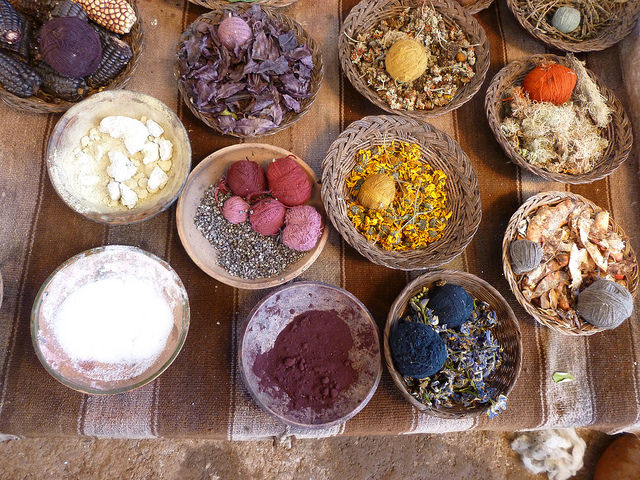
What really helped was the trip to The Center for Traditional Textiles of Cusco where we had the raw fiber to finished product demonstration that I had been hoping for. I was fascinated at the range of dyes they could get from the traditional plants. Their products were beautiful and very intricate. They said that it used 500 warp strands and took over a week to weave. I think the altitude was getting to me because I only purchased a little fiber instead of asking for a bale! I did purchase beautiful poncho (S/500 = $155) and some other souvenirs. They were very interested in the nuno scarf that I brought along. They had a few alpaca there, as well as guinea pigs (dinner?) and some other traditional food – dried beans & quinoa, potatoes.

We went to another small market and saw more varieties of potatoes, including naturally freeze-dried potatoes that could be rehydrated and eaten 20 years later We also purchased some coca and chewed on it like natives (or not – yuck!). We ate lunch at a lovely buffet where we could taste many of the local foods. They also had llamas, alpacas, & a couple of vicuna. Sadly, none would let me close enough to pull of the scissors for fiber samples. Macchu Pichu was the next day. It is lower than Cusco, at 7,972 ft (2,430 m), so we had a night to acclimate a bit.

Our day at Macchu Pichu started off beautifully. I was able to take some post-card quality photos. We hiked along the Inca Trail up to the Inca Bridge; we were not allowed past it. The trail was not too dicey; the guide took suitable breathing breaks. The scenery was beautiful. As usual, I wish I knew more about the flora in the area.

Nights were at the Inkaterra Lodge – a beautiful property that I wish I could call home. If you didn’t like the color green, then you were out of luck. Even though orchid blooming season was past, there were plenty of beauties to look at. The staff regularly ‘baited’ trees with bananas to attract birds, as well as keeping the humming-bird feeders well-stocked.

After Macchu Pichu we returned to Cusco via Ollantaytambo and Saqsaywaman, two more amazing ruins. Our guide for this part of the trip was just as knowledgeable as our Amazon guides. I regret not taking more notes, but I enjoyed all of it. We saw where the quarry for the stones at Saqsaywaman was across the river and up at the top of a mountain. These multi-ton stones were moved by a civilization that had not invented the wheel yet. Amazing what a LOT of person-power could do. At Ollantaytambo the granaries also were across the river and up the mountainside. I guess the women couldn’t send their husbands out for a cup of quinoa very easily.

photo by Elizabeth Sutherland

From Cusco we flew back to Lima and modern-day civilization. I was sad to say goodbye to Peru, but looking forward to my own bed and getting back to family, friends, fiber, and furry cats.


Lambing in Sweden 2015

Lambing in Sweden 2015

Our guest author/artist today is Zara Tuulikki Rooke.  She recently shared the experience of shearing her sheep with a note that Spring will bring new lambs. So, today we share her experience of the birth of new lambs.

Spring has arrived (according to the calendar), which means the lambing season has started. Most sheep become receptive to mating in the autumn, when the length of daylight starts decreasing, and have their lambs in the spring, after almost 5 months of pregnancy (on average 145 days). However, some breeds are less seasonal, and can be manipulated with artificial light to mate at other times of the year. Spring is often late in the north of Sweden, so we waited until mid-December before we released our ram with our ewes. That postponed our lambing until May.

Now, it would be nice if one could calculate the exact date for lambing, but nothing is ever that simple. The 145 days is an average plus/minus 3 days, and you never quite know when (or if) the ram actually mated with the ewes, as they are in estrus for 24 to 72 hours, every (again on average) 17 days. So when it is getting close, you need to look for tell-tale signs. Some are quite obvious, such as the swelling bellies (which look especially large when they are lying down). The base of the tail will also feel very loose (as if the tail had been dislocated), and when the belly drops, the area between the ewe´s hips and ribcage becomes concave. Suddenly the ewes look underfed, which mine are not. And the day before lambing, my ewes had conspicuously enlarged udders, showing that milk production had started.

image

I thought that Citronella (on the photos above) would be the first to lamb. She was huge and we watched her closely (and frequently) for two weeks. But then suddenly, Lisen developed a huge udder overnight, and the next morning my eldest daughter found her with a lamb by her side. After watching and waiting about 30 min, the kids had to leave for school/preschool (they were a bit late that day, but we phoned ahead to explain why). I then decided to just quickly run back to the house to fetch a cup of coffee. And sure enough, when I got back less than 5 min later, Lisen had just had a second lamb.


image
A few days later, we found Citronella in the barn with two new-born lambs. Luckily, the kids did not have to go to School/preschool that day, and could sit on a bale of straw (dressed in boots, nightclothes and a jacket) and watch the new-borns as long as they liked. It is such a relief when all goes well, and all the mothering instincts are in place. As a sheep-owner, you need to be prepared to intervene if there are any complications during lambing. We have opted for easy-lambing, traditional breeds, with smaller lambs (compared to meat breeds), and we do not give our ewes extra feed before mating (which can increase the number of lambs). Ewes only have two teats, and if a ewe has more than two lambs you usually end up having to bottle-feed the additional lambs. So far, all I have had to do after lambing is check for milk – and admire the lambs. I also weigh the lambs after birth and the next day, to ensure that they are gaining weight.

image
Last to lamb was Brittis. She looked so much smaller than the others, so we thought we would have to wait at least another week. But, suddenly, she also developed pronounced udders, and the next morning she was not very interested in her portion of pellets. Hmm… a sure tell-tale sign! Now this lambing I was determined not to miss! So, I climbed up on a bale of straw and waited, as Brittis moved around and pawed the straw-bed. It is a sort of nesting-behaviour before lambing – although a bit annoying when I had just laid out a fresh layer of straw for her. Now she was digging up the older layers of dirtier straw. She laid down, stood up, moved around, laid down again, breathed heavily and stood up again. Over and over. And yes, I do remember how uncomfortable I was just before I had my kids… After an hour, I just had to run back to the house to get a cup of coffee. After another hour, I fetched another cup of coffee and an unfinished crochet project I had laying around. I ended up spending five hours on that bale of straw. But it is quite a pleasant way to spend time – as long as you have coffee and a piece of craft to work on. Finally, she went into labour, and I actually got to see the whole lambing. It really is amazing to see how quickly these newly born lambs scrabble to their feet and start suckling, during the constant licking and low, encouraging, grunting noises from the caring mother.

image

Here is a short video of the first few minutes of the newborns life.

https://www.dropbox.com/s/tvzwkr8mzd8vw9d/Video%202015-05-23%2002%2027%2047.mov?oref=e&n=93043268

A general rule is to keep the mother and her lamb/lambs in a small lambing pen for as many days as the number of lambs, plus one day extra. This gives them time to bond properly before they are released with the rest of the flock. Suddenly our little flock has more than doubled in number and there seems to be little black lambs running and jumping around everywhere. It will still be a while before we can let them out to graze (spring is very late this year), but they have access to an outdoor enclosure. And they sleep in the barn at night, which is much safer with a lot of foxes, and occasionally other larger predators around.
image
And I just cannot resist also showing you some photos of the first chicken that hatched here this spring. There is something very beautiful about a pair of small child’s hand carefully cradling a newly hatched chicken. The same goes for small arms hugging a lamb.

image

Thanks Zara for sharing this wonderful experience with us.


From Raw Fleece to Carded Batts of Wool

From Raw Fleece to Carded Batts of Wool

Our guest author/artist today is Zara Tuulikki Rooke.  She generously offered to take us through the process of preparing fibers from her own sheep to use for felting.

As I enjoy felting, I feel very fortunate to also be able to keep a couple of sheep. My four ewes are crossbreeds, from traditional Swedish breeds including the more well-known Gotland, and the perhaps internationally less well-known Rya and Finull. In any case, they do have really nice locks.

Photo 1

In Sweden, the common recommendation (with exceptions for certain breeds) is to shear the sheep both in the spring (to remove the thick winter fleece before they have their lambs and before the summer) and in the autumn (when they return to the barn and start spending more time indoors). The summer fleece (sheared in the autumn) is considered to be of higher quality. It has been grown while the sheep have been out grazing nutritious green grass, and not full of hay and straw like the winter fleece. Below is a photo of their summer fleece, sheared last autumn. The lighter, brown tips are from bleaching by the sun (and probably some dirt as they are unwashed).

Photo 2

My ram is from an old breed called Åsen. His fleece is straighter, without real locks. This breed can have a variety of fleece characteristics and different colours in patches on the same individual animal. My neighbour also has a ram of the same breed, and the darker fleece (black-brown-grey) on the photo below is from one of her lambs.

Photo 3

In addition, I also buy raw fleeces from pure Gotland sheep from a farm in a neighbouring village. The photo below shows some of the variation you can get between individuals, both in colour and in the size and shape of the locks. The lambs are born black, but later the wool turns grey and the once black tips are bleached by the sun. Or rather, they grown an increasing proportion of white hairs – there are no grey hairs, just different proportions of white or black hairs making the fleece look grey.

Photo 4

To a felter, this abundance of raw fleeces must seem like an ideal situation. And I certainly think it is. But, the process of turning raw fleece into carded wool is quite time-consuming. And that is what this post is really about.

After shearing, the fleece needs to be skirted and sorted, to take away wool that is too short, dirty or tangled. The short wool can either be from the head or legs of the sheep, or the result of what we call double-shearing (i.e. shearing a patch a second time to even it out). You usually also need to remove a fair amount of grass seeds and other vegetable matter that gets stuck in the fleece. That can take a lot of time, but it helps to do the sorting on some kind of wire mesh that allows small bits to fall through.

Then comes the washing. I try to get as much washing as I can done outdoors in the autumn, after shearing, up until the temperatures drop below freezing (in the North of Sweden that can be quite early in the season). I leave the wool to soak overnight in net-baskets in an old bathtub filled with cold water. The next day, the water will be really brown, but that just shows how much dirt you can actually clean out from a raw fleece with just cold water. I change the water at least twice after that, allowing the wool to soak for at least a few hours between changes, until the water no longer looks dirty. In my opinion, washing the wool in just cold water is sufficient if I am going to use the wool for wet-felting. During felting it will anyhow get washed again with hot water and soap.

Photo 5

During the winter, I do the washing in my bathtub indoors (which prevents anyone in the family taking a shower/bath for 24 hours), and then I usually use lukewarm water. If the wool is very dirty, I also add some washing powder (the type used for knitted wool items). The main rules when washing, to avoid felting the wool in the process, it to avoid too hot water, or quick changes in water temperature, and to disturb the wool as little as possible.

After washing comes drying. The net-baskets are easy to just lift out of the water and then I usually hang them up for a while to drip off a bit. If I am washing a smaller amount of wool, I often use one of those contraptions meant for spinning water from salad. Then I lay it out to dry, on a wire mesh or on towels on a clothes drying rack. Drying takes time, usually several days. It helps to turn the wool over each day and fluff it up a bit each time. It may seem dry on the surface, but wool has an incredible capacity for retaining moisture.
Finally, you have your washed and dried wool, ready for carding. However, some locks do need to be teased first. This means pulling apart the locks/fibres – and you will probably find even more grass seeds now. The photo shows washed locks, before and after teasing. It´s an extra step in the process, but if the locks are tangled in the tips, teasing really does facilitate the carding.

Photo 6

I own a drum-carder, which really does save time compared to using hand-carders. The wool is feed in under the small drum, which in turn feeds it onto the larger drum, as you turn the handle. After two or three runs through the drum-carder, you can finally lift off a batt of lovely, fluffy, carded wool. Then you can start felting!

Photo 7

It does take a lot of time and effort, and I do swear about grass seeds through the whole process, but each step also has its own charm. I often find it very relaxing to sort, tease and card wool. It provides an opportunity to really feel and look at the locks – and to plan what to do with them. And at the end of the day, when I look at my washed locks and carded batts of wool, I feel really wealthy. Perhaps, in part, because I know how much time and effort has been invested into those locks and batts of wool.

Thank you  Zara for such a wonderful tutorial with exceptional pictures to show us the whole  process from fleece to wool batts!

Arm Warmers by Cathy Wycliff

Arm Warmers by Cathy Wycliff


Our guest artist/author today is Cathy Wycliff aka Luvswool who made a variety of arm warmers this Christmas for her family and friends.

Most of my felting this year has focused on wall hangings and scarves. Earlier this year, I went through a nuno-felting craze, followed by designing and felting cobweb and thick, wooly scarves.
But mostly, I focused on wall art, which included entries for the Quarterly Challenges, as well as some portraits, landscapes and seascapes. In November, I decided to experiment with arm warmers, or fingerless gloves and–if they turned out well–I would gift them to my mom and four sisters at Christmas. I looked at many wrist cuffs, arm warmers, gauntlets and fingerless gloves on-line and decided to start out simply with arm warmers–that is, short and long felted cuffs which extend over the fingers but do not include thumb or finger holes.

imageimage

My first pair would go to my youngest sister, who works in a cool office and wears arm warmers as part of her daily outfit. She mostly wears black, but I asked if I could toss in a color as well, and she chose olive. Using black Gotland and olive Coopworth (torn from a batt), I fashioned a rectangle which would make a pair. My intention was to cut the piece in half and then use buttons to close. Because I like to work on two projects at once, I then chose some grey Navajo churro and some mixed color merino and tussah for the second pair. Felting the wool was as easy as making a piece of flat felt, but choosing the proper buttons and making the buttonholes proved to be problematic.

image

image


image


image

I have a modest collection of vintage buttons, some of my own from sewing 40 years ago, and some which were given to me by friends and family. But many of those buttons are one or two of a kind, so it was a challenge to find enough buttons for my project. I chose olive ball buttons for the first pair, and teal wavy buttons for the second pair. My mistake was in thinking I could snip small holes into the wool that would serve as buttonholes. I tried needle-felting, hidden binding, and blanket stitching; however, the holes remained loose and too large in some cases. My solution was to use hidden stitches to bind the seam and make a seamless arm piece. And yes, wool felt “gives.” The buttons became a decoration, rather than a functional part of the cuff.

image

image

I continued to make enough arm warmers for my female family members, choosing the colors and lengths I knew they would prefer: pink, blue & white merino for my sister-in-law; shorter cuffs in black merino with embellishments for another sis, and finally small white wool cuffs with silk hanky embellishment for my mom. With the rush of the holidays, I never got around to making a pair for myself, but I am jumping on the slipper bandwagon next. My new lasts are ready and waiting!

image


image.

Thanks Cathy, I’m sure your family and friends will enjoy these lovely gifts to stay warm in the cold Chicago weather.