Browsed by
Author: Shepherdessann

A Felt Landscape Class with Jan

A Felt Landscape Class with Jan

I keep wanting to take this class with Jan, but it always seems to get scheduled when I have a class the next day or when I am at the Farmers Market. I finally got to sign up. My class was scheduled before Jan’s. Then I got the dates for the Christmas markets. The hat class was planned for the day after the last market. It would have to move. I would still be exhausted the day after the market. I don’t want to do that to the students or myself. So now I am taking Jan’s class on Saturday and teaching Felt hats on Sunday. I am sure it will be fine. I got all ready for my class early in the week, so all I have to do is load the car on Sunday morning.

To start, Jan emailed us some pictures so we could choose what we wanted to make. There was one I really liked, but thought it needed something else. So I had a chat with Jan about that. She does say you are the God of your picture. And she never does what everyone else is doing when she takes my classes. I went searching on the internet to see if I could find what I wanted to add. I did not have much luck. Google thinks it knows what I want to look at even when it doesn’t match what I put in the search. I found out later that I should try the in cogneto mode to get better results. Jan sent me a couple of pictures, and I found what I wanted.

I picked the one on the top right, but wanted to add a small shed. I know you were expecting one of the ones with sheep, weren’t you?

At the workshop, Jan had lots of her work to show us, to help us understand what we were doing.


Jan gave us lots of information about different ways to work. She explained all the needles she had given us to try out. You can see them stuck in the orange noodle. She included different versions of our pictures to help us pick out the wool we needed.

Then we had to pick our wool. She had a lot of wool. The bags covered 3 6-foot tables. There were also several books on the table for us to look at. I have no picture of the books. We were all wanting to get stabbing. I will ask Jan to look at the landscape book she has that I haven’t looked at before.

On to working. I chose to do a rough outline of where things were by holding the thin felt over the picture on a window. It was fun and absorbing, so I didn’t take as many pictures as I should have.

My friend Judy took this picture of me working.

This was my neighbour, she was working on a musk ox picture.

And here is a shot down the tables, of others busy stabbing away.

After adding the fog, I put in a little shack.

As we neared the end of the day, I went to add another layer of trees in front of the fog, but I couldn’t get them right at all. I think I was done with trees for the day. So I added the snow in the foreground. I may add the grass with stitching.

So now it is a few days later, and looking at the pictures, I can see the fog needs to fade out more. And maybe not cover all the trees. I will remove the tree trunks and fix the shack door.  Taking a picture really shows you what you can’t see looking at it live. I am not sure where I will go with the trees. I think I swapped the picture I wanted with a darker one. I may bring the fog down and add a few trees in the mid-ground, maybe with some snow on them.  We will see. I will take it to guild socials and continue.

Jan included a large instruction manual for us( 32 pages) in case we want to do another picture and forget everything we were told (completely possible, there was a lot to learn).

I think we all need to pester Jan to make this an online class or a book.  She has so much of it already done.

A lot of yarn, but not really

A lot of yarn, but not really

I like to spindle spin. I am slow at it, and it is just a fun, relaxing thing to do at a social or demonstration. I don’t knit or crochet. I have what seems to me to be a lot of small balls of 2-ply handspun. I know it’s not a lot really, I don’t suppose there is enough for even one sweater. I do use some in my felting. I never used a lot of it,  but since I don’t really sell anymore, I use even less. I thought about trying some pictures using yarn. I could needlefelt it down a bit and then wet felt it. I have several large freezer bags of yarn. I thought it would be best to see what I have and sort it by colour.

I had 4 bags and some part bags of yarn.

There should be more. I went searching. I think they must still be packed. I did find my bin of short-length mini skiens that I used to sell. More about them later.

I sorted them into colour groups: greens, red/pinks, blue/purple, yellow/orange, grey/brown and mixed. I had no idea I had so much pink.


I need to rewind some of the balls. Not sure what happened to them.


These are the miniskiens. They are 12.5 yards(11.4m) in each mini skien. That’s enough to do a pretty dense design on an 8-foot (2.4 m)by 1-foot (30cm) silk scarf blank. Enough to add a couple of accent rows to a knit hat or use for a bit of colour in punch needle or rug hooking. I can’t find a picture of them nicely displayed in a basket for sale. I bet Jan has one, but I don’t want to bug her to find it. This is what they looked like when I dumped them out of their box with all the tags on them.


I took all the tags off. The are all sorts; thick and thin, and some that are both. I will add the gag of them to my class supplies.  I plan to make some more small skeins from the newer handspun to add to it, so there is more colour choice. I know I saw my 1-yard niddy noddy recently.


and all safely back into ziplock bags


All in all, not a lot of yarn. I have a commercial yarn stash too, it is a real mix of fibres and styles, and a whole other story. I don’t know if I will try a picture completely out of yarn, but maybe I will make more of an effort to use some of it in pictures and other felt.

And lastly, I have to thank Jan for doing some blog posts for me lately. I have been run off my feet baking to get ready for our 2 Farmes Market Christmas sales. The last one was Saturday. There is a small one that my daughter will go to with my husband. I will be teaching.  Anyway, here is a picture just before opening on the 15th.  No snow this year.

Oh ye, the comment button is at the top of the post.


Making Bubbles

Making Bubbles

This is an old post from several years ago of some fun bubbles I did with a friend. I thought you might like to see it again. This last weekend was our guild sale, and I have nothing to show you felt wise. Jan has so many pictures of the sale to show you, I will leave that post to her. I have such fond memories of this friend and our felt journey.

A while back, I went to a felting friend’s for a few days of fun.  She showed me how to make bubbles and cut them open to great effect. Here are the pictures of what I did.

First of course, I laid out some wool to felt. But these are samples, so plain felt won’t do. I added silk threads, a silk square, some silk roving and other wools to see how it would all go. This is the underside.

This is what the top side looks like

Then, of course, there was the usual rolling and fulling.

rolling rolling rolling

Here they are all finished and ready for the marbles.

The next step is to put marbles in while it is still damp. You pull the felt tightly around the marble and secure it with an elastic, and now it looks like a bubble. We used the elastics they use to put braids in horses’ tails and manes because they are small, stretchy,  strong and cheap.  You put in as many as you like and whatever sizes you like. You can also use felt balls. The felt balls are good if you want to leave them uncut. Marbles are too heavy for that.

Here they are all tied up.

Felt with marbles tied in to make bubbles

Here they are cut.  I cut the tops off, I cut x’s and star patterns, and some I turned inside out. If you cut more off, you see more of the inside, and you can stretch them flatter, too.

Bubbles cut open

You can see how the underside becomes the inside of the bubbles. These samples started out about 6×8 inches, and the finished pieces are about 1.5 by 2.5 inches. They take up a lot of room. I only have 2 of them left; my friend’s dog ate one. I think I will glue them to some leather and make brooches out of them. They are lots of fun to do. I made some wrist cuffs with this method, and I will blog about them next week.

Getting things ready for the Sale and Exhibition and class.

Getting things ready for the Sale and Exhibition and class.

First, there are still a couple of days to sign up for the 3D multi-part resist workshop. It starts on the 17th, so hurry if you want to join us. https://feltingandfiberstudio.com/classes/3d-multi-part-resist/


On November 1 and 2 is our guild’s Annual Sale and Exhibition. https://www.ovwsg.com/sale/ Or her on Facebook FB Event The guild runs a booth for people who don’t have enough things to have their own booth. I have been getting my things ready for the booth.

I have a few needle books from several years ago. I had to check the tags, replacing some and adding price stickers. They have 4 needle pages, 2 pouches, 2 pins, 1 needle, on thread storage card, and one needle threader.

I also have some scissors cases with scissors. These are great little scissors, I like the big handles so you’re not tight to get your fingers in or out of.

And there are the sheep keychains. I told you about them here. https://feltingandfiberstudio.com/2025/09/13/this-and-that-5/

I had to iron their ears as they needed flattening. I thought I might need hairspray, but I didn’t.


I stamped the back of their cards

I put them into their plastic. I need to finish that. I think I need to get some double-sided tape to keep them centred in the bags. And for some, I may resize their bags.


I may put the other things in plastic, too. Do you think it would look more professional?


I still have to make felted soap. That is on the to-do list. But now I am out of time for today.


Registration for the 3D multi-part resist workshop is now open.

Registration for the 3D multi-part resist workshop is now open.

Hi, I’m Ann McElroy. I have been doing in-person teaching for about 20 years now.  After hearing much demand for a workshop like this from people who do not have access to in-person teachers and much nagging encouragement from my fellow bloggers, I put this class together.  Doing multi-part resist is great fun, and there are so many possibilities for this technique. Registration opens today, and class starts Oct 17.  You can register here, just scroll to the bottom: https://feltingandfiberstudio.com/classes/3d-multi-part-resist/

Have you ever wondered about working with more than one resist? Have you tried one resist and found that only one is not enough? Do you want more? I can help! Why have a single resist when you could have a full book of them! This fun course will expand your felting horizons. This step-by-step course will guide you from building the multi-part resist to the finished piece and give you the skills to continue. Why use only one resist when you can use more?

This workshop is $60 Canadian, approx. $45 US, $37 Euro, $32 British Pounds, $66 Aus., $73 NZ.

The workshop will be open for 4 weeks: from October 17 to November 14, 2025.  Here is a link to the material list: 3D supply list.   You will likely already have most or all of this. Registration and contact information are at the bottom of the page. Registration will open on October 1 2025.

This course is designed for Felters who have felted over a simple resist before. An experienced felter may be able to complete this class within a single day; however, the course can easily be extended over multiple days as needed. You can stop at the end of each PDF and continue another day or time. Using a step-by-step guide, you will make a three-dimensional six-part resist. This type of resist is often called a book resist, as it resembles an open book with the pages splayed.

The workshop is accessible for four weeks and has four downloadable instructional PDFs. I will be available to answer any questions for the 4 weeks the class is open. You will also have access to community spaces where you can share progress pictures and connect with the teacher and other students.

Your learning goals

  • Learn how to make a multipart 3D book resist
  • You will learn how to lay out and manage your wool for a three-dimensional resist.
  • How to bring the wool and resist together in an organised and logical way. Including all the fiddly bits.
  • How to felt a multi-part resist, managing all the parts.
  • Learn three different methods of fulling and their advantages and disadvantages.
  • You will have the option to choose from various finishing methods.
  • How to use some everyday items to help with shaping and finishing.
  • Experimenting with different shapes.

By the end of the course, you will have a unique sculpture. Mastering the book resist technique, you will unlock new creative possibilities for complex sculptural felting.


This workshop is $60 Canadian, approx. $45 US, $37 Euro, $32 Pounds, $66 Aus., $73 NZ.

You will be billed/invoiced by PayPal, and the vendor name on the bill will be Shepherds’ Spring Farm. Class sizes are limited to 50. A supply list, a Class Website Navigation PDF, and an Adding Photos to the Class Website PDF will be attached to the PayPal invoice for your convenience.

Please remember that the course content is for your own use and should not be reproduced or transmitted in any form or by any means without obtaining my prior written permission. Please respect the copyright.

The workshop will be open for 4 weeks: from October 17 to November 14, 2025.

Registration is now open. Register here, just scroll to the bottom: https://feltingandfiberstudio.com/classes/3d-multi-part-resist/


Felted Flower Workshop

Felted Flower Workshop

You may remember I did a post about dyeing silk hankies for a workshop at Pinhey’s Point.  https://wp.me/p1WEqk-j91  Sunday was the class.

I was set up in what was originally the dining room of the house. It was a bit tight with 10 people around 2 tables,

But everyone did fine. Everyone kept thier elbows down and we had a great time.

First, we did a petunia/morning glory. More in general shape than reality.  This is a nice, simple flower for people who have never felted anything before. Not a great picture, but it was the only one I could find that I had uploaded before. I used to be terrible at naming my pictures. I am much better now. Makes it much easier to find what you’re looking for.

Once everyone had their flower done, we had a break. The museum provided a great snack table for our break. We all felt very spoiled.

Then we moved on to the silk hanky flower.  I explained about what they were and how they were made, and everyone had to pick a colour. It was so hard to choose.

They learned how to make the stems and the stamens for a more complete flower. Here they are doing the dry rolling to compact it before wetting.

Then it got busy, and I was running around the tables helping people. It is always tricky getting the stem and stamen centred on opposite sides. But everyone managed.  The biggest problem was with stems not sticking. We had 3 with stems totally detached and one partial detachment. I think it was a combination of felting the base of the stem too hard at first and pulling it away when moving the stem to a different position to rub the flower. All but one had felting needles at home with instructions on reattaching the stem after it’s dry. I gave a needle to the last person and explained how to use it to fix the small area that was not attached properly.

No more pictures until the end. All in all, a great day. Everyone seemed happy, and there are definitely some new addicts in the making.


I have no idea what the white spot is. It is on the original in my phone.

Ann


This and That.

This and That.

It is almost Fall. You can feel it in the air, and a few trees are starting to change. Usually, we like to hang on to summer as long as possible, but I am happy the dry, searing heat of this summer is finally gone. Yes, I am touching some wood as I say that.  It’s been a busy 2 weeks with school starting and the market picking up. Suddenly, we were out of meat pies, and I had to get baking. That doesn’t leave much time to felt. I did manage to get to the Almont Fibre Festival to help with the demonstration.

I put all my sheep key chains together

I am wondering about putting some wax or something on their ears to make them a little flatter and protect them. My thread wax is too hard. I wondered about some of the solid lip balms. It’s mostly wax. I think that might be too soft. I’m not sure what to do. I don’t want to use glue because it will make them too hard, or the PVA (school) glue can take up water and get tacky. Any suggestions?

I am packaging them so they stay neat. I had to get bigger bags for them. The ones that came with the card were not big enough. I have a shrink wrap machine that has a hot wire cutter, so I will cut the bags down so they fit properly.


While searching for some lost samples, the book resist thing I did about 10 years ago surfaced. The idea I had was to weave the ropes into a basket. But not thinking it through, I made 6 lobes and strings. You need an uneven number for the weaving to work. I took it to a social, thinking I had a good idea of a way to weave it. It didn’t work. Partly, it was not cooperative and partly (mostly?) I was impatient. Anyway, everybody had fun looking at it and playing with it. The general consensus was that it wants to be a jellyfish. So, I need to create some long, wavy, ribbony pieces, and possibly some long curls for the middle to hang down inside the long tentacles. I wonder if it will take me another 10 years. LOL


We would love to hear from you. If you would like to leave a comment, the comment button is at the top of this post, just below the title.

Sven Came Home

Sven Came Home

We got the call the other day that our new (baby) ram is ready to come home. We decided to call him Sven. He has grown since April. He now weighs 70 pounds(32 kg).

Here he is with his fellow lambs. He is the one in the back with the white on top of his head. He knows something is up.

HI is still a baby, so he was easily rounded up and carried to the dog crate in the back of the van. He was not impressed with his travel accommodation.

Here he is looking back as we drove away. It made me feel sad.

But that didn’t last long, and he was looking out the front window. He didn’t complain much at all.

And now he is in his new temporary home. He will stay here for a few weeks to settle in, and then we will put him next to the Storm, our current ram, and the ladies to get acquainted.

Here he is listening to Storm and the ladies yell greetings from the other side of the barn. This was a couple of weeks ago. He is settling in nicely and no longer thinks my son is going to kill him when he brings him his grain. He will even let him pat him if there is grain on the offering.

Lastly, a couple of close-ups of his wool. I hope to make something nice out of it next year. The sun shot shows you the lovely colour.

Silk Hanky Dyeing

Silk Hanky Dyeing

I have a Flower Workshop coming up in September at a local museum. Just outside Ottawa, at Pinheys Point. If you’re interested, sign up here.

One of the flowers we make uses a silk hanky. I was running low on most of my colours, so it was time for a dye day.

New undyed silk hankies are hard to get wet. There is still a lot of sericin in the hankies. Particularly in the thicker edges. For those who don’t know, silk hankies are usually made from the cocoons of silk moths that hatch. The cocoons are stretched out into rectangles or caps. The cocoons are held together with sericin, it is like a glue that doesn’t easily dissolve in water.

In order to get them properly wet, I use a little soap in the water and let them soak overnight.


Here is what I had in my box of hankies

I had quite a few of the pink and grey. It’s not a popular pick for anyone in classes. I don’t know why I think it’s really pretty.  There is quite a bit of magenta the purple, and pink. I will over-dye some of those.

For silk dying, you can use either acid dye, like you use for wool or other animal fibres, or MX dye (fibre reactive dye), like you use for cotton or other plant fibres. I use a variation of low water immersion dying with MX dyes.  The site I like for dye information is Paula Burches’ All about Hand Dying

Then I added colour to the new ones.

This one, I added the kelly green first in a few spots, and then a mix of the amethyst and navy to get a blue-purple.

This one folded the hanky by pinching the middle and folding the edges down. I added the yellow where the point is.  and a little at the bottom. I mixed some red to the peach to get a more burnt orange colour and poured it over the rest. I elevated the pointy end a bit so the red-orange wouldn’t flow over it.

For this one again, an orangy red and ice blue.

And lastly, seafoam and plum blossom. I don’t use seafoam often; I always think it will be an icky pale green colour, but as you see, it is not. I need to find my dye chart and hang it up somewhere. I almost forgot to take a picture of this one.


I didn’t take pictures of rinsing.  So you don’t get to see where I forgot to put my gloves on and turned my hands blue. The one thing to note with MX dye is that the colours do not exhaust.

Then it was onto the drying racks.

Have you been dying lately?


A Sample for my Seat Cushion

A Sample for my Seat Cushion

I decided to make a sample before plunging into making a seat cushion. I decided this for 2 reasons. First, I am not sure where most of the batts are hiding, so I only had a small batt handy. Second, I needed to do some quick felting for the blog today. The sample fit the bill perfectly.

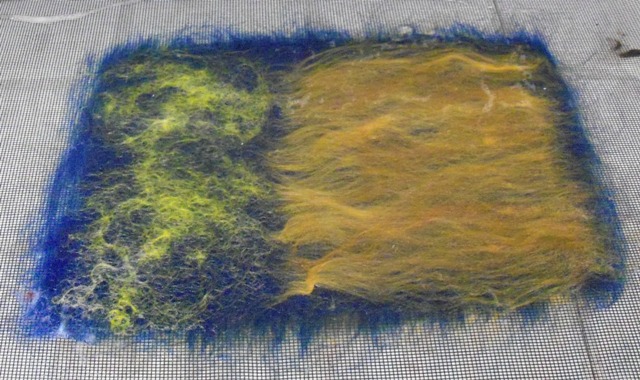
This is a Swiss Mountain batt. I got it off Etsy a few years ago.

I decided 10 inches by 10 inches is a good size for a sample and makes shrinkage easy to calculate. Please excuse my dirty-looking table; it’s some sort of glue that won’t come off.

The edges a thin, so I folded them down to make it square.

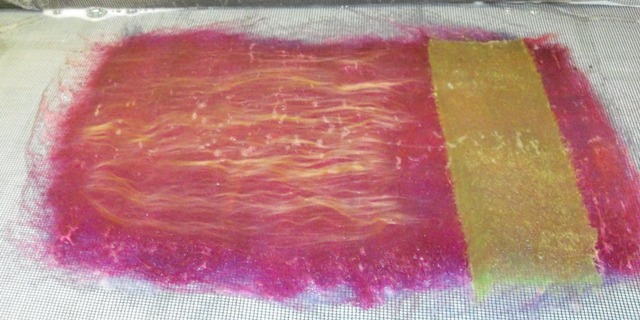
I added a layer going up and down.

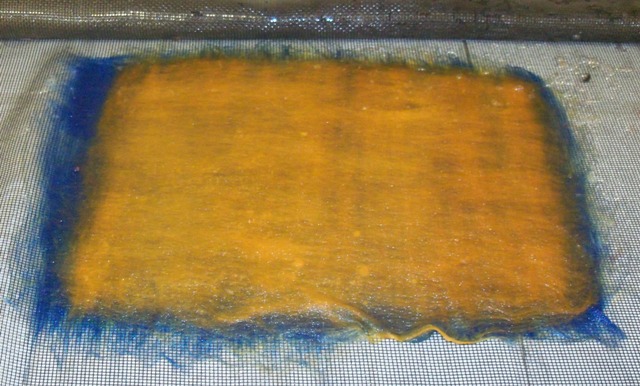
Once it was wet down, I folded the thin edge top and bottom to square it to 10 inches. That would have been enough to make a sample, but it would also be very boring.

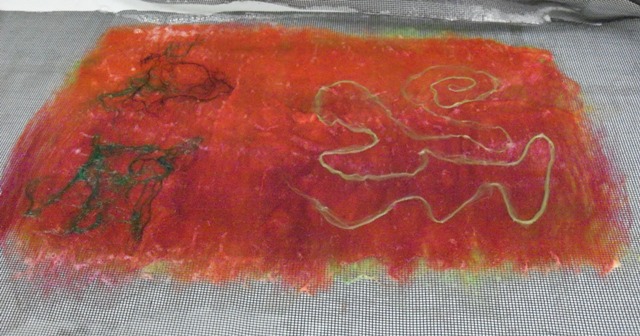
I got out some balls of my handspun and made a spiral. Who doesn’t like a spiral?

I spent longer than normal rubbing so the yarn would stick without moving too much. My impatience usually results in wobbly lines.

Then, of course, lots of rolling to full it properly.

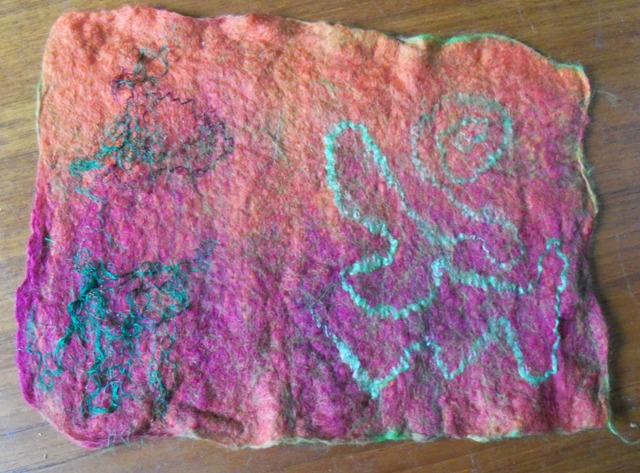
The finished sample ended up just about  7 by 7 inches

It ended up fairly sturdy. The spiral ended up holding its shape very well. However, it is quite hairy and I think it would be a bit prickly to sit on with thin pants or a dress. Once it is dry, I will try shaving it, but I don’t think it will work. There will still be short, strong fibres on the surface. I may have to try some Blue-faced Leicester or maybe some Corriedale. What’s your favourite strong wool for sturdy applications?