Browsed by
Tag: felting techniques

felting techniques class

felting techniques class

Sorry For the late post, I thought today was tomorrow.

Last weekend I had four ladies for a techniques class. This is not an advanced class, but it is also not a beginner class. People had to already know how to make felt.

First, we did inclusions. They used a piece of thicker prefelt and elastics to enclose some large glass beads (the kind they are used in the bottom of vases for decoration) and a felt ball.  Then laying out a base and top they enclosed some glass beads, a felt ball, a circular resist with a hole and a squashed tasimo pod with a resist over it.  Sorry, I forgot to grab the camera until they were at the rubbing stage. Part way through they cut some holes on top of the beads and pod.

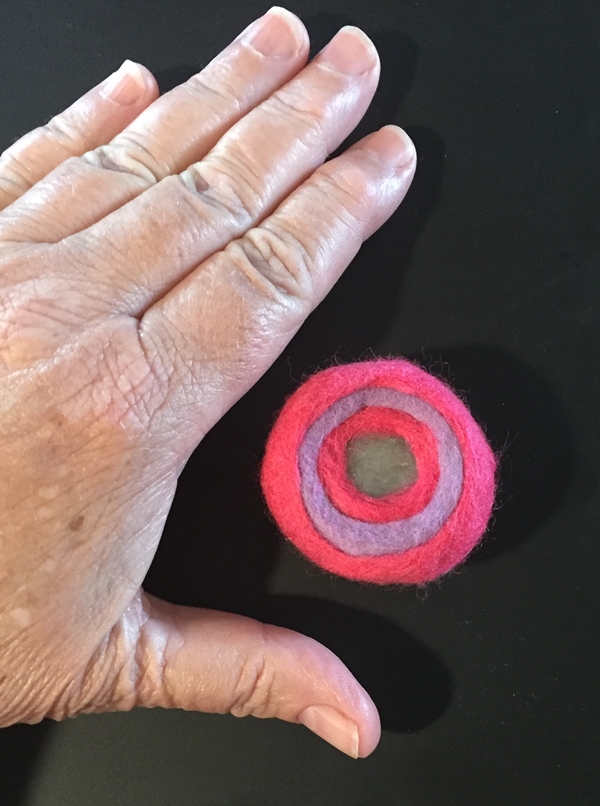
When they were laying out I had them cover a pebble with 2 layers in different colours. I had them put a resist on top of the first layer and wrap it with the second colour. They popped them into a piece of nylon stocking to contain it all and make it easier to felt. You can see the first sample on the table in the picture below. They mostly felted the pebbles during lunch while eating and chatting. Once it was mostly done they cut a hole in the top and after healing the cut edge removed the resist and cut a smaller hole to reveal the pebble.  Similar to the one below that I made a few years ago.

felted pebble

Next was cracked mud. I had them layout two 10×10 pieces( top and bottom) they added painter’s tape in 2 widths and then added the top

Naturally, because it was a wet felting class, they had to do some rolling.

I had them cut the mud sections at different stages of felting, prefelt, mostly done and done. so they could see how that affects it. I think they could have used more felting before the fulling but we had limited time and had to move on to book resists. I had them make a four-page book resist using half circles. they managed to get it laid out and wet down but then we were out of time so they had to take them home to finish.

3 students sent me pictures of the finished pieces. The first one she manipulated to look like origami.

And this one, She says it needs more fulling but wanted to get me the picture.

The third student got creative and combined her samples into a tea cozy.

All in all a good class. I just wish I could squeeze more techniques in. But no matter how fast you want to be felting takes time.

Surface Design Elements

Surface Design Elements

I made an accidental landscape picture last week at the well-being centre. I’d taken lots of the wool kebab tubes in for a play around and thought I’d see how laying them in 2 different directions worked out. I put the middle lot of tubes on first, then the diagonal ones at the top, then filled in the gaps at the sides with a couple more on each end. We were talking about the bag of dyed embellishments I’d taken in and I pulled out some cotton and fluffed it up, and noticing some gaps on my layout, thought I’d add it to show how it felted. It looks kind of futuristic, in a non gloomy or dystopian kind of way:

The mix of fibres is more apparent on an angle:

One of the grey angled tubes was made from weird tops I got in a mostly grey bag of Botany lap, it is a soft natural wool blended with something like Angelina. I never thought I’d find a use for it, but wrapped around a skewer it looked kind of industrial, like something with copper wires poking out. I tried to get a good close up:

I thought I’d try making a piece with the tubes kind of crammed on, instead of laying them out neatly next to each other, because they tend to move a bit and leave gaps. I didn’t over do it, just added two or 3 more than if I’d positioned them. I also wanted to see what the tubes looked like if they were stretched, so I pulled some of them from each end until they were the right size to fit accross the layout:

On an angle:

I liked the contrast of the shiny red and yellow bamboo on the Sapphire blue of these:

These next couple of pieces are made with wool and fibre twists. I used quite a lot of the tops from my weird grey/black and white botany lap waste bag for the twists used on this, plus a few blends of my own:

An angled pic of course:

And a sideways close up:

I thought it’d be nice to show twists used simply because not everyone wants to make something which looks ‘real’, I cut the twists in half, and then made some little woolly balls to go in the gaps:

It has a kind of swaying seaweedy feel to it:

**EDIT: I realised it isn’t easy to visualise making the wool tubes with the kebab skewers, so I’ve done a quick video:

Second Quarter Stephenson Challenge

Second Quarter Stephenson Challenge

I’ve been working on the challenge on and off for a couple of months.  My first impulse was to chose his Blue Vertigo. 

blue vertigoI made some batts and used them to make the circular design. I pulled strips off the batt and laid them out.  Then added bits of colors as needed.

batts design of purple


StephensonThis piece worked out well, but I wanted to try another of his watercolor like pieces.  So, the next one was based on his Purple Rooftop. 

purple rooftop

I used some black pencil roving in the middle, a black background underneath in the center of the piece to help shadow the reflection in the pond and some mulberry silk for a reflective effect.  Unfortunately, the purple wasn’t as obvious in mine after felting.

Stephenson 1Stephenson’s Green Love reminded me of the carving technique I learned in Fiona’s class, so I wanted to try that, too.

GreenloverSM

The background is black prefelt and with a white center of merino over cotton batting and some of the radiating lines with different colored roving.  The carvings weren’t as wide, but I like the effect.

Stephenson 3a Stephenson 3


I enjoyed the challenge and the variety of techniques I was able to use to achieve the different effects.  Have you done the challenge yet?