Browsed by
Category: workshops

Samples for my Valentines class.

Samples for my Valentines class.

I was asked to give a Valentine-themed workshop, specifically hearts. No surprise there. This is a short evening class. I am teaching in person in Ottawa at my guild on Feb 7, 2024. https://www.ovwsg.com/events/event/2407-felted-hearts/I had no pictures to put with the workshop so I had to create something. I decided on heart-shaped baskets with rope handles.

I started by finding a heart shape on the internet and sizing it up to about 6 inches across. I decided to do one this size and one bigger to end up at 6 inches.


they will fit nicely onto my rolling mat. I need to keep an eye out for a bigger one of these. This one is supposed to be for drying dishes. It might do for one person for their lunch dishes.

I decided on one in red and one in this year’s Pantone colour of the year coral pink. The colour doesn’t show well wet but you will see it when it’s dry

Next was adding embellishments. Coral pink is one of my least favourite colours so I added some sari silk in the colour Salsa. It is primarily red with bits of other colour in it.

The red looked pretty plain so I added a pale pink heart

Next of course was all the rubbing and rolling and cutting it out and rubbing and rolling and fulling. The red one is now 6 inches across and the pink one is 4 inches across.


I rolled a couple of snakes for handles. The idea was to poke holes in the hearts to poke the snake ends through and tie a knot. the pink one was okay, but the red one wasn’t long enough so I just felted the ends in. Jan thinks they should have a bell on the tip but I am not sure. I think I will offer them to the student but I don’t think I will add them.

And here they are on Jan’s new photography backdrop which I am sure she will be telling you all about in a later post.

Tada!

I like the picture of the pink one best. The angle is good. The red one is more from over the top of the heart. The chocolate hugs are some Jan gave me as a librarian present. Perfect for a Valentine’s photo shoot.


Slipper Workshop

Slipper Workshop

Not very long ago I taught a felt slipper workshop. There were 6 students including Jan. Here is the set-up in my guilds classroom It holds 6 tables reasonably well. You can see the table looms waiting for class on the left.


After we discussed the different styles of slippers, everyone traced their foot and sized up to make their template. We used floor underlay for the templates.


Everyone laid out both sides of their resist and got them nicely wrapped around

Then started embellishing them

Then it was time for felting. Start gently with some rubbing


Then rolling. No rolling pictures, you would think with everyone busy rolling I would have lots of time to take pictures but I guess I was too busy talking.

then more rubbing to heal the cut and on to fulling and shaping

And don’t forget to try them on to see where they need more work and in which directions. I brought new bread bags so they could try their slippers on without getting wet feet or socks.

Getting there

Here are some of the finished slippers.


Now you are probably thinking that at the top I said Jan was in the class but I haven’t seen her. Well, that is because Jan is the problem child of the class. She can’t just do what everyone else wants to do, and so she gets a section all of her own. Jan wants boot-style slippers. Ok, that’s no problem and you are wondering what’s the problem with that?  Well, she wants really tall rear entry boot, style “slippers”.

I had her come to class early so we would have time to discuss the how of making rear entry extra tall slippers. She says they are slippers and not boots.  You can see Jan’s diagram of what she wants in the first picture. I was explaining how the resists would work. This was best explained with a mini paper example.

Jan’s foot pattern and then her mane resist drawn out.


Jan started laying out wool about the same time as the others but she had much more wool and resist to cover.

she did a lot of rubbing but I didn’t get a picture of that and then she started rolling. By the end of class, the slippers had started to felt well but were not up to fulling yet. So now the next step is for her to visit me over the holidays and finish the slippers. I think this means I need to sweet-talk one of my men to bring the dryer into the studio. I am not sure where it got stored. I am sure letting the dryer do some of the manual work is a good idea. Maybe we can work on the dinosaur bag while it rolls around and around. These slippers should be good for sorting out what needs to be tweaked to make some more solid boots. These are Corriedale but we would both like to make some good boots out of Finnish wool. Have you made booths? What wool did you use?

As a measure of how much effort and concentration went into these, Jan only had about 20 or so pictures to share with me. All the pictures of Jan’s work are hers except the last one of Jan rolling.

Wishing Everyone a Very Happy Holiday Season!

Another Art Retreat

Another Art Retreat

My last post was about an art retreat and normally, I would just have one a year to tell you about.  But this year, I had two only weeks apart. This is the annual retreat that my small art group does in late summer/early fall at the Kiwanis Lodge on Little Bitterroot Lake.

Landscape of Little Bitterroot Lake with pine trees in foreground and mountains in background on a cloudy day.

This is the view off the deck of the lodge. The weather was a bit cool and rainy but so much better than smoky skies from wildfires.

This year we decided to play around with making our own natural inks, printing and painting with the inks and then doing some bookmaking.

Before anyone points out that many of these types of ink are fugitive and might not last, we realize that. We were just playing around to see what happens and what colors we could get as a result. No “serious” artwork is being made from these inks.

We started by grinding up Haskap berries (Fly Honeysuckle) with a bit of water and straining the result. That is the bright red color on one of the acrylic printing plates in the foreground of the left hand photo. We also ground up beets, grass and kale and tried grinding choke cherries. The choke cherries were a disaster but Sally tried boiling them after she got home and got much better results than the fresh berries.

So Paula had gotten all of us some acrylic printing plates which we covered with ink and then let dry. We left watercolor paper in a baggie with water to get damp overnight and then printed the next morning. The two photos on the left show different prints and the photo on the right was painting haskap berry ink on to a page and soaking three squares of felt in the ink and laying these down on the paper. The ink changed colors depending on oxidization and what paper it was applied to.

Make Ink book by Jason Logan.

This is the book we referred to for various recipes and what mordants or modifiers to use with different foraged materials.

Drawing organic lines with oak gall ink on to previously printed watercolor paper.

I also added further ink (oak gall with ferrous sulfate) to one of my prints with my new fountain pens. I wanted to get used to using the fountain pens so this was good practice.

We then set about making a bunch of inks including hibiscus, acorn caps, acorn caps with ferrous sulfate, oak gall with ferrous sulfate, avocado, turmeric, blue pea flower and walnut ink. Paula also brought copper ink which takes several weeks to make but is the most beautiful blue. We put these in small individual jars with a whole clove to keep the ink from molding. These are now stored in the refrigerator in hopes of keeping them good a bit longer. These should be used fairly quickly. Paula had some that she had stored in the fridge for 6 months or so and they were mostly dull and brown and had lost their original color.

We then set about making little samples of the colors from these various inks. And then you can start adding the different inks together and see how they mix on the page. Such fun!

Table set up with blue pea flower dyes and various modifiers.

Our next set of experiments were with blue pea flower. Apparently, you can buy this as a tea. All you do is steep the blue pea flowers and then add different modifiers. The modifiers that we used were baking powder, baking soda, vinegar, cream of tartar and vinegar. The modifiers change the color of the ink.

Sampling of blue pea flower ink with a variety of modifiers.

Here is some lovely sampling of the different colors that you can get from the blue pea flower inks. They range from green to blue green to blue to purple.

Here are a couple of landscapes that I painted with blue pea flower dye. I love how they mix on the paper and the variations that you get.

You can also paint your paper with blue pea flower ink and then drop dry modifiers on top such as baking powder or baking soda. You really get some interesting effects with that.

Shibori tissue paper dyed with inks glued to watercolor papers to create bookmarks.

We did put some ink on shibori folded tissue paper that could then be overlaid on previously inked watercolor paper and glued down to make bookmarks.

Paper coasters with natural dyed organic patterns.

Paula supplied us with white paper coasters and we played with ink on those too. The left is a combination of walnut ink, acorn caps and oak gall. The right is blue pea flower and hibiscus with baking soda dropped on top while still wet.

Here a three of the books that I created at the retreat. The middle one was using a bit too thin paper which had not been ironed so it is a little sad. But I learned how to fold the triangular pages which was fun. I was using papers that I had previously printed with deconstructed screen printing.

I took my tree specimen book with me and painted one of the plastered pages with oak gall. The photo on the left shows that page which was interesting. The photo on the right is Sally’s book where she has collage parts of the page and added oak gall ink to as well.

We had the best time and thanks to Paula for most of our supplies. We also want to thank the Kalispell Kiwanis Club for letting us stay at the lodge each year!

Salt Spring Island Retreat

Salt Spring Island Retreat

I recently went on a trip to Salt Spring Island, BC, Canada with a group of my friends from my Level 3 Stitch Class. What an enjoyable visit we had!

We drove up from Anacortes, WA to the Vancouver Tsawwassen ferry and then ferried over to Salt Spring Island.

We stayed at Catherine’s sister Fran’s, who kindly hosted us at her house/farm. It was a gorgeous property on the water, with a working farm/orchard.

The first day we went to the farmers and craft market. I took a bunch of photos of colorful produce as you can see above. We also visited the town of Ganges and went to a few galleries and shops.

Next up was a walk on the beach which was rocky but Edgar had a blast. There were four dogs during our stay and I think Edgar thought he was in heaven. He played and explored and had an absolutely wonderful time.

Then we started making baskets. Fran is a wonderful basket maker who supplied us with everything we needed and taught us how to make a simple basket. We thought it would take two days but it actually took three. I haven’t made a basket before and I think this will be my last one.

Here we are working away on our baskets. You can tell by my face that I am having a great time – ha ha! We also made a basket for one of our classmates who could not come to the retreat. That’s the basket I am working on in the bottom right photo.

Here is the result of our basket making. We all have a finished basket and they are pretty colorful too. Group of women sitting at dining table folding small books.

We also had a short session of folding small books with pockets.

Sunset over the water from deck.

We had a wonderful time together, great meals and Fran was so welcoming! Thanks for everything Fran and Catherine!


Retreating Beautifully

Retreating Beautifully

My first group were felting novices, learning to felt a vessel over a flat resist. They were all super-creative and keen, producing some outstanding vessels that I hope they are all proudly displaying.

The second and third events were at the Auckland Creative Fibre Retreats. These are amazing weekends away where 20-30 fibre enthusiasts converge at a retreat centre to focus on all things fibre while a wonderful team from the centre look after us, feeding us and keeping us supplied with tea, coffee and hot chocolate.

These retreats are great opportunities to learn new skills, share ideas and teach (if you want to). I offered to teach felted soaps and it was a huge hit, with each person producing at least 2 beautiful soaps.

In return Shaz (in the green sweater) taught us a cable / crepe-style plying technique. This is the first stage:

And the finished yarn:

I am the first to admit this skein is a tad garish, however, Shaz also shared some gorgeous versions she had made with less contrasting colours. This is definitely a technique I would like to try again in different colour ways and with finer, more evenly spun yarn – this yarn was a bit rushed as we were all trying to finish the hank before dinner!

I also managed to finish / make progress on a couple of crochet projects at the retreats. This poncho is a brioche crochet project I started in 2021, the pattern I was following required quite a lot of focus so this project only saw the light of day when I knew I wouldn’t be multi-tasking, hence it took so long to complete.

I also made some good headway on a brioche cushion cover I started in August. I’m not following a pattern for this one, just making it up as I go. This is using some hand-spun yarn that I dyed before plying it a few months ago. The colours are brighter IRL and it reminds me of light coming through a stained glass window.

The retreats definitely aren’t all work, knowing you have comfy bed to fall into and don’t need to drive home, most of us arrived well supplied with chocolate, wine and other beverages…. (don’t be fooled by the oranges, they were just for show! 🙂 )

An awesome time was had by all!

If you ever find yourself near south Auckland I enthusiastically recommend a visit to the Franklin Arts Centre in Pukekohe, they have 2 excellent exhibition spaces and run a varied program of affordable arts and crafts courses from their workshop.

Nuno Felt Scarf Class + Sheep

Nuno Felt Scarf Class + Sheep

I had another wonderful day teaching some ladies to nuno felt scarves.

I was busy ( talking) and didn’t take as many pictures as I would have liked at the beginning. So no pictures of the starting silk. I dye the blanks myself using the scrunch method of low-immersion MX dying. I learned how to form Paula Burches All about hand dyeing site. It is an amazing site. Don’t go unless you have some time to explore, there is so much information.  http://www.pburch.net/dyeing.shtml 

If you click any of the pictures they should open up larger in a new tab.

Back to the class, here are the layouts just before we wet them down.

pink and purple wool in the shape of a scarf, with an orange silk flower pink and purple wool in the shape of a scarf, with an orange silk flower. close up

Dark grey wool with silk hankies in various colours. In the shape of a scarf. Dark grey wool with silk hankies in various colours. In the shape of a scarf, close up

blue, grey and brown wool and silk in the shape of a scarf. blue, grey and brown wool and silk in the shape of a scarf, close up

pink and orange wool and silk in the shape of a scarf. pink and orange wool and silk in the shape of a scarf, close up

and then everyone got rubbing. This is the time it’s great to have a chatty group. It makes the work go faster. And I don’t have to do all the talking.

woman rubbing a wool scarf layout to make a felt scarfwoman rubbing a wool scarf layout to make a felt scarf

woman rubbing a wool scarf layout to make a felt scarfwoman rubbing a wool scarf layout to make a felt scarf


Sorry, no rolling pictures. The problem with a chatty group is I love to chat too and forget to take pictures.

But I do have some pictures of the finished scarves once all the fulling was done.

Finished pink and purple nuno felt scarf with an orange flowerFinished pink and purple nuno felt scarf with an orange flower. close up of flower end.

Finished grey, brown and beige nuno felt scarf with colourful accents.

Finished blue grey and brown nuno felt scarf Finished blue grey and brown nuno felt scarf up close

finished Pink and orange nuno felt scarf. finished Pink and orange nuno felt scarf close up

here’s a nice group shot from the end of the class.

Group of women holding nuno felt scarves


One of the ladies went home and dried her scarf so she could wear it right away. Doesn’t Kim look great? The colours really suit her.

Kim taking a selfie with her new scarf.

Denice also sent me a picture of hers when it was dry. I love the silk flowers.

nuno felts scrf on a hanger, dry

It was a fun day for everyone.

I taught a short sheep class the other day. They were young people so just one picture of the finished sheep.

4 multicoloured felted sheep

2D felted landscape workshop

2D felted landscape workshop

Saturday, Feb 11th, 2023, was the date scheduled for the next 2D felted landscape workshop at the local guild. Before Xmas we had a lot of workshops have to reschedule. Either the weather was against us, or the instructor or the students had caught the flu going through town. (Technically that is better than covid but it still sounded awful.)

In the aftermath of the sudden arrival of winter the weekend before, I had been left fighting Glenn’s generosity (he gave me his cold). I had noticed I was feeling better each day from about Wednesday so by Saturday I was pretty optimistic that I had defeated most of it and would be able to teach. (I had been avoiding Glenn but it is a small house.) I had spent the week slowly gathering supplies, sorting out all the things the students would need and had Glenn do a run to Dollerama for the missing items.

Saturday morning started very early, Glenn loaded the supplies, samples and many bags of different fibre. When everything was in the car, there was still room in the front seats for both of us.  Seeing out the back is not that important, I have side mirrors! So, off we went to the studio to set up before the workshop.

 1) small grey 4 door Kea Soul with Glenn bringing in as much as he could carry each trip. The parking space is still covered in snow and the Dairy Queen on the other side of the street is not yet open. 1) small grey 4-door Kea Soul with Glenn bringing in as much as he could carry each trip. The parking space is still covered in snow and the Dairy Queen on the other side of the street is not yet open.
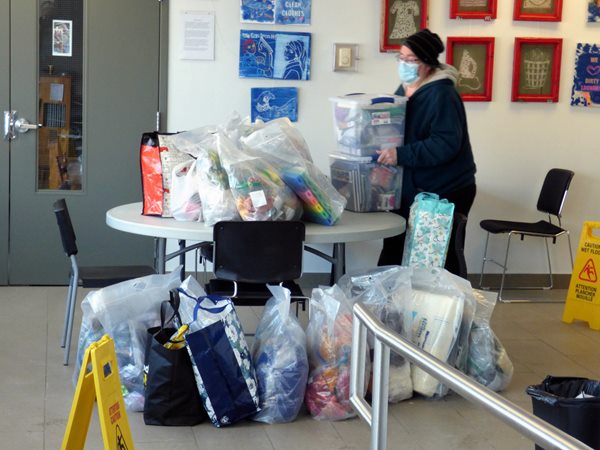
2)  clustered around or on the table outside the studio; 12 giant zip lock bags, 4 large bags, one file holding plastic box, and Glenn placing the last 2 mid-size clear ruff totes on round plastic topped table. There are “caution wet floor” signs in the foreground and off to one side.2)  clustered around or on the table outside the studio; 12 giant zip lock bags, 4 large bags, one file-holding plastic box, and Glenn placing the last 2 mid-size clear ruff totes on a round plastic-topped table. There are “caution wet floor” signs in the foreground and off to one side.

Glenn unloaded the car and set up the extra tables in the studio so I could set out the student’s supplies and set up the examples.

3) Class room set up with each students notes, foam pad, frame, needles set out at there place. To the right are examples of my work (including the Mr. and Mrs. Mer to show 3D Dry Felting). In the background, Glenn is reading and you can see a smaller table full of other supplies we will need as well as a 5 foot table overflowing with bags of wool. (There are a couple bags sitting on my walker).3) Classroom set up with each student’s notes, foam pad, frame, and needles set out at their place. To the right are examples of my work (including the Mr. and Mrs. Mer to show 3D Dry Felting). In the background, Glenn is reading and you can see a smaller table full of other supplies we will need as well as a 5-foot table overflowing with bags of wool. (There are a couple of bags sitting on my walker).

4) Close up of examples of 2D and 3D needle felting and 3 books (Art in Felt and Stitch, Jaana Mattson's Landscapes in Wool: The Art of Needle Felting and Painting With Wool Landscapes) I had brought for the students to look at.4) Close up of examples of 2D and 3D needle felting and 3 books (Art in Felt and Stitch, Jaana Mattson’s Landscapes in Wool: The Art of Needle Felting and Painting With Wool Landscapes) I had brought for the students to look at.

In the student’s notes, I gave them a list of books that may be of interest if they enjoyed 2D picture felting.

  • Painting With Wool Landscapes by Bethany Harris
  • Creating Felt Pictures by Andrea Hunter
  • The Art of Moy Mackay by Moy MacKay
  • Art in Felt and Stitch Felting Book by Moy MacKay
  • Jaana Mattson’s Landscapes in Wool: The Art of Needle Felting  by Jaana Mattson
  • The Art of Felt Felting Book by Loumange Francoise Tellier (inspirational)

5) Three bins and a bag of other things the students might need or could try. Fake clover tools, bags of scissors, extra needles, pins, small pet brushes that work like mini carders, and a bag of permanent markers are arrayed on the table. There are also a couple more small samples of felting and using different types of backing or ground felt.5) Three bins and a bag of other things the students might need or could try. Fake clover tools, bags of scissors, extra needles, pins, small pet brushes that work like mini carders, and a bag of permanent markers are arrayed on the table. There are also a couple more small samples of felting and using different types of backing or ground felt.

6) 13? Bags of wool on a five foot table over flowing with one on the floor and two bags on my walker.6) 13? Bags of wool on a five-foot table overflowing with one on the floor and two bags on my walker.

7) Well-padded rolling desk chair with green and black pillow sits behind a folding table with all the students’ supplies.7) Well-padded rolling desk chair with a green and black pillow sits behind a folding table with all the students’ supplies.

I found out that one of my students had hurt her back and was not sure if she could make it or how long she would be able to felt, so had one of the comfy chairs and pillow ready for her arrival.

8) A close up of one of the students workshop supplies, with various candy and chocolates for stamina (keep watching the pictures and you will see more of the candy selection).8) A close-up of one of the student’s workshop supplies, with various candies and chocolates for stamina (keep watching the pictures and you will see more of the candy selection).

Most of the students had chosen an image from a selection I had sent earlier in the week. We wound up with two students working on the tree in winter with a fence and two on an ocean image. Since I had not heard from all the students I thought I better bring all the colour options so I would be ready for whatever they wanted to try. We had two missing students, one was a booking error that had been corrected but was not on my list, and the other was actually missing. ( I found out when I got home that she had not felt well and had tested positive for covid that morning!)

I had set out the student’s supplies; Name tag (rectangle thick wool felt): (safety pin & sew-on pin, sock yarn, piece of scrap paper and Marker).  Foam Kneeling pad, 1 sheet of 100% wool felt (enough for two 5×7 pictures), 1 sheet of acrylic craft felt, I sheet of card stock (to make a window mat), a Plastic ruler, a Wooden Frame with a mat from Dollarama, XXL Project bag, bag for the needle, 21 pages notes and Felting needles.

  • 2x  T36-333 needles (Blue)
  • 2x  T38-333 needles (PINK)
  • 2x  T42-222 needles (Turquoise)
  • 1x Crown 40-111 needles (Orange)
  • 1x Reverse 40-222  needles (Green)

We started with a name tag; making your name in yarn to practice eye-hand coordination and get used to the needles.   I usually review what’s in the notes, the basics of history of landscape, mentioning the golden mean and the rule of 3’s for photography,  a review of perspective, some of the techniques that apply to pastels, acrylics and watercolours that can be used with wool.  As well as blending fibres by hand or by hand cards to get the colours you want. I also chatted briefly about ways to transfer images to the felt.

I didn’t go into as much detail as I usually do since I was starting to feel a bit more brain-stuffed up than I had been when I arrived and started to set up.  I was sure I was feeling better, but this cold seems to keep trying to sneak back and hit you again. Even so, the students did very well. Maybe not overloading them with info helped.

This time everyone wanted to use the “lightbox” (or window) method so I reminded them that the template version, which is good for thicker felt bases or dark-coloured base felt, was in their note if they needed to use it in the future.

9) Student with ocean view with lots of blues teals light teals, grey and white wool strewn around. There are is also a package of rockets candy rolls in the foreground9) Student with ocean view with lots of blues teals light teals, grey and white wool strewn around. There are is also a package of rockets candy rolls in the foreground

For each image I had two copies of the original image (in case they chose the template method), a colour blocked version and a colour saturation image to show hidden colours they may want to consider.  I can do this with Microsoft Word 2010. (Sometimes things work and upgrade then lose the effects you want.)

10) The second Ocean image again has fiber strewn around it. In the foreground, my male cardinal on a branch, using the template method for transfer. Like Watercolour painting, layers of thin colour for the back ground and a thicker more like acrylic approach to the bird.10) The second Ocean image again has fibre strewn around it. In the foreground, my male cardinal on a branch, using the template method for transfer. Like Watercolour painting, layers of thin colour for the background and a thicker more like acrylic approach to the bird.

Normally each student has chosen a different image, this time one of the ocean images was popular and the tree in winter with a fence and hill had found favour with the other 2 students.

11)student working on background behind the tree first. This time the fiber is a mix of white, grey, green-grey, light blue and brown with gray. In the foreground there is the green handle of the clover tool rake (originally designed to clean a clover brush) but works very well to hold down the wool as you felt, it keeps your fingers away from the pointy end and less bloodshed.11) Student working on their background behind the tree first. This time the fibre is a mix of white, grey, green-grey, light blue and brown with gray. In the foreground there is the green handle of the clover tool rake (originally designed to clean a clover brush) but works very well to hold down the wool as you felt, it keeps your fingers away from the pointy end and less bloodshed.

12) The second tree image is having its fence added. in the foreground are a works in progress of a night winter tree and on the cheap Dollar Tree craft felt a pair of sheep (you can just see the eye) a pair of hand carders sitting on a copy of the students 21 pages of notes. Next to that is a brass nautical caliper, a wooden frame with an XXL project bag and a box of mini boxes of smarties (candy coated chocolates).12) The second tree image is having its fence added. in the foreground are works in progress of a night winter tree and on the cheap Dollar Tree craft felt a pair of sheep (you can just see the eye) and a pair of hand carders sitting on a copy of the student’s 21 pages of notes. Next to that is a brass nautical calliper, a wooden frame with an XXL project bag and a box of mini boxes of smarties (candy-coated chocolates).

Winter trees were also popular.  I reminded the class that they could play God and move, remove or change trees, clouds or anything else that offended them. It was their landscape and they could adjust it so it would suit their liking.

I talked about how to think like a watercolour painting with washes and layers of thin wisps of fibre building up to a final image (not the fastest way to work but it can be very effective as in the fox who still needs to have whiskers added and I’m at about 30 hours). I also mentioned that after laying in the trunk and main branches, wisps of fibre worked well to create a hallow of tiny branches for the winter tree.

13) The first tree picture, Using a 5x7 opening to check the framing of the image. Behind the image and card stock mat is the foam kneeling pad that we were using as a felting surface.13) The first tree picture, Using a 5×7 opening to check the framing of the image. Behind the image and card stock mat is the foam kneeling pad that we were using as a felting surface.

Using a mat or just a card stock stand-in for a mat will give your eye and brain another view of the image you have been working on.

14) The second tree picture, held up to getting a quick check for position in the mat.14) The second tree picture, held up to get a quick check for position in the mat.

Both trees look great and are their own tree, even having used the same inspiration to start with. The same individual personality happened with the stormy sky ocean picture.

15) a vary active roiling sky with sea and beach underneath, there is a seagull added to the right side. 15) a very active roiling sky with sea and beach underneath, there is a seagull added to the right side.

16) a turbulent sky and sea with a beach in the foreground.16) a turbulent sky and sea with a beach in the foreground.

Both have great movement in their pictures, again when using the same image each saw and focused on different aspects of the image.

I have found sometimes after working on an image for a while I need to take a break. I will put it aside and come back to consider it again later. I may decide “yes I am happy” and the picture is done or I may decide it needs a bit of fibre added here or there to complete it. Sometimes using a card stalk mat will help me consider the image, looking at the picture in a mirror or turning the image and the felt picture upside down will help you see what you are looking at, rather than what your brain says it thinks it is looking at. (It makes it easier to see the negative space and compare the image with the picture you are making).

I hope they had fun and I hope that this opened up a new expression of creativity with wool.

The class finished up early but they also took a much shorter lunch than the last class. I had given each student a project bag (giant XXL zip lock bag) to store their extra wool, felt samples and needles in. They had the leftover fibre from their first picture and a couple selected a second image to try. A different water picture and a sheep in a field of snow.  it was impressive how far along they got in an hour on their second images.

17) An hour in on a second image of a sheep in a snowfield and snowy sky, sitting in a card stalk mat17) An hour in on a second image of a sheep in a snowfield and snowy sky, sitting in a card stalk mat

I seem to have missed getting a shot of the other ocean image! I was really only working at about 90% efficiency. It took me about an hour to pack up the workshop supplies and Glenn loaded them back into the car. Then put away the extra tables (I think tomorrow is a spinning workshop and they will need the space).

There is a very good restaurant across the street from the building the guild is in, I think I get a happy Sherpa by making sure I linger in the parking lot while he runs over and orders dinner. It was very good, the car smelt like hot pizza all the way home.

Felted Lantern Workshop

Felted Lantern Workshop

This last Sunday I taught the felted lantern cover workshop that should have happened in December but was delayed. I was teaching at the guild I belong to, Ottawa Valley Weravers’ and Spinners’ Guild.

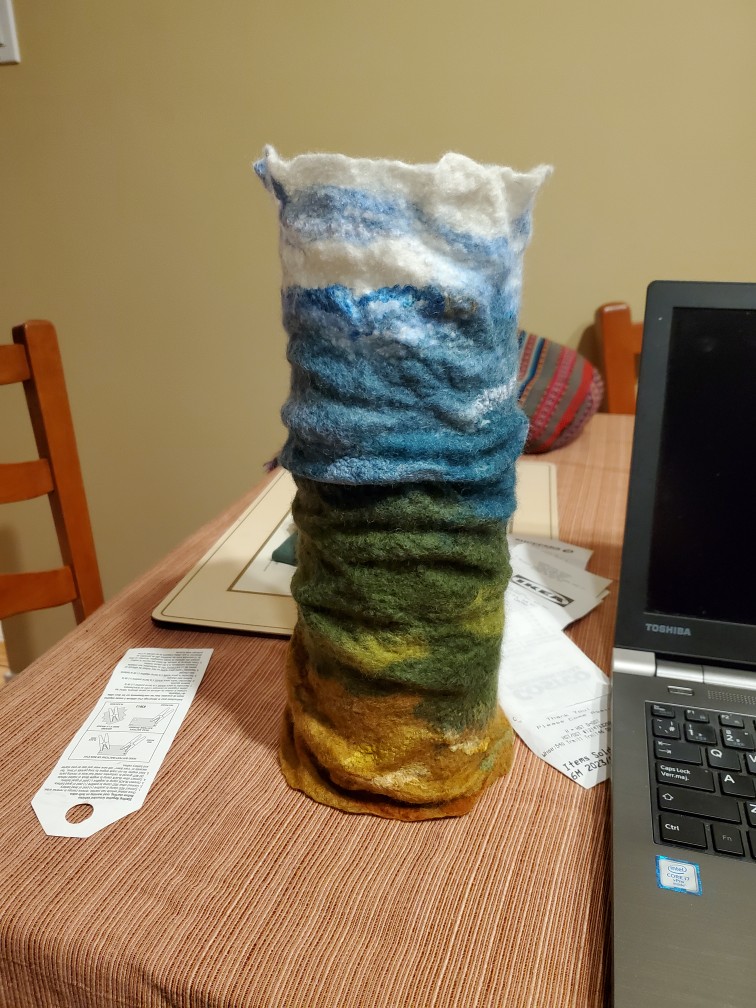
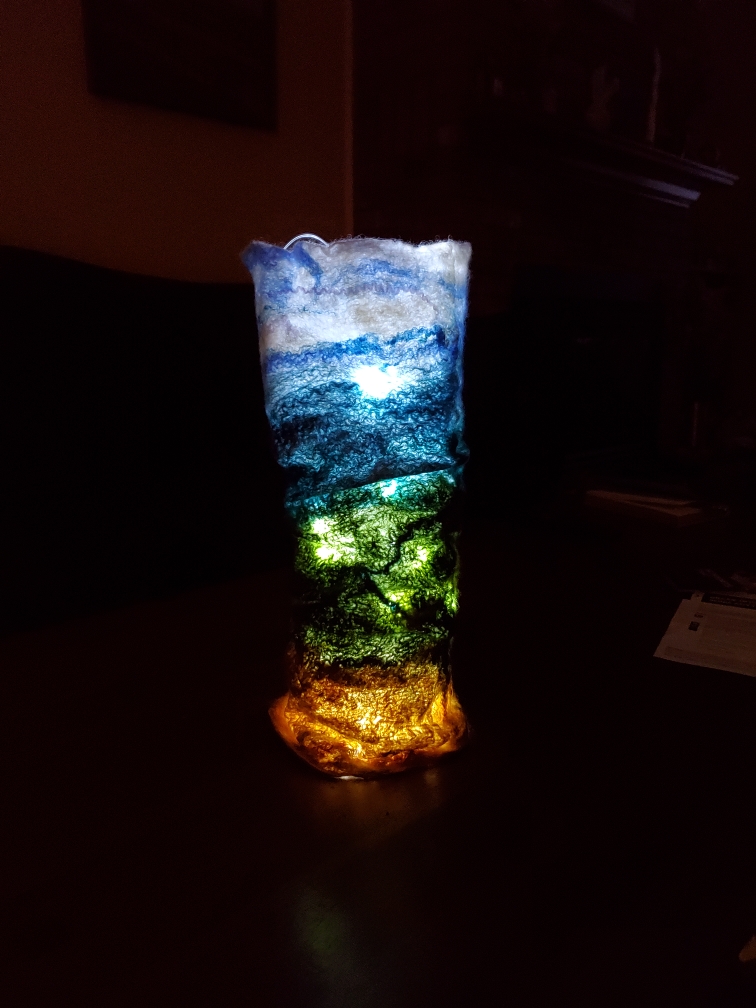
It was a half day class. the biggest challenge with the lantern covers is laying out the wool thin enough to let the light through but with enough wool to hang together. They don’t need to be strong because the lantern will give them structure. For this class, I provided a glass vase so everyone would be working to the same resist size. You can use a large pop bottle with the top cut off but I would add some weight to it to make it more stable.

I had 5 ladies for this class. I showed them two examples of covers I made.

wool felt lantern cover, blue, green, brown wool felt lantern cover lit up, blue, green, brown

Everyone wanted the longer one so they could add wrinkles

laying out wool for a felted lantern cover laying out wool for a felted lantern cover laying out wool for a felted lantern cover laying out wool for a felted lantern cover laying out wool for a felted lantern cover


I only just realized we ended up with just 2 colour palettes. the largest part of this class is taken up with layout and decoration. We discussed how you can add things to the inside of the cover that won’t show when it’s not lit up but will show as silhouettes blocking more light.  A couple of people decided to give that a try.

Adding embellishments to felt lantern covers Adding embellishments to felt lantern covers Adding embellishments to felt lantern covers Adding embellishments to felt lantern covers Adding embellishments to felt lantern covers

It is hard to see on the last one but she is adding white and blue silk hanky pieces to the wool. they disappear as soon as they get wet. They will show up again later. You can see them a little in the pictures below. I think everyone had a great afternoon.


Group shot of the students with their lantern covers.

finished wool lantern cover finished wool lantern cover finished wool lantern cover finished wool lantern cover finished wool lantern cover

Two of my students sent me pictures of their covers dry and lit.

Christine

lantern cover drylantern cover lit up

Janet

lantern cover dry Lantern cover lit up

I hope the others will send me pictures as well. One was very thin and delicate and I think it will look amazing lit up. If they send them I will add them here.

I did have someone ask why I like to make covers rather than making them with a bottom. There are 4 reasons, first making a nice flat bottom that will allow the vase to stand properly can be tricky. A cover that is self-supporting needs to be felted much more or be thicker to be stiff enough. Having an internal structure gives you something to put the lights in and attach the controller to. And lastly, the container inside allows you to add water if you would like to use it for flowers.


Needle Felted “THING” first time running this workshop

Needle Felted “THING” first time running this workshop

The local Ottawa Guild had been optimistic in the latter part of 2022 and started to reschedule workshops, unbeknownst to us the evil covid was friends with 2 influenzas and invited them to drop by too. So we wound up with students and instructors out sick by the end of November into December. This was also the month my new workshop had been booked. I had offered to teach a chickadee or a tiny dragon but had been requested to make a Thing since Elizabeth, the workshop coordinator and I had not been able to decide on a definite thing. This is the description that was listed for the workshop.

Description:  Jan is paralyzed with too many possibilities for an item to use to teach needle felted sculpture, thus we announce a workshop in needle felted THING creation.  Jan will probably decide more or less what the THING will be before the workshop but it will be a surprise for students.  You will create your THING using three dimensional needle felting. By the end of the workshop, students will have the skills needed to go home and make a THING of their own choosing.  Previous felting experience is helpful but not necessary. Good eye hand coordination is very helpful (those needles are sharp).”

As soon as it was scheduled, I started to work on organizing a brand new workshop. I quickly figured out this scope is a bit broad, so making a small basket protecting thing would help. I had admired an amigurumi mix-and-match monster making book.  “Edward’s Crochet Imaginarium: Flip the pages to make over a million mix-and-match monsters” by Kerry Lord.  Using the simple shapes from crochet to inspire the students, should give absolute beginners an achievable target and those who have felted before the opportunity to try four different wire gauge hands or wings and a tail.

The notes covered wire and needle gauges, fibre, fibre preparations (carded vs Combed it can make a difference), then wrapping. I had gone through and followed a couple of my projects and showed how I had made and built the armature, as well as a few wire augmentations I have had to do over the years. Most of that last section is actually in the blog posts! I finished off the notes with a list of books they may want to investigate and three online sources of videos.

If the various flues and covid were not enough of a challenge we had our first big winter store about to hit. I think most of the worst went south of us. I wonder, what the states could have done to offend the weather? After some debate with Elizabeth it was decided that since the forecast was to have the storm ending by Saturday morning, we would see how the roads looked closer to the workshop.  The snow had momentarily stopped and the workshop was declared a go.  I had collected the supplies together and then pulled the bags of fibre to go from the basement. Glenn hauled and loaded it all into the car. He and our new neighbour also cleared out the end of the driveway and we made a brake for the Guild Studio on the other side of Ottawa.

Car is being loaded to go to the workshop with fiber and suplys, snow covered car, tree and drive way. the driveway is getting quite icy. Grey Kia hatchback still dusted with snow, with hatch back open showing it is Full of bags of fiber. snow covered branches above car hang low from the weight of the clinging snow. Inside my Gray kea soul. there are bags of fiber and suply filling the back of the car blocking direct vision out the back and getting quite close to the inside of the roof. 1-3 it’s impressive how much wool you can stuff in a Kia Soul!

The side streets were not the greatest, but the highway was fine and the parking lot had been cleared!!!

the snow covered and slippery walkway in front of Heartwood house (the Building the guild is in) snow covers the ground and is clinging to the trees, the front corner of my car is visible on the left of the pictures. Front Gallery just outside the Guild studio, 7 large bags of wool on one side and boxes and bags of suplys on the other side of the hall way. in the distance my walker also carying boxes. the gallary has tropical plants along the windoe and artwork (prints) on the walls. 4-5 Arriving at the Guild and dropping off the stuff

He carried in the bags of wool, the box of armature things and the couple boxes of supplies. Then went and found the missing tables.

4 large plastic folding tables and a smaller white one hold fiber and boxes of suplys for workshop within the OVWSG studio6 Tables found and now I can set up!

He set them up in a C or U pattern so I could sit in a rolling chair in the center and help any student without a lot of standing and bending over.

18 pages of notes, a colourfull foam nealing pad (originaly for gardening), a pice of pool noodle, 3 sizes of small wooden dowls, leather Finger cots, wooden single needle holder all sitting on grey folding table 7  18 pages of Notes, Foam kneeling pad, A piece of pool noodle, 2 sizes of dowels, finger cots, wooden single needle holder. Still to add will be the needles.

I had also had a few needles for them to see what difference a gauge will make. T32,T36,T38,Crown40,Revese40 and 42. all needles are in zip lock bags and in little pieces of pool noodle foam. 8 I also had a few needles for them to see what difference a gauge will make.

a book on comparitive anatomy and one on Anagarumi monsters both listed in the text below picture9 the books just past the needles

You may have spotted I brought a few possibly useful Books; Comparative Anatomy (Animals Vs. Human)  Cyclopedia Anatomicae: More than 1,500 Illustrations of the Human and Animal Figure for the Artist by Gyorgy Feher. I also had a book on Anagarumi to give the students some ideas.  Edward’s Crochet Imaginarium: Flip the pages to make over a million mix-and-match monsters by Kerry Lord. (Kerry Lord also has a book on crocheting sheep! Toft Sheep – 18 Crochet Sheep Patterns (uses UK terms))

a couple of my sculptural felting books. both books are listed in the text below the picture.10 a couple of my sculptural books.

Armature/Sculpture books I brought to show the students; A Masterclass in Needle Felting Dogs by Cindy-Lou Thompson, Needle Felted Kittens: How to Create Cute and Lifelike Cats from Wool by Hinali.

There are now quite a few good books on sculptural felting with or without an armature. I had a list of 14 that they may want to keep an eye out for.

plastic haloween skeliton of a dragon standing on pacagease of smartie candys (candiy coated chocholet)11   I also brought sustenance and plastic inspiration

The Ottawa guild has always wanted to have small class sizes to insure good student-teacher ratios. Most workshops have a maximum of six students. With the first snow dump of the year and 2 types of flu plus covid, I was a bit worried that it may not run. In the end, we had one student driving over an hour to Ottawa and made it safely but one was sick and another with a sick child. So we ran with four students.  Three went for Anagarumi-based Things and one went with a Kraken/Octopus combo. They were a bit bigger than I had envisioned but they all still had their armatures in time to have lunch.

4 images of hands working on bending wire to make there armatures12  Armatures are underway

We had two Things with four arms and a tail, one with two arms a tail and wings, and the octopus creature used pipe cleaners (ok now there called Chanel stems since there are not a lot of pipes to clean anymore) to see how that would help with wrapping later.

After a lunch break, they started to wrap the fibre around their armatures.

wool aplication starts, 3 of the scupltures has the first bit of wool added. 13 wool wrapping begins

I brought a couple of types of fibre preparations. This would let them see the difference between carded (which makes a woollen yarn)  and combed (which makes a Worsted yarn). I am going to talk about this more in a future post.

This thing was being helpful by holding fiber for its creator, even when that was not as helpful as it sounds.14 This thing was being helpful by holding fibre for its creator, even when that was not as helpful as it sounds.

this thing is developing fabulous wings.15 this thing is developing fabulous wings.

Unlike my last octopus this one has 8 arms! The pipe cleaners were found easy to wrap over.16 Unlike my last octopus this one has 8 arms! The pipe cleaners were found easy to wrap over.

A little way into wrapping, the students all realized it takes a bit of time to wrap, so instead of rushing and risking lots of punctured fingers, they decided they would like to add a second half to the workshop and focus on surface work. I did spend part of the time they were wrapping to show them a couple of options for adding fluffy furry surfaces.

two of this things arms were added to increase its head.17 two of these things arms were added to increase its head.

This one still has all four of his arms and is now standing on his own.18 This one still has all four of his arms and is now standing on his own.

By 4 pm we had good shapes developed and no major bloodletting due to rushing.

the octopus is starting to emerge. 2 legs are wrapped in white Top (Combed) and the rest are wrapped in Roving (Carded) wool.19 the octopus is starting to emerge

the thing with 4 arms has now received a head20  the thing with 4 arms has now received a head

the winged thing has temporary eyes and looks like he is looking forward to getting wings.21 the winged thing has temporary eyes and looks like he is looking forward to getting wings.
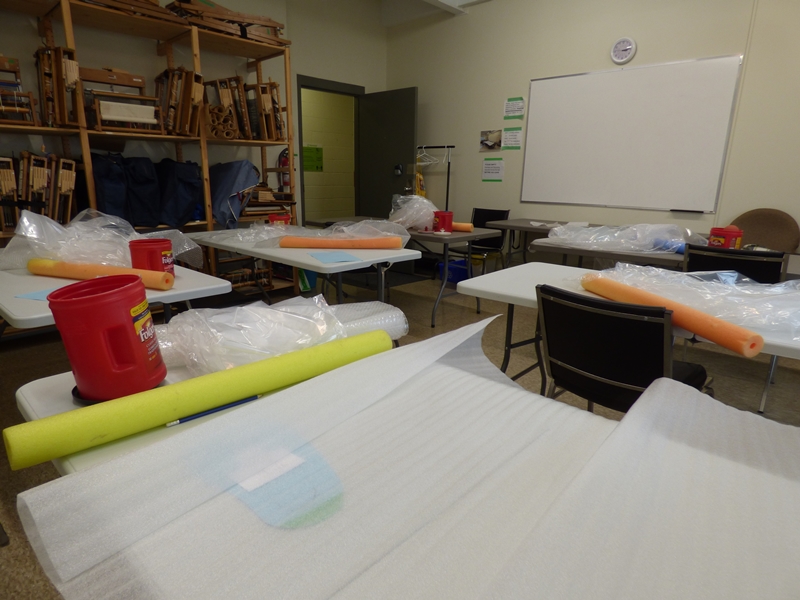
The class while not quite finished seems to have had fun to this point.  We will get a bit of time scheduled for part two to finish the outer layers in the new year. It’s always hard to estimate on time for a new workshop and the pace the students will progress at. Not pushing for speed, I think is the way to go for this one. Needle felting yourself is not conducive to creating more needle felters!

I hope you will get to take some time over the holidays to do a bit of needle felting. If you are at a loss for what to make you may want to peruse the Anagarumi Monsters for a bit of mix and match inspiration! Happy Hanukkah, Mary Christmas, Happy Solstice and Happy Holidays from the Mer Family, the Scott-Martin Family and the rest of my felted menagerie.

PS is it just my dyslexic brain or is this date really cool 12-22-2022 (if only we had 20 or 22 months it would be perfect! OK, the last few years have felt like years containing more than 12 months) but I hope you can enjoy such a fabulously numbered day! See you Next Year!!

Spinning Spirals and other topics.

Spinning Spirals and other topics.

A few years ago, while searching for an online textile workshop, I happened upon one that made me curious.  I was familiar with the tutor’s name, Ruth Lane, as her book “The Complete Photo Guide to Felting” was and continues to be one of my ‘go-to’ reference books.  Among its many attributes are two that I hold important, good writing and clarity.

At the time, Ruth was offering, among her courses, one titled   Nuno Felting with Paper Fabric Lamination.  This four week course is available under the heading Embellishing Felt With Surface Design Techniques – A Mixed Media Approach.

(https://feltingandfiberstudio.com/classes/embellishing-felt-with-surface-design-techniques-a-mixed-media-approach/nuno-felting-with-paper-fabric-lamination/)  Ruth lived up to expectations by providing concise instructions on her methods.  The smaller class size made the whole experience very personal and enjoyable.  It also provided a space where I, as a participant could interact easily with fellow students – it’s something personally I think important as sometimes on-line classes can leave me feeling quite remote.

I was absolutely delighted when Ruth asked me to write some posts for the Felting and Fiber Studio blog and when I finally decided to design and produce the online Spiral Workshop I was thrilled when it was accepted as one of the courses on the FFS workshop platform.  I feel so comfortable with the whole ethos of small class sizes and encouraging participants to engage with others if they so desire.

The Spiral workshop came about as a result of a challenge put to me by a fellow felter.  Once I had refined my technique I set about filming each step of the process.  I wanted clarity as, to a large extent, the videos needed to replace my physical presence in the learning space –  that said as with all courses offered by FFS, tutors are available to answer questions for the duration of the course.

Once the full course was recorded, I set about editing the material. This did not involve a lot of deletions.  Instead the videos were broken into smaller steps which would make particular elements of the process easier to locate for participants.  Each video has an accompanying PDF which again is broken into steps to match the videos.  These are available for participants to keep and the videos are available for the duration of the course (and a few extra weeks).

This will be the third run of the course which will start on 26th August.  Registration for it opens today (12th August) and numbers will be limited to make the experience more intimate.

Here are some photos of students’ work.  They are all so gorgeous and so different. I have included some of the reviews at the end of the video.


If you are interested in finding out a bit more, feel free to check out the following link:

HANGING FELTED SPIRAL WITH HELENE DOOLEY