Browsed by
Author: ruthlane

When I discovered felting in 2007, I finally found the creative outlet for which I had been searching. I love that the versatility of fiber allows me to “play” with a wide variety of materials including wool, silk, fabrics, yarns and threads. Creating one of a kind fiber art pieces to share with the world fulfills my creative passion.
Hand Stitched Cover

Hand Stitched Cover

I suddenly realized that it’s already March and nearing the end of the first quarter. So I needed to get going on my entry for the 1st quarter challenge. Did I have something that needed a cover? Perhaps my tablet needs a little felt surrounding it and keeping it safe.

Two pieces of nuno felt in blue green, one piece with tracing paper design of tree pinned in place.

I found these two pieces of nuno felt in my stash that were already cut to approximately the right size. I found a copyright free design of two entwined trees that I decided would be nice to embroider a design on the cover. I traced the design on tracing paper and pinned it in place.

Then I used machine thread in dark brown with a running stitch to follow the design. It works for a fairly simple design but might be an issue for really complex designs. I used brown thread so that if it showed on the edges of the stitching, it wouldn’t stand out. You can remove any of these threads if the embroidery doesn’t cover them. I have found with thin pieces of the design such as branches, that it works best to have just one line of running stitch and it takes less time to stitch the design.

Piece of nuno felt with tracing paper design of tree pinned in place and running stitch completed to transfer design to nuno felt. Using end of needle to run along stitch line to easily remove tracing paper.

The next step is to remove the tracing paper. I saw this on a YouTube video but don’t remember who to credit for the idea (Sorry!). Use your needle to run along the line of running stitches and that will tear the tracing paper so that it is easier to remove the paper without pulling on the stitches as much.

Piece of nuno felt with running stitch completed to transfer design to nuno felt and tracing paper removed.

Here’s my design now transferred on to the nuno felt and ready to embroider. I considered using various brown yarns to couch down but they were too large a scale for this small of a tree. So back to my stash to find brown perle cotton thread. I ended up deciding that #8 perle cotton was the size that worked best and that I had the right colors in.

Blue green nuno felt with couching on tree design with dark brown #8 Perle cotton thread.

So I started with the darkest brown threads and started couching them down with the brown machine thread. I did a little bit of this on a recent car trip but did most of the couching after I got back home.

So here’s the finished tree trunk and branches. Now to add some leaves. Once I have finished with the embroidery, I will work on construction of the cover.

Have you made any covers lately? If so, we would love to see what you have created. You can submit your challenge entry here. 

Playing with Collage

Playing with Collage

My local art group has been playing with collage for our last several meetings. We usually find an interesting online video to “follow” and then take off with the basic ideas from the video.

Grid of small collages in a sketchbook.

The first attempt was with small squares on a page and using a limited palette in all the squares. Then add some markmaking with different tools, small pieces of paper glued in place; then more mark making on top. This is my attempt at the technique. I wasn’t able to attend our meeting so I didn’t get any photos of my friends work.

Gelli plate print glued into sketchbook

The next video suggest starting with an old gelli plate print glued into the sketchbook. Then to “randomly” add collage, printing and painting on top “without thinking too much”. I never seem to do well with this type of activity as it gets way too jumbled and nothing ends up looking good to me.

Sketchbook with layered collage on table with paper, tools, glues.

Here’s where we were working and you can see my hideous collage results in the foreground of the photo. There are many layers and thinking a bit more about my choices might have improved this mess.

Layers of collaged papers and paint in sketchbook

Here’s the final outcome of my collage. Still pretty hideous to me.

Sally created two collages using up a lot of her eco printed papers that she had in her stash.

Collaged papers in a sketchbook

Louise was still working on hers but had a great start.

And here’s Paula’s effort. She was working on two pages in a spread. I don’t think she was finished with these yet.

The nice thing about this project was using up painted and printed paper from our stash and just allowing ourselves to play a bit. Even though I wasn’t happy with my outcome, I had fun messing around 😉

Made in Canada: Sustainable Fibre Arts Conference 2024

Made in Canada: Sustainable Fibre Arts Conference 2024

This is a guest post by Charlotte P. of The Craft Council of Newfoundland and Labrador. I thought our readers would like to hear about this interesting conference being held in September. Thanks for writing the post Charlotte!

The Craft Council of Newfoundland and Labrador has the pleasure to announce the
Made in Canada: Sustainable Fibre Arts Conference 2024. The Conference is taking
place from September 19 to 23, 2024, in Gros Morne National Park, a UNESCO
World Heritage Site, in Newfoundland and Labrador, Canada.

Photo of eco printing on fabric with hands rolling up leaves and flowers into a piece of fabric.

Last held in 2015, our Fibre Conference brought presenters, participants, and visitors
from all across the globe together to discuss the exciting developments in the fibre arts.
While sustainability is far from a new concept, sustainable textile practices are evolving
and being adopted by hundreds of artists in Canada and across the globe. Focusing on
sustainability and respect for the land, water and air, this conference aims to discuss
sustainable and ecological craft practices and materials, and how sustainability can
support rural and urban craft communities and move forward in the craft industry. For
more information, please visit www.fibrearts2024.ca.

Among the workshops offered will be foraged plant fibre weaving, animal hide tanning,
papermaking with recycled textiles and flax fibre, and block printing with natural dye
mordants.

Photo of two hands holding a handmade loom and beginning to weave natural materials.

If you need a break from the hands-on activity, there will also be lectures and panel
discussions on sustainable animal fibre harvesting and processing, Indigenous fibre
systems, and other topics! Attendees will have the opportunity to connect with other
fibre artists during the conference’s meet & greet luncheon and cumulative artisan
market. For more information on the conference’s schedule of events, please visit
https://www.fibrearts2024.ca/program.

Sustainable Fibre Arts 2024 registration logo.

Registration is open now until July 31, 2024, with special early bird pricing open until
March 31!


Tips for Taking Photos of Your Fibre Artwork

Tips for Taking Photos of Your Fibre Artwork

This is a guest post by Dani D. Thanks Dani for your photography expertise!

Part 1 of 3: Telling the story

Hi! I’m Dani and this is my first post here, though 2024 marks my 20th (!!) year of blogging. I started blogging about raising my family, and then about photography. Now that my kids have grown up, I’ve moved my bloggy thoughts to a new home at Curious Crone, so feel free to come visit me there some time. 

Ruth generously invited me to share a few tips about digital photography and I had so many thoughts it turned into a trilogy. Today, we’ll talk about telling the story and basic tips on using your smartphone to take better photos of your fibre projects. In later posts, we’ll talk about the two most important factors that will affect your photos: light and colour.

In many ways, taking photos of your fibre arts projects is easier than photographing humans. The fibre art doesn’t stick out their tongue when mom is not looking (this happens rather a lot in my family photography business) nor do they give that tight-lipped fake smile while stage-whispering out of the corner of their mouth to the other subjects in the photo “if you don’t behave for this photos I will take away your devices for a year!” 

First, a few words about smartphones and apps. For this post, I’m thinking mostly in terms of taking pictures with your phone. There are two terrific free apps for editing photos: Google’s Snapseed and Adobe’s Lightroom. (And yes, you really should edit your images to polish them – it can make all the difference in the world.) I use Snapseed on my iPhone and Lightroom for editing dSLR images on my Mac, but there’s a great version of Lightroom as a mobile app and as an online editor. Both Snapseed and Lightroom mobile apps are available for iOS and Android. Did I mention free? 

As every photography teacher will tell you, getting the image as right as possible before you press the shutter saves you time and effort at the editing stage. So whether you’re taking photos of a wet-felted vessel or your adorable two-year-old nephew, take a second before you click the shutter and think about the following things: 

  • Is the background clear of clutter? 
  • Do other elements in the frame complement or compete with the subject?  
  • What story am I trying to convey?
  • Would a different perspective tell a different story? (Try shooting looking up at the subject, looking down at the subject, zoomed in to fill the frame, zoomed out to show something as small in a large background, shoot down from overhead, shoot at eye level, shoot super close to illustrate a fine point of detail.)

If you start thinking in terms of the story you are telling, your photography will improve immensely. In fact, as a successful licenser of stock photos to Getty Images, I’d argue the story is more important than the technical criteria of the photo. Every successful image should tell a story, whether it’s about the texture of the piece or the shape, the colours or the light. The photo is not just a static thing, it’s an invitation to interact with your creation or your creative process.

Collage of photos showing variety of fiber art tools, artwork and supplies.

How do you begin to tell that story? Don’t just snap the photo as soon as you have your subject trapped in the viewfinder – compose your image deliberately and thoughtfully. For more tips and ideas around how to compose your image, search up ‘rules of composition’ for ideas like leading lines, rule of thirds, etc. 

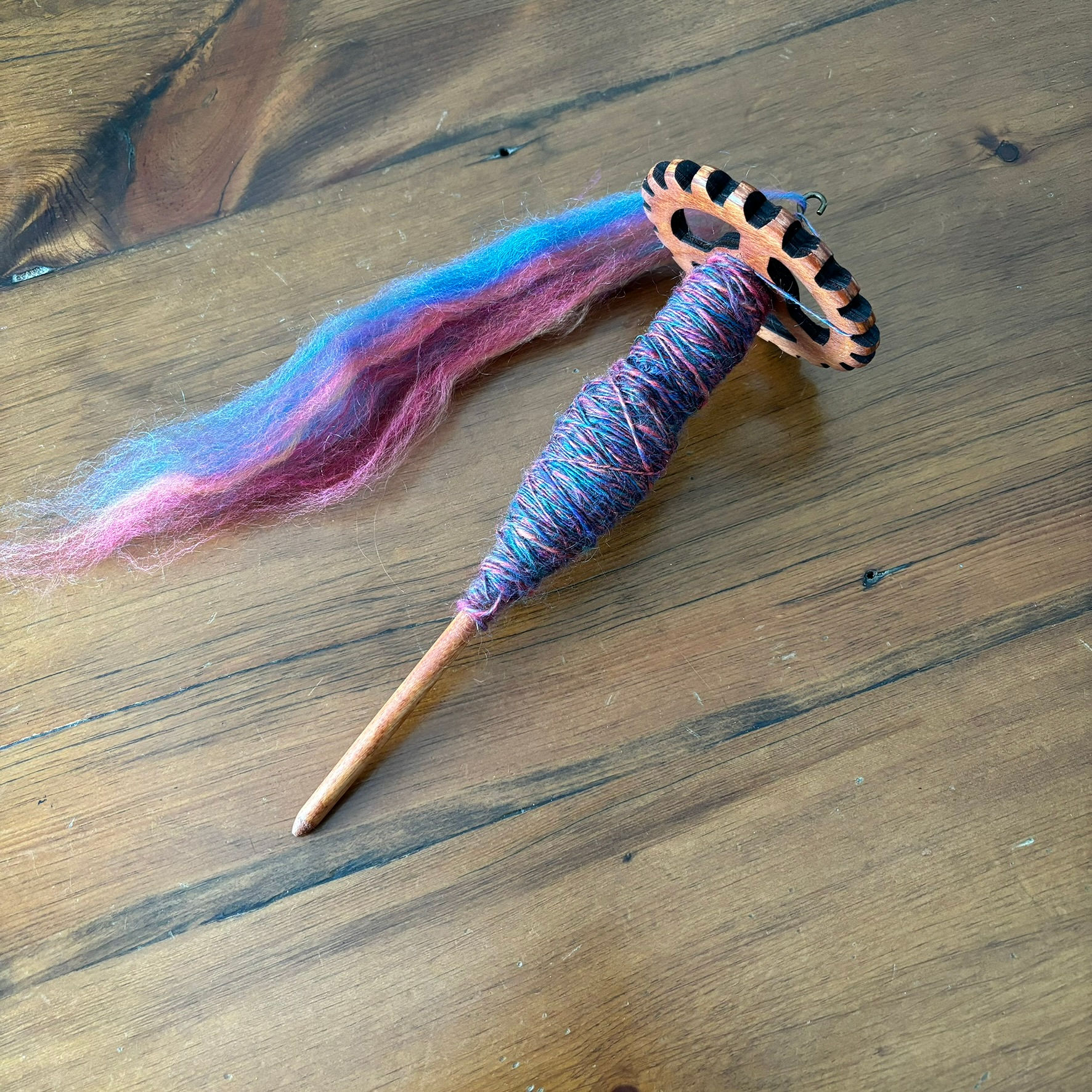
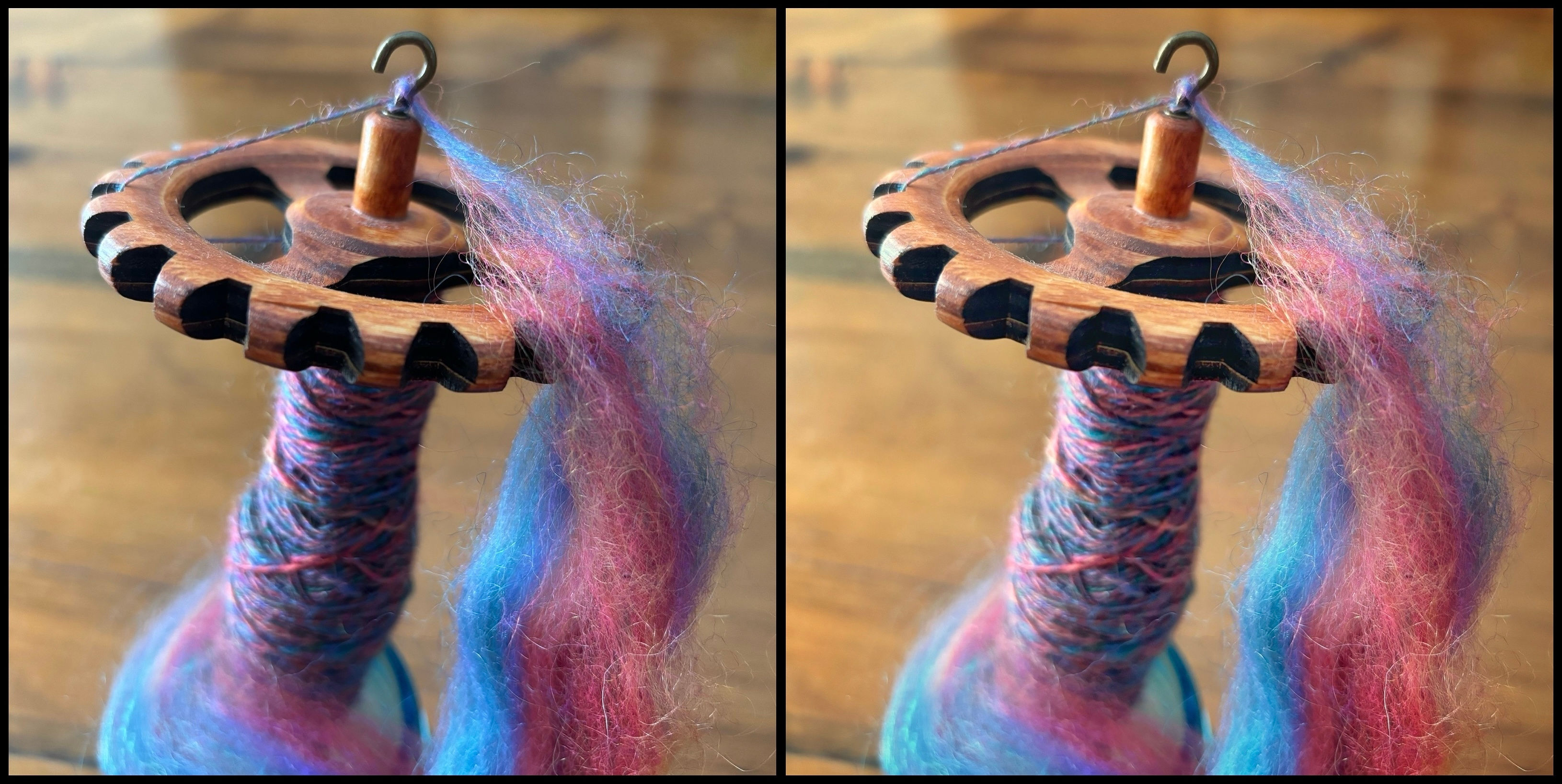
Here’s an example of me finding the story I wanted to tell. First photo, basic spindle and wool. Not very interesting.

Drop spindle with blue and purple handspun yarn on wood background.

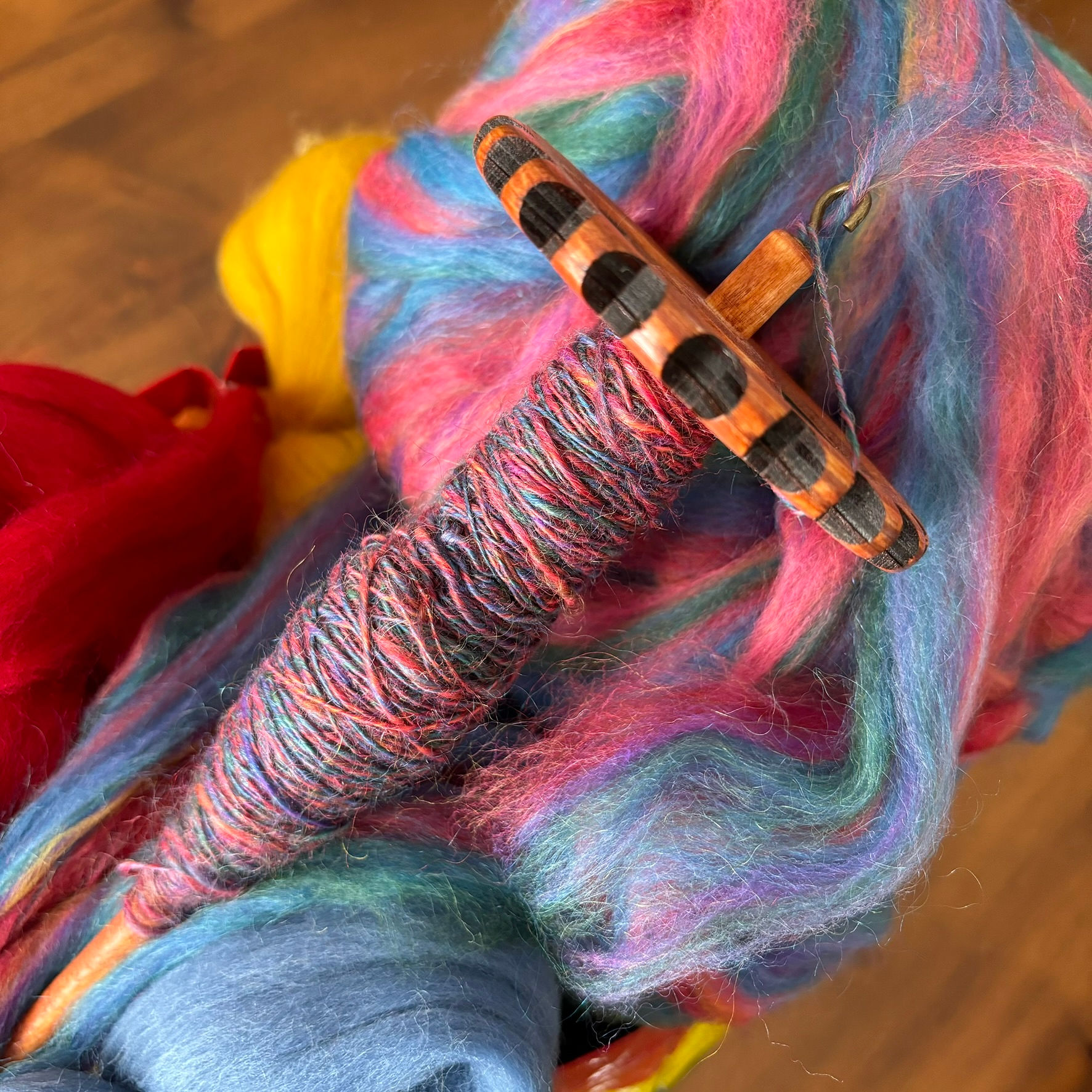
What if I added some fibre to flesh out the photo? Nope, too busy. Background is distracting focus from the subject.

Drop spindle with blue and purple handspun yarn on wood background.

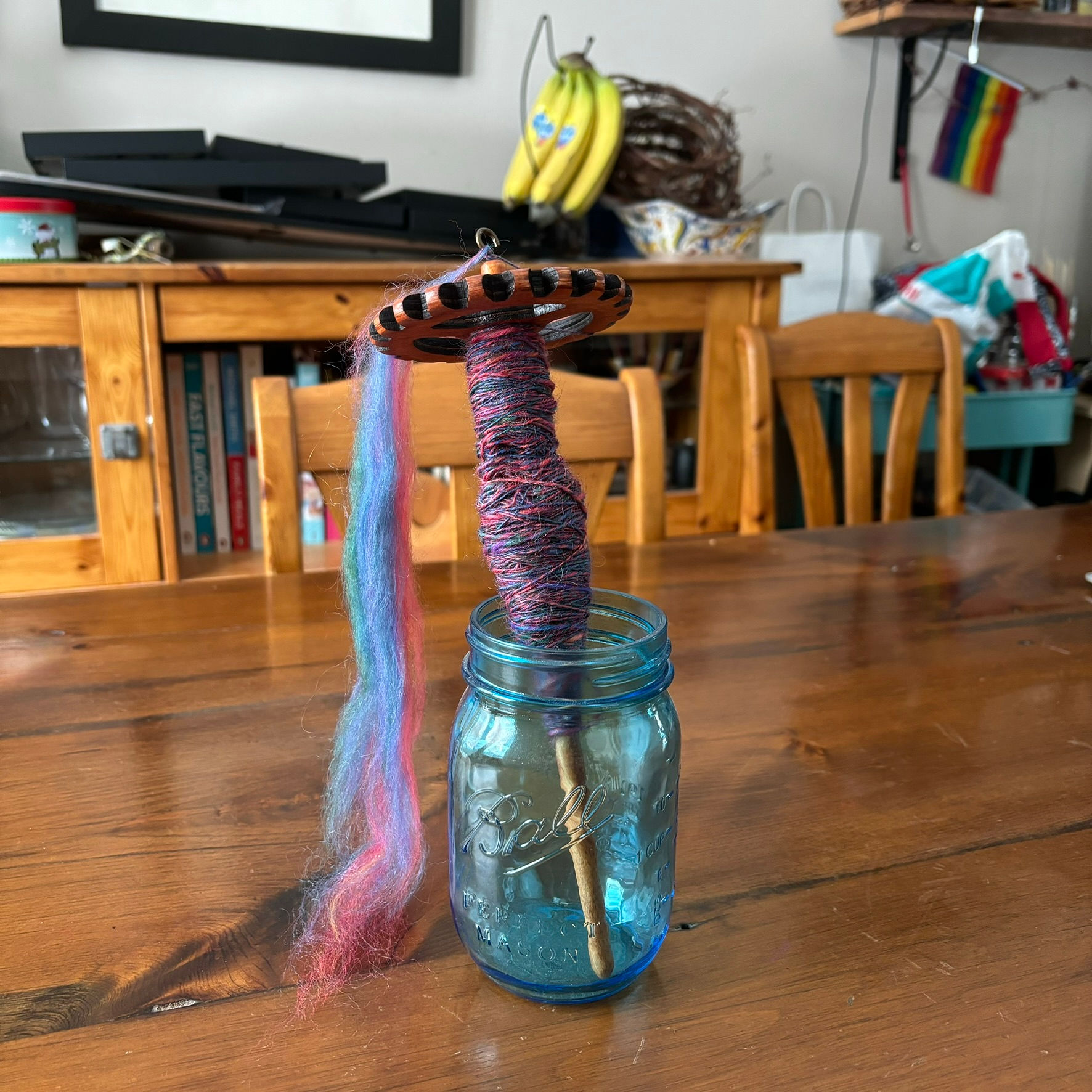
I love this blue mason jar. I could use it to stand the spindle up for a better angle. Except the background is too cluttered.

Drop spindle in blue mason jar on wood floor.

I’ve zoomed in and am playing around with the perspective.

If you’re making photos for an Etsy or other online shop, think about setting a mood with props and building a little tableau. An old piece of barn board and some cream linen evokes a sort of farmhouse chic mood, where a cup of coffee and an aloe plant set more of a lifestyle vibe. Just keep in mind that you want accessories to compliment your subject and not compete with it.

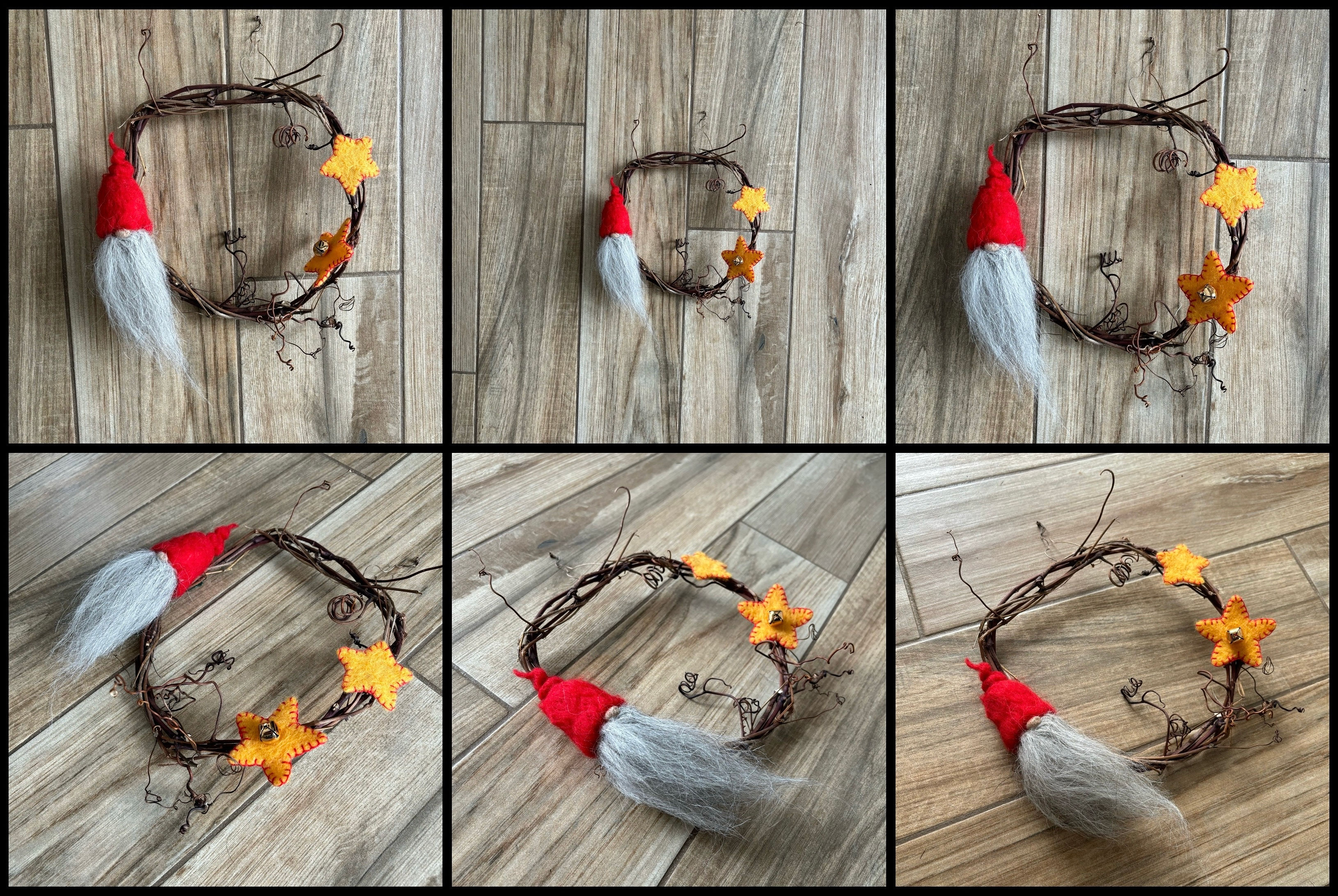
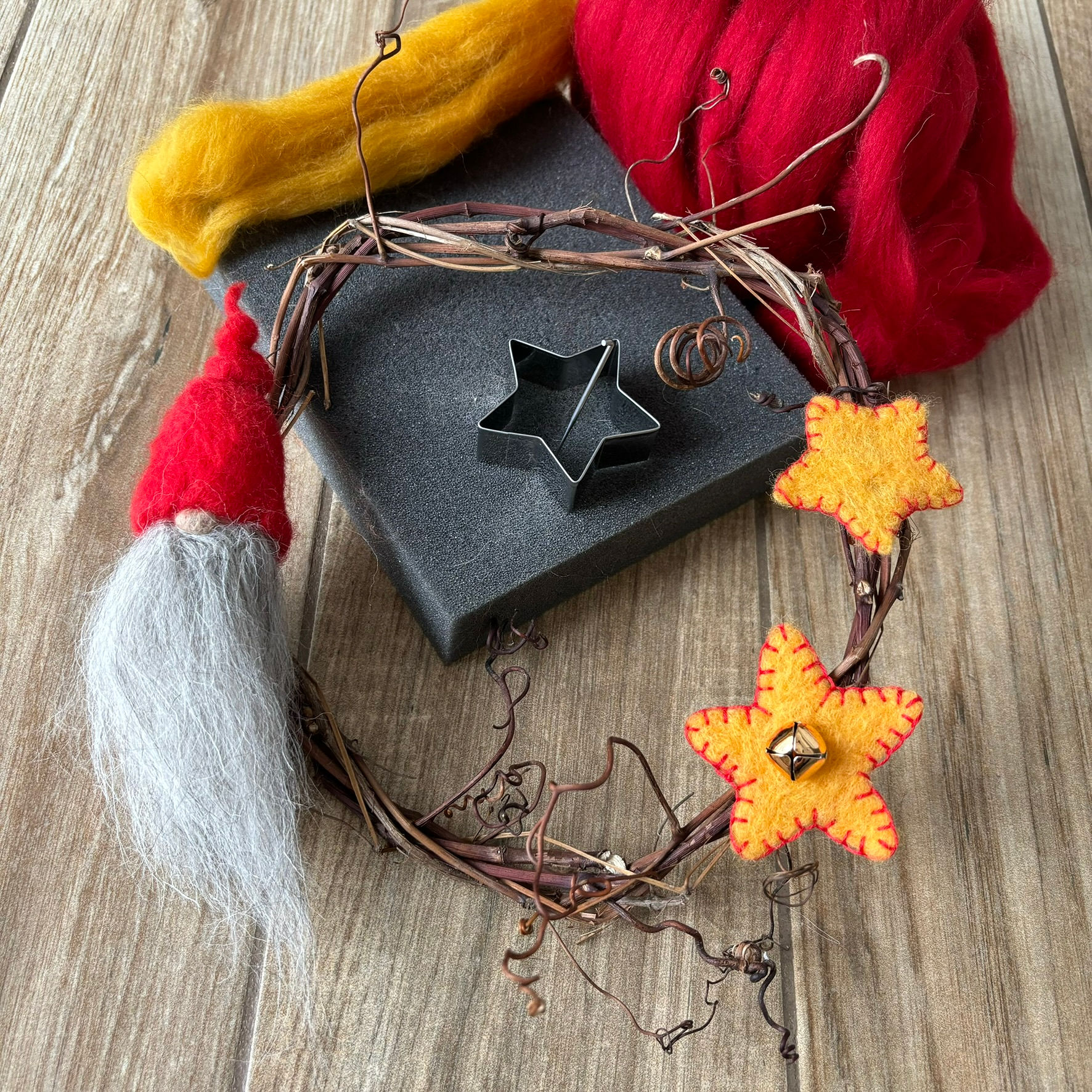
This is my kitchen floor, after a quick swipe to remove crumbs and pet hair. The first thing I noticed in the first photo was the seam down the middle of the wreath, which is a distraction. I played with the angles a bit but didn’t love any of these.

Collage of different photos of Christmas wreath on wood background

I pulled some loose wool and tools in to tell a bit of a how-to story. I liked that much more.

Collage of different photos of Christmas wreath on wood background

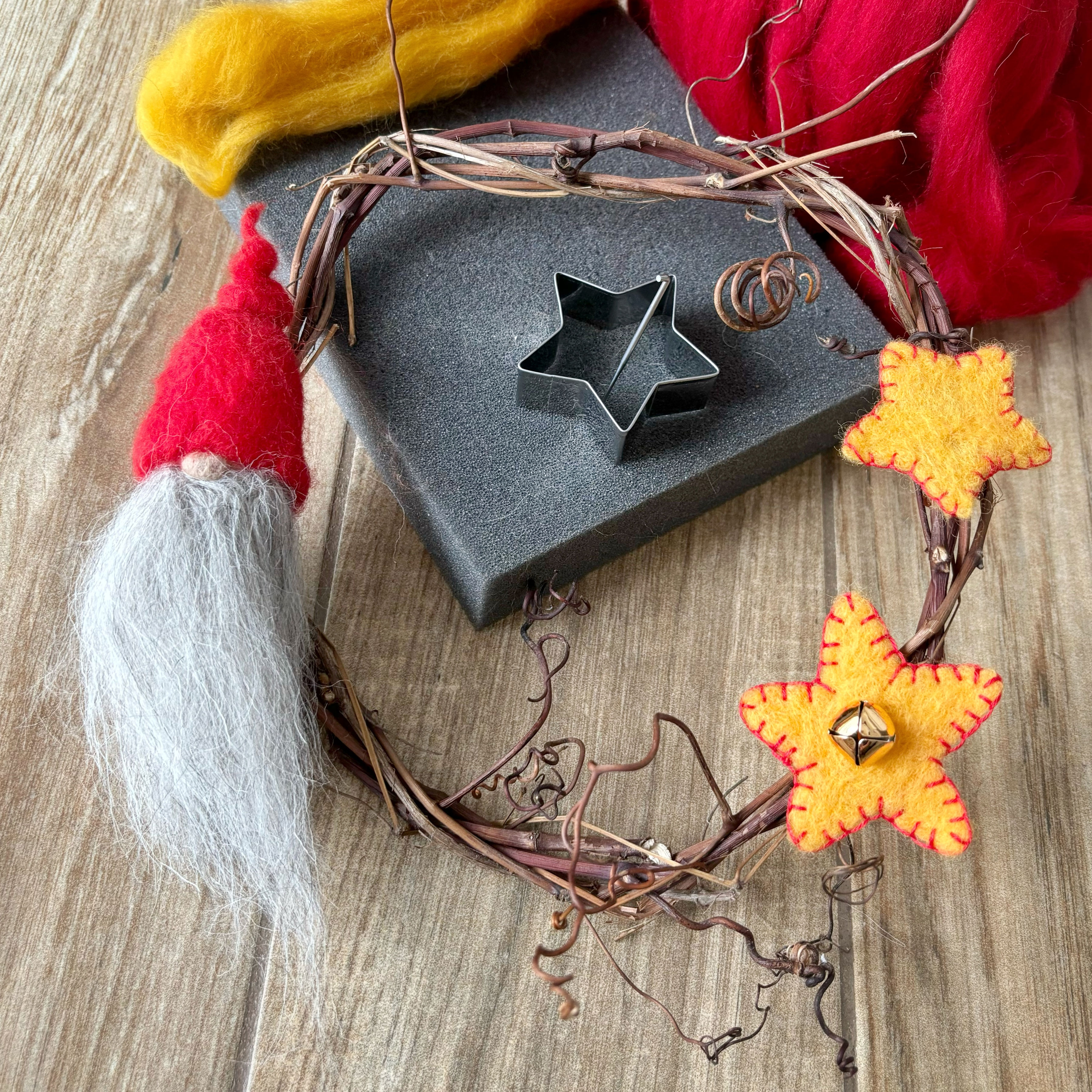
These last two photos show the difference editing can make. The first is straight out of the camera.

Christmas wreath with gnome and two stars on wood background

The one below has been edited for brightness (more), ambiance (more) and a slight rotation and crop to cut out the bit of gap at the top right to keep the viewer’s eye in the frame. Bright spots and colour will draw viewers’ attention, so use them deliberately.

Christmas wreath with gnome and two stars on wood background

I don’t like that I cut out a bit of the tips of the curly bits of grapevine, and I would have liked the gnome closer to the ⅓ line, and that the top of the felting needle doesn’t reach over the cookie cutter. But, if I don’t stop playing with this and get it to Ruth it will never get published!

Digital cameras love averages

A camera’s sensor pulls everything toward average, so it makes a bright scene more dull and a dark scene more light. The more dark the camera senses, the more light it tries to bring in, and vice versa. But on a sunny winter day, we don’t want it to turn all our lovely white snow to grey, and we don’t want it turning the closeup of our lush black felted hat to a murky grey either. Be aware of this and use the Brightness or Exposure setting in your editing app to make your whites bright (but not too bright!) and your darks proper dark.

There are three basic edits that will significantly improve most photos. In Snapseed, all three of them are under “Tools” (at the bottom) then “Tune Image” at the top left. 

Swipe down to find Brightness (I often lift the brightness a bit since I am usually inside where the light is dimmer), Contrast (a touch more contrast is often pleasant), and Ambiance. I love the Ambiance slider. I’m not entirely sure what the special sauce is, but it’s mostly mid-tone contrast, and it makes colours pop. Just a little swipe to the right is often enough to give you a lovely bit of extra magic.

Screen shot of Ambiance under tools in Snapseed

Here’s one of the photos from the series above straight out of the camera (left) and edited (right). I tweaked Shadows (less) , Ambiance (more), Contrast (more) and white balance (warmer). We’ll talk more about white balance in a later post.

Comparison of photo before and after editing in Snapseed.

So that’s my introduction to making the most of smartphone photography. First, think about the story you want to tell. Next, compose your image thoughtfully, and pay equal attention to what you include and what you exclude. And finally, give it a little polish with a photo editing app. But not too much!

Next time we’ll talk about the number one most important thing that can make or break your photos.

Forest Floor Landscape Completed

Forest Floor Landscape Completed

Finally, I hear you saying. I have finished the forest floor nuno felt landscape that I have been working on since October.

Nuno felt landscape of the forest floor with leaves pinned in place.

I pinned the leaves in place and hand stitched them down. I also did a bit of trimming on the leaves that were further back in the landscape to give a feeling of distance.

Nuno felt landscape of the forest floor with leaves stitched in place.

Here they are stitched in place. I also added a few bits of darkness to leaves that were partially in the shade. I used a green felt tip pen for this.

Nuno felt landscape of the forest floor auditioning cut paper flower placement.

And next, I auditioned flowers. Those of you who are felt purists, look away. I cut the flowers out of sketchbook paper. I think the contrast between the smoothness of the flowers and the matte fuzziness of the felt leaves make the flowers stand out more. Then I needed to make sure the flowers on the left were in the shade so I used a bit of Payne’s Grey watercolor to create the “shade”.

Nuno felt landscape of the forest floor with stitched yellow centers in cut paper flowers.

The flowers were stitched down with French knots and wool thread. The flowers on the left have a bit darker yellow than the ones in the “sunshine”.

Nuno felt landscape of the forest floor completed and laced to backing board with dark brown fabric.

I even got the piece stitched down to the background matte fabric and laced around a piece of matte board. So it is ready for framing, Yay! I have decided to call this one “Sunlit Dance”. Not sure what is on the agenda next but perhaps I should think of something to cover for the first quarter challenge.

Forest Floor Continues

Forest Floor Continues

In my last post about my forest floor piece, I had gotten to the point of cast shadows from the rocks.

Nuno Felt Background with appliqued felt rocks and sheer fabric cast shadows stitched in place.

When you look at this, what is missing? More shadows. So I needed to add the cast shadows from the trees.

Nuno felted landscape added dark blue sheer fabric for cast shadows from trees.

So I added more blue sheer fabric to cast the shadows from the trees. Suddenly, there’s another glaring ommission (Antje pointed this out in her comment on my last post). The rocks on the left need to have shadows cast on them by the trees. So more dark blue sheer fabric is needed.

Nuno felted landscape added dark blue sheer fabric for cast shadows from trees over rocks.

Ah, that’s better. You can really see the sun shining through the trees now.

Nuno felted landscape, scraps of green felt in foreground auditioning for leaf colors/values.

Next up is leaves. The leaves on the left need to be in the shade, thus darker and more grey blue. The pieces of felt scrap that I originally found was not going to be enough.

Nuno felted landscape laid on table in workspace/studio.

So I searched for more felt and found a neutralized green that should work. Here you can see my messy workspace while I’m working. Other projects that are in process are on the back of the work table.

Nuno felted landscape added cut leaf shapes over foreground area.

Here’s as far as I have gotten. I need to change out the leaves on the upper right as those are too bright in the shade of the tree. I may use some ink or paint to tone them down or I may just cut out more leaves in the neutralized green I used on the left. Then on to the flowers. I will need to find some light grey for the flowers on the left and brighter white for the flowers in the sunshine. Getting close to the finish now!

Dog, Edgar, in shoveled snow paths.

And just for entertainment purposes, here’s my dog Edgar in the big snow we had last week. The snow is almost as tall as he is and he’s decided that he doesn’t need to go wading!


Forest Floor Update

Forest Floor Update

I have continued to make slow progress on my forest floor piece. Since I showed you last, I have stitched down the rocks and added some shadows.

Nuno Felt Background with appliqued felt rocks stitched in place.

I decided on the final rock placement and then stitched them in place. I moved the rock that is now on the top right over from the left since it was much lighter. This reinforces the feeling of the light shining from behind the trees. Once the rocks were stitched in place, I decided they needed a bit more definition as they kind of looked like potatoes to me.

I remembered a book about nature journaling that I had checked out from the library by John Muir Laws. I decided to look him up online to see if he had some information about drawing rocks. I found a wealth of information on his site about drawing in nature. If you would like to improve your drawing skills, this is an excellent resource.

Photo of forest floor piece with tracing paper and rock shadows sketched in with pencil.

I took the photo from above and printed it out. Then I used a piece of tracing paper to sketch the rock placement. Then I used hatching techniques to give some shape to the rocks. These aren’t specific rocks. I find it much easier to draw/sketch when I have a photo of what I am trying to draw or I can look at a specific rock or landscape. But they look more like rocks than potatoes now.

I decided to use the same blue that is already in the nuno background for the shadows. That would tie all the blue bits in as shadows and move the blue over on to the right side of the composition too. I used a straight stitch to do the “hatching” on the rocks using #12 Sulky cotton thread. Once those shadows were in, I knew I needed to add cast shadows from the rock on to the ground. So I brought out my navy blue sheer fabric to create some cast shadows.

Nuno Felt Background with appliqued felt rocks and sheer fabric cast shadows stitched in place.

Here’s the piece after adding the sheer fabric around the rocks. I stitched the sheer fabric down with #40 machine thread with tiny stitches. Now guess what? I need more shadows in front of the trees. It’s always funny to me that I am working along and when some shadows are added, I can immediately see that I need more. So the next step is more sheer blue fabric to add the cast shadows from the trees. Then I will begin adding more leaves and the white flowers so that it will resemble my original collage below.

Paper collage of landscape of forest floor, white flowers and tree trunks in the distance.


Mark Making on Felt – Online Class Registration Opens

Mark Making on Felt – Online Class Registration Opens

Would you like to learn new methods of “mark making” on your felt? Are you looking for ways to create work that is uniquely your own? Are you wondering about surface design on felt? If you are looking for a new learning experience, please join me. Registration opens today for my online classes! The classes are listed below with a link to each class page.  You don’t need to be present at any certain time to participate in a class and you will receive PDF’s to keep with all the relevant information learned in the class.

Screen Printed Felt Journals by Ruth Lane

All four modules of my class, EMBELLISHING FELT WITH SURFACE DESIGN TECHNIQUES – A MIXED MEDIA APPROACH, will begin on January 12th  and end on February 23rd. Registration opens today for these online classes. Click on the class link below to register for that particular class.

Nuno Felting with Paper Fabric Lamination

Experimental Screen Printing on Felt

Free Motion Machine Stitching on Felt

Printing, Stenciling, and Playing with Thickened Dye on Felt

Click on any of the links above to find out more about the class and to register and join in the fun.

Our Wet Felting for Beginners class is always available. You can start any time and follow along at your own pace. Register here.


Happy New Year!

Happy New Year!

Happy New Year to you all from all of us at The Felting and Fiber Studio.

Antje thought it would be fun if all of the cards from the card exchange could be brought together into one post. Some people have already posted about their cards and others have not. This way, you can see all the creativity in one post. There were 14 of us that decided to participate in the card exchange this year. Ann M. randomly chose partner’s names and we created a “card” that could be holiday themed but didn’t necessarily need to be.

Carlene and Ruth exchanged cards.

I have written about making the card for Carlene here.

Carlene explains about making my card here: In September and October, I collected some birch bark with the idea of trying to make something out of it.  I watched a number of videos on YouTube explaining how to collect and process birch bark.  I was particularly inspired by this video of Pat Kruse: Birch Bark Artist (https://www.youtube.com/watch?v=84JyLNUDXz0).  In the video there were some amazing motifs that were cut out of birch bark and sewn into a picture.  So I decided to try a simple flower motif and sew the stacked pieces together.  I also opted to add a felt backing for additional support and to give me something to sew clips to the flowers.  This would allow the flowers to be used as hair adornments or clipped onto a lapel.  Sewing through the bark was not too bad, though I did end up with some tearing.  And the back of my pieces were not very neat.  But the fronts looked OK.  Sewing on the clips was harder than I expected. I also applied a thin layer of white glue to the front of the bark to create a clean and shiny surface on the finished flowers.  The next challenge was mailing them.  I clipped them to a post card and put them into a plastic container to protect them from getting destroyed by the postal service.  It was an interesting experiment and I look forward to collecting more birch bark next summer and trying to make something larger.  (Those YouTube videos show some amazing projects.  But you need a good supply of high quality bark for those.)

Leonor and Helene exchanged cards.

Leonor’s post about her knitted card for Helene is here. And Helene’s post is here.

Karen and Caterina exchanged cards.


Karen explained her process in making a card for Caterina here. Caterina is writing a post for early January but gave me a bit of information about her card:

Firstly, I wetfelted a bigger abstract piece of nuno felt, using an upcycled piece of silk and viscose fabric in winter colours, merino wool, merino prefelt and upcycled yarn. I cut it into the right size for my card, choosing a part that I liked and felt meaningful. I was thinking about an abstract landscape or mindscape in winter colours for my card cover or first page. I felt it would “open the conversation”, kind of state the setting and also be recognisable as sent by me, and so prepare for the ” friendship message” in the second page.

To compose my second or inner page, I printed and marked some upcycled fabrics in white and pale blue with dyeing inks in blues and black and greys. I cut some of the printed fabrics and composed a collage of fabrics on a dark grey fabric background (a sample furniture fabric) with a dahlia flower. I added a scrap of the silk fabric used for the nuno felting of the first page of my card, and hand stitched it all together with different types of stitches, aiming to encourage a suggestion of stylized flowers and snow. The stitches helped to define and enrich the abstract marks on fabric, and also to attach the fabrics together in a less apparent way. I used white french knots to suggest snow coming from clouds above (the silk fabric looked a bit like clouds to me.). My message was a friendly offering of flowers in a winter landscape symbolising the Christmas season.

Ann and Lindsay exchanged cards.

Ann explained her proces for her tree card here. Lindsay writes about her process:

I decided to send Ann a sheep-themed card, given that she’s a shepherdess. I laid out a thin layer of merino and silk prefelt with some moody sky grey/blue merino inclusions. I then added some sheer silk, recycled from a dress I bought in a charity shop, on the bottom section, to give the impression of a hillside. When that was felted and dry, I ironed it and then heat printed a tree and two ewes that I’d adapted on photoshop to fit to scale. I hand stitched some glass bead ‘baubles’ onto the tree and a tiny metal star on the tree top. Using double sided tape I set the piece into a tri-fold card and wrote ‘Merry Christmas two ewes’.

Lisa and Capi exchanged cards.

Lisa explains about her Christmas tree card here:

I made my Christmas Card for Capi, based upon the old fashioned version of a boxed card. (The ones that were 3D, padded cards that came in a box).  It was decorated with little bells as the baubles, and some hand spun yarn for the garland. I inserted some fairy lights through the felt and put the controls under the snow, seen on  the first photo. The box frame can be opened from the front to access the light switch. It’s gone off to Capi, and I received hers yesterday.  I was blown away with Capi’s creation, put me to shame! But I hope she likes mine. Lisa reports that Capi based her card on her favorite scene from Hilton Head Island.

Jan and Marie exchanged cards.

Jan explained her process for the moose card here. Marie sent Jan a tree card:

My card was made from silk paper with some felted Christmas trees. The trees were machine stitched down, and I hand stitched some beads to one of the trees, and glued 2 small swarovski crystals to 2 trees and sequins to the rest (could not find my other crystals). The silk paper is in white, blue, wintery colours to indicate cold, snowy or frosty area. I have attempted to add a felted moon also. I attached the silk paper to some stiff art paper, and added a greeting on the back. I secured both with a close zigzag stitch around the outside edge.

Tesi and Antje exchanged cards.

Tesi talks about the card she made for Antje:

Handmade greeting card

Leftover acrylic paint used for mark making on cotton fabric is what I used for the postcard background. Then I added collage elements that I had made for my L3 Stitch course monocratic color scheme. I used green mixed with black, white, and grey and then used stencils with my gelli plate to pull the prints. When I got all my collage pieces added, I put a light coating of Matte Medium over the top of it and let it dry overnight. Then I added some sturdy interfacing to the back, stitched a couple of lines through it, added some backing fabric to cover up the stitching and zigzagged around the edges.

Antje writes about Tesi’s card:

DESIGN – My thinking process is like percolated coffee….it has to filter through the layers, and usually involves a few doodles along the way!

So ‘Christmas trees with stars on their top’ was my starting point becoming….Individual star topped trees triangular in shape – But trees are not all the same shape! – What happens if they all lie down with tops and stars to the centre? – Mmm, looks like a cut tree trunk – A tree has years of growth rings – Mmm, rather like us, all individual, with years of experience/knowledge, together forming a tight group around a central interest….and the idea was born (and doodled)!

PRODUCTION – My exchange partner, Tesi, I knew was a whizz at quilting and that stuck in my mind, although I knew I would definitely not be quilting as such! Instead I gathered a variety of cream/neutral fabrics, many were small off-cuts or snippets (that I always save) which I layered with Bondaweb to a thin background fabric. After simplifying the design, I then cut various triangles and machine stitched them to a background fabric, to which I had attached an off-centre golden circle. Once attached I hand embroidered the growth rings.

RESULT – Togetherness.
Unfortunately, in my haste packing for a few days away, I only took a quick photo of the card and envelope (so the image is blurred).

I did however pack the same collection of fabrics and paper to create some smaller versions, balancing them on my lap! They currently remain WIPs….I was having too much fun!

I hope you have enjoyed all the cards from our talented and creative group. We wish you all the best in 2024 and hope you have a creative year!

Winter Solstice

Winter Solstice

I don’t know about the rest of you but this time of year seems to move a bit too quickly. There are always extra things on my to do list during the holidays. Then this year, the football games I attend have been extended way beyond the normal season. The University of Montana Grizzly football team has made it into the national championships.

All of this to say, that I haven’t gotten much done on my forest floor piece that I showed you before.  So my post this week is going to be a bit short on fiber art content but I hope you will forgive me.

Nuno Felted Autumn Background with two felt tree trunks and stitched cheesecloth "moss".

Here’s my progress on the forest floor piece. I have stitched down the trunks and the cheesecloth moss. Next up, is to work more on the foreground rocks, and add leaves and flowers.

Since this post is publishing on the Winter Solstice, I thought you might enjoy a poem about winter.

THE SHORTEST DAY BY SUSAN COOPER

So the shortest day came, and the year died,

And everywhere down the centuries of the snow-white world

Came people singing, dancing,

To drive the dark away.

They lighted candles in the winter trees;

They hung their homes with evergreen;

They burned beseeching fires all night long

To keep the year alive,

And when the new year’s sunshine blazed awake

They shouted, reveling.

Through all the frosty ages you can hear them

Echoing behind us—Listen!!

All the long echoes sing the same delight,

This shortest day,

As promise wakens in the sleeping land:

They carol, feast, give thanks,

And dearly love their friends,

And hope for peace.

And so do we, here, now,

This year and every year.

Welcome Yule!


Happy Winter Solstice to you all and all the best in the new year!