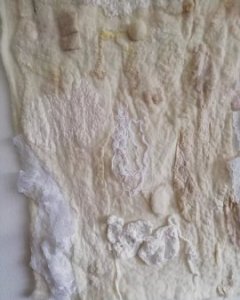
I wish to show you my last abstract piece: I am quite proud of having included free crocheting and free knitting bits and of having gone bigger than my usual size, all things outside of my comfort zone that were inspired by other artists’ and crafters’ works.
“Good girl bad girl” abstract felt painting, around 80 x 50 cm.
It was about experimenting with felt without the distraction of colour, and I decided to use undyed or white and whitish materials, so as not to distract my eye from the final purpose. This made me think about “lack of colour” and “white” in terms of emotions and morals: how you are not supposed to show a lot of true emotions if you are a “good girl”, how the colour white has been linked to “good” in certain cultures, how silence and demure behaviour (not showing your colours) had been linked to “good behaviour” in such cultures.
So, this has made me think about what “good girl” and “bad girl” meant when I was growing up, and how problematic those concepts have become for me in time (and have been even then). This led to me choosing specific fabrics and fibers, and techniques to add to the piece. So, I guess, concepts and techniques called one to the other from the beginning of my project and I can’t say which came first, if ideas to express or techniques to try.
I thought of the piece as layered, as our life experience and identity are layered, and being a “good girl” or “bad girl” is not something straightforward either. So, firstly I made a layer of felt to go over a pre-felt background.
But how to make the surface layer? I remembered about the layout for cobweb scarves that had been suggested in the Felting and Fiber forum, the one that is made by tearing a long length of merino tops and then carefully teasing the whole length open: I wanted holes and different thickness on my surface layer of felt, so I went for that type of layout for it and it worked very well.
Laying out my natural white merino wool on for the cob-webbish upper layerHow the cob web layout progressed
The surface layer was embellished with undyed locks, undyed white eri silk fibers, scraps of undyed habotari silk, white flax, and silk carrier rods. Its shape is very irregular and there are vertical holes from which one can peek at stuff underneath. I liked the fact that it’s not one single white, but many different shades of undyed natural white and of bleached or optic white. Even stretching the idea of “white” a bit to include cream and beige even.
I added a natural-fiber net that I got from my grocery shopping, and on the background strings gotten from labels of clothes and scraps from a cotton handkerchief, to remind me of all the mother-work wife-work women-work that is the “good girl” ‘s lot in life.
An overview of my upper layer layout with all the embellishments before feltingSome of the embellishments that I added on the merino wool : you can spot the vegetable carrier net, locks and a silk carrier rod.An habotai silk scrap and some locks on another part of the upper layer merino layout before feltingIn various areas I used the embellishments as bridges over the holes between the merino wool parts, so as to link all the parts together.
I lightly rubbed it and then used the sander to be sure that all the bits could stay firmly in place. I did not want it felted firmly, and I rolled it only a few times in two directions, horizontally and vertically. I washed it and left it to dry.
This wet prefelt of the upper layer does not seem too exciting, yet, but the holes seem just right for what I want to do.
In the meantime I prepared the background layer, with 3 layers of undyed merino wool in a simple horizontal-vertical lay-out. I rubbed it and rolled it a few times, leaving it at the pre-felt stage. I washed it and let it dry.
On the second day, I combined the two layers, that were mostly dry, and all the other embellishment elements.
I laid out the two prefelt irregular layers on my carpet to have space to work on them and add all the sewing.
I wanted to explore what it used to mean to be a “good girl” and to make mistakes and be a “bad girl”, so on the background and peeking through the holes I placed different things that had been linked to women’s craft and life, including commercial lace, scraps from a child’s wool vest (mothers always used to make their kids put their vest on underneath their shirts) and different fibers and yarns, and strings (women forever tying and untying shoes clothes bags families).
A detail of some of the embellishments that I added to the bottom part of the artwork: strings and lace and scraps of an old merino wool baby vest.
On the background, like alpha and omega at the top and bottom, I also wanted “wrong” (but free) crocheting and “wrong” (but free) knitting pieces, and the making of those was an experience in itself, as I found very hard to let go of purpose and of “perfection”, especially in the knitting. I used a cotton yarn for the crochet and a mixed wool yarn for the knitting, as those two types of yarn are most closely related to those crafts to me. I have to say that I quite enjoyed the free crocheting and I maybe will use it again soon, whereas I doubt that the freeform knitting will become a favourite of mines!
My “wrong” knitting at its very beginningMy foray into free form crocheting
The irregular shape of the crocheted embellishment quite pleased me.On the top, the knitted embellishment is waiting to be sewed fast and then felted into the artwork.
After placing all the elements where I wanted them to be, I hand stitched them in place with a few hidden stitches each, starting from the top and the outer edges towards the inner parts and the bottom. It took me a bit, but it was essential, as I was much more confident that nothing was going to move when I went on with the following wetting and sanding and rolling. I hate hand sewing, but this time I felt that it was worthwhile!
I washed and dried the piece, and then waited to see if anything else was needed: I often find that I need to let the work get washed and dry out to be able to see what is not fine yet! In fact, I found that the merino wool vest scraps had not quite felted in as I wanted them to do, so I decided to needle felt them with a bit of added merino wool top fiber. This gave me the itch to add a few needle felted 3D shapes, vaguely organic shapes that are a symbol of the “good girl” sense of her body.
A needle felted sphere shape seemed also a good ideaI added some needle felted organic shapes
I really liked the journey and I think that the piece says what I wanted it to say. Moreover, I enjoyed trying new things in making it, and using those techniques in an organic way to express a world of meanings and experiences that I hope will find resonance in the viewers.
Some of the embellishments on the finished artwork upper partLower left of the finished artworkThe upper right corner shows clearly the two layers of feltThe laces have not really felted in, but I was not expecting them to: it’s synthetic commercial lace, so I make sure to sew them to the felt quite well.
It’s me again, a beginner felter, a novice in knitting and crocheting
(have I told you the story of my then-boyfriend’s knitted scarf? the one that kept getting longer and longer the more he used it, and his mother, an accomplished knitter and crocheter who knits a new woolly jumper for my kids each Christmas, kept undoing the last bit of the scarf and fixing it? well, he is my husband now, it goes to show that even disastrous knitting is useful…)
no skills in weaving, BUT I used to do quite a bit of embroidery, and that’s how I began my adventure in textiles, so I better tell you a bit about it.
I started with cross-stitch as a little girl (maybe 10-11-years-old) at my local Parish: an ex-teacher of Feminine Skills at schools (yes, she was that old that the subject existed with that name when she used to teach) had accepted to run a class of basic embroidery stitches for little girls at the Parish, with the aim of having a few of them join the Parish group of embroiderers who would sell their works for charity once or twice per year at the Church. She was a spinster, with loads of nephews and nieces to dote on, and she was prim and welcoming: we addressed her as Miss, Signorina in Italian, ate the cookies that she brought as treat, and loved her. My mum accepted to send me only if I promised not to lose my time and sight on finicky embroidery, and at the beginning it seemed that we were making quite small designs, such as cross-stitch butterflies for cards, or a grass stitch embroidery on a cotton bag that was supposed to hold bread.
I have kind of disappointed my mum during the following years: the idea of painting with thread caught my fantasy, and I started spending more and more time (sometimes secretly) embroidering, especially cross-stitch. Miss and the group of local embroiderers were an oddity like myself, all guiltily enjoying together an outmoded craft while chatting away a few hours. My schoolmates were half in awe of my skill and half disbelieving that I could spend so much time on that.
In time I cross-stitched a lot of things, cushion covers, cards, bathroom towels, tablecloths of various sizes (never the big ones, though) and place mats and runners, babies’ bibs, alphabet samplers and Christmas decorations… I loved the fact that you could achieve marvelous paint effects just with thread and a wise design. I also liked the idea of following a pattern, and the repetitiveness of the cross-stitching itself, that helped me calm down in difficult times and made me happier.
I used to have a subscription to two main Italian magazines that were my inspiration:
one is the monthly “Le idee di Susanna”, skewed towards cross-stitch, but with loads of practical crafting ideas around it, and also a bit of knitting, crochet and sewing thrown in to entice you to more. See it here if you are curious.
the other was a magazine about any kind of embroidery, especially the free stitch types of hand embroidery, it makes you dream about the highest skills of the ancient embroiderers and the top modern ones, and had been published since 1929. its past issues of the Sixties and Seventies were more practical, with knitting and useful sewing, and are still traded online by crafters. Unfortunately, it has gone downhill very quickly around the 2010 after being sold to a new publisher, and I can’t seem to find any recent issue, so I guess it is not active anymore. Such a pity, but I guess I could sell my old issues for a good price in a few years! See some of its cover images here.
Most of what I embroidered and made in those years was sold for charity or gifted to friends and family, and there weren’t mobiles to take a quick photo, so I do not have much left of them. Not because I am particularly generous, you know, it was just safer not have all those proofs of my not-studying lying around the house… Anyway, I did not need twenty baby bibs, but they were all so cute that it was hard to resist when my nephews were arriving… Oh, well, some of the bibs actually came back to me when my kids were coming in turn, so.
Here are just a couple of bathroom towels that I cross-stitched for myself when I started getting serious with my then-boyfriend (way after the longest-scarf-of-all-times): I have the photos only because those were on linen, and thus light enough to come with me when we moved from Italy to England. I loved cross-stitching on linen or cotton-linen blends: slower, but the final effect is so neat and lovely!
(I apologise in advance for the fact that none of the things are properly ironed or pressed: those are all things that I fished out of drawers as they were, and I can not face the iron at the moment, please forgive me!)
Cross-stitch embroidered towels with a blue pattern.Detail of the blue cross-stitch pattern: it repeats itself three times to achieve the right length.I always like a neat cross-stitch back.Pink roses cross-stitch towels.Detail of the pattern: you can see that the rose is the unit repeated to achieve the right length.I noticed some humidity stains on the towels (that’s how much we use them!), so those are now getting their duty time in our bathroom!
We have some more cross-stitched towels in storage boxes in Italy, to gather dust there, along with a few other embroidered things. Here are cross-stitched place mats that I embroidered on an ecru linen-cotton blend fabric, that we use as breakfast place mats. I embroidered the edges with the simplest point-a-jour: I am not really a fan of making point-a-jour, but I like having my edges neat and hate hand-sewing even more!
Cross-stitch place mats and napkins for our breakfast.Detail of the place mat and napkinA view of the a-jour that borders the whole mat and napkinI always check my backs!
During my University years I started improving my free-stitch embroidery skills, and could not resist a forage into the variety of embroidery stitches that I was seeing on my magazines. Firstly, just learning about patterns and stitches, I soon started to use elements from books and magazines and adapting them to my needs and taste to create new things. Lately, I created a couple of things completely to my own designs. Here again I am afraid that I do not have much to show, because most of my creations were gifted to special persons or are in storage boxes in Italy at the moment. One day we will get all our stuff out of storage, who knows.
I only have three examples of my free hand-embroidery to show you: two of them, bathroom towels and a small tablecloth for teatime, I have brought with me to England, and the third is a small curtain that I have embroidered and hand-sewed for one of my best friends, and she graciously sent me the photos during the Christmas holidays.
So, here we go.
The bathroom towels are of the finest linen and I wanted a refined effect. It took me ages to complete the complex point-a-jour of the border, but it gave me plenty of food of thought for other embroidery projects (more on that later on). The embroidery itself is white on white: my initials framed by flowers and leaves for the main towel, and a smaller version of the initials for the small towel. I am afraid that I do not know the names for the stitches in English and I am kind of hazy about the Italian names as well right now: we are talking about nigh on twenty years ago, and even then I tended to focus on doing more than on names. The design of the embroidery was taken from a book or magazine that I had, and I modified it only a bit to simplify the framing elements, if I remember correctly.
Towels embroidered with my initials, white on white.Here is the embroidery: I hope you like it.The flowers on the left of the initials.The flowers and leaves on the right of the initials.This bordering took me ages: just tell me if it was worthwhile!My fascination with neat backs goes on: I am quite happy with this one, what do you think?
As to the teatime tablecloth, we use it as breakfast table tablecloth: I like my breakfast as you may guess! and I really need something fresh and lovely for it to work, as I am not a morning person and waking up to ugliness would be too much. This is finest cotton, very lightweight and almost see-through. I designed it completely, and I wanted it quite simple and colourful. I started by edging the border: at the beginning, it was a lot of fun changing colours randomly every little while, but it was a long way to the end, I can assure you.
My favourite breakfast tablecloth: violets on a snowy white fabric.I changed threads randomly to achieve a multicoloured look for the border.
The violets were quick to embroider, I remember, just a stem of grass-stitches and the violets themselves done with different violets or white (also mixed together) in lazy daisy stitches (is this the right name? I think so, I felt very lazy for sure, I wanted to finish it quickly). The leaves I outlined with grass-stitch and chose to cover only half with satin/full stitches in different greens. I like how it feels a very easygoing and modern type of tablecloth, in the end.
Which of the violets do you like most? Number 1Number 2Number 3or Number 4?I am satisfied with the backs as well.
And, lastly, the curtain that I made for my friend. Well, that was my first curtain, so I just could not reassure my friend of the final results: she was a bit doubtful, and also more than a bit afraid of my mum’s disapproval of me “wasting my time in useless old stuff”, I am guessing.
I presented her with my idea of design for it in a secret meeting at my place: she was going to live in a terraced house and I adapted her a terraced houses outline, taking inspiration from one of the magazines, that had a very intriguing design. In my mind the idea was already taking shape drawing from my experiences with variants of point-a-jour , openwork and different embroidery stitches, but she had to take a leap of faith and trust in my skills.
We went together to the market to buy the fabric, and she sensibly opted for a mixed synthetic and cotton: after all, she would have to wash it, not I! It took my around 2-3 months to finish it and present it to her: I remember that I was so excited when she lastly saw the finished curtain!
My terraced-houses curtain. Courtesy of Alessia Fabris: 18-years-old and still going strong!All the houses are different! Courtesy of Alessia Fabris
I wanted all the houses to be very different one from the other: each of them has a different door and various windows made using different types of stitches. I made the windows all openwork, and used this as a way to practice different openwork effects. I hand sewed it completely, as I did not have a sewing machine.
I asked my friend to take photos of some details to her taste, and she sent me these:
Detail of one of the doors. Courtesy of Alessia FabrisThis door has a couple of windows on top. Courtesy of Alessia FabrisI am amazed that those openwork windows are still looking fine after 18 years of washing cycles! Courtesy of Alessia FabrisThe same house seen a bit farther away. Courtesy of Alessia Fabris
My friend reported neighbours and passersby asking for information on her unique curtain that they could see from the outside, during the first years that she lived there. I want to think that it helped her make friends there faster.
I then went on to make two free hand embroidery curtains for myself before my daughter was born: both white on white, a small one designed by me, all butterflies of different sizes and was actually a sampler of stitches and openwork. The other one quite big, an adaptation of an idea and design from a magazine, was embroidered on all the borders (apart from the upper one) with a continuous repetitive swirling pattern, all in one single easy type of stitch, chain stitch. I finished it with my belly growing and going in the way of embroidering and sewing, but I got it done, and had the help of my first sewing machine to finish it faster. Still, it took me a couple of months to finish it (I was not working, and paused most of my attendance to my second degree at University due to not being able to move.), and none too soon: my daughter was born shortly after the last stitches.
As to point-a-jour, openwork and needle lace, they made me sweat swear and tense, but I love the look of them once it is finished, so my big unfinished project of embroidery is a linen towel set with a maybe 8-in-height border (20 cm) of openwork-needle lace. I got through maybe half of it on the first towel. I guess that it must be in one of the storage boxes in Italy, although I could swear that I brought it to England when we moved, still hoping that in time I would be able to go on..that was around nine years ago! Embroidering takes too much time for my current life style!
I hope that I gave you some ideas of embroideries to try!
I am Caterina, and you probably have seen me around the Forum asking questions about felting and trying to learn from scratch and the web.
I have started felting just around the time we were all stuck at home with the pandemic, and it was a revelation, though not an instant success 🙂 I guess the other beginners here will sympathise with my struggle to get a precise idea of steps to take in order to get the magic of felt to work perfectly: I was instantly fascinated by the sheer freedom of not having a set of precise rules to follow to get there, and at the same time frustrated by so much choice of different paths to take!
I guess that it is the fact that this is based on traditional craft, and, like many crafts and women’s works, it is a fluid collection of honed instincts, oral passed wisdom, intimate physical knowledge of materials and creative whim. Like cooking, like spinning I guess, like parenting I am finding. And all those hundreds and thousands of years of crafting, I suppose: felting is so old and it shows on how many ways of going about it there are around, from before humans could leave written shape to their rules and steps.
So, I guess felting is something that you need a community of fellow humans to help you figure out, through apprenticeship, passed wisdom and experimentation: I am glad that I found the very supportive Felting and Fiber Forum community to guide me through my beginner’s steps on wet and needle felting.
My first experiments had mixed results, and all the successive tries have not changed this trend also!
My kids were very forgiving with my first needle felted tiny penguin, a misshapen thing that my son instantly appropriated and called like his younger cousin ( I am not sure what that says, I wouldn’t want to overthink it..). It is so tiny that he lost it a million times already, and I had time to curse my decision to make it so small while going around the flat looking for a squishable scrap of wool called Giorgio!
My first try at needle felting
My daughter asked for a cat: I will not go into that, it’s best left forgotten. I only have blurry photos for it, mercifully.
Is that a cat, mummy?
She lost it soonest, and is now wary of asking for more pet animals (she is very kind and well behaved and couldn’t bring herself to say “What’s that thing??” to my face, it was a gift, you know, and she had seen me poking needles into my fingers for a long afternoon).
Luckily for my kids, I then dramatically improved my animal shaping skills by using real life photos as reference and learning to change needles as my felting progresses. (I still occasionally poke my fingers, I am told that this is normal?) A Waldorf style little playmat with tiny needle felted animals ensued, and I discovered the possibilities of wet felting that really got my mind reeling.
My first Waldorf play felted mat, with tiny polar animalsA mummy and her cub for the polar landscapeThe Penguin familySurely we need seals as well?
I felt on top of the world, and decided that I could make more of those playmats with animals, and start a home-based business! The idea was not exactly new: there are several businesses selling that type of toy on Etsy, as I discovered in time! Unfortunately, it is not as simple as that: I decided that I wanted to understand regulations on selling toys in United Kingdom, and found out that I could not really make those tiny needle felted animals pass official Health and Safety regulation tests. They are just too tiny, and too easily breakable, and I like them as they are. Also, it costs to have some of tests done (you can do some of them in your home, but not all of them).
If you are interested in understanding the requisites for toys in UK and Europe, check current Regulations for Health and Safety of toys with the British Toy & Hobby Association, that is the biggest Toy Makers association in United Kingdom, here.
Other people would maybe choose differently, one could market the toy as something else, forget the labels and hope for the best, but I, on my part, would not feel comfortable with the idea, and decided to shelve the handmade toys budding business. I made only another play set for a friend’s 7-year-old kid as Christmas gift: I had other experiments to try, and wet felting to explore! More on that in following posts..
I am sure that many have had to shelve craft business idea, after discovering that they were impractical, or not profitable or not-the-right-time-for-this, or not really what their heart felt like making: I would love to hear about what those ideas were and the reasons for letting them drop. Please, leave a comment and tell us about your shelved plans.