Browsed by
Author: Marilyn aka Pandagirl

Inspiration, etc.

Inspiration, etc.

Usually, I find inspiration in nature or another artists work.  But recently I saw an ad in a department store flyer for a bedspread that caught my eye.   I kept going back to it until I finally I cut the picture out and laid it on my work table.

It stayed there for a while and I kept asking myself what about it that kept drawing me back to it.  I didn’t need a bedspread, but there was something about the colors and design I found intriguing. The design looked as if the colors were painted with a brush and there were uneven lines like paint dripping down the wall.

I was in the process of trying to come up with a design for a book cover and thought I’d use the design elements I liked in the ad for that.

I measured meticulously for the the book cover allowing for fold over sides, shrinkage, straps, etc.  With my template finished, I laid out my design.  I really wanted to emulate that brush feel, so I even used a comb to separate the fibers.  For the paint squiggles, I used mohair yarn I had dyed.

white cover layoutHowever, once it was done I realized I couldn’t use it for the cover.  I would distort the design to cut the straps.  So, plan B — a pillow.  I had a pillow form that would work just fine.   The felted piece was a little too large so I wet it and threw it in the dryer.  Perfect. But now I needed a back.

The white wool I used was more of a light cream color, so I didn’t want to make a white back.  I had enough dark blue.  Again, I wanted to try to recreate that brush stroke.   I made a smaller template and proceeded to lay out the second side.

side by sideSince the finished piece was the right size, I didn’t have to put it in the dryer.  Consequently, it is smoother than the white side which is fine.  I sewed the pieces together and now I have a reversible pillow with two different textures and looks!

pillow front


pillow back


The brush stroke design wasn’t exactly what I wanted. The felting process tightened up all my careful combing, but I learned a lot and will try again.

I really liked the dark blue color and  wanted to dye some new thick and thin yarn I purchased to use on another project.

Of course, even though I have a variety of thick and thin yarns this dark blue wasn’t one of them.  I found this new Ashland Bay yarn and just love the texture and novelty of the twist.

undyed thick and shinThe Midnight Blue acid dye on my shelf was just what I wanted.  I thought.  Next to the dark blue it looks purple.  The silk cocoons I threw into the dye pot turned a light purple and the wool batting is a medium purple.  It’s a good thing I like purple as well.

midnight blueNow back to the drawing board!


Communicating with Customers

Communicating with Customers

In my last marketing post, I asked “what makes you a loyal customer?”  The reason I asked is that it helps you get into the customer mindset when you can understand what your own buying habits are and why.

I answered my own question in a discussion of customer benefits about ebooks on the forum.  I consider myself a loyal customer of Lyn and Zed’s ebooks because the books are well written, have easy to understand instructions, a lot of good pictures And the fact I can work at my own pace. When they produce new books, I would likely buy them because I know the quality is good,  the price was reasonable, purchase was convenient — immediate download and I was able to contact the seller with questions.  All of these things are key benefits to me especially since I’ve purchased ebooks more expensive and less user friendly.

groceryMy buying loyalties for groceries are different.  I like a good bargain and am loyal to retailers who are conveniently located, offer sales, discounts and coupons, good customer service with liberal return policies.

When buying art, fibers or art supplies, I have an impulse buyers addictionmindset. Although I won’t turn down a coupon, discount or sale. I love this, I have to have it! I’m sure you all know what that is like.

As a business person, you want to cultivate loyal customers.  How? It’s all about understanding buying habits, mindsets, benefits and problems.  The best way to keep on top of trends is to do a little market research and communicate with your customers and get to know them.

Ask customers why they like the specific product they are buying.  Is it for themselves or someone else?  If for someone else, who?  Starting this conversation will bring more detail because most people love to talk when they like something or someone.  Of course, this is easier to do if you are selling face to face at a craft fair or to friends and family.

women shoppingBut if you are selling through a third party like a gift shop or an art gallery, the people who procure your products know this information and will share it with you since it is a benefit to them to keep customers satisfied and popular products coming in.  They can also give you an idea why something isn’t selling.  It’s not necessarily negative feedback; you may find this is just not the right market for that product.

On the forum discussion, Ruth mentioned all the things she does at her store to keep loyal customers  Basically, great customer service was at the heart of it.  A few of them —

  • Shipping at cost
  • Free gift wrapping
  • Keeping the inventory fresh and unique
  • Custom orders
  • Creating customer oriented events.

She said, “go a little beyond the normal service, people are wowed because the norm is pretty low.”

When communicating with people, don’t underestimate your enthusiasm.  When you do what you love it shows through in the attention given to making the item, but your enthusiasm for what you do is contagious!  So, is your loyal customers.

excited womanIf you’re selling online and don’t have the opportunity to communicate face-to-face, keep an email list and follow up after the sale.  Asking a customer if they are satisfied or if the gift was well received can help reveal trends and keep your customers coming back. Most people will respond to one or two questions.  It tells them you value their opinion and want to guarantee their satisfaction. Many retailers like Amazon and Barnes and Noble follow up with an email after the sale to ask you to rate the product and make comments.  Take the marketing hint from companies who spend a lot of money researching these things!

Emails can be used to communicate news about introducing a new product or line, exhibit emailor fair dates.  Email marketing is inexpensive and can result in repeat sales. Of course, e-newsletters and blogs also provide the same benefits.

Posting news and pictures of works in progress also works using social media like Facebook.  If I see an item I know one of my friends would like, I can share it on my news feed or send it to that persons news feed.  Again word of mouth in the digital age!

Remember less can be more.  I say this because if people are busy too much information becomes background noise.  So, be selective about what and how often you post or email.  Make it newsworthy and friendly.

You may be saying, but I do all this or I’ve tried that and it’s not working.  Again, knowing your customer will help you determine where to sell and the best strategies to use. If normal outlets aren’t working, it’s  time to get creative to develop better strategies and or find new markets.

Food for thought:  Where do my customers go?  What do they do?


Easter Baskets

Easter Baskets

With Easter around the corner, I decided to make Easter baskets for my grandsons this year.

Since I didn’t have a container the size or shape I wanted, I chose to make a resist using Rosiepink’s “How to Make Vessels with a Resist” ebook.

I wanted to put a different design on each side, but have both the same. A bunny on one side and a chick on the other.  Then I made a resist design on paper and cut a template from plastic flooring material.  After sketching out a design, I made some prefelts in colors I didn’t have because I decided it would be easier to control the small design pieces.

prefelt

I cut out the designs from the prefelt and needle felted them together using yarn to decorate the eggs.  I used an extra white layer underneath the bunnies because I didn’t want the background colors coming through after fulling.  I also used another layer under the bottom of the eggs to level them out.  Before laying out on the resist:

chick and bunny

At the last minute I changed the position of the eggs making them vertical instead of horizontal.  When I put the designs on the resist they were too tall!  Back to the drawing board to make a bigger resist.  I added another two inches in height to accommodate the height and shrinkage.

Since they are baskets, I wanted to make them look like it.   So, I alternated background colors on the first layer.  It got tricky on the second layer because the roving was laid out perpendicular and the colors didn’t match because of the staple length.  I found the sparse spots and filled in those colors first then proceeded with the second layer design careful to alternate the side colors as well. I used four layers total one side at a time.

First layer
First layer


After I finished felting, fulling and shaping, I noticed my bunny and chick designs were too low.  I’m sure the kids won’t care, but I’ll know better next time.  I was very pleased with the final result.  Although, the bunnies need some whiskers. Any suggestions?

easter baskets 2

To finish it off, I made basket handles by braiding roving, then felting and fulling them.  I also used Zed’s “Polymer  Clay Simply Made” ebook to make “egg” buttons. That was fun, too.  I still have to put them together.  The handles are soft which was intentional so that we could easily pack them and use the buttons to remove the handles.

What spring or Easter projects are you working on?

Thanks to Lyn and Zed for creating such easy to follow tutorials!

Identifying Customer Problems and Product Benefits

Identifying Customer Problems and Product Benefits

In my previous marketing post, I asked, “Who Are Your customers?”  We had a nice discussion on the forum about customers and how some of the members found their markets.  Some of the members who are selling products that responded had to think hard about it.  But once they did give it some thought, they had a good idea of who their customers are.  Of course, those people selling multiple types of products had a broader range of customers depending on the product.gift giver

As a summary, I’ve compiled a very general profile:

  • Women were the primary market
  • Ages 25-65
  • Who have disposable income
  • Who value handmade goods and specialized services

There were several common threads in the development of an art business, whether it was intended to start a business or not.

  • Product appeal and uniqueness
  • Seeing the product as a gift for oneself or someone else
  • Word of mouth

Leonor (Felt Buddies) and Carole aka craftywoman each experienced the building of a potential or actual business through word of mouth.  It doesn’t just happen to artists. It can happen on a major scale in the corporate world as well.

word of mouthI worked for one company that did not have a sales force, did no advertising and at the time were in 18 states with their own warehousing and distribution systems.  All of the growth was due to word of mouth.  What they had was a unique concept that was appealing to parents at schools who did fundraising to help the school support special programs.  No door to door selling required!  Products were ordered ahead of time and delivered once a month to the school.  Volunteers ran the sale. This all evolved because one woman provided something other than baked goods for her child’s fundraising program at school.  Word spread quickly and a business was born!

The customers (parents who convinced school officials to use the program) were the company’s best salespeople!  But that doesn’t mean a business can always depend on that.  It’s up to the business owner to know their customers, the problem being solved and the benefit to the customer.  For this company, it was parents and administrators who needed to raise funds.  The benefit was the school being able to raise funds without sending children door to door and excellent products being delivered to the school.  Parents and teachers felt good to help out, keep the programs running and still benefit by obtaining excellent and unique products for their families.  Win, win for everyone.

For your business, it may mean a customer needing to find a unique gift (problem).  When they purchase one of your items, they feel good about finding something meaningful and/or unique (benefit.)

Let’s look at a few examples from my perspective:

Ann (Shepardess) makes fingerless mitts that are popular with young women.  Problem:  The women like to text, but find it too hard to do with traditional gloves.  Benefit:  They can keep their hands warm and text to their hearts content while making a fashion statement.

Ann's fingerless mitts
Ann’s fingerless mitts

Leonor makes custom felted animals.  Problem:  Pet owners want a remembrance of their beloved animals or a unique gift resembling a favorite pet for a family member or friend.   Benefit: The lifelike miniature brings joy and sometimes comfort to the recipient. The gift giver feels good about giving a special gift.

Worrying about capturing this pet's personality
Worrying about capturing this pet’s personality

Carole has been making flower brooches and hair clips for her friend’s craft fair this summer.  Problem:  Her friend needed inexpensive items to sell.  Benefit:  Fun, bright, inexpensive items customers will feel good about purchasing and using and will help fair sales.

Carole's Flower Pins
Carole’s Flower Pins

What problems can you solve for your customers and what benefits can you provide for them?  You may be thinking  “problem,” my customers don’t have problems to solve.  Maybe they just like to buy pretty, artsy things, then switch the word problem to goal if that helps you to understand your buyers needs better.

Food for thought:  Are you a loyal customer?  What are the attributes about those businesses you frequent that makes it appealing for you to keep going back? What are the benefits you get from shopping there?  How can you use this information to understand your buyers better?

photo 1

Thank you to everyone who shared their experience with me on the forum and gave me permission to use that information and pictures.

Watch the Marketing section on the forum for more discussion.


Ruffled Nuno Felted Silk Scarf

Ruffled Nuno Felted Silk Scarf

I personally like the feel of silk.  So, I decided to learn to make a silk ruffled edge on a scarf.  This was an experiment for the ruffle and using a few other techniques with different fabrics and yarns. While I’m not a pink person, I thought if this turned out well I’d give it as a gift or sell it.

Before starting, I decided to make the scarf two-sided. So, I had to use flipping boards which I marked off with two colors of tape.  Blue to show the outside lines of the ruffle and regular masking tape for the place to join the edge of the silk ruffle and the inside design area.

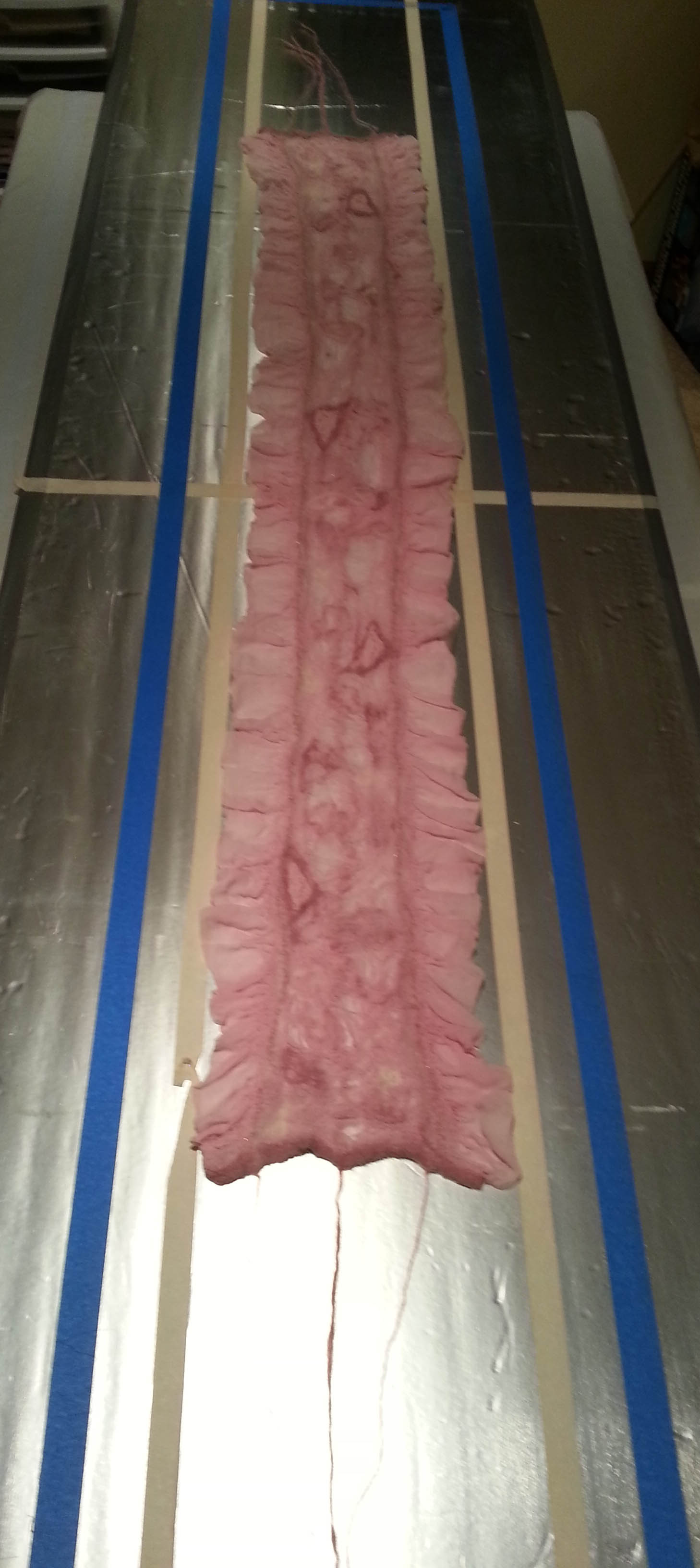
I used a piece of hand dyed pink chiffon.  The chiffon shrank a little with the dyeing process, so I allowed for some more during felting.  The piece measured 20 1/2′ by 86″ (52 cm x 218.44 cm) to start with before folding over 2″ (5.08 cm) on each side for the ruffle.  I used a ruler and iron as I went along .  To make sure the silk edge stayed down, I used fabric glue along the edge.  This dissolved during the felting.

2014-03-17 14.47.45

The flipping boards are from insulation board I bought from the local hardware store.  They were kind enough to cut it in half lengthwise for me.   I covered the edges in duct tape to protect them from water damage.

I carefully laid the silk open edge up following the lines on the board.  I put wisps of pink and white roving lengthwise along the ruffle edges careful to have a little over each side of the raw edge.  Because the wool will shrink lengthwise it gathers up the material on both sides creating the ruffle.  I used some pink mohair yarn in a design down the middle and left fringe hanging on both ends.  I covered the raw edges with wisps of wool.

I used some tencel in addition to random wisps of wool for ruching and two different yarns to decorate the first side.

pink scarf materialsWhen the first side was done, I very carefully rolled plastic wrap (out of the box) over the first side.  I cut it off with a scissors a little longer than the design.  Since the wrap as not as wide as the design, I had to overlap a second layer in the center to cover the width.  Rolling the wrap helps keep the design in place and creates less static than trying to pull a piece off and laying it over the design.  Using my hands, I gently pressed down along the design to remove any air bubbles.  You could also use a rolling pin or foam noodle.

I covered the plastic with bubble wrap bubbles down.  Then I placed the second board on top being careful not to disturb the design. I secured the boards with panty hose tied tightly in three places along the board. Then I carefully flipped the boards.  It’s best to do if you have help, but not necessary if you have enough room to do so without juggling it around. Any kind of ties would work as long as you can secure them tightly without disturbing the design.  I just had an abundance of old pantyhose.

2014-03-17 14.56.43My table is shorter than the boards, so I made sure the boards were centered over the table.  The last thing I wanted was for the scarf to go sliding to the floor.  After removing the ties,  I used a chop stick to gently lift it slightly to make sure the design hadn’t been disturbed and lifted up slowly. Any static can cause the silk, wool and decorations to shift.

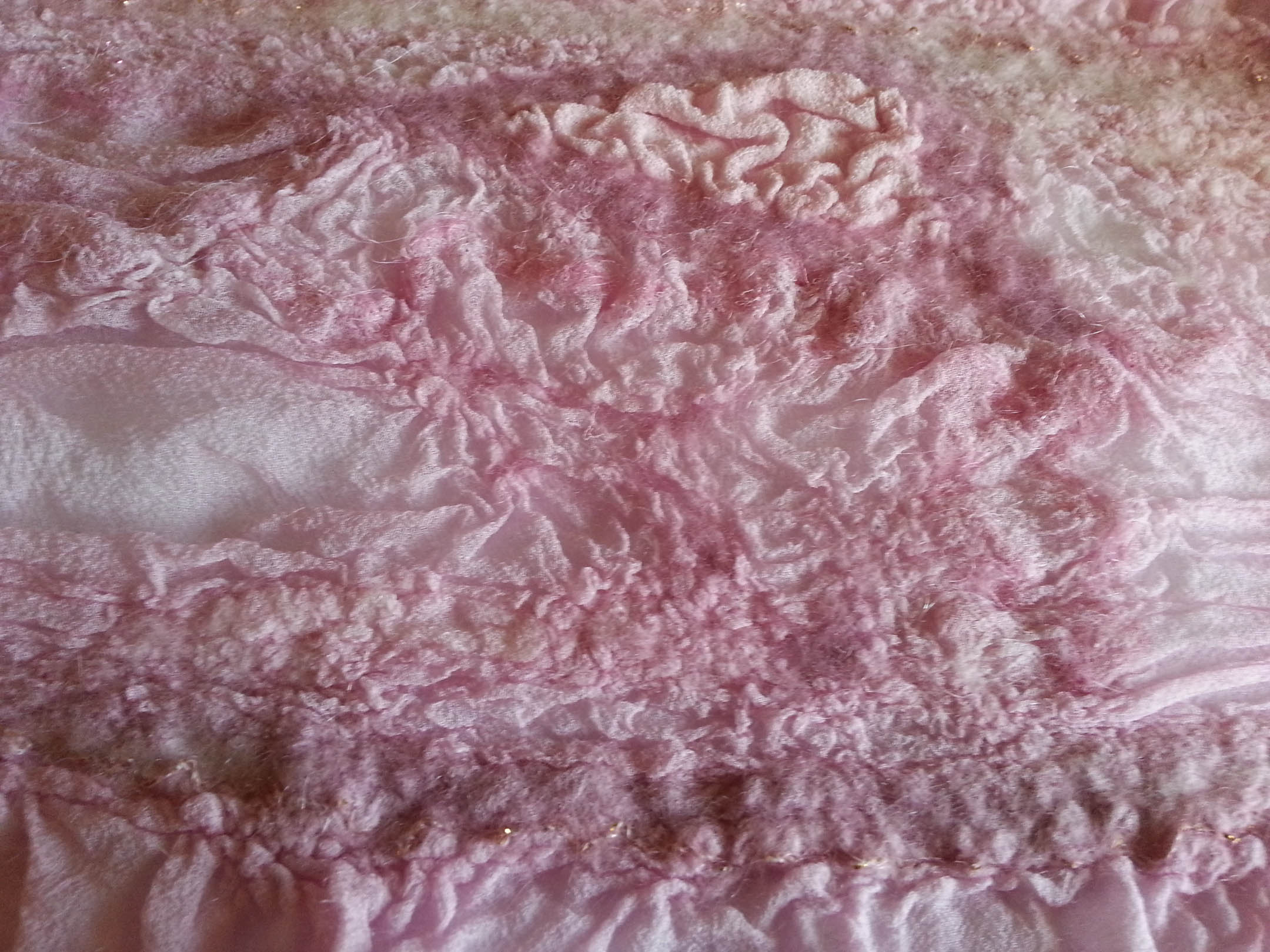
On the second side, I used pieces of silk gauze and a sparkly open weave fabric (different shapes with wool under and along the edges) and a pin/gold mohair yarn along the center of the ruffle seam on each side leaving fringes on each end.  I covered the raw edges of the ends with wool and used some of the pink/gold yarn across.

SAMSUNGWhen I was satisfied with the design, I covered this side with netting and began wetting it down with room temperature soapy water (for me this usually turns cold quickly since I work in a cold basement.) For this project, I used a sprayer with a few drops of Dawn dish soap being careful not to over wet it.  Then I used a foam roller and rolled over the scarf to help disperse the water more evenly.  I checked for dry and overly wet spots. I used a sponge to pick up excess water and applied more water to dry areas.

Then I began rolling, starting at one end using a foam pool noodle cut to size.  I rolled for ten minutes, unwrapped and started the roll from the opposite end.  I did this several more times check to see how well the fibers were starting to felt on both sides and everything was evenly wet.  I started with light pressure and increased a little more with each roll. When I thought the fibers were starting to felt, I flipped it over, removed the plastic wrap and started again alternating the direction of the rolling and increasing pressure.

There were a few spots of the dark pink yarn in the center that weren’t sticking, so I re-wet those areas with soapier water and continued to roll.  Now, I would just run the soap bar over the netting and rub.

After I finished rolling, I used hot slightly soapy water to full on the glass bead board rubbing in all directions, but particularly lengthwise along the ruffle lines.  I flipped it over and repeated the process.  Then I took it to the sink and ran it under hot then cold water while scrunching it up and throwing the wet scarf in the sink.  (I can’t help myself, I love that part.)  I let it sit in a vinegar water bath for 15 minutes, then rinsed and laid it out on towels to dry.

ps length side two ps front

The next day I measured the scarf.  It was 9″ x 55″ (22.86 cm x 139.7 cm) without the fringe.  The shrinkage was approximately 36-38% in each direction.  There were a couple of spots that needed  attention so I needle felted them down.

ps side 2
Side 1
Side 2
Side 2

I learned several things with this project.  The more wool you use along the ruffle line, the more ruffles you’ll get.  The ruffle didn’t shrink much, so the next one I made used a narrower ruffle and more wool along the ruffle seam and I got a much better ruffle. I didn’t use that as an example because it was black and it would have been hard to see.  The pink was good to use for a first time because I could see where I had the design on the back side.  While I was satisfied with the ruffles and ruching, I wasn’t in love with the scarf.  But it was an excellent learning experience. I hope this process will help those of you who would like to try a ruffled silk scarf.

Closeup

Closeup


What is Marketing?

What is Marketing?

Every artist who wants to sell their work needs to understand what marketing is and isn’t.  Judging from the questions I’ve received, it is a total mystery to most people.  I hope to be able to dispel some myths and ideas and help you to understand the basics to so you can devise a plan for your business without losing some of the mystery that marketing offers.

Marketing is not easily defined, because it is multifaceted and is used differently by many companies.  The simplest explanation I can give you:

Marketing is an effort to discover, create, arouse and satisfy customer needs.   It is a process of creating and communicating value, understanding your customers and their needs, teaching the customer what the differences are between your product and your competitors, and developing a demand for your products.

My intent is to not overwhelm you.  It is a huge subject.  I will try to keep discussion to those simple concepts that apply to artists.

sale tagSo, what about selling?

Selling is the effort to devise tricks and techniques to get people to buy a product. 

Marketing supports sales by providing communication, creative work, research, product development, and marketing strategies to name a few services.

There are no formulas or right way to create a marketing plan. Most of you work alone or have a partner.   So, marketing and selling must go hand in hand.  Yet, they are two separate sets of strategies.

Marketing pie

This graphic depicts the different aspects of marketing.  It is close to a traditional marketing model. However, as the individual business person you will be wearing all these hats and make decisions about how much time, effort and/or money you will put into each segment.  I will address each one of these along our marketing journey.

Marketing is dynamic and changes as customer needs, wants and the marketplace changes.  When I first started in marketing  there were the four Ps of marketing– Product, Price, Promotion and Place.  Today there are at least six.

psProduct – the items you make to sell

Price– the price you determine based on materials, time, distribution and other costs plus desired profit margin

Promotion – What methods you use to promote your work and the places you will feature it.  This has been called the “face” of marketing because it determines how your potential customers will perceive you and your products.

Placement – Where and when you will present your work for sale

Positioning – Each artist should have a unique selling position for their products to distinguish them from competitors.  It is a promise to the consumer to provide a particular benefit.  For example, M&Ms — Melt in your mouth not in your hands.

PR/Publicity – How you tell people about you and your work using public media

People –For artists, it is your network of friends, family, colleagues, customers and you as a person and artist. This is particularly important when using social media.

Customers are key.  Marketers spend a lot of time getting to know their customers– who they are, their age, where they live, what type of lifestyles they have, how they behave in the marketplace, what they like or dislike, the avenues of communication they use, the places they shop, how they shop and their buying preferences.  They use this information to formulate their strategies on how to approach the customer. This is obvious in the commercials on TV, magazine and newspaper ads or radio commercials.  Or even the ads on social media.  Information is constantly being collected to be able to target the consumer. This is another big subject we’ll address later.

 fashionista woman w dogsocialitehipster

Who is your customer?

While these pictures represent stereotypes, they are meant to get you to think more about who your customers are.  It may be a combination of types of people depending on what you are selling.  For example, fingerless mitts will likely appeal to a younger person who likes to text.  For someone who spends a lot of time outdoors in the cold, but enjoys handmade articles a nice heavy woolen scarf may be what they want.  An art scarf may be purchased by a socialite or fashionista.

Food for thought:  While you are pondering your customers, think about yourself and how you relate to your customers.

We’ll continue our marketing journey soon.  I’m looking forward to your comments and  insights.

Fiber — An Adventure in Textures

Fiber — An Adventure in Textures

Hi, I’m Marilyn.  I’ve recently accepted the invitation to be the fourth moderator of the Felt and Fiber Forum to replace Karen who left last year.

Paper sculpture "Change"
Paper Sculpture “Change”

As long as I can remember, I’ve been fascinated with textures—the grooved trunk of a tree, the delicate petal of a flower, the juxtaposition of smooth sand and a raging ocean wave.  I’m a hands on person and have reveled in creating textures in a variety of mediums involving fiber.

As a young girl, my aunt taught me to sew which was great since I was able to make my own clothes to fit since I had long arms and legs. Later, when I had two boys of my own, I made their clothes.

Throughout my young adult life I continued to sew, design clothes, crochet, embroider, knit, played with string art, quilling and macramé. I also was interested in drawing and watercolor.  But 3D texture was always the draw for me. And water. For many years I made paper, my specialty being textured paper sculptures. Of course, paper is fiber and requires water to process. I had wanted to be an artist, but coming from a practical family I was encouraged to go into business instead.

Stained Glass Vase
Stained Glass Vase

My college education was interrupted, but when I returned after my sons were born I waffled about my major. Most of my credits were in business so if switched to art I would have had to start over. My husband Craig gave me excellent advice. He was a marketing major in college and told me that no matter what career path I chose I would always have to market myself and a product. So marketing became my major.

It was more creative than I imagined and I was able to combine my knowledge of art and design as well as my love of writing into a career in corporate marketing.

I discovered felting when I retired a few years ago. It was instant love.  Like all of my other creative endeavors, I researched and learned on my own.  But now thanks to the wonders of the Internet and You Tube it was a much quicker and easier process.

Hand Stitched Eyeglass Case

When I found the Felt and Fiber Forum/Studio, I knew I found a home.  I’ve learned so much from the wonderful cyber collective of felt and fiber artists from across the globe. I enjoy the camaraderie and look forward to sharing my knowledge of art, marketing and my creations.  And, of course, continuing to learn and be challenged by all of you as well.

Apopka Lake, Florida