


Saturday, Feb 11th, 2023, was the date scheduled for the next 2D felted landscape workshop at the local guild. Before Xmas we had a lot of workshops have to reschedule. Either the weather was against us, or the instructor or the students had caught the flu going through town. (Technically that is better than covid but it still sounded awful.)
In the aftermath of the sudden arrival of winter the weekend before, I had been left fighting Glenn’s generosity (he gave me his cold). I had noticed I was feeling better each day from about Wednesday so by Saturday I was pretty optimistic that I had defeated most of it and would be able to teach. (I had been avoiding Glenn but it is a small house.) I had spent the week slowly gathering supplies, sorting out all the things the students would need and had Glenn do a run to Dollerama for the missing items.
Saturday morning started very early, Glenn loaded the supplies, samples and many bags of different fibre. When everything was in the car, there was still room in the front seats for both of us. Seeing out the back is not that important, I have side mirrors! So, off we went to the studio to set up before the workshop.


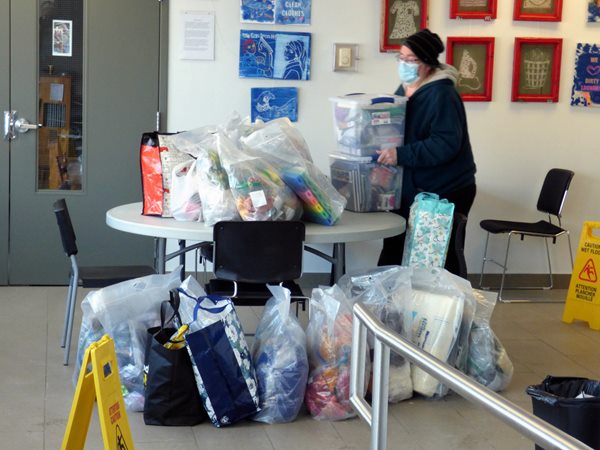
Glenn unloaded the car and set up the extra tables in the studio so I could set out the student’s supplies and set up the examples.


In the student’s notes, I gave them a list of books that may be of interest if they enjoyed 2D picture felting.
- Painting With Wool Landscapes by Bethany Harris
- Creating Felt Pictures by Andrea Hunter
- The Art of Moy Mackay by Moy MacKay
- Art in Felt and Stitch Felting Book by Moy MacKay
- Jaana Mattson’s Landscapes in Wool: The Art of Needle Felting by Jaana Mattson
- The Art of Felt Felting Book by Loumange Francoise Tellier (inspirational)


I found out that one of my students had hurt her back and was not sure if she could make it or how long she would be able to felt, so had one of the comfy chairs and pillow ready for her arrival.

Most of the students had chosen an image from a selection I had sent earlier in the week. We wound up with two students working on the tree in winter with a fence and two on an ocean image. Since I had not heard from all the students I thought I better bring all the colour options so I would be ready for whatever they wanted to try. We had two missing students, one was a booking error that had been corrected but was not on my list, and the other was actually missing. ( I found out when I got home that she had not felt well and had tested positive for covid that morning!)
I had set out the student’s supplies; Name tag (rectangle thick wool felt): (safety pin & sew-on pin, sock yarn, piece of scrap paper and Marker). Foam Kneeling pad, 1 sheet of 100% wool felt (enough for two 5×7 pictures), 1 sheet of acrylic craft felt, I sheet of card stock (to make a window mat), a Plastic ruler, a Wooden Frame with a mat from Dollarama, XXL Project bag, bag for the needle, 21 pages notes and Felting needles.
- 2x T36-333 needles (Blue)
- 2x T38-333 needles (PINK)
- 2x T42-222 needles (Turquoise)
- 1x Crown 40-111 needles (Orange)
- 1x Reverse 40-222 needles (Green)
We started with a name tag; making your name in yarn to practice eye-hand coordination and get used to the needles. I usually review what’s in the notes, the basics of history of landscape, mentioning the golden mean and the rule of 3’s for photography, a review of perspective, some of the techniques that apply to pastels, acrylics and watercolours that can be used with wool. As well as blending fibres by hand or by hand cards to get the colours you want. I also chatted briefly about ways to transfer images to the felt.
I didn’t go into as much detail as I usually do since I was starting to feel a bit more brain-stuffed up than I had been when I arrived and started to set up. I was sure I was feeling better, but this cold seems to keep trying to sneak back and hit you again. Even so, the students did very well. Maybe not overloading them with info helped.
This time everyone wanted to use the “lightbox” (or window) method so I reminded them that the template version, which is good for thicker felt bases or dark-coloured base felt, was in their note if they needed to use it in the future.

For each image I had two copies of the original image (in case they chose the template method), a colour blocked version and a colour saturation image to show hidden colours they may want to consider. I can do this with Microsoft Word 2010. (Sometimes things work and upgrade then lose the effects you want.)


Normally each student has chosen a different image, this time one of the ocean images was popular and the tree in winter with a fence and hill had found favour with the other 2 students.


Winter trees were also popular. I reminded the class that they could play God and move, remove or change trees, clouds or anything else that offended them. It was their landscape and they could adjust it so it would suit their liking.
I talked about how to think like a watercolour painting with washes and layers of thin wisps of fibre building up to a final image (not the fastest way to work but it can be very effective as in the fox who still needs to have whiskers added and I’m at about 30 hours). I also mentioned that after laying in the trunk and main branches, wisps of fibre worked well to create a hallow of tiny branches for the winter tree.

Using a mat or just a card stock stand-in for a mat will give your eye and brain another view of the image you have been working on.


Both trees look great and are their own tree, even having used the same inspiration to start with. The same individual personality happened with the stormy sky ocean picture.


Both have great movement in their pictures, again when using the same image each saw and focused on different aspects of the image.
I have found sometimes after working on an image for a while I need to take a break. I will put it aside and come back to consider it again later. I may decide “yes I am happy” and the picture is done or I may decide it needs a bit of fibre added here or there to complete it. Sometimes using a card stalk mat will help me consider the image, looking at the picture in a mirror or turning the image and the felt picture upside down will help you see what you are looking at, rather than what your brain says it thinks it is looking at. (It makes it easier to see the negative space and compare the image with the picture you are making).
I hope they had fun and I hope that this opened up a new expression of creativity with wool.
The class finished up early but they also took a much shorter lunch than the last class. I had given each student a project bag (giant XXL zip lock bag) to store their extra wool, felt samples and needles in. They had the leftover fibre from their first picture and a couple selected a second image to try. A different water picture and a sheep in a field of snow. it was impressive how far along they got in an hour on their second images.


I seem to have missed getting a shot of the other ocean image! I was really only working at about 90% efficiency. It took me about an hour to pack up the workshop supplies and Glenn loaded them back into the car. Then put away the extra tables (I think tomorrow is a spinning workshop and they will need the space).
There is a very good restaurant across the street from the building the guild is in, I think I get a happy Sherpa by making sure I linger in the parking lot while he runs over and orders dinner. It was very good, the car smelt like hot pizza all the way home.