


On the last day in February, I ran the Needle Felted landscape workshop for the Ottawa guild. We had six students sign up but one had to stay home to attend a first time mom who was expecting twins. The impending mom, being a sheep, was not as forthcoming in accurately indicating her due date and did not actually go into labour during the workshop but I am sure she would have them if he had joined his wife and left the sheep alone.
I brought a good amount of my fibre stash (I have been collecting fibre focusing on the landscape workshop and the sheep workshop). By the time Glenn got the car loaded, I had a full car of fibre and supplies to the point I could not see out the back window! Ok, it’s a Kia Soul so not a huge car but that was a lot of wool!

1) This is the foyer at Hartwood house. The studio is on the other side, through the double doors that Glenn is moving my stuff towards.
I had intended to get a picture of the room once I got it set up but I got distracted by one of the students arriving early and then I forgot. I had set out all the items the students were getting with their workshop.
Which included
- 23 pages of notes plus an appendix of photo options,
- the foam kneeling pad that is made of a pool noodle like foam,
- 4 types of felt, (for a name tag, a large piece of good wool felt half of which was to be used for the project, a cheaper lower percentage wool felt and an acrylic felt to compare to).
- different Needles, (including a finer spiral)
- Permanent markers,
- a test tube with a lid to keep the needles,
- elastics,
- pins,
- hard ruler (not a tape measure),
- paper to make a template for the mat,
- 3 sizes of finger protectors (wooden)
- Wooden frame with mat and glass
- Fine particulate mask (no one wants to get wool lung!)
I had also brought Sock yarn to make their names and Lots of wool to select colours from!
To borrow I had extra scissors and a 7 needle holders tool with a guard (it’s the fake clover tool from somewhere in China).
I had them start with making a name tag allowing them a chance to try out the needles and work on eye-hand coordination. They wrote their name in yarn on a piece of felt from an accidentally felted duvet. Only one bandaid was needed so the practice was helpful.


2-3) Nametags – note the bags of wool in the background of the second photo
Next, they were on to choosing a picture from the ones I had pulled or three had brought one of their own. Two of my adventurous students had painted before and the other one had done a number of other types of felting so I felt they might be up to a bit more challenging subjects.


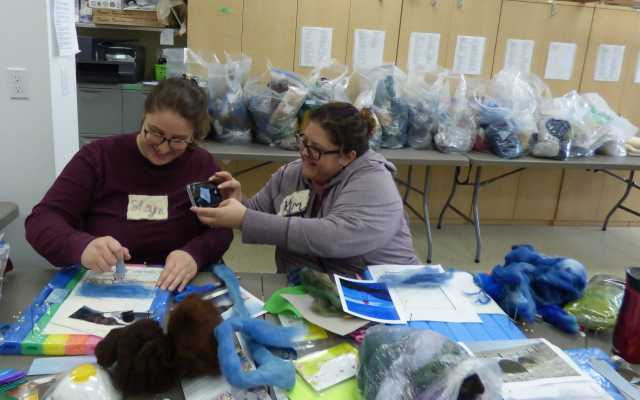
4) Using the phone to see details of the image and checking the pictures as they progress.
I had asked the students to bring a camera, an eye pad or a phone with a good camera function so they could check their work as they progressed. One had her Lama picture on her phone and could zoom in and look at details which was also an excellent use of technology. The phone works similarly to looking at your drawing in a mirror. It allows you to see proportions and negative space more clearly.
Transferring the chosen image to the felt
I discussed the lightbox or window method of tracing. This works well on thin light coloured felt or pre-felt but not as well on thicker or darker felts. If you are using a window, it works best on sunny days (sunny days can be scarce in winter). This transfer method was used in the workshops I have attended.
I also mentioned the grid method to scale a drawing while transferring it to your work surface. It is a lot slower but can produce an extremely good underdrawing. I suggested they check out their notes for other methods like the projector, Lucy and camera obscura.
I wanted to give them another option if they did not like to draw freehand or using a lightbox. I explained the template method of transferring an image, which requires scaling your image by photocopier or by computer and printer to make your image the size you would like to work with. Make a border on your felt, the outside size of your picture. Then divide your picture into basic tonal areas again working from the background to the foreground. It can be handy to put your image in Microsoft word then adjust the image with “Artistic Effects” look at “cut out” to give tonal blocking. While you are in Microsoft, you can check under “colour saturation” to see what hidden colours are in your image.
This is the point that you move trees or tilt hills to suit your wants. You are God of your landscape! If you want to have a tree lose or gain a bit of weight, you can decree it!

5) Freehand drawing and the use of a paper mat
One student went with the freehand method. She referred to her phone to get the detail in her picture. I had a number of different colours of permanent markers. We were using permanent markers since I have used quilting makers in a workshop I had taken that did not stay on the felt but appeared as a blue smear on my arm from finger to elbow as I worked on my piece. (The options of various colours of permanent markers are nice since they stay where you put them and they will be hidden under the fibre you are adding.)
I had them make a paper mat the size of their picture, 5×7. This lets them check to see if their picture was getting bigger or smaller as they worked. Checking your image with your paper mat will save you money by ensuring that your image will fit in your mat and frame when it is done.

6) Template method of transfer and using the phone to check the progress
Continued in part 2 scheduled for March 15th 2020 (lots more pictures to come in part 2!!)