

Going around here in West London and in England, I have come across some textile-based community projects that maybe you will find interesting.
They are crocheting and knitting public projects that use those skills creatively to raise awareness and educate the public, and also inject beauty and fun in our lives of course! Maybe something similar is done in your own neighbourhood and community: it would be nice if you could share other similar projects in the comments.
The first couple of projects that I want to show you are projects that I came across to inside the Royal Botanics Gardens Kew or Kew Gardens.
This is a UNESCO World Heritage site that holds a collection of more than 28,000 taxa of living plants and around seven million of dried specimens in its herbarium, not counting the lovely historical buildings and surroundings that make for an enchanting visit: it is definitely a picnic favourite of Londoners and tourists alike, although the ticket is a bit expensive. I personally always try to go for the Orchids Festival, as I am a fan of orchids, but my kids like the yearly Children Science Festival!
Here are the links to the Kew Gardens official website and to the entry on them in Wikipedia.
In a small and quiet separate greenhouse very close to the famous historical Temperate House we found two textile pieces: one horizontal artwork about Food Security, and the other a vertical artwork about natural life classification for plants or the Plant Tree of Life.
Both were created as community projects by people coming together to express what the themes meant to them through knitting: the Community Learning group of Kew Gardens is aimed at people who may have difficulty in accessing the Gardens and would like to know more about plants and be involved.


If you would like to try your hand at knitting nature, as those ladies did, here is a link to some free patterns on the Community Learning Kew website that you might try. The Community Learning group is the one who created those two beautiful works and it is made up of people who face some barriers to accessing the Gardens and are part of an organisation who applied for a Community Learning Access. Barriers to access may be such as some physical, mental or psychological impairment or social and financial barriers.
The other project is way more informal, has been going on in my Ealing neighbourhood for a while and I recently saw another one in Norfolk, and realised that it is something widespread in England, UK: all British crocheters and knitters, please, let us know about something that you can see around your neighbourhood as well.
So, now that I have created a bit of suspence, here it is, a Pillar Box Topper: a crocheted or knitted shape is fitted on the top of the iconic red Royal Mail pillar boxes, and on top of that layer there are different clever crocheted or knitted shapes representing a theme, to raise awareness on charity associations or local features or something that takes the fancy of the artist. I gather that it is not usually something that you need to plan with the approval of Royal Mail, as long as you keep well off the critical bits of the post box, and do not cover the hole or the signs.

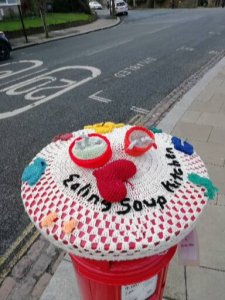


There definitely are various charity associations doing this, but it is also used just for a bit of fun and to commemorate events as you see. It is quite popular here: check out its history here on Wikipedia, and here you can find a blog with the list (unfortunately around 2 years old, sorry) of the places where you can find them in UK and links relating to groups of Post Box Toppers enthusiasts.
And, if you wish to try, here is a link to free crochet and knitting patterns for Post Box Topper by the Townswomen’s Guild: of course, those are only the basic Post Box covers, without all the knitted and crocheted embellishments. There are other free patterns online, if you wish to try your hand at one.