

As you may have guessed, my family lives in London, United Kingdom at the moment, but English is not our mother-tongue. We happen to celebrate our birthdays all in UK, though, so during the years I managed to collect a few birthday party buntings here: of course, all of them celebrate “Happy Birthday!” in English and none in our language, Italian. Also, I only have a short felt one and all the rest are plastic. I like the felted one a lot better than the plastic ones, it’s so much easier to store without worrying about creases, it is always in perfect shape and luxurious looking, even though it was not actually more expensive than the flimsy Lego themed one!
I decided to make us a new felted bunting with the Italian equivalent of “Happy Birthday!” written on it: as it will use Italian words, it will be longer than the English one, and I will be able to add more elements to make it longer still. It will be very colourful and it could be used for all our birthdays for years and years to come, and no more worries about creases and folds. It seemed a nice plan.
It is a fairly easy basic kind of felting project: one just needs to make as many flat triangles shapes as needed to spell the words and punctuation (in my case “Buon” and “Compleanno!”, so it’s 15), with one more for the space between the words, and as many more for decoration as one likes. On the triangles, you can needle felt the letters in contrasting colours.
Then, a satin ribbon will be passed through slits on the upper part of the triangles: this will mean that one will be able to adjust the length of the bunting to different size spaces. If you do not wish to have an adjustable bunting, you could make a felt cord of the desired length and attach the triangles to it at fixed intervals by needle felting or sewing them to the cord. And the bunting will be ready to go.
I wanted to go for needle felted triangles, although I guess it could be a much quicker job if you wanted to wet felt them : just wet felt different wool colours and cut them in triangles, then seal the edges with rubbing.
Well, I need the needle felting practice, so I took out my needle felting supplies and had a go at making a needle felted triangle shape.


I needed a thicker needle for the first shaping stabs: that would be a 32 gouge, that is silver coloured in my set.


Never mind the photo, that I was taking with my phone while moving the needle with my right hand: I actually started shaping my triangle by stabbing and shaping the edges of the triangle first, then moving towards the center.
I lifted the shape from the foam mat and stabbed a bit more on the other side as well, adding some more wool if I thought that some parts were uneven or not thick enough.


Then, I saw that it was the time to change the needle to a thinner one.

I usually like to use a 38 gouge needle, colour coded red in my set, to do more detailed work when I am needle felting. Sometimes I pass through the 36 gouge needle (green one in my set) before the 38 g, or use a 40 g needle (blue in my set) to finish, but in this case the job was fairly basic, and I did not want to change too many times.

After stabbing more, I felt that the shape was looking good. If you wanted it more regular, and were not lazy like me, you could make it more regular than mine by starting at the beginning with a rectangle shape and then folding the rectangle in half diagonally into a triangle shape, and stabbing more. But if I have to make more than 15 triangle shapes I am not going to bother making them regular: I am just so lazy!

I guess one could stab on and make the shapes very firm, but I have no patience and was eager to go on (14 plus triangles to go, you know…), so I selected a bit of merino wool roving in teal for the first letter to add to my triangle shape. You do not need a big amount to complete one letter, you can use leftovers from other projects. I like to use carded merino slivers if I have them for small areas of flat needle felted decoration, I find that it is easier to shape them into small regular shapes.

I used the same red 38G needle to stab the teal wool on the triangle shape. It is not difficult to make the wisps of carded wool take the shape that you want, you just need to work on the surface, really, without stabbing too enthusiastically.


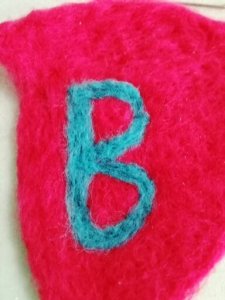
I managed to finish my first letter quite quickly, but, guess what, I stopped there and never mustered the will to make all the other 14+ triangles! Well, the first birthday coming is not till ages….
P.S. the nail varnish was courtesy of my daughter, who wanted to play nail decorator that day!