Browsed by
Month: June 2013

Around the Web

Around the Web

I have been out of town this past week but I thought you might like to see a few links of fun stuff while I get caught up.
Felting around the web banner

Gala Filc’s Linen Dresses with Flowers

Sandy’s Stitched Felt

Nature Nurture by Pam de Groot

Gala Filc’s Teapot and Cup Purses

buttons around the webGina’s Transfer Dyed Button Hat

stitching around the webJane’s Garden Doodles

Dog Daisy Chains Adventures in Embroidery

mixed media around the webVicki’s Fused Glass

dyeing around the webNatural Dyed Yarn

Ann’s Nuno Challenge

Ann’s Nuno Challenge

Well im just getting in just in the nick of time for Ann’s nuno challenge
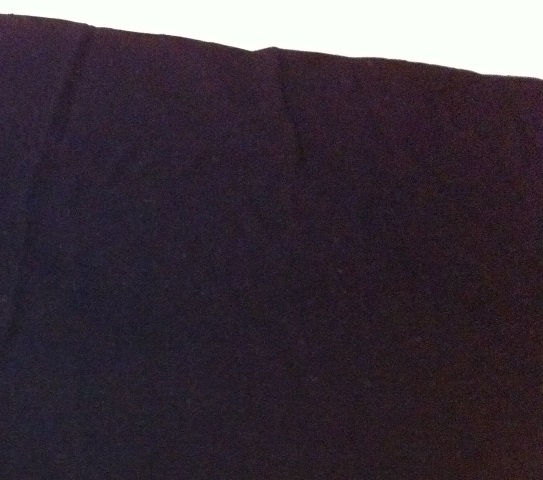
As I was just practising I used some scrap material and I have no idea what sort it is, although it did have a bit sparkle, its really soft to so this is it

fabric1

Not sure if it was the sheen on it or not but it was horrible to felt lol
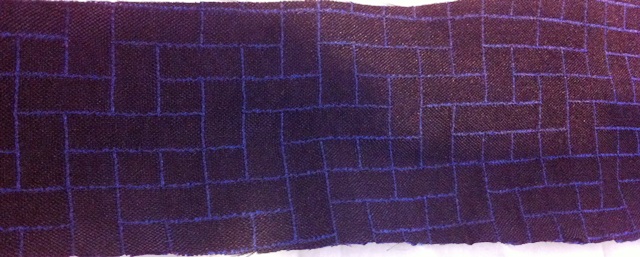
I wanted to use white trilobal nylon and was hoping it would pucker and thicken so I could cut it out and use for making flowers for my next project, well that didn’t work and after about 1 hour of rubbing It ended up like this

fabric2

Didn’t adhere to anything so I gave up on that lol
Then I pulled out some merino and as most of my things are still packed in boxes and I couldn’t be bothered going through every box , I grabbed what was close and it happened to be blue, this was much quicker to felt and it shrunk by at least 50%

fabric3

fabric4

Not the best colors I know but it worked ok, its quite strong, I’ll definitely give this another go but ill use some silk next, Ann did send me a gorgeous piece last Christmas and I was going to use it but im so glad I didn’t because I would hate to have ruined it. I need way more practise before I use something so lovely lol

Bits and Pieces

Bits and Pieces

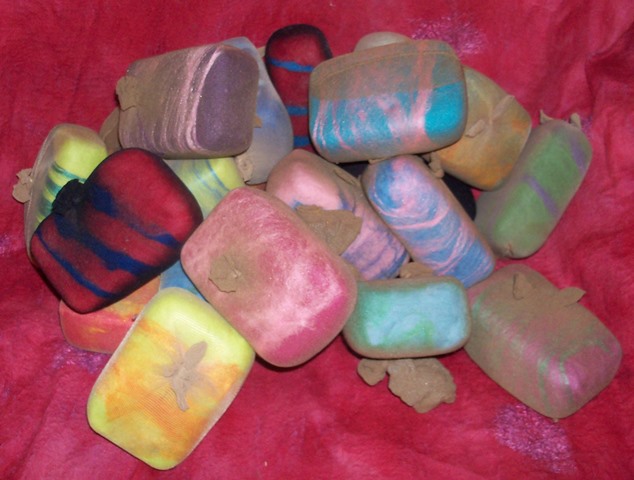
This week has been about getting things moving towards upcoming shows. I spent an afternoon wrapping soap in wool and putting them in little nylon bags ready to felt.

soap

I sent another afternoon getting sheep parts ready to felt. The body parts are roughly needle felted then wet felted. The legs are wet felted.

sheep parts

This is what they look like when they are all put together and their wool is added.

sheep small

Lastly I have been soaking a fleece. I have no idea what kind of wool it is. it was a bag given to me a couple of years ago. Here it is getting a rain water rinse hanging in my apple tree. That wasn’t on purpose but the thunderstorm came in before I got it back into a bucket for its first rinse.

wool hanging


Tutorials and E-Books

Tutorials and E-Books

I really haven’t had the time to do anything but work on my Fimo tutorial lately. I didn’t think that would make a very long or interesting post so I thought I’d do one about what goes into writing tutorials or e-books. Looking at a really good one, you’d be forgiven for thinking that it’s pretty much just getting someone to take photos while you go through the stages, or at the most, stopping to take photos if you’re doing it alone. Then just adding some text to the photos in Word. Ah, if only it was that simple  🙂  Sometimes the shorter ones can be straightforward if it all goes well, but even then there is usually lots of photo editing,  cropping, resizing, etc. and rewrites of the text.

So, what does happen? Well we probably all do it a little differently, but usually I start off with a rough idea, a few things jotted down, then write a brief outline of what I want to include.

OLYMPUS DIGITAL CAMERAI’ll type this out onto Wordpad, then start to give it more definition, separate it into sections then add info about the content I want in each section. I usually do a copy of this new outline with a list of all the photos I need to take for it or sets of photos, then print it out and start on the photos.

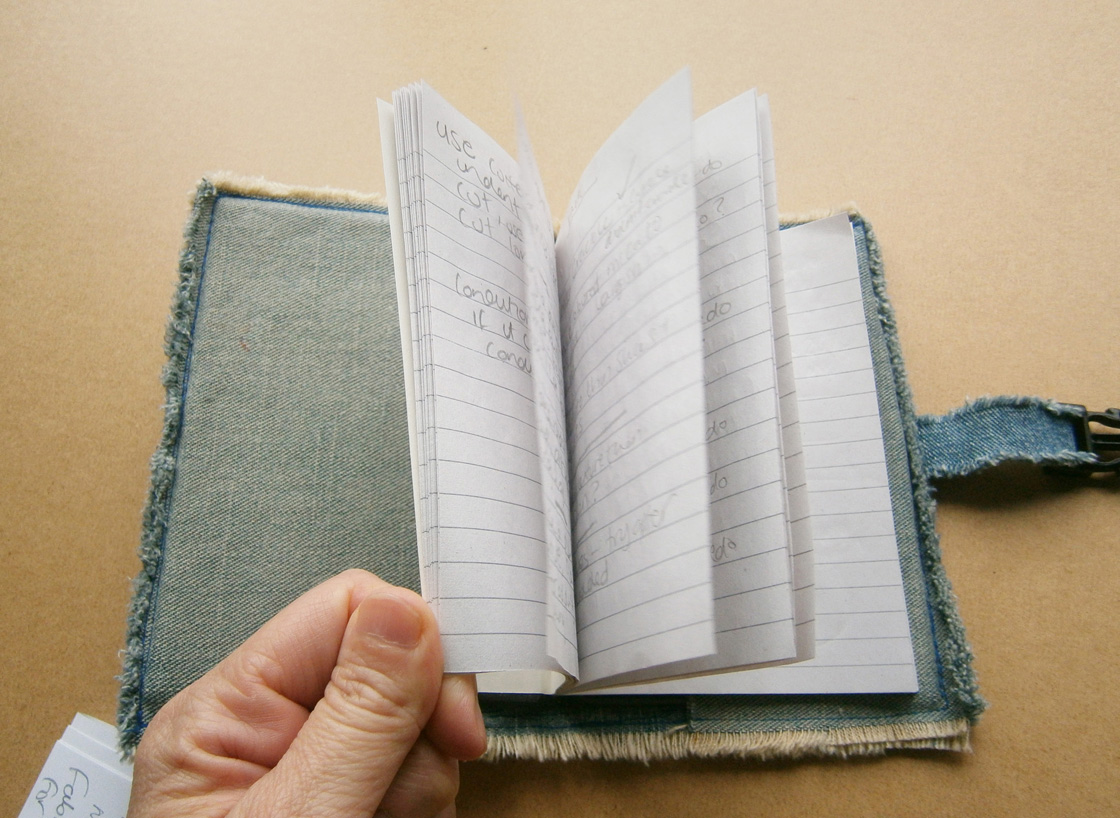
OLYMPUS DIGITAL CAMERAI’ll probably re-print the list quite a few times as I work through it and change my ideas. I like to keep a notebook close by when I take photos because I usually end up with ideas for something else I need to include or an idea that will help make another set work better. Also it’s good to take notes about what you’re doing in the photo and at certain stages because it will help to explain the process more clearly.

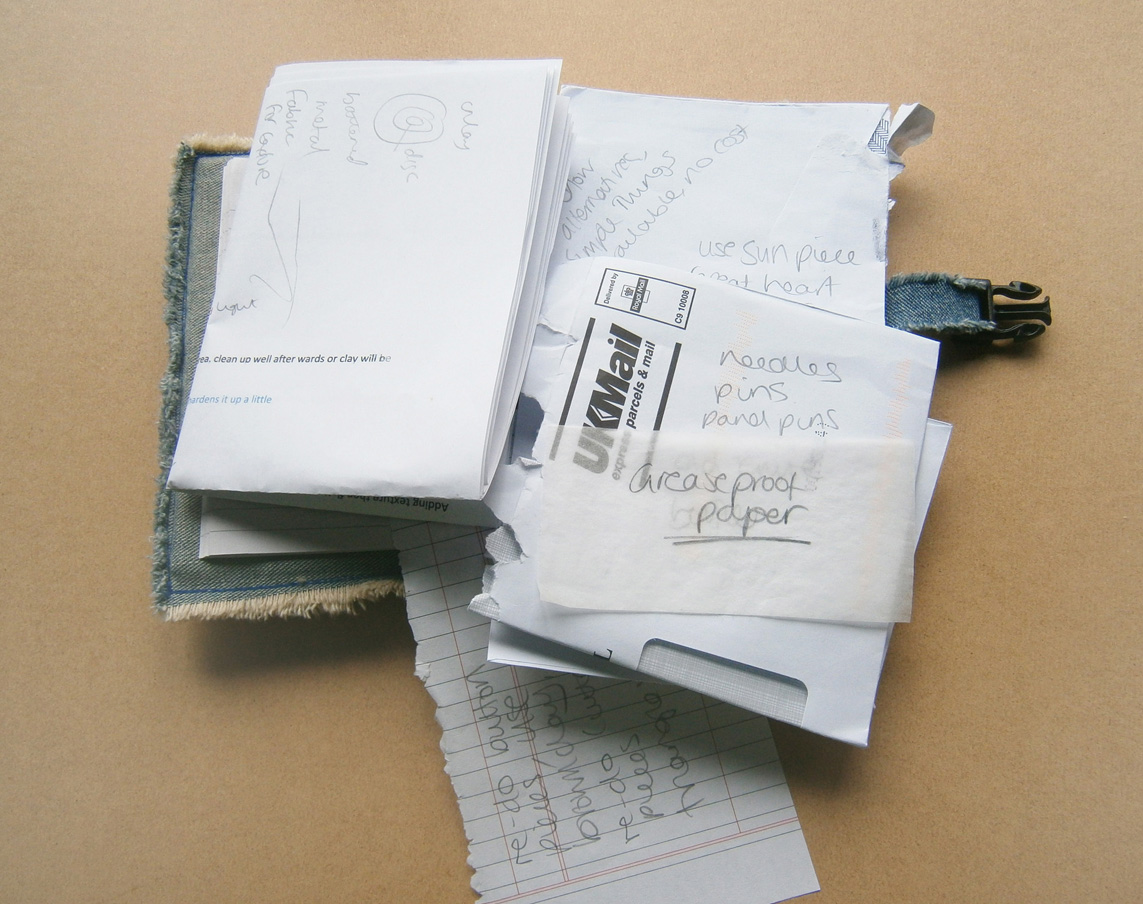
OLYMPUS DIGITAL CAMERAEven when I’m not actually working on the tutorial, something will pop into my head, so I usually end up with lots of loose pieces of paper with little notes on. It’s like one idea inspires others and you can’t see how you can leave something out without it seeming incomplete. I thought from the original idea for my Fimo tutorial it would be several pages long and just take a few days to do with careful planning, but by the time I wrote down my outline it was already turning into a mini e-book!

OLYMPUS DIGITAL CAMERAOnce all the photos have been taken, the most laborious part I find, is going through all the photos…deleting blurry ones first then going back and looking through the rest carefully to choose the final ones. And if you’ve ever taken photos of felt or fibre, you’ll know it usually takes a lot of photos to get the one good shot you need 🙂  I then usually make duplicate folders for resizing. It isn’t unusual for me to have 4 duplicate sets all at different sizes.

Photo foldersWhen it comes to the writing, I usually start by simply describing the process, trying not to overthink it, and use the photos to illustrate this. Then I pester my girlfriend to read it through for me, it’s really good to get the opinion of someone who hasn’t tried what your tutorial is about, they can ask all the questions you need to answer but might have missed. Once the first draft is finished, I’ll probably ask Ann, Ruth and Karen from the studio site and Lyn from the forum to read through too, it’s good to make sure it’s understandable to people all over, and that there aren’t any words or phrases that are unfamiliar, even to English speakers. It’s strange the words we take for granted that are often questioned. Once I’m happy with all the words and pictures, I work on the layout. That’s where the duplicate sets of photos come in, if a photos used in the tutorial only needs to be small and doesn’t show any detail, using photos of smaller dimensions and file size can reduce the overall file size of the document and subsequent PDF.

I’m just past the first draft stage of my Fimo tutorial and ready to start work on fine-tuning the text and working on the layout. I keep getting more ideas for things to include though!

OLYMPUS DIGITAL CAMERA

Just a small one !!!

Just a small one !!!


 This is only a small one, it seems to take me a fair while to do any posts lately as we have a lot going on 🙂

A couple of weeks ago Ruth did a post on this book she had, so of course I had to go right on-line and purchase it,  I didn’t really know what to expect but I took ruths word that it was good J

I received it a few days ago and sat down for a read that night and wow I could have sworn this woman was talking to me and about me lol  

 Its about finding your own way and being yourself,  and even in those first few pages I felt she was in my head.  Ive only read a couple of chapters so far but its made me think about creating the way I want to and not doing things to fit in, if that makes sense ! I get excited when I read a couple of more pages, she quirky and fun and gives lots of food for thought and shares her own story.

Heres the book again and Thankyou Ruth for posting about it, im thoroughly enjoying the read !

Image

 So after those first few chapters and lots of trying to contemplate my style , I woke up the other morning and had an image of what it is that I wanted to do,  its mixed media of course but as you know I’ve been trying to find my own thing for ages, so without looking on-line or  anywhere else  for inspiration I decided to try looking within to see what I could come up with. Ive spent the last 3-4 days working on this and im loving it.  But  !!    I cant show you just yet as its not finished and it will also  be part of the next quarter challenge lol  sorry, I will give you a sneak peak though but don’t worry   its not really what it seems  🙂


Image


For now I have 1 more week to do Ann’s nuno challenge so I’ll definitely get that done before the end of this week.  I hope your all enjoying whatever it is that your creating 🙂


Yurt Beginnings

Yurt Beginnings

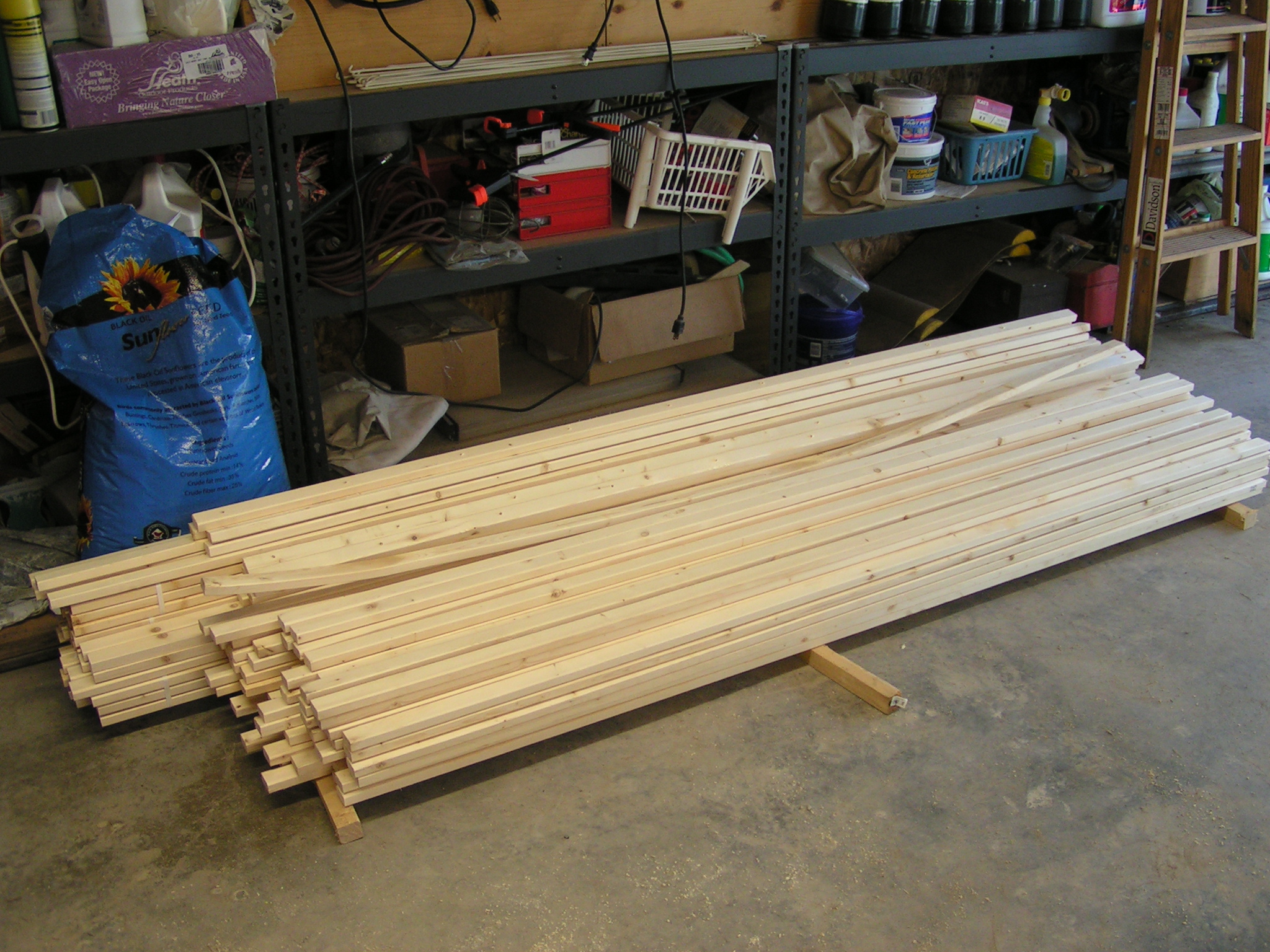
We finally purchased the wood to begin making the yurt frame. I can’t begin felting until the side walls are made so I know the correct size to felt the cover. The yurt frame is made up of 4 lattice sections (think baby gate here) and then the roof poles attach to the top of the lattice and insert into a round piece called the tono at the top of the yurt. We are following instructions from a book by Paul King. If you click on the link, you can see what a professionally built yurt looks like. Hopefully, ours will be close.

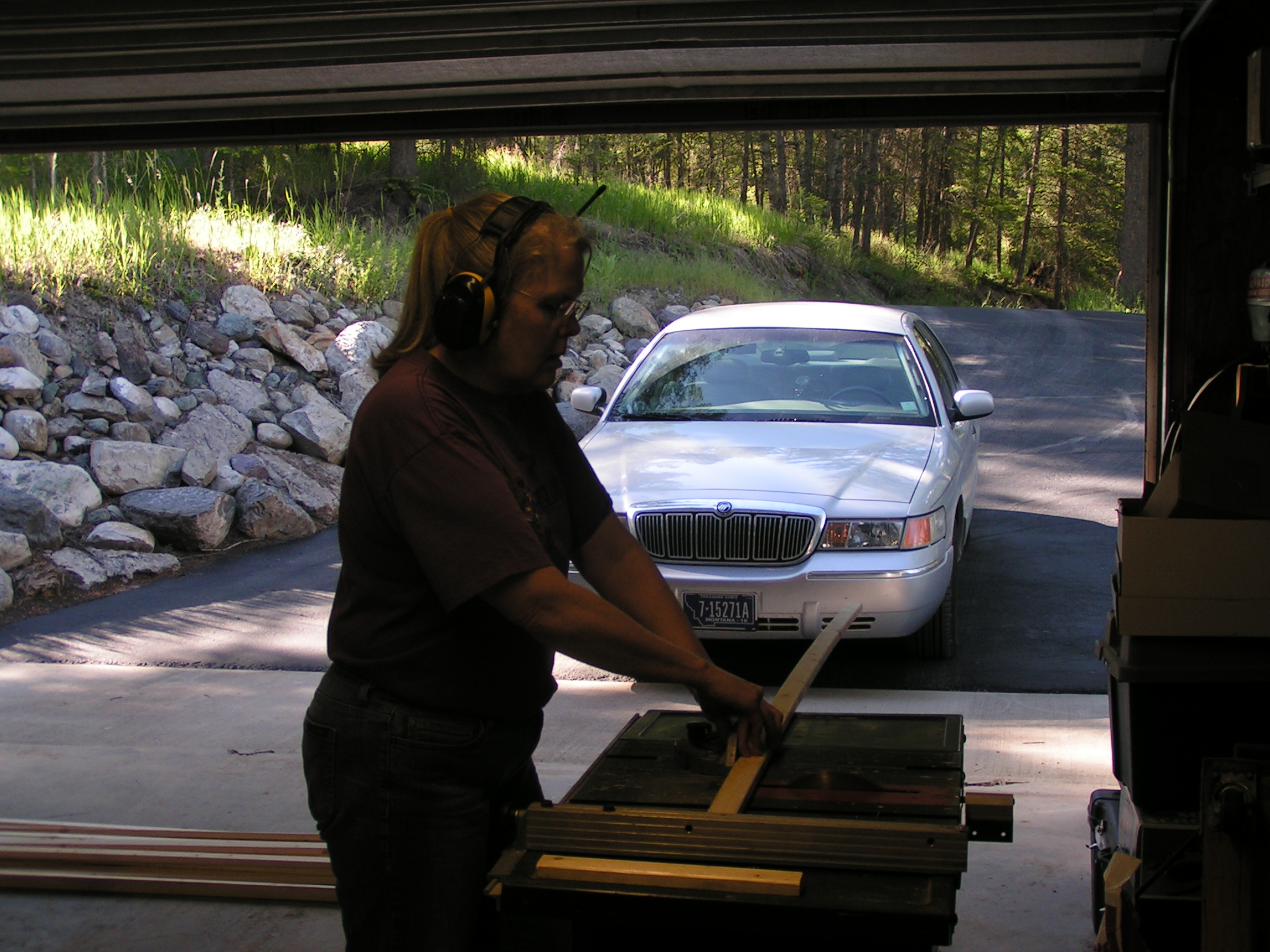
Yurt woodOur plan is for a 16′ diameter yurt made in the Mongolian style. We bought 162 1″x 2″ x 8′ pieces of wood. 110 of these are for the side walls and 52 for the roof poles. The side wall pieces needed to be 7′ long so I cut off a foot with the table saw. Do you see that pesky warped piece. It didn’t look like that when we bought it but without any pressure from other boards, it warped like that in about 30 minutes. That will be a short piece for sure.

Ruth on the Table SawThis isn’t the best photo but here I am sawing away. I did take shop class in high school but it’s been a while since I’ve used power tools. The ripping fence kept moving and I sawed several pieces too short. Luckily, we need 44 pieces that will be shorter than 7′ long for the ends of the lattice. Dennis finally figured out how to attach the fence properly and I got all the pieces down to the required seven-foot length.

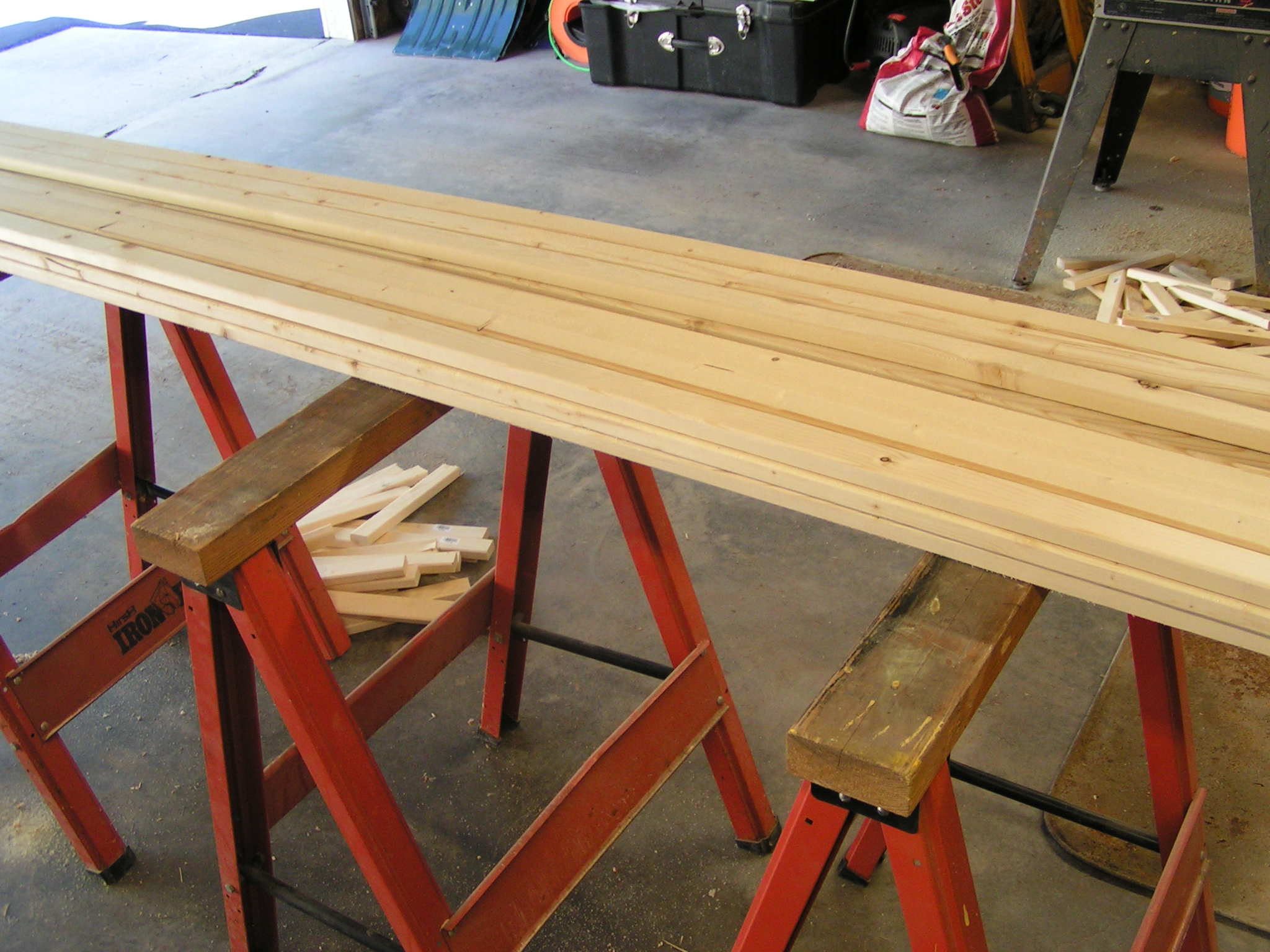
wood scraps

Here’s the pile of ends after sawing. I’m not sure what we’ll do with these scraps but I’m sure we’ll think of something.

Short piecesWe had to separate out all those short pieces and then figure out what sizes they need to be to fit on the ends of the lattice where you don’t need a full piece. There’s something about counting the holes; we need two 8 up lengths and two 8 down, four 6 up and four 6 down etc. I have read that part of the book three times and I’m still not sure what he means exactly. I think we’ll have to lay out one lattice section and see exactly where we’re supposed to cut as we really don’t want to have to go back and buy more wood.

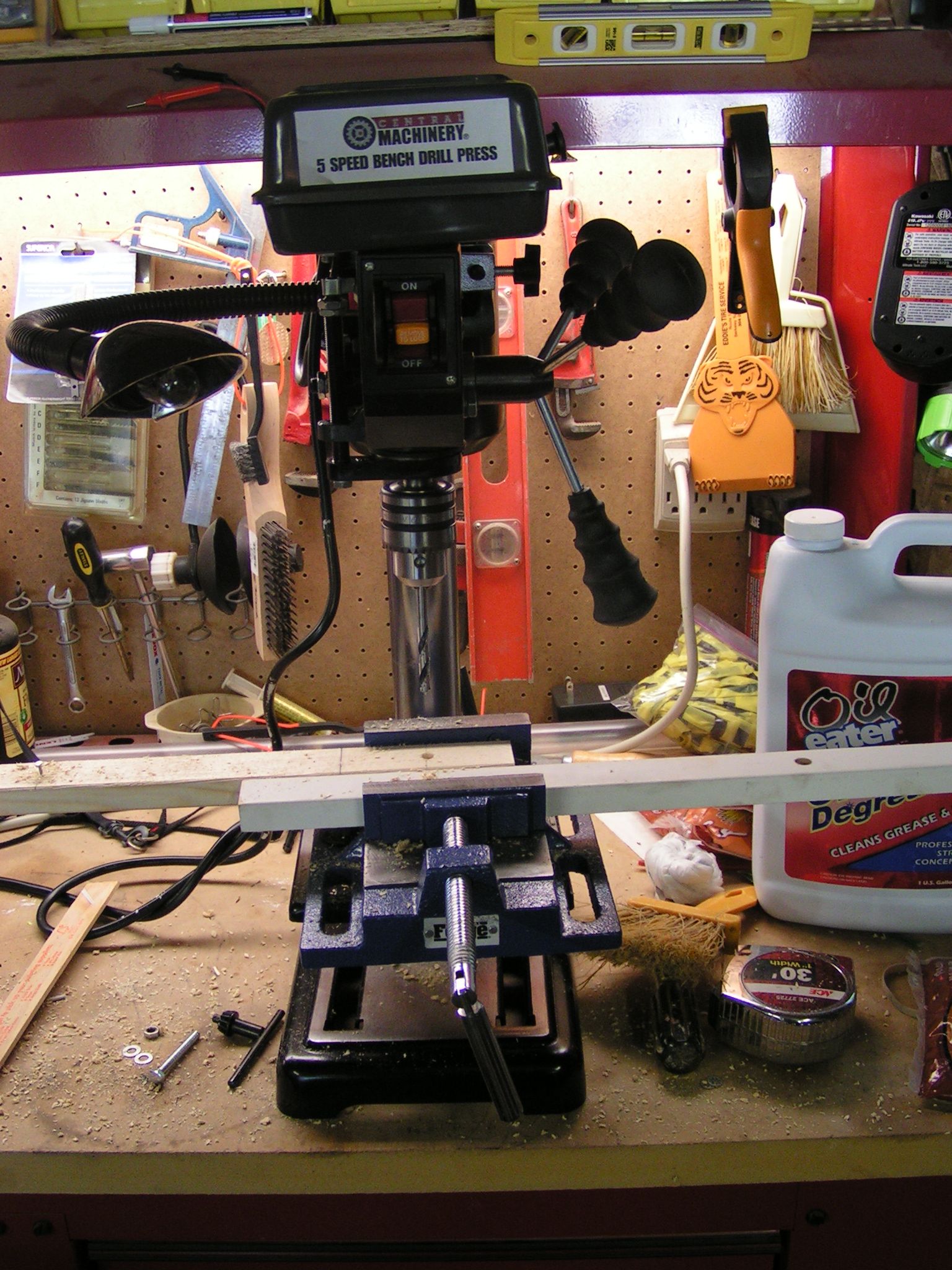
Drill PressNext up was the drilling process. The lattice has to be connected together at all the crossing points on those 7′ long boards. So each board needs to have 10 holes drilled into it. 10 holes in 110 boards or 1,100 holes drilled. Exactly 9″ apart and then holes need to be vertical or the lattice won’t operate properly. Thus the need for a drill press. In the instructions, Mr. King kindly explains how to make a little jig or pattern to follow. The first hole is drilled at 2″ and then each hole after that is 9″ apart.

Drill JigHere’s the jig we devised from his instructions. The mark to the left of the drill hole is 2″ so you line up your board and drill the first hole. Then further over to the left, you’ll see a nail. Once your first hole is drilled, you lift up the board, put the hole you just drilled over the nail and then drill the next hole. The nail is exactly 9″ from where the drill bit goes in. And then you just keep moving your board down and putting the hole you just drilled over the nail until you reach the end of the board and have drilled 10 holes.

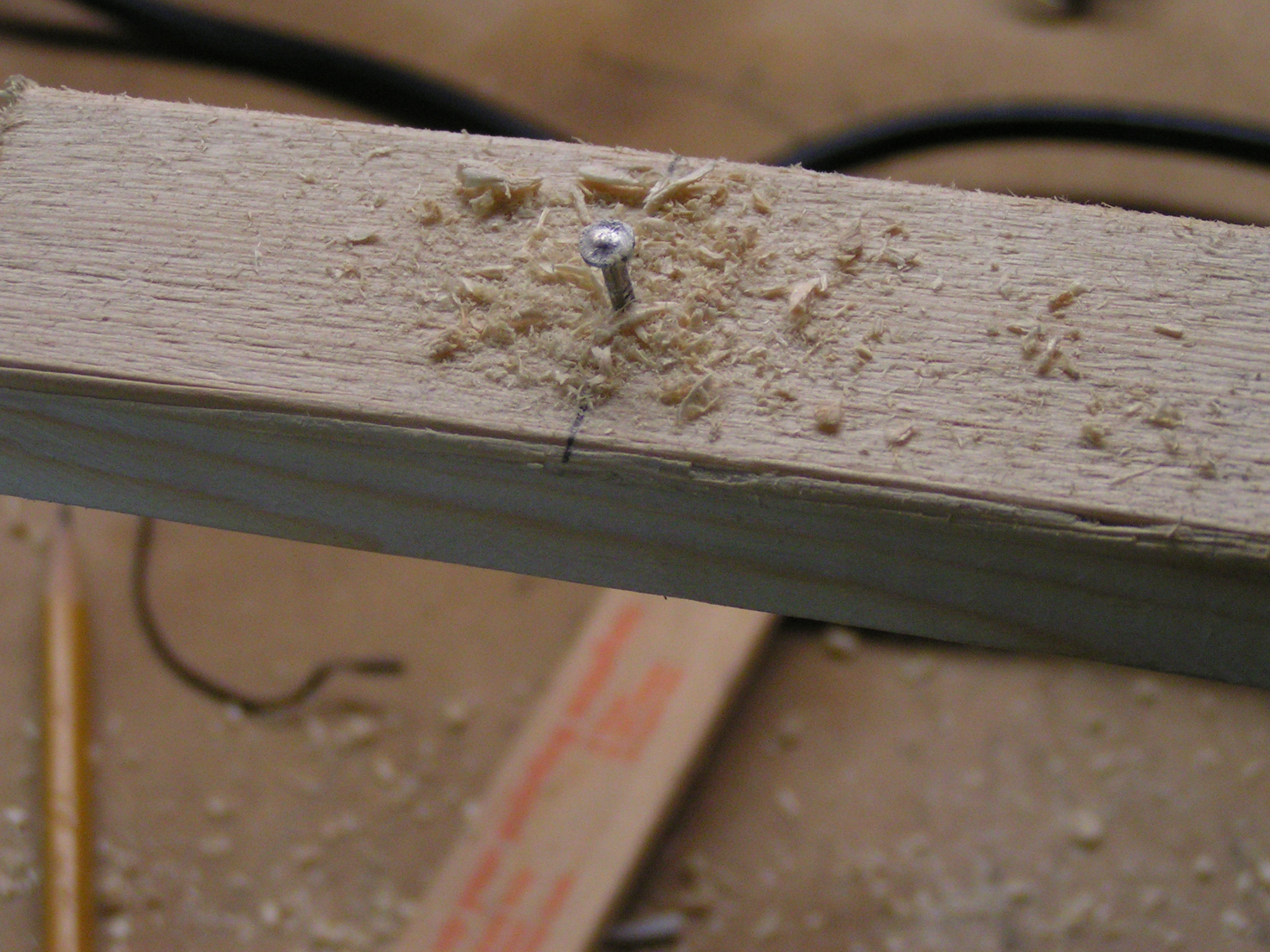
nailHere’s the nail; I did end up marking the side of the board where the nail is so I could move a little faster. After drilling a few of these though, you really get used to where 9″ is.

DrillingHere is a board being drilled. I drilled for about 4 hours on Sunday and Dennis drilled for another hour or so. We are about 1/3 of the way through our 110 boards. Then they’ll need to be sanded and we’ll have to figure out the cutting of the short pieces. Some have to be cut square and others at a 45 degree angle. The ones cut at the 45 degree angle go by the door frame. I did buy a 5 gallon container of orange paint to paint all the wood. That should brighten up the inside. So I’ll keep you posted on our progress. We’re going out of town next week but I hope to get all the boards drilled before we leave.

P.S. I still have all my fingers! 🙂

P.S.S. If you’d like to see an update on the umbrella tree, see my post on Permutations in Fiber.

Nuno Felt Experiments for the Studio Challenge

Nuno Felt Experiments for the Studio Challenge

Every quarter on the forum we do a challenge.   http://feltandfiberstudio.proboards.com/thread/622/second-quarter-challenge  I thought I better get on with it myself before the challenge runs out. I challenged people to try nuno felting or to try it on something they hadn’t before. I decided to try some fabrics that I wasn’t sure would work, to see what would happen. There are lots of pictures. I did shrink them so I hope they don’t overwhelm anyone’s computer connection.

For all the pieces I used merino wool in a contrasting colour so I could see how the wool migrated better.

The first is  a polyester knit that is like t-shirt material. It feels a lot like cotton.

poly knit

this is what it finished like. It worked really well. I think because it is a soft knit the fabric fibers could easily move out of the way letting the wool through.

polly knit felted polly knit felted cloce

This one is from a poly knit dress more like the polyester we used to wear in the 70’s.

polyester dress

It worked fairly well but it is heavier material and the wool didn’t come through as much.

poly dress felted poly dress felted close

These next two are different sides of the same silk fabric cut from a woven silk jacket. it was a pretty little jacket but small and out of date. The texture of the fabric is great, quite 3 dimensional. This is the right side.

silk jacket right side

silk jacket right side felted 1silk jacket right side felted close

I think it worked really well.

This is the wrong side.

silk jacket wrong side

It didn’t felt as well, I do not know why the fiber would not travel through fabric as well in this direction but as you can see not nearly as much wool migrated to the top.

silk jacket wrong side felted silk jacket wrong side felted close

Lastly is a mystery fabric. it is cut from a blouse. Both sewn into the seam together. one said 100% silk and the other said 100% polyester.

maybe silk

It did work very well but you can’t see its shine much at all. You do see it more in person.

maybe silk feltedmaybe silk felted close

There is still time to join in the challenge. Try something new or show us something old you tried that worked or didn’t. I think the failures or things that went sideways are sometimes the most interesting.

An Old Piece and a New Piece

An Old Piece and a New Piece

I only realised yesterday when I started to plan my blog post, that all my photos are still on my old hard drive. I was looking for another felt scrap piece that I recently started on when I came across a piece I made quite a while ago which I never posted about. If any of it looks familiar, it’s because I used it for the banners for the studio site and the forum 🙂
I wanted to make a piece with colours and textures inspired by the natural colours of the landscapes between Manchester and West Yorkshire. I used lots of different coloured natural wools and wool tops: Merino, Bluefaced Leicester, Manx Loaghtan, Zwartble, Black Welsh Mountain, Jacob, Gotland. I also used raw gotland locks and Lincoln locks.
OLYMPUS DIGITAL CAMERAI mostly used mid to dark shades of wool and animal fibre, there’s some sandy coloured Alpaca in here too.

OLYMPUS DIGITAL CAMERAFor texture I used some wool nepps.

OLYMPUS DIGITAL CAMERAAnd also some silk noil, I added a lot of this so it would look like a solid band.

OLYMPUS DIGITAL CAMERATo create a kind of mossy/spongey moorland type grass look, I blended some plastic fibre with some natural shades and  green shades of merino.

OLYMPUS DIGITAL CAMERAI was really pleased with the way it turned out, especially the shape, I wanted an organic shape because I thought this suited it better.
I did find the scrap piece that I was working on, I think this will be the outside of a notebook cover.

OLYMPUS DIGITAL CAMERA

Finished Cuffs

Finished Cuffs

This week has been a snatch a little felting here and there week. The cuffs dried out twice before they where ready to have the marbles added.

I use elastics for doing braids in horse manes and tales to put the marbles into the felt.

cuffs with marbles 1 cuffs with marbles 2

After they are dry its time to cut the tops off and pop out the marbles.

cuffs with marbles 3cuffs finished 2

 
After I cut the marbles out of this one with the silk on the back it didn’t look right. You cant see the silk inside.

cuffs finished

So I cut the blobs down farther to open them up more and now you can see the silk

cuffs finished 4

Here are all three finished.

cuffs finished 3

They are quit big.

cuffs on 1 cuffs on 2

I pulled the corners on one side of each end to make it cover a lot of area, mostly to see what it would look like. I like it.


Growing Roots and a Bit of Ground

Growing Roots and a Bit of Ground

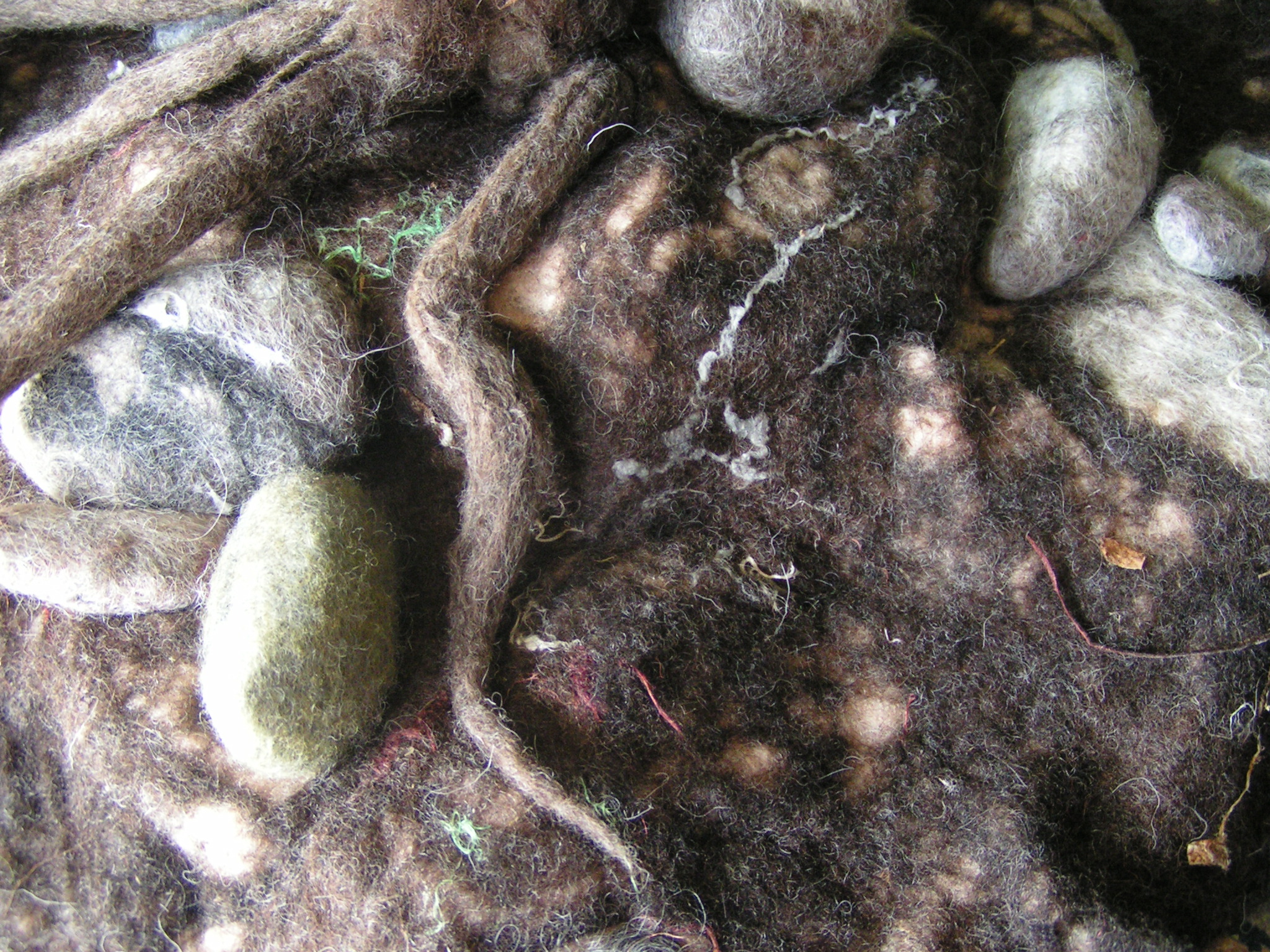
I have been continuing to work on my exhibition piece and it is getting closer to being finished. I started with felting a bunch of rocks, then ground to cover the base and last I made roots. Now I just have to put them all together, sew on the nuno felt to the umbrella and finish up the details.

Felted RocksThe rocks went pretty quickly, I used a variety of grays, black, browns, tans and greenish/browns. Even a little bit of red. The rocks in Montana are a variety of colors.

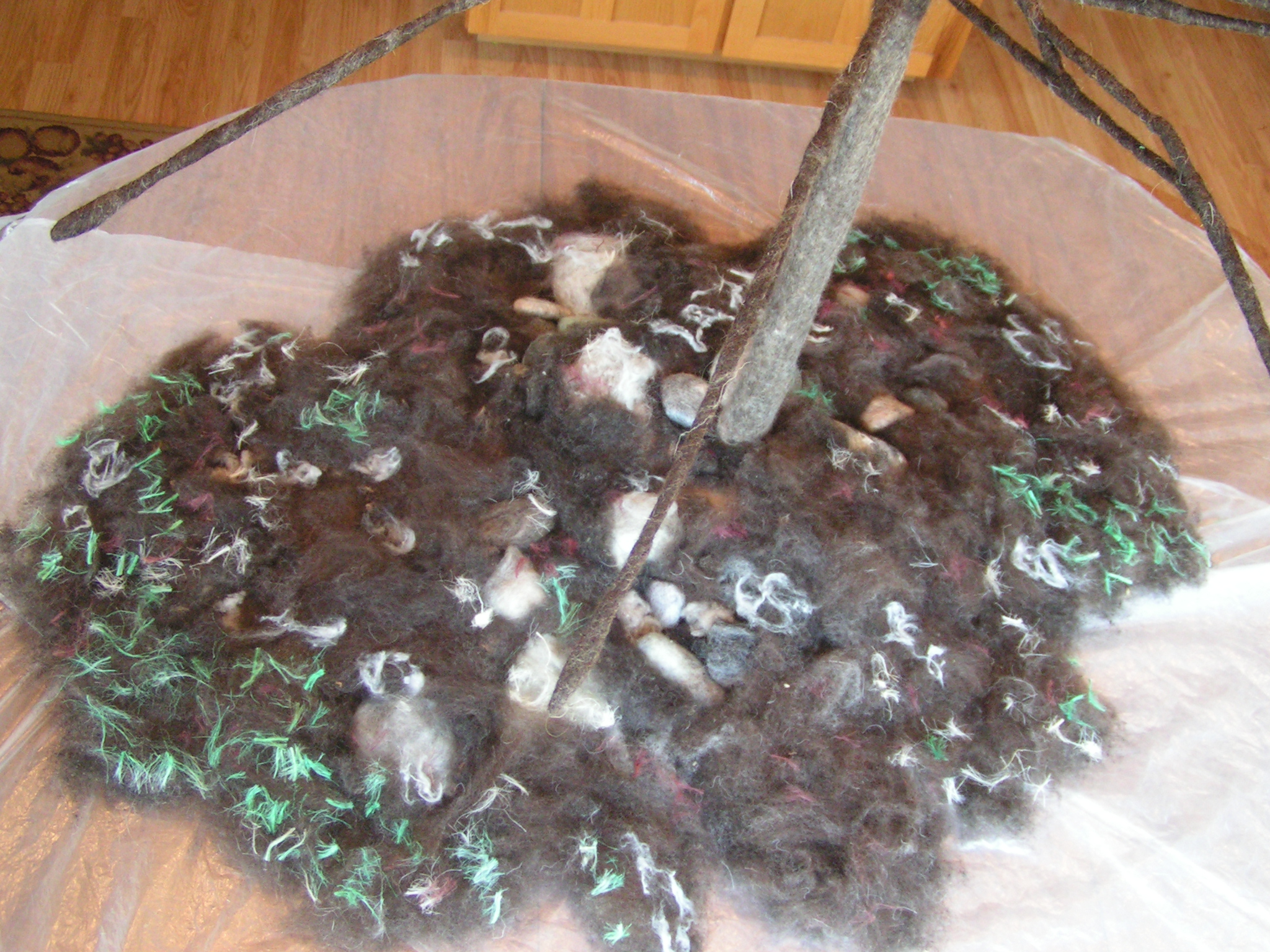
Lay out under treeNext up, I laid out the wool around the base. I wanted to felt it right around the trunk so it there would be no seam. I’m sure I could have done a piece of pre-felt but decided just to felt it right in place.

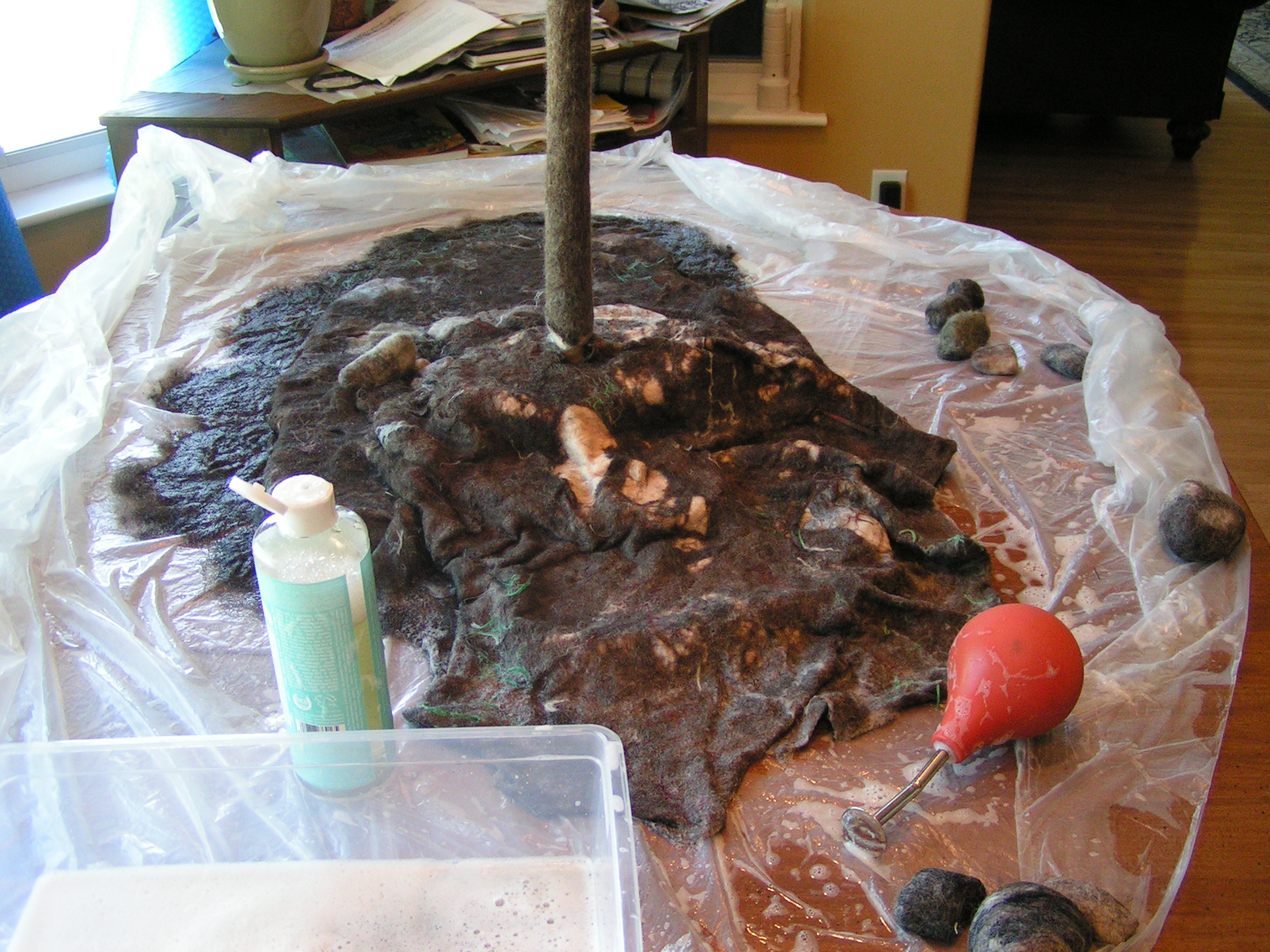
Wetting it down


Here it is being wet down. I had the felted rocks on top of the wool but decided they would have to come off or everything wouldn’t felt properly.

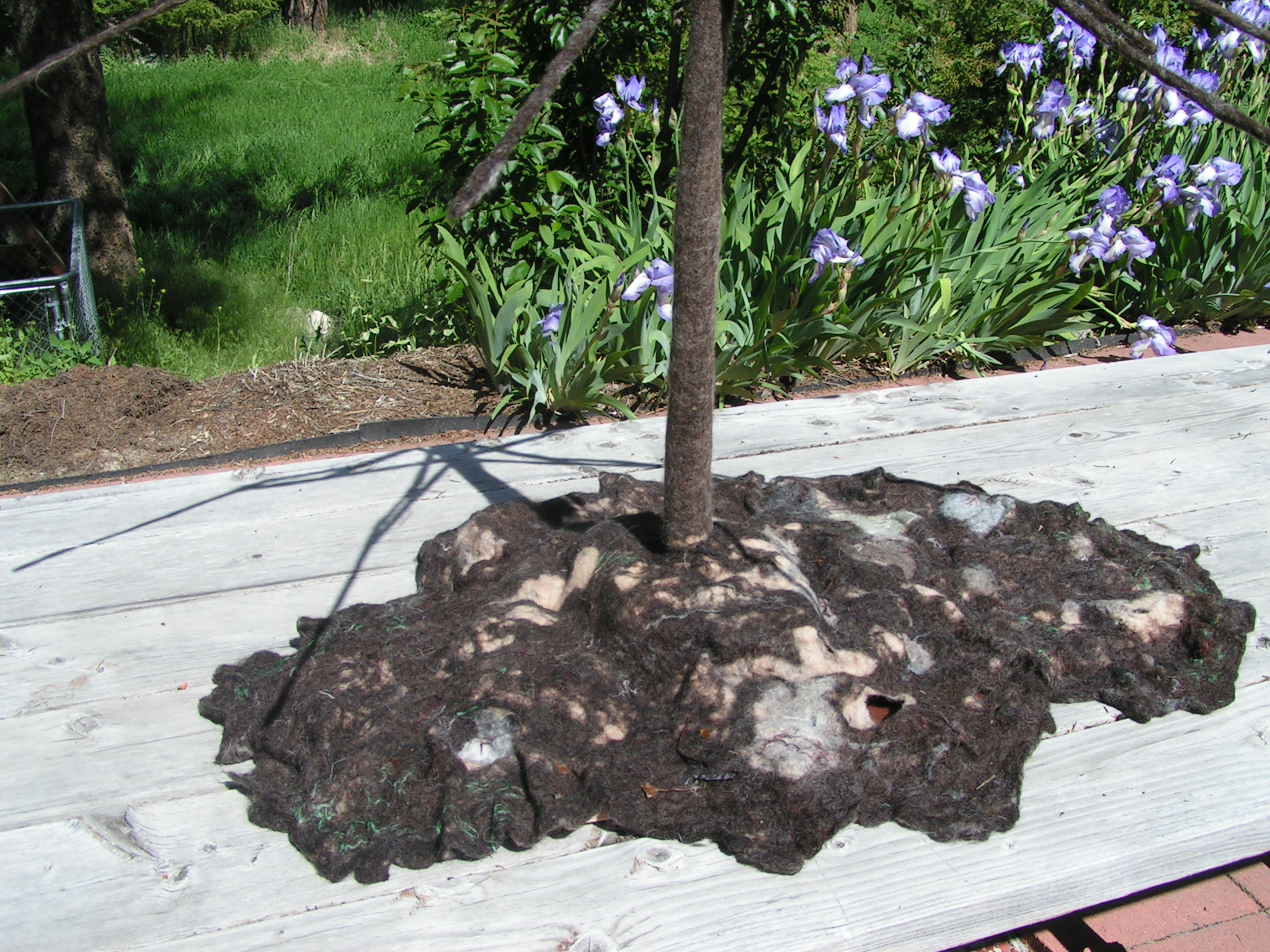
All Felted


Here it is drying in the sun after it was completely felted. I did have a bit of shifting of the surface “earth colored” wool but that will most be covered up by rocks, roots and other finishing details.

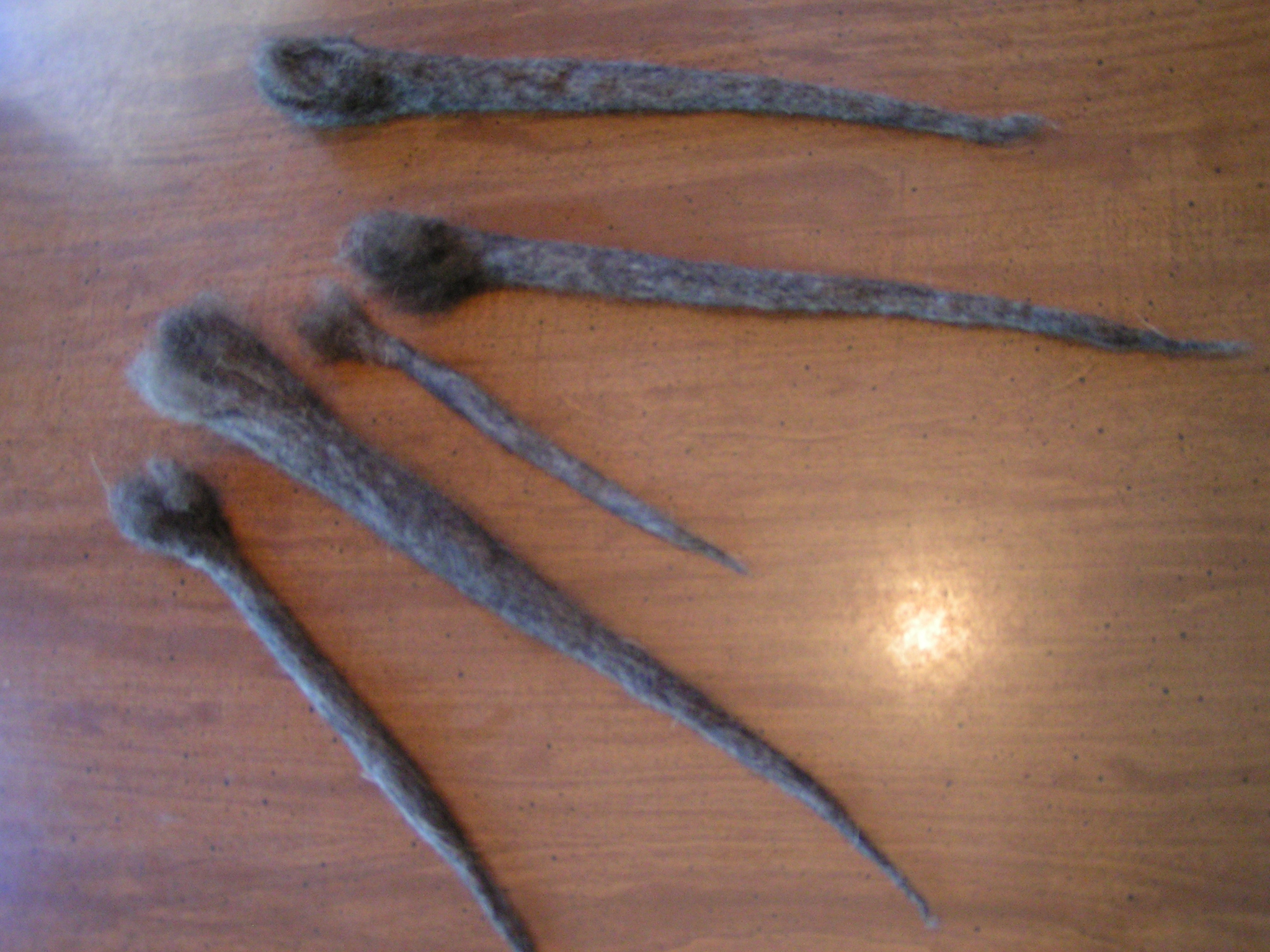
Soft rootsNext up was making some spikes for roots. Here they are after dry felting and rolling on the “Turbo Felting Board”. This board really works great for making cords. You can use stair tread that they sell at hardware stores as a substitute.

Felted rootsHere are the roots after felting down. I didn’t harden them up because they need to be shaped once they get attached to the tree.

Around the trunkHere’s the entire tree with the roots just laid down. It almost looks finished now!

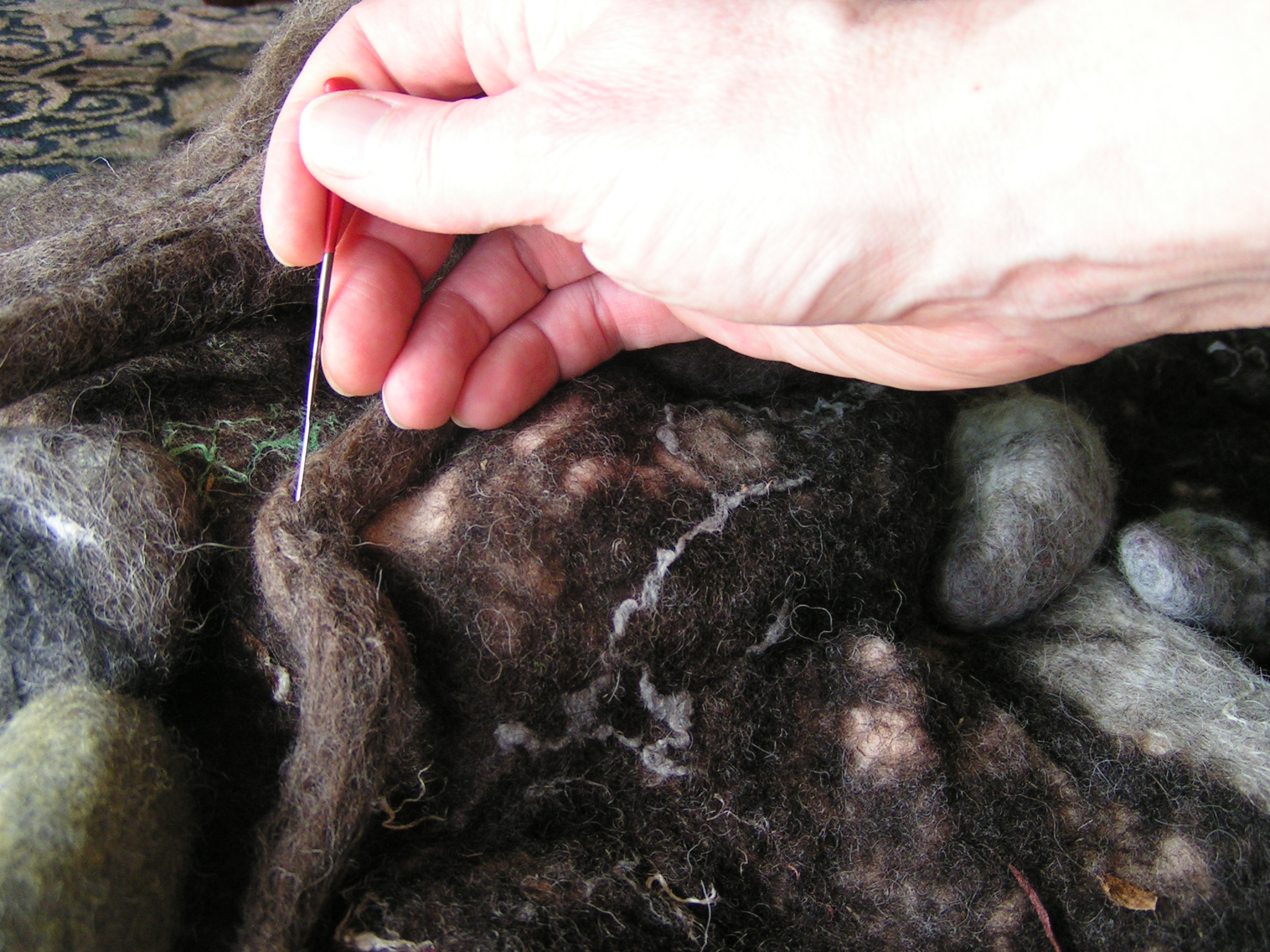
Needle FeltingNext up was a little needle felting to shape the roots and attach them to the trunk.

More like a rootAh… that looks more root like.

Partially FinishedI got two roots started on the needle felting process. I am still going to add some padding underneath the “earth” and glue it down so it won’t be shifting around if someone touches it. So it is getting there. I am happy with how it is turning out.

I also thought you might like to see part of my inspiration for this piece. A poem by Karen Shragg:

Think Like a Tree

Soak up the sun
Affirm life’s magic
Be graceful in the wind
Stand tall after a storm
Feel refreshed after it rains
Grow strong without notice
Be prepared for each season
Provide shelter to strangers
Hang tough through a cold spell
Emerge renewed at the first sign of spring
Stay deeply rooted while reaching for the sky
Be still long enough to hear your own leaves rustling