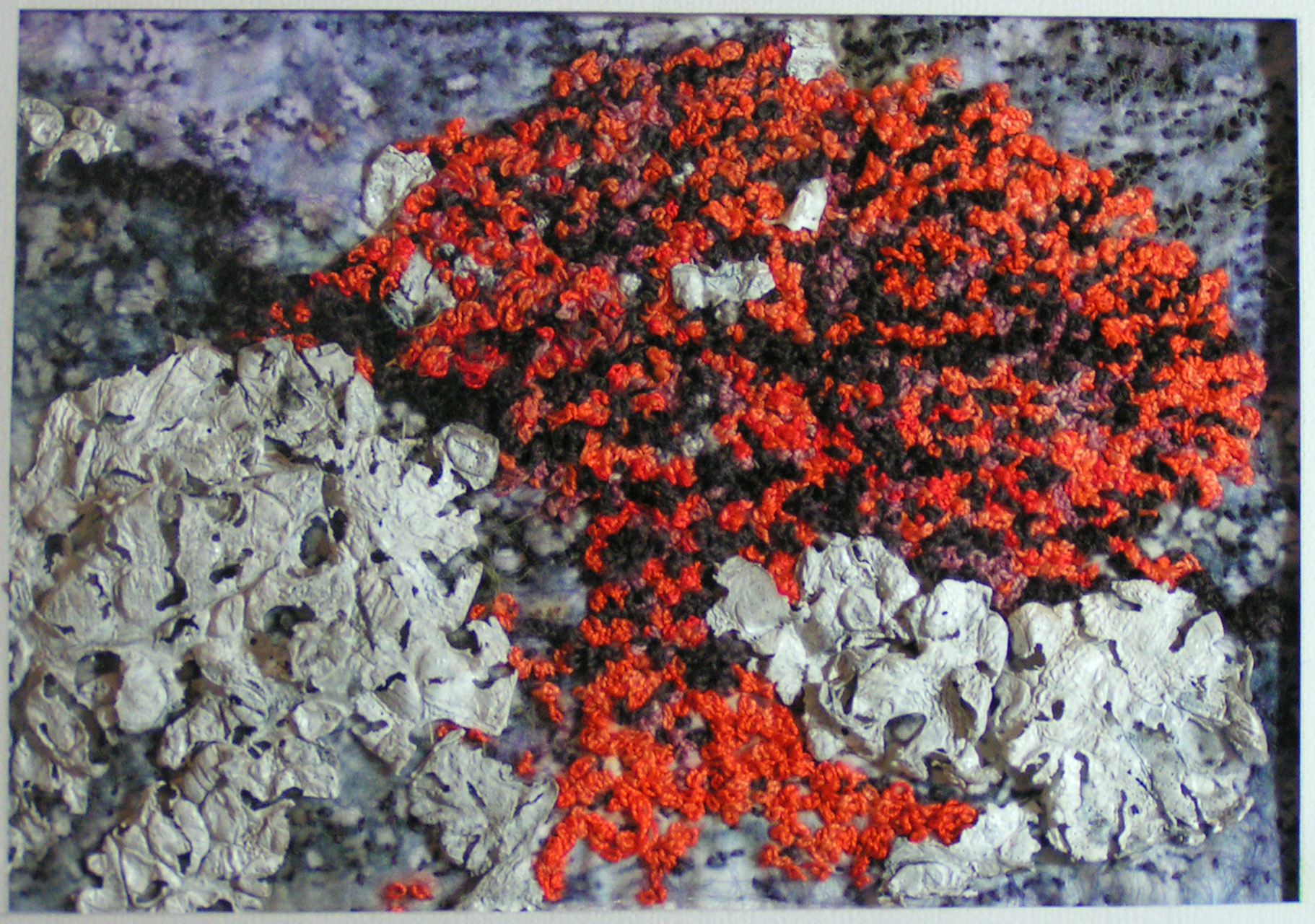
I finally finished my last print to stitch piece from my class homework. This piece was all stitched by hand and I started it in class on September 8th. I finished it on November 22. I can’t say that I worked on it every day but I did spend 3-4 hours per week on it. I thought it was never going to be finished. But I made it just in time. I go back to class on November 28th.
This is the original photo. It is a rock with various kinds of lichen on it. The photo was cropped and printed on to fabric. And then I started stitching. I stitched and stitched and stitched…
Here is the finished piece. You should be able to click on the photo to get a better look at the stitching. Most of the stitches are detached chain stitch with the thread left loose. The white parts at the bottom are painted and heated Tyvek. The background stitching is seed stitch. All the orange stitching was done with a variety of shades of orange which were hand dyed. I am so happy it’s finished!
One thing that a lot of us who share photos on the internet have in common, is that we can spend hours editing them. Almost every time I do a blog post, I have around 5 or 6 photos that I need to crop and shrink so they aren’t too big when they’re clicked on, and so they don’t take up all the storage memory.
A lot of the photo editing programs have ‘Batch Editing’, this allows you to open multiple photos and edit them all in exactly the same way very simply with just a few clicks, so you’re not having to sit there and manually alter every single one. It really saves a lot of time and effort. It is particularly useful if you have to shrink a lot of photos or have a batch that all need brightening up, or maybe you want to add a signature or apply an effect to create an abstract design….I found this really useful when working on photos for Ann’s abstract challenge a few months ago.
I’ve written a tutorial showing how to use the Batch Editing feature on Photoshop. I’ve only ever used Photoshop, so I can’t be sure that other programs do it the same way, but this should give you a good idea of what to look for on other programs. I’ve used shrinking as the example on the tutorial, because this is one I use most often. I know a lot of people like to add signatures or watermarks to their photos, batch editing is really good for this as long as you want the text to be exactly the same on each photo.
It’s always a good idea to have a practice first before recording an Action for batch editing. I usually keep notes for each effect applied, type size, or what the brightness and contrast levels were etc, then it’s easier to recreate. One thing that is important to point out, for certain effects, alterations or filters, for the results to be exactly the same, the resolution of the photos must be the same as each other and as the photo you originally worked out the Action on. If not, you could end up with type of different sizes for example.
I hope you find it useful and if you have any ideas for other tutorials, please let us know 🙂
In the last column, I discussed ways to start working on your artist’s statement and why you might need one. Did you get started? Do you have a list of phrases and words to use that describe your work? If so, you’re ready to start putting the statement together. Let’s get started.
Keep it Simple – Make sure that everyone can understand what you’re saying. Use simple language, keep it short and concise. Forget all that artist speak and say it in your own words.
Open with Flare – Come up with an original opening sentence. Most statements start with “My work is…” or “I’m inspired by…” Avoid those and come up with something fresh and from your own perspective.
Speak as Yourself – Write in the first person. What would you say to a customer or a gallery owner about your work? You wouldn’t say “Sue Smith makes felted scarves”. Make “I” statements.
Include the Basics – Make sure to include how you make your work, what media and tools you use, what the work means to you, what inspires you and how that inspiration appears in your work.
Keep it Short – This bears repeating. Your statement should be no longer than three paragraphs. More words doesn’t make it better. Once you’ve written a first draft, go back and cut out any unnecessary words.
Let it Stew – After the first editing, leave it alone for at least 2-3 days. A week would be better. You will come back to it with a fresh eye. Edit the statement again after you’ve let it rest. Keep pruning!
Share it – Let a close friend review your statement. A second opinion is always helpful. Tell them that they won’t hurt your feelings and that you want an honest opinion and suggestions for improvement.
Rewrite It – Now that you have further suggestions, use those to rewrite and revamp your statement. Make sure the words match your work. If your work is playful, write the statement in the same vein.
Save All the Work – Keep all your notes and all the versions of your statement. You will need to occasionally rewrite your statement and you can use these notes for rewrites.
Put It Out into the World – You’re now ready to tell the world about your art. Print out copies to be ready to give to interested galleries, customers and to include in applications. Your artist statement will be your personal ambassador and will open new opportunities for you, so don’t be bashful.
If you write a statement, I’d love to see it. Ann started a post on the forum about artist statements, so feel free to add yours.
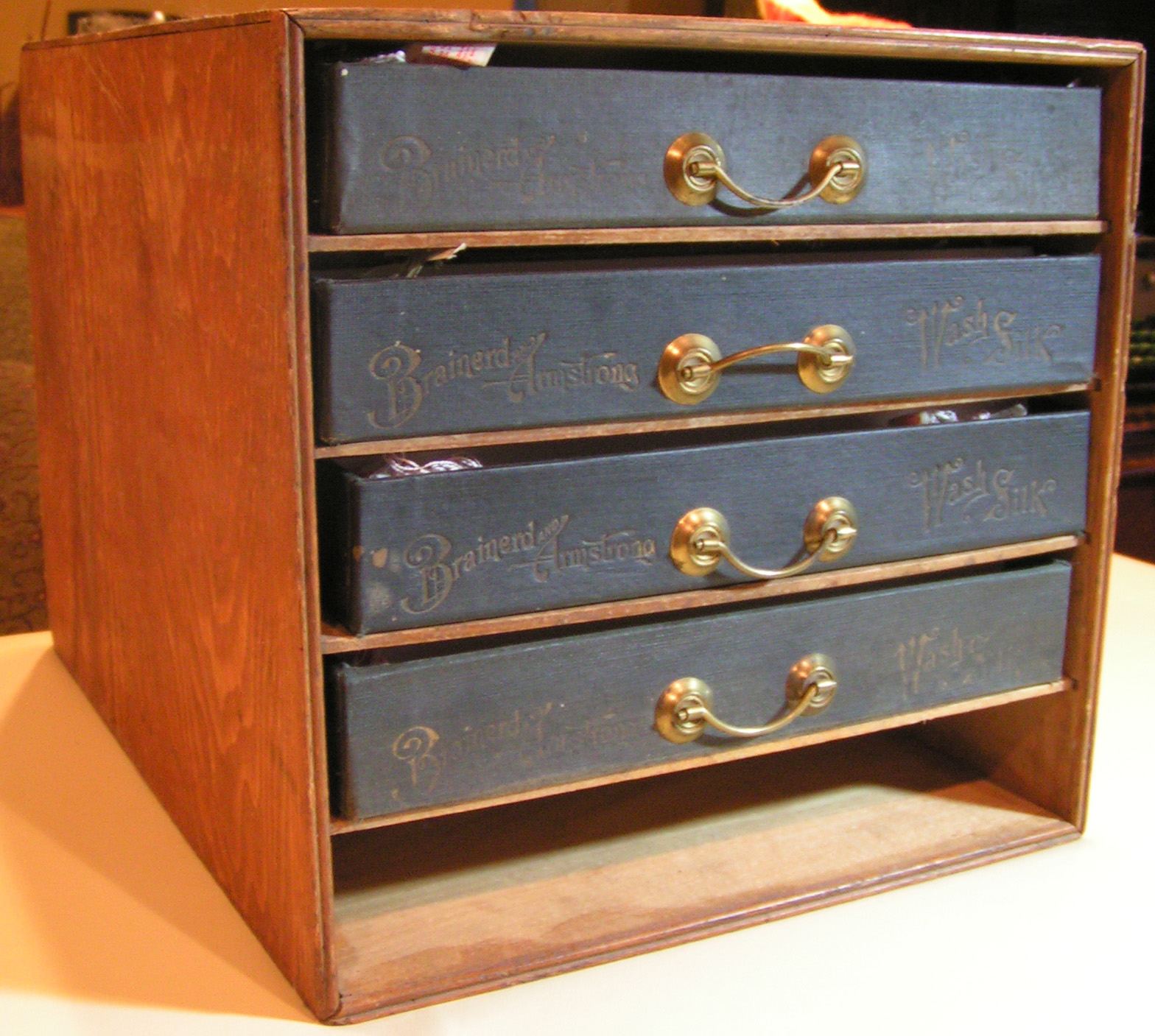
My friend Paula found an amazing box at a yard sale. I’m not much one for going to yard or garage sales as I don’t have the patience for it. But luckily Paula found a box of silk embroidery thread that must have been from a retail establishment. Believe it or not, she paid a quarter (25 cents) for it.
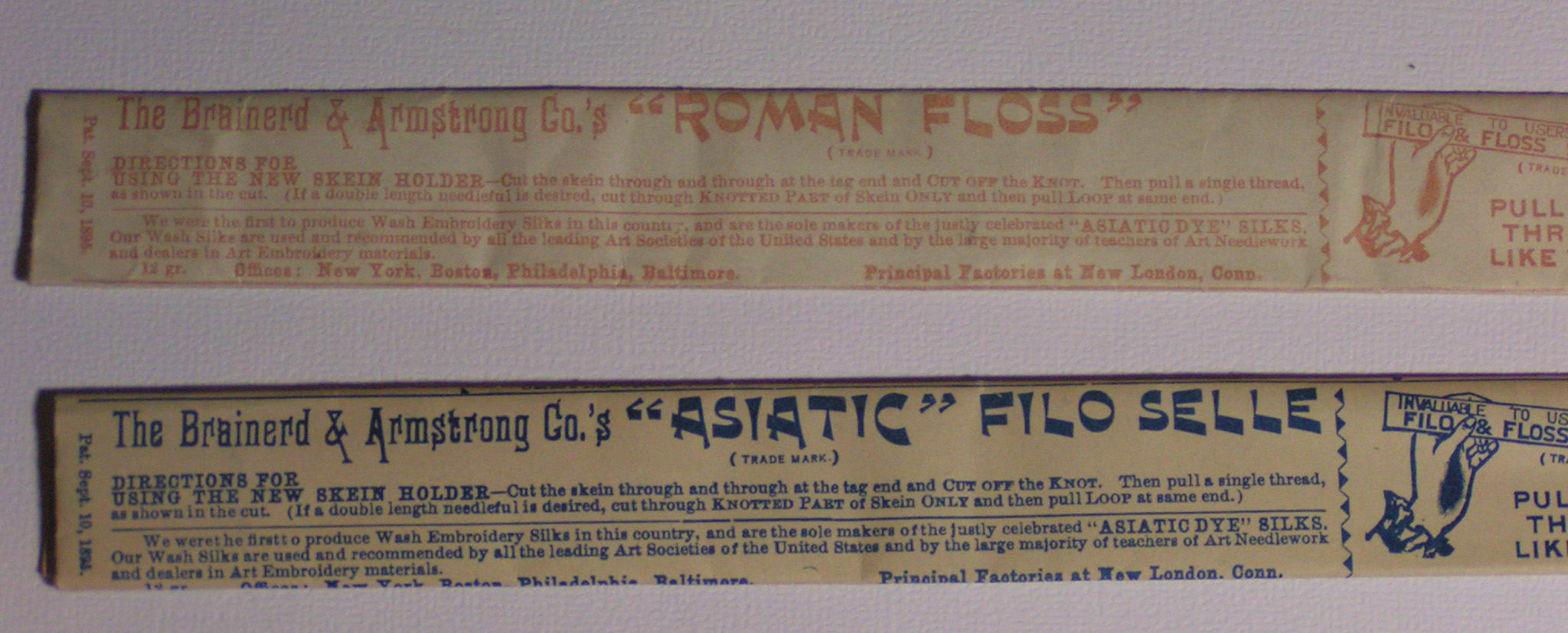
It is from the Brainerd and Armstrong Company. After a little searching on Google, I found out that this company was in business in the late 1800’s until 1922 in New London, CT, USA. They made “wash silks”.
Wash silks were also called “society silks” and were used in silk art embroidery.
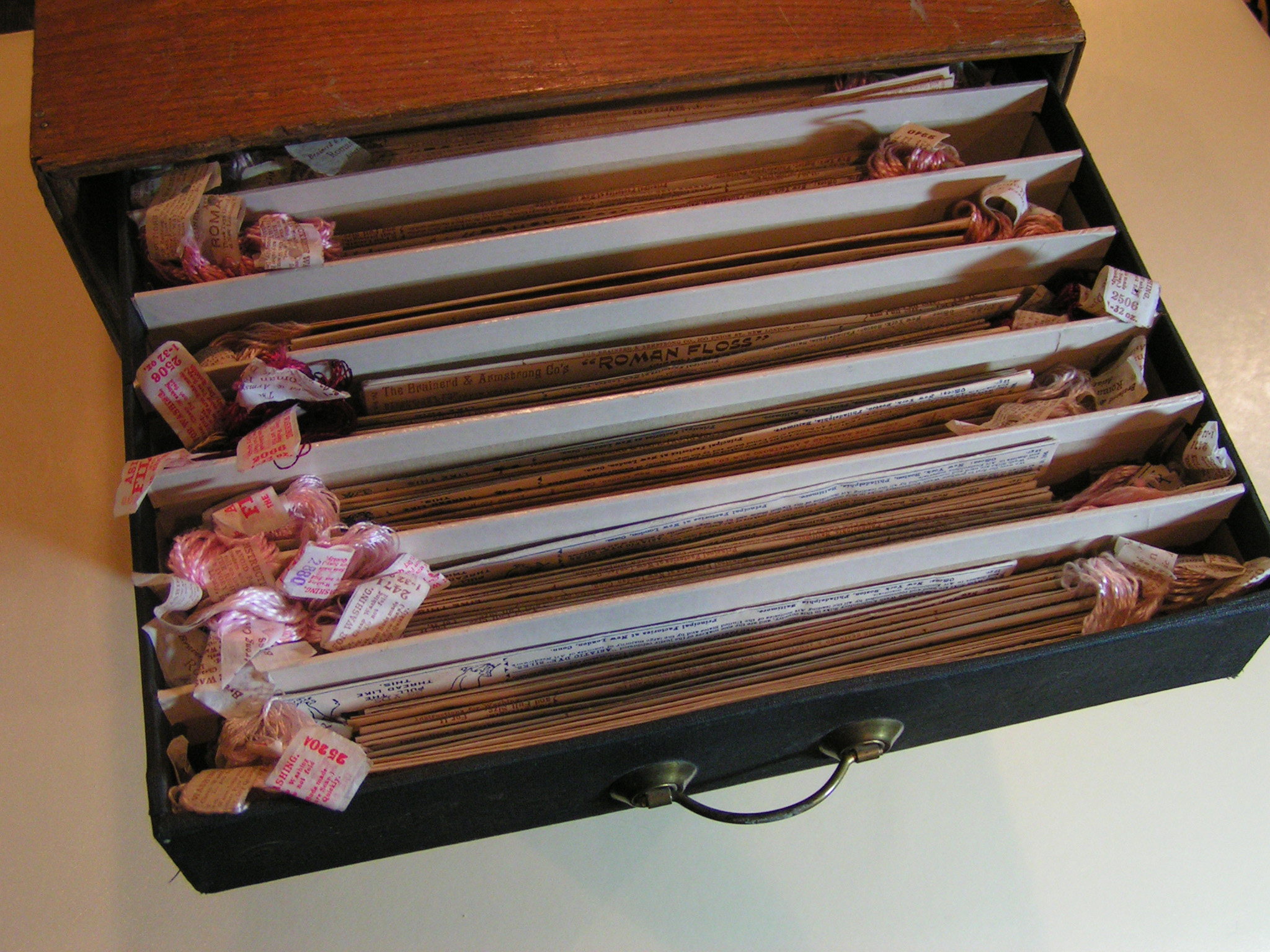
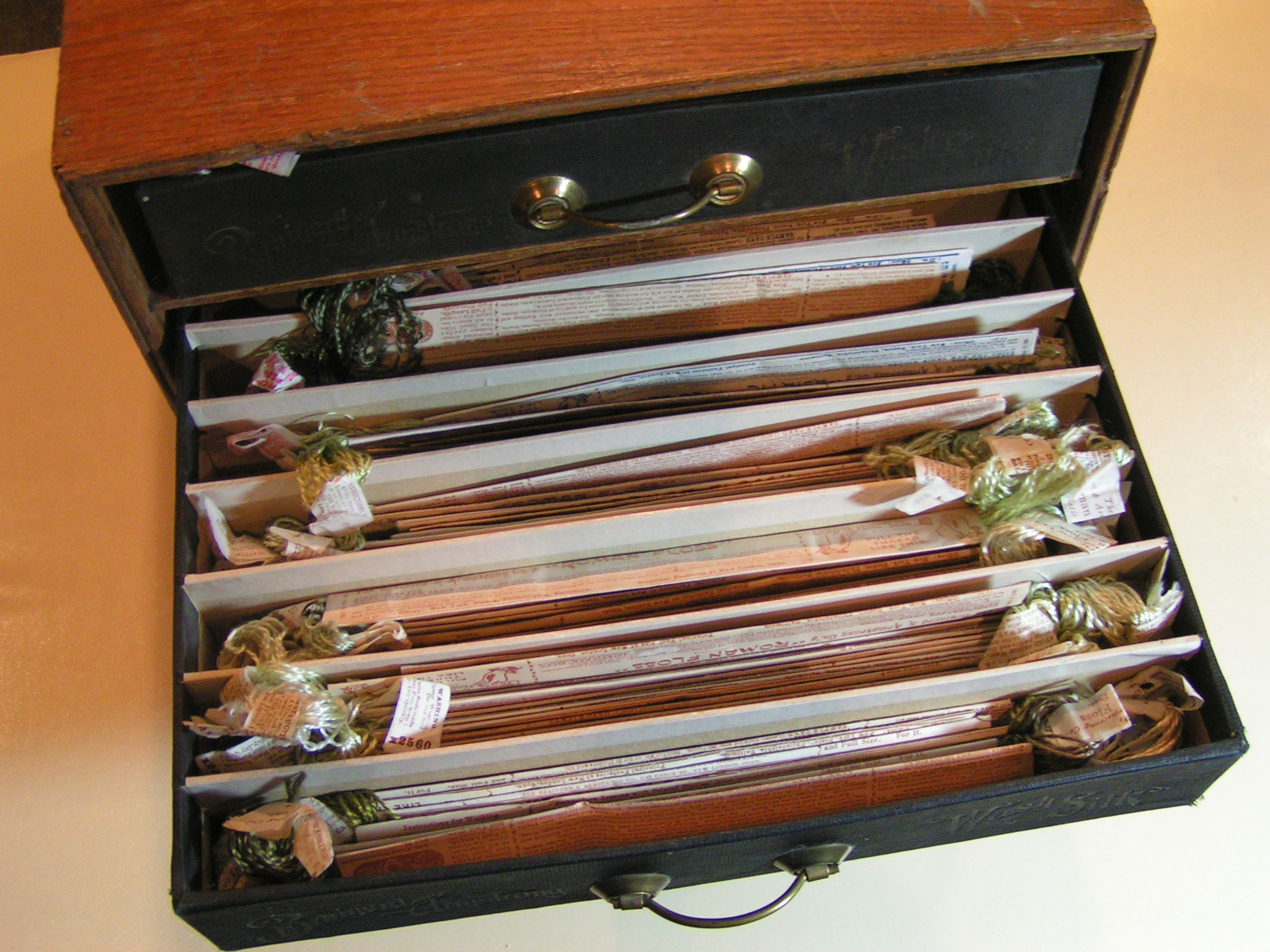
As you can see, the drawers are stuffed with little packets of thread. There are several different weights in a range of colors. I couldn’t resist and this box now belongs to me.
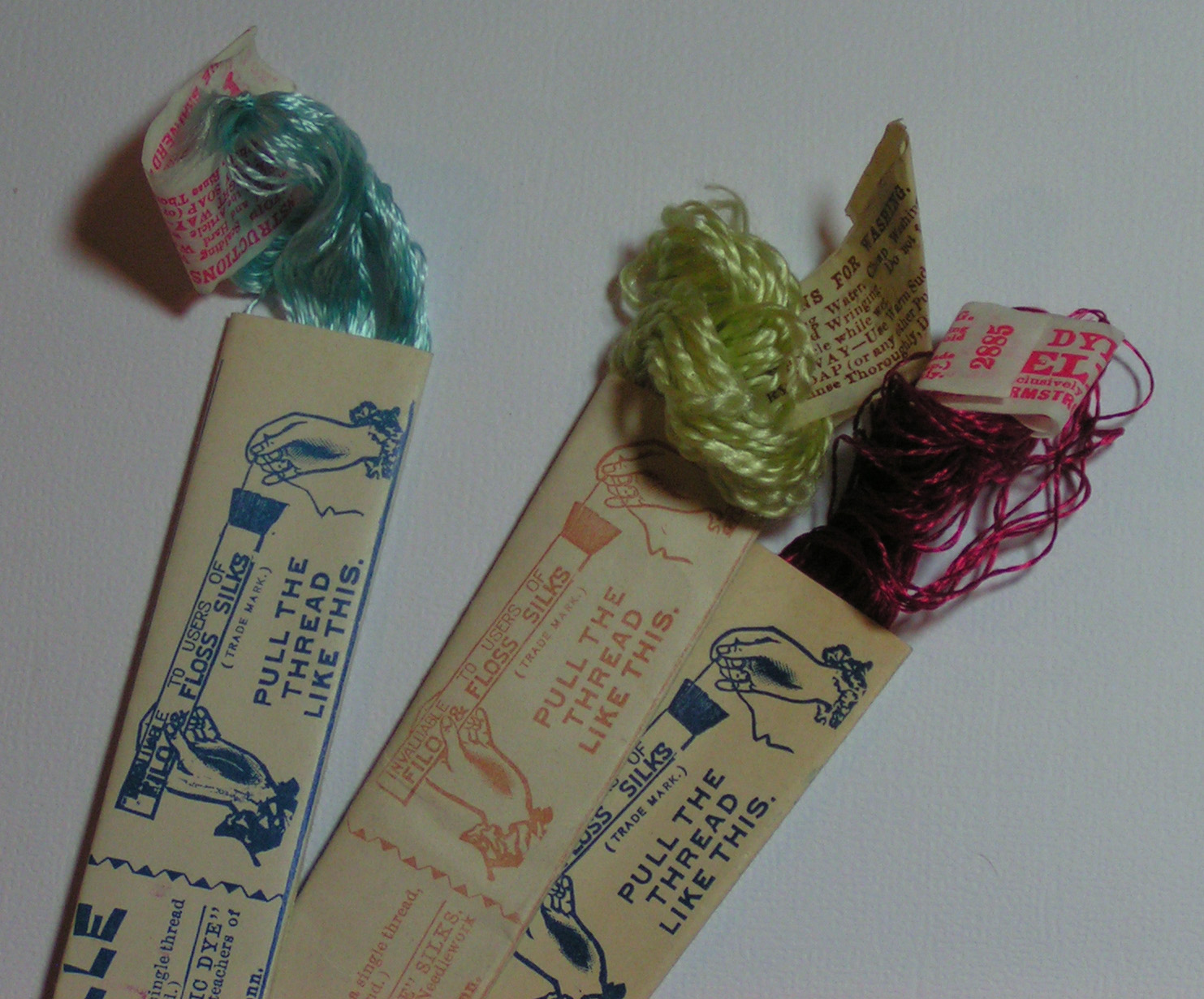
These packets have lots of information on the outside and are made specifically so the threads won’t tangle.
Here’s just a few of the colors. Most are in the pink/red shades but there are lots of greens as well as some purples and blues. I found several books on archive.org that were published by Brainerd and Armstrong. The first book, Embroidery Lessons with Colored Studies gives projects to work and has very generalized instructions. The second book is a general look at silk, The Story of Silk and Embroidery. You can download these book for free and they are actually quite entertaining. I wouldn’t recommend them as a stitch guide as the instructions are vague but it’s well worth the time if you are at all interested in hand stitching.
I don’t think I will be able to make myself use these threads but we’ll see. It’s amazing that they are in such good condition. What do you think? Would you use the threads or save them?
Here in the U.S. it is Thanksgiving. Most people stuff themselves with turkey and all the fixings, watch the Macy’s Thanksgiving Day Parade and football games on TV and try to get along with all the visiting relatives. Many of us forget to think about what Thanksgiving is really about. Giving thanks, being grateful for what you have and counting your blessings. I thought today I would take a little time to do just that.
I am grateful for the beautiful area where I live. Northwest Montana is gorgeous in any season and is such an inspiration in my artwork. I used to live in Florida and really missed the change of seasons, mountains, and snow. I might complain at the end of the winter about the snow, but I am happy to see it snow and I love to ski, so I’m praying for snow again.
Thank goodness for sheep! I am grateful for the wool they provide and the magical ability of the wool to felt. It still amazes me when I take a pile of fiber and turn it into a piece of felt. And isn’t it nice that wool is a sustainable product that doesn’t hurt the sheep to produce? Just think how many different types of sheep and wool there are in the world, isn’t it wonderful that we have all those varieties with which to experiment?
Iris Vase
Speaking of fibers, I am grateful that there are many different types of fibers and that I get a chance to play with them. Finding your passion is a wonderful thing and I hope that you have found something in your life to be passionate about. It has been wonderful this year for me to focus on fiber art and to participate in learning more about machine and hand stitching. It is a wonderful journey to be following and I hope it will continue to be as fun and fulfilling as it has been for me this year.
I am thankful for owning my own business and being able to make a living. Pursuing your dreams is not always easy but I am so glad that I took the jump nearly 15 years ago to start my own business. All the hard work has been well worth it.
My family is very important to me and I am grateful that I have a loving, supportive husband and two healthy and happy dogs.
I am really grateful to my friends here at The Felting and Fiber Studio. Thanks Zed, Ann and Karen for all your support, we make a great team! I am also thankful for all of you who read the blog, participate in the forum and post photos to Flickr. We appreciate your comments and hope you’ll keep coming back as we have loads more fiber fun in store for you.
Take a few minutes today and think about thankfulness and gratitude. With the holiday season upon us, it is easy to get busy and stressed out. Taking a few minutes each day to make a list of reasons that you are thankful can put a little peace into your life. Happy Thanksgiving 🙂
P.S. Take a look at this post by Christine Kane about gratitude.
I haven’t had much free time to felt or make things lately, but making the collage notebook cover made me realise I could have a sewing project on the go that I could spend 15 minutes on here and there when I feel like taking a break (instead of watching cat videos on youtube!) I still had my felt offcuts to hand so I made myself a glasses case to match the notebook. I needed a sturdy one for the glasses I keep in my bag, so they don’t get damaged by all the other useless stuff I pile in there 🙂
I got some nice fabric from Ikea a few years ago and used some to make a nice lining.
When I was sorting through my spare felt and offcuts, I came across a few pieces of felt that I made earlier in the year to use for stitching practice. You may remember a few of us said we were going to do the Take a Stitch Tuesday challenge? I did try and probably lasted about 10 weeks, but I found the instructions too hard to follow. Ruth kindly looked up videos to help us, but sometimes there wasn’t one available, so I lost interest when I was spending more time looking for understandable instructions than actually doing the stitch. So, now I have 4 spare pieces of felt and thought I would ask everyone for their suggestions what to do with them. These first two are both about 8 x 12 inches
And these two, made from all natural shades of Merino and Bluefaced Leicester are about 10 x 12 inches
I look forward to hearing your suggestions and I will post photos of what I finally decide to do with them 🙂
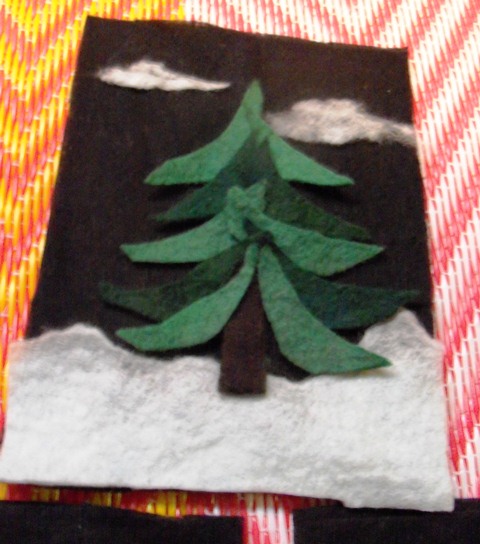
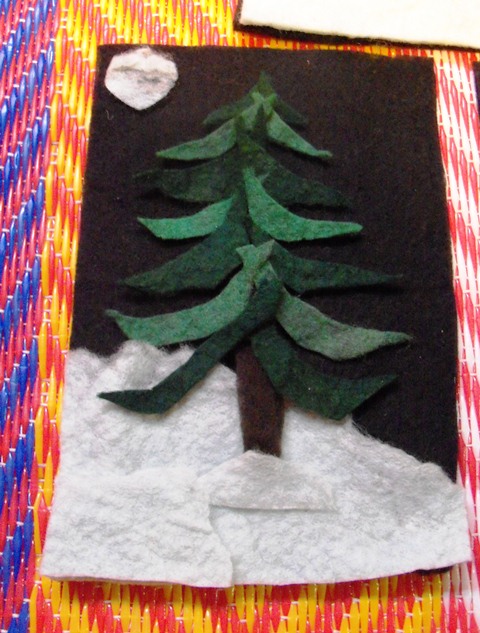
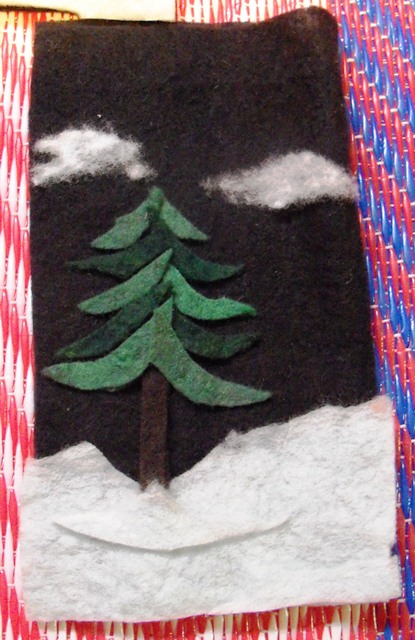
I was tidying up after making something else and had a pile of green trimming. With Zed’s felt scraps post still fresh in my mind they looked like branches to me. I think I must be in a tree mood. I used prefelt for the back ground because I didn’t have any scrap black felt and I wanted to get on with making the pictures and not with felt making.
I used the edge of an off cut in very pale blue piece of felt for the snow and a very thin edge piece for the clouds and moon. its hard to see but I layered the snow pieces on 2 of the pictures to see if it would give more depth after felting. i have never had much luck wet felting finished felt to semi felted pieces but after some rubbing and rolling it all went together really well. I am quit pleased with how they turned out.
There is more depth in the layered pieces. It doesn’t show well bit it does make the snow look more dimensional. They still need ironing to straighten up the edges. They are a bit to big to use on cards. I think they might look nice side by side in a long frame.
I thought it would be fun to show some holiday crafting ideas. These aren’t all specifically felt or fiber but I thought it might help to spark some ideas for those of you who make your own gifts and holiday decor. Many of these ideas could be adapted to felting or fiber arts. I’d love to see what you’re making for the holidays so do leave a link if you’ve made something fun or post it on Flickr or the forum.
I decided not to wait until the last min to do my challenge piece this time. The forth quarter challenge is weather. http://feltingandfiberstudio.com/2012/10/25/weather-challenge/ This piece I did on a piece of black silk chiffon. It’ s meant to be framed. I was going to use this for my exchange gift but then thought It wouldn’t be fair so send something they then had to frame.
The picture on the right is of the snowscape and several other things rolled up. I am messy. You can see the water on the table from me wetting down and it pouring off the corner. It’s OK though I have cement floors and a center drain.
Needling on some of the snowflakes that did not stick during rolling. I think I made the little balls to tight.
The finished picture from the front and back. I like both
I have a second entry on the same theme I will show you in a few days.
Most artists that I deal with do not like writing an artist statement and many don’t have one at all. Since most artistic people are more visual than language oriented, writing an artist statement becomes a difficult task. So why should you bother? People communicate with language and when they are interested in your art and want to know more, the artist statement can be the start to that conversation. Whether it is something you give to potential buyers, give to galleries or is required for entering shows, the artist statement is essential for communicating what you do in your art and why you do it.
A good artist statement reveals more about you the artist, your inspiration and motivations, how you work, the materials you use and what your art means to you. To communicate this information, you need to keep the statement short and succinct in language that anyone can understand. Avoid using vague language that could be used by anyone such as “I am inspired by nature”. What specifically inspires you about nature? Is it the vast desert landscapes and the colors of the sunset? Or are you inspired by the textures of lichen on a rock? Use your thesaurus to find adjectives that specifically communicate the idea you are expressing. Find words that match the type of art that you create. Is your work comical or funky? Think about the language that would fit and express that side of your art.
Start listening to what others have to say about your art. What words do they use to describe your work? Write the words down. Think about why you do what you do. What makes you the happiest about your work? Is there a specific method that you like the best? Why? Is there something that you do that never fails to inspire? Write it all down quickly like taking notes. Don’t try to edit the words when you first start. Just write it all down.
Once you’ve started your list of words and phrases, look all these words up in the dictionary and thesaurus and find more words to add to your list. Spend time on this search and keep thinking about your art. Ask yourself what your art means to you. Keep your list handy so when an idea pops into your head, you can write it down. Many times your subconscious can work on these questions while you are busy doing something else and great ideas will arrive at the most unexpected times.
So do you have an artist’s statement? If you do, are you happy with it? Did you write it ten years ago? Take the next two weeks to get a list of words that describe your art and why you do what you do. I’ll discuss writing the full statement in my next column. Don’t miss this opportunity to better communicate with the world what makes your art unique.