Browsed by
Month: April 2012

How to Approach a Gallery or Store to Carry your Artwork – Part 1

How to Approach a Gallery or Store to Carry your Artwork – Part 1

As a store owner, I really hope that you pay attention to this post if you’re thinking about approaching a gallery or store about carrying your work. One of my pet peeves is artists showing up without an appointment. Take a few minutes and find out the gallery’s policy for taking work, either on consignment or wholesale and follow that process to a T. Starting out on the wrong foot by just stopping by can really reduce your chances of getting your work accepted.

Do a little research first. Find several businesses in your area that you think might be good possibilities for your work. Look at their websites and see if they have a submission policy listed. Print it out and read it carefully. While you’re on the website, look at other artist’s work that they carry. Do they have work that is very similar to what you do? If so, you probably need to find another place as they will have their loyalties with that artist first and most likely will not take in work that will directly compete with something they already carry. Do they only show paintings? Unless your work is two-dimensional and a “wool” painting, the gallery will most likely not be interested in carrying work like felted soaps or nuno felted scarves. If the gallery doesn’t have information online about their submission policy, call and ask what it is. Again, make sure to follow whatever instructions you are given.

Once you’ve found a few businesses that you feel might be a fit for your work, do a reconnaissance mission and check out the gallery before trying to make an appointment. Don’t try to talk to the staff about your work, just go look at the gallery. Does it seem like a good fit? Do you know some of the artists whose work is in the gallery? Does the gallery carry your type of media and if so, what kind? Do you have work that you think will be a good addition to the mix that the gallery carries? If you do happen to know any of the artists, contact them and ask them how it has been working with the gallery. How has their work been selling? Do they get paid in a timely manner?

Next, you need to do a little planning and thinking about your work and what you think will interest the gallery the most.  If you are submitting photos of your work, make sure to get good clear shots with a white or neutral background. If you will be showing your work in person, think about which pieces make a nice set and plan on taking enough work so that the owner or buyer can get a feel for what you do. Most galleries carry work on consignment basis which means that you don’t get paid for the work until after it sells. The gallery will take a percentage of the retail price since they are the ones selling the work. An average percentage rate is 60% of retail paid to the artist and 40% of retail paid to the gallery. Make sure to take this into consideration when pricing your work.

If you are submitting your work by e-mail, write a nice letter to accompany the photos and price list. Tell the gallery about yourself and your work process. Explain why you think your work would fit well in their gallery. Ask them to reply to the e-mail so that you know they received it. You could also include your artist statement and resume if that seems appropriate. Again, make sure that you follow all the directions you were given for submission.

In Part 2, I’ll discuss visiting a gallery with your work, what questions you should ask and what to do if you get accepted. The worst thing that can happen if you approach a gallery is that they say no. Don’t let that scare you off from trying. There are many reasons for the no and it isn’t always because your work isn’t good enough. Ask why your work was rejected. You might be able to learn from the situation and improve your presentation with your next try.

Felting Around the Web

Felting Around the Web

Felt Alongs Lamp/Vessel

Deborah’s March Doorstops

“Ordinary” Face by Mattie van den Heuvel

Felted Hand Puppets by Frauke Walder

Felted cords/ropes

http://anajskreativestagebuch.blogspot.com/2012/04/sowohlalsauch.html

Flextile’s Shibori Dragonfly

Deborah Schlegel’s Post of Kelsey V. Wiskirchen’s Thread Sketching Exhibit

Kay Susan’s Slow Cloth with TAST stitches and a second post about it

Louise Saxton’s Reclaimed Needlework

Paper Sculpture by Anna-wili Highfield

Fabric and button flower brooch tutorial

How to make an owl from felt pieces

Whitney Matalone’s Time Lapsed Video of the IKAT weaving process

A Few Felt Samples

A Few Felt Samples

I haven’t been doing much that is interesting to look at lately. Everything is white and is waiting for the dye pot.  I thought I would show you some samples a made a little while ago. The first 2  are purple merino with some silk strips on them. I thought they came out nicely with lots of texture.

Purple wool with strips of silk before felting
Purple samples after felting

The second is orange merino with some silk and curls on it, here I wanted to felt the curls right into the background. I also wanted to see how it would stick if I put it over the silk. I really like the way the little blob of curls all became one with nice texture. The curls going across the silk stuck down very well. Enough wool migrated through the silk to grab the courser wool of the curls.

Orange wool with silk and curls before felting
Orange sample after felting

This last set I wanted the curls to be attached at the base and left loose and hanging for the rest of their length. I use a small piece of scrap floor underlay with a hole in it so the wouldn’t stick down. It worked very well. I am not sure how I ended up with one really long curl.

Small samples with curls with their resists on before felting
Small samples with curls after felting.

I am not sure what I am gong to do with these. I might make some buttons or hair clips. Do you have any ideas?

Kantha Embroidery Homework

Kantha Embroidery Homework

I had a request for further photos of my Kantha embroidery homework from my stitch class. Although my initial tries at Kantha weren’t all that enjoyable, I have really learned to appreciate the stitch. It takes a bit of practice but is well worth the effort.

This first two photos are NOT by me. The photo above is a stitched sari from Penny Peter’s collection that we got to study in class. I just wanted to remind you of what elaborate patterns Kantha can make.

This is another sari from Penny’s collection. I just love the endless possibilities of pattern that Kantha involves.


Here is one of my samples showing different ways to make a Kantha circle.

Here is a leaf pattern.


And this is bending stitch. I used a stencil pattern that I made several years ago in the shape of a nautilus.

This last sample is showing shisha stitch and flat stitches and is technically not Kantha but still based on Indian embroideries. I used Canadian pennies as I didn’t have any shisha mirrors. I’ve enjoyed learning how to use the Kantha stitch. If you have tried it, I’d love to see your samples.

Not quite what I’d imagined

Not quite what I’d imagined

I mentioned the other day that I’ve been working on Ann’s Abstract Challenge. I had a folder full of ideas and photos that I’d worked on, but couldn’t quite see how they’d translate into felt or maybe fabric. After looking at the photos with me, my girlfriend suggested looking at something more simple and bold, like maybe a cup. So I started looking at different photos, found some with simpler shapes and lines, bolder features. One that I really liked was a simple photo of a shell. It was almost colourless so I gave it a blue tint.

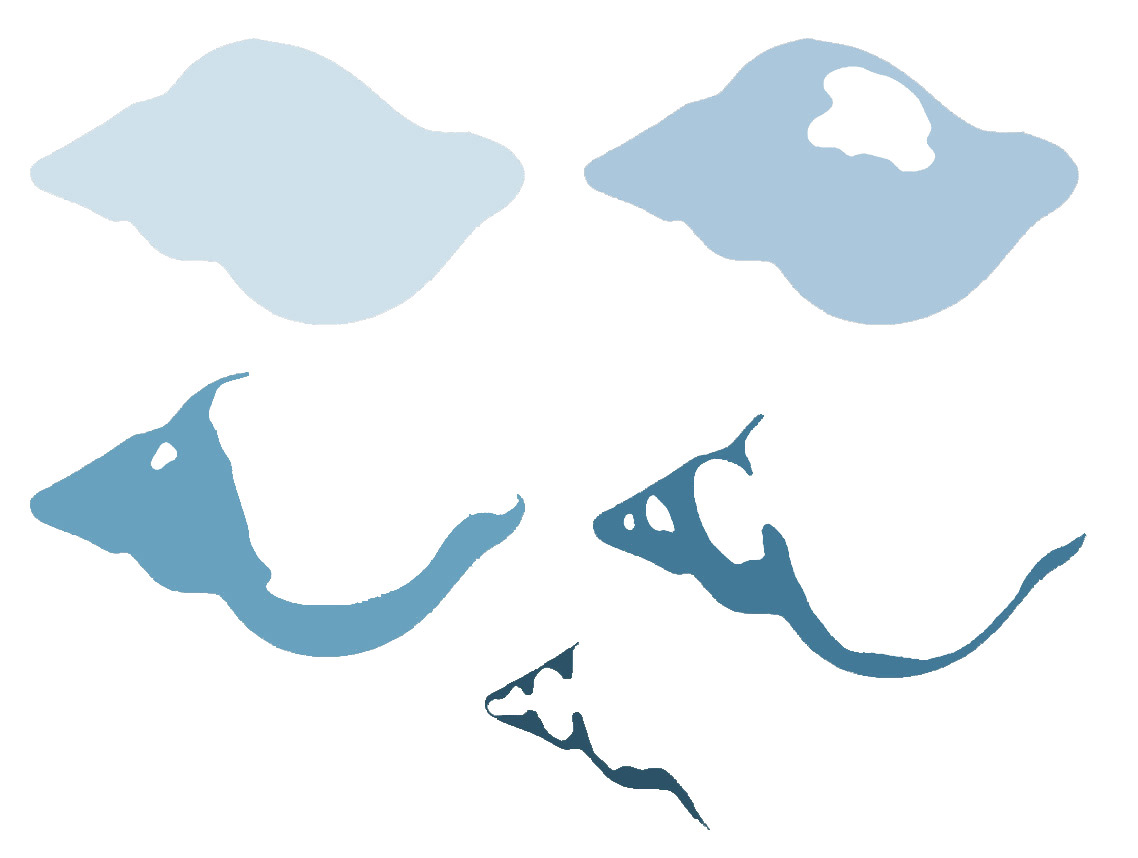
I then played around with it until I was happy with an abstract design.

This seemed like a perfect picture to try with my idea of layering organza. So I worked out how many layers I’d need and what shapes those layers would need to be. I wanted a black background, so I thought it’d be a good idea to have a base layer of white felt the same shape as the first organza layer.

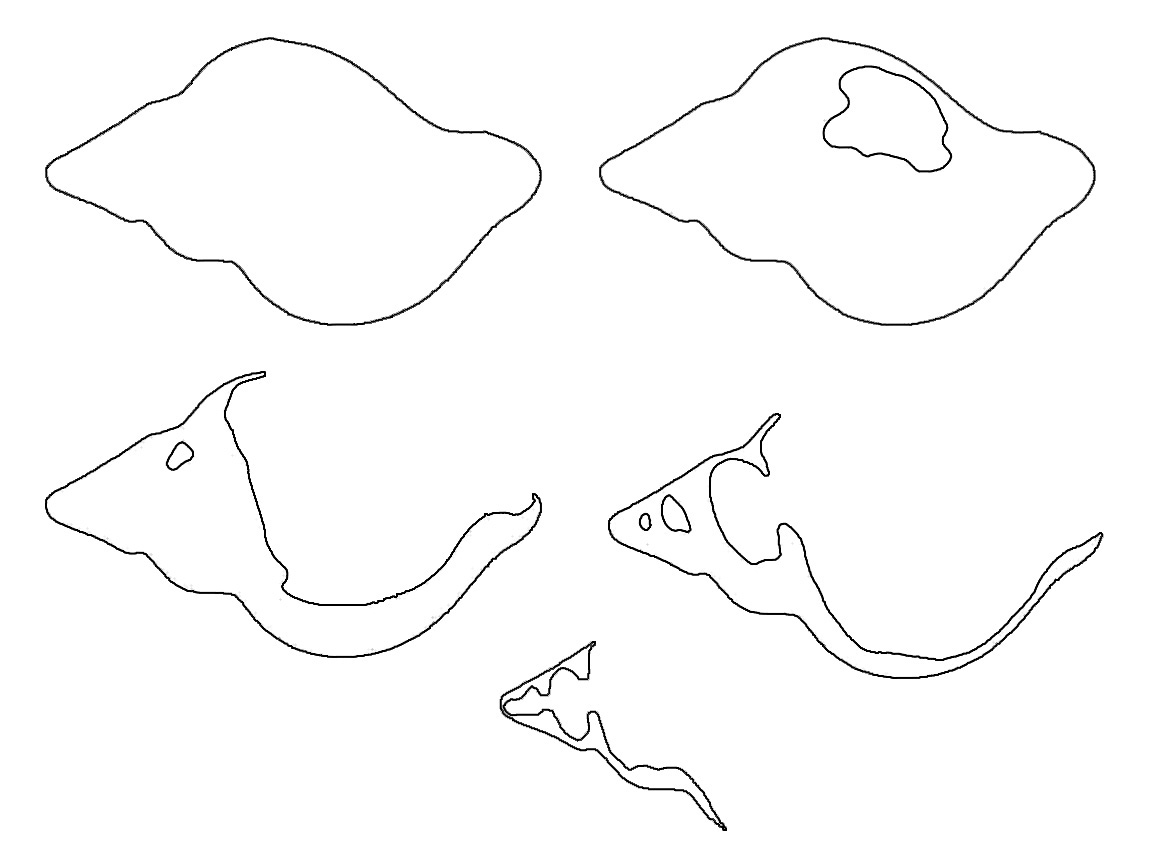
I then made the shapes into outlines, so I could print them out and trace the shapes onto the pieces of organza for cutting out.

I chose the colours of organza I liked and layered them together to see if they would work.

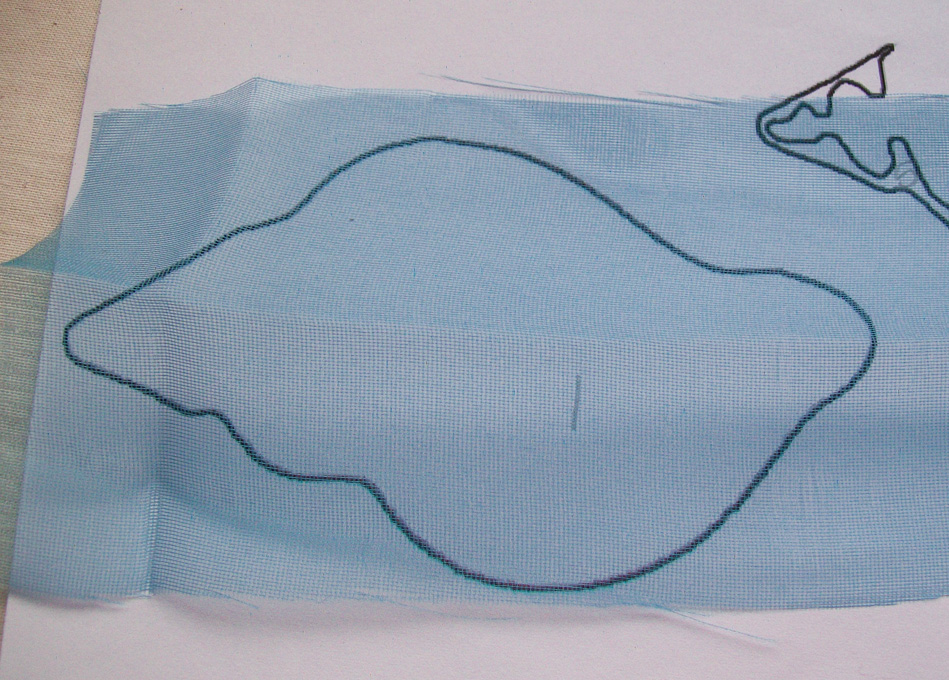
I then traced all the outlines onto the organza pieces and cut them out. It was then that I started to realise this wouldn’t be quite as simple as I’d first thought. Some of the organza was very thin and distorted while I traced, so I had to re-do a couple of pieces.

Layering the shapes together wasn’t easy either, they just wanted to slide about, so I started with sewing the first couple of layers together. That seemed to go alright. It wasn’t looking as tidy as I’d hoped-the organza was fraying, but the abstract design had outlines around the sections/layers, so I hoped these would hide the edges. When I started to add the 3rd and 4th layers, my sewing machine (hand cranked ancient Singer 🙂 ) started to make weird noises. When I looked at the back of the piece, it was a mess, all the thread from the spool had looped up underneath. I don’t know if there was a tension problem, but I decided to abandon it as a failure.

I left it on my work table and tried to think of other ways I could interpret the design with the supplies I’ve got, but all I could think of was using 5 shades of blue cotton fabric, which I don’t have. Looking at it in daylight this morning, it didn’t look quite as bad as it did yesterday, so I decided to put a bit of effort into finishing it. I had to patch up the second layer, as it had frayed so much it wasn’t attached at the edges. I also had to recut the top layer as when I was sewing it on by hand, the thread caught on it and tore it. It didn’t really turn out how I’d expected and hoped it would, (maybe some fabric stiffener and a bigger scale would help?) but it wasn’t the complete disaster I thought it was yesterday 🙂

How would you have interpreted the abstract shell picture differently? Would you have used different fabrics, or maybe wet felted or needlefelted the design? If you’d like to use the design, please feel free to do so. I’d love to see what you come up with.

Nuno Felt and Abstracts

Nuno Felt and Abstracts

I’ve been doing a lot of nuno felting recently, mostly a lot of samples for reference, but also quite a few pieces for using to make into things at a later stage. One thing I like to do with nuno felting is use different types of silk together. I think the differences in thickness, sheen and texture work well together and highlight each others’ properties. These two pieces use hand dyed silk ponge 5mm, which is floaty and shiny, and also silk chiffon 3.5mm which, though lighter, almost seems heavier than the ponge because of its ‘rough’ texture. For this first piece I used strips of silk in roughly equal widths.

This close up shows the difference in the textures of the two types of silk, and also the differences in the way they felt. The silk chiffon seems to sink into the felt, becoming more a part of it than an embellishment or surface texture.

For the second piece, I used smaller pieces of silk to create a kind of mosaic effect.

Close up:

Another thing I’ve been working on lately is Ann’s 2nd Quarter Studio Challenge. I’ve been looking through photos for inspiration, taking photos, editing, altering… trying to think what technique would work best with different pictures etc. One of my favourite photos is of a bunch of tulips in the snow. I tried a few different techniques in Photoshop to alter the photo and make it more abstract. This is a collection of the original (top left) and 3 abstract versions.

Thinking about the simplest way to achieve all the different shades of pink, I thought about organza and how using 3 pieces of the same colour can give 3 shades when layered. So I got out my organza collection to have a look through the shades. I hadn’t realised I had so many until they were all out together!

Seeing all the shades brought me back to one of the first pieces I started working on, a photo of a Mahonia bush. My first thought was to make different colours of prefelt, cut the shapes out then felt together, but I think this could be achieved more effectively with a combination of fabrics and organza.

Have you thought about joining in with the Abstract Challenge? It doesn’t have to be figurative. Do you often make abstract pieces from fabric, fibres or felt? Do you have any good tips to share? We’d love to see your work if you’d like to share with us 🙂

The Top Ten Ways to Improve Your Booth Displays

The Top Ten Ways to Improve Your Booth Displays

I’m sure there are more than 10 ways you can improve your booth display but these are some major issues that you should address when displaying your products. You will be amazed at the difference a little change in your display will have on increasing your sales. It is worth your time and effort to create the most eye-catching and welcoming booth to attract more customers to take a closer look at your work.

  1. Neatness – Make sure that everything is neat and tidy. You should have table coverings that reach all the way to the ground so that you can use the space under the tables for storage. Make sure all boxes, gear and anything that isn’t a display or your product is hidden from sight.
  2. Warm and Welcoming – Your booth should be welcoming to your customers. Try to avoid the “cave” appearance.  Do you have room to add any cozy touches such as a floor lamp? You should also have some type of flooring, even if it is an indoor show. For someone who has been on their feet for a while, it is nice to have something soft and cushy underfoot. For outdoors, you  might try the interlocking foam squares and for indoors perhaps a piece of remnant carpet or carpet squares.
  3. Full Displays – The displays in your booth should be full but not overcrowded. Avoid cramming pieces in but you also don’t want only one or two pieces alone. Bring enough product to refill your displays immediately after making sales. If you run out of something, then remove that display or shelf entirely or fill the lower displays with silk flowers or driftwood so the displays don’t appear empty.
  4. Group Products – Have enough of each type of product that you carry so that you can group them together. If you have a choice of colors, make sure that the group of products shows these color choices. Grouping products also helps with your signage so that if a product needs explanation, then one sign can be placed by that group.
  5. Match Displays to Products – Everyone has different products and so no one type of display will work for all. The display should show the product to its best advantage. Does it need light shining on it? Should the item be propped up? Does the product need to be filled with paper to give it shape? The key to the right display is visibility. If it can’t be seen right away, then the customer won’t see it. Can you display your work vertically? What type of display makes your work the most visible?
  6. Bring Products Forward – The less distance the customer has to travel to be able to touch your products, the better. If you are selling small items such as jewelry, perhaps all the display cases need to be at the front of the booth. Use shelves that are shallow and avoid deep cabinets. With deep shelves, the products towards the back will be less visible and in the shadows.
  7. Eye Level Displays – Put as many of your products at eye level as possible. Things on the floor/ground will be missed. Make it easy on the customer, so that they can see all of your beautiful work without having to work at it. Also use different levels in your displays to give interest.
  8. Branding Banner – Use a large banner in the back of your booth with your “brand” on it. Make sure it is easy to read from a distance and includes an eye-catching color or photo.  The banner will help to draw customers from a distance. If you are selling small products, it would be wise to invest in posters with blown up photos of your work that can be seen from a distance.
  9. Improve Lighting – Color sells. If a customer can’t see the colors or details in your work, you will lose sales. Lighting is the key. Be creative with your lighting. There are many types of battery-powered lights these days. Perhaps your products would look good with under lighting. Use a piece of plexiglass with a battery-powered light underneath to add light to your displays.
  10. Tell the Customer What to Do – Use simple signs to let your products speak for themselves. Perhaps your sign will say “Felted merino scarves, the softest scarf you’ll ever feel”.  Or it could be “Scented felt soaps – Smell me!” Get the customer to use some of their other senses besides sight. Encourage them to pick up the product and you will see more sales.

Once your made your improvements, continue to tweak your booth displays and designs. See what works and what doesn’t. Look at what other artists do that works. Can that be adapted in some manner to improve your displays?

I’d love to see some photos of your booth at a craft fair. If you have some, please feel free to add it to our Flickr group or start a post on the forum.

Dyeing a Color Wheel

Dyeing a Color Wheel

Usually, when I dye, I don’t have the patience to dye the full color wheel. I end up picking colors at random and mixing a variety of colors, usually ones that I neutralize. Then I either end up with threads or fiber that’s all in the same color range or colors that I probably won’t use ever.

Recently, my friend Carole gave me 60 skeins of #5 Perle cotton threads. What an amazing gift, thanks Carole! When I was considering dyeing the threads, I decided that since I had so many threads, I would try dyeing a color wheel. I already had the Procion MX Dyes mixed up and had all 12 colors of the color wheel mixed from turquoise, magenta and lemon yellow.

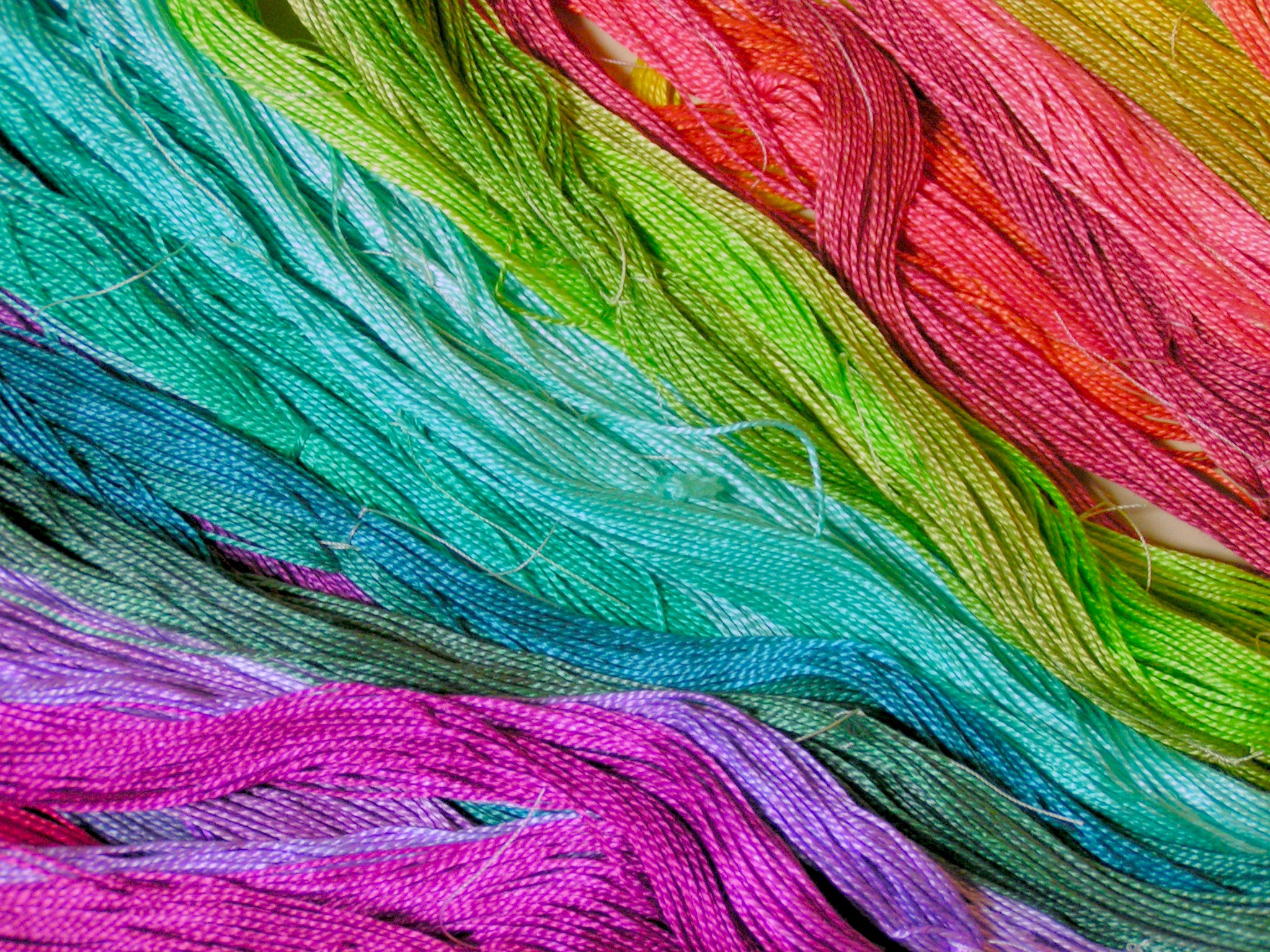
So I finally did it! I dyed the full color wheel. I had 5 skeins for each of the 12 colors. So what I decided to do was do the full strength color for a dark value, a half strength color for mid range value and a very watered down color for a pale value. Then for the other two skeins I added black to one to make a shade and I made a neutral color for the last skein by adding that colors complement. You find the complement of a color by looking on the opposite side of the color wheel. It took me all day to dye these threads and a few pieces of fabric but I’m pleased with the outcome. If I mix colors again, I think I need to add more blue to the blue-violet and more blue to the blue-green. The blue is the slowest of the dyes to set and attach to the fiber. Therefore, it seems you need a bit more than you think because the other dyes mixed in will attach to the fiber before the blue even starts.

Here’s a close up of some of the threads. Aren’t they delicious? Now the only problem is that I am so enamored with all the colors that I’m hesitant to use any of the threads because then I won’t have my full color wheel. I’m sure I’ll use them but for now I just like to admire them 🙂

A New Bag

A New Bag

A New Bag

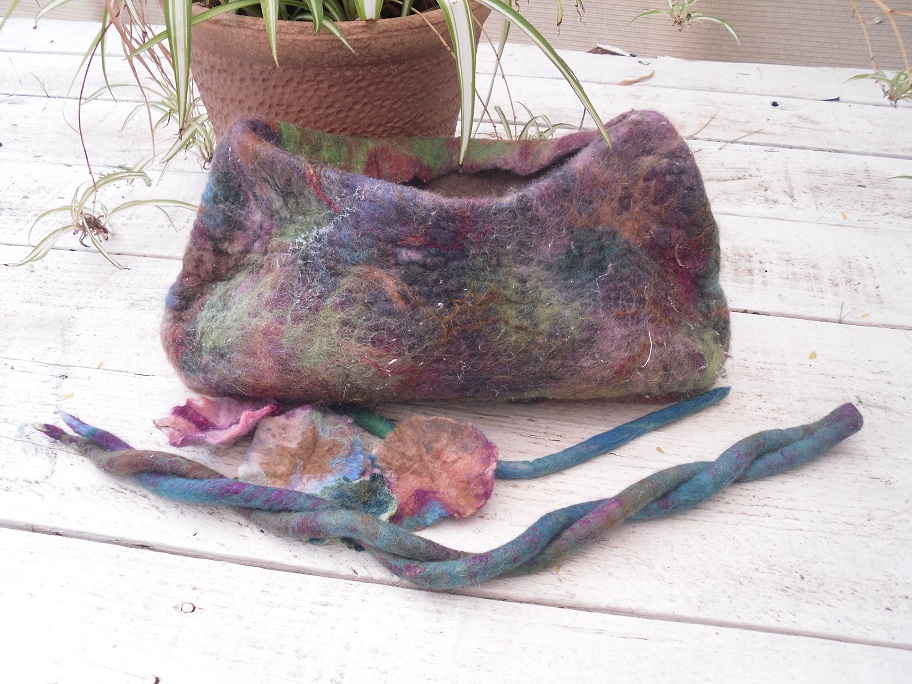
Ok so im trying again to felt another bag but this time I’m a lot happier with the outcome, I still have a long way to go but I think I’m getting there

I started out with a full batt of Alpaca for the inside and then used BFL, Merino, silks,  silk waste and a touch of nylone that Zed sent me.  This has about 6 layers and hours and hours of rolling and rubbing that i ended up putting it in the washing machine, I wanted it thick and I wanted a nice thick handle so I felted a rope,  doubled it over and gave it a twist, then just a loop for the closure.

I still cannot get the open top nice and even and I’ve ended up turning it over and blanket stitching it in place, I have the thing for straight edges and this is something I cannot do as yet lol

You can see what I mean by this pic, it’s a bit wonky so I’ve tried to turn it over to sit a bit more even

All the bits ready to put together, I didn’t take pics of the start and that’s mainly because I really didn’t think it would work out.  I have a lot of faith in myself don’t I lol

 I like this side better so its now the front.

I do seem to have created a seam on the bottom but I’m hoping that will wear down as it wears in, I ironed it flatter so it would sit better  and Yes I’m definitely using this bag as I really like it

I love how the handle is super strong.  I’m not usually a bag person and I would have like it a little bit deeper to but  i’m still happy, Plus it’s the first one I can actually use !!

The largest button I had was this black one but I will be on the look out for something more suitable

And the back

Hopefully my next attempt will be even better !!!!!

Even more Natural Wools and Fibres

Even more Natural Wools and Fibres

Earlier this year, I made a piece of felt intending to make a notebook cover out of it. The base is natural grey Merino and on the top there is: crimped viscose; black viscose top; banana fibre; hemp; soybean fibre and top; milk protein fibre; black and white bamboo top; ramie; ingeo; flax; silk top; egyptian cotton and cotton gauze.

I’d really like to use a yarn or thread spun from natural grey wool to sew it up, preferably not too expensive. If anyone knows anywhere selling natural yarns, I’d be really grateful to know 🙂

Every now and again, I like to try felting with things found in the garden. A while ago I tried bamboo leaves between layers of felt which turned out really well. I also tried some pampas grass flowers (Cortaderia) at the same time, and was surprised how well that felted with very little anchorage. The pampas is felted to the surface and on this piece is just artistic/decorative, it wouldn’t stand up to handling etc.

I don’t know what plant I used in the third piece, it is some little branches from a tumbleweed my girlfriend saw while out walking her dog and brought home for me. I love the way it looks held up to the light, it almost looks stitched.


*** Sorry for the lay out and the use of the carousel yet again. I did originally format the post so that the photos appeared between the text in the relevant places, but, like Ann last week (and me every time I try to include photos) what was published was nothing like how it was originally layed out. After 3 attempts to get it to stay how I write it, I’m giving up. To see larger photos, click ‘permalink’ under the photos in the carousel.