Browsed by
Month: January 2012

Felting Around the Web

Felting Around the Web

Diane Christian’s Felting in the New Year (fabulous Greenman mask)

Jana’s Felted Calendar Cover

Red 2 White’s Felted Throws

http://www.gillianchapmanfelts.info/

Crochet 101

Bumble Bee Pot Holder free pattern

Guzzie Sue’s Fly Stitch for TAST with handspun thread

Beautiful bead mandala using Fly Stitch for TAST

Choosing the right size needle and thread for your project

Peacock using Fly Stitch for TAST

Felt Stitched Tiny Toadstool Beret

How to Make Skeleton Leaves

Dragon made completely out of plastic kitchen utensils

Helen’s Natural Dyed Fiber from her Winter Garden

http://dipandstain.blogspot.com/

Merino and Hemp pouch

Merino and Hemp pouch

Just before Christmas, Karen sent me some gorgeous fibres. One of the fibres was hemp. A couple of days ago I made a small pouch from Merino wool with the hemp as a surface embellishment.

I didn’t really intend to make a pouch, I was planning to make an unusual shaped vessel. I started by laying a piece of cotton gauze in the centre of a rectangular template, then added a couple of layers of merino and the hemp fibre on top. Just after I’d wetted it all down, I saw a 3d resist I’d used previously and thought that would work better than what I’d planned to use. I lay the resist on the felt (the resist is basically a couple of lightbulb boxes wrapped in bubblewrap and packing tape), then wrapped the felt around, snipping it in a couple of places to overlap. When it was almost felted, I removed the resist and shaped the bottom and sides to soften the edges.

I was really pleased with the way it turned out, especially the way the hemp looked with the white merino, and the texture of the gauze inside is really nice, too.

Whats on my Table

Whats on my Table

My Nightmare Album

 Yes that is what its been,  but I’m determined to get this finished if it’s the last thing I do lol

I started out with a nice size piece of felt that I made especially for this project.  It’s to be an Album cover to give to my Daughter In-laws mum on the birth of our very first Grandchild,  a little girl called Charlie.  She’s so divine but I better not start talking about her or I wont actually get to my project  !!!

So I had this idea in my head of creating a nice design ( not flowery or girly) but just something different that I could add lots of stitching and beads to and then adding in either her name (Charlie) or stitching something like “my first grandchild”  on the front.  It seems that everything I did to it just wasn’t right and this is the first pic to show where I was trying to go at the very start.

Well I didn’t like it at all, in fact I hated it. I shouldn’t have put the orange seed beads on and the whole design was way off,  no amount of work was going to make me like it and I just couldn’t move on.  So I painstakingly unpicked every single bead and most of the stitches and started in a new direction.

Unfortunately I didn’t like the way this was going either, so again I took out all the stitches, they were all French knots!  Have you tried unpicking them without ruining your felt? I had to be very careful and  you don’t think I was getting pretty frustrated by this stage!  Well, yes and no, I just wanted to kept going. I changed the mauve coloured thread to green,  and removed the mess down the bottom, which was supposed to be kinda of like a starbust that didn’t quite get there.

I am actually starting to like it more now so to date, this is what it’s like. I’ve decided I’m not going to touch it or even look at it for at least a week  so I can come back and tackle it with some fresh eyes.

I’m glad I changed the mauve thread to green, I think it suits much better. I like the little seed beads over the fly stitch, (thank goodness for TAST ) lol , I’m going to take out the word Charlie and make that bigger so its stands out more ( it’s a bit hard to see her name at first glance )  but I didn’t want any one thing to overpower anything else.  I hope that all makes sense and if anyone has any ideas, I’ll be happy for the input. This is the largest detailed piece I’ve started working on and when you have one idea in your head but cant quite get it down on paper ( so to speak) It makes for a very frustrating time.

Having said all that, I’m really loving the fact that  if you don’t like something, take it off and start again and hopefully this Nightmare Album will turn into something to treasure, its certainly has my heart poured into it and all for a Very Good Cause,  Charlie  xo


Surface Texture Challenge – From Studio Journal to Finished Piece

Surface Texture Challenge – From Studio Journal to Finished Piece

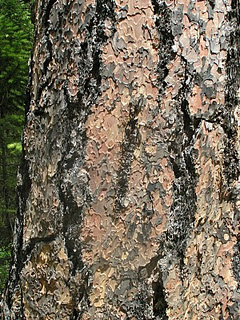
Here is one of my many photos of bark. This type of bark has flat looking pieces that resemble puzzle pieces. The pieces gradually flake off and I collected a bunch of these off the ground. I love the different layers and colors that result. Many times, I work in a studio  journal when I find an inspirational source. Over the last several years, I have played around with these bark pieces.

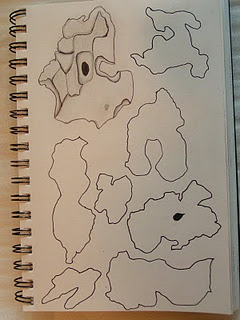
Here I have sketched the various shapes of the bark. Most are multi layered like the sketch in the top left hand corner. I just shaped the overall shape of most of the pieces. I made several different stamps and a few stencils of these shapes.

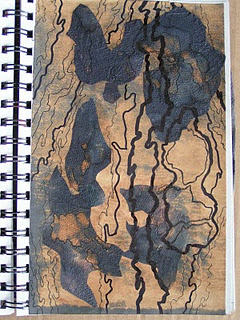
This is a collage that I did in my studio journal with pieces of discharged paper and stamps. I also added the linear components to give it the feel of bark on a tree. This has been in my studio journal for two years and I really haven’t done anything else with it. This past weekend, I decided I was going to try a technique that I have been thinking about for a long time. Because I had this challenge to work on, I finally got this idea in motion.

I took two pieces of water-soluble fabric and sandwiched some wool and viscose fiber between them. On the top piece of water-soluble fabric, I had traced some of the imagery from my paper collage. I then free motion stitched with zigzag stitch over the lines and shapes. I ended up not putting in as much detail because it shrunk so much with the stitching. And it would shrink more with the next step.

I then took the free motion design and added it into a felted cover I was making for my new Kindle. Since the fabric is water-soluble, it would wash away during the felting process and just leave the stitching. When you stitch directly on felt with the machine, it gives a quilted effect. I was trying to add machine stitching without getting that quilted look. I also want to be able to add machine stitching easily to 3D felt objects. It is hard to get a three-dimensional felt to fit under the sewing machine.

Here is the result. It was a bit dark when I was taking the photos so sorry for the quality. (Click on the photo so you can see the details better.) I loved the result! The stitching is completely attached as the fibers it was sewn to, felted right in with the rest of the fibers. And the stitching is right on the surface, it worked perfectly. The darker lines in the middle were yarn that was couched down by machine stitching. The machine threads are shiny in comparison with the felt and add a very interesting texture as the thread didn’t shrink but the wool did. I will definitely be trying more of this technique.

Here’s the Kindle sliding into the top of the cover. I made the cover fairly thick so that when I put this in my bag, it won’t get banged around so much. That shows a little bit of the way I tend to work. Have you tried anything yet for the surface texture challenge? Do leave a comment and let us know.

Spinning Day

Spinning Day

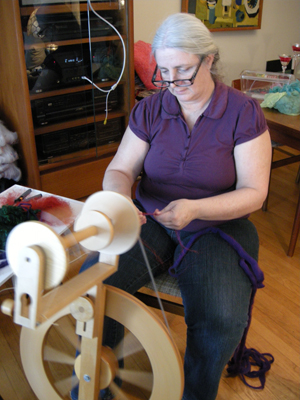
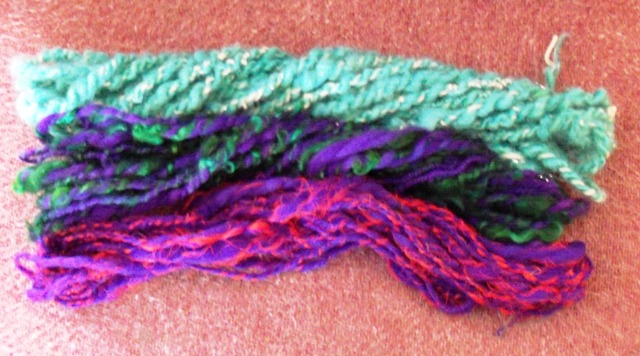
During the Christmas holidays I got together with 2 friends to do some spinning. I was trying to do some art yarn with a Lendrum wheel I rented from local guild, Ottawa Valley Weavers and Spinners Guild.

I borrowed it because it had a bulky head with a large orifice. Unfortunately the drive band was really tight so it made the wheel very difficult to treadle so I didn’t get a lot done but learn that I would like to do some more art yarns, so now I am saving to get the bulky head for my Ashford traveler. I had a little trouble trying to ply one batch and ended up with a big tangle of yarn.

Getting in a tangle while trying to ply from both ends

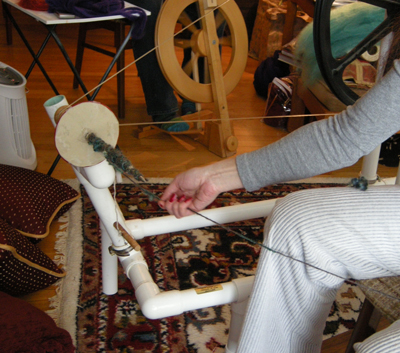
My friend Judy brought her Babe Big River Spinner wheel for us to try.

It’s an interesting wheel made from plastic pipe and it has a quill (long sharp spike) rather than a flyer.

You have to spin off the end of the spike. It is a very fast wheel and you build up to much twist very quickly. It was fun to give it a try.All in all it was a fun day with friends even if I didn’t end up with much yarn to show for it.

Our Etsy Store

Our Etsy Store

Since starting the website a couple of months ago, we’ve had lots of great comments and interesting feedback. Some of the things we’ve noticed since starting the site, and more recently, the forum, is that more people would experiment with different fibres if they were more easily available and not quite so expensive.

So, we’ve opened an etsy store 🙂 The four of us have all been felting for quite a few years now and all have our favourite fibre suppliers, both locally and internationally. It’s not our aim to make a profit from selling fibres, but to use that knowledge, along with our own skills to source fibres and felting supplies and make them more accessible and affordable, especially to beginners who would like to try sample sizes without having to pay extra for them.

We’ve started with a silk fibre sample pack. This has 20g each of silk hankies, silk noil, silk carrier rods and silk throwsters waste. We’ll be adding more items as they become available. We’ve already had lots of feedback on the forum about the kinds of things people are interested in: samples of plastic, nylon, viscose and cotton fibres; handmade yarn samples; a sample pack of different silk fabrics; buttons and beads, and sewing threads; and embellishment fibres.

We’ll be keeping our eyes out for bargains or offers that we can then pass on through etsy but we’d love to hear from you if you have any ideas for things you’d like to see. There’s a button on the sidebar to take you to etsy or just click the link below. Feel free to contact us on etsy if you have any specific requests 🙂

http://www.etsy.com/shop/FeltandFiberStudio

Resist Shapes

Resist Shapes

Several people have asked me about what shape resists I use when making hats or vessels.  A resist is used in felting to make three dimensional objects from a flat pattern. The resist can be anything flat that will keep the two sides of felt from felting together, i.e. it “resists” the felting process. I usually use a thin foam as it is waterproof, inexpensive and can be used over and over again. The resist shown above is from floor underlayment. That is the stuff that is used under laminate flooring. It comes in huge rolls so unless you’re making large patterns for things such as clothing, you might want to use a craft foam or recycled packing materials. You can also use bubble wrap, plastic, cardboard or anything that will hold up to the felting process. The resist above made the orange hat in the next photo. The hat block shown in the middle gives you the idea of how much shrinkage occurred. I used merino with a shrinkage of about 30%. But if you’re going to be adding lots of folds in the felt, that takes lots of extra room in your original pattern.

For this hat, I wanted to have random folds but it could have been finished different ways. That is the fun thing about using a resist with lots of extra room in it. You can make small, subtle changes in the shaping of the hat and you’ll get a completely different look. This hat could have had uniform folds done concentrically and it would look like a completely different hat.

This is the resist shape that was used for the hat shown below.  All of the space at the top is used for the concentric folds that make the top of the hat.

This hat is made from a Stratta batt from New England Felting Supply. It felts very easily and is a quick and easy lay out as you don’t have to pull the wool all apart, just tear it to shape and you’re ready to go.

Here is the resist used for the Iris flower vessel shown below. I leave the top open so the edge is uneven, given it a more organic look. You could cover the entire resist with wool, cut it open and then have a straighter edge on the top of the vessel if that was the look that you wanted.

I made this vase for my sister as she loves iris. It is made with a variety of wool and silk.

This is the basic shape I use for making slippers. The resist shown here was for my husband’s slippers and I didn’t make as a big a cuff for him. The cuff is the connecting part between the two slippers. The more space in between the two foot shapes, the longer the cuff is. Or you could make it really long and make boots. Just remember to make them wide enough to get your feet in and out. You can see I’ve taped this resist back together again with duct tape. You cut the two slippers apart after you’ve gotten to the soft felt stage to remove the resist. But you can use the resist again, you just have to retape it each time.

Here are slippers made on a similar shape resist. I don’t wear these because they ended up just slightly too small. I’m going to need to make a new pair soon!

This is an experimental resist shape. If I was going to make this again, I would not leave the edges so pointy. Any pointy edge or really sharp angle is hard to cover in wool. I have found that the best resist is the most simple one. Just make the resist bigger for extra room if you want folds.

Here is the resultant felt vessel from the resist shape above. It’s kind of odd, isn’t it?

This is a vessel resist covered with wool and wet down. I used this same shape resist to make both of the vessels below. This shows that you can use the same shape resist but come up with a very different end product.

This taller vessel was made by stitching ridges lengthwise and then felting them together. You can see the thread at the top before it was removed. This formed a tall and slender vessel.

This vessel was made from the same resist as the tall vessel. However, I made concentric folds around the shape to make a short and squatty vessel.

As you can see, almost any shape can be used to make felt. The fun thing is that even if the same shape resist is used, the final shaping of the felt can change the end result. What shape resists do you use when felting? Or perhaps you haven’t tried felting with a resist? Give it a try and let us know how it worked out for you!

Surface Texture Challenge

Surface Texture Challenge

I’ve been thinking about Ruth’s Studio challenge and taking lots of photos of anything with an interesting texture.

It was really frosty here earlier in the week, so I got lots of nice photos from the garden and nearby park. After looking round the garden and seeing lots of frosty moss, I started working on my first piece. Of course, when I downloaded the photos, this was one that didn’t come out. I blended some different shades of green merino tops, then layed out a couple of layers in an ‘organic’ shape. I then blended some shades of green merino with different amounts of plastic fibre and layed this on top. After it was felted, instead of rolling as I’d usually do, I scrunched the felt as I rinsed the soap out and after squeezing the water out, scrunched it again to give it its shape.

Frosty Moss
Frosty Moss Texture

 I’m really enjoying this challenge. If you’d like to join in, and show us what you’ve made, post a comment to any of the 2012 First quarter challenge posts and link us to what you’ve made, or join our flickr group and add your photos there. Don’t forget to tag them with “surface texture challenge”.

 
TAST 2012

TAST 2012

Take a Stitch Tuesday

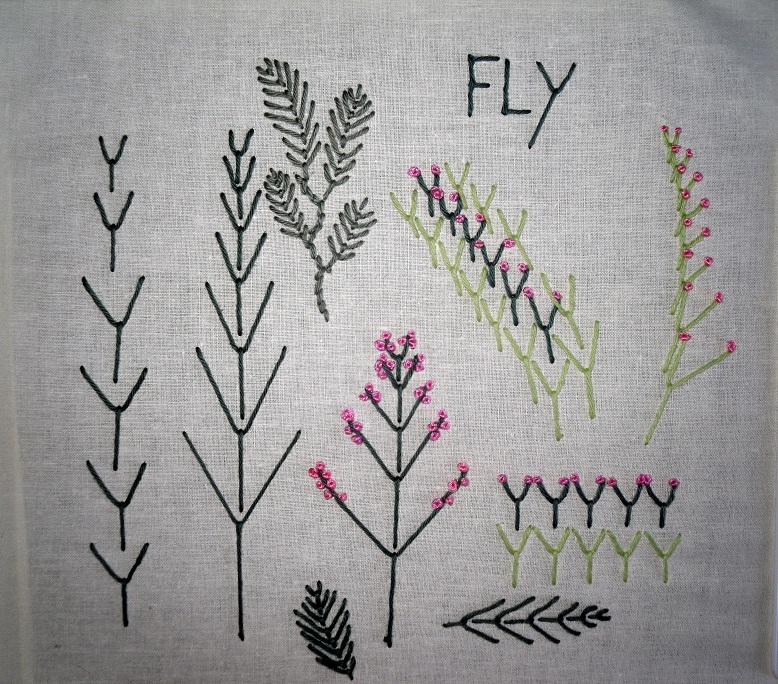
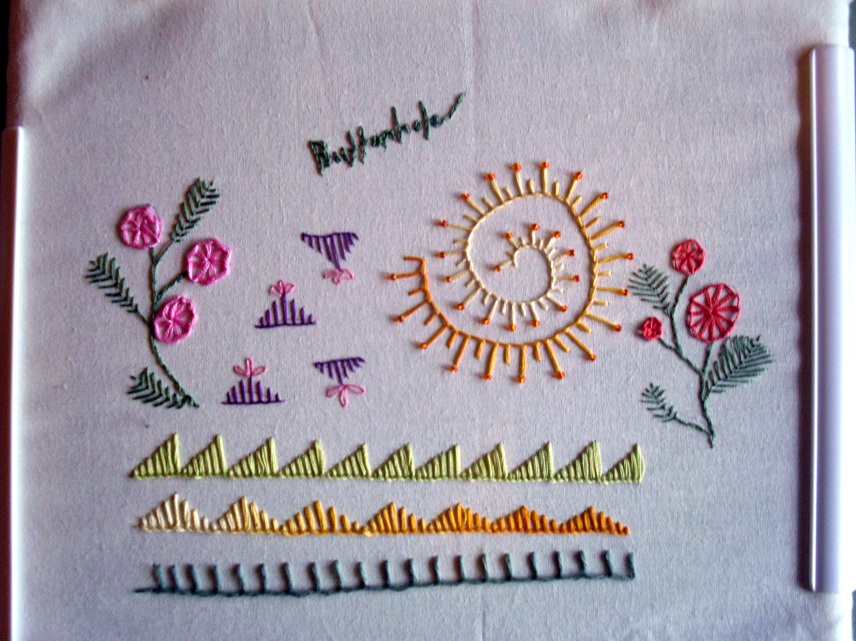
Or TAST is from Sharon B’s website introducing a new stitch every week for the whole year. I’ve decided to do this as I love stitching and only had a few that i knew. I’m wanting to use a lot more stitches in my mixed media so I’m having fun with this and hopefully I’ll be able to finish the whole year .

I’m using a square frame  and stitching on calico,  I’ll turn this into a book of stitches that I can  keep as a reference.

The first week’s stitch is called the Fly Stitch

The second week’s stitch is the Buttonhole Stitch

So who’s up for joining me in learning our stitches every week?  You could just do a sampler and make them into book marks or tags.  You can also share your pics on our flickr site  http://www.flickr.com/groups/feltingandfiberstudio/

If you’d like to  join in then follow the link to Sharon’s site at Pin tangle and lets have some fun    http://www.pintangle.com/